


Secondary sourceSculpture1702
St Francis Xavier
Pierre Le Gros · 1702
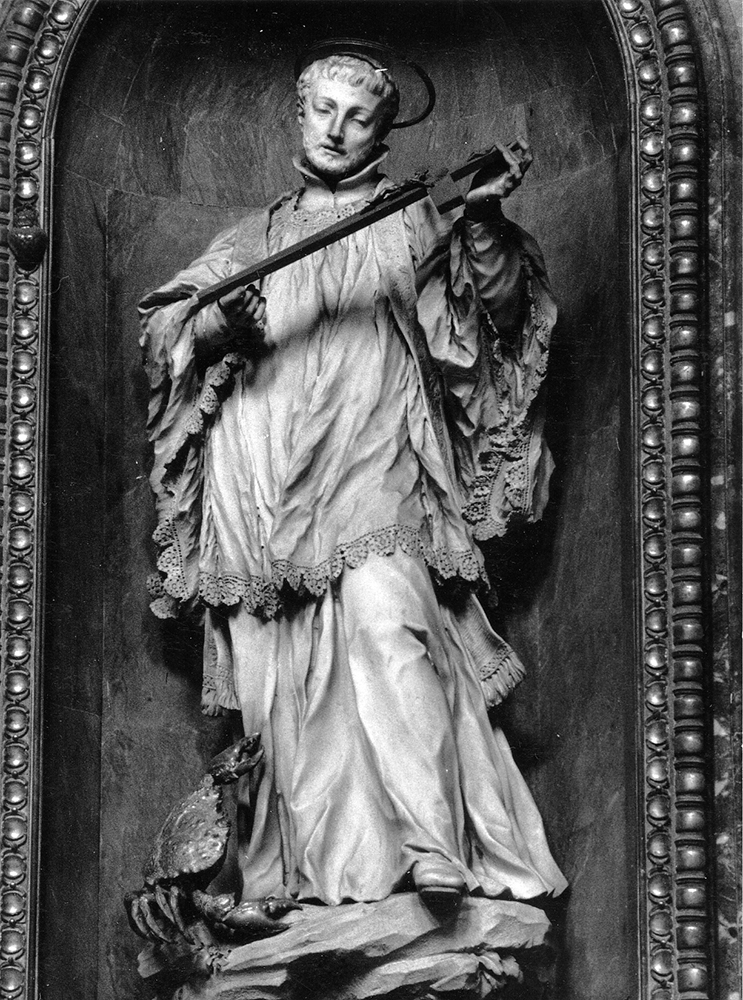
A marble statue of Francis Xavier by Pierre Le Gros, made in Rome in 1702, long after the saint's death. It is shown here in a black and white photograph.
Shows how Xavier was honored in Rome after his death, through a statue made by a French sculptor in 1702.
About this source
What it is
This is a marble statue of Francis Xavier made by Pierre Le Gros in 1702 for the church of St Apollinare in Rome. The image is a black and white photograph of the statue. The saint stands in a niche framed by ornate molding, holds a staff topped with a crucifix, wears a lace-edged surplice, and has a halo. A crab is carved at his feet on a rocky base.
Why it matters
The statue was made more than a century and a half after Xavier died. Sculptures like this helped the Catholic Church present him as a saint for worshippers in Rome. The crab at his feet is a detail that connects to the stories told about him, so students can see how artists used symbols to identify saints.
Look closer
- What objects does the saint hold, and what do they tell you about him?
- Why would a church place a statue like this in a niche?
- What does a black and white photo leave out about the marble and its surface?
This sculpture is part of the curated material that grounds the AI version of Francis Xavier on Humy.ai — when students ask about related events, the AI can quote it and cite it.
More Francis Xavier sources
Browse all 85 →

Ready when you are
Start chatting with Francis Xavier now.
20 messages free · No credit card · Available in 50+ languages.