


Secondary sourceArtifact1584
Stjärneborg
1584
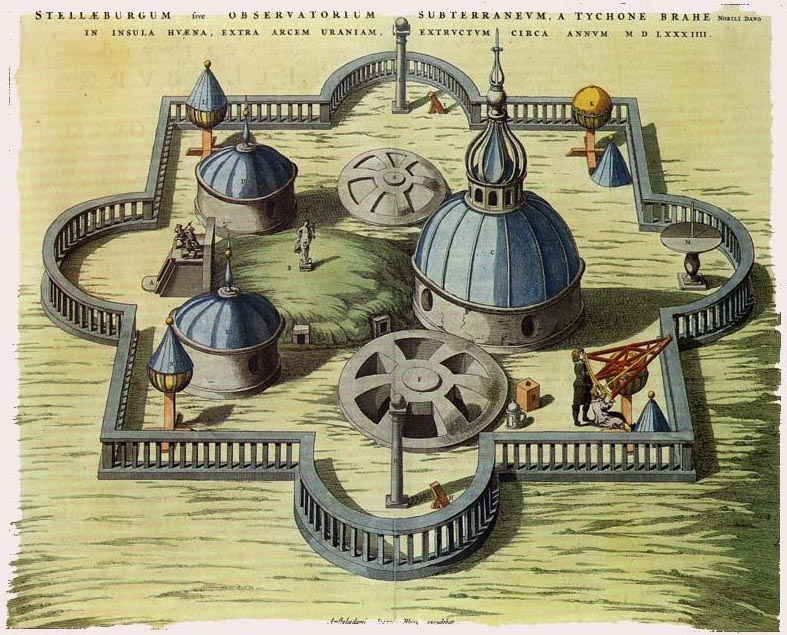
Tycho Brahe's semi-underground observatory on the island of Ven, built in 1584 to shield his instruments from wind.
The observatory Tycho built on Ven to house his instruments, reflecting his drive for precise astronomical measurement.
About this source
What it is
Stjärneborg, meaning "star castle", was an underground observatory built by Tycho Brahe around 1581-1584 next to his palace-observatory Uraniborg on the island of Ven. The surviving image is a hand-coloured engraving made later, based on a woodcut Tycho himself published in his own book on instruments in 1598.
Why it matters
Tycho explained that he built the chambers underground partly to protect his instruments from wind and partly to keep his assistants working separately so they would not compare observations too early. This reveals how seriously he took accuracy and control over his data, decades before telescopes existed. The site was later excavated in the 1950s and is now open to the public.
Look closer
- Why might placing instruments underground improve the quality of observations?
- What does separating his assistants tell you about how Tycho managed his research team?
- This image was made almost a century after the building existed — how might that affect its accuracy?
This artifact is part of the curated material that grounds the AI version of Tycho Brahe on Humy.ai — when students ask about related events, the AI can quote it and cite it.
More Tycho Brahe sources
Meet the AI Tycho Brahe →
Ready when you are
Start chatting with Tycho Brahe now.
20 messages free · No credit card · Available in 50+ languages.