


Primary sourceArtifact1883
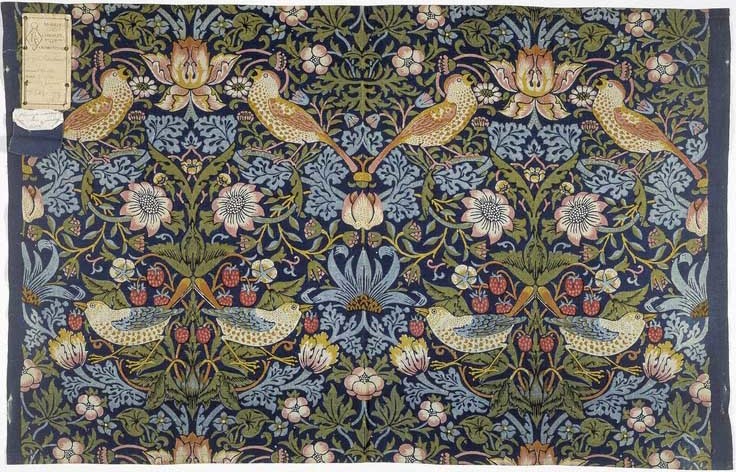
Strawberry Thief
William Morris · 1883
Morris's famous printed cotton pattern of thrushes stealing fruit, made by the slow indigo-discharge process he revived.
Morris designed and named this fabric, drawing it from birds he watched in his own garden at Kelmscott Manor.
About this source
What it is
Strawberry Thief is a printed cotton furnishing fabric designed by William Morris in 1883. It was made using an indigo-discharge printing method that Morris had struggled for years to master, finally succeeding at his Merton Abbey works. The design shows thrushes among strawberries and flowers, and a copy is held by the Victoria and Albert Museum.
Why it matters
Morris based the pattern on thrushes he saw stealing fruit in the garden of his home, Kelmscott Manor. He was proud enough of the technique to register the design with the Patents Office, and despite its high cost it became one of his most commercially successful patterns. It shows how closely Morris linked careful craftsmanship, nature observation and business success.
Look closer
- What does the choice of a slow, expensive printing method tell you about Morris's values?
- How does the repeating pattern use the birds and fruit to create rhythm across the fabric?
- Why might customers have been willing to pay more for a hand-printed design like this?
This artifact is part of the curated material that grounds the AI version of William Morris on Humy.ai — when students ask about related events, the AI can quote it and cite it.
More William Morris sources
Browse all 96 → Artifact
Primary source
Red House
Philip Webb and William Morris · 1859-1860
 Book
Primary source
News from Nowhere
William Morris · 1890
Primary source
Manifesto of the Society for the Protection of Ancient Buildings
William Morris and Philip Webb · 1877
 Painting
Primary source
William Morris
George Frederic Watts · 1870


Free account
Read every William Morris source
Sign up free →
Ready when you are
Start chatting with William Morris now.
20 messages free · No credit card · Available in 50+ languages.