


Secondary sourcePaintingc. 1390-1400
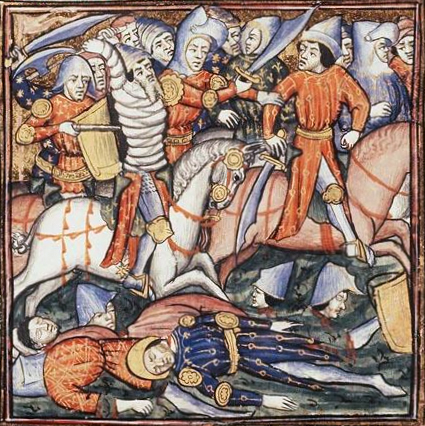
The Battle of Cannae
Follower of the Luçon Master, or the Ravenelle Master (illuminators) · c. 1390-1400
A medieval French manuscript miniature showing a battle scene from Livy's Roman history, depicting Hannibal's victory at Cannae. It was painted about 600 years after the battle.
Shows Hannibal's victory at Cannae as later medieval readers pictured it, through a French translation of Livy's Roman history.
About this source
What it is
This is a painted miniature from a three-volume French manuscript, a translation of the Roman history by Livy made by Pierre Bersuire. The illumination shows the battle of Cannae, fought in 216 BCE. It was made in Paris, probably between about 1390 and 1400, by an artist in the circle of the Luçon Master or the Ravenelle Master. The manuscript is held by the Bibliothèque nationale de France as Fr. 159.
The image shows armored soldiers on white horses and on foot fighting among helmeted men with raised swords. Bodies lie in the foreground, and blood is visible. The gold-tinted background is typical of the period.
Why it matters
Livy wrote his history of Rome long after the events he described, and this French version was made even later. The picture therefore reflects how medieval readers imagined an ancient battle, with knights and armor rather than ancient equipment. Hannibal led the Carthaginian army at Cannae, and the scene connects him to Livy's account of Roman defeat.
Look closer
- What clothing and weapons do the soldiers wear, and which details look medieval rather than ancient?
- Who made this picture, and why might a 14th-century French patron want an ancient battle illustrated?
- What does the image leave out, such as the reasons for the battle or the perspective of the defeated Romans?
This painting is part of the curated material that grounds the AI version of Hannibal Barca on Humy.ai — when students ask about related events, the AI can quote it and cite it.
More Hannibal Barca sources
Meet the AI Hannibal Barca → Book
Secondary source
The Histories
Polybius · c. 150 BCE
 Book
Primary source
History of Rome
Titus Livius · 27-9 BC
Secondary source
Life of Hannibal
Cornelius Nepos
 Book
Secondary source
The Hannibalic War and The Punic Wars (Libyca)
Appian of Alexandria · c. AD 150
 Sculpture
Secondary source
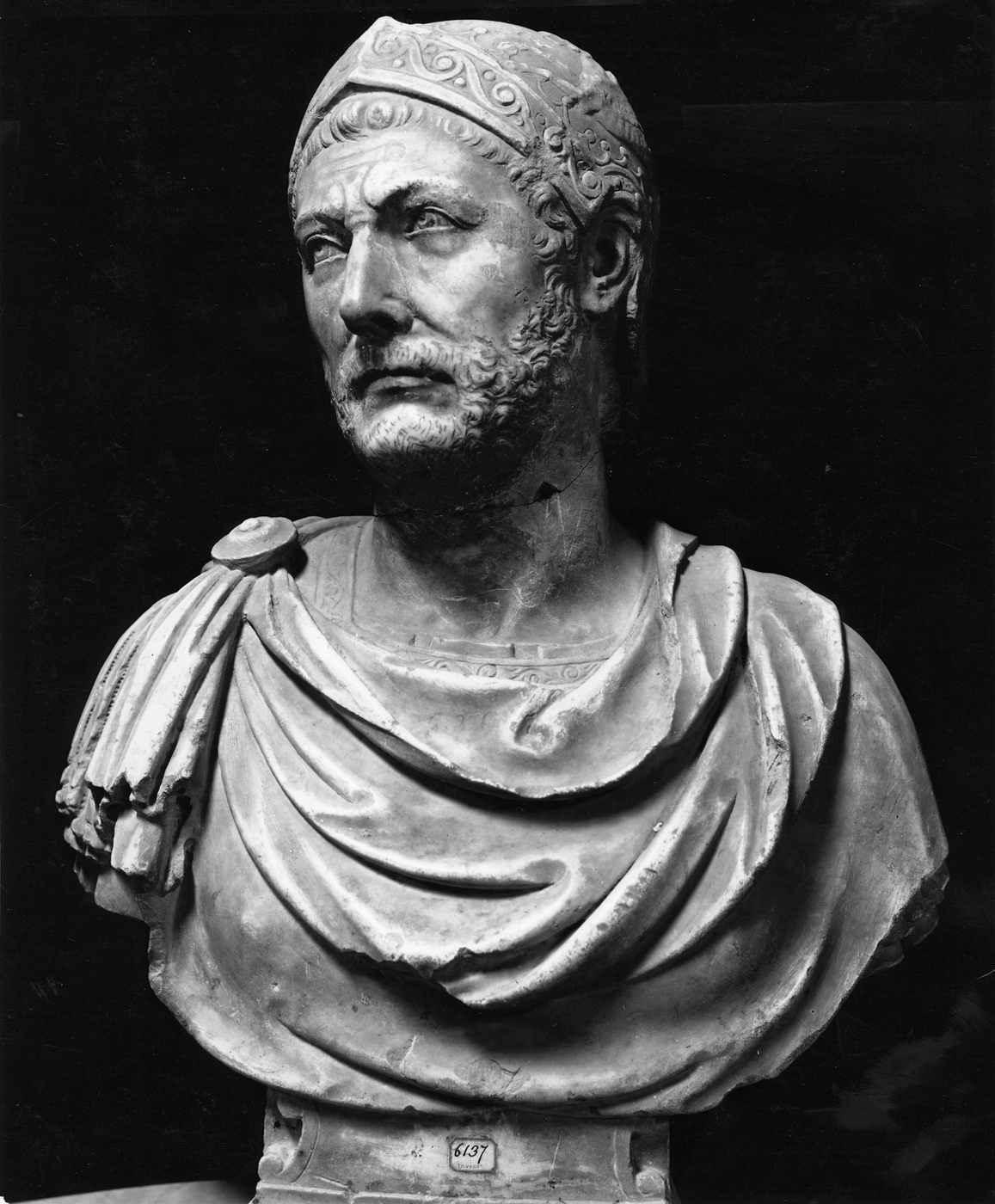
Capuan bust of Hannibal
1st century BC - 4th century AD
Ready when you are
Start chatting with Hannibal Barca now.
20 messages free · No credit card · Available in 50+ languages.