


Primary sourcePainting21 December 1793
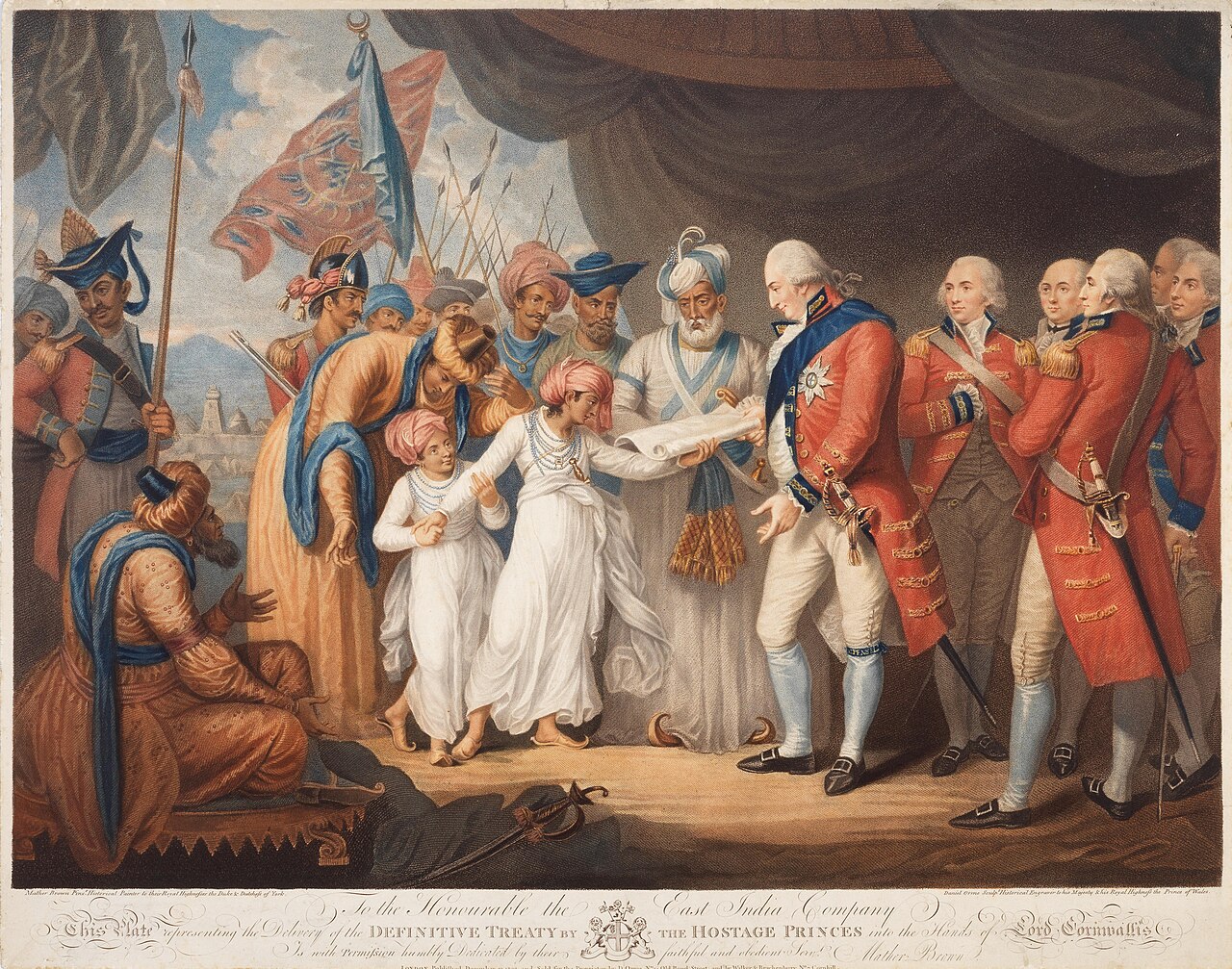
The Departure of the Sons of Tippoo
Mather Brown · 21 December 1793
A 1793 hand-coloured aquatint by Mather Brown showing the sons of Tipu Sultan being led before British officers. It is linked to Cornwallis through the hostage policy after the Anglo-Mysore wars.
The print is linked to Cornwallis through the hostage policy, though his own presence in the scene is not clear from the record.
About this source
What it is
This is a hand-coloured aquatint plate published by D. Orme on 21 December 1793. The image was made by Mather Brown and the plate was worked by F. Bartolozzi and Daniel Orme after Brown. It shows two young princes in white robes, one holding a rolled document, led forward by a richly dressed attendant before a British officer in a red coat and blue sash. Other British officers and Indian attendants gather in a tent, with a sword on the ground. The record does not show Cornwallis clearly in the scene.
Why it matters
The title refers to the sons of Tippoo, the ruler of Mysore, whose sons were handed over as hostages during the war. Curators link the print to Cornwallis's hostage policy, which is why it is in his archive. The print is a European view of an Indian ruler's family being given up, and it presents the British as the arbiters of the outcome. Mather Brown, a Boston-born painter who worked in London, produced it for a British public. It reveals how the wars in India were pictured in Britain.
Look closer
- Who is shown as powerful in this scene, and how can you tell from posture and placement?
- Why might a London publisher in 1793 have wanted to show this event, and to whom?
- What does the print leave out about the princes' own feelings or the reasons for the war?
This painting is part of the curated material that grounds the AI version of Charles Cornwallis on Humy.ai — when students ask about related events, the AI can quote it and cite it.
More Charles Cornwallis sources
Meet the AI Charles Cornwallis →Primary source
Articles of Capitulation, Yorktown
Charles Cornwallis; George Washington; Comte de Rochambeau; Comte de Barras · 19 October 1781
 Painting
Secondary source
Surrender of Lord Cornwallis
John Trumbull · 1819
 Painting
Primary source
Charles Cornwallis, 1st Marquess Cornwallis
Thomas Gainsborough · 1783
 Painting
Secondary source
Lord Cornwallis receiving the Hostage Princes
Mather Brown · 1793
 Document
Primary source
Treaty of Amiens
25 March 1802
Ready when you are
Start chatting with Charles Cornwallis now.
20 messages free · No credit card · Available in 50+ languages.