


Secondary sourcePainting19th century
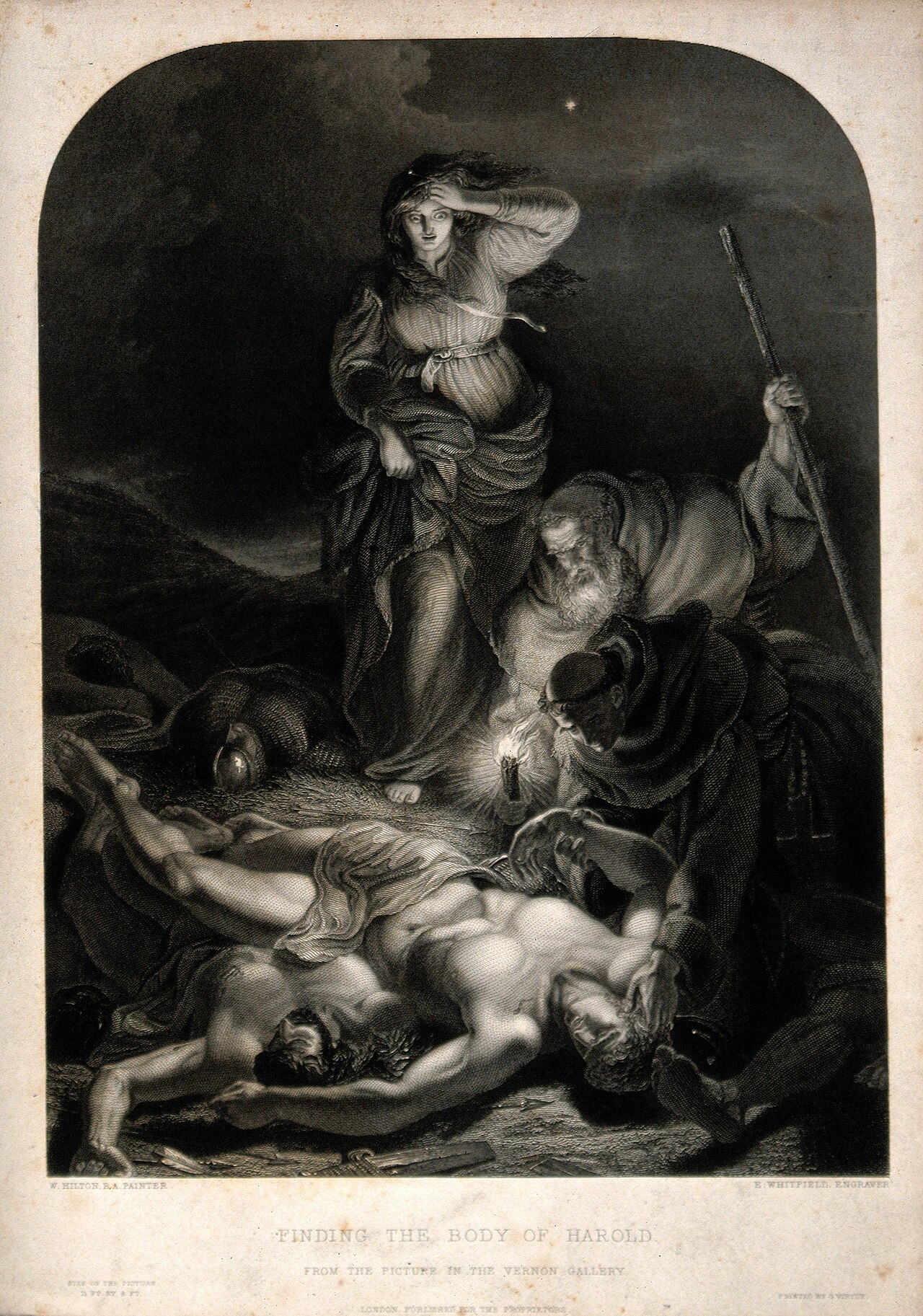
The Discovery of Harold's Body
E. Whitfield after W. Hilton · 19th century
A 19th-century engraving imagining the finding of King Harold's body after the Battle of Hastings.
This engraving depicts the discovery of Harold's body after his death at Hastings in 1066.
About this source
What it is
This is a line engraving by E. Whitfield, made after a painting by W. Hilton. It shows a scene imagined long after 1066: the discovery of Harold's body following the Battle of Hastings. The print comes from the Vernon Gallery collection.
Why it matters
Harold Godwinson died at Hastings in 1066, ending his short reign and opening the way for Norman rule. This image was made centuries later, showing how later British artists dramatised his death as a moment of tragedy and loss.
Look closer
- What mood does the stormy sky and the figures' poses create?
- Why might a 19th-century artist choose to depict this particular moment rather than the battle itself?
- What does this image tell us about how later generations remembered Harold?
This painting is part of the curated material that grounds the AI version of Harold Godwinson on Humy.ai — when students ask about related events, the AI can quote it and cite it.
More Harold Godwinson sources
Browse all 51 →
Ready when you are
Start chatting with Harold Godwinson now.
20 messages free · No credit card · Available in 50+ languages.