


Primary sourceArtifact1952
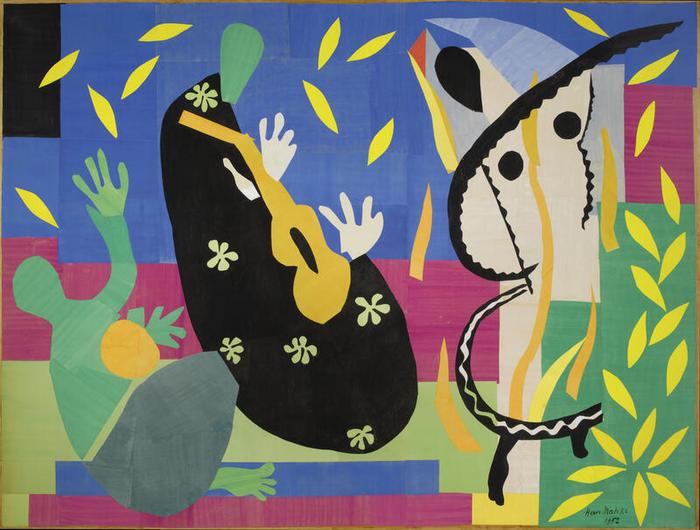
The Sorrows of the King
Henri Matisse · 1952
A large cut-paper collage by Matisse from 1952, widely seen as his final self-portrait made near the end of his life.
This late cut-out is widely interpreted as Matisse's own self-portrait near the end of his life.
About this source
What it is
This is a paper collage made by Henri Matisse in 1952, using shapes cut from paper he had painted with gouache and then mounted on canvas. It is held at the Musée National d'Art Moderne.
Why it matters
By this point in his life Matisse was in poor health and had largely stopped painting in favour of these cut-out works. The piece is often read as his last self-portrait, showing himself among music and dance even as his body failed him. It stands for his final creative period, when illness forced him to find new ways to keep making art.
Look closer
- Why might an artist nearing the end of his life choose to show himself through a guitar player among dancers and musicians rather than a realistic face?
- What do the bold flat colours and simple shapes tell you about how this piece was made, compared to painting?
- What might this work leave out about how Matisse actually felt or lived at this time?
This artifact is part of the curated material that grounds the AI version of Henri Matisse on Humy.ai — when students ask about related events, the AI can quote it and cite it.
More Henri Matisse sources
Browse all 99 →
Ready when you are
Start chatting with Henri Matisse now.
20 messages free · No credit card · Available in 50+ languages.