


Secondary sourceDocument2018
Translations of The Dancing Girl of Izu up to 1968
Thomas Hagemann · 2018
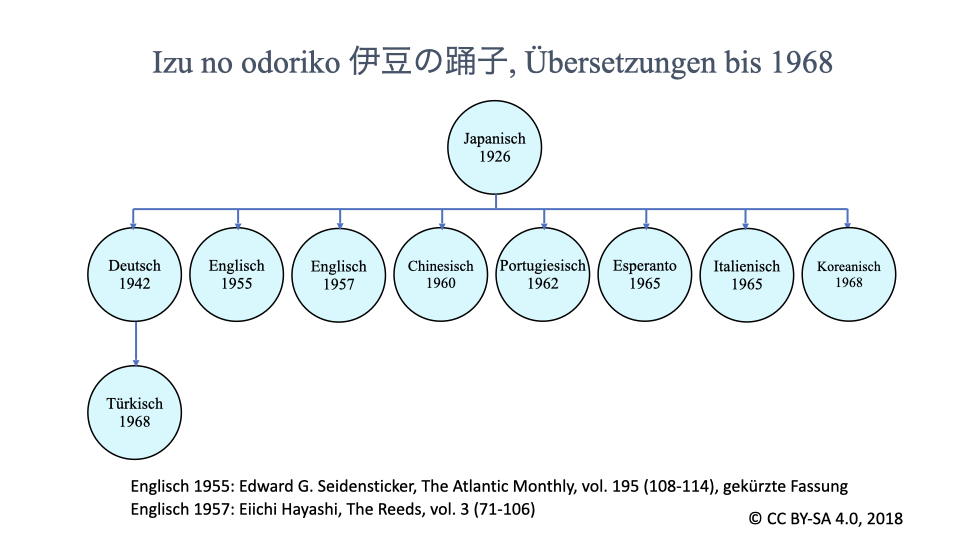
A scholarly chart listing all known translations of Kawabata's story Izu no Odoriko made before his 1968 Nobel Prize.
This chart documents how Kawabata's early story spread worldwide in translation before he won the Nobel Prize.
About this source
What it is
This is a diagram from a 2018 scholarly article by Thomas Hagemann, mapping the translations of Yasunari Kawabata's story Izu no Odoriko (The Dancing Girl of Izu) made between its original 1926 Japanese publication and 1968, the year Kawabata won the Nobel Prize in Literature.
Why it matters
The chart traces how one story spread across languages—German, English, Chinese, Portuguese, Esperanto, Italian, Turkish, Korean—showing the growing international interest in Kawabata's work in the decades before his Nobel recognition. It is a research tool made long after Kawabata wrote the story, not a document from his own hand.
Look closer
- What does the spread of translations suggest about how international reputation builds over time?
- Why might a scholar create a chart like this instead of just listing dates in a paragraph?
- What is left out of this diagram about how readers in each country actually reacted to the story?
This document is part of the curated material that grounds the AI version of Yasunari Kawabata on Humy.ai — when students ask about related events, the AI can quote it and cite it.
More Yasunari Kawabata sources
Browse all 61 →Primary source
The Dancing Girl of Izu
Yasunari Kawabata · 1926
Secondary source
The Dancing Girl of Izu (1933 film)
Heinosuke Gosho · 1933
 Photograph
Primary source
Portrait of Yasunari Kawabata, 1938
1938
 Photograph
Primary source
Kawabata Yasunari 1968 Nobel Wire Photo
UPI · 1968

Free account
Read every Yasunari Kawabata source
Sign up free →
Ready when you are
Start chatting with Yasunari Kawabata now.
20 messages free · No credit card · Available in 50+ languages.