


Primary sourceDocument1896
Vier ernste Gesänge
Johannes Brahms · 1896
Brahms's final published work, four songs on biblical texts about death, composed in 1896 as his friend Clara Schumann was dying.
Composed by Brahms as his last published work, reflecting his grief over Clara Schumann's final illness.
About this source
What it is
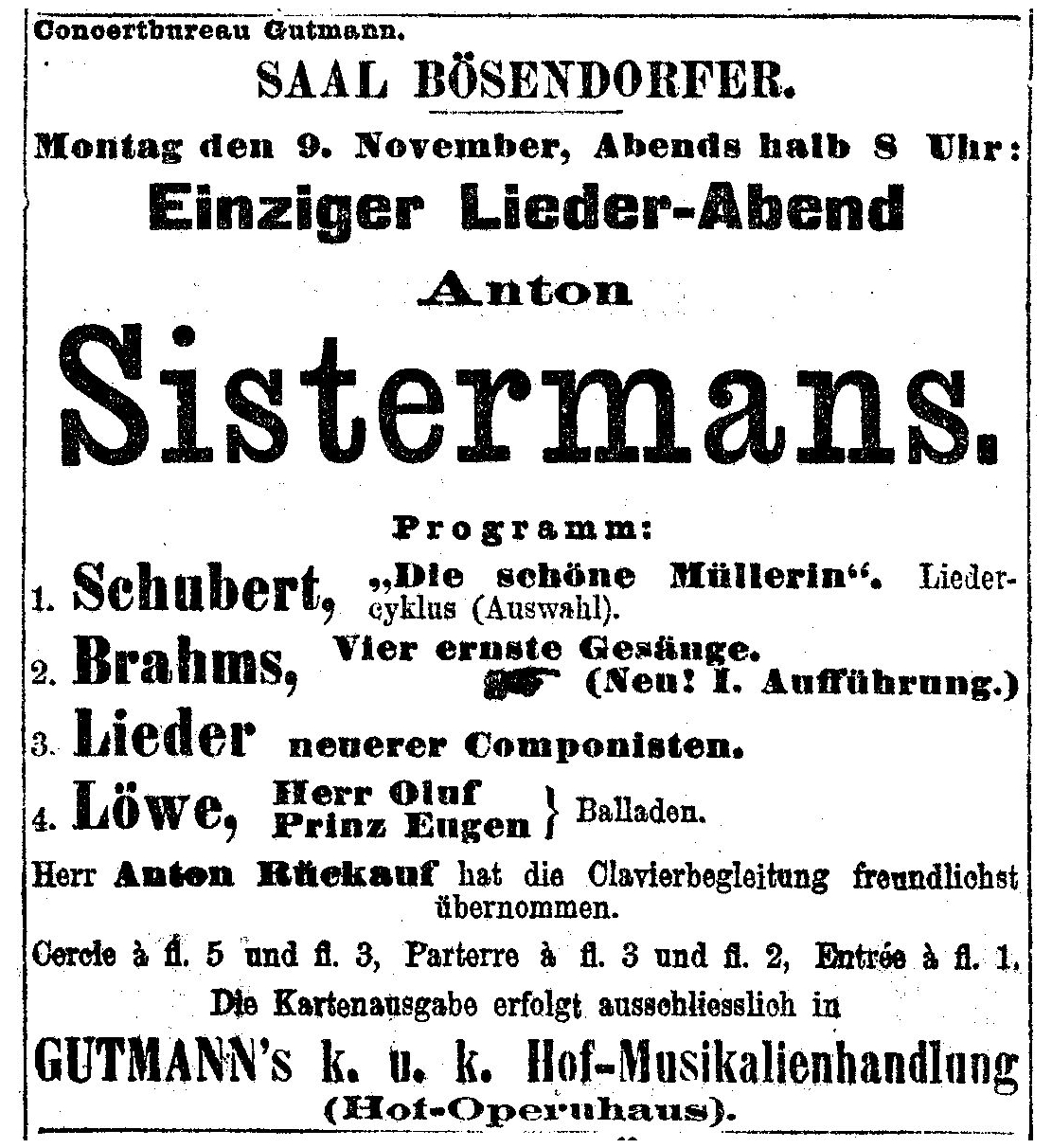
Vier ernste Gesänge ('Four Serious Songs'), Op. 121, is a song cycle for bass and piano composed by Johannes Brahms in Vienna in 1896, using texts from the Luther Bible. He dedicated it to Max Klinger, and it was premiered that year by baritone Anton Sistermans with pianist Coenraad V. Bos.
Why it matters
Brahms wrote these songs after learning that his close friend Clara Schumann had suffered a stroke, finishing them around his birthday in anticipation of her death. As his last published work, the cycle's meditations on death and transience, drawn from Ecclesiastes, Sirach, and Corinthians, reveal how Brahms faced mortality and honored his deep, lifelong bond with Clara.
Look closer
- Why might Brahms have turned to the Bible rather than other poetry for this final work?
- What does the timing of composition, linked to Clara Schumann's illness, tell us about Brahms's feelings?
- Why do three songs deal with death while the fourth turns to faith and hope?
This document is part of the curated material that grounds the AI version of Johannes Brahms on Humy.ai — when students ask about related events, the AI can quote it and cite it.
More Johannes Brahms sources
Browse all 98 →Primary source
Neue Bahnen
Robert Schumann · 28 October 1853
Primary source
Brahms Voice
Johannes Brahms · 1889
 Document
Primary source
Symphony No. 1
Johannes Brahms · 1876
 Document
Primary source
Symphony No. 4
Johannes Brahms · 1885
Free account
Read every Johannes Brahms source
Sign up free →
Ready when you are
Start chatting with Johannes Brahms now.
20 messages free · No credit card · Available in 50+ languages.