


Secondary sourcePainting1817
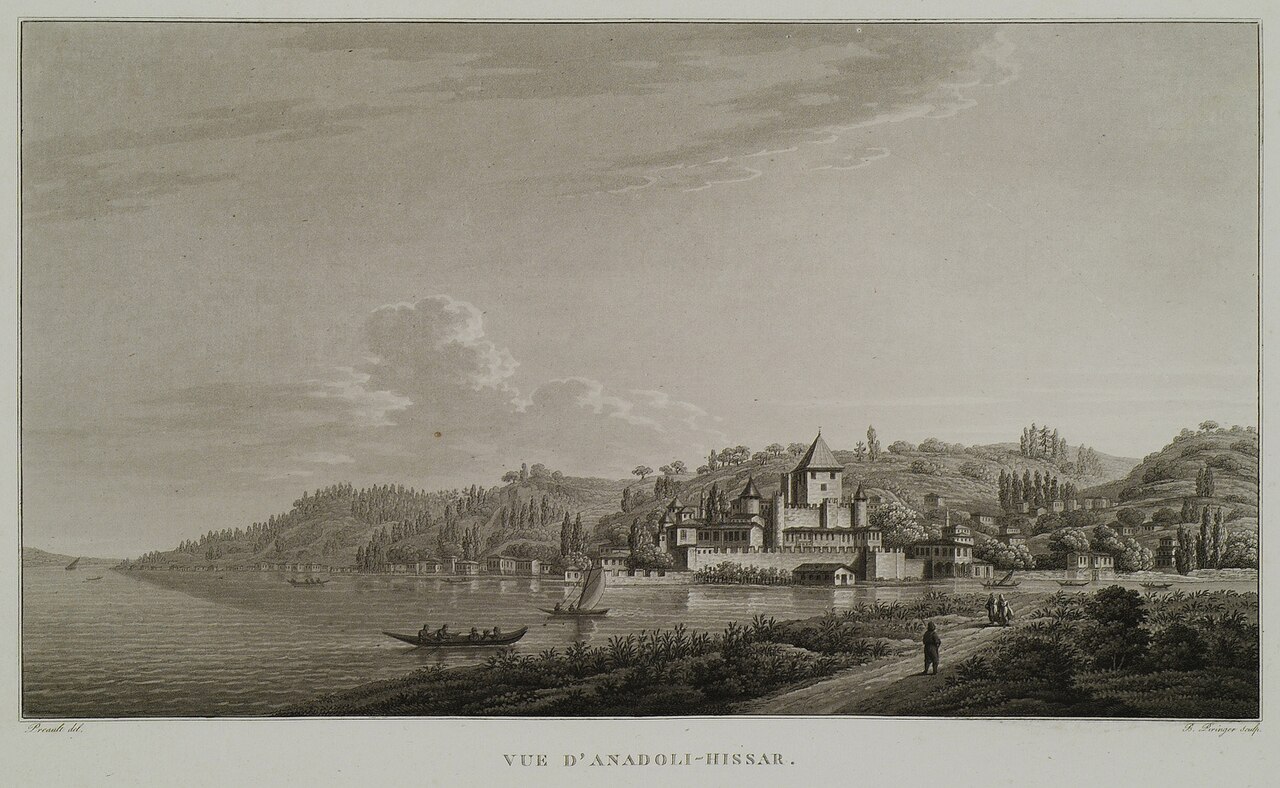
View of Anadoli-Hissar
Charles Pertusier · 1817
An 1817 sepia-toned engraved view by the traveller Charles Pertusier showing the waterfront fortress of Anadoli-Hissar on the Bosphorus.
Shows Anadoli-Hissar, a fortress linked to Bayezid's building work, as recorded by a traveller about four centuries after his reign.
About this source
What it is
This is a sepia-toned engraving titled Vue d'Anadoli-Hissar, dated 1817 and made by Charles Pertusier. It shows a waterfront castle with a tall tower with a conical roof on a hillside above the water. Small boats sit on the sea, and two figures walk on a path in the foreground.
Why it matters
The curator's note describes Anadoli-Hissar as a fortress built in Bayezid's time, and this view is a traveller's record of it from the early nineteenth century. Bayezid I reigned from 1389 to 1402. The view therefore shows what a European traveller saw about four centuries after the sultan who built the fortress. It is a useful reminder that our picture of the Ottoman past often comes through outsiders' eyes.
Look closer
- What details make the castle look like a fortress, and what details show everyday life nearby?
- Why might a traveller choose to include the two figures on the path?
- What might this view leave out about the people who lived in the area?
This painting is part of the curated material that grounds the AI version of Bayezid I on Humy.ai — when students ask about related events, the AI can quote it and cite it.
More Bayezid I sources
Browse all 91 →

Ready when you are
Start chatting with Bayezid I now.
20 messages free · No credit card · Available in 50+ languages.