


Primary sourceNewspaper articleNovember 1789
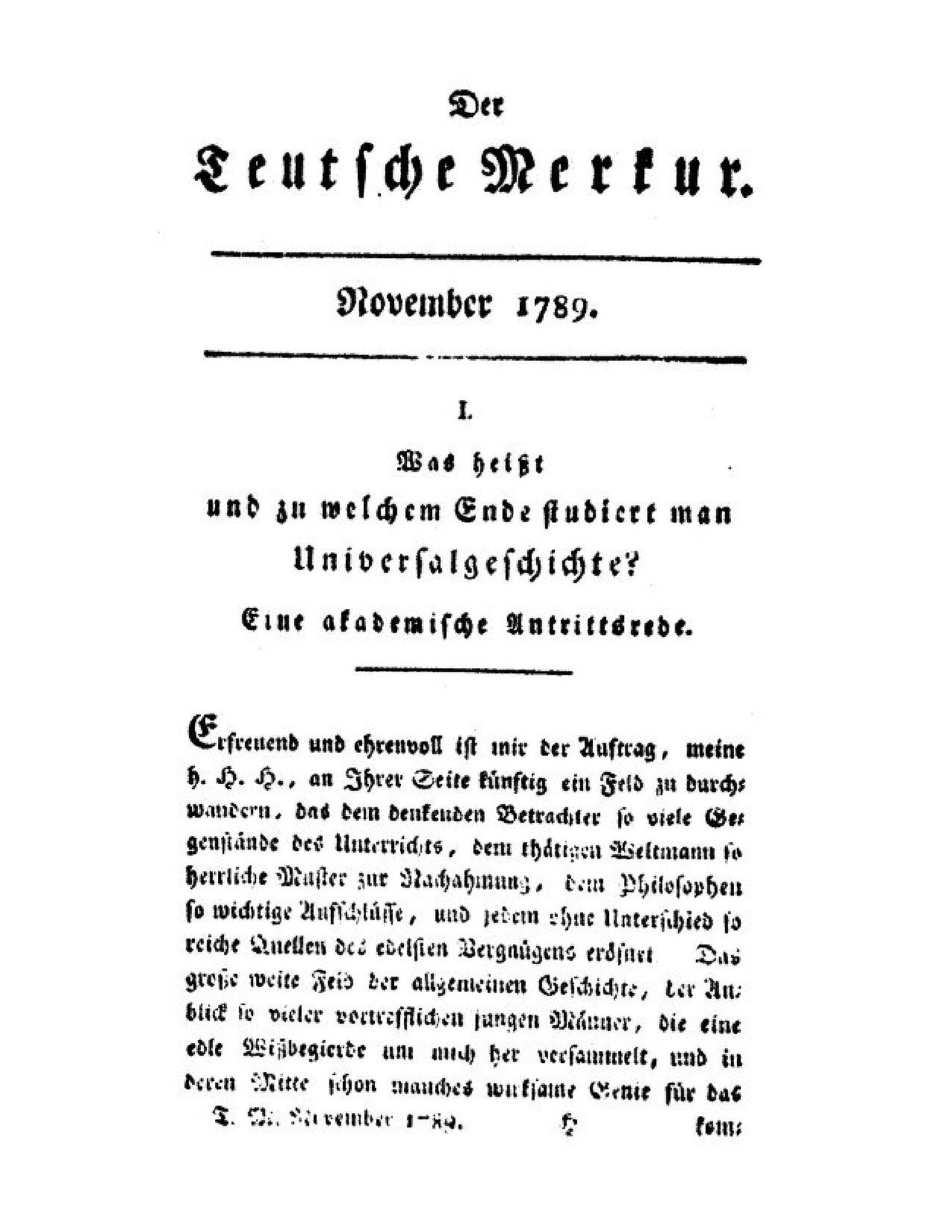
Was heißt und zu welchem Ende studiert man Universalgeschichte?
Friedrich Schiller · November 1789
The first printed version of Schiller's Jena inaugural lecture on universal history, published in Wieland's journal Der Teutsche Merkur in 1789.
Schiller wrote this lecture himself; its publication shows how his ideas on history teaching reached the public.
Free Humy account · No credit card · 120,912 sources to read
About this source
What it is
This is the title page of the November 1789 issue of Der Teutsche Merkur, a literary journal edited by Christoph Martin Wieland. It carries the first printing of Friedrich Schiller's academic inaugural lecture, asking what universal history means and why one should study it.
Why it matters
Schiller delivered this lecture as he began teaching history at Jena, and its publication in Wieland's widely read magazine shows how quickly his ideas reached an educated public. It reveals Schiller not only as a playwright but as a thinker trying to give history a moral and philosophical purpose.
Look closer
- Why might a lecture be printed in a magazine rather than kept only for students?
- What does the formal Fraktur typeface and language tell you about the audience for this text?
- What questions does the title itself raise about the purpose of studying history?
This newspaper article is part of the curated material that grounds the AI version of Friedrich Schiller on Humy.ai — when students ask about related events, the AI can quote it and cite it.
More Friedrich Schiller sources
Browse all 88 →

Ready when you are
Start chatting with Friedrich Schiller now.
20 messages free · No credit card · Available in 50+ languages.