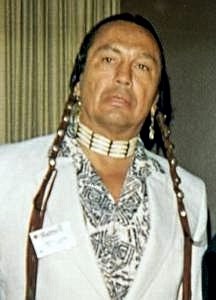
Portrait of Russell Means

AI Historical Figure

Russell Means

American Indian activist and actor.

Chat with Russell Means via text or voice — in 42 languages, drawing on a curated biography and 30 historical sources. Available 24/7.

Start chatting with Russell Means20 messages free · No credit card
Lived
1939–2012
From
United States
Known for
Politics & governmentFilm, stage & dance
Russell Means

Russell Means

Online · responds in seconds

Hello — I'm Russell Means. American Indian activist and actor. What would you like to ask me?

20 messages free · No credit card · Powered by Humy.ai

Live preview · Switch between 42 languages above · Send a message to continue in the app

Multilingual

Talk to Russell Means in 42 languages

Ask Russell Means questions in any language below, and the rest of Humy's app speaks it too. Pick yours to open the chat in that language.

Also in German (Austria), German (Switzerland), English (UK), English (Australia), English (Canada).

The sources behind this AI

30 sources · 16 photographs · 5 artifacts · 4 documents · 2 documentaries · 2 books · 1 newspaper article

Russell Means doesn’t improvise from thin air. The AI is grounded in 30 curated historical sources students can inspect. Open any of them to see what informs the conversation.

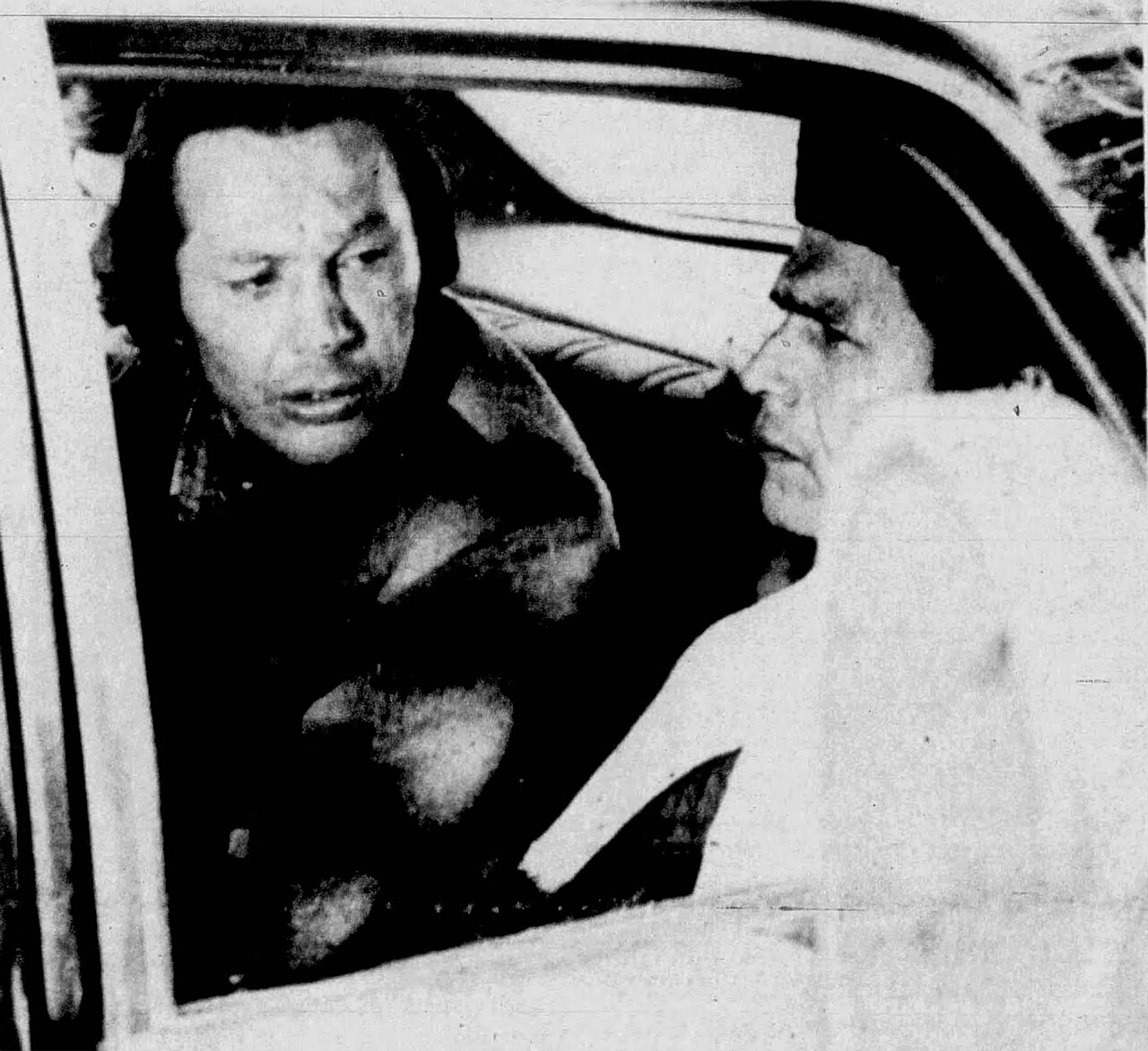
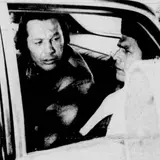
Black and white photograph taken through a car window. On the left, a man with dark, shoulder-length hair and a dark jacket leans forward and speaks. On the right, a man in a light-colored coat and dark hat faces him, looking toward him.Photograph

Primary source

Russell Means with Dennis Banks in car, 1973

The Alliance Times-Herald · 1973

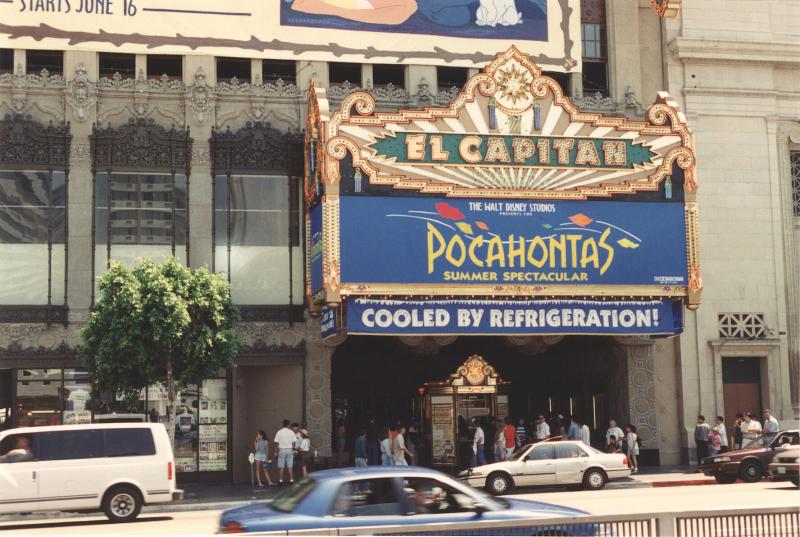
Exterior of the El Capitan Theatre in Los Angeles at street level, with a blue marquee advertising Disney's Pocahontas Summer Spectacular and the banner 'Cooled by Refrigeration!'. Pedestrians and cars are on the street.Documentary

Primary source

Pocahontas

Stephen Schwartz · 1995

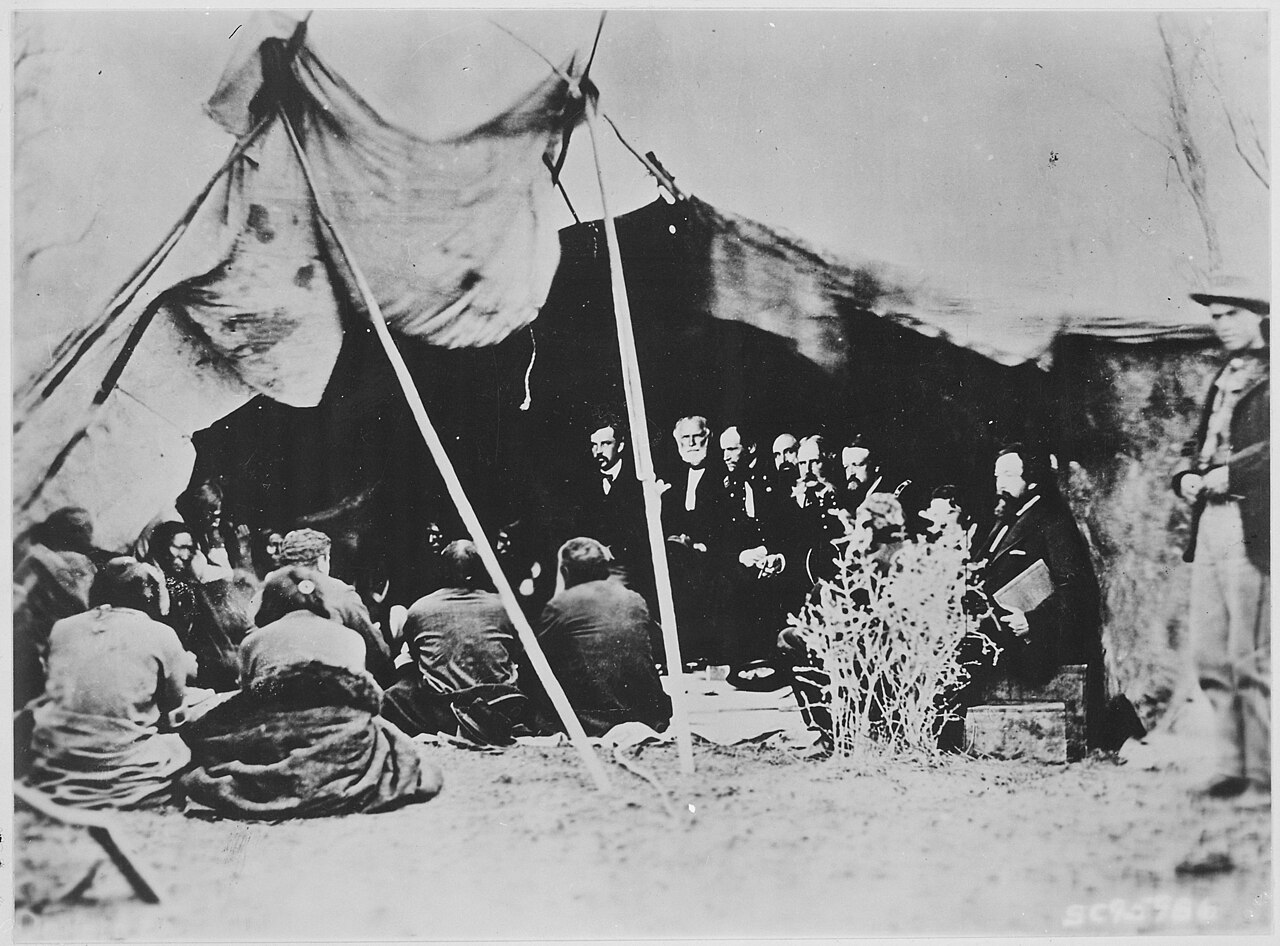
Black-and-white photograph of a council under a canvas tent at Fort Laramie. Men in dark suits and hats sit in a row on the right, facing seated Native American men in blankets on the left. A standing man in a wide-brimmed hat stands at far right. A tent pole and a small shrub are in the foreground.Document

Primary source

Treaty of Fort Laramie

1868

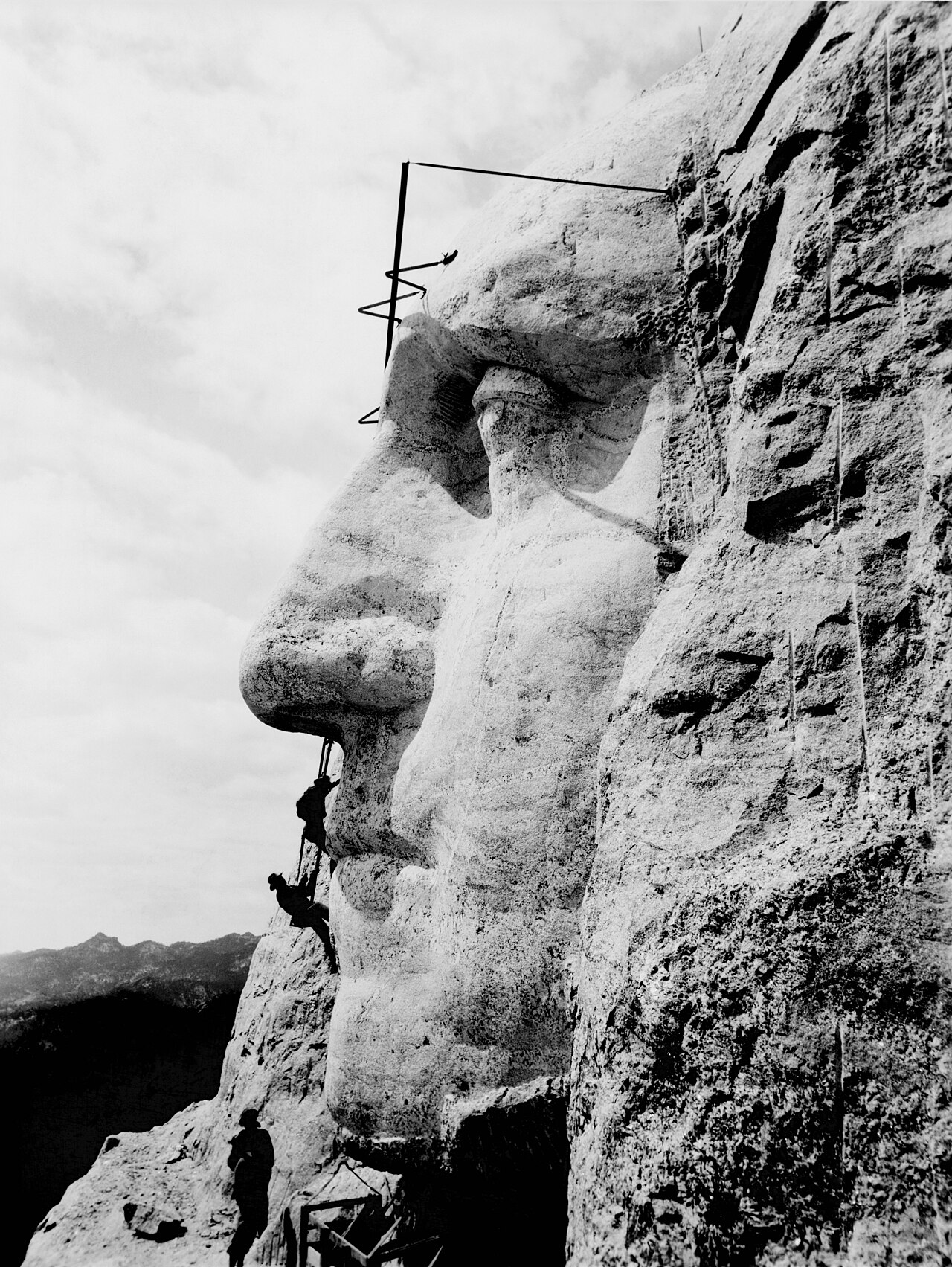
Black-and-white photo of the carved granite face of a Mount Rushmore figure, in profile, under construction. Workers on ropes and a scaffold climb the rock, with a wire measuring frame above.Artifact

Secondary source

Mount Rushmore National Memorial

Gutzon Borglum · 1927–1941

Color photograph of a man with long dark hair parted in the middle and braids, wearing a light-colored blazer over a patterned shirt, a beaded choker necklace, and beaded earrings. He has a name tag on his jacket and stands against a striped curtain background.Photograph

Primary source

Portrait of Russell Means, 1987

1987

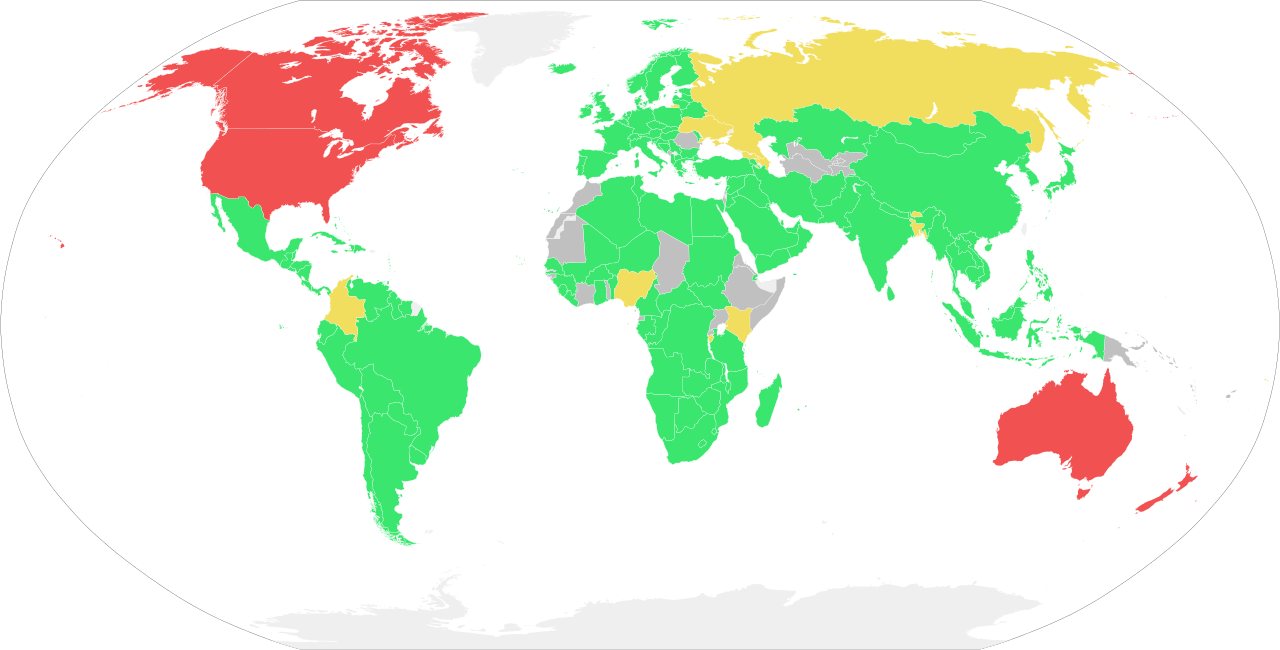
World map colored by vote on the 2007 UN Declaration on the Rights of Indigenous Peoples: green for yes, red for no, yellow for abstain, grey for absent or not voting. Canada, the United States, Australia and New Zealand are red; Russia and much of Asia are yellow.Document

Primary source

Declaration on the Rights of Indigenous Peoples

13 September 2007

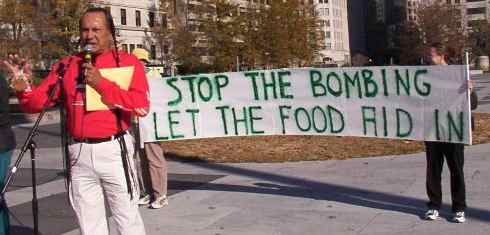
A man with long dark hair wearing a red long-sleeved shirt and white pants speaks into a microphone held in his right hand while gesturing with his left hand outdoors. Behind him a hand-painted green banner reads 'STOP THE BOMBING LET THE FOOD AID IN'. Other people and tall buildings are visible in the background.Photograph

Primary source

Russell Means, 11 November 2001

Carolmooredc at English Wikipedia · 11 November 2001

Yellow, slanted block capital letters spelling NATURAL BORN KILLERS with red drop shadows on a black background. This is the film's logotype.Documentary

Primary source

Natural Born Killers

Oliver Stone · 1994

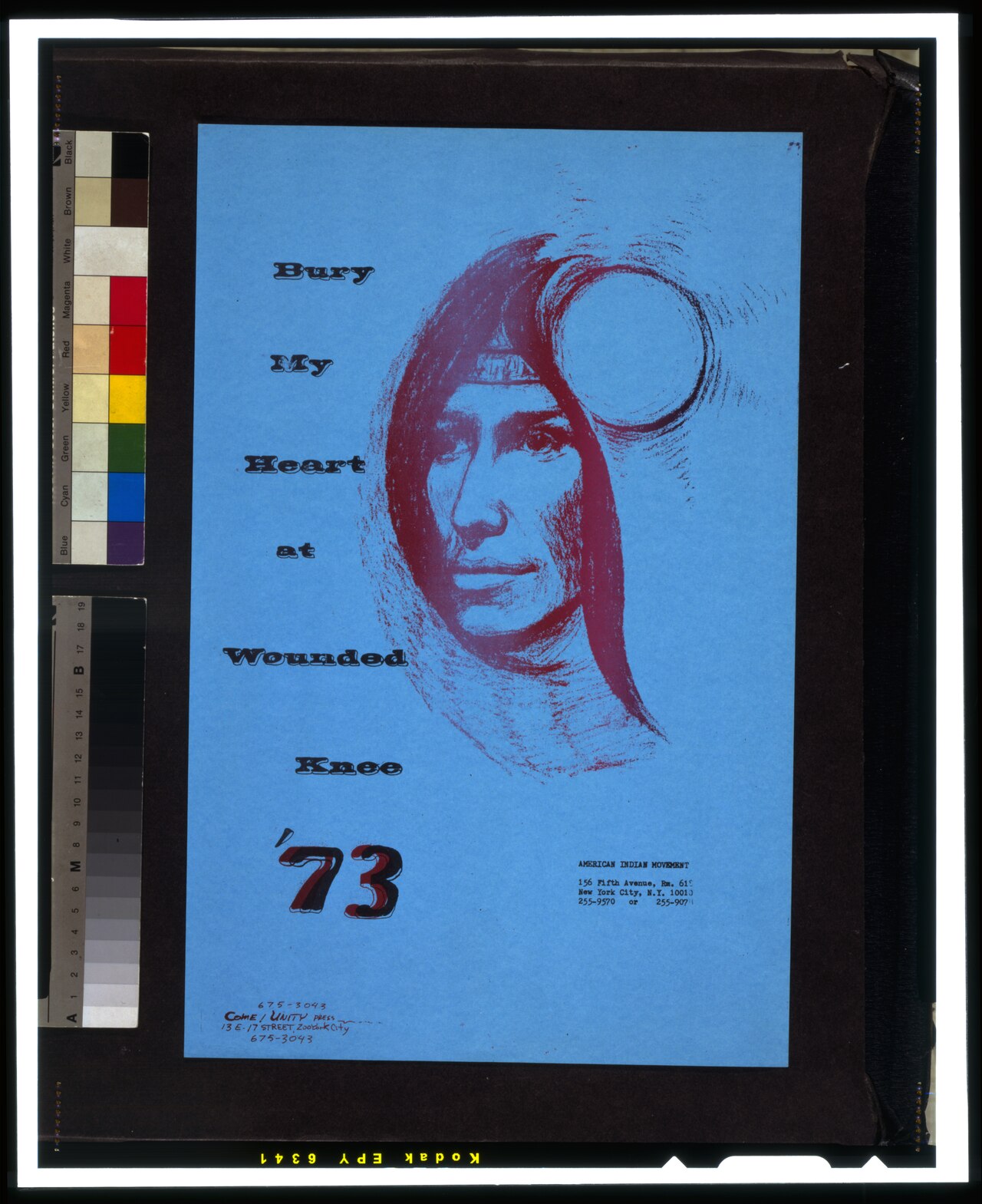
Scan of a poster on light blue paper with a red-and-black illustrated portrait of a Native American man wearing a headband, with a circular sun-like shape behind his head. Text reads 'Bury My Heart at Wounded Knee' and '73'. Small print gives American Indian Movement address in New York City. A color calibration strip and grayscale scale border the image.Artifact

Primary source

Bury My Heart at Wounded Knee, AIM poster, 1973

American Indian Movement · 1973

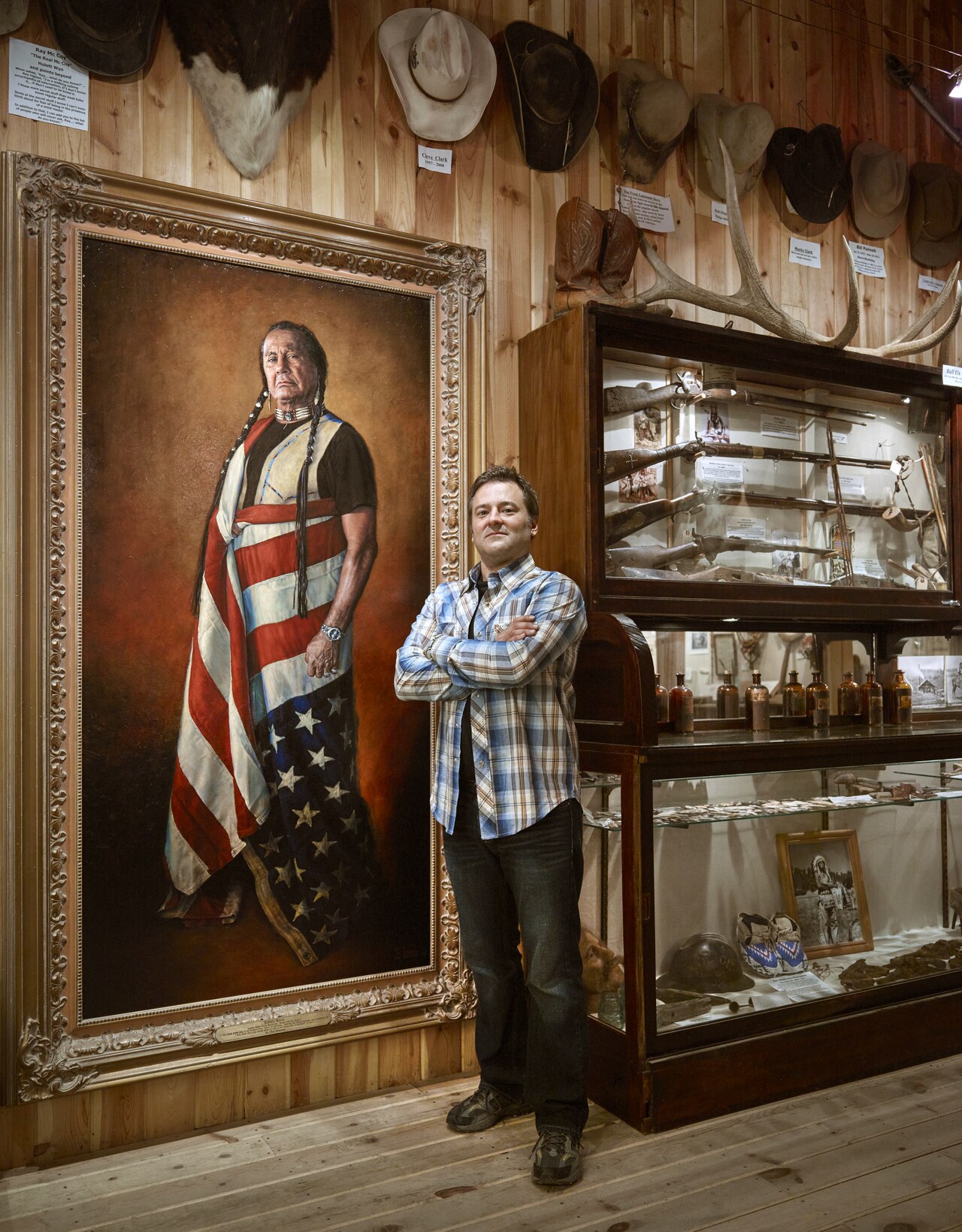
A man in a blue plaid shirt and dark jeans stands with arms crossed beside a large framed painting of a man in a braided hairstyle wrapped in an American flag. The studio walls are wood with hats, antlers, and glass display cases of rifles and bottles.Photograph

Secondary source

Bob Coronato with his painting of Russell Means

Carol M. Highsmith

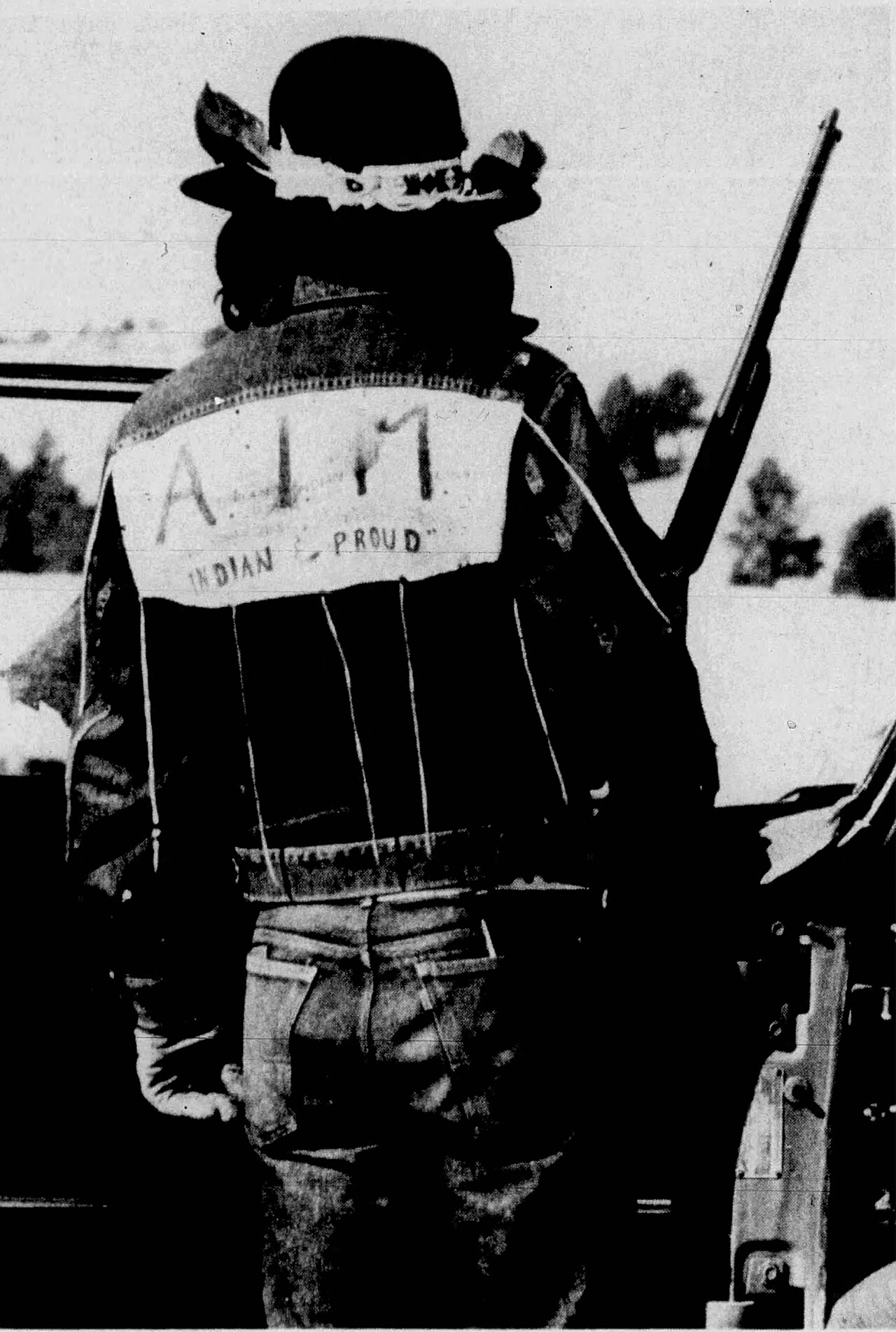
Black and white photo of a man seen from behind, wearing a dark denim jacket with 'AIM' and 'INDIAN PROUD' painted on a light patch on the back. He wears a feathered headband and carries a rifle over his shoulder. Snowy ground and a vehicle appear at the edges.Photograph

Primary source

AIM Member at Wounded Knee

The Alliance Times-Herald · 6 March 1973

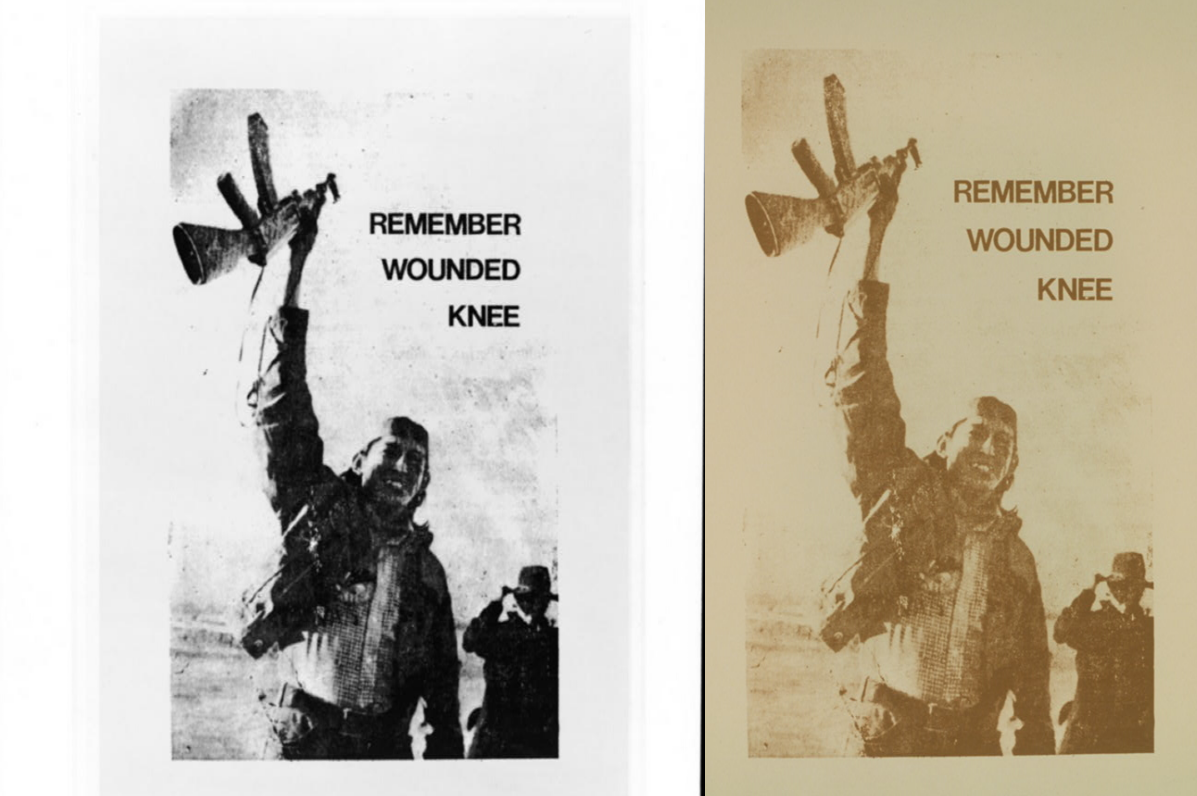
Two side-by-side versions of a Remember Wounded Knee poster: a black-and-white version on the left and a sepia-toned version on the right. Both show a man in a jacket raising a rifle overhead with one fist, with a second man in a hat behind him, and the text REMEMBER WOUNDED KNEE stacked in three lines at right.Artifact

Secondary source

Remember Wounded Knee Poster

c. 1973–1980

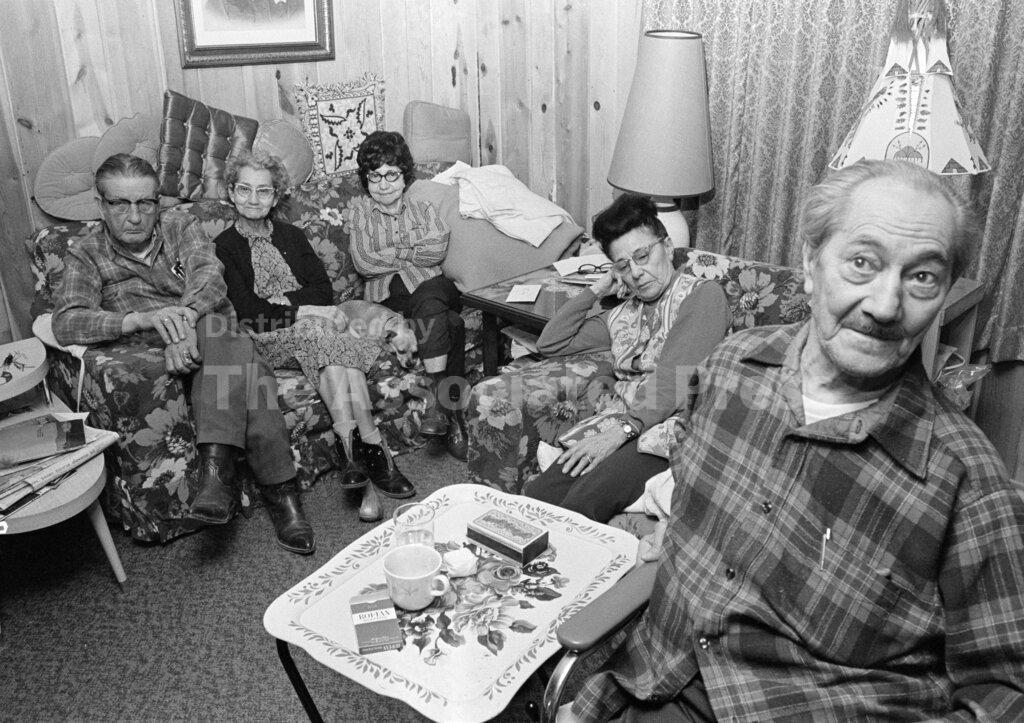
Black-and-white photo of five elderly people in a wood-paneled living room. Two men and three women sit on floral upholstered sofas and chairs. A man in a plaid shirt in the foreground looks at the camera. A table with a cup and a box sits in front, and a lamp with a teepee-shaped shade stands behind.Photograph

Primary source

Hostages Released from Wounded Knee Occupation

Jim Mone · 2 March 1973

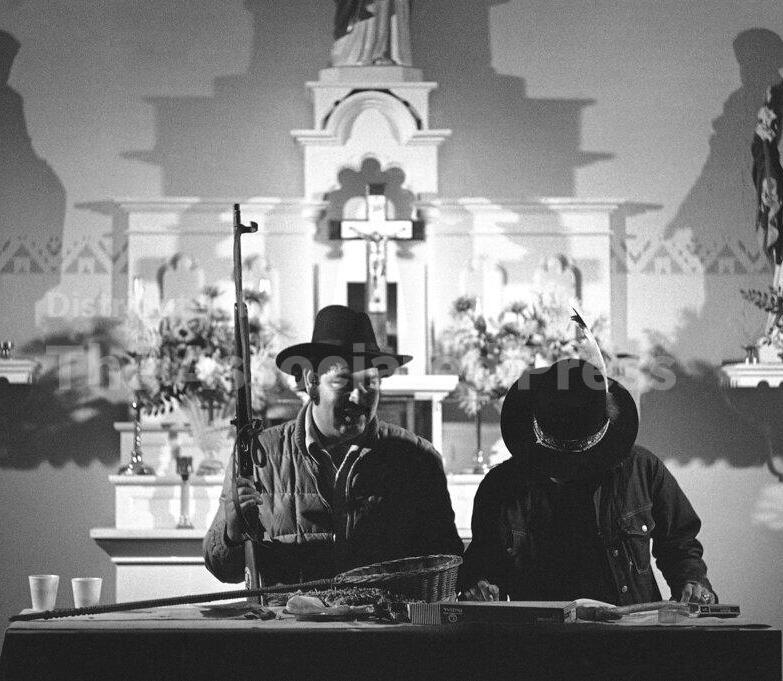
Black and white photograph of two men standing behind a table inside a church altar area. The man on the left wears a dark wide-brimmed hat and quilted jacket and holds a rifle upright. The man on the right wears a dark hat and denim jacket and has his head bowed over the table, which holds a basket, cups, and small objects. Behind them is a white altar with a crucifix, flowers, and candles. Faint watermark text reads 'The Associated Press' across the image.Photograph

Primary source

Armed AIM Members Behind Altar at Wounded Knee Church

Jim Mone · 2 March 1973

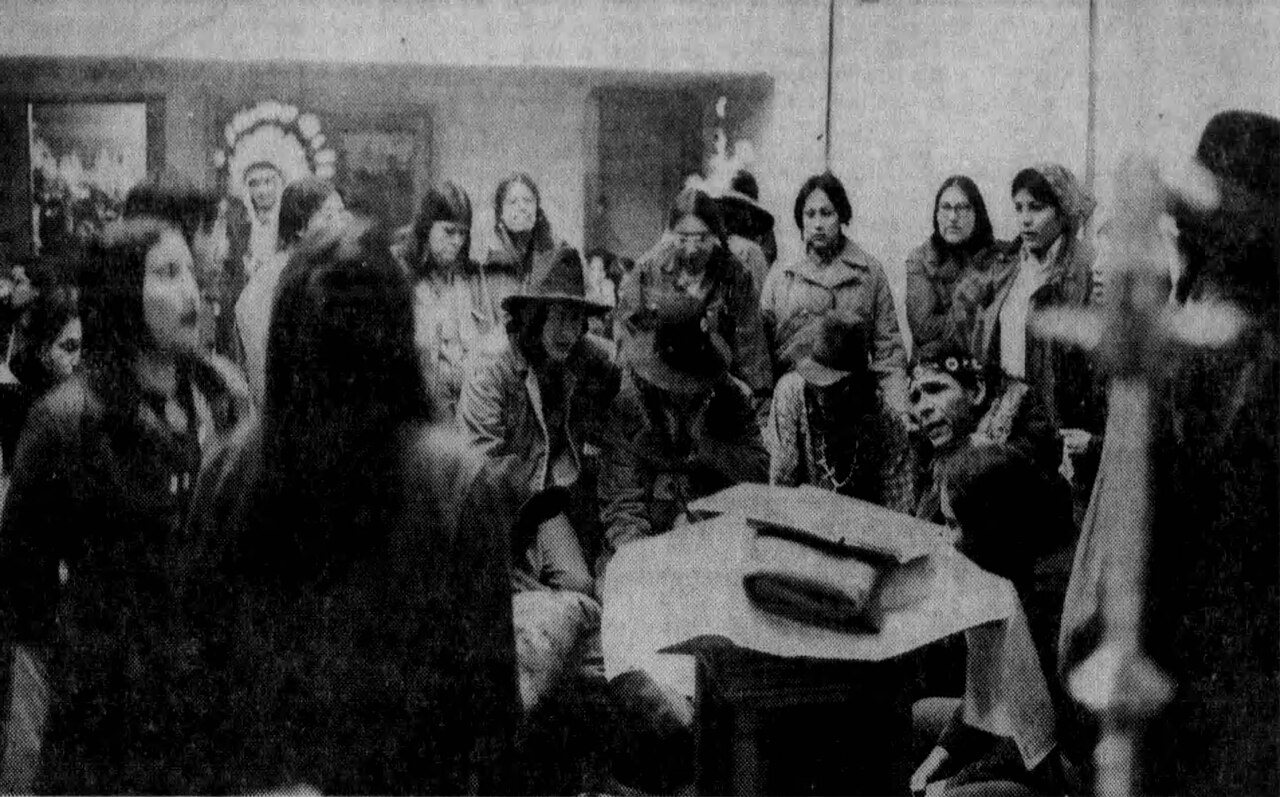
Black-and-white photo of a crowded room with many people, some in hats and headbands, standing and seated around a table with papers and a bundle on it. A man in a headband sits at right near the table; a man in a wide-brimmed hat sits near the center. A blurred figure in the foreground at left.Photograph

Primary source

Dennis Banks Speaks at Wounded Knee Church

Walter Fisk · 27 February 1973

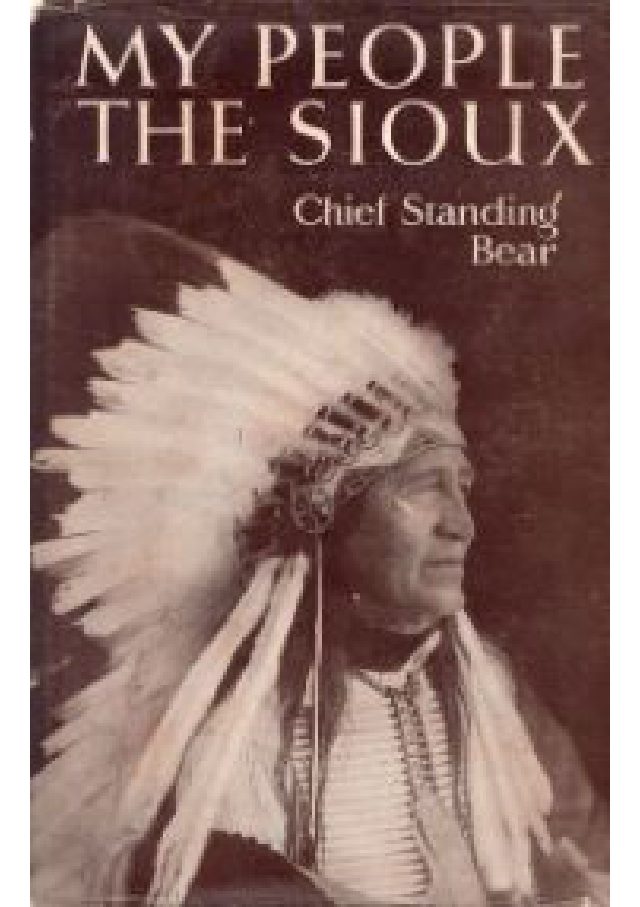
My People the SiouxBook

Secondary source

My People the Sioux

Luther Standing Bear · 1928

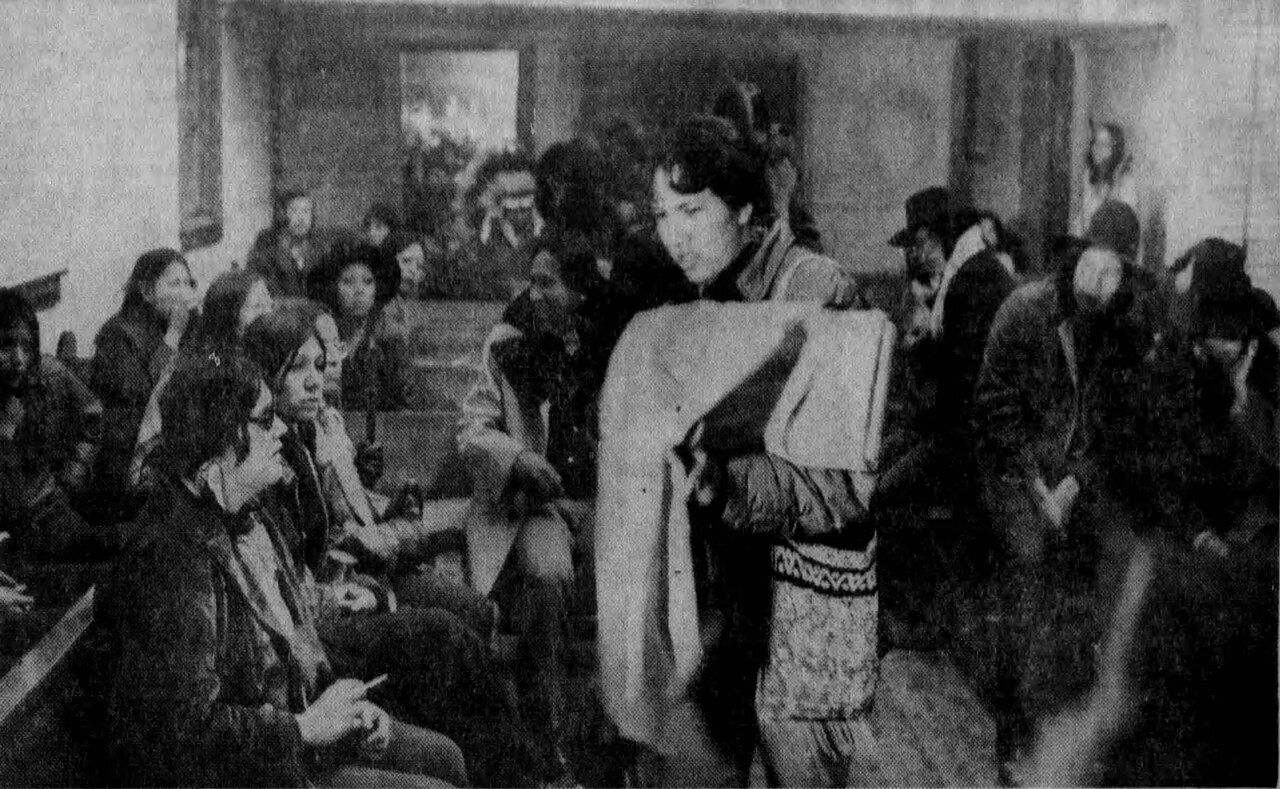
Black-and-white photograph of a crowded room with seated people. In the center, a woman with dark hair holds up a large folded cloth or blanket over her arm while walking through the room. Others, some wearing hats and jackets, sit and stand around her.Photograph

Primary source

Woman Displays Cloth at Wounded Knee Church

Walter Fisk · 27 February 1973

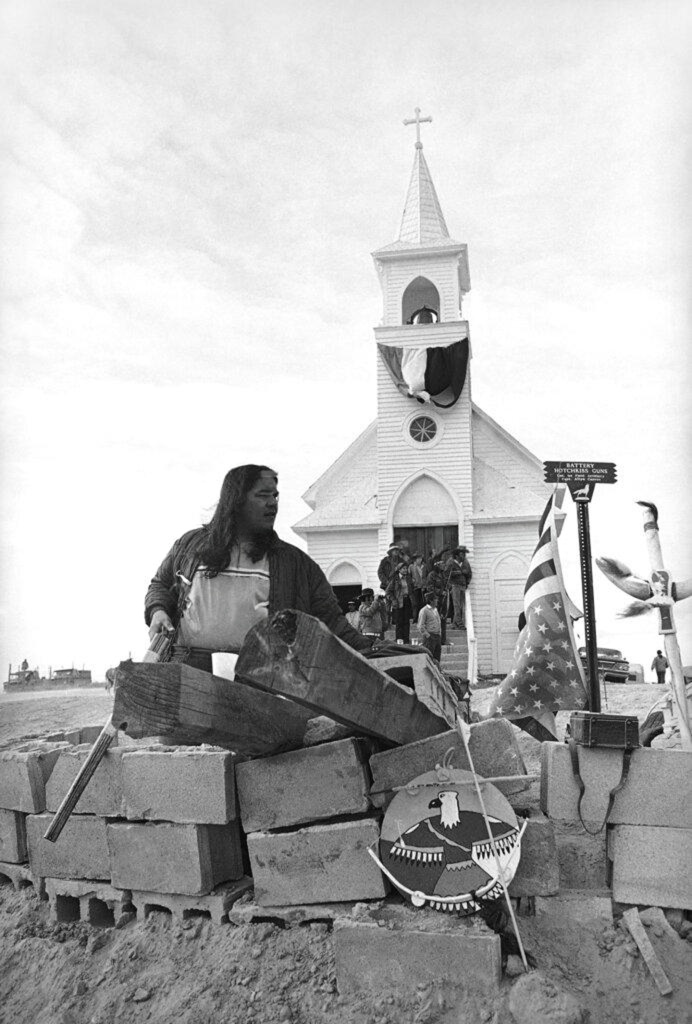
Black-and-white photo of a long-haired man in a jacket behind a low barrier of concrete blocks and wooden beams, holding a rifle. Behind him stands a white church with a steeple, a bell tower, and a cross. A flag with stars and stripes, a round emblem, and a sign reading Battery Hotchkiss Guns are in front. People stand near the church door.Photograph

Primary source

AIM Member in Bunker Outside Wounded Knee Church

Jim Mone · 2 March 1973

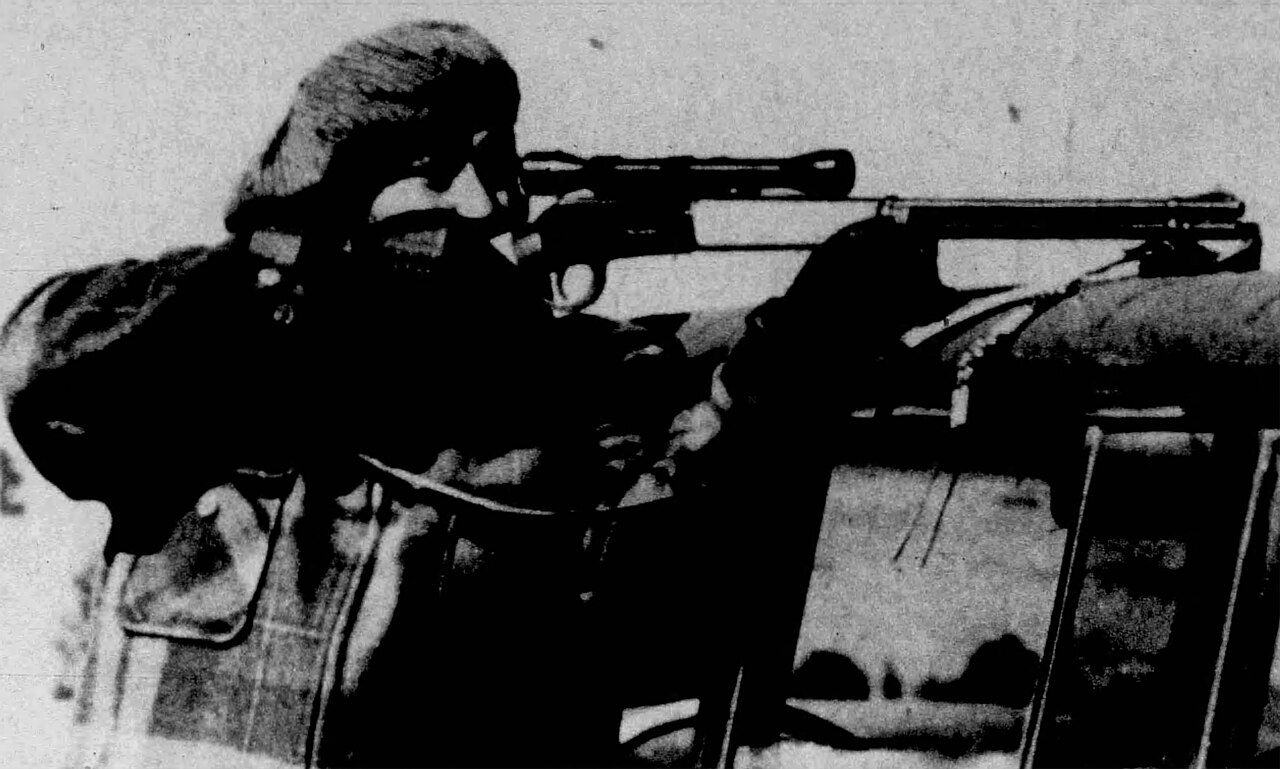
Black and white photo of a person wearing a dark hood or head covering, aiming a rifle with a mounted scope over the top of a vehicle. The person looks through the scope toward the left of the frame.Photograph

Primary source

AIM Member Watches Federal Marshals at Wounded Knee

The Alliance Times-Herald · 6 March 1973

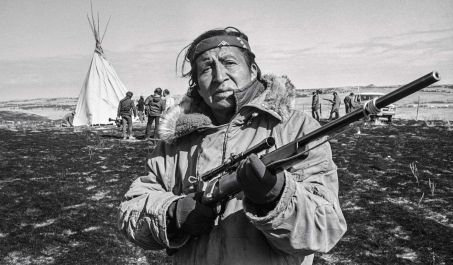
Black-and-white photograph of a man with a headband and a fur-trimmed parka holding a rifle across his body, with a cigarette in his mouth. Behind him a tepee stands on flat, burned-looking ground, and several people are scattered across the field.Photograph

Primary source

Oscar Bear Runner with Rifle at Wounded Knee

UPI · 4 March 1973

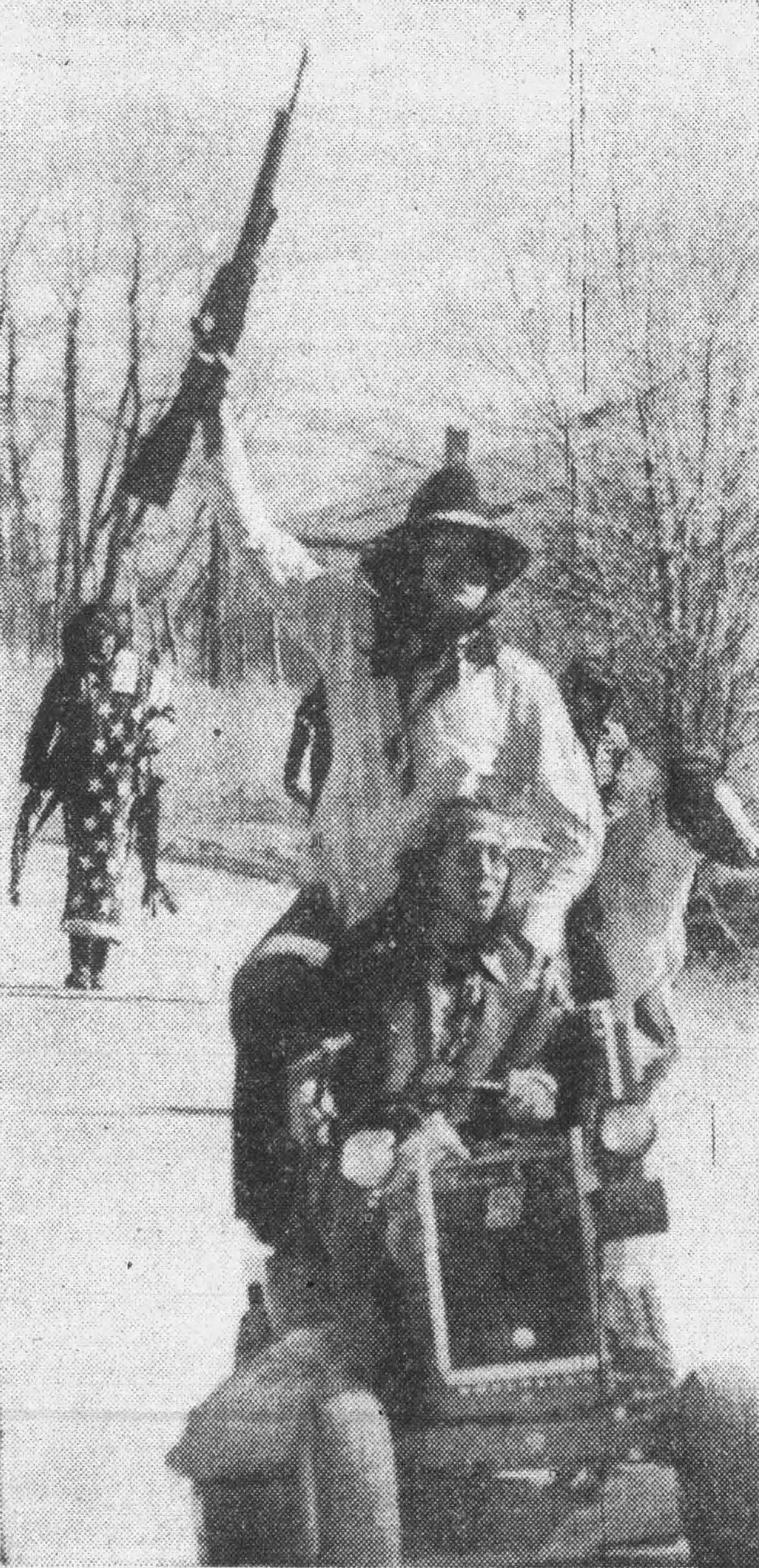
Black-and-white halftone photograph of men at the Wounded Knee Occupation, 1973. A man in a wide-brimmed hat and jacket stands at center; a man in a dark jacket sits on a mowing machine in the foreground. A figure with a rifle stands at left, and a flag with stars is visible. Bare trees in background.Photograph

Primary source

AIM Members on Mower at Wounded Knee Occupation

UPI · 2 March 1973

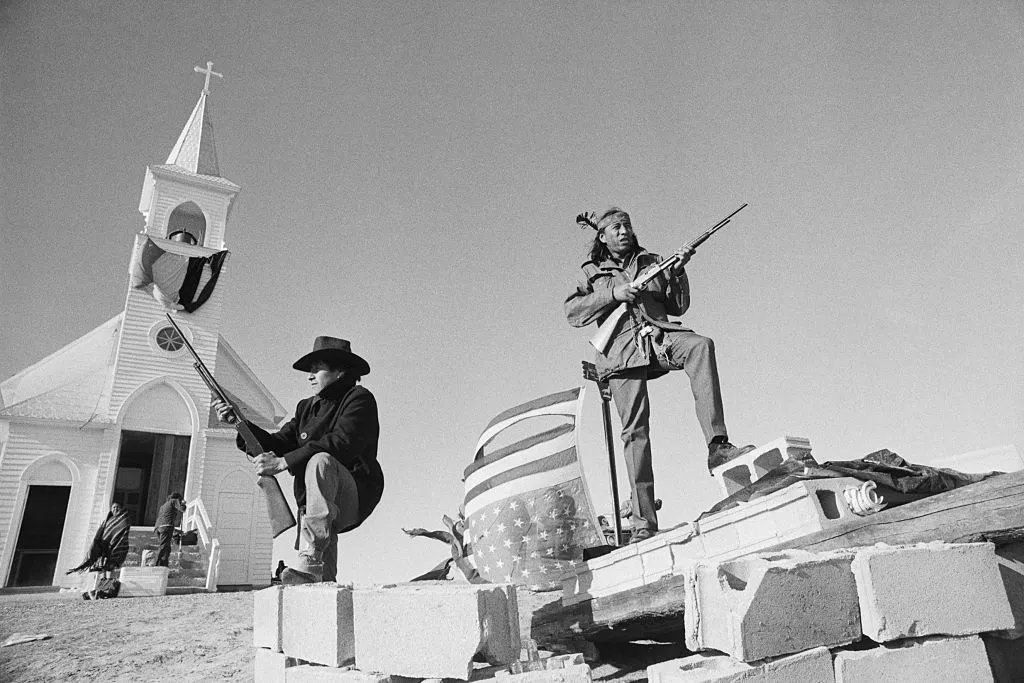
Black and white photograph of two armed men on a barricade of concrete blocks in front of a white church with a steeple and cross. The man on the left in a cowboy hat kneels holding a rifle; the man on the right stands on the blocks in a headband and jacket, holding a rifle. A folded American flag lies on the barricade and a figure sits near the church entrance.Photograph

Primary source

AIM Guards Outside Wounded Knee Church

UPI · 3 March 1973

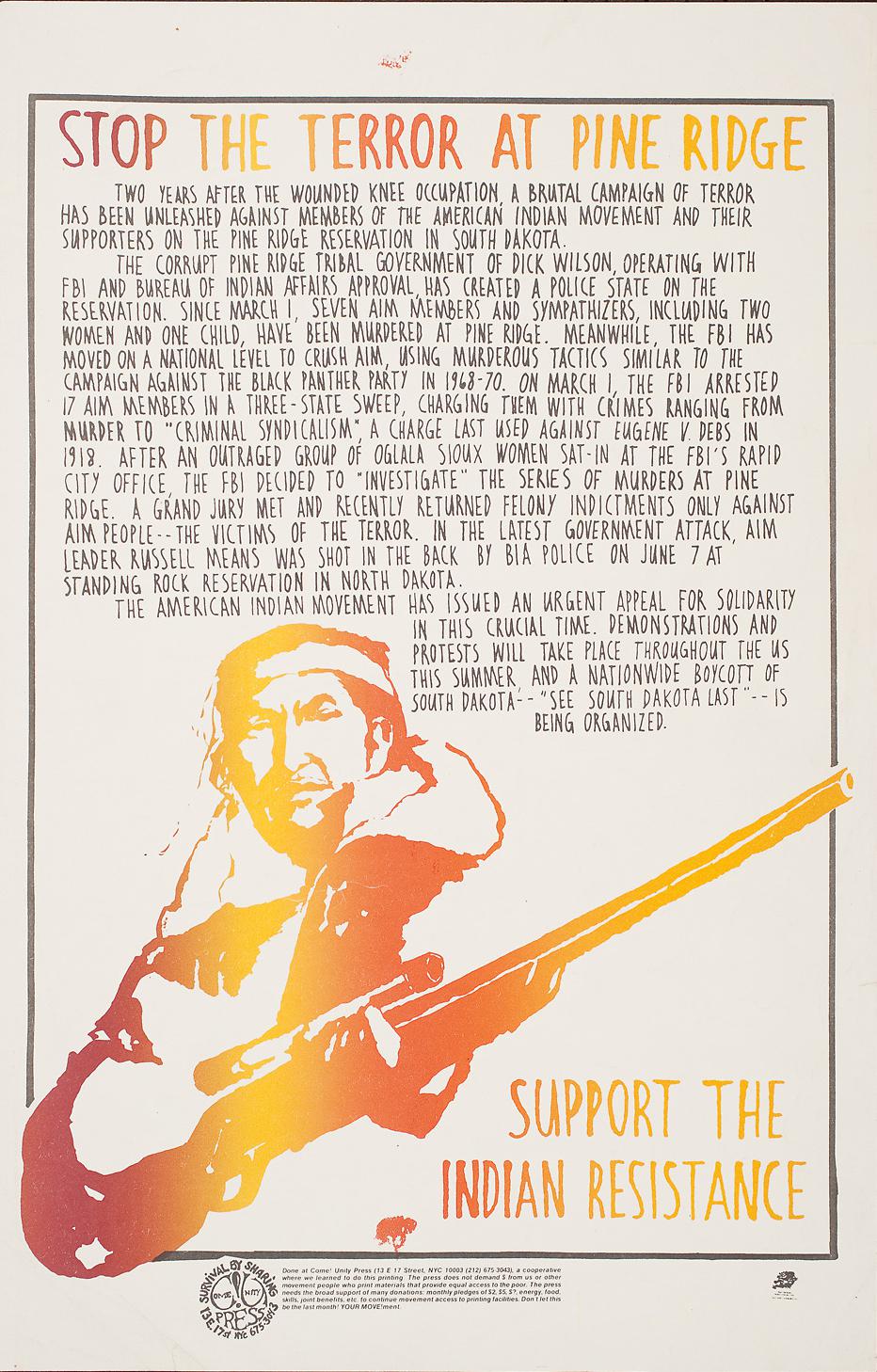
Scan of the 1973 poster 'Stop the Terror at Pine Ridge'. Orange-to-yellow gradient print of a man with a long braid and headband holding a rifle diagonally. Headline at top, body text describing violence at Pine Ridge and FBI actions, and 'Support the Indian Resistance' at lower right. Printer credit 'Unity Press' appears at bottom.Artifact

Primary source

Stop the Terror at Pine Ridge Poster

Unknown author · 1973

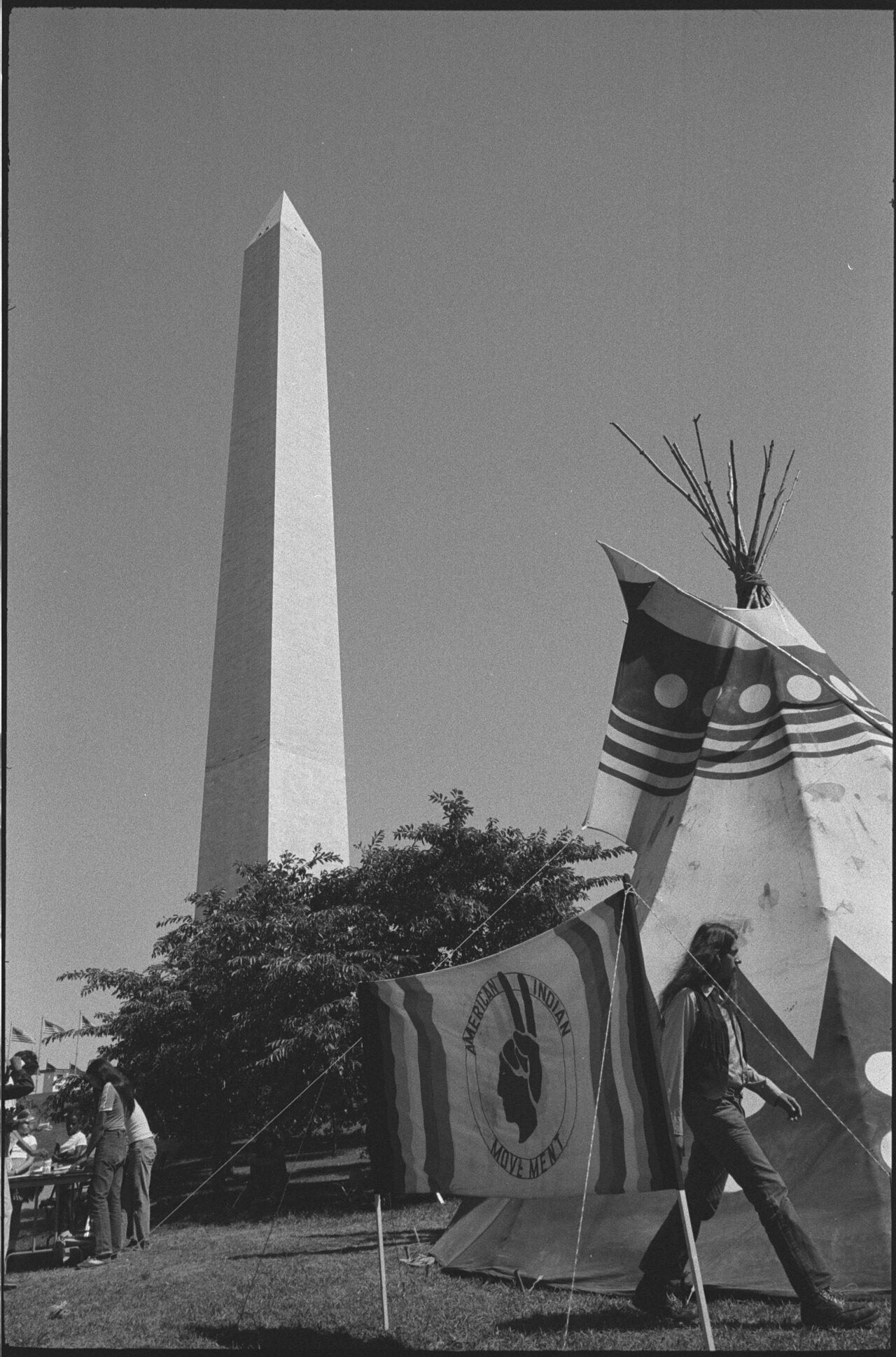
Black-and-white photograph of the Washington Monument's tall obelisk rising behind a tipi with painted stripes and dots. A flag reading AMERICAN INDIAN MOVEMENT with a profile emblem hangs in front. A long-haired man in a vest walks past, and people stand near a table to the left under trees.Photograph

Primary source

Longest Walk at Washington

Warren K. Leffler · 11 July 1978

The Oglala LightBook

Secondary source

The Oglala Light

The Oglala Indian Training School · 1913

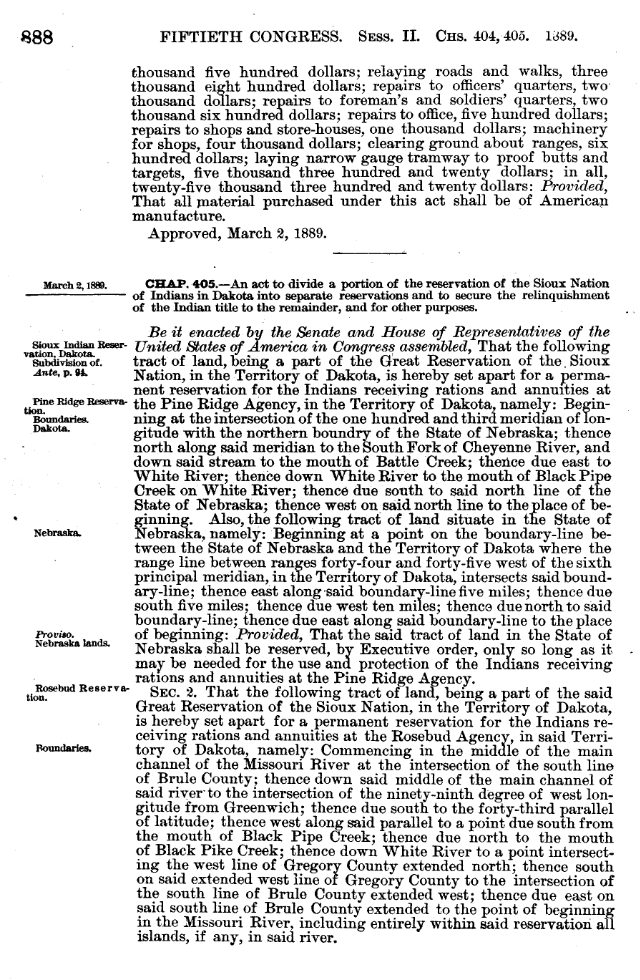
Act of March 2, 1889 Dividing Sioux Reservation LandsDocument

Secondary source

Act of March 2, 1889 Dividing Sioux Reservation Lands

United States Congress · 2 March 1889

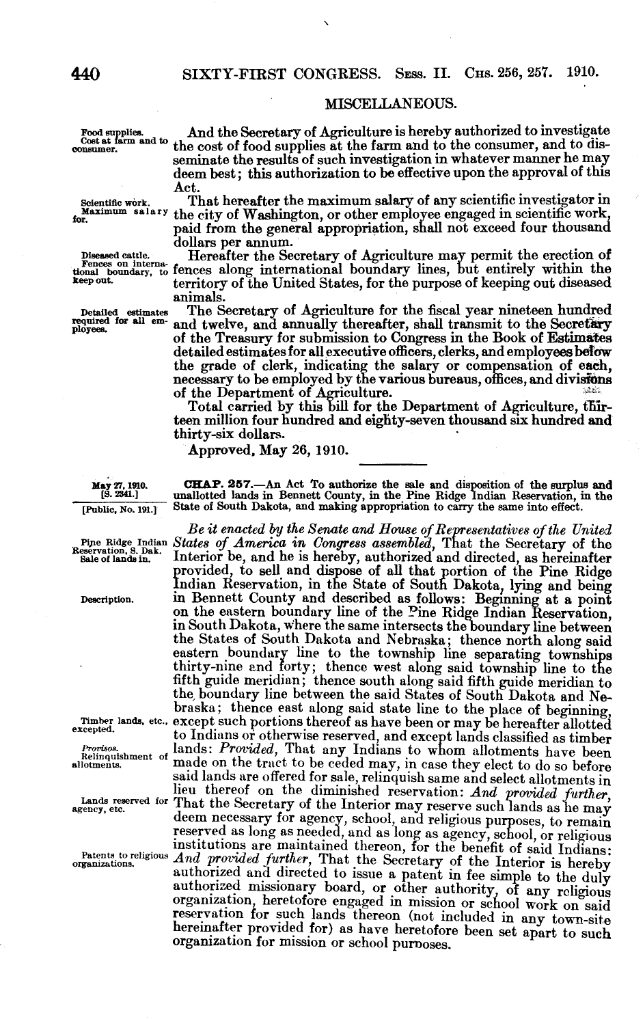
Act of May 27, 1910 Selling Surplus Pine Ridge LandsDocument

Secondary source

Act of May 27, 1910 Selling Surplus Pine Ridge Lands

United States Congress · 27 May 1910

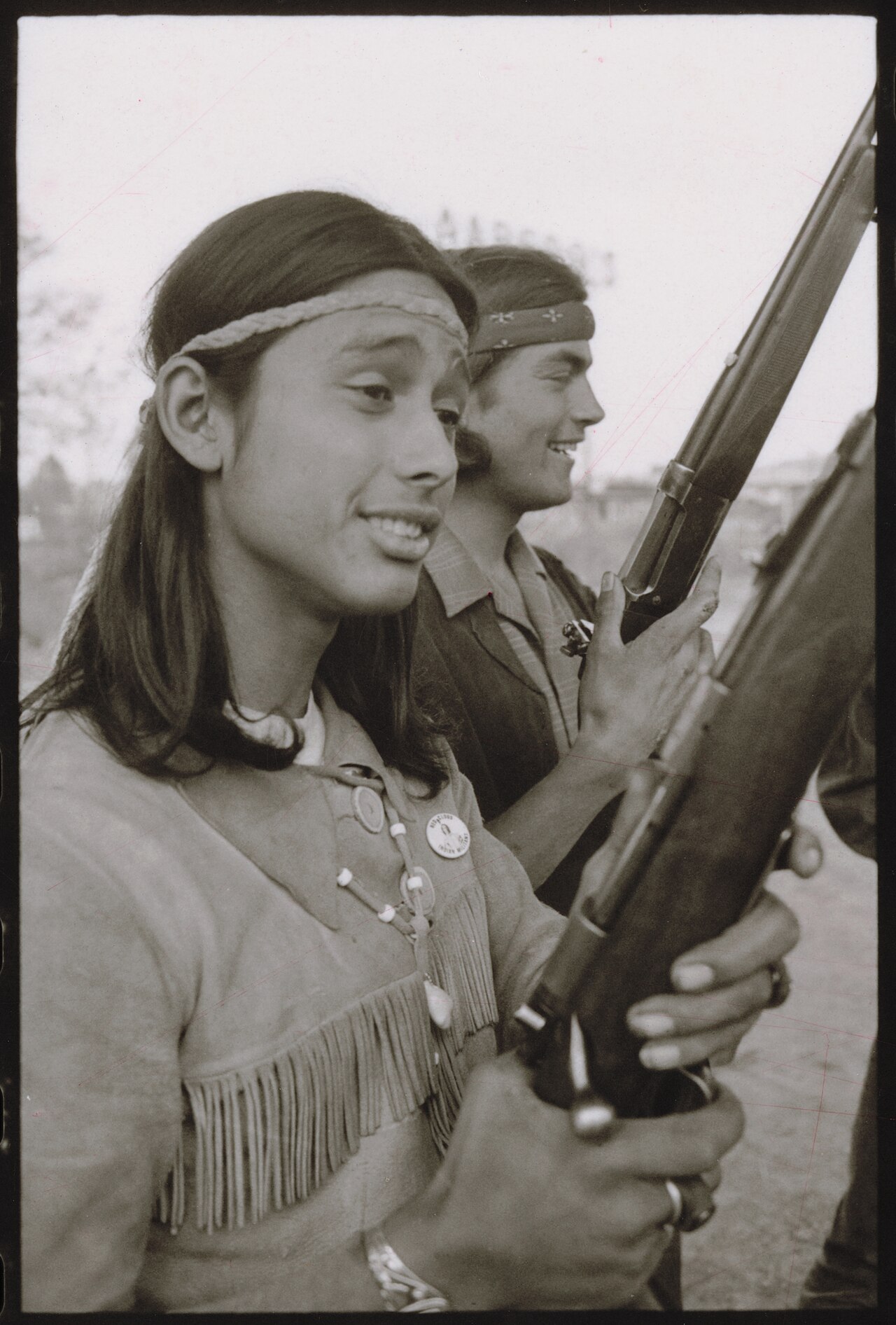
Black-and-white photograph of two young men holding rifles. The man in front wears a braided headband, a fringed suede jacket, beaded necklace and a round button pin, and smiles. Behind him, another man in a headband and dark shirt smiles while holding a rifle.Photograph

Primary source

Photograph of American Indian Protest in Seattle

1964–1979

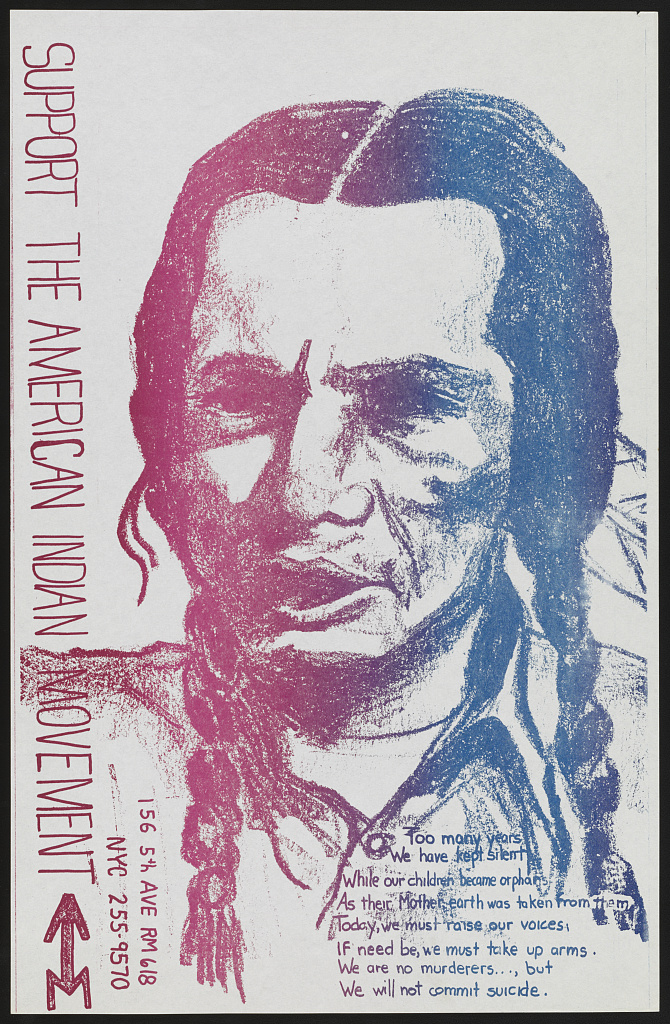
Two-tone magenta and blue poster with a large stylized portrait of a Native American man with long braided hair. Vertical text reads 'SUPPORT THE AMERICAN INDIAN MOVEMENT' with an address and phone number, and a handwritten-style poem on the lower right.Artifact

Primary source

American Indian Movement Poster

American Indian Movement · 1968

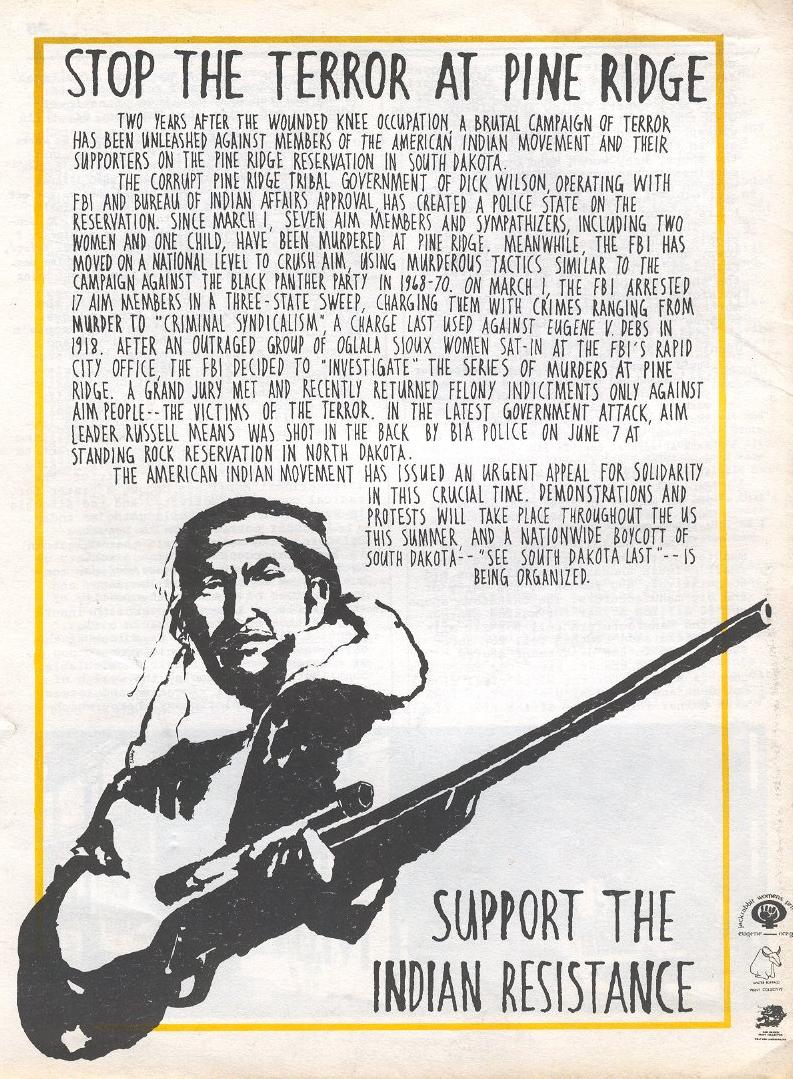
Printed flyer titled 'STOP THE TERROR AT PINE RIDGE' in black capital letters on white paper with a yellow border. Body text describes events on Pine Ridge Reservation. Below is a black-and-white illustration of a man with a headband holding a rifle, with the text 'SUPPORT THE INDIAN RESISTANCE' at bottom right.Newspaper article

Primary source

Osawatomie Newspaper No. 2 on Pine Ridge Events

Weather Underground · Spring 1975

Want the full shelf? Chat with Russell Means in the app and open the Sources panel — every quote links back to the original.

Use Russell Means in class

1 collection

A ready-made collection from the Humy team that features Russell Means. Preview it, then try it free.

Trusted by educators worldwide

Conversations
375,000+
Real exchanges between students and historical figures
Messages exchanged
4,142,000+
Across every figure, classroom and language
Historical figures
100,000+
Each informed by a curated biography and selected sources
Languages supported
50+
From English and Spanish to Arabic and Korean

Paying customers

Used by 98 schools and universities

Partner school logo
Tecnológico de Monterrey logo
Hyper Island logo
Partner school logo
Chambersburg Area School District logo
Broward County Public Schools logo
Nebo School District logo
National Louis University logo
South Florida PBS logo
Punahou School logo
University of Wisconsin–River Falls logo
Partner school logo
Partner school logo
Archbishop Mitty High School logo
Kingsburg High School logo
Norwalk Public Schools logo
Partner school logo
Connections logo
Partner school logo
Moore Public Schools logo
Partner school logo
Partner school logo
Partner school logo
Partner school logo
Robbinsville Public Schools logo
Partner school logo
Partner school logo
Partner school logo
Tecnológico de Monterrey logo
Hyper Island logo
Partner school logo
Chambersburg Area School District logo
Broward County Public Schools logo
Nebo School District logo
National Louis University logo
South Florida PBS logo
Punahou School logo
University of Wisconsin–River Falls logo
Partner school logo
Partner school logo
Archbishop Mitty High School logo
Kingsburg High School logo
Norwalk Public Schools logo
Partner school logo
Connections logo
Partner school logo
Moore Public Schools logo
Partner school logo
Partner school logo
Partner school logo
Partner school logo
Robbinsville Public Schools logo
Partner school logo
Partner school logo

What educators are saying

“We enjoyed the program last year and used it frequently.”
“My students say it’s a welcome change of pace. I’m not a fan of the “sage on the stage” model, so I try to incorporate research-oriented and self-paced activities. With Humy, students have to take charge of their learning. They’ve become more adept at critical thinking, forming better questions, and improving their reading comprehension. The interview feature has been my go-to tool. I create assignments where students must ask historical figures a set number of questions, then summarize the responses to ensure they’re truly absorbing the material. This approach lets them actively explore the past rather than passively consuming information.”
“Humy has helped me bring historical figures, sometimes long past, to life. When my students interact with these figures in real-time, it eliminates some of the perceived “ancient” characteristics of my curriculum. This has shifted my students’ thinking away from viewing history as abstract or irrelevant. Real-time interactions make historical figures relatable, even allowing students to ask off-topic questions that help put historical lives in a more relevant context for 13-year-olds. The feature I use the most is the interview feature. After teaching a topic, most recently Gandhi and Joan of Arc, I have the students ask pointed, focused questions. We practice good conversation techniques beforehand, teaching them to listen (or read) carefully and formulate thoughtful follow-up questions rather than just interrogating. It helps students practice effective conversation skills.”

FAQ

Frequently asked questions

Who is Russell Means?
American Indian activist and actor. On Humy.ai you can chat with an AI version of Russell Means that draws on a short biography and 30 historical sources during the conversation — by text or voice, in 42 languages.
Is Russell Means AI free?
Russell Means is part of Humy's full library of more than 100,000 figures, which comes with a paid plan. A free account (no credit card) includes 20 messages a month with the free library's figures, so you can try how the conversations work first.
What sources does the Russell Means AI use?
It draws on a short biography and 30 historical sources (photographs, artifacts and documents), including “Russell Means with Dennis Banks in car, 1973”, “Pocahontas” and “Treaty of Fort Laramie”. Each source has its own page on Humy.ai.
How historically accurate is the AI version of Russell Means?
Each figure uses a short biography and a small set of selected historical sources as context (retrieval-augmented generation), so answers stay closer to known material than the model's general knowledge alone. It isn't a citation-grade research tool — like any LLM, the AI can get details wrong or extrapolate. Treat it as a strong starting point for inquiry and cross-reference important claims.
Can I talk to Russell Means by voice?
Yes. In addition to text chat, you can call Russell Means and hear their voice respond in real time — useful for auditory learners, interview practice and Socratic dialogue.
Is Humy.ai safe and compliant for schools?
Yes. Humy.ai is used by more than 100 schools, universities and organisations. The platform is FERPA- and GDPR-aligned, supports SSO, and offers an IT-approval pack tailored for school procurement teams.

Ready when you are

Start chatting with Russell Means now.

20 messages free · No credit card · Available in 50+ languages.