


Secondary sourcePainting1832
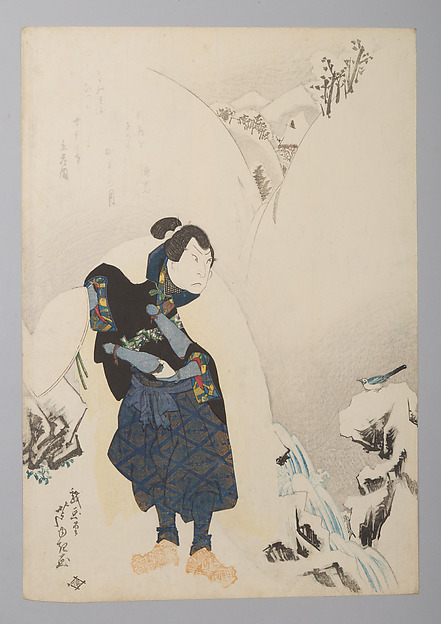
Actor Arashi Rikan II as Miyamoto Musashi
Gigadō Ashiyuki · 1832
An 1832 Japanese woodblock print showing the kabuki actor Arashi Rikan II performing the role of Miyamoto Musashi.
A later theatrical depiction showing how Musashi's legend was dramatized in Edo-period kabuki theatre.
About this source
What it is
This is a woodblock print made in 1832 by the artist Gigadō Ashiyuki, during Japan's Edo period. It depicts the kabuki actor Arashi Rikan II dressed in costume for the role of Miyamoto Musashi, standing in a snowy landscape beside a waterfall. The print is now held by the Metropolitan Museum of Art.
Why it matters
By the 1830s, nearly two centuries after his death, Musashi had become a popular subject for kabuki theatre, showing how his story was turned into dramatic entertainment for Edo-period audiences. This print reveals how later generations imagined and performed his legend rather than depicting the historical man himself.
Look closer
- How does this image, made for the stage, differ from a portrait meant to record someone's real appearance?
- What choices did the artist make in costume and setting to suggest the role of Musashi?
- Why might audiences in the 1830s have enjoyed stories about a swordsman who lived two centuries earlier?
This painting is part of the curated material that grounds the AI version of Musashi Miyamoto on Humy.ai — when students ask about related events, the AI can quote it and cite it.
More Musashi Miyamoto sources
Meet the AI Musashi Miyamoto →

Ready when you are
Start chatting with Musashi Miyamoto now.
20 messages free · No credit card · Available in 50+ languages.