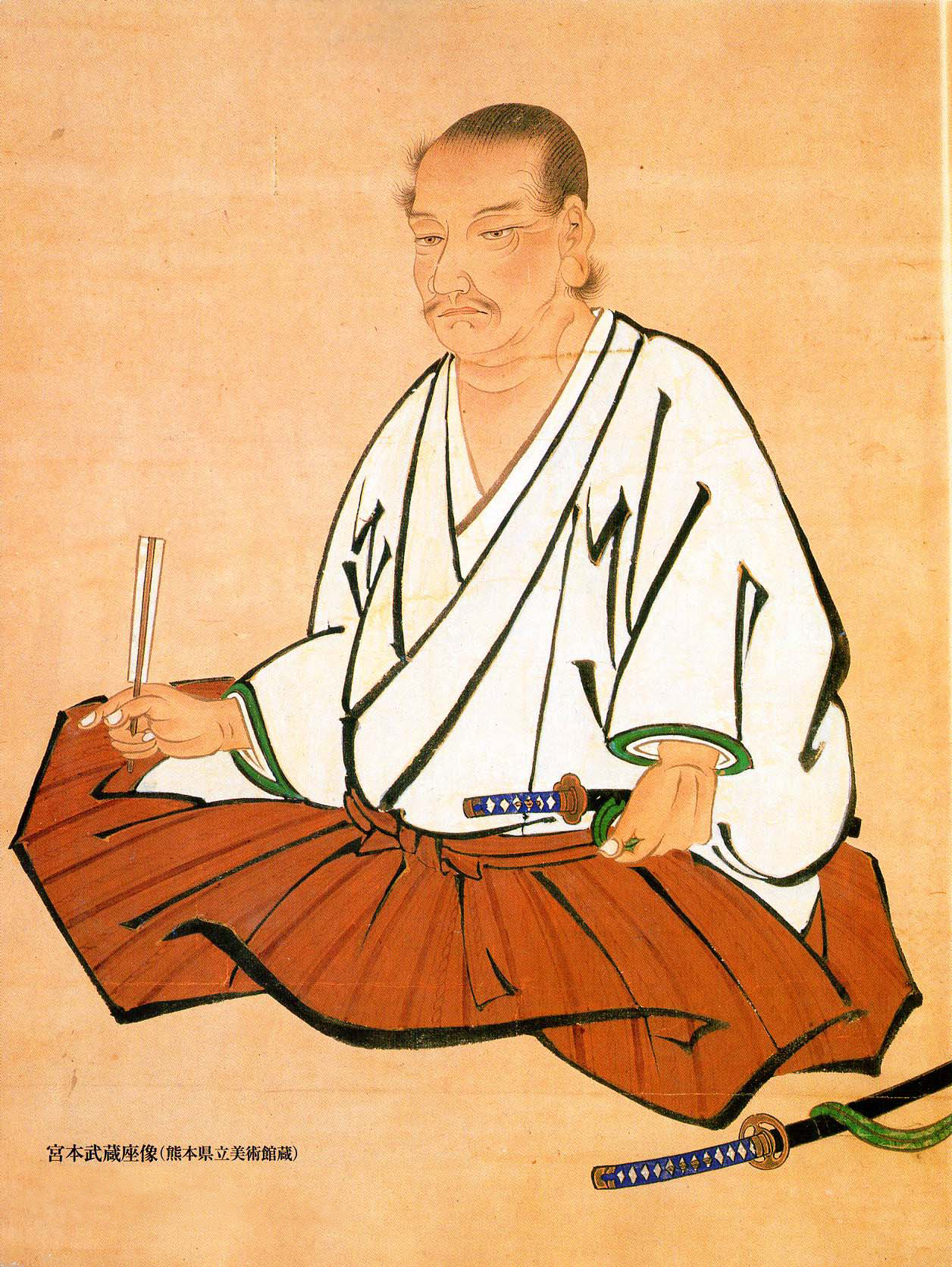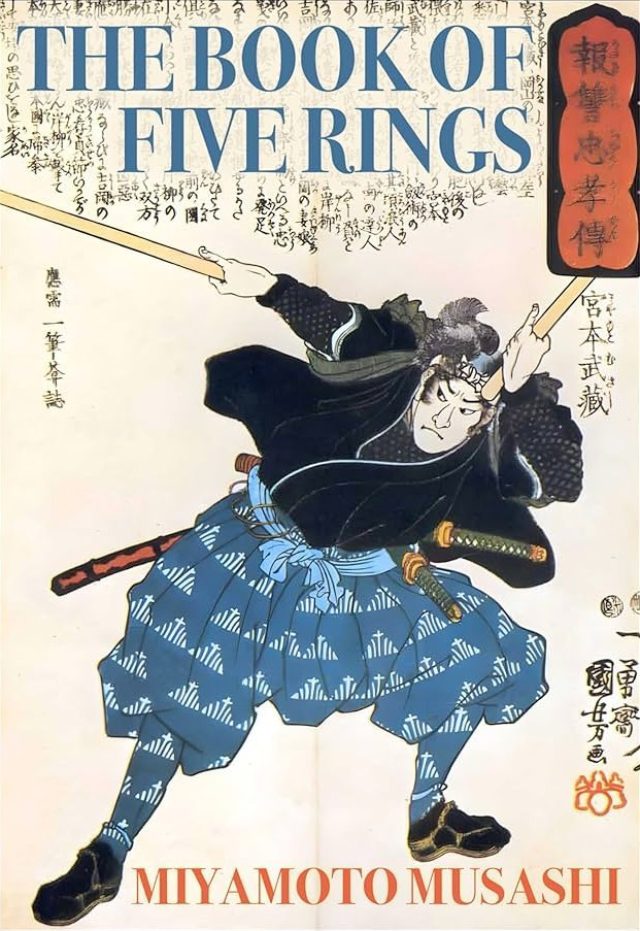
Portrait of Musashi Miyamoto

AI Historical Figure

Musashi Miyamoto

A legendary Japanese swordsman and philosopher known for developing the Niten Ichi-ryū style.

Chat with Musashi Miyamoto via text or voice — in 42 languages, drawing on a curated biography and 73 historical sources. Available 24/7.

Start chatting with Musashi Miyamoto20 messages free · No credit card
Lived
c. 1584–1645
From
Japan
Known for
MilitaryPhilosophy
Musashi Miyamoto

Musashi Miyamoto

Online · responds in seconds

Hello — I'm Musashi Miyamoto. A legendary Japanese swordsman and philosopher known for developing the Niten Ichi-ryū style. What would you like to ask me?

20 messages free · No credit card · Powered by Humy.ai

Live preview · Switch between 42 languages above · Send a message to continue in the app

Multilingual

Talk to Musashi Miyamoto in 42 languages

Ask Musashi Miyamoto questions in any language below, and the rest of Humy's app speaks it too. Pick yours to open the chat in that language.

Also in German (Austria), German (Switzerland), English (UK), English (Australia), English (Canada).

The sources behind this AI

73 sources · 32 paintings · 14 sculptures · 13 photographs · 7 artifacts · 5 books · 2 documents

Musashi Miyamoto doesn’t improvise from thin air. The AI is grounded in 73 curated historical sources students can inspect. Open any of them to see what informs the conversation.

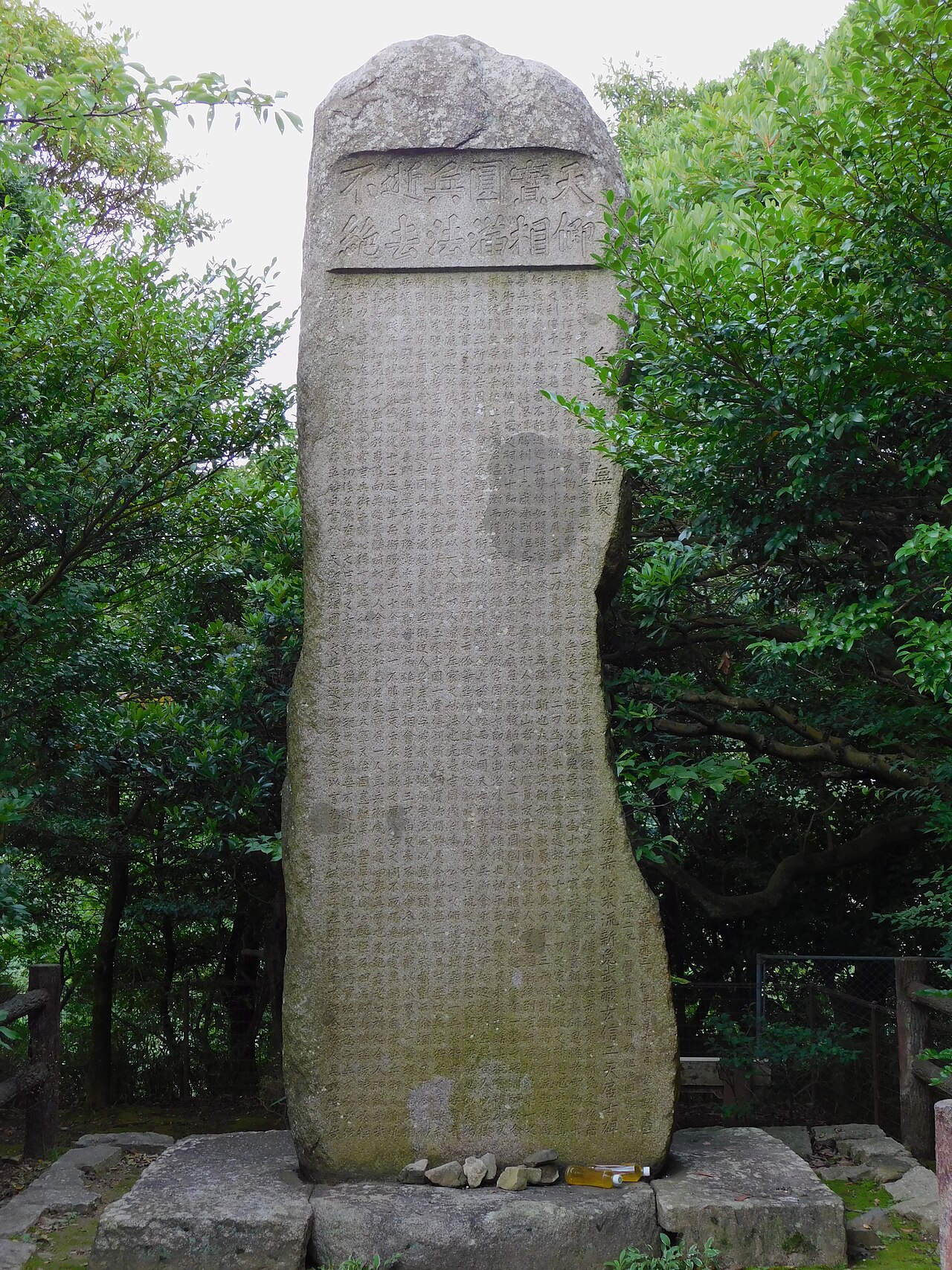
A tall, narrow, weathered stone monument with an inscribed upper panel of large characters and dense vertical text covering its face, set on a stone base among green trees and shrubs in a wooded park.Sculpture

Secondary source

Kokura Hibun

Miyamoto Iori · 1654

Painting of a seated man in a white kimono with dark green-trimmed sleeves and rust-red hakama pleated trousers, holding chopsticks in one hand and a sword hilt in the other. A katana lies across the lower right. Japanese caption in lower left.Painting

Secondary source

Portrait of Miyamoto Musashi

Edo period

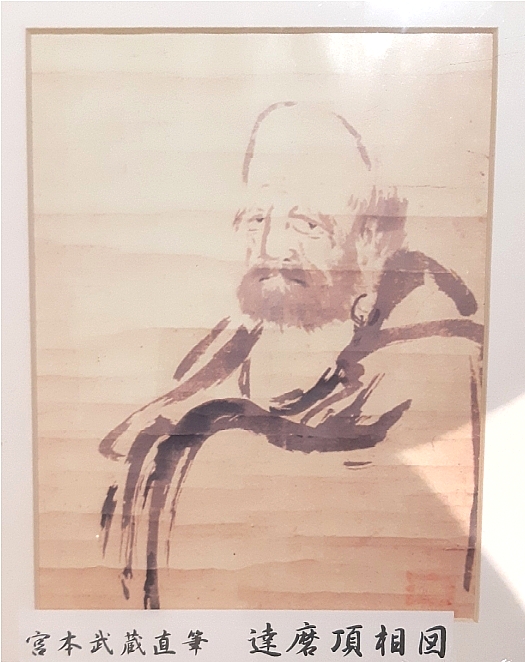
Ink painting on paper, framed, of a bearded monk with a large round head and heavy brows, drawn in loose brush strokes with a flowing robe. Japanese calligraphy caption appears below the image.Painting

Primary source

Daruma-Bodhidharma

Miyamoto Musashi

A tall, narrow vertical scroll of pale paper with large bold black brush calligraphy at the top reading in Japanese characters, and smaller columns of black brush characters below, with a small red seal near the bottom right.Document

Primary source

Kanjisenki

Miyamoto Musashi

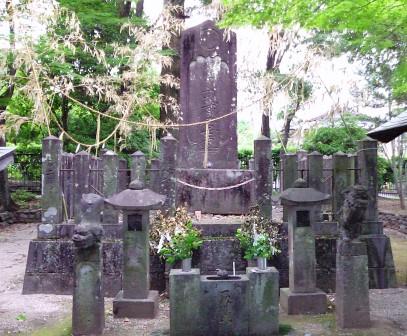
A stone grave monument in a garden. A tall upright gravestone stands behind a tiered stone base, with a twisted straw shimenawa rope wrapped around it. Stone lanterns, a stone basin with flowers in vases, and other grave markers stand in front, with green trees behind.Sculpture

Secondary source

Grave of Miyamoto Musashi

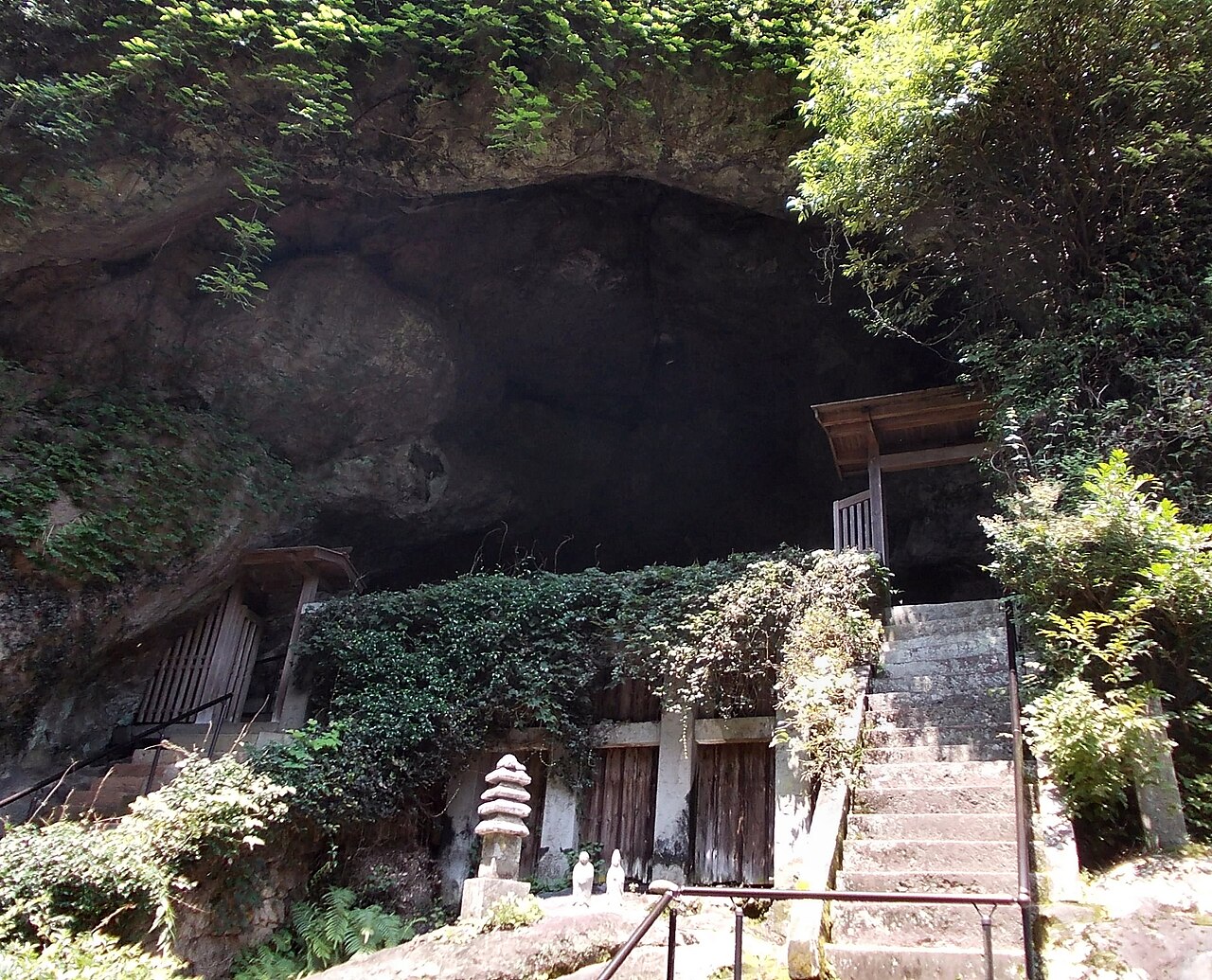
A large natural cave in a rock cliff face, overhung by green vines and foliage. Inside the cave mouth are wooden-doored shrine structures, a small stone pagoda-like monument, two small white stone figures, and a stone staircase with a metal handrail leading up to the cave entrance.Artifact

Secondary source

Reigandō

from 1643

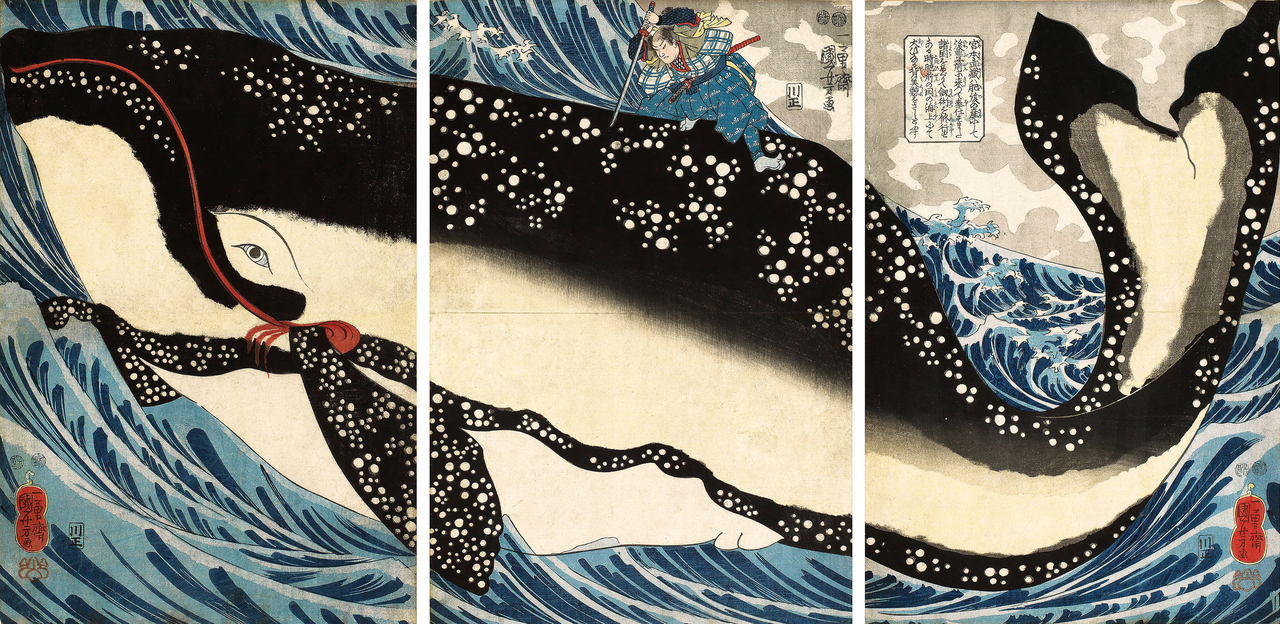
Triptych woodblock print of a samurai in blue robes with a sword, standing on the back of a huge black-and-white whale with white spots, amid stylized blue waves. Text cartouches appear at top right and center.Painting

Secondary source

Miyamoto no Musashi Attacking the Giant Whale

Utagawa Kuniyoshi · 1847-1850

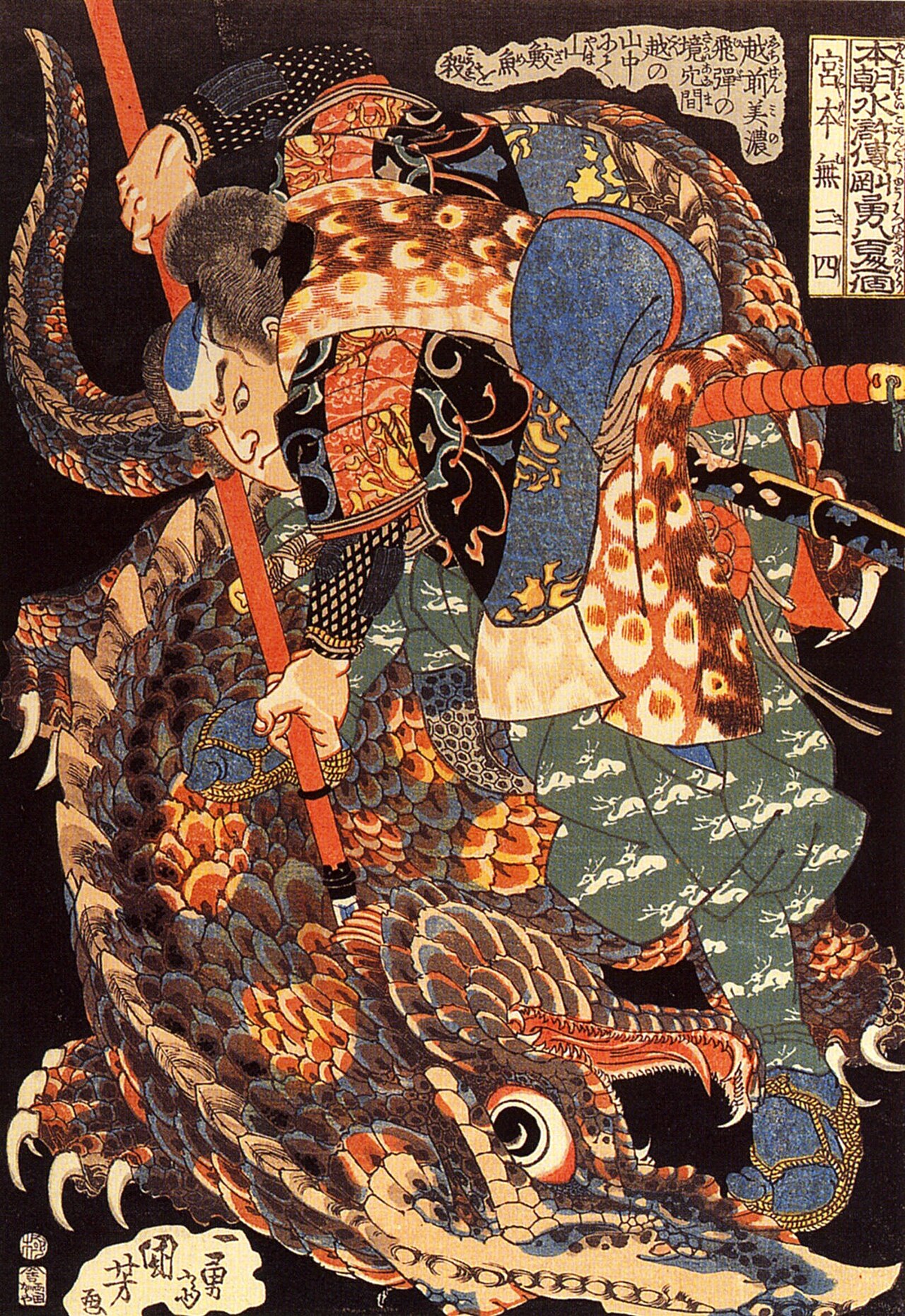
Woodblock print in bright colors of a warrior with a red-shafted spear pinning a huge scaly monster with a fanged, open-mouthed head and clawed feet. The warrior wears a patterned patchwork kimono and a sword. Japanese text and a seal appear in the upper right and lower left corners on a black background.Painting

Secondary source

Miyamoto Musashi Killing a Giant Creature

Utagawa Kuniyoshi · 1833

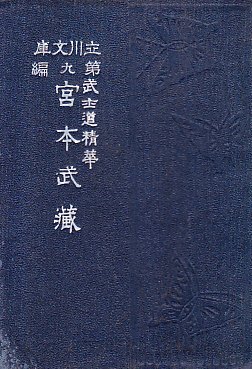
Dark blue cloth-bound book cover with white Japanese vertical text reading 立川文庫 第九篇 武士道精華 宮本武蔵 and 立川文庫編 along the spine and title area, with faint decorative floral patterns in the background.Book

Secondary source

Bushidō Seika Miyamoto Musashi

立川文庫 · 1911

The Book of Five RingsBook

Primary source

The Book of Five Rings

Miyamoto Musashi · c. 1645

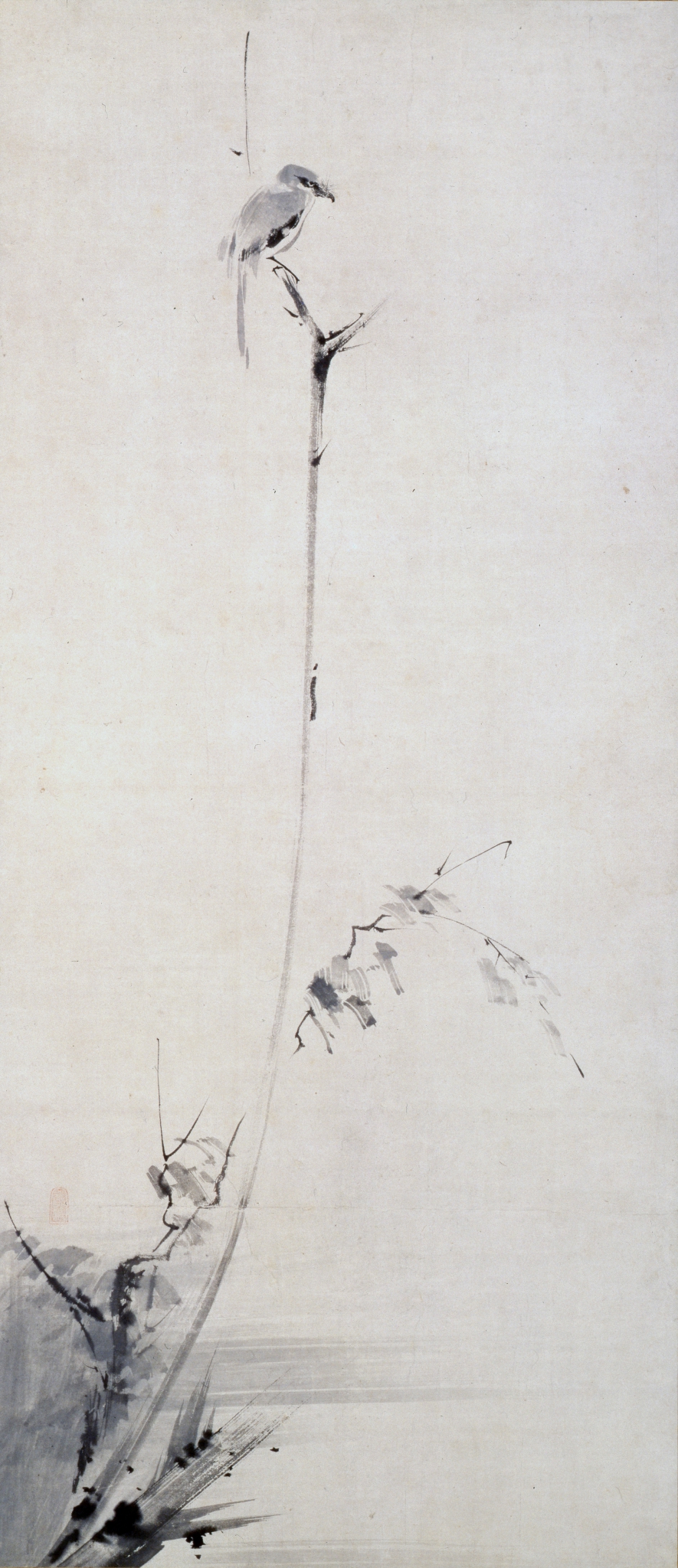
Ink painting on pale paper of a grey shrike perched on the tip of a tall, thin bare branch near the top. Below, a gnarled branch with sparse leaves curves across the lower right, and rocky ink washes sit at the lower left.Painting

Primary source

Shrike in a Barren Tree

Miyamoto Musashi · before 1645

Japan in Days of Yore, chapters on Miyamoto MusashiBook

Secondary source

Japan in Days of Yore, chapters on Miyamoto Musashi

Walter Dening · 1887

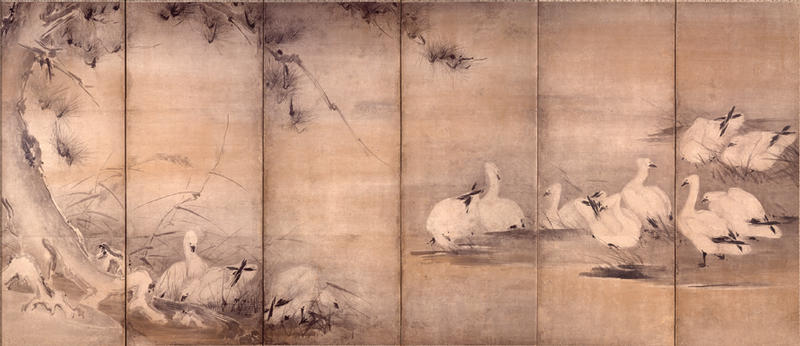
Six-panel folding screen painting in muted ink and pale tones on a tan background. Pine branches hang at the top left. White geese with dark-tipped wings rest on water and among reeds, with a pine trunk at the far left.Painting

Primary source

Wild Geese and Reeds (Right Screen)

Attributed to Miyamoto Musashi · 17th century

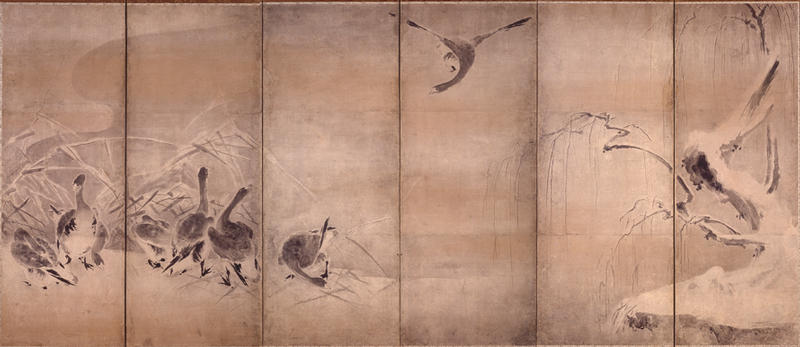
Six-panel folding screen painting in ink and muted color on a tan ground. Wild geese gather among reeds in the left panels, one goose flies across the center panel, and bare willow and snow-covered branches appear on the right.Painting

Primary source

Wild Geese and Reeds (Left Screen)

Attributed to Miyamoto Musashi · 17th century

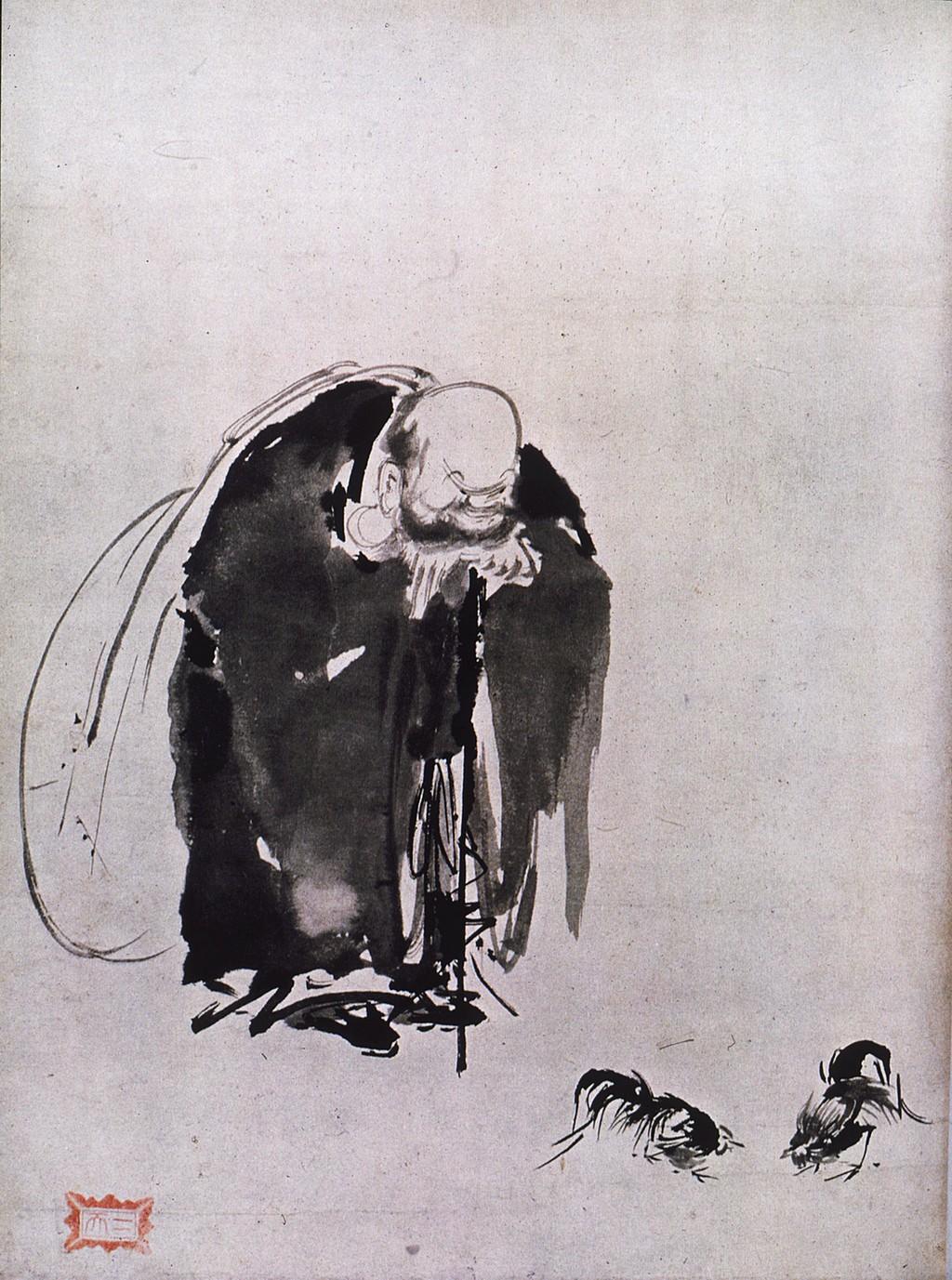
Black ink monochrome painting of a bald, robed figure with a long sleeve and staff, head bowed, looking down at two small fighting birds at lower right. Red seal stamp at lower left. Pale background.Painting

Primary source

Hotei Watching a Cockfight

Miyamoto Musashi · Unknown date

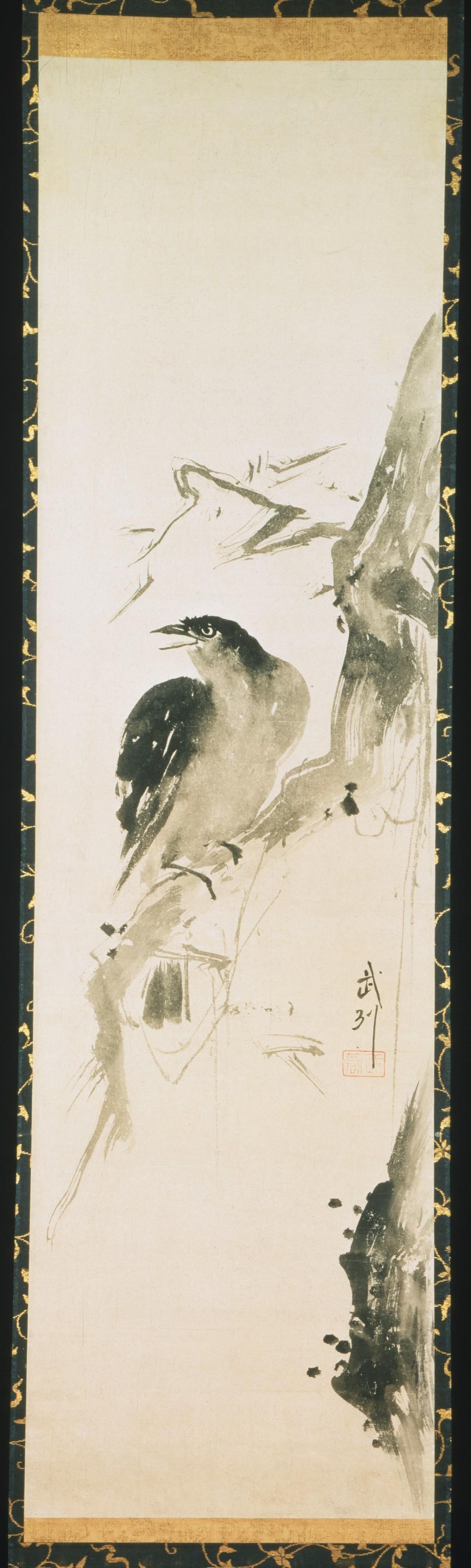
Hanging scroll with ink painting of a dark-winged bird perched on a gnarled branch, looking upward, with a few sketched leaves and a signature and red seal at lower right. Brocade mounting with gold pattern.Painting

Primary source

Bird on Branch

Miyamoto Musashi · Unknown date

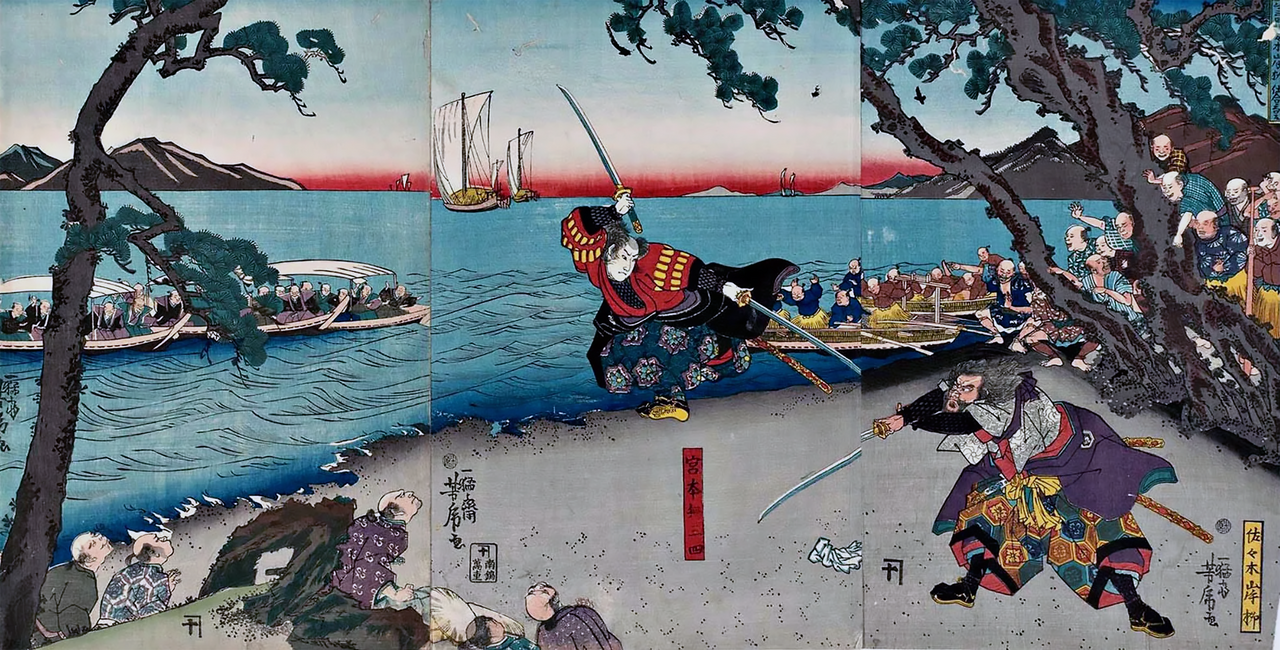
Triptych ukiyo-e woodblock print of a duel on a sandy shore by water. A samurai in red and black armor raises a long sword overhead at center. At right, a man with a shaved head and dark robes thrusts a blade toward him. Boats with rowers and sails fill the water, and spectators watch from rocks and pine trees.Painting

Secondary source

Musashi Fights Sasaki Kojiro at Ganryu Island

Yoshifusa Utagawa · c. 1843–1847

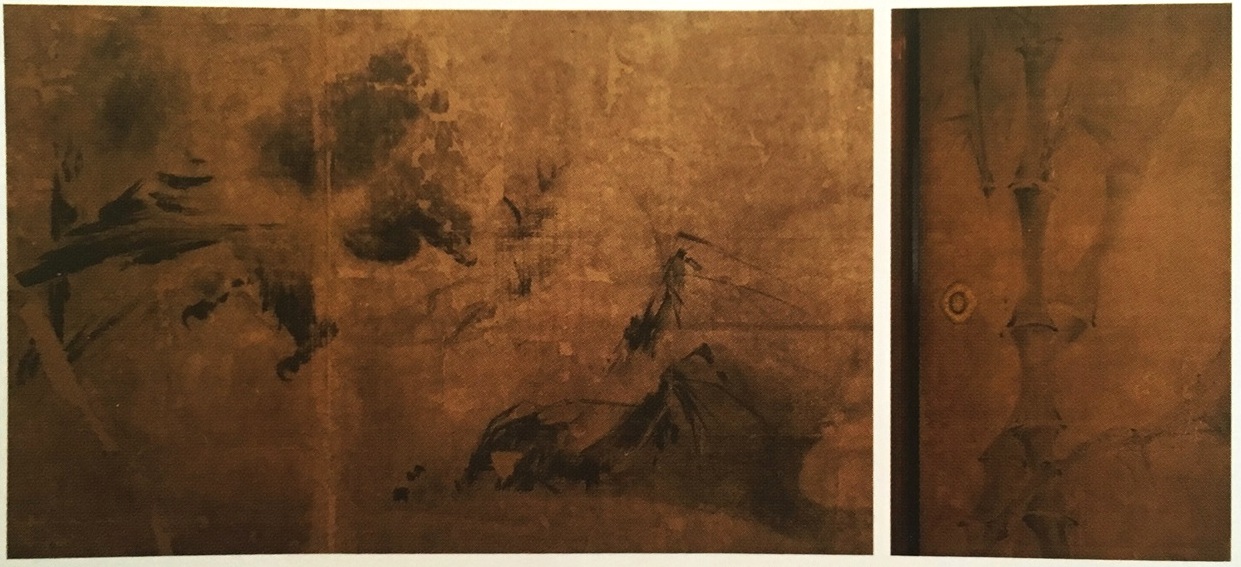
Faded brownish-ink painting on silk or paper showing a dark ink sketch of a bird with outspread wing at left, a few dark wash shapes and a figure-like form at center, and an overall pale, mottled background. At right is a separate panel with a vertical bamboo stalk and leaves in dark ink on a pale ground, with a small circular seal mark.Painting

Primary source

Eagles with Bamboo Forest

Miyamoto Musashi · Unknown date

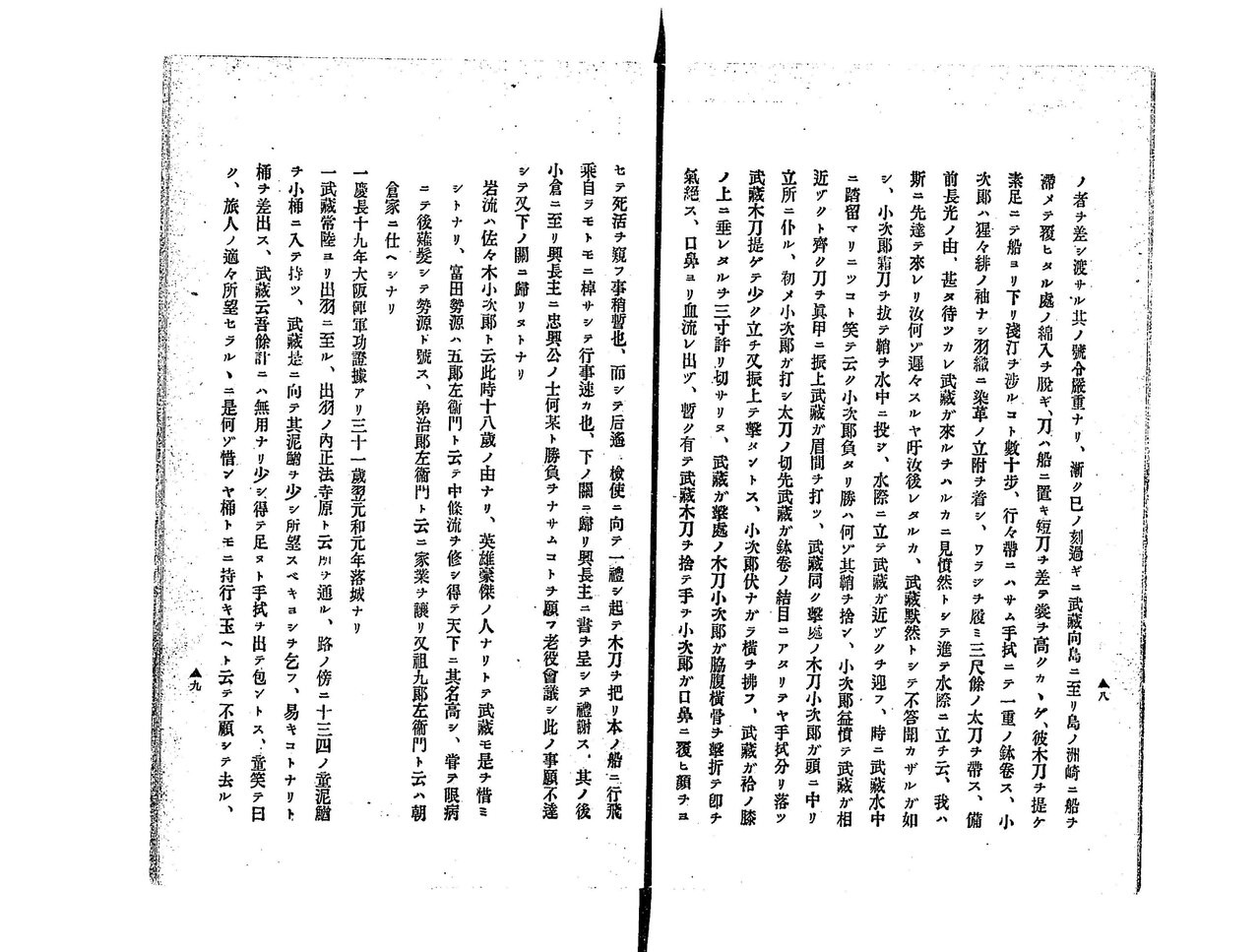
Two facing pages of a printed Japanese book in vertical columns of black text on white paper, with a black binding shadow down the center. Page numbers 八 and 九 appear at the outer edges, and the text has small annotation-style characters in the margins.Book

Secondary source

Nito Ichi-ryu Kendo Hiyo

Miyamoto Musashi; annotated by Mitsuhashi Kanichiro

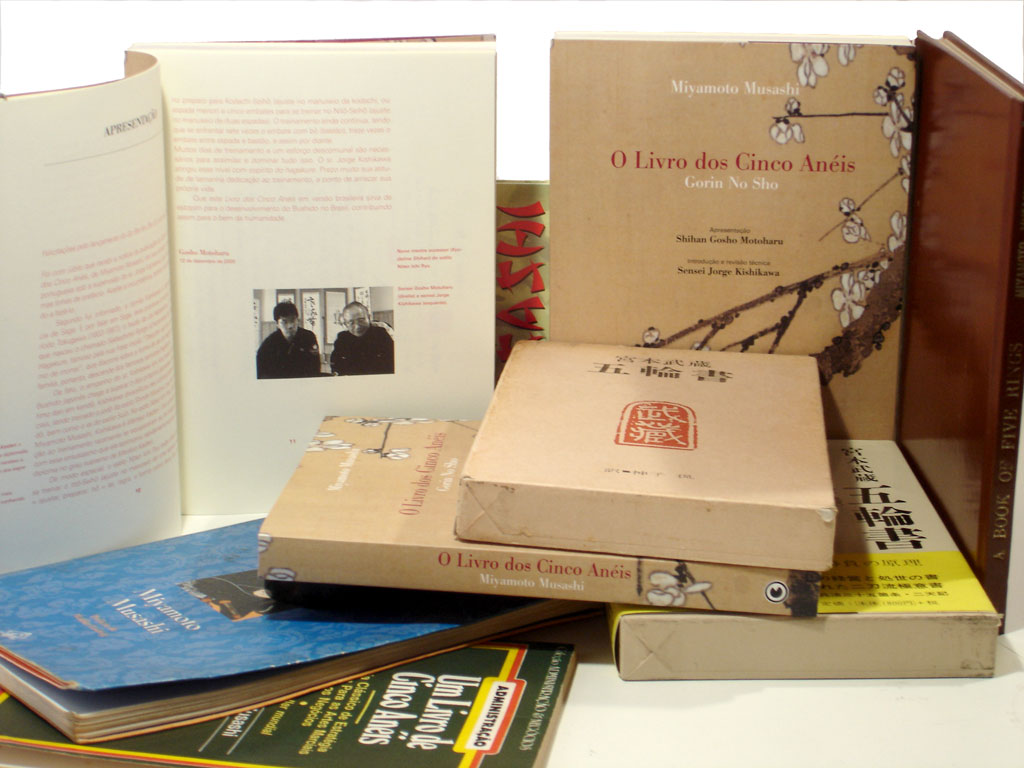
A stack of several editions of the Book of Five Rings on a white background. Front cover reads 'O Livro dos Cinco Anéis' by Miyamoto Musashi with a floral branch design; a boxed edition with red seal; a blue-covered book titled 'Miyamoto Musashi'; an open book showing Portuguese text and two photographed men; and a spine reading 'A Book of Five Rings'.Book

Primary source

Editions of The Book of Five Rings

Miyamoto Musashi · 2007 (photograph of editions)

Colour woodblock print of a samurai in patterned blue-and-white hakama and dark robe, holding a round mirror-like object to an old bald monk in a yellow robe beside a weeping willow. Red cartouche with Japanese text at top, and two seated figures watch at left.Painting

Secondary source

Musashi in Thirty-six Famous Battles

Utagawa Kuniyoshi

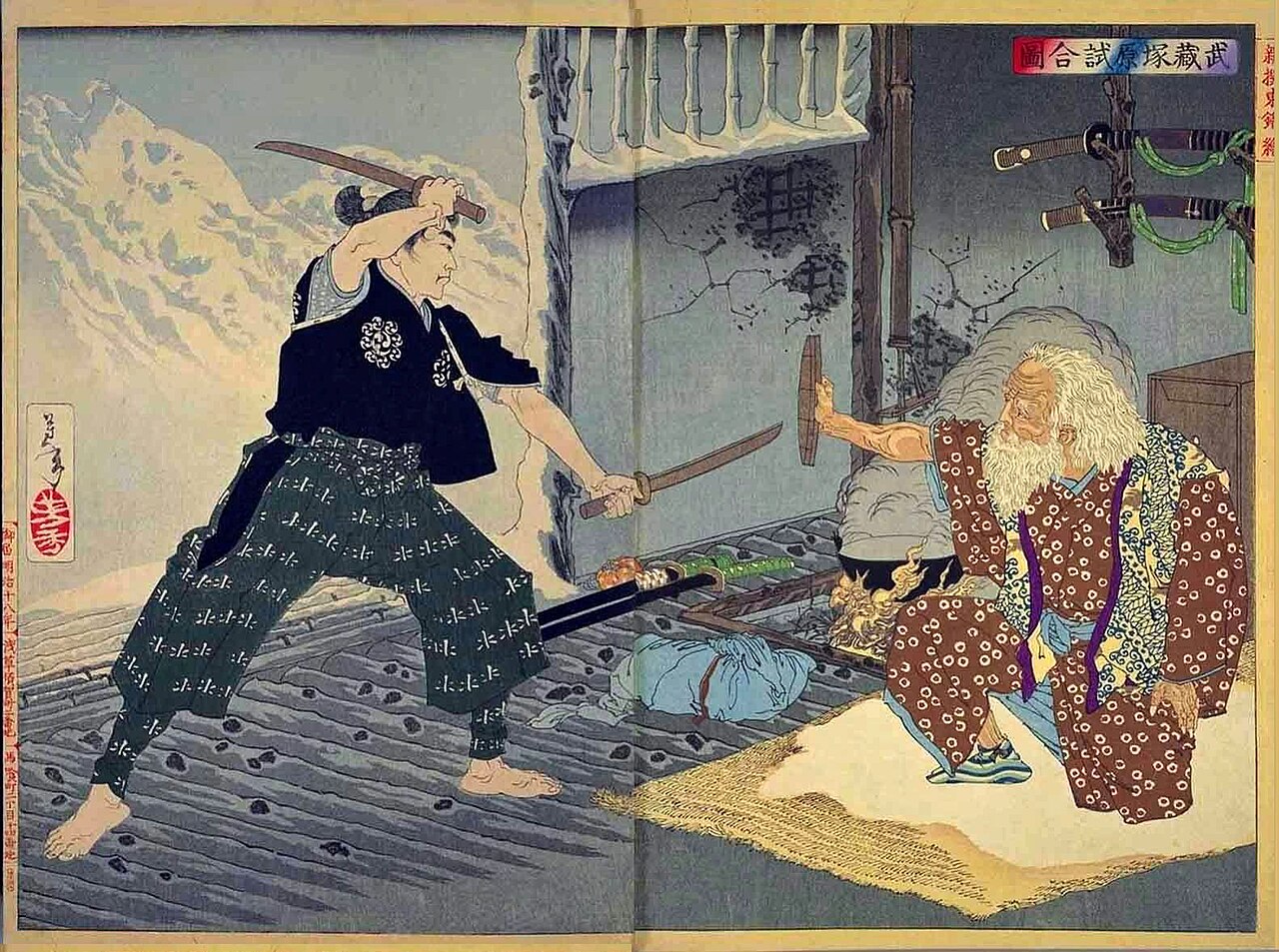
Colour woodblock print of a samurai in dark patterned hakama holding a raised sword in a snowy courtyard, facing an elderly bearded man seated on a straw mat who holds a wooden paddle; swords hang on the wall and a stone and bundle lie on the ground. Mountains are in the background. Japanese title cartouche at upper right.Painting

Secondary source

Musashi and Tsukahara Bokuden

Yoshitoshi · Meiji period

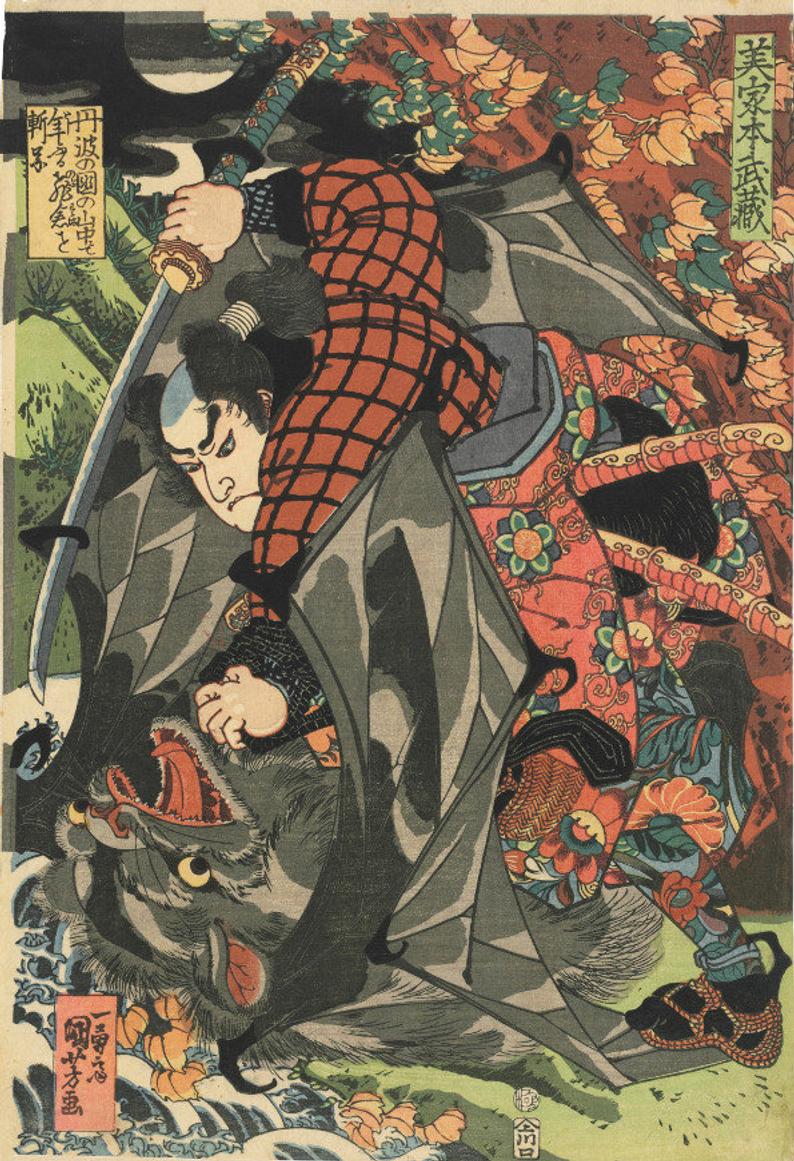
Woodblock print of a samurai in a red checkered robe and patterned kimono, sword raised, fighting a huge gray bat with open fanged jaws. Green hillside, autumn-colored leaves, and a moon at top left. Japanese text labels along the edges.Painting

Secondary source

Musashi Kills a Giant Bat in Tanba

Utagawa Kuniyoshi · before 1861, Edo period

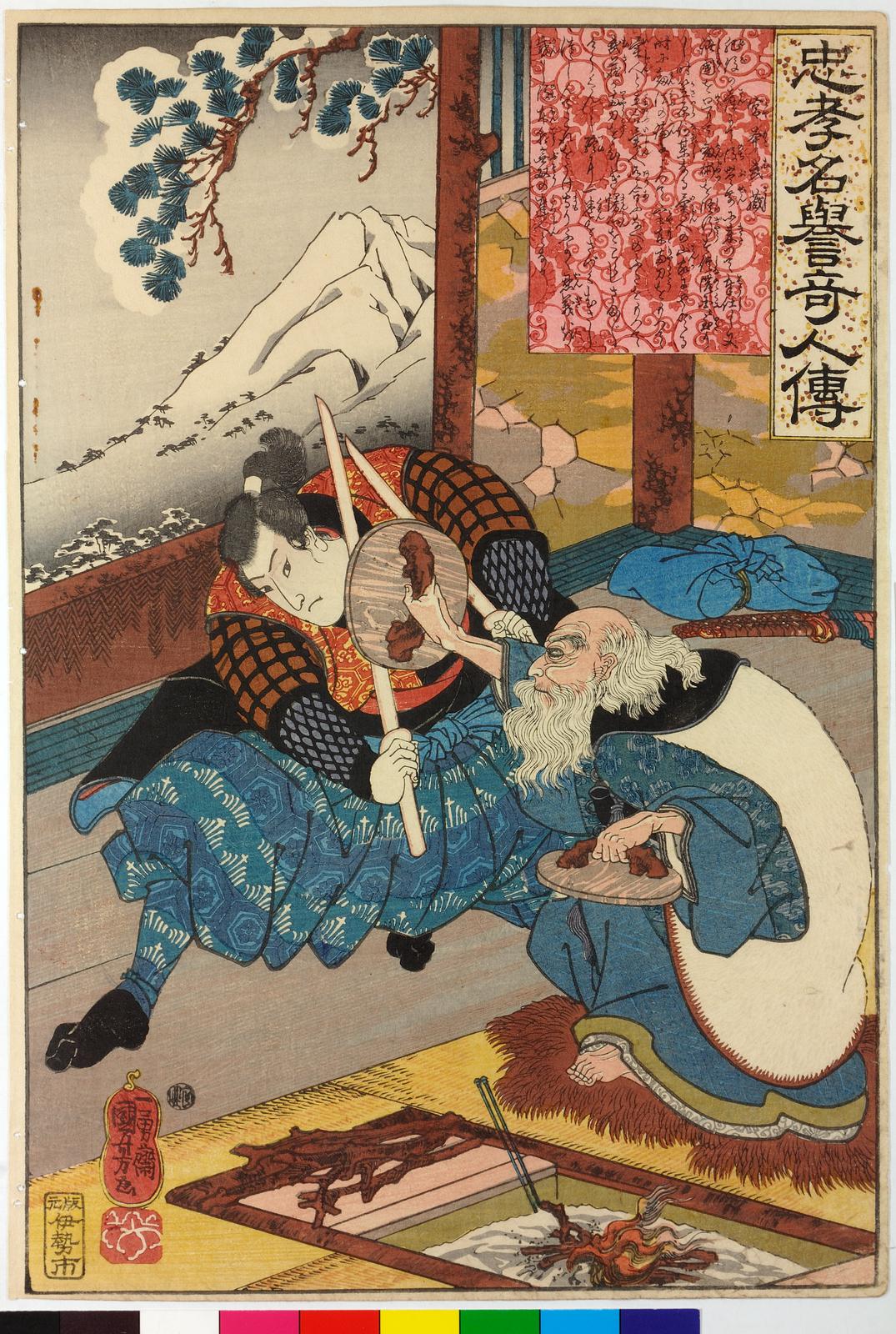
Japanese woodblock print in vertical format. A young samurai with a topknot, holding two long wooden swords, lunges toward an elderly bearded man in blue robes, who defends himself with a round wooden lid. A pine branch and snowy mountain appear at left; a blue bundle lies on the floor, and a red text panel with a title cartouche is at upper right.Painting

Secondary source

Musashi Sparring with Tsukahara Bokuden

Utagawa Kuniyoshi · between 1845 and 1846

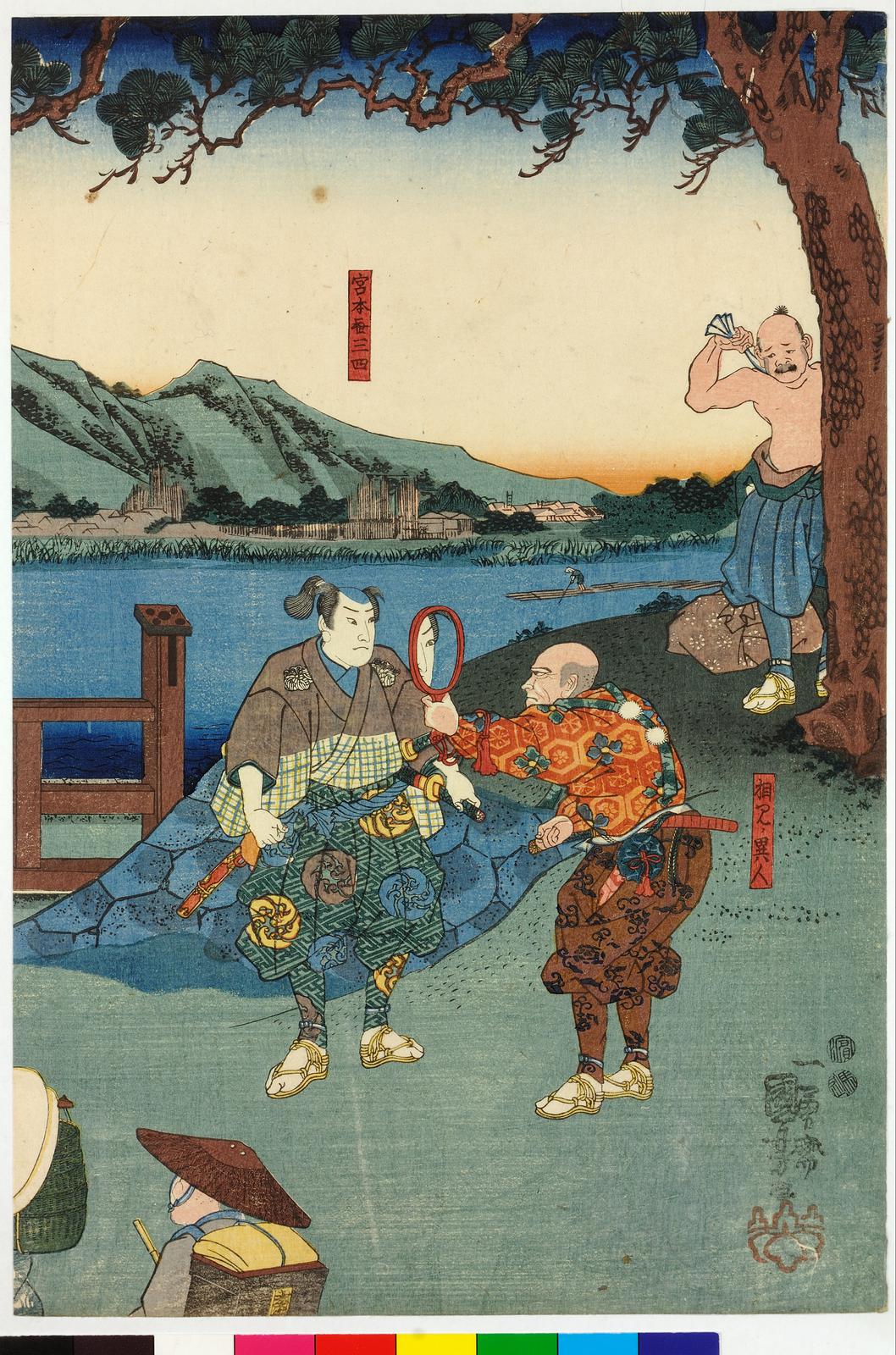
Colour woodblock print of a samurai with a topknot in a plaid-patterned kimono and green hakama, holding a sword, while a bald man in an orange patterned robe holds up a round red-framed mirror. A shirtless man in blue trousers stands by a pine tree, a traveller in a conical hat is at lower left, and a lake and mountains lie behind.Painting

Secondary source

Musashi at a Post-Station

Utagawa Kuniyoshi · mid-19th century

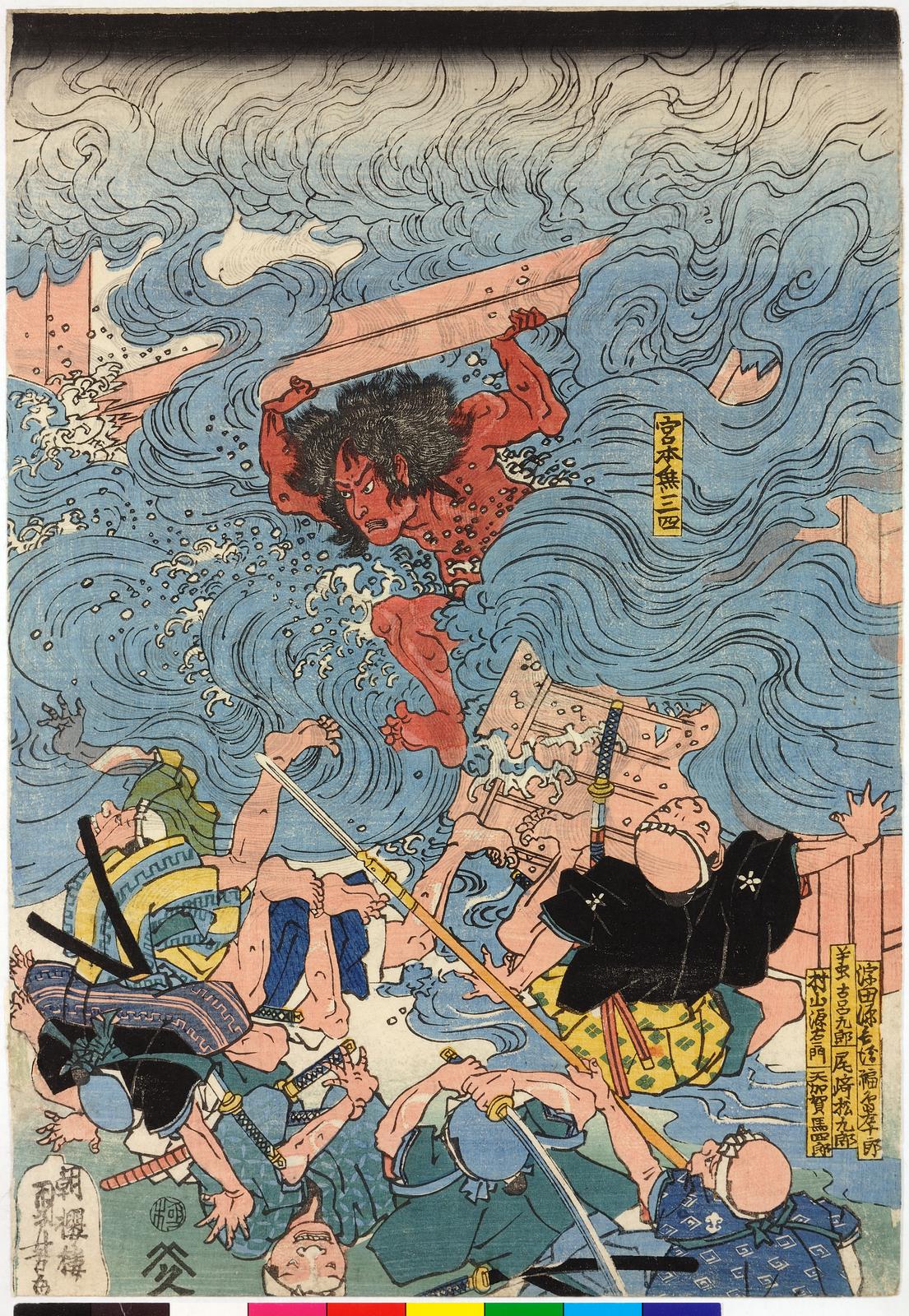
Colour woodblock print of a red-skinned, wild-haired man bursting upward through a broken wooden structure, holding a plank overhead. Wavy blue water and pink splintered wood surround him. Men in dark and patterned robes fall or struggle below, some drawing swords. A vertical title cartouche and signature appear on the sheet.Painting

Secondary source

Miyamoto Musashi Bursting from the Bath-House

Utagawa Kuniyoshi · mid-19th century

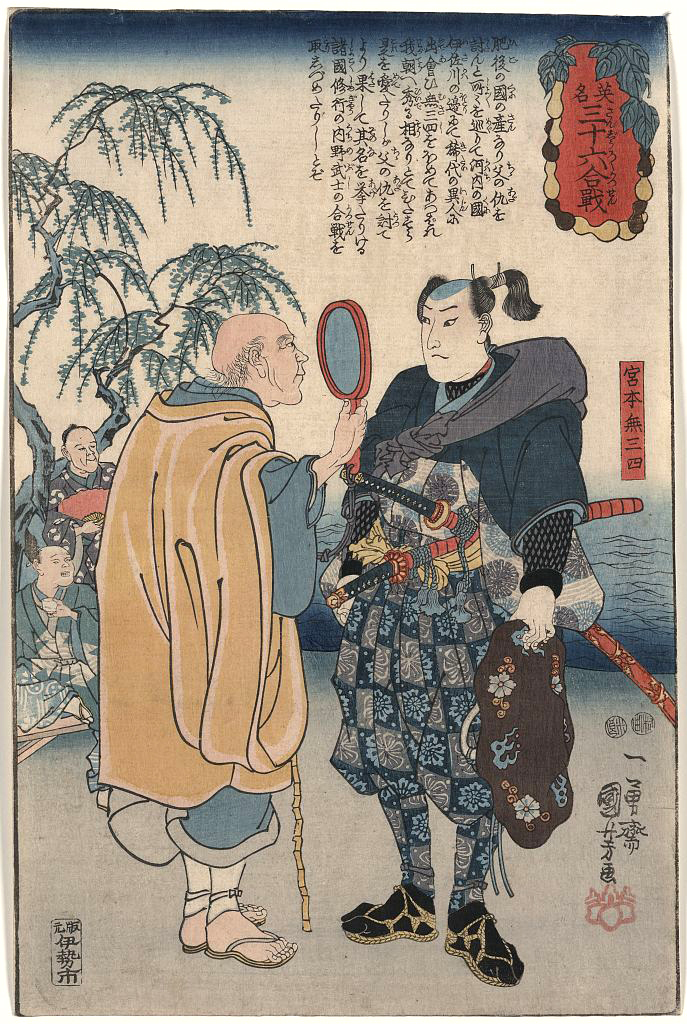
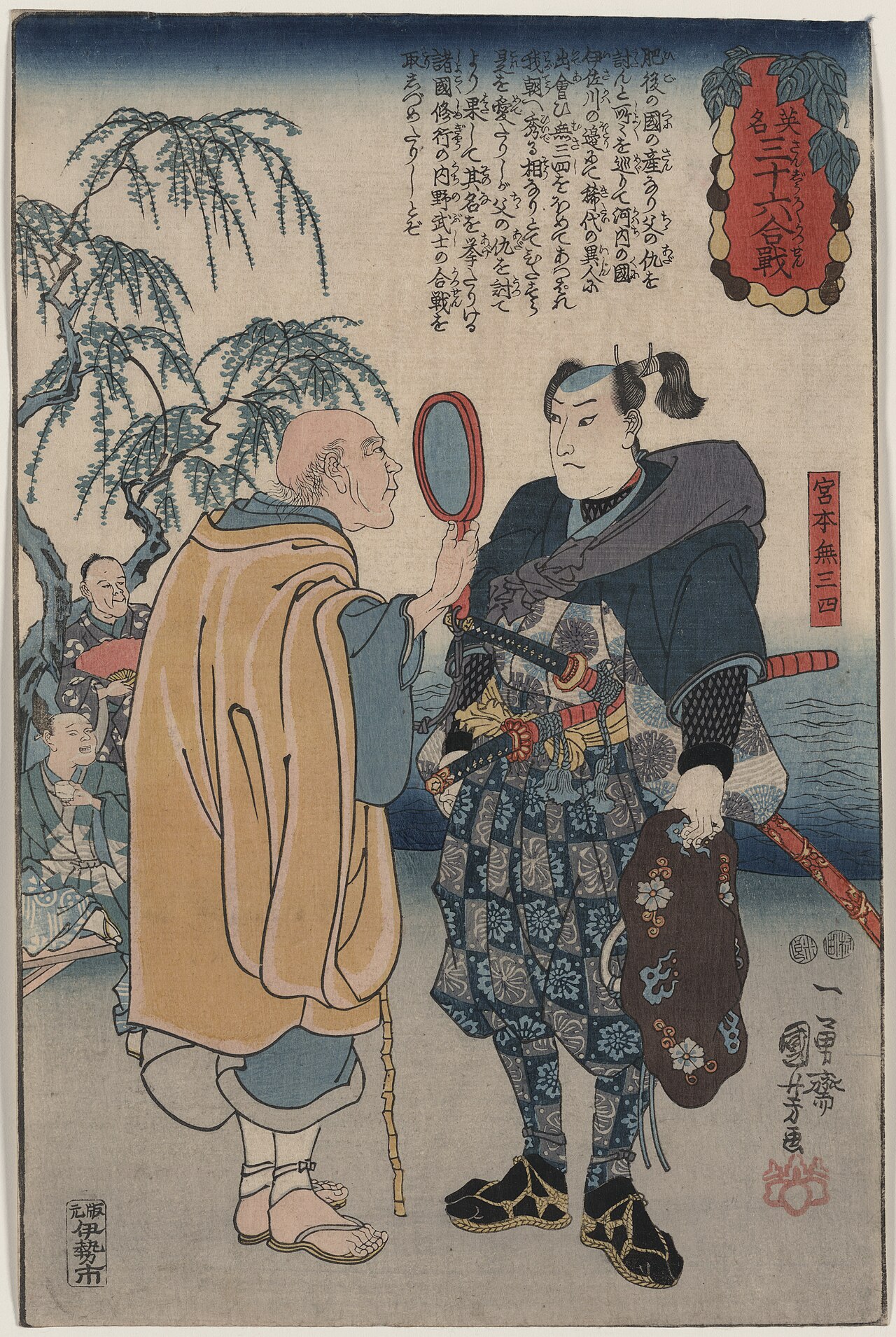
Woodcut print in color showing a samurai in a patterned blue kimono holding a round hand mirror, facing an elderly bald man in a yellow robe who holds a mirror up to his face beneath a weeping willow. Two seated onlookers are at left, and a Japanese title cartouche and inscription column appear at top right. Water is visible behind the samurai.Painting

Secondary source

Miyamoto Musashi and the Magnifying Glass

Utagawa Kuniyoshi · 1847

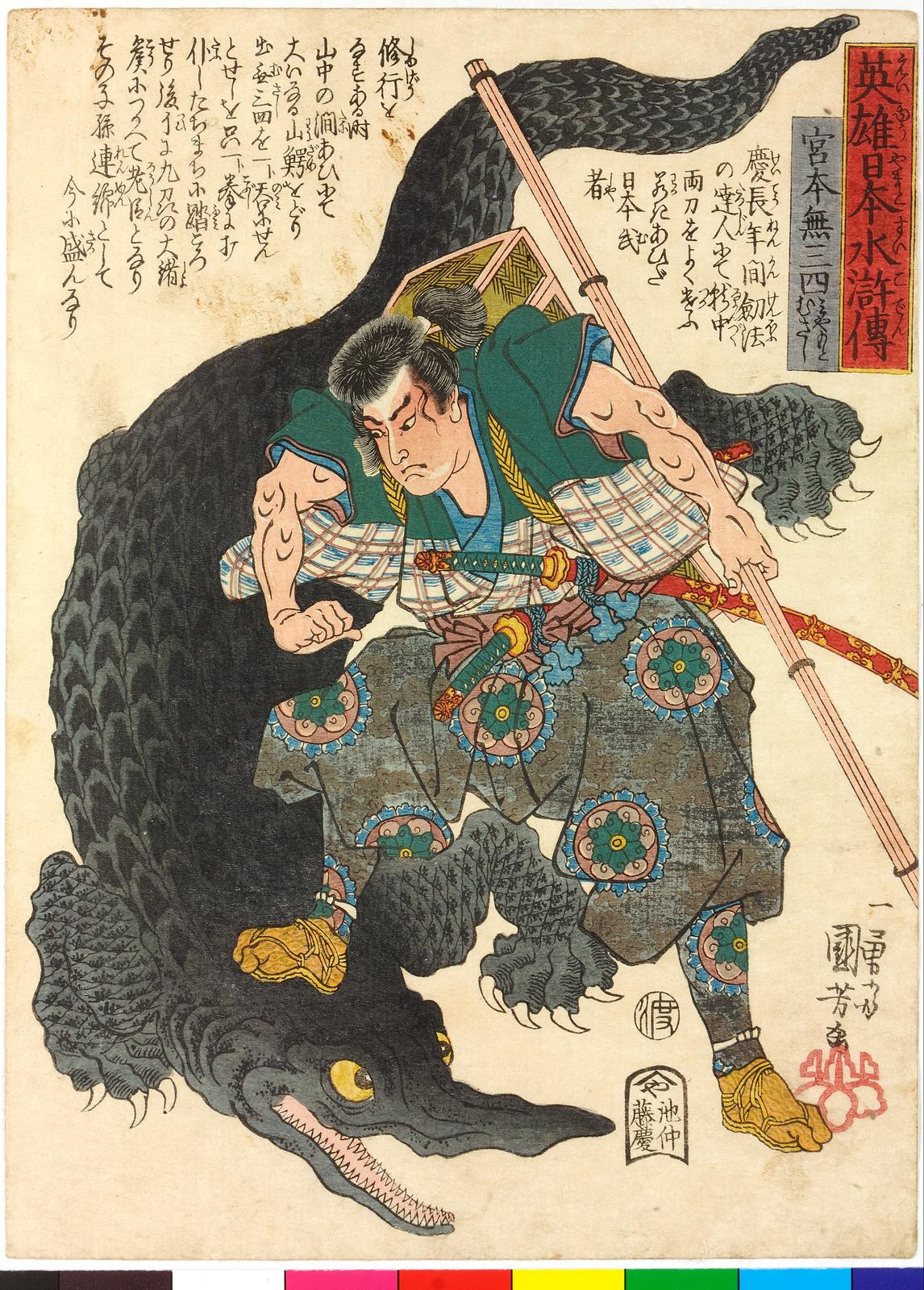
Japanese woodblock print of a samurai in a green jacket and patterned trousers, stepping on the head of a large dark scaly yamazame creature with claws and a toothed snout. Japanese text fills the upper left and center, with red and gray title cartouches at top right.Painting

Secondary source

Miyamoto Musashi Stepping on a Yamazame

Utagawa Kuniyoshi · c. 1843

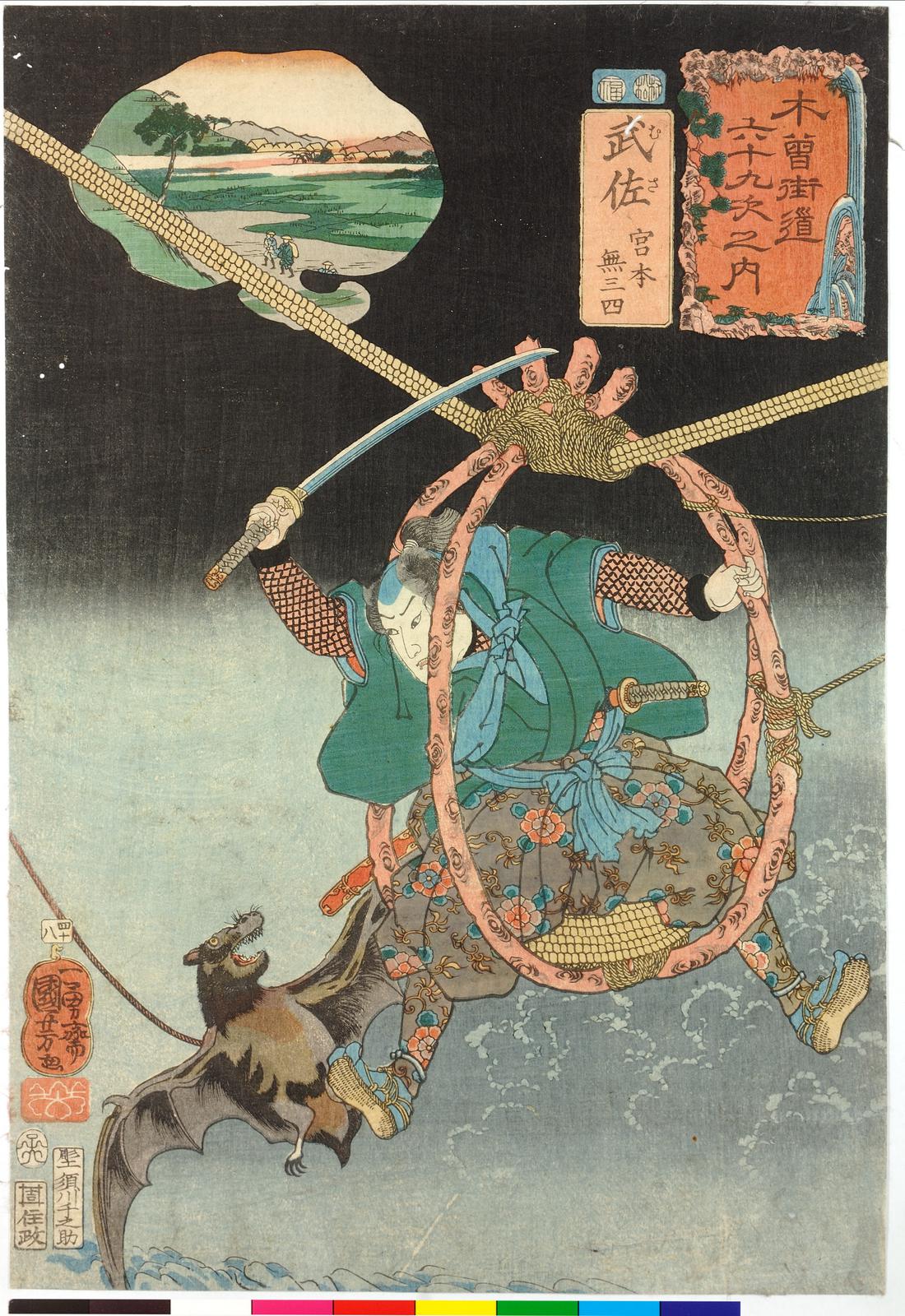
Colour woodblock print of a samurai in a green kimono and patterned trousers, holding a raised sword while suspended in a round rope cage on cables. A large snarling bat with spread wings attacks from below. A vignette at top left shows travelers on a path by a river. Title cartouche at top right, with Japanese text and a seal at lower left.Painting

Secondary source

No. 48 Musa Station: Musashi and the Giant Bat

Utagawa Kuniyoshi · 1852

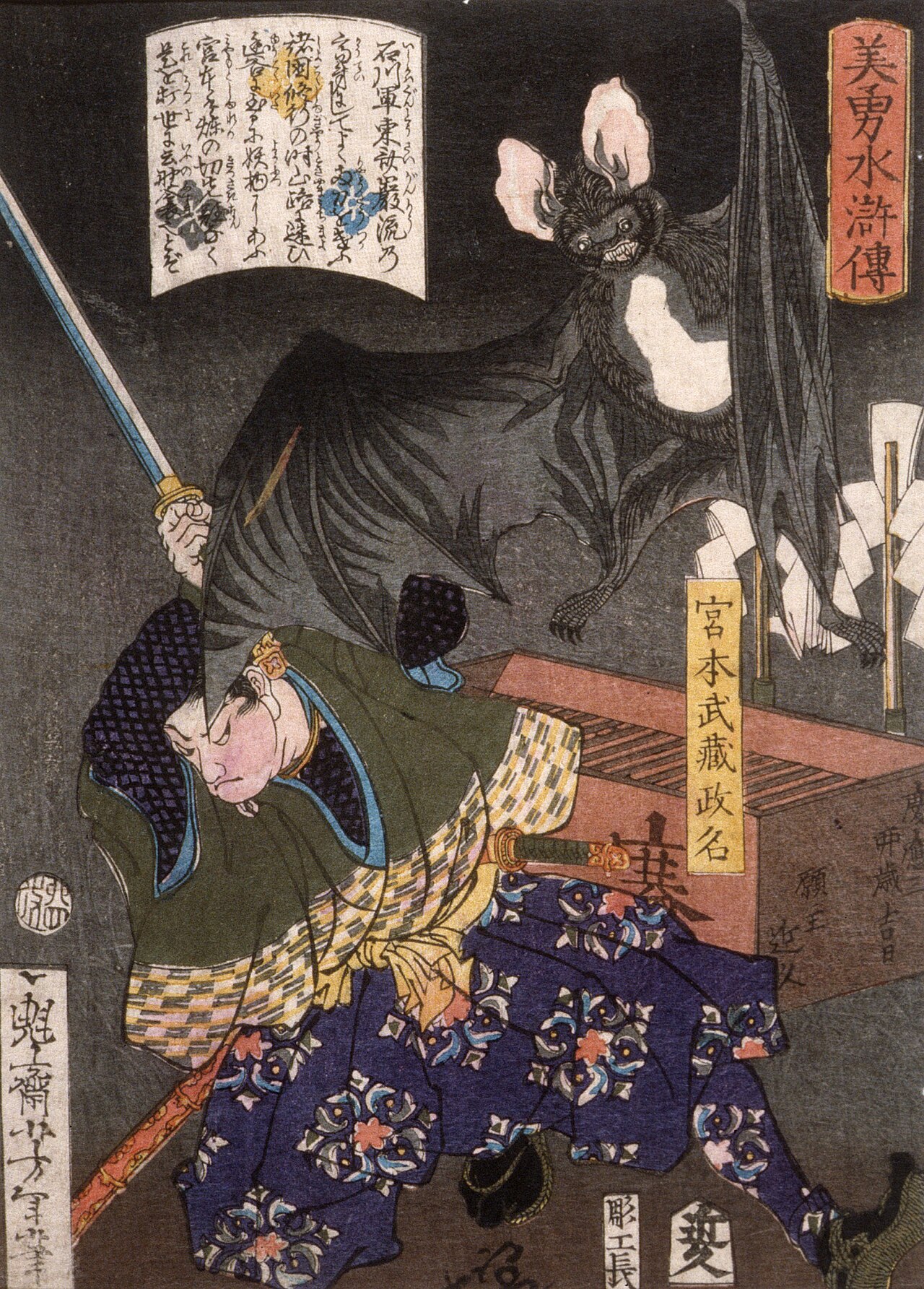
Color woodblock print showing a samurai in a green robe and blue patterned hakama, holding a drawn sword overhead and facing left with a fierce expression, while a large black bat with bared teeth swoops above him. A paper poem sheet hangs at top left, a vertical title cartouche reads Beauty and Valor in the Suikoden at top right, and a wooden box with a carved sign stands at right beside paper streamers.Painting

Secondary source

Miyamoto Musashi Slashing a Bat

Tsukioka Yoshitoshi · April 1867

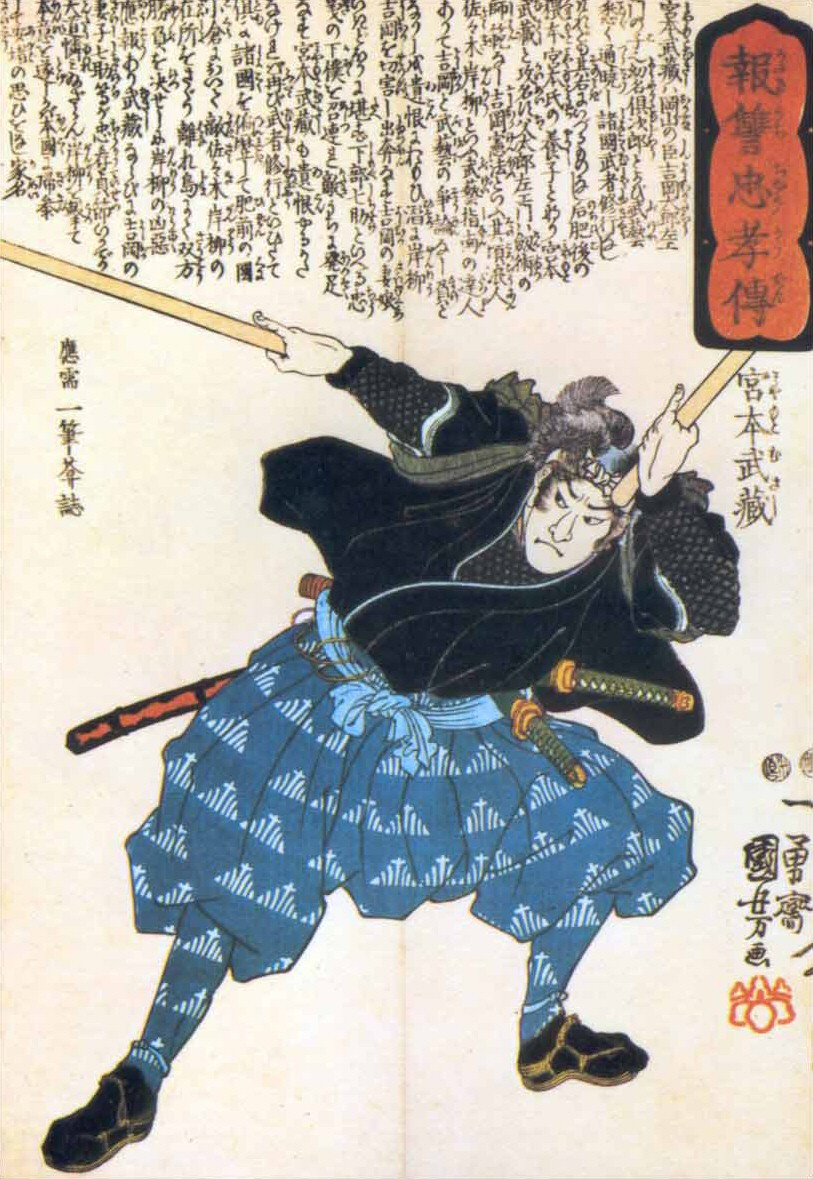
Colour Japanese woodblock print of a standing samurai in dark robes and blue patterned hakama, holding a long wooden staff in each hand. Vertical columns of Japanese text fill the background, and a red title cartouche reads 報讐忠孝傳. The name 宮本武藏 appears beside the figure.Painting

Secondary source

Miyamoto Musashi with Two Wooden Swords

Unknown (colour revision uploaded by Alkivar)

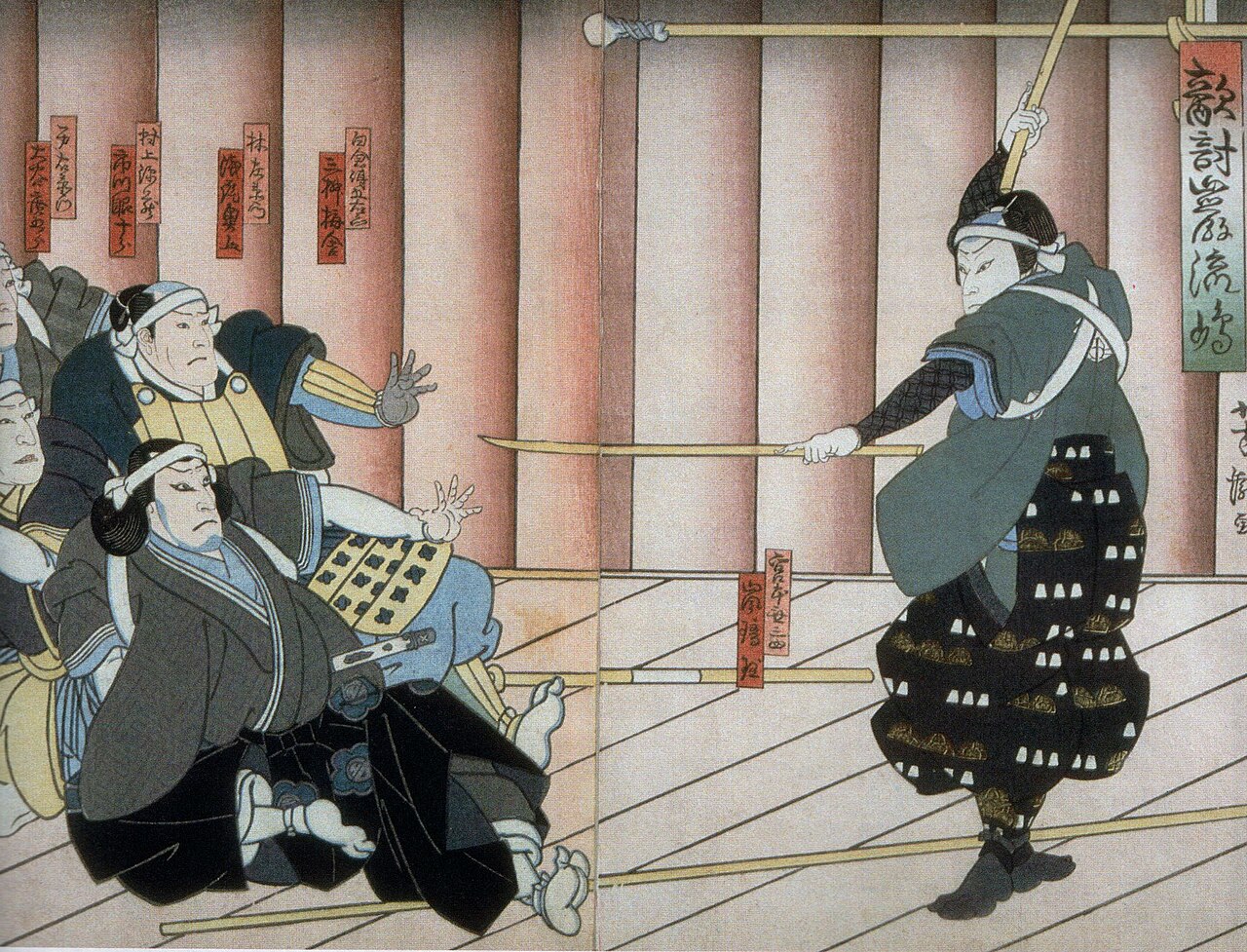
Colored woodblock print showing a standing samurai in a dark green kimono and patterned black hakama holding a long pole overhead and pointing a sword-like staff, facing seated and kneeling opponents in dark robes on a wooden floor, with red and cream vertical panels and a title cartouche at right.Painting

Secondary source

Miyamoto Musashi Print

Yoshitaki Tsunejiro · 1855

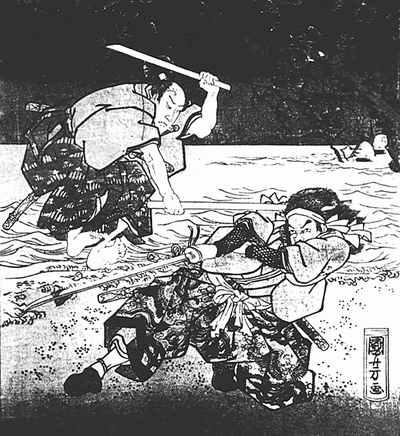
Black-and-white woodblock-style print of two samurai in combat beside water. The figure on the upper left raises a long sword overhead, and the figure at lower right lunges with a sword. A seal is in the lower right corner.Painting

Secondary source

Sasaki Kojiro vs Miyamoto Musashi

Unknown

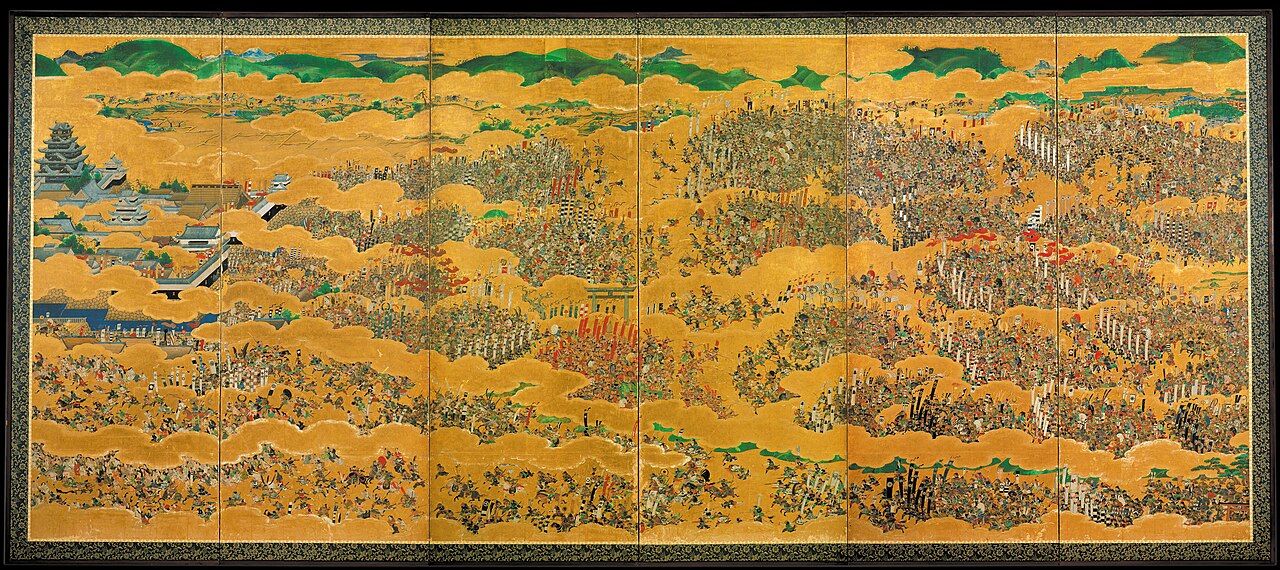
Six-panel gold-leaf folding screen showing a dense panoramic battle scene of the Siege of Osaka. Warriors in armor and banners fill a golden clouded landscape, with a castle with white walls and tiered roof at the left edge and green mountains at the top.Painting

Primary source

Summer Siege of Osaka Screen

Unknown (anonymous court painters) · 17th century

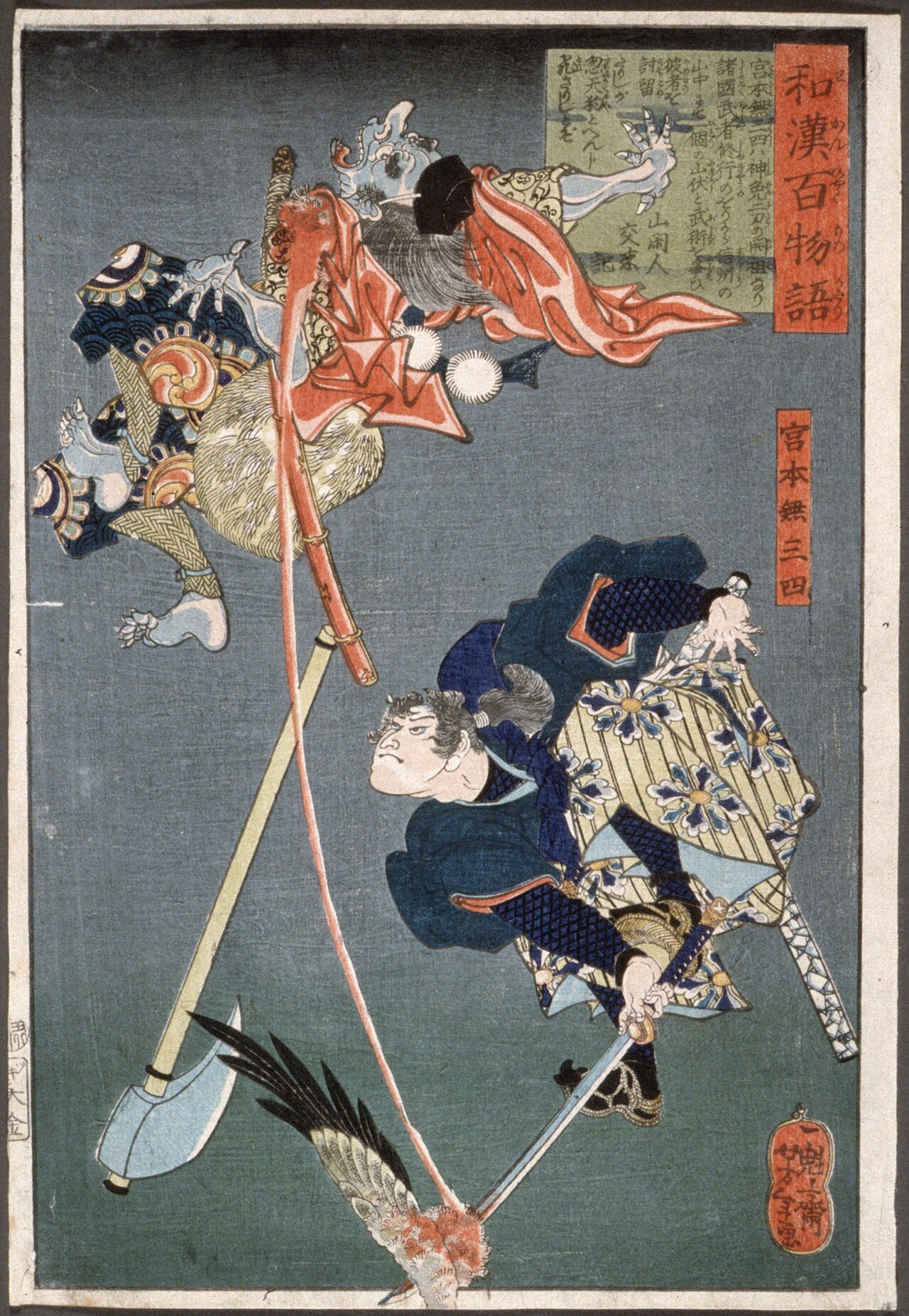
Colour woodblock print in a Japanese style. A samurai in a dark blue kimono with a patterned cream and blue haori, and hair tied in a topknot, slashes with a long sword at a red-faced tengu creature with a long nose and wings. The tengu's red robe billows above, and a sword-like weapon with a tassel lies across the scene. A tall staff with a blade lies diagonally at left. A cartouche of text and the signature appear at top right and bottom right, with a red seal near the bottom.Painting

Secondary source

Miyamoto Musashi Slashing a Tengu

Tsukioka Yoshitoshi · August 1865

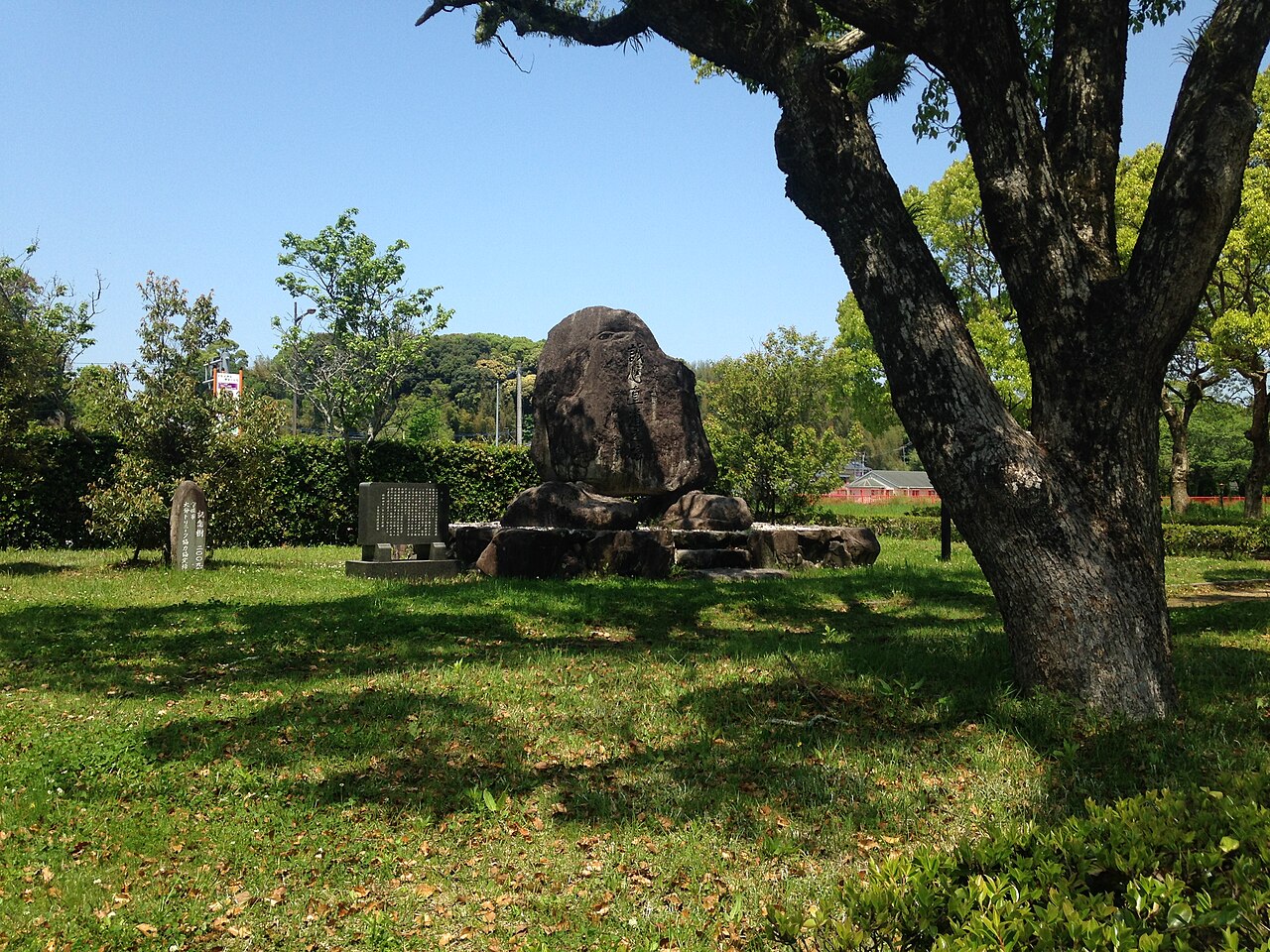
A large dark rounded stone monument with carved inscription stands on a stepped stone base in a grassy park. A tree with a thick trunk overhangs it on the right. A smaller stone marker and a dark plaque on a pedestal are to the left, with hedges and trees behind, under a clear blue sky.Sculpture

Secondary source

Stele of Miyamoto Musashi at Usa Shrine

Unknown

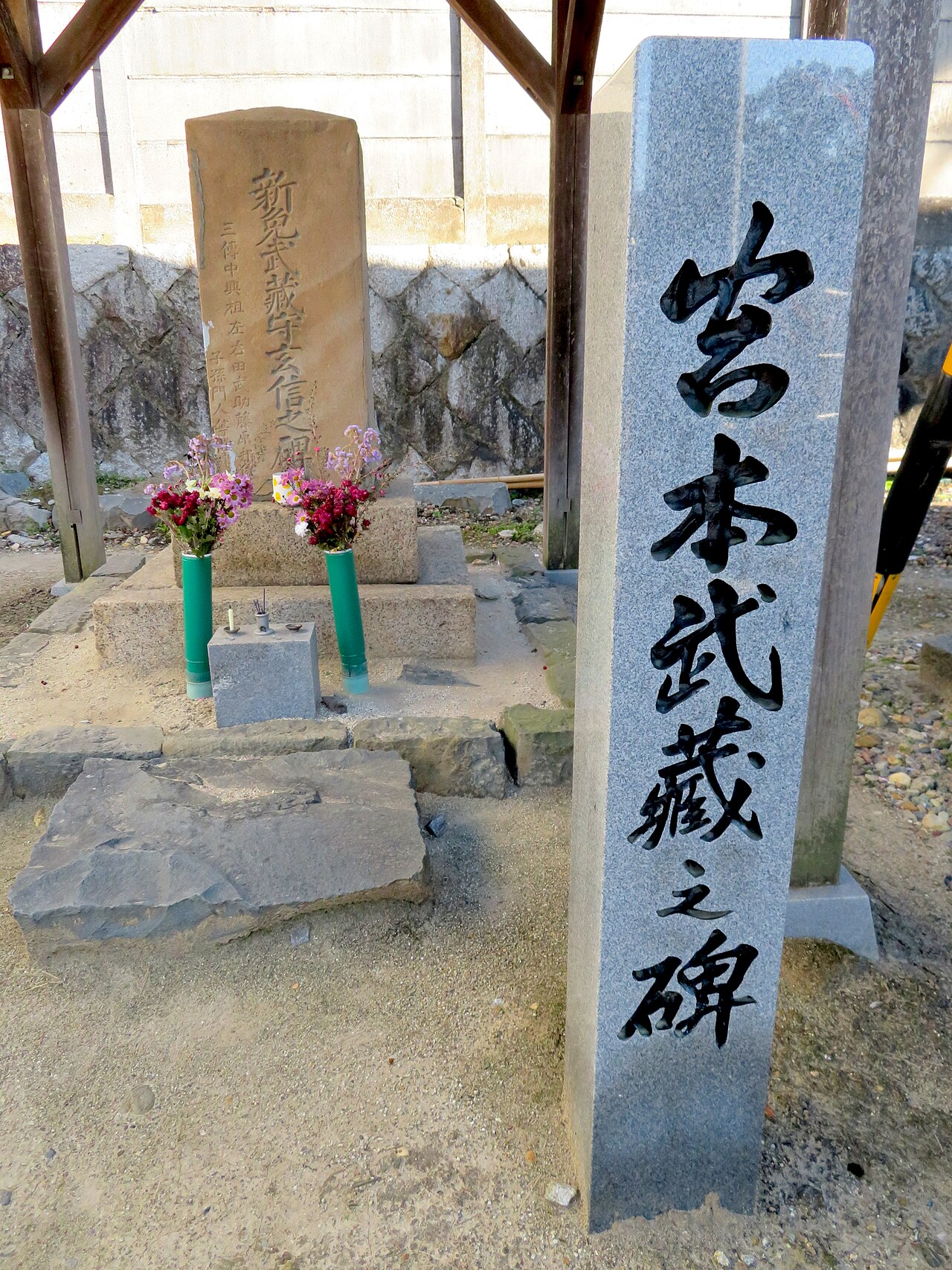
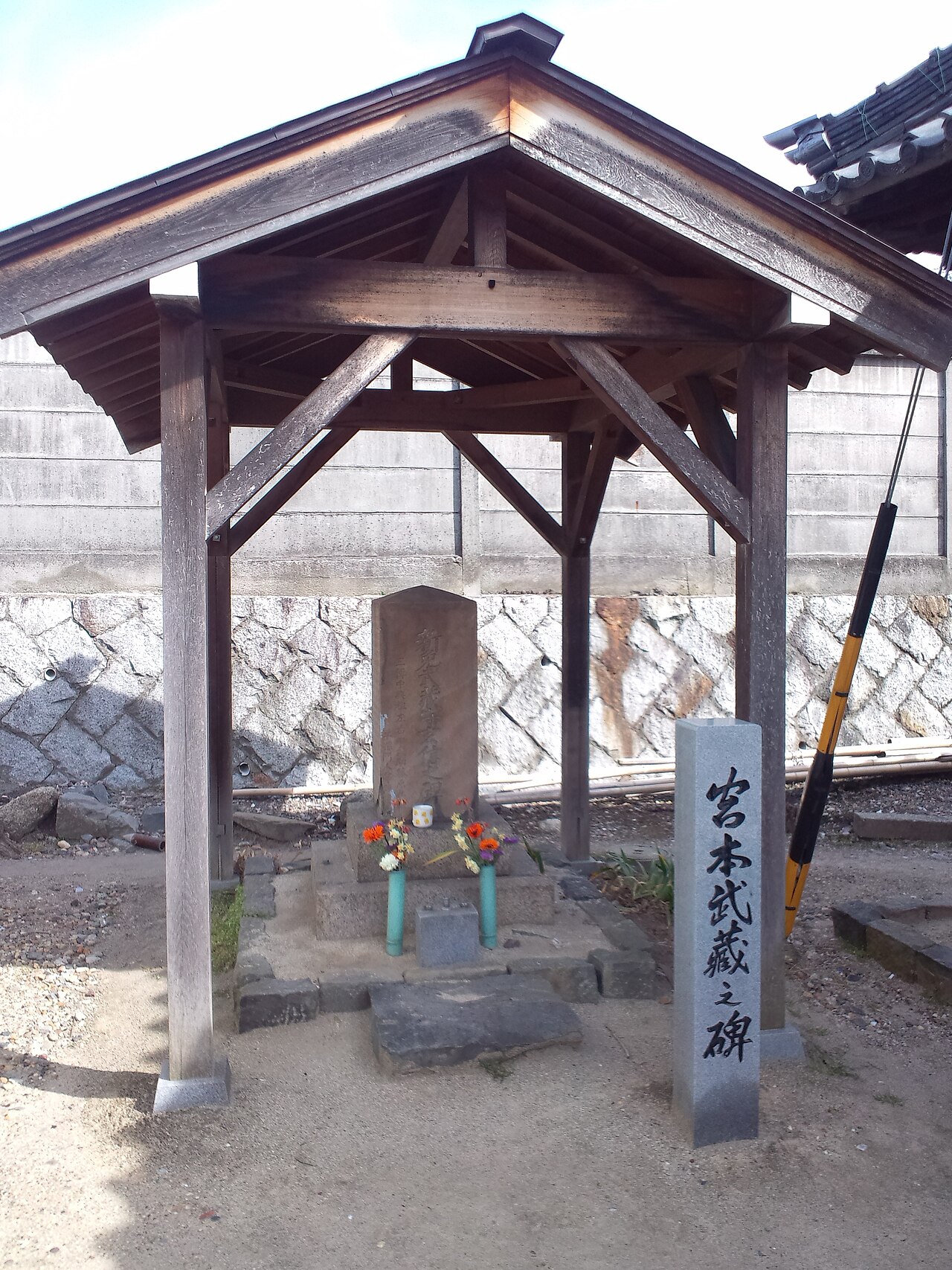
A tall grey granite monument with black carved Japanese characters reading 宮本武蔵之碑, standing in front of a older brown stone monument with carved text, two flower vases, and a small offering stand under a wooden roof.Sculpture

Secondary source

Stone Monument to Musashi at Kasadera Kannon

KKPCW · Photographed 2 February 2020

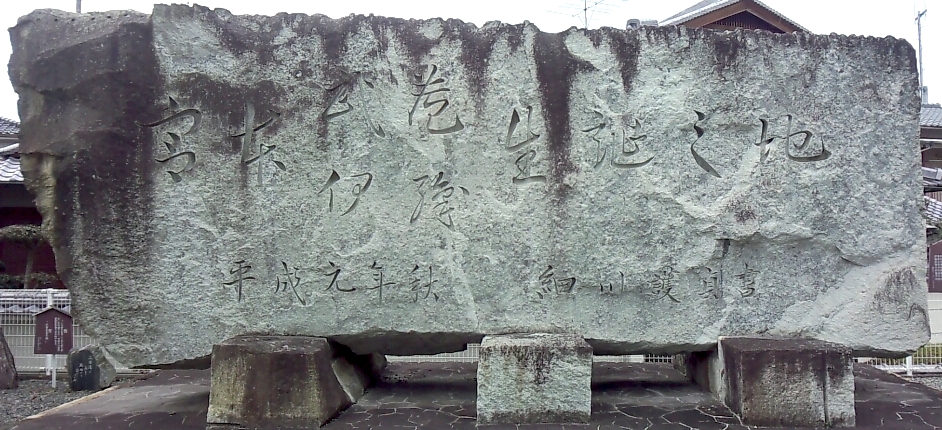
Large grey granite boulder-like memorial stone set on stone blocks, with incised Japanese characters reading 宮本武蔵・伊織の誕生地 and a smaller line reading 平成元年 建立 細川護熙 below. A small information plaque and a white fence are visible behind it.Sculpture

Secondary source

Musashi and Ikio Birth Memorial Stone

Bio06940 · Photographed 14 January 2014

A wooden roofed shelter over a stone monument with inscribed characters, flowers in green vases in front, and a tall granite marker beside it engraved with Japanese characters reading Miyamoto Musashi monument. A stone wall stands behind.Sculpture

Secondary source

Miyamoto Musashi Stone Monument, Ryūfuku-ji Temple

Yanajin33 · Photographed 17 March 2013

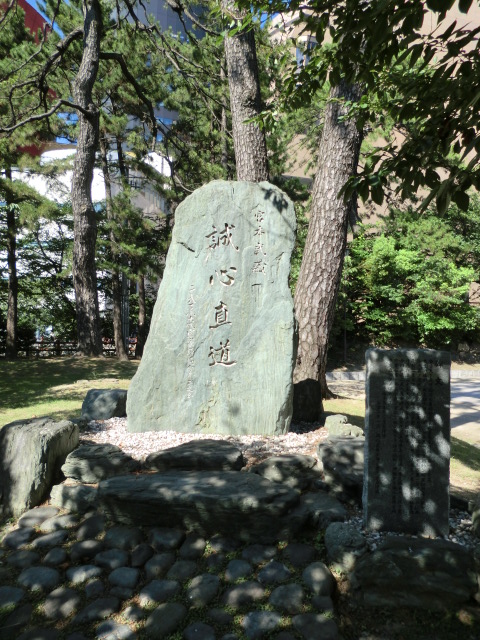
A tall, rounded green-grey stone monument with carved Japanese characters reading 誠心直道 stands on a bed of pale gravel in front of trees. A smaller dark stone tablet with inscriptions stands to the right, set on a cobbled stone base in a park setting.Sculpture

Secondary source

Monument at Kokura Castle Commemorating Nitō Ichiryū Succession

Nissy-KITAQ · Photographed 3 August 2006

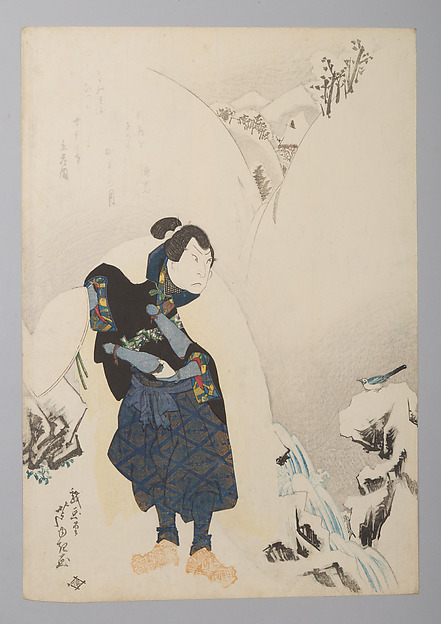
Japanese woodblock print of a kabuki actor in a dark kimono with patterned blue hakama, standing in snow beside a waterfall and a rock with a small bluebird; a pale mountain and bare tree in background, with calligraphy at upper left.Painting

Secondary source

Actor Arashi Rikan II as Miyamoto Musashi

Gigadō Ashiyuki · 1832

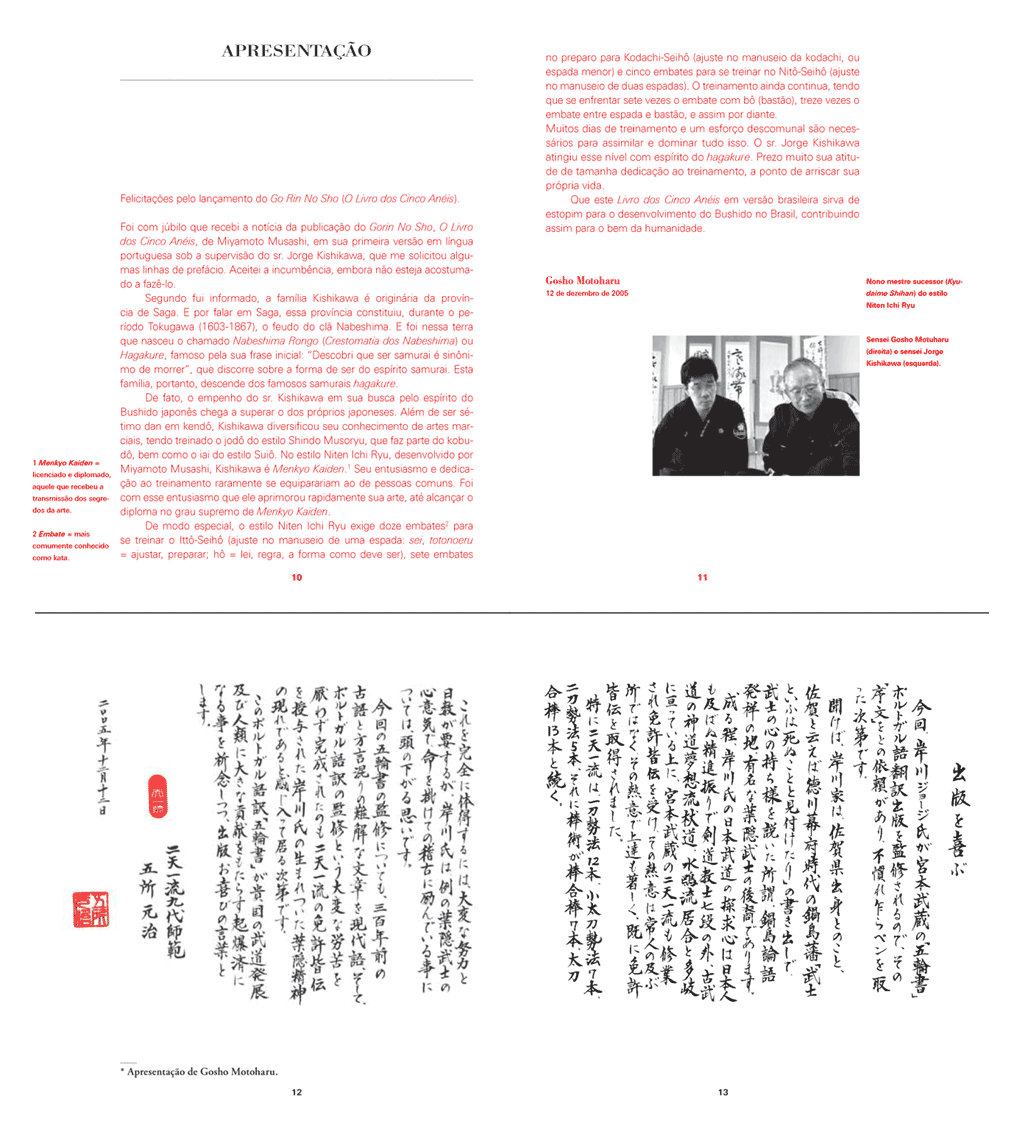
Two-page spread of a Portuguese-language presentation text titled APRESENTAÇÃO, with pages numbered 10 and 11 at top, featuring a photo of two men seated side by side and a signed note from Gosho Motoharu dated 12 de dezembro de 2005. Pages 12 and 13 below show a handwritten Japanese calligraphy text with red seal stamps, a signature, and a footnote reading Apresentação de Gosho Motoharu.Document

Secondary source

Presentation by Gosho Motoharu to Brazilian Edition of The Book of Five Rings

Gosho Motoharu · December 2005

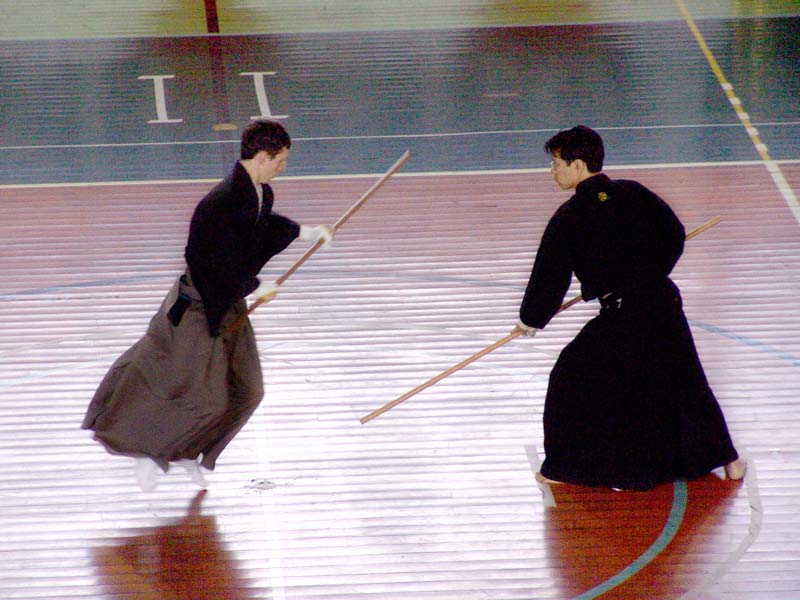
Two martial artists in black hakama-style uniforms face each other on a wooden gymnasium floor, each holding a long wooden staff. The man on the left wears grey-brown hakama and white gloves; the man on the right wears black and white gloves. Lines and numbers mark the floor behind them.Photograph

Secondary source

Bojutsu Staff Technique of Niten Ichi Ryu

Instituto Niten · 9 December 2005

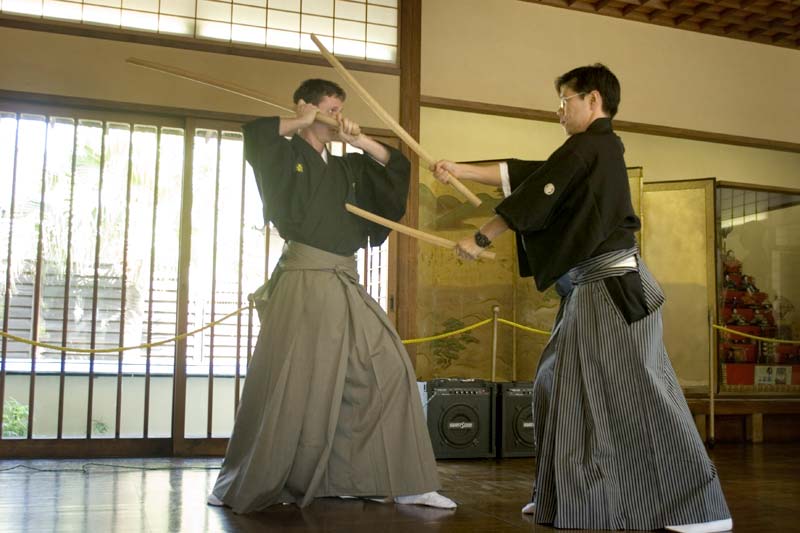
Two men in black kimono tops and pleated grey and striped hakama trousers face each other in a traditional Japanese room with wooden floors and paper-screen windows. Each holds wooden practice swords, and the left man holds two raised near his head.Photograph

Secondary source

Nito Seiho Two-Sword Technique of Niten Ichi Ryu

Instituto Niten · 24 April 2006

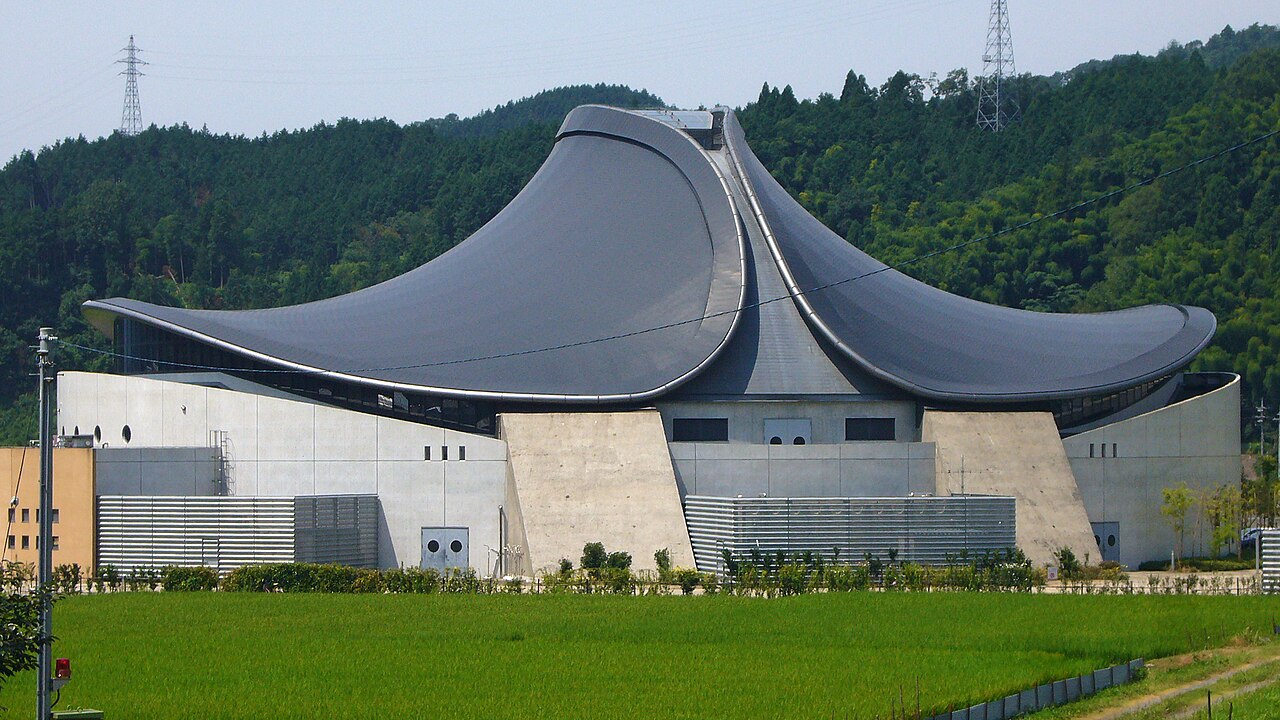
Exterior of the Musashi Budokan building in Mimasaka, Okayama: a large dark grey curved roof rises in two swooping peaks above pale concrete walls, set against a forested hillside, with green rice fields in the foreground under a clear sky.Photograph

Secondary source

Musashi Budokan Training Centre, Mimasaka

663highland · 12 August 2006

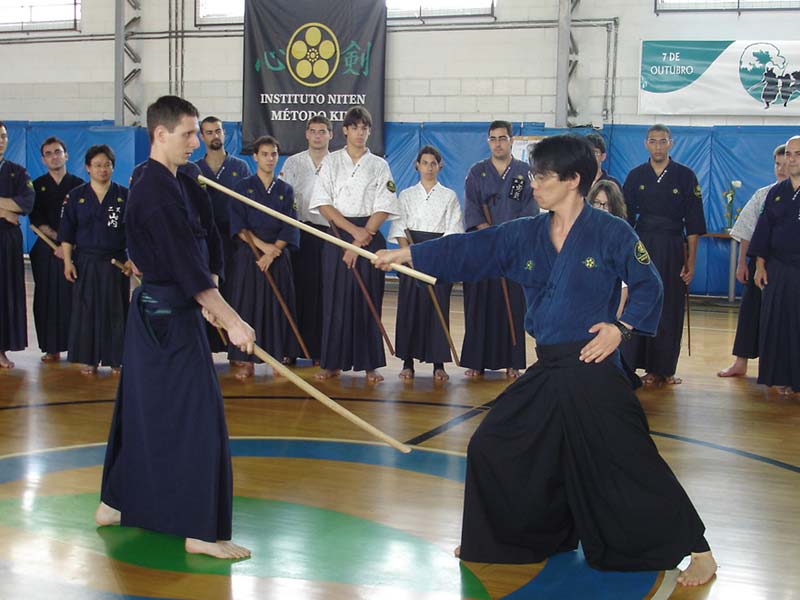
Two men in dark blue hakama and keikogi demonstrate a paired kendo-style sword form with long wooden bokken on a wooden gym floor. A man in a blue keikogi on the right holds his bokken extended toward the other. Behind them, a line of students in dark uniforms stands watching, and a banner reads Instituto Niten Metodo Kiai.Photograph

Secondary source

Sassen Kata, First Niten Ichi Ryu Form

Instituto Niten · 8 October 2006

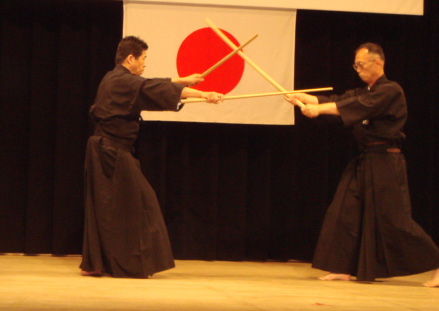
Two men in dark traditional hakama and kimono stand on a wooden stage, each holding a wooden sword (bokken) crossed in a demonstration of two-sword technique. A red sun disc on a white flag hangs behind them against a dark curtain.Photograph

Secondary source

Masters Demonstrating Hyoho Niten Ichi Ryu, Nito Seiho

Kendobr · December 2005

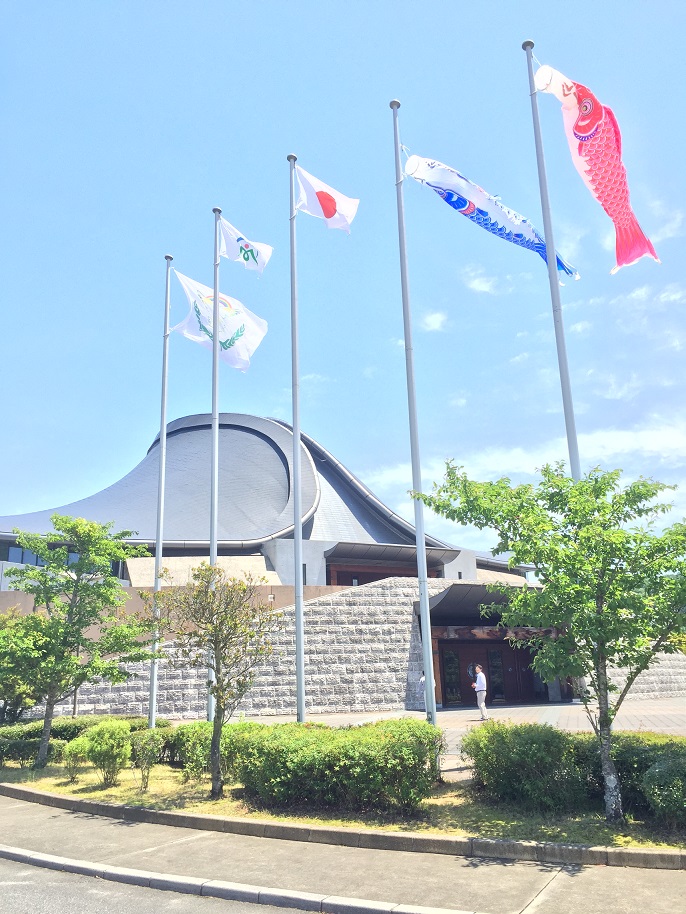
Exterior of the Budokan Miyamoto Musashi building with a curved gray roof and stone-faced base, under a clear blue sky. Several flagpoles fly white flags and two koinobori carp streamers, with green shrubs and trees in front.Photograph

Secondary source

Budokan Miyamoto Musashi, Mimasaka

Memoria33 · 19 May 2015

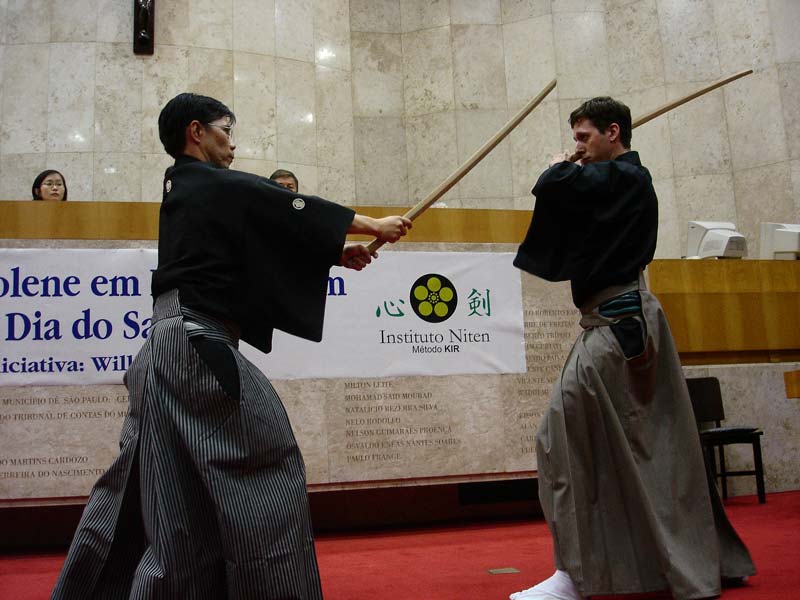
Two men in black kimono-style jackets and striped or grey hakama trousers face each other on a red carpet, each holding a long wooden sword (bokken) raised in a guard, in front of a white banner reading Instituto Niten, Método KIR. A woman and another person watch from behind a wood railing.Photograph

Secondary source

Tachi Seiho Technique of Niten Ichi Ryu

Instituto Niten · 24 April 2006

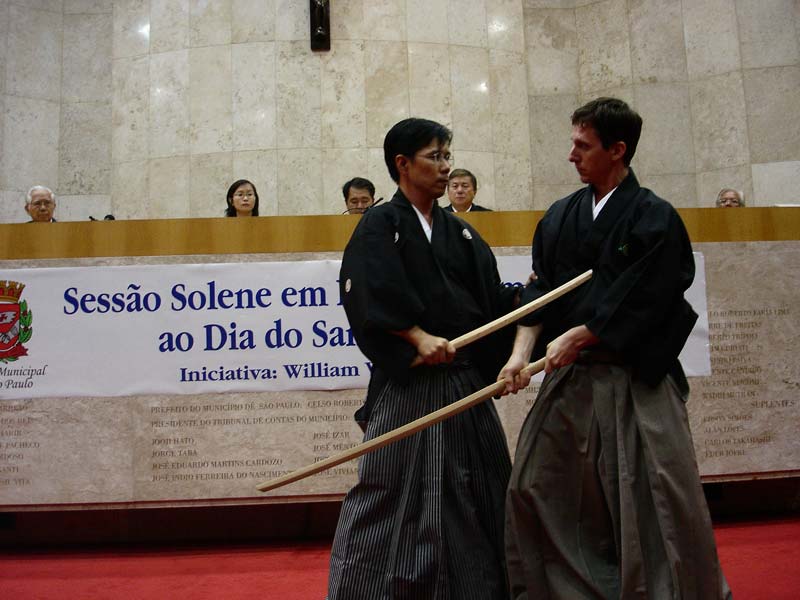
Two men in dark martial arts hakama and kimono stand facing each other on a red carpet, each holding a wooden sword (bokken) in a pose of technique. Behind them is a stone-walled hall with a white banner reading 'Sessão Solene em ... ao Dia do Sa...' and 'Iniciativa: William...', with rows of names engraved on a wall and spectators seated in the background.Photograph

Secondary source

Kodachi Seiho Technique of Niten Ichi Ryu

Instituto Niten · 24 April 2006

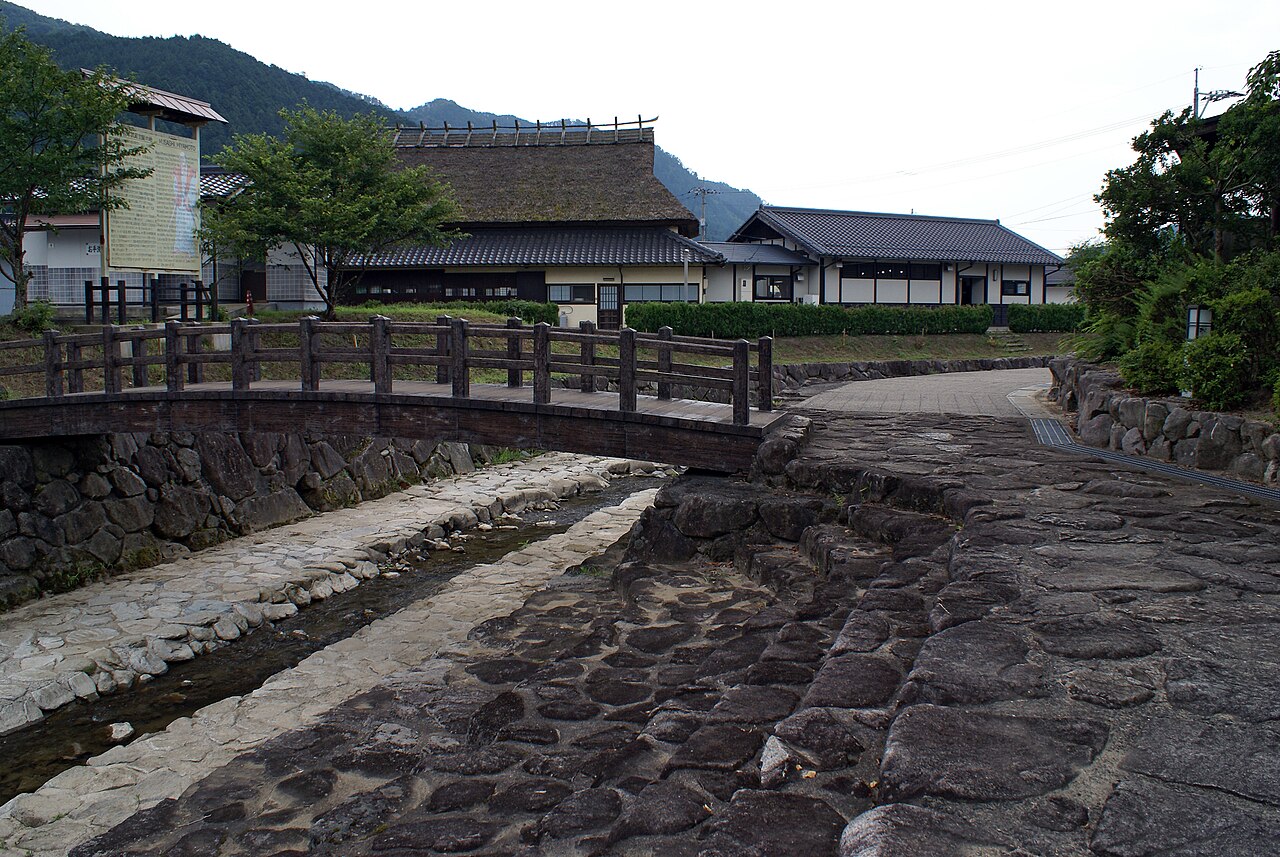
A wooden footbridge with dark railings crosses a shallow stream lined with stone on the left and a paved stone path on the right. Behind is a thatched-roof traditional Japanese building with white walls, next to a tiled-roof structure, with green trees and forested hills behind.Photograph

Secondary source

Musashi-no-sato Gorinbo Heritage Site

663highland · 12 August 2006

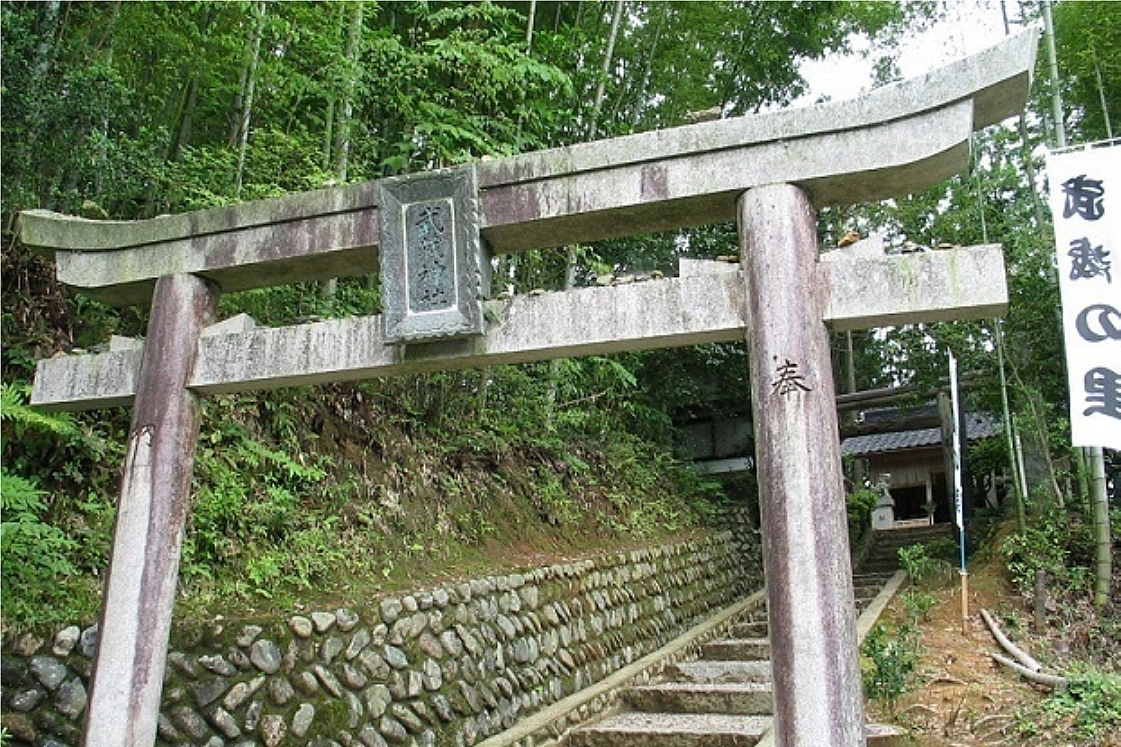
A weathered stone torii gate stands at the top of a stone-paved staircase flanked by a rough stone retaining wall. A plaque with carved characters is set on the gate's crossbeam. Dense green bamboo and trees surround it, and a white banner with black Japanese characters hangs at the right. Further up, a small wooden building with a tiled roof is partly visible.Photograph

Secondary source

Temple of Miyamoto Musashi Near His Grave

Fildazur · 4 March 1999

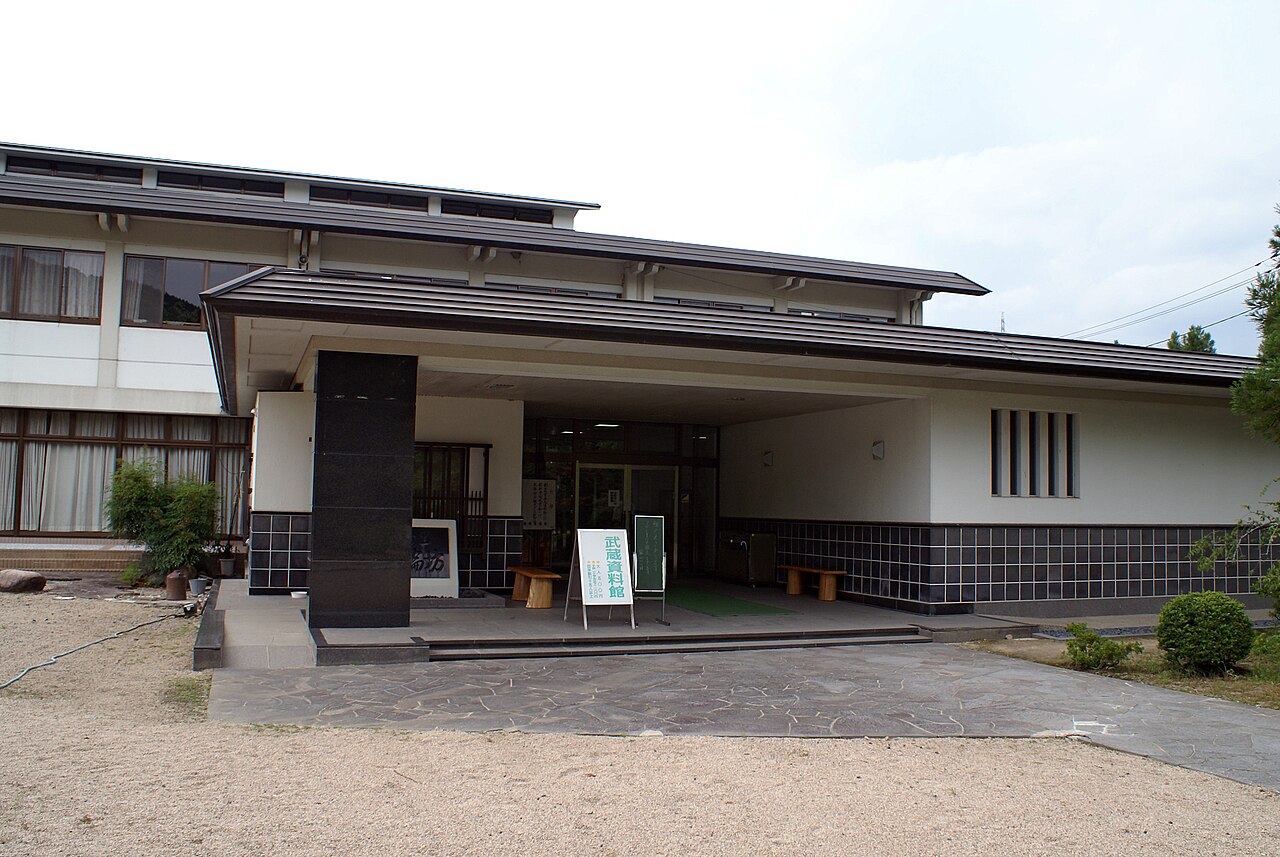
Front view of a low, modern single-storey museum building with dark tiled roof edges, white walls and dark tiled base, a black stone pillar at the entrance, and a green sandwich board sign with Japanese text. Gravel and paved approach in front, trees at right.Photograph

Secondary source

Musashi Museum at Musashi-no-sato Gorinbo

663highland · 12 August 2006

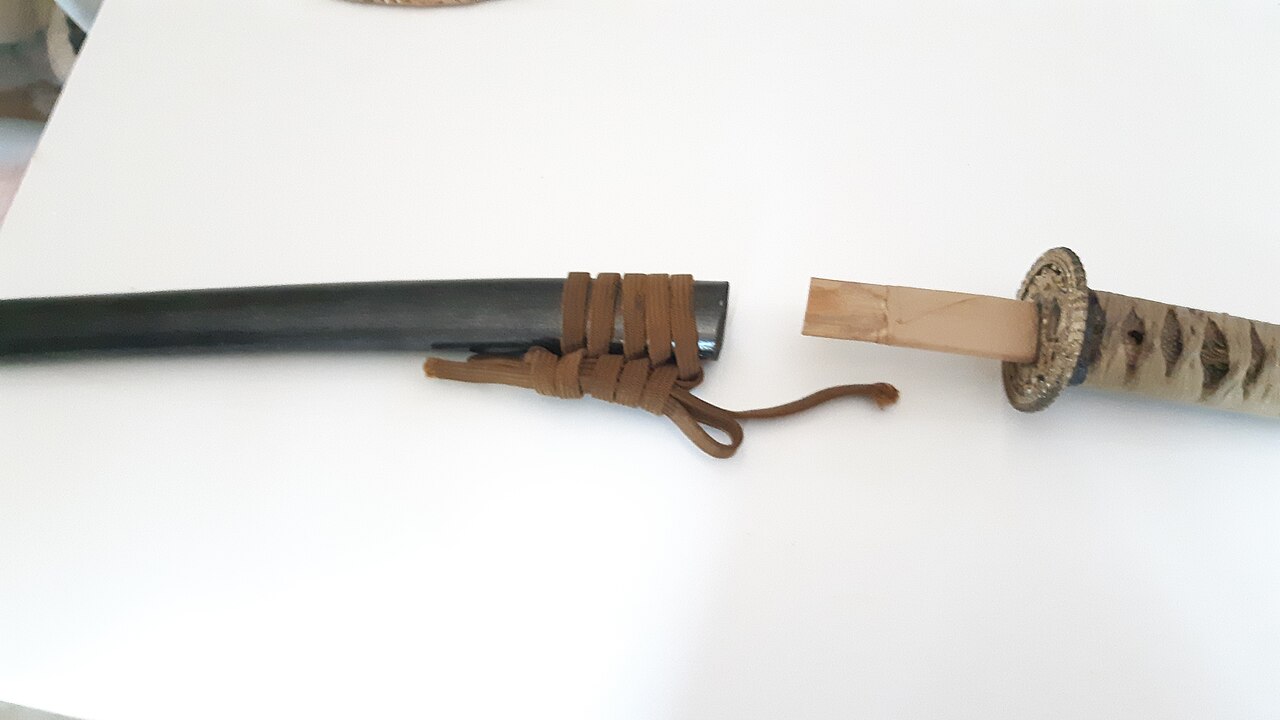
A short Japanese sword (kodachi) lying on a white surface: dark lacquered scabbard with brown cord wrapping and tied knot, and the tsuka (hilt) with light-colored wrapped grip and a round metal tsuba guard, with the handle end and scabbard mouth visible.Artifact

Secondary source

Kodachi Short Sword of the Heiho Niten Ichi Ryu School

4 March 1999

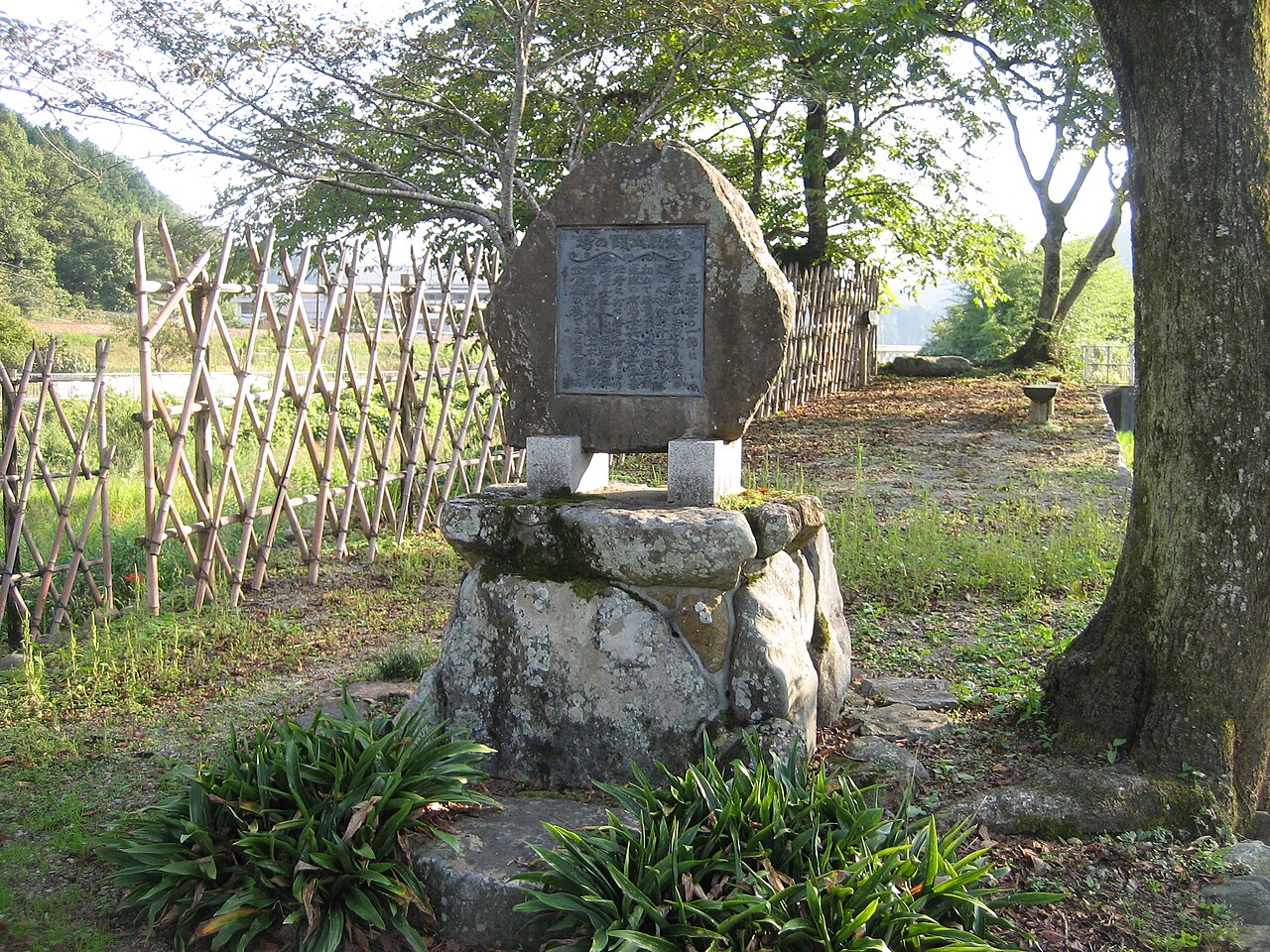
Photo of a stone monument in a garden-like setting: a tall rounded upright stone slab with a dark metal plaque bearing inscribed text, set on a base of stacked rough stones. Bamboo fencing, trees, and green plants surround it.Sculpture

Secondary source

Stone Monument at Kanakura Rokujizō

Corpse Reviver · 8 October 2008 (photograph)

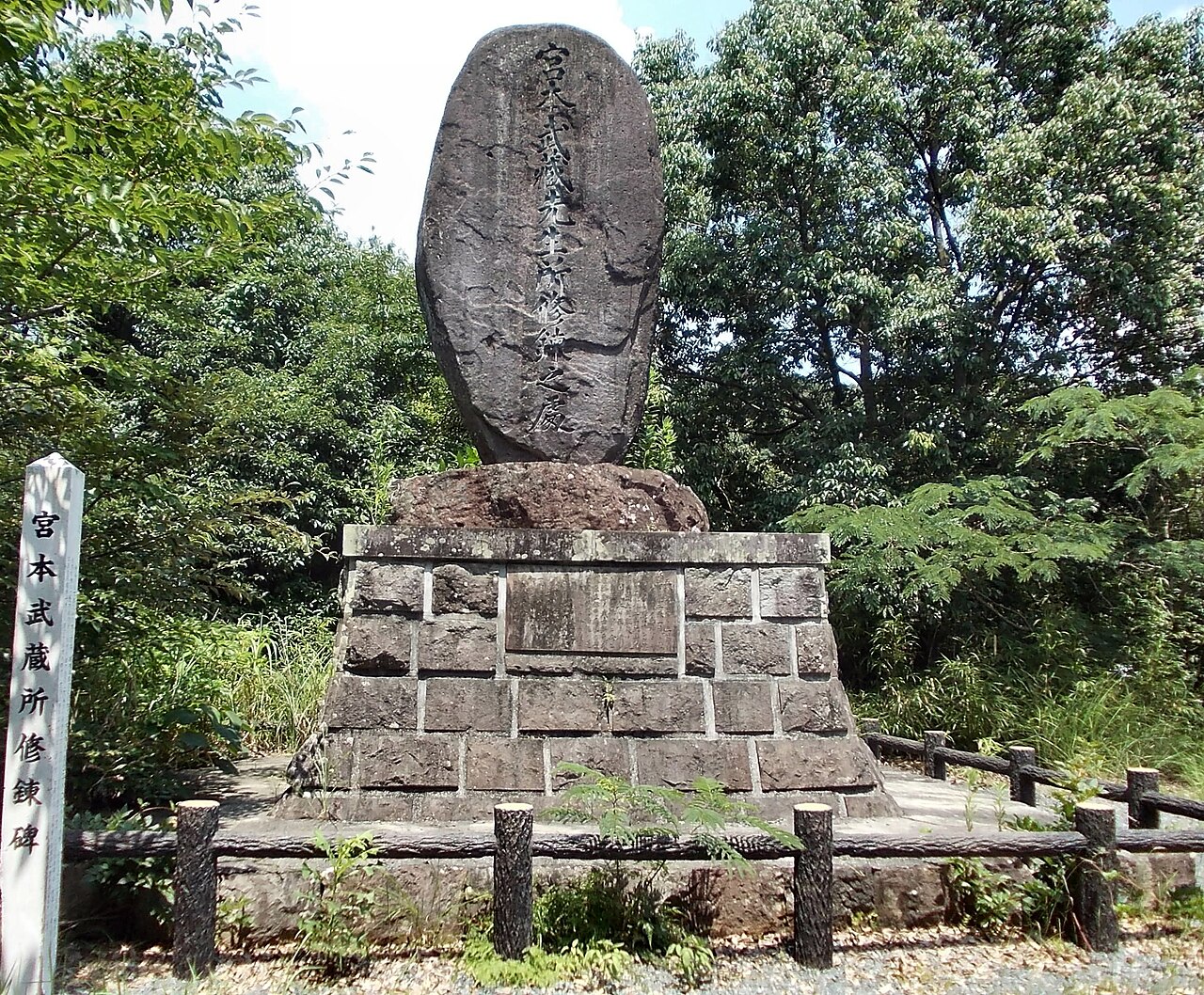
A tall, oval-shaped dark stone monument with vertical Japanese characters carved into its face, set atop a stepped stone base of rectangular blocks, surrounded by a low wooden fence amid green trees. A tall white post with vertical Japanese text stands at the left.Sculpture

Secondary source

Monument of Miyamoto Musashi at Iwato-no-sato Park

STA3816 · 25 July 2012 (photograph)

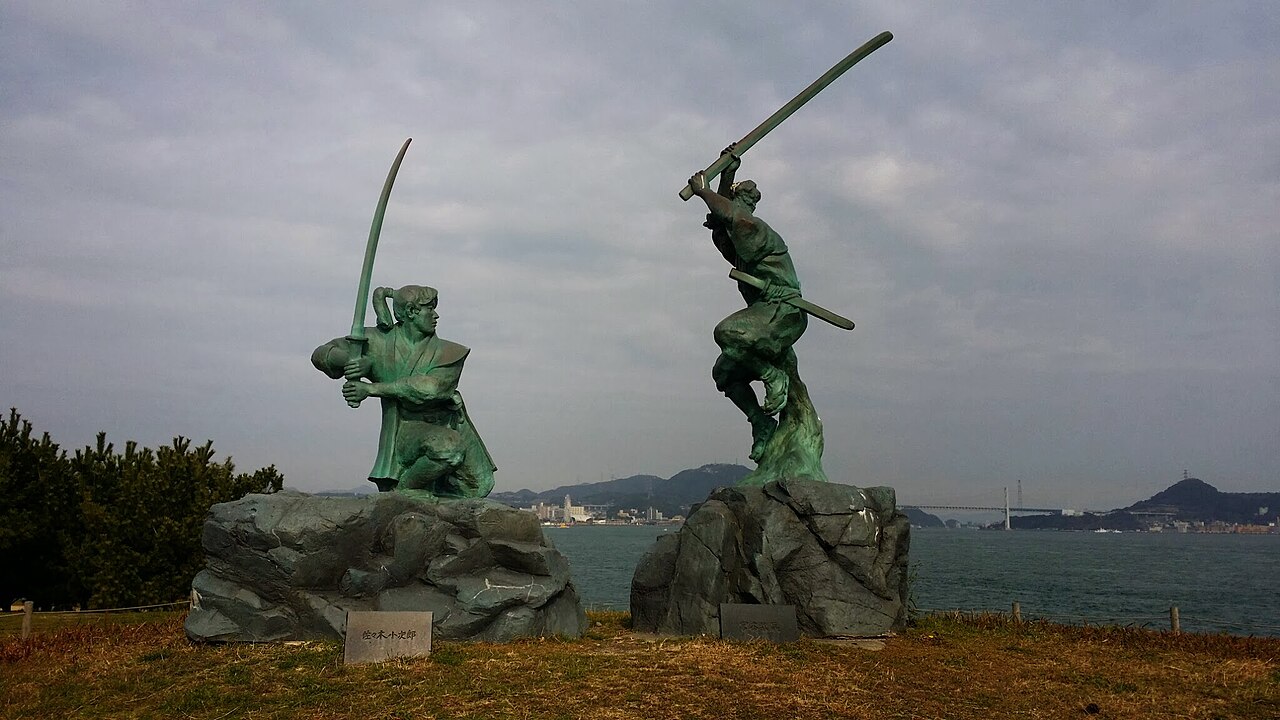
Two green bronze statues of samurai on large grey rock pedestals at a waterfront on grass. The left figure holds a long curved sword raised; the right figure holds a long sword raised overhead in a striking pose. Sea and hills with a bridge are behind.Sculpture

Secondary source

Statue of Musashi and Kojiro's Battle, Ganryu Island

RoninjapanWiki · 3 January 2014 (photograph)

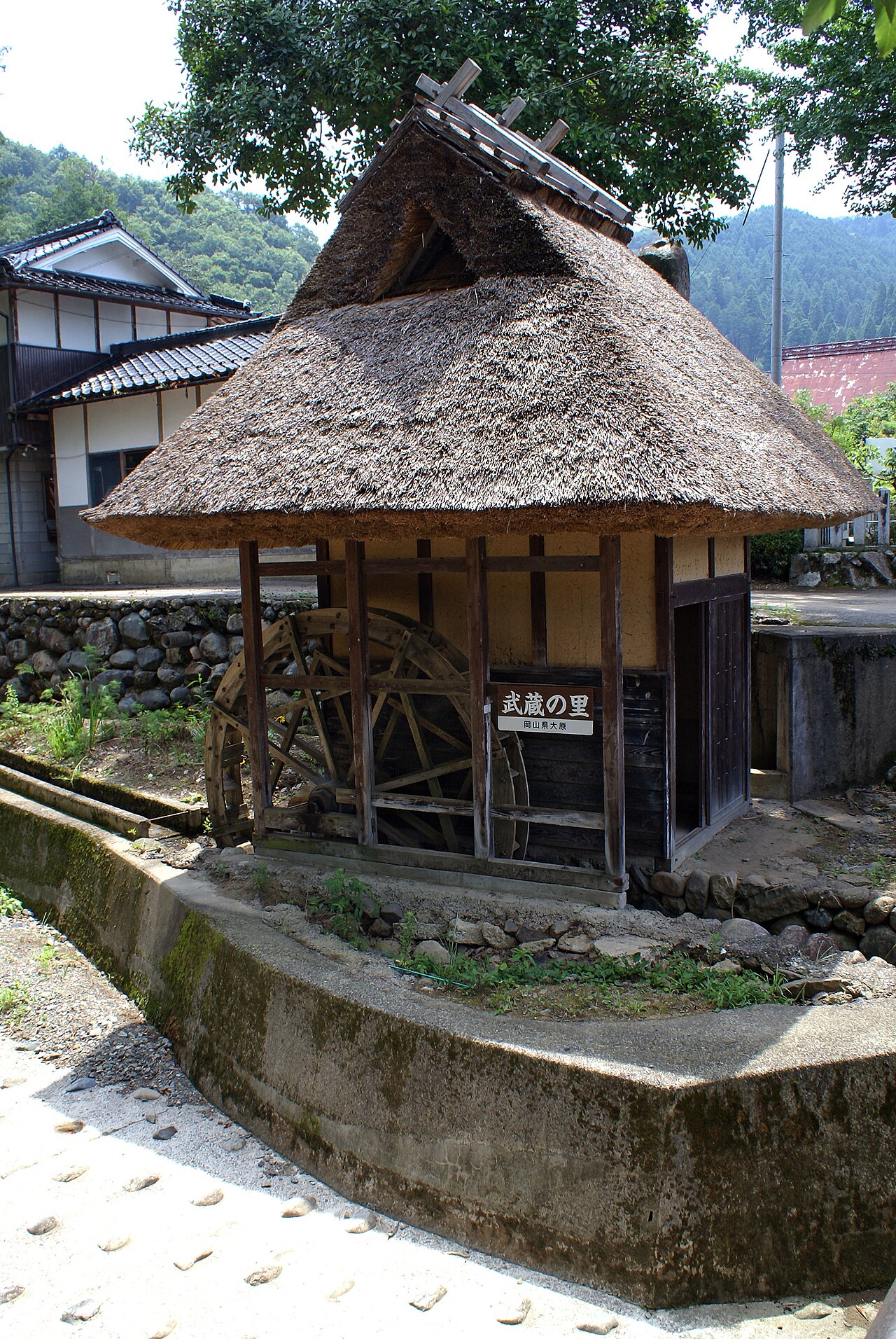
A thatched-roof wooden building with a large waterwheel on its left side, set beside a stone-walled channel. A sign with Japanese characters hangs on the wall. Houses and wooded hills are behind it.Artifact

Secondary source

Musashi-no-sato Park, Mimasaka

663highland · 12 August 2006 (photograph)

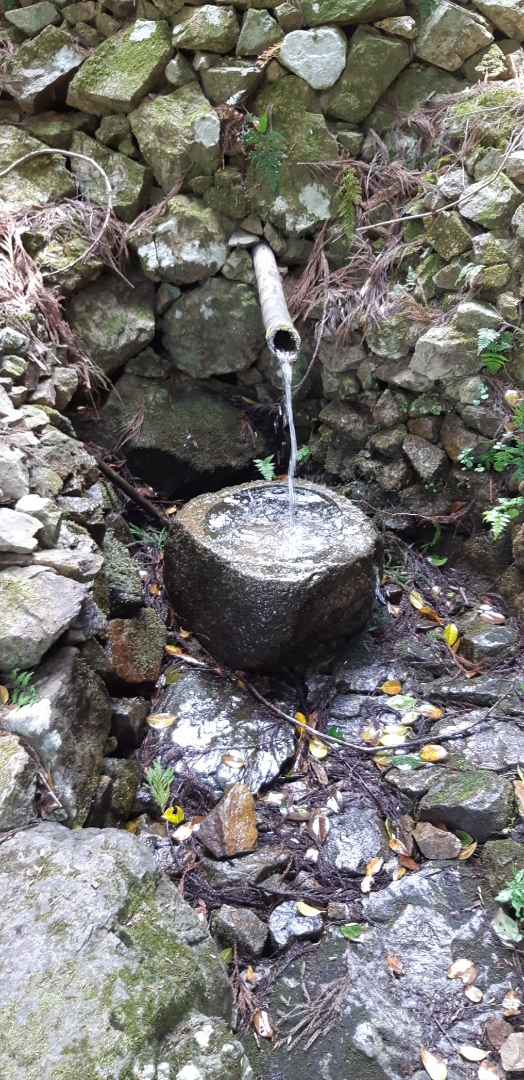
A moss-covered stone basin with a bamboo pipe spout set in a stone wall; water flows from the pipe into the basin. Fallen leaves and ferns surround it on a rocky ground.Artifact

Secondary source

Miyamoto Musashi Spring Memorial, Ōhara

Heimori · 4 March 1999 (photograph)

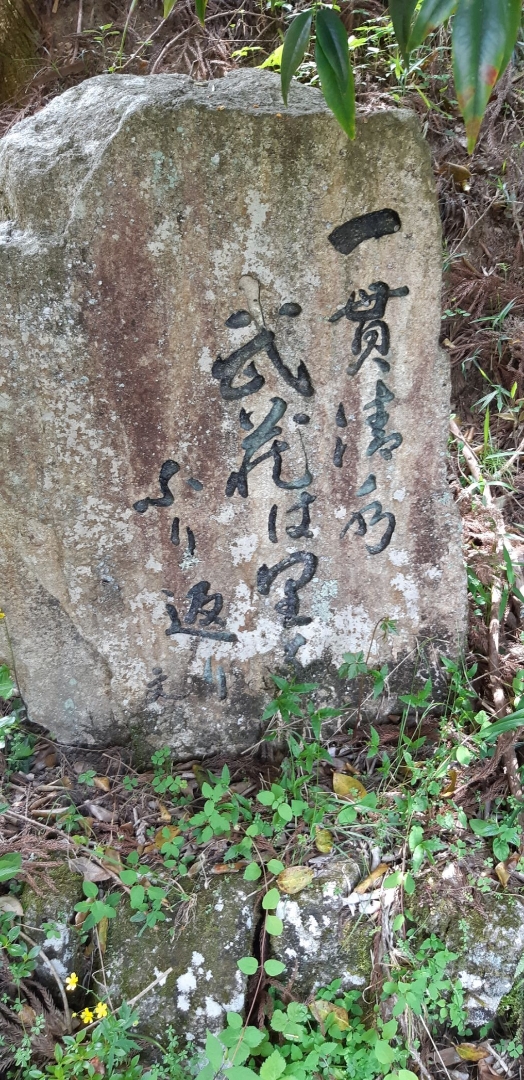
Weathered upright stone stele with vertically carved black inscription in Japanese characters, set among green leaves, grass and small stones on a forest floor. Yellow flowers are visible at lower left.Artifact

Secondary source

Stele Beside Ikkanseisui Spring, Ōhara-chō

Heimori · 4 March 1999 (photograph)

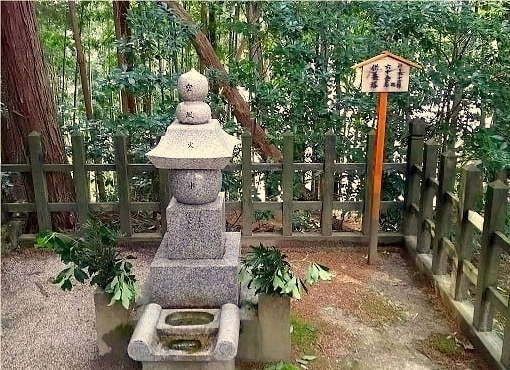
A granite gorintō, a stone monument of stacked five-part form with a round top, a block, and a pagoda-like roof, stands on a stone base in a garden. Dark carved characters are visible on the upper stone. A low wooden fence and trees are behind it, with a small wooden sign on a post to the right and potted plants nearby.Sculpture

Secondary source

Gorintō Honouring Sasaki Kojirō at Musashi Temple

Heimori · 4 March 1999

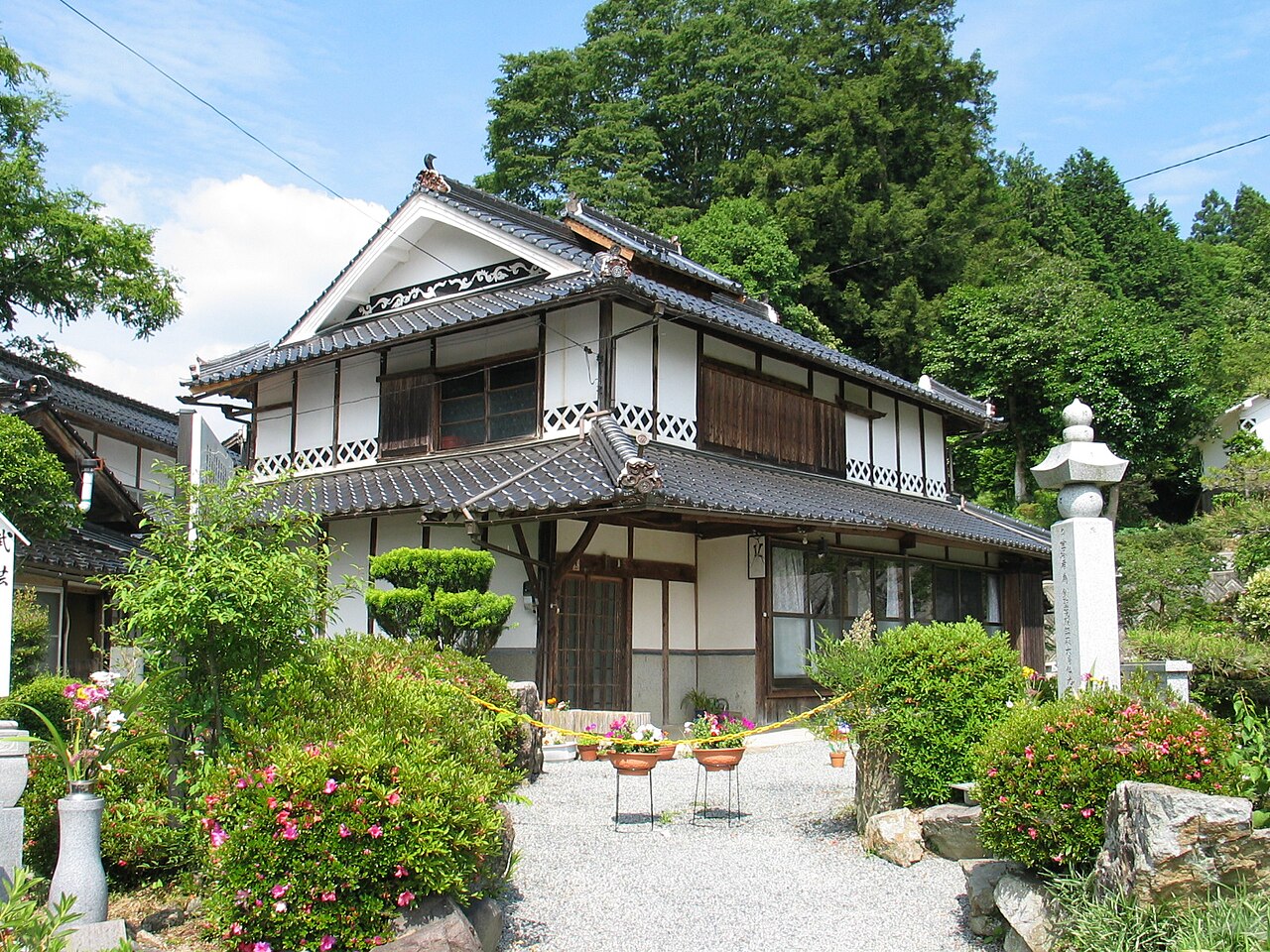
A two-storey traditional Japanese house with white plaster walls, dark tiled roofs, and lattice-patterned wooden lower windows, set among green trees and shrubs with a gravel forecourt, flower pots, and a stone lantern on a pillar at right.Artifact

Secondary source

Designated Historic Site of the Supposed Residence of Miyamoto Musashi

社会教育課 · 8 June 2005

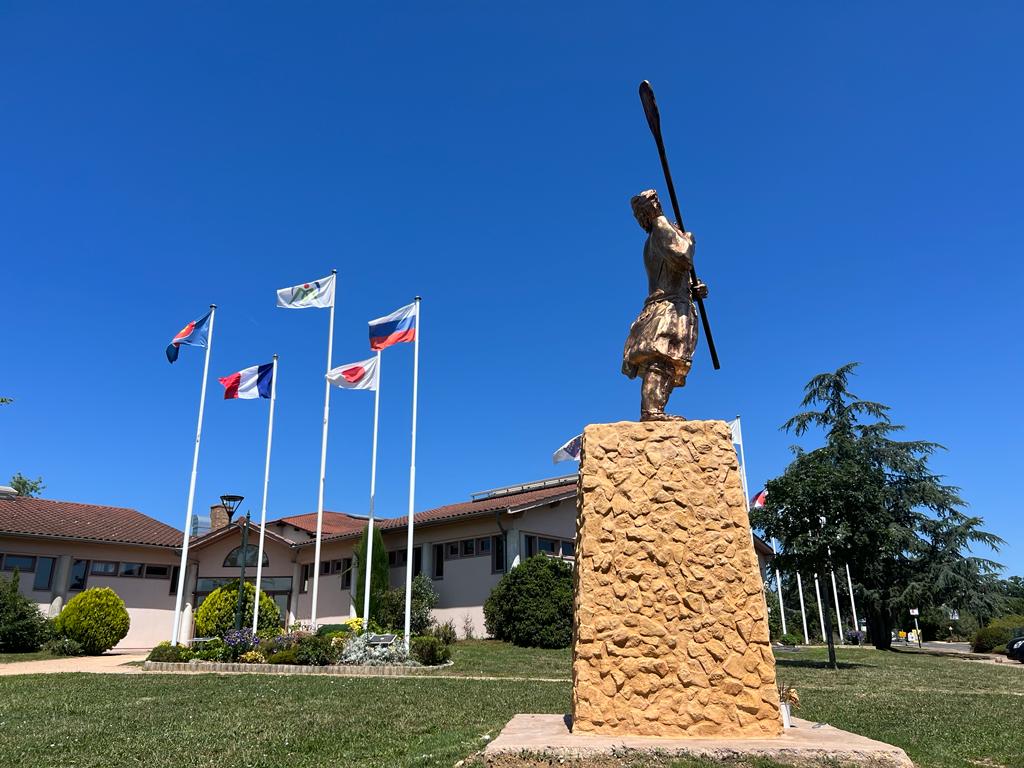
A bronze-colored statue of a figure holding a long staff or oar upright over the shoulder, standing on a tall rough-stone pedestal on a paved base. Behind it are a low cream building with a tiled roof, several flagpoles with flags including French tricolor, green shrubs, and a clear blue sky.Sculpture

Secondary source

Statue of Miyamoto Musashi in Gleizé

Forgottencompt123 · 17 June 2023

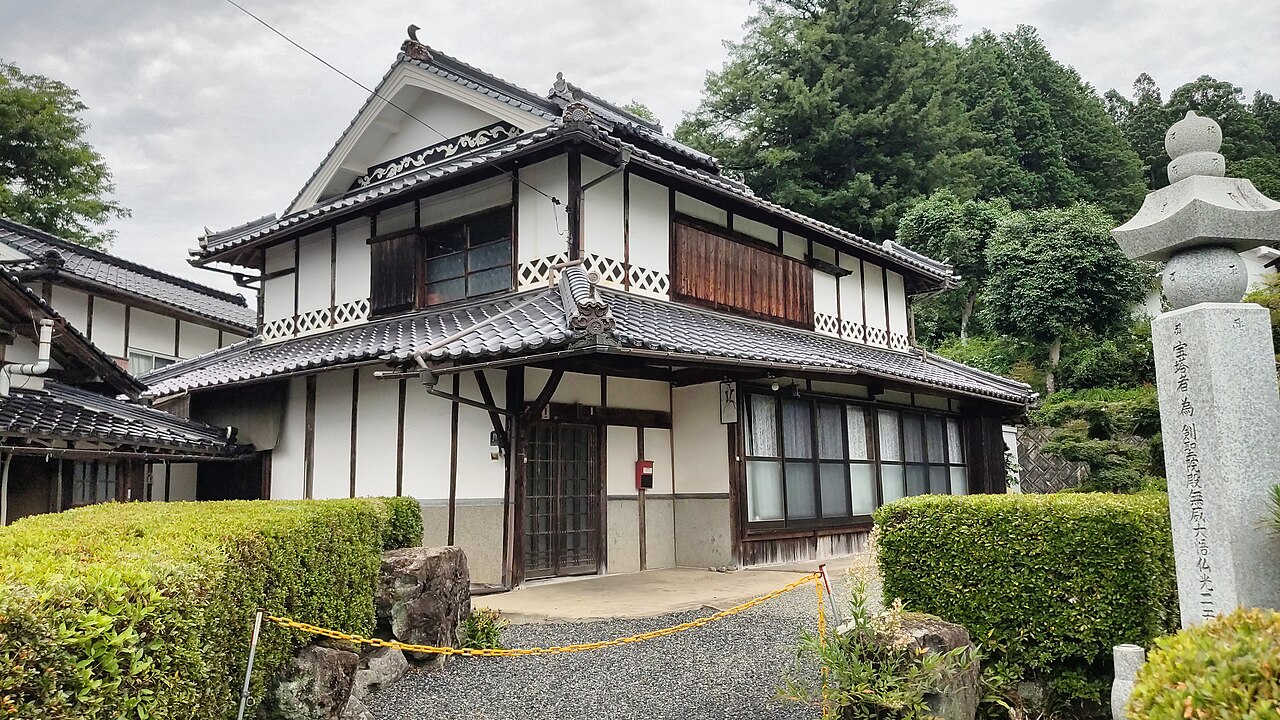
A two-storey traditional Japanese house with a dark tiled roof, white plastered walls with lattice details, wooden shutters, and a sliding wooden entrance door. A gravel forecourt with a yellow rope barrier lies in front, with clipped green hedges and tall trees behind. A stone lantern with an inscription stands at the right.Artifact

Secondary source

Miyamoto Musashi Birthplace

Drivephotographer · 22 June 2021

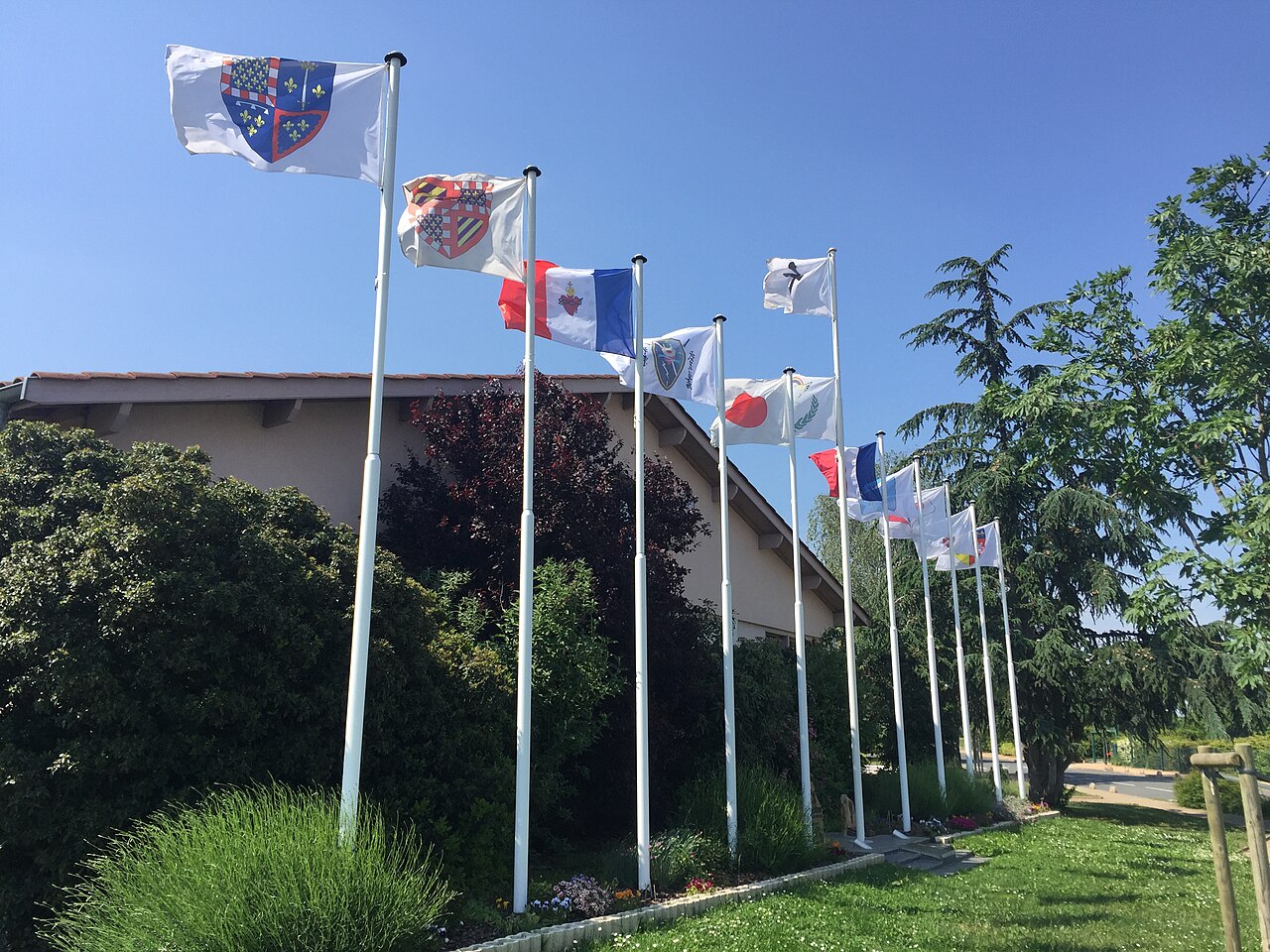
A row of about ten white flagpoles in front of a light beige building under a clear blue sky. Flags of varied designs flutter in the breeze, including a white flag with a red and blue heraldic shield at the far left, and a red and white flag with a blue band. Green shrubs and trees line the grounds.Photograph

Secondary source

Flags at the Heiho Niten Ichi Ryu Memorial

Official site · 18 May 2018

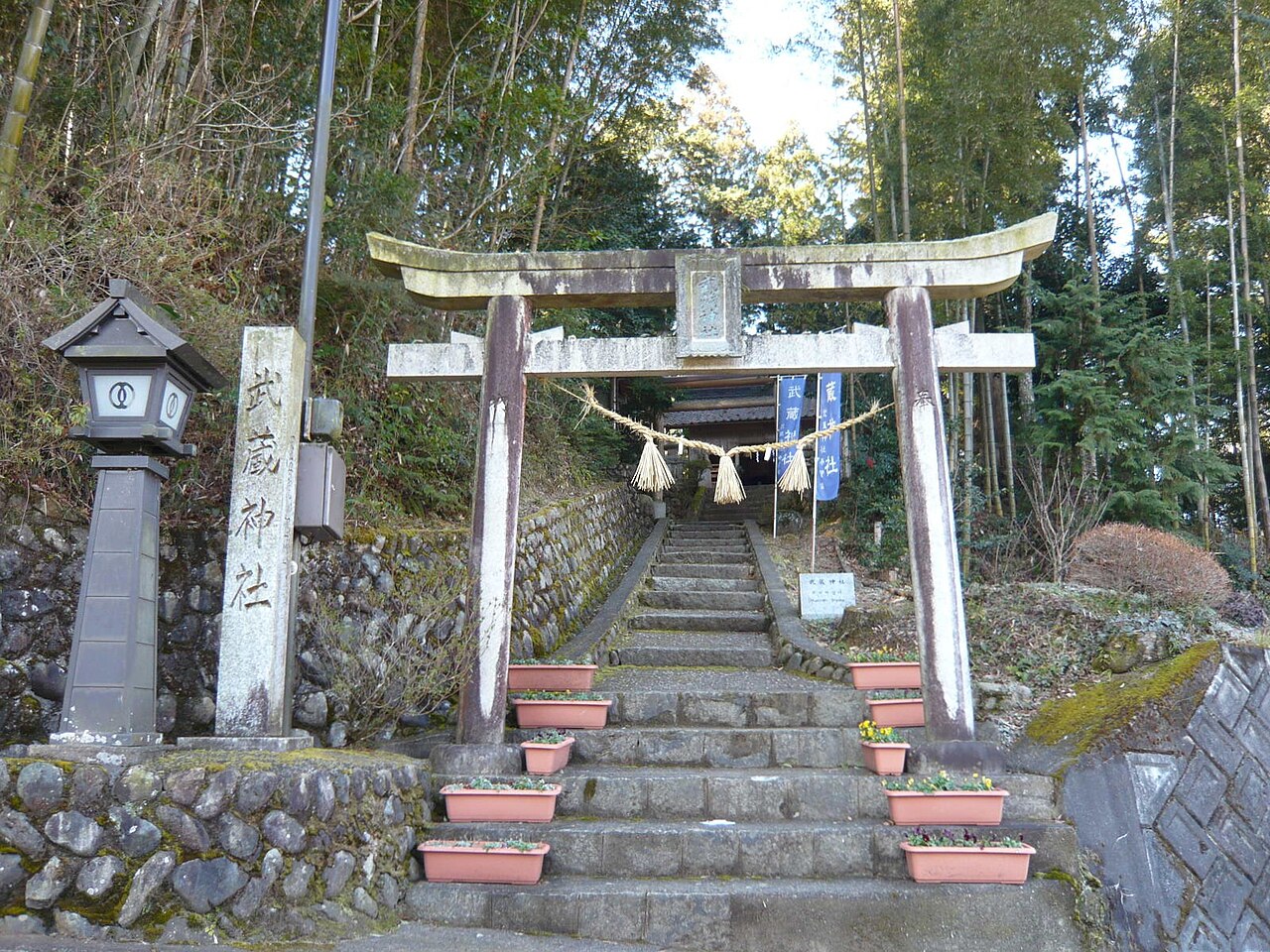
A stone torii gate with a shimenawa rope and paper streamers stands at the foot of a stone staircase leading up through bamboo and trees to a shrine. A tall stone pillar beside the gate reads 武蔵神社. Potted plants line the steps, and a stone lantern stands to the left.Photograph

Secondary source

Musashi Shrine

Masikyo · 27 January 2010

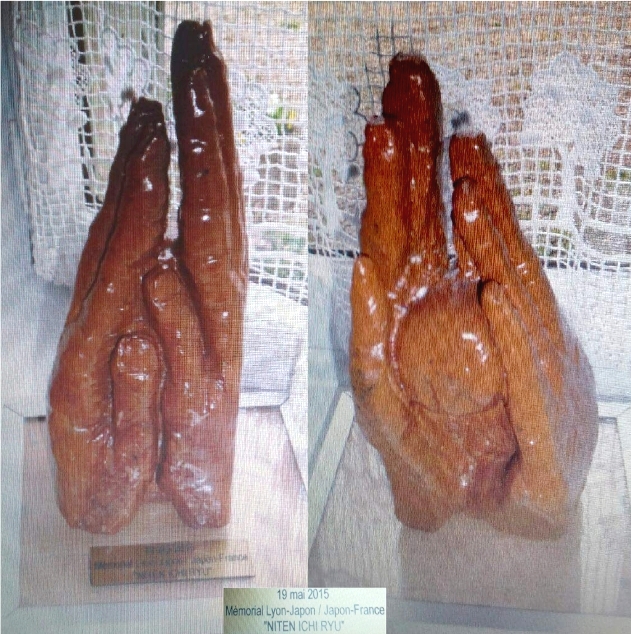
Two side-by-side photographs of a glossy reddish-brown carved object on a display stand, in front of a lace curtain. The object has several rounded, elongated projections. A small plaque sits at the base. A caption reads: 19 mai 2015, Mémorial Lyon-Japon / Japon-France, NITEN ICHI RYU.Sculpture

Secondary source

Niten Ichi-ryū Memorial Stone Carving

Heimori · 11 February 2015

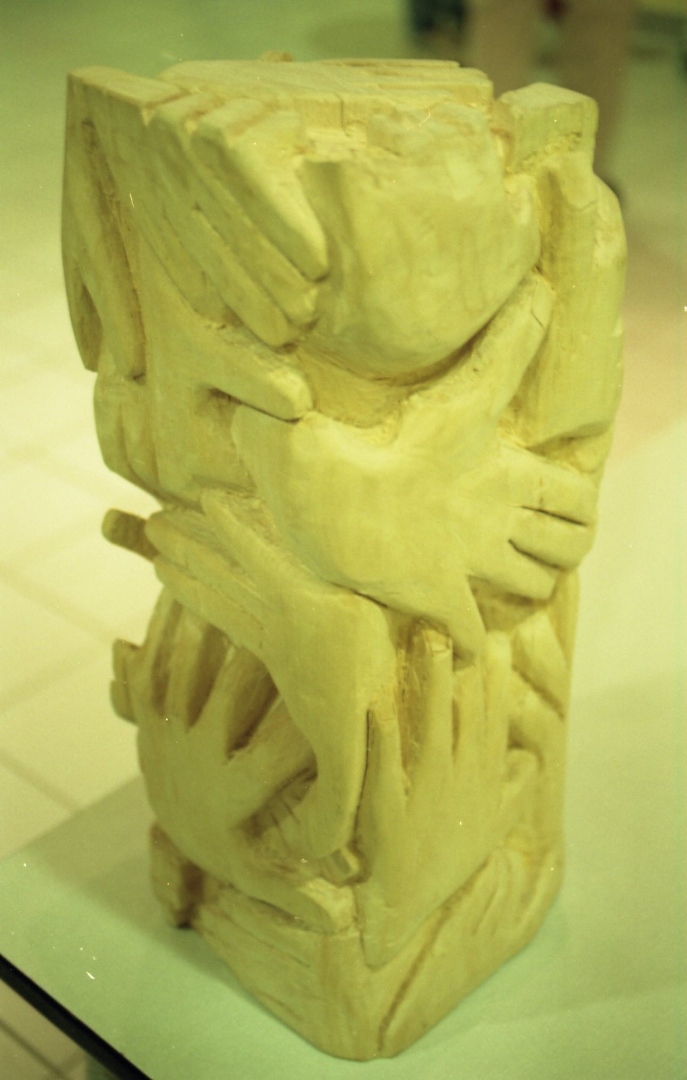
Photograph of a pale wooden sculpture on a glass-topped surface. A carved block shows multiple stylized hands and forms interlocking, with fingers and a rounded head-like shape visible in the carved relief.Sculpture

Secondary source

Musashi School Memorial Wooden Sculpture

Heimori · 4 March 1999

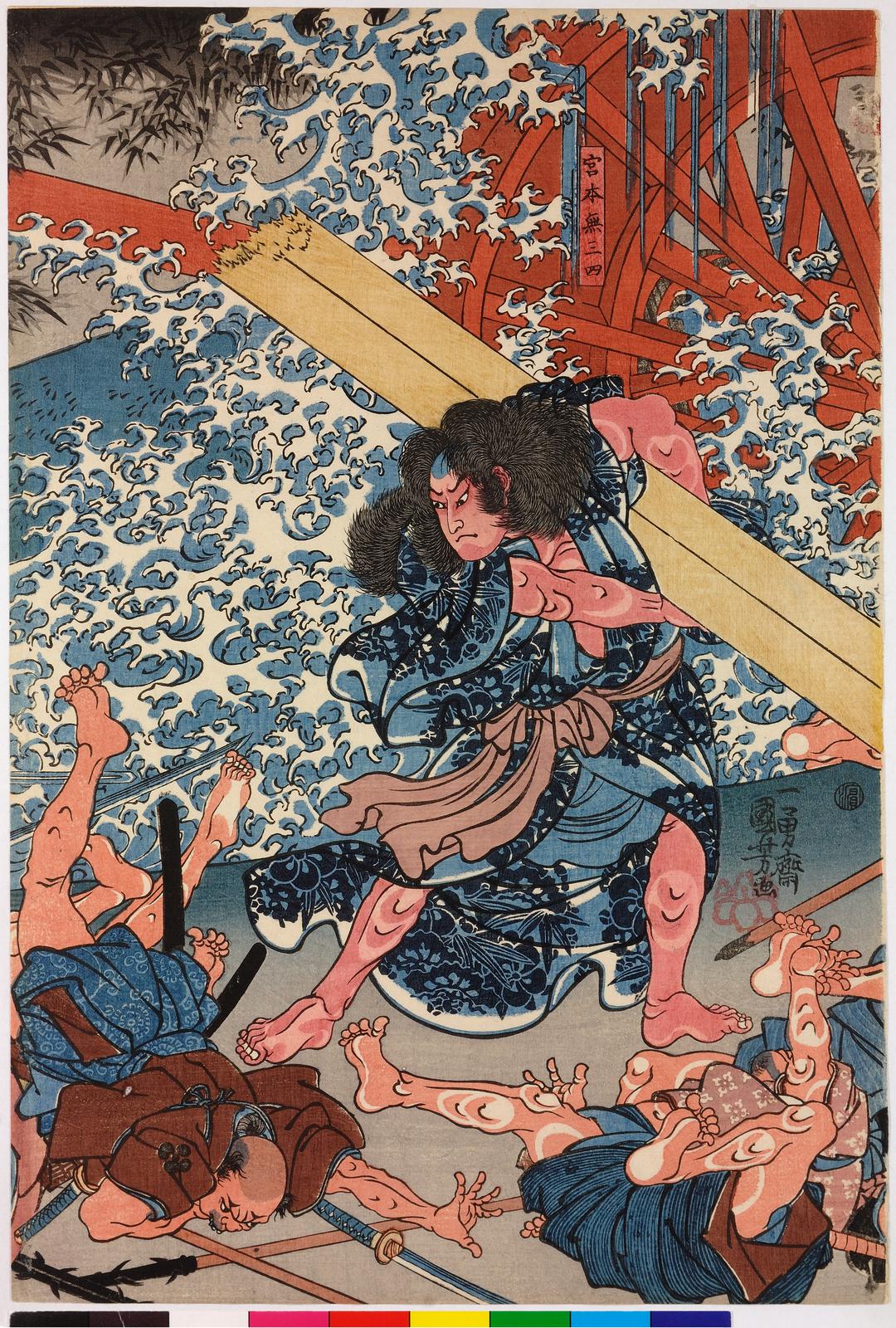
Woodblock print of a muscular, fierce-faced man in a blue patterned kimono gripping a long wooden beam diagonally across a scene of stylized white-crested blue waves and a red wooden structure. Two or three men lie sprawled on the ground at the bottom, one with a sword nearby. Bamboo appears at upper left.Painting

Secondary source

Seiran: Musashi Attacked by Shirakura Dengoemon

Utagawa Kuniyoshi · 1846

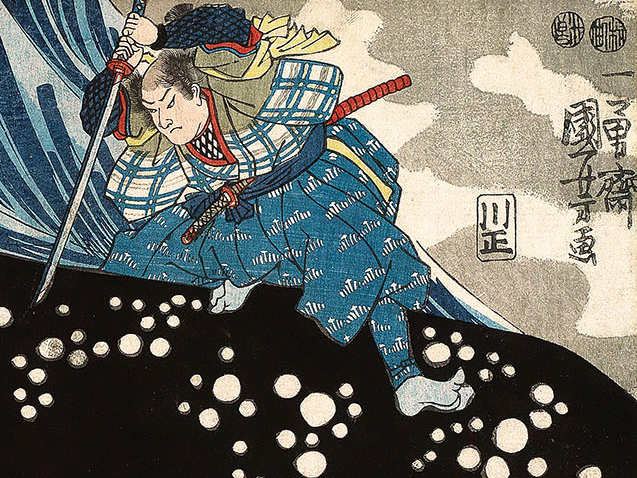
Color woodblock print showing a samurai in blue and white patterned robes and a red-hilted sword, leaping across a dark sea covered with white circles, with a blue wave and stylized clouds behind him. Calligraphy and seals appear at the upper right and center right.Painting

Secondary source

Miyamoto Musashi Attacking a Giant Whale

Utagawa Kuniyoshi · circa 1847

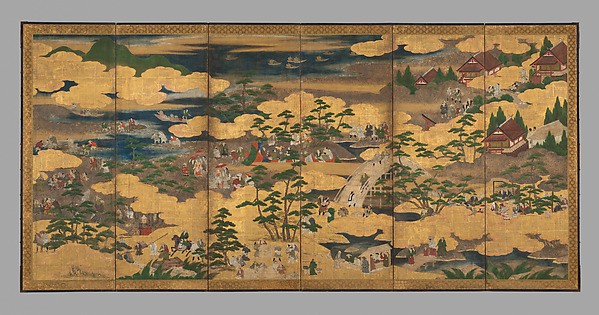
A six-panel folding screen with gold clouds and gold leaf background, showing a Japanese landscape with pine trees, a river with boats, and figures in the foreground. Red-roofed shrine buildings appear on the right panels, with green hills at the top left.Painting

Primary source

Sumiyoshi Taisha Screen

Unidentified artist · early 17th century

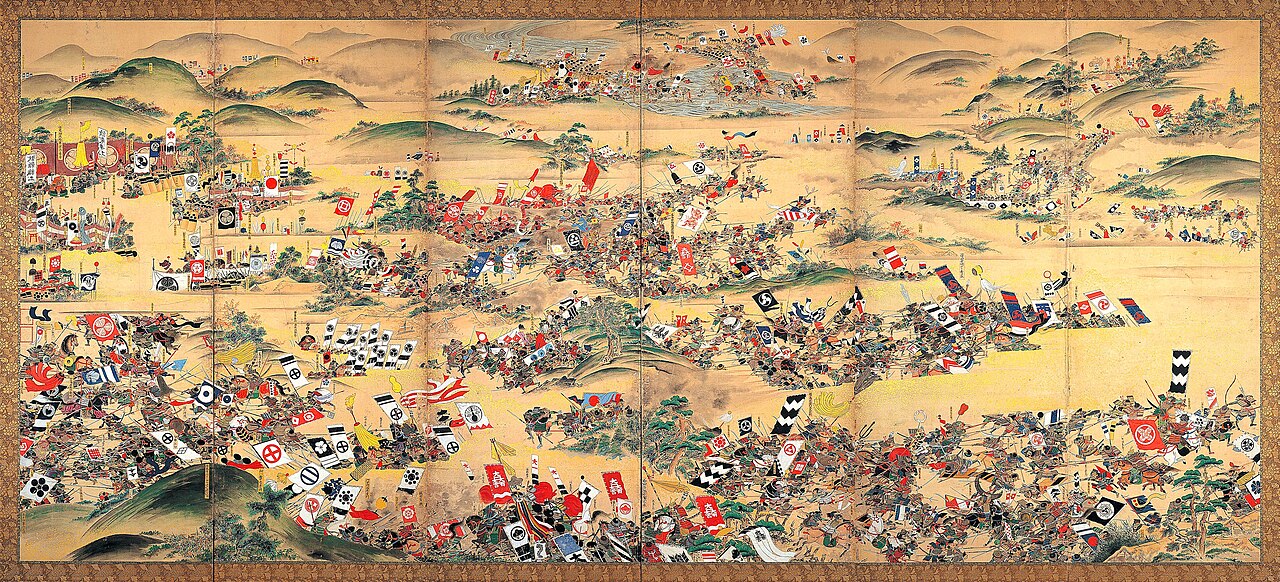
Gold-leaf folding screen painting of a crowded battlefield with many armored warriors, red and white banners, black-and-white crest flags, hills, pine trees, and clusters of soldiers across the landscape.Painting

Secondary source

Sekigahara Kassen Byōbu

Unidentified artist · 19th century (late Edo era)

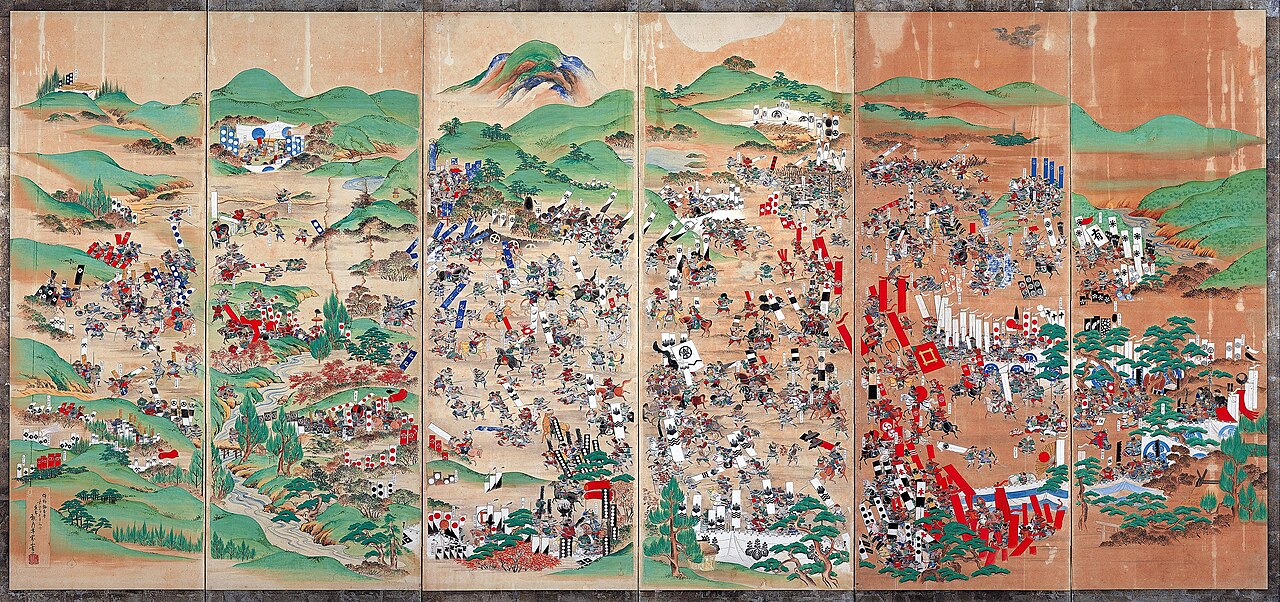
A six-panel folding screen painting of a large battle scene with many armored samurai, horses, red and white banners, green hills, pine trees, and a tan background with a sun near the top.Painting

Secondary source

Sekigahara Battle Screen

1854

Want the full shelf? Chat with Musashi Miyamoto in the app and open the Sources panel — every quote links back to the original.

Use Musashi Miyamoto in class

1 collection

A ready-made collection from the Humy team that features Musashi Miyamoto. Preview it, then try it free.

Trusted by educators worldwide

Conversations
375,000+
Real exchanges between students and historical figures
Messages exchanged
4,142,000+
Across every figure, classroom and language
Historical figures
100,000+
Each informed by a curated biography and selected sources
Languages supported
50+
From English and Spanish to Arabic and Korean

Paying customers

Used by 98 schools and universities

Partner school logo
Tecnológico de Monterrey logo
Hyper Island logo
Partner school logo
Chambersburg Area School District logo
Broward County Public Schools logo
Nebo School District logo
National Louis University logo
South Florida PBS logo
Punahou School logo
University of Wisconsin–River Falls logo
Partner school logo
Partner school logo
Archbishop Mitty High School logo
Kingsburg High School logo
Norwalk Public Schools logo
Partner school logo
Connections logo
Partner school logo
Moore Public Schools logo
Partner school logo
Partner school logo
Partner school logo
Partner school logo
Robbinsville Public Schools logo
Partner school logo
Partner school logo
Partner school logo
Tecnológico de Monterrey logo
Hyper Island logo
Partner school logo
Chambersburg Area School District logo
Broward County Public Schools logo
Nebo School District logo
National Louis University logo
South Florida PBS logo
Punahou School logo
University of Wisconsin–River Falls logo
Partner school logo
Partner school logo
Archbishop Mitty High School logo
Kingsburg High School logo
Norwalk Public Schools logo
Partner school logo
Connections logo
Partner school logo
Moore Public Schools logo
Partner school logo
Partner school logo
Partner school logo
Partner school logo
Robbinsville Public Schools logo
Partner school logo
Partner school logo

What educators are saying

“We enjoyed the program last year and used it frequently.”
“My students say it’s a welcome change of pace. I’m not a fan of the “sage on the stage” model, so I try to incorporate research-oriented and self-paced activities. With Humy, students have to take charge of their learning. They’ve become more adept at critical thinking, forming better questions, and improving their reading comprehension. The interview feature has been my go-to tool. I create assignments where students must ask historical figures a set number of questions, then summarize the responses to ensure they’re truly absorbing the material. This approach lets them actively explore the past rather than passively consuming information.”
“Humy has helped me bring historical figures, sometimes long past, to life. When my students interact with these figures in real-time, it eliminates some of the perceived “ancient” characteristics of my curriculum. This has shifted my students’ thinking away from viewing history as abstract or irrelevant. Real-time interactions make historical figures relatable, even allowing students to ask off-topic questions that help put historical lives in a more relevant context for 13-year-olds. The feature I use the most is the interview feature. After teaching a topic, most recently Gandhi and Joan of Arc, I have the students ask pointed, focused questions. We practice good conversation techniques beforehand, teaching them to listen (or read) carefully and formulate thoughtful follow-up questions rather than just interrogating. It helps students practice effective conversation skills.”

FAQ

Frequently asked questions

Who is Musashi Miyamoto?
A legendary Japanese swordsman and philosopher known for developing the Niten Ichi-ryū style. On Humy.ai you can chat with an AI version of Musashi Miyamoto that draws on a short biography and 73 historical sources during the conversation — by text or voice, in 42 languages.
Is Musashi Miyamoto AI free?
Musashi Miyamoto is part of Humy's full library of more than 100,000 figures, which comes with a paid plan. A free account (no credit card) includes 20 AI messages a month with the free library's figures, so you can try how the conversations work first. The free plan's 20 AI messages a month are shared by you and your students: enough to try Humy yourself; a whole class needs Plus.
What sources does the Musashi Miyamoto AI use?
It draws on a short biography and 73 historical sources (paintings, sculptures and photographs), including “Kokura Hibun”, “Portrait of Miyamoto Musashi” and “Daruma-Bodhidharma”. Each source has its own page on Humy.ai.
How historically accurate is the AI version of Musashi Miyamoto?
Each figure uses a short biography and a small set of selected historical sources as context (retrieval-augmented generation), so answers stay closer to known material than the model's general knowledge alone. It isn't a citation-grade research tool — like any LLM, the AI can get details wrong or extrapolate. Treat it as a strong starting point for inquiry and cross-reference important claims.
Can I talk to Musashi Miyamoto by voice?
Yes. In addition to text chat, you can call Musashi Miyamoto and hear their voice respond in real time — useful for auditory learners, interview practice and Socratic dialogue.
Is Humy.ai safe and compliant for schools?
Yes. Humy.ai is used by more than 100 schools, universities and organisations. The platform is FERPA- and GDPR-aligned, supports SSO, and offers an IT-approval pack tailored for school procurement teams.

Cross-reference Musashi Miyamoto

Like any LLM, the AI version of Musashi Miyamoto can get details wrong. Open one of these sources in a new tab to verify what you’ve read.

Ready when you are

Start chatting with Musashi Miyamoto now.

20 messages free · No credit card · Available in 50+ languages.