


Secondary sourcePainting1732
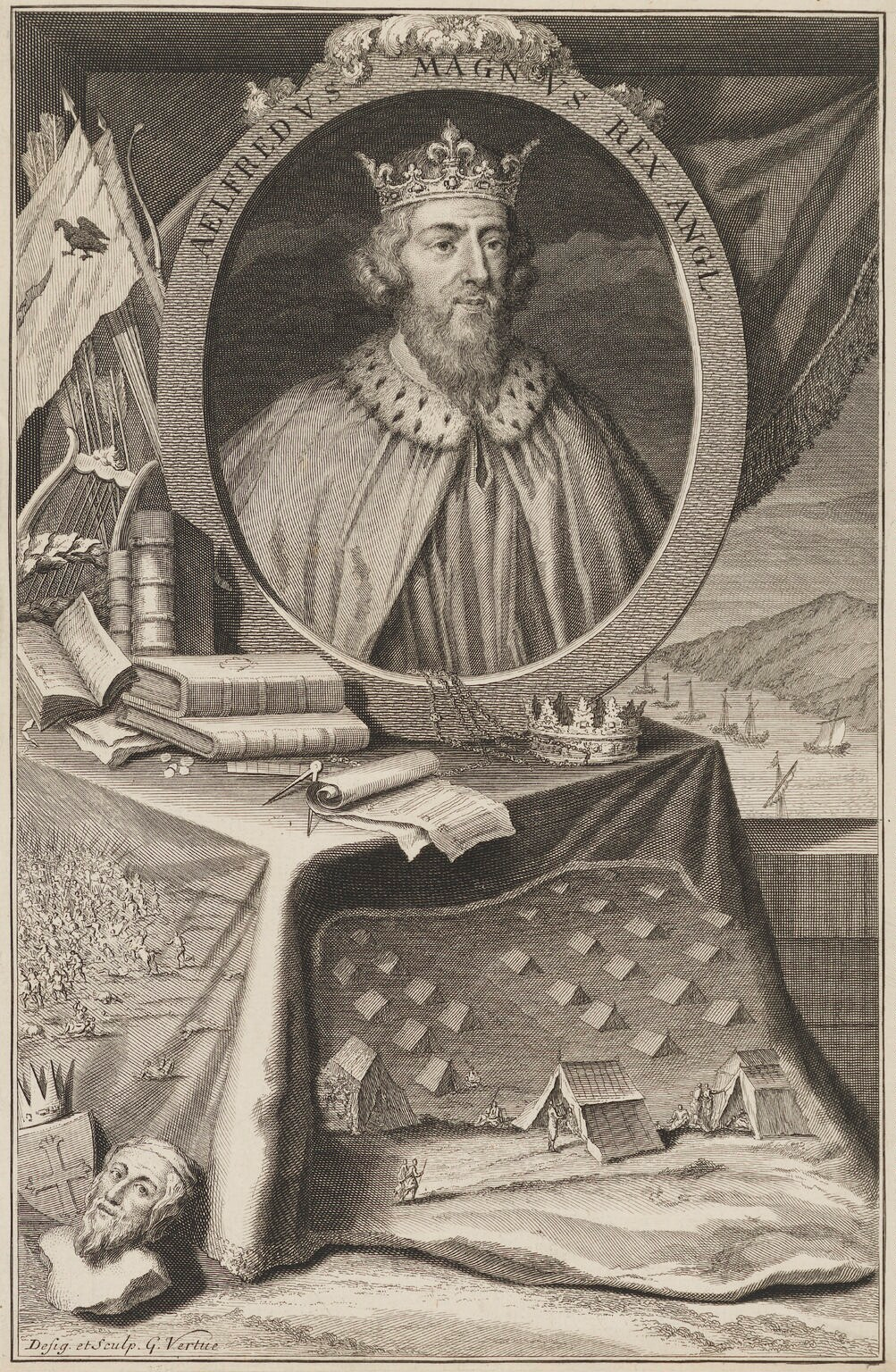
Alfred the Great, Engraving by George Vertue
George Vertue · 1732
A 1732 line engraving by George Vertue showing a crowned Alfred in an oval frame. It is a later imagined likeness made for a History of England.
Shows Alfred as an imagined crowned king in an eighteenth-century history, a later likeness rather than a portrait from his lifetime.
About this source
What it is
This line engraving was made in 1732 by George Vertue, an engraver and antiquary. It shows a bearded, crowned king in an oval frame labeled ALFREDUS MAGNUS REX ANGL. Books, a crown, dividers, a scroll, tents, a bust and a distant coastline surround the portrait. It was made as a frontispiece for the folio edition of The History of England, translated by Nicolas Tindal from the work of Paul de Rapin.
Why it matters
The engraving is a later imagined likeness, so it tells us how eighteenth-century English readers pictured Alfred rather than how he looked. Rapin was a Huguenot from France who wrote for George I, and Tindal was a vicar who translated and extended the history. Their work presented Alfred as an early founder of England's monarchy.
Look closer
- What do the books, scroll and tents around the portrait suggest about the king's achievements?
- Why would a history book of 1732 place a portrait of an Anglo-Saxon king at its front?
- What does the engraving leave out about how Alfred actually looked or lived?
This painting is part of the curated material that grounds the AI version of Alfred the Great on Humy.ai — when students ask about related events, the AI can quote it and cite it.
More Alfred the Great sources
Meet the AI Alfred the Great →
Ready when you are
Start chatting with Alfred the Great now.
20 messages free · No credit card · Available in 50+ languages.