


Secondary sourceArtifact1854
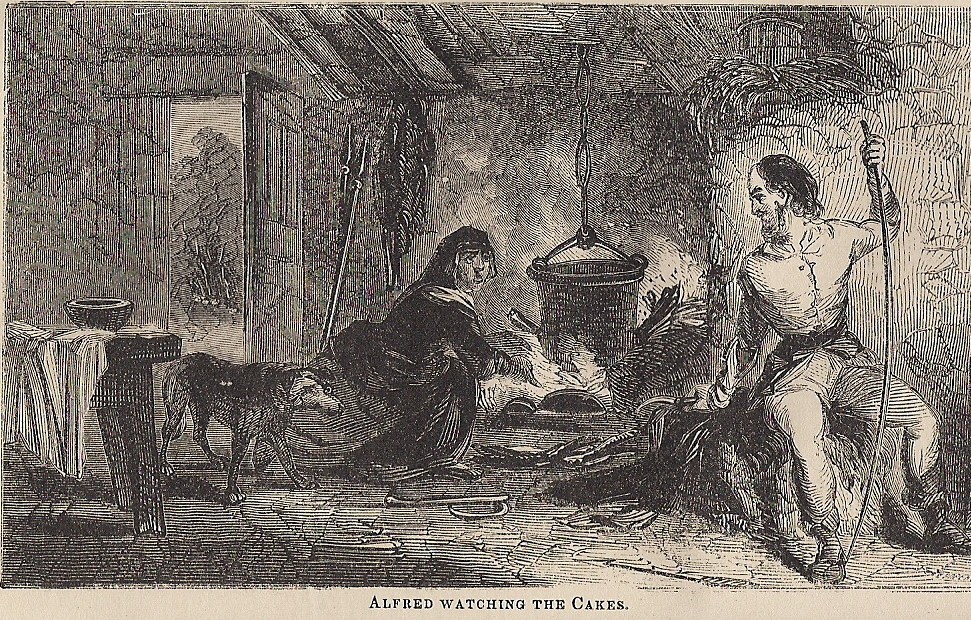
Alfred the Great Watching the Cakes
1854
An engraving from 1854 showing the legend of Alfred the Great tending cakes in a peasant woman's hut.
This engraving shows the legend of Alfred and the cakes, a later story about the king rather than a record of his own time.
About this source
What it is
This is a black and white engraving titled Alfred watching the cakes. The title page states 1854, and a copyright notice behind it states 1849. The artist is not known. It shows a woman in a hooded cloak crouching by a hearth, with a cauldron over the fire, a dog beside a wooden table, and a man with a tall staff sitting by the fire.
Why it matters
The engraving illustrates a legend, not a recorded event. In the story, Alfred is hiding in the countryside and is given the job of watching a woman's cakes, which he lets burn while his mind is elsewhere. The woman scolds him, and he accepts her reproach. Such stories were retold in the nineteenth century to present Alfred as humble and thoughtful, and they show how his later reputation was shaped.
Look closer
- Who is shown as the powerful figure in this scene, and how does the artist signal that?
- Why might a later artist choose a quiet domestic moment to picture a king?
- What does this legend leave out about Alfred's actual wars and government?
This artifact is part of the curated material that grounds the AI version of Alfred the Great on Humy.ai — when students ask about related events, the AI can quote it and cite it.
More Alfred the Great sources
Meet the AI Alfred the Great →
Ready when you are
Start chatting with Alfred the Great now.
20 messages free · No credit card · Available in 50+ languages.