


Secondary sourcePainting2007-11-25
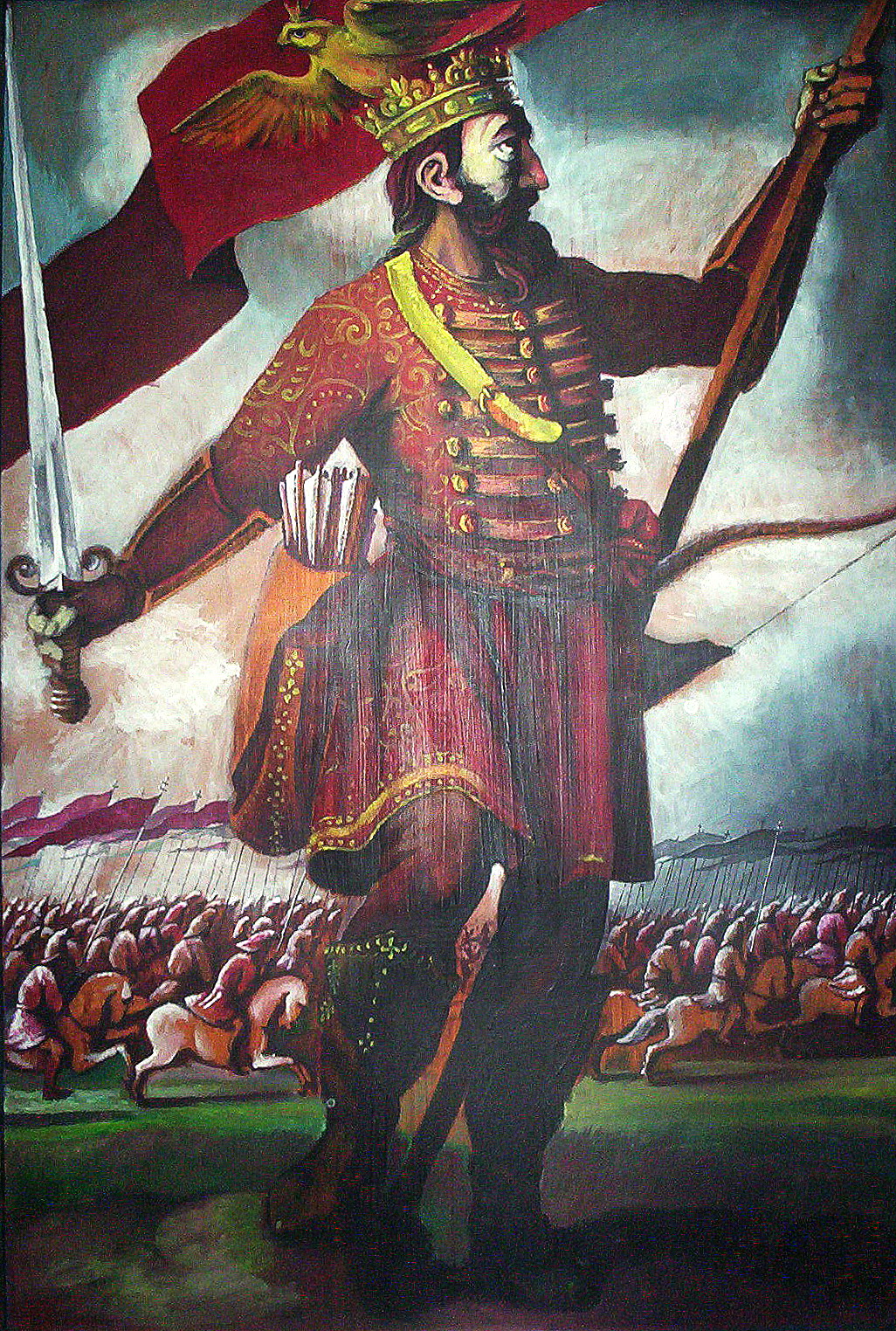
Atilla király (King Attila)
Tamás Tulipán · 2007-11-25
A 2007 tempera painting on wood by Tamás Tulipán showing a crowned, bearded King Attila with a sword and a golden-bird staff in front of mounted warriors.
Shows how a modern artist pictured Attila as a crowned king, so it belongs in his archive as a later interpretation.
About this source
What it is
This is a tempera painting on a wooden panel by Tamás Tulipán, dated 25 November 2007. The title is Atilla király, Hungarian for King Attila. It shows a bearded man in a gold-trimmed crown and a red embroidered tunic with a yellow sash. He holds a sword in one hand and a staff with a golden bird on top in the other. Behind him are a red banner and mounted warriors on a green field under a cloudy sky.
Why it matters
This is a modern artistic interpretation, not a source from Attila's time. It shows how Hungarian artists in the twenty-first century still use Attila as a national symbol of a warrior king. The painting reflects present-day ideas about the past, not the ruler's actual appearance.
Look closer
- Which details, such as the crown, banner and sword, make Attila look like a king, and why?
- What might a painter in 2007 want viewers to feel about Attila and his army?
- What does the painting leave out, such as any evidence about how Attila really looked?
This painting is part of the curated material that grounds the AI version of Attila the Hun on Humy.ai — when students ask about related events, the AI can quote it and cite it.
More Attila the Hun sources
Meet the AI Attila the Hun →
Ready when you are
Start chatting with Attila the Hun now.
20 messages free · No credit card · Available in 50+ languages.