


Secondary sourcePainting1838
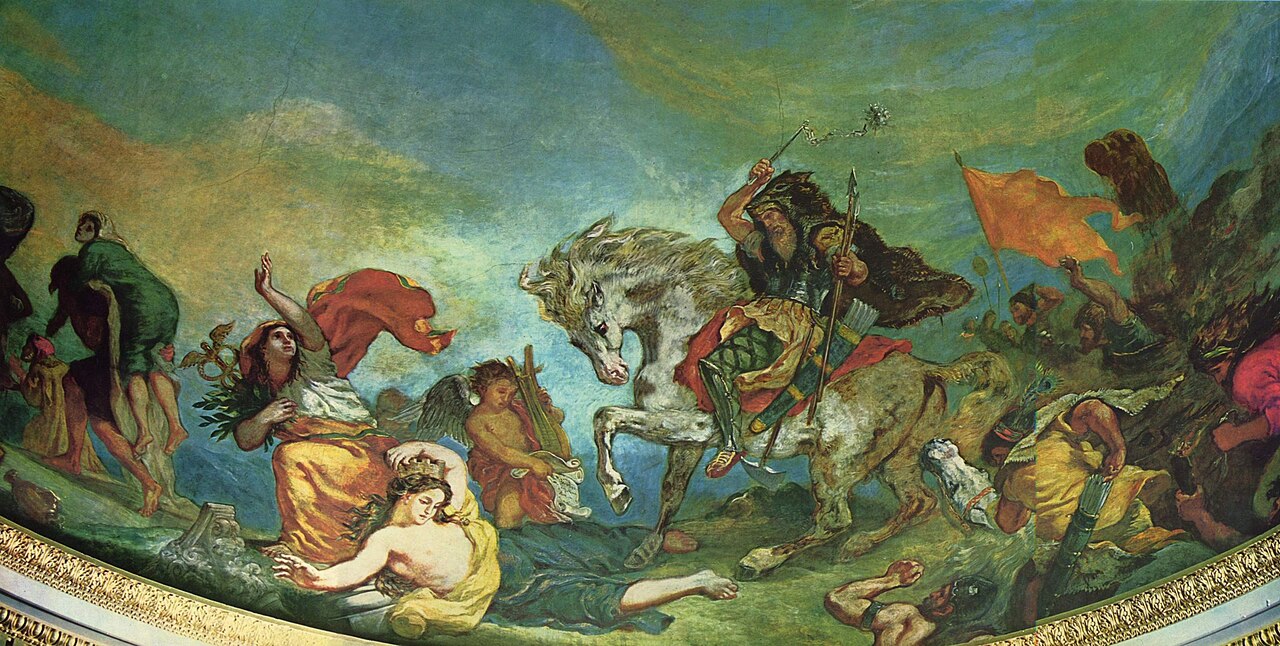
Attila and his Hordes Overrun Italy and the Arts
Eugène Delacroix · 1838
Eugène Delacroix's 1838 Romantic ceiling painting showing Attila as a destructive barbarian conqueror trampling civilization.
A 19th-century Romantic vision of Attila as the barbarian destroyer of civilization.
About this source
What it is
This fresco was painted by Eugène Delacroix in 1838 and is held in the Palais Bourbon in Paris. It shows Attila on horseback, sword raised, riding over fallen figures representing the arts and civilization.
Why it matters
Painted in the Romantic era, this image reflects 19th-century European views of Attila as the destroyer of classical civilization, a dramatic symbol rather than a historical portrait. It shows how artists like Delacroix used ancient history to explore themes of violence, loss and the fragility of culture.
Look closer
- What does the trampling of figures and the broken instruments suggest about what Delacroix thought Attila represented?
- Why might Delacroix choose a dramatic, violent scene rather than a calm portrait?
- How much of this image reflects actual history versus 19th-century imagination?
This painting is part of the curated material that grounds the AI version of Attila the Hun on Humy.ai — when students ask about related events, the AI can quote it and cite it.
More Attila the Hun sources
Meet the AI Attila the Hun →
Ready when you are
Start chatting with Attila the Hun now.
20 messages free · No credit card · Available in 50+ languages.