


Secondary sourceDocument1846
Attila
Giuseppe Verdi · 1846
An 1846 opera by Giuseppe Verdi that cast Attila's invasion of Italy as a patriotic allegory for the Italian unification movement.
Attila is the title character and antagonist of Verdi's opera, which reimagined his invasion of Italy as a patriotic story.
About this source
What it is
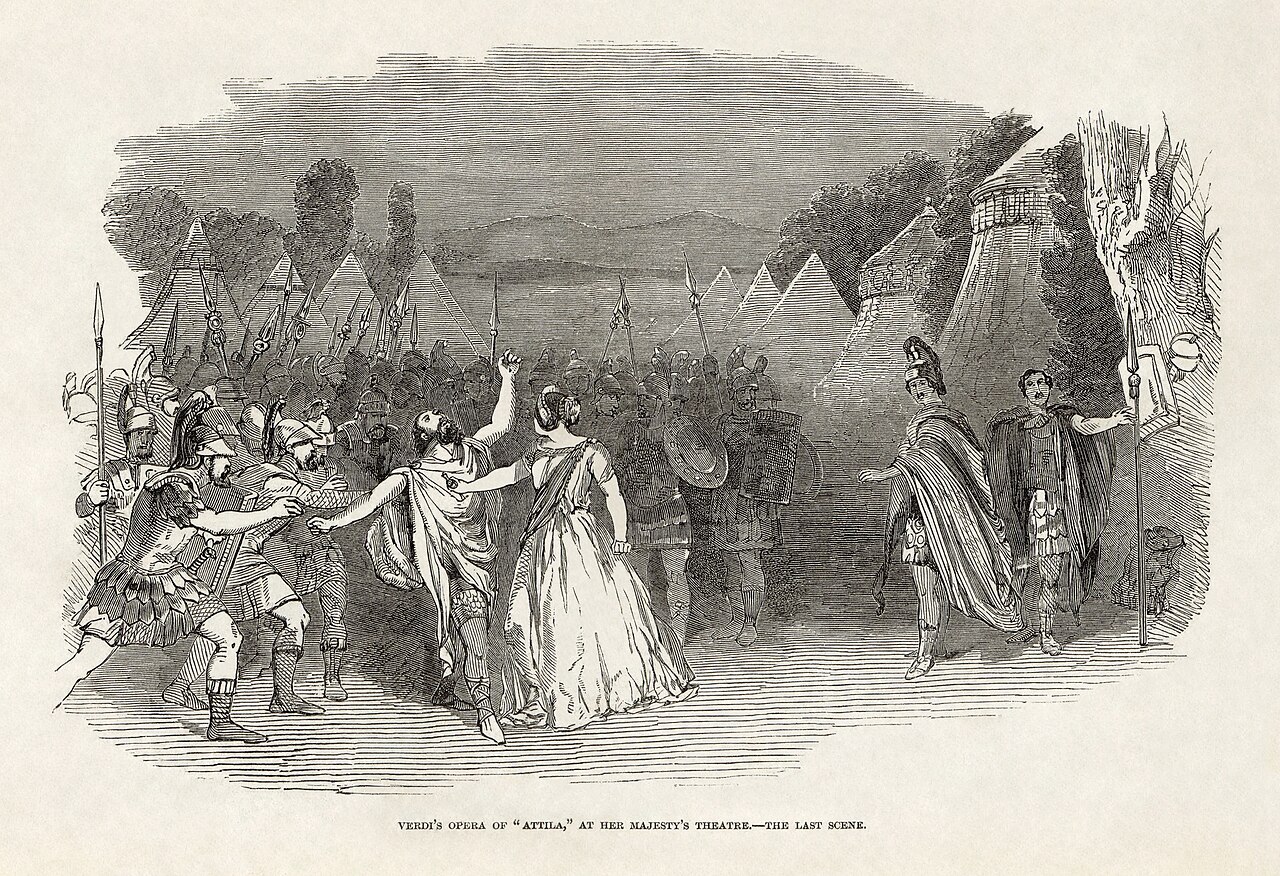
Attila is an opera by the Italian composer Giuseppe Verdi, with a libretto mainly by Temistocle Solera (completed by Francesco Maria Piave), based on an earlier German play about Attila, King of the Huns. It premiered in Venice in 1846 and went on to be performed across Italy and abroad, including London and New York.
Why it matters
Verdi and his librettists used the legendary story of Attila's invasion of Italy to stir patriotic feeling during the Risorgimento, the movement for Italian independence and unification. A famous line, in which the Roman general Ezio tells Attila he can have the world but must leave Italy alone, drew cheers from audiences who read it as a comment on their own political situation. The opera shows how a figure like Attila could be reshaped centuries later to serve the needs and hopes of a very different time.
Look closer
- Why might 19th-century Italians have identified with the Romans fighting Attila rather than with Attila himself?
- What does the illustration of the London performance suggest about how opera staged ancient history for audiences?
- How does turning a historical figure into an opera character change how people remember him?
This document is part of the curated material that grounds the AI version of Attila the Hun on Humy.ai — when students ask about related events, the AI can quote it and cite it.
More Attila the Hun sources
Meet the AI Attila the Hun →

Ready when you are
Start chatting with Attila the Hun now.
20 messages free · No credit card · Available in 50+ languages.