


Secondary sourcePainting1689
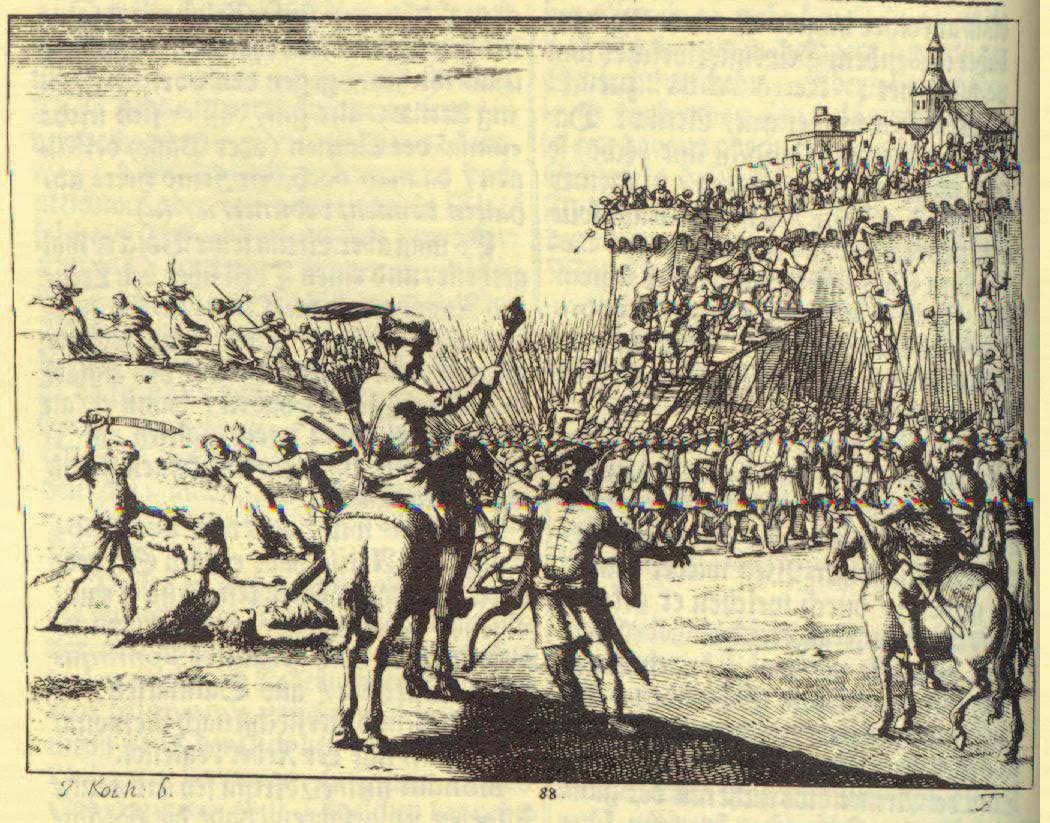
Attila's attack on Emona, engraving by Valvasor
Johann Weikhard von Valvasor · 1689
A 1689 engraving by Johann Weikhard von Valvasor showing Attila attacking the city of Emona. It is a 17th-century view of the ruler's campaign, not a record made at the time.
Shows how a 17th-century engraver pictured Attila's attack on Emona, a later view of one of his campaigns.
About this source
What it is
This is an engraving printed in 1689 by Johann Weikhard von Valvasor. It shows Attila attacking the walled city of Emona. Mounted warriors fill the foreground, one raising a torch, while soldiers climb ladders and fight along the walls. Figures on a hill at left flee or fight with swords, and a church tower rises behind the walls. The printed page number 88 and the artist's signature appear at the bottom.
Why it matters
Valvasor was a 17th-century writer and engraver working more than a thousand years after Attila's campaigns. His print shows how that later period imagined the Hunnic attack on a Roman city. Such images were used to make history vivid for readers, and they show the tastes and assumptions of their makers as much as the events they claim to show.
Look closer
- Which figures in the engraving are attacking, and which are defending or fleeing?
- What makes this scene look like a battle to the viewer, and what details might have been added by the artist?
- What does this print leave out about the people of Emona and the reasons for the attack?
This painting is part of the curated material that grounds the AI version of Attila the Hun on Humy.ai — when students ask about related events, the AI can quote it and cite it.
More Attila the Hun sources
Meet the AI Attila the Hun →
Ready when you are
Start chatting with Attila the Hun now.
20 messages free · No credit card · Available in 50+ languages.