


Secondary sourcePainting1894
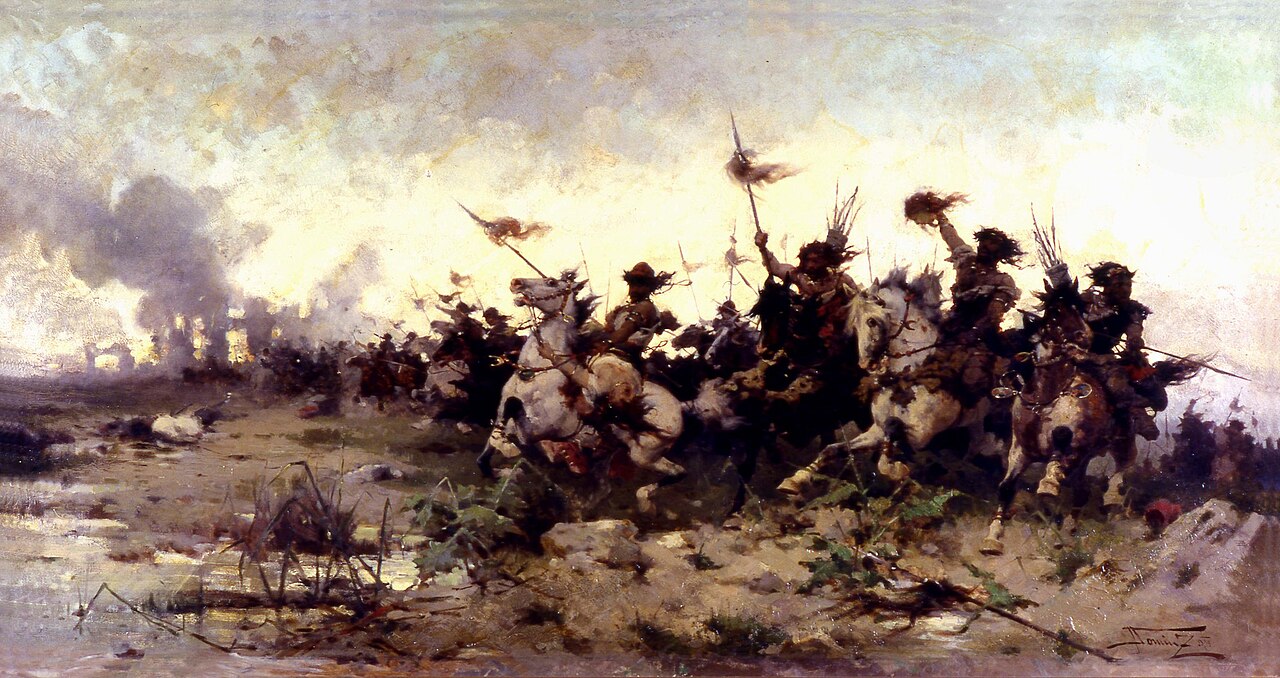
Battle of Aquileia, 452
Alfredo Tominz · 1894
An 1894 history painting by Alfredo Tominz showing a cavalry battle at Aquileia, placed in 452 during Attila's campaign. It is a later imagined scene, not an eyewitness record.
Shows a later painter's imagined battle at Aquileia during Attila's campaign, linked to his siege of the Roman city.
About this source
What it is
This is an oil painting by Alfredo Tominz, dated 1894, titled The Battle of Aquileia, 452 A.D. It shows a chaotic cavalry battle at dusk. Horsemen with spears and plumed helmets ride toward the viewer over muddy ground, and smoke rises from a burning settlement at left. The artist's signature is in the lower right corner.
Why it matters
The painting shows Attila's siege of Aquileia as imagined about forty years after the Italian Risorgimento period, not as recorded at the time. Painters of the 1890s often chose such scenes to present the past as heroic and dramatic. The work tells us how a late nineteenth-century artist saw the Huns and the defeat of a Roman city, and it shows what that audience expected from a battle scene.
Look closer
- How does the painter use light, smoke and the riders' movement to make the battle feel dramatic?
- What did the artist choose to show about the Huns, and what did he leave out about the people of Aquileia?
- Why might a painter in 1894 want to depict a battle from the fifth century?
This painting is part of the curated material that grounds the AI version of Attila the Hun on Humy.ai — when students ask about related events, the AI can quote it and cite it.
More Attila the Hun sources
Meet the AI Attila the Hun →
Ready when you are
Start chatting with Attila the Hun now.
20 messages free · No credit card · Available in 50+ languages.