


Secondary sourcePainting1521
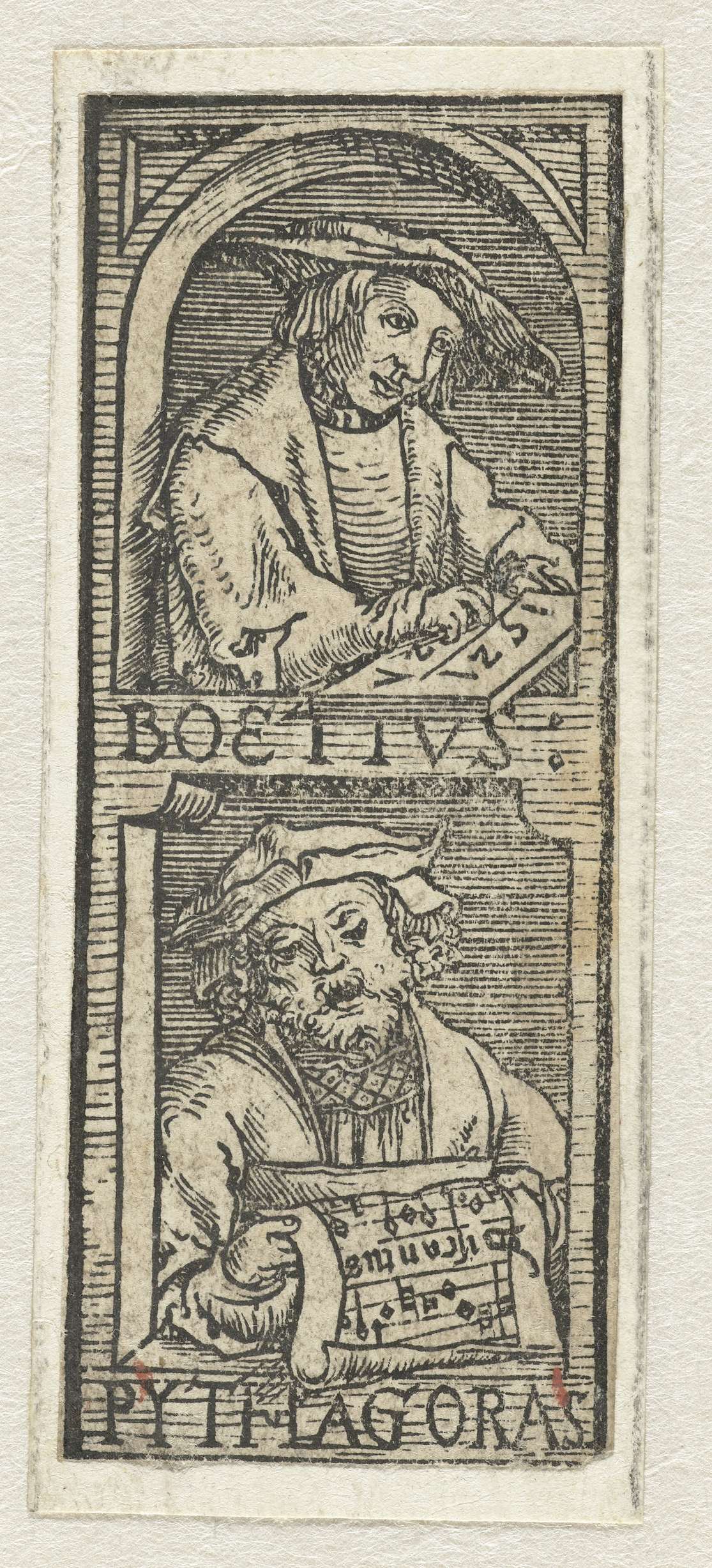
Boethius and Pythagoras
1521
A 1521 woodcut print pairing Boethius and Pythagoras, showing Pythagoras holding sheet music as a symbol of his musical theories.
Shows Pythagoras holding sheet music, reflecting his later reputation as a thinker on music and harmony.
About this source
What it is
This woodcut print from 1521, held by the Rijksmuseum, is one of a set of four portraits of ancient Greek and early medieval scholars. It shows two stacked framed figures: above, Boethius writing on a tablet, and below, an older bearded man labeled PYTHAGORAS, holding a sheet of music notation.
Why it matters
Pythagoras is remembered not only as a mathematician but also for ideas linking music, numbers, and harmony. This print, made many centuries after his death, pairs him with Boethius, a later writer who discussed music theory, showing how Pythagoras's reputation as a thinker about music endured into the early modern period.
Look closer
- Why do you think the printmaker gave Pythagoras sheet music rather than mathematical tools?
- What does pairing Pythagoras with Boethius suggest about how later scholars connected their ideas?
- What does this print leave out about Pythagoras's actual life and teachings?
This painting is part of the curated material that grounds the AI version of Pythagoras on Humy.ai — when students ask about related events, the AI can quote it and cite it.
More Pythagoras sources
Meet the AI Pythagoras → Book
Secondary source
Lives and Opinions of Eminent Philosophers, Book V (Life of Aristotle)
Diogenes Laërtius · c. 3rd century CE
 Book
Secondary source
Histories
Herodotus · c. 440 BCE
 Painting
Secondary source
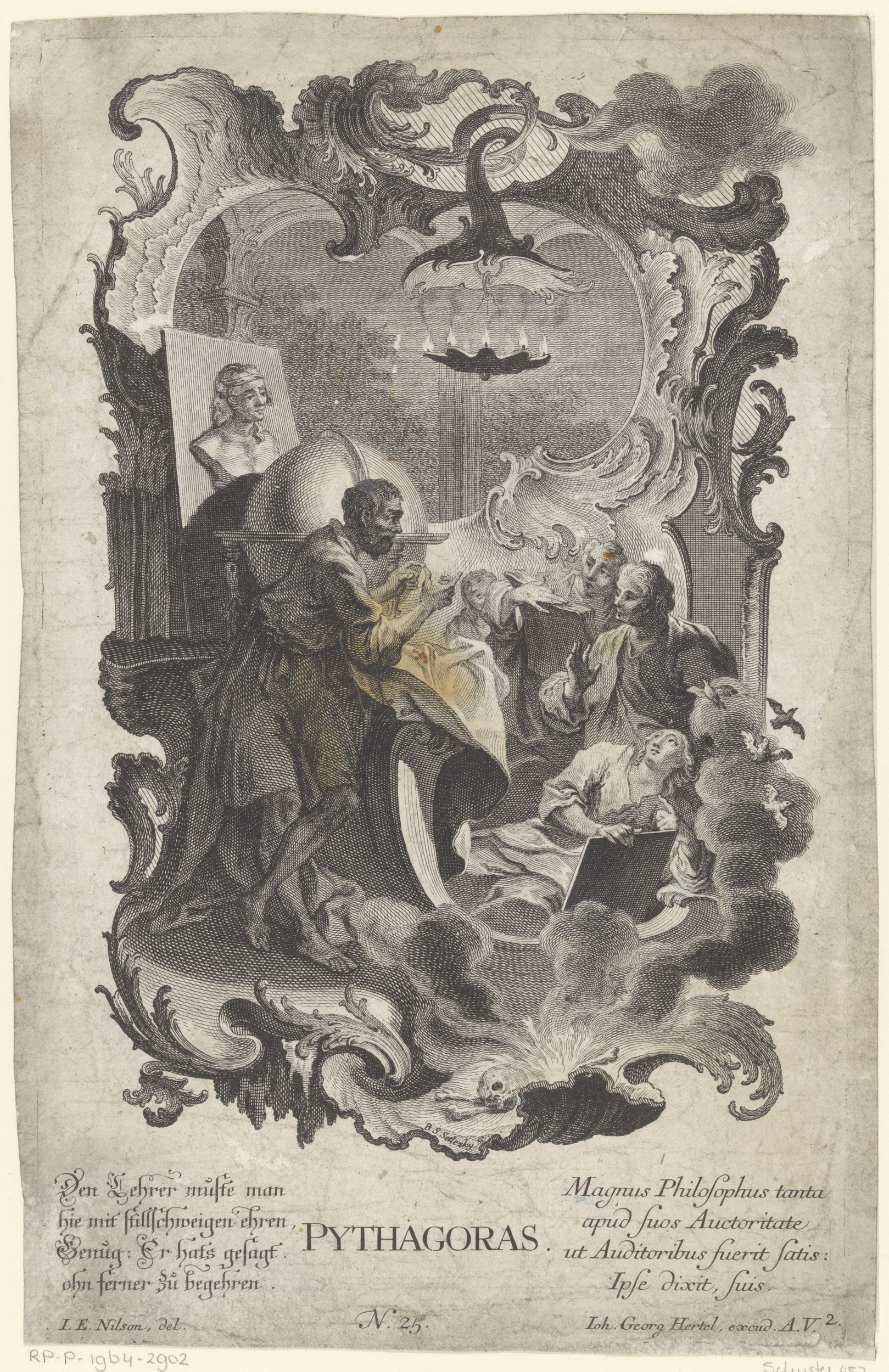
Pythagoras Leaning on a Globe with Four Listeners
 Book
Secondary source
Metaphysics
Aristotle · c. 400 BCE
 Book
Secondary source
Life of Pythagoras
Porphyry · c. 270 AD
Ready when you are
Start chatting with Pythagoras now.
20 messages free · No credit card · Available in 50+ languages.