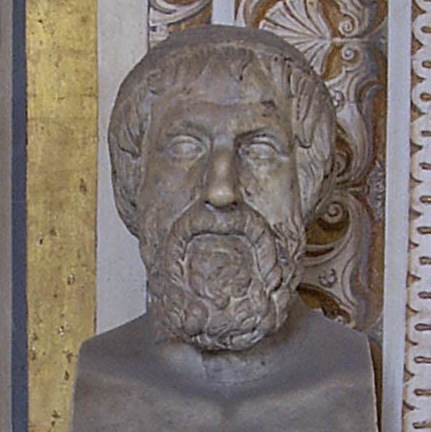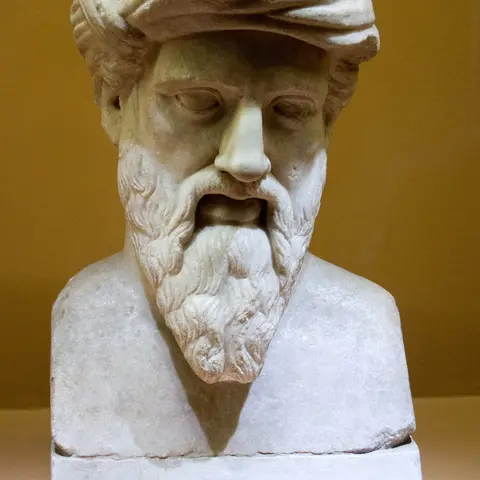

Portrait of Pythagoras

AI Historical Figure

Pythagoras

Ancient Greek mathematician and philosopher, known for the Pythagorean theorem.

Chat with Pythagoras via text or voice — in 42 languages, drawing on a curated biography and 86 historical sources. Available 24/7.

Start chatting with Pythagoras20 messages free · No credit card
Lived
c. 570–495 BCE
From
Greece
Known for
PhilosophyScience & medicine
Pythagoras

Pythagoras

Online · responds in seconds

Hello — I'm Pythagoras. Ancient Greek mathematician and philosopher, known for the Pythagorean theorem. What would you like to ask me?

20 messages free · No credit card · Powered by Humy.ai

Live preview · Switch between 42 languages above · Send a message to continue in the app

Multilingual

Talk to Pythagoras in 42 languages

Ask Pythagoras questions in any language below, and the rest of Humy's app speaks it too. Pick yours to open the chat in that language.

Also in German (Austria), German (Switzerland), English (UK), English (Australia), English (Canada).

The sources behind this AI

86 sources · 32 books · 31 paintings · 10 sculptures · 9 artifacts · 3 photographs · 1 document

Pythagoras doesn’t improvise from thin air. The AI is grounded in 86 curated historical sources students can inspect. Open any of them to see what informs the conversation.

Front cover of a dark black clothbound book with a circular blind-embossed Bohn's Libraries seal in the center and a partial light blue label with cut-off text reading 'nia' and 'd' on the left edge.Book

Secondary source

Lives and Opinions of Eminent Philosophers, Book V (Life of Aristotle)

Diogenes Laërtius · c. 3rd century CE

Photograph of a brown papyrus fragment with black Greek uncial-style handwriting in about twelve lines, with a measuring ruler along the right edge marked in centimetres. The fragment has ragged edges and visible fibres.Book

Secondary source

Histories

Herodotus · c. 440 BCE

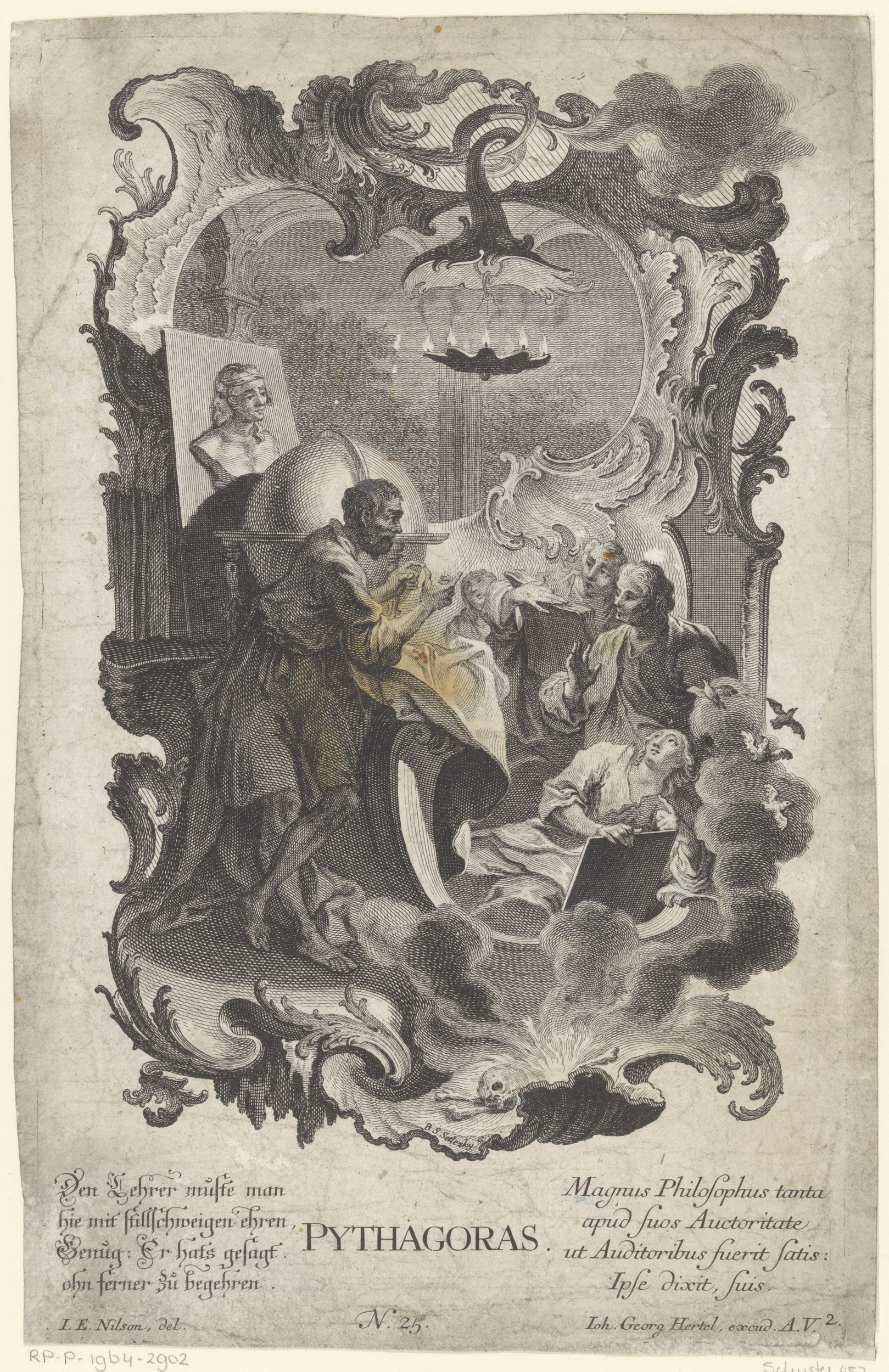
Engraved print in a rococo frame. An elderly bearded man in a long robe stands at left with his hand on a globe, beside a bust on a pedestal. Four listeners gather at right, one seated writing in a book. Smoke rises from a skull at the bottom. Verses and the name PYTHAGORAS appear below.Painting

Secondary source

Pythagoras Leaning on a Globe with Four Listeners

Manuscript page 124 with several dense lines of handwritten Greek text in brown ink on aged, yellowed paper. Marginal marks and a numbered page label appear at the top right.Book

Secondary source

Metaphysics

Aristotle · c. 400 BCE

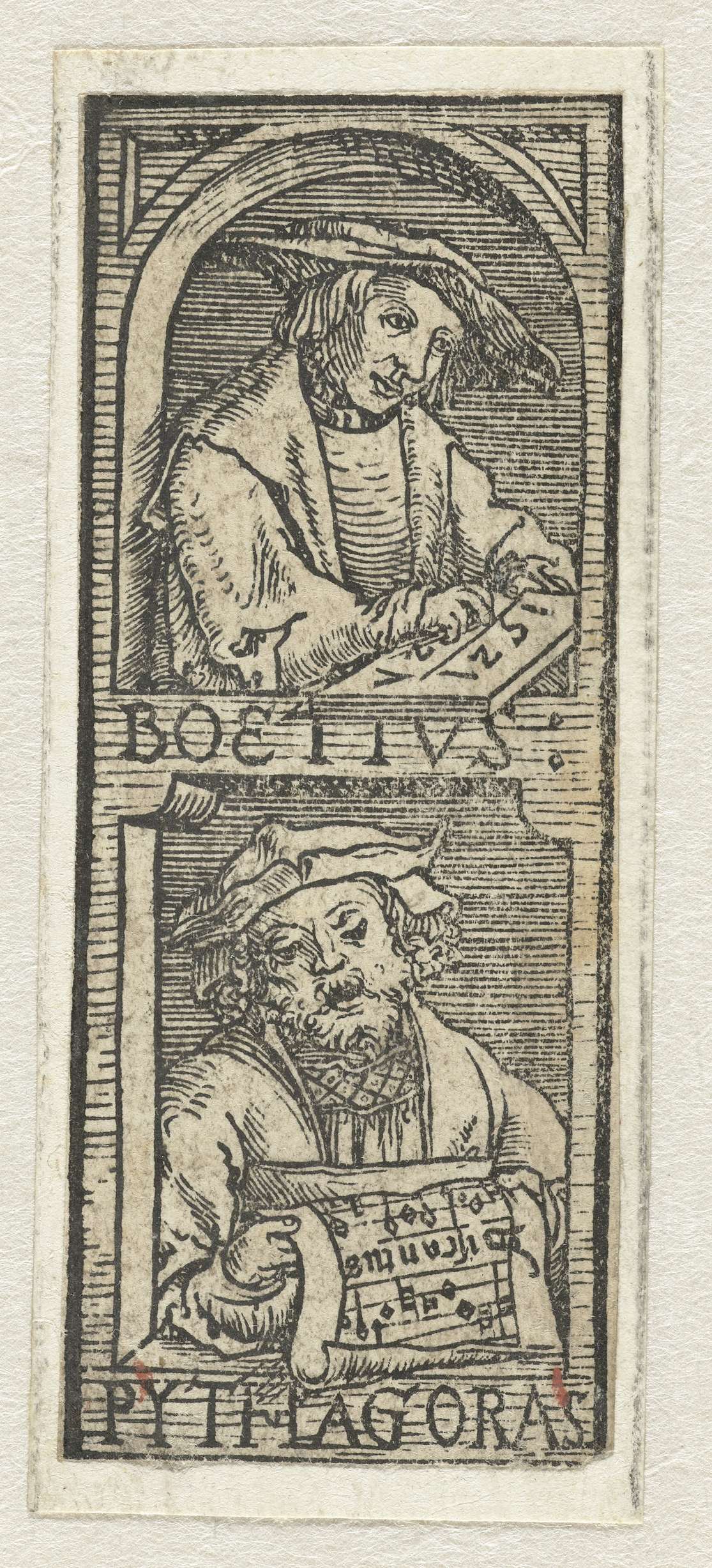
Woodcut print with two framed figures stacked vertically. Above, a figure in a hat with a long robe writes on a tablet inside an arched frame, labeled BOETIVS. Below, an older bearded man in a cap looks upward, holding a sheet of music notation, labeled PYTHAGORAS.Painting

Secondary source

Boethius and Pythagoras

1521

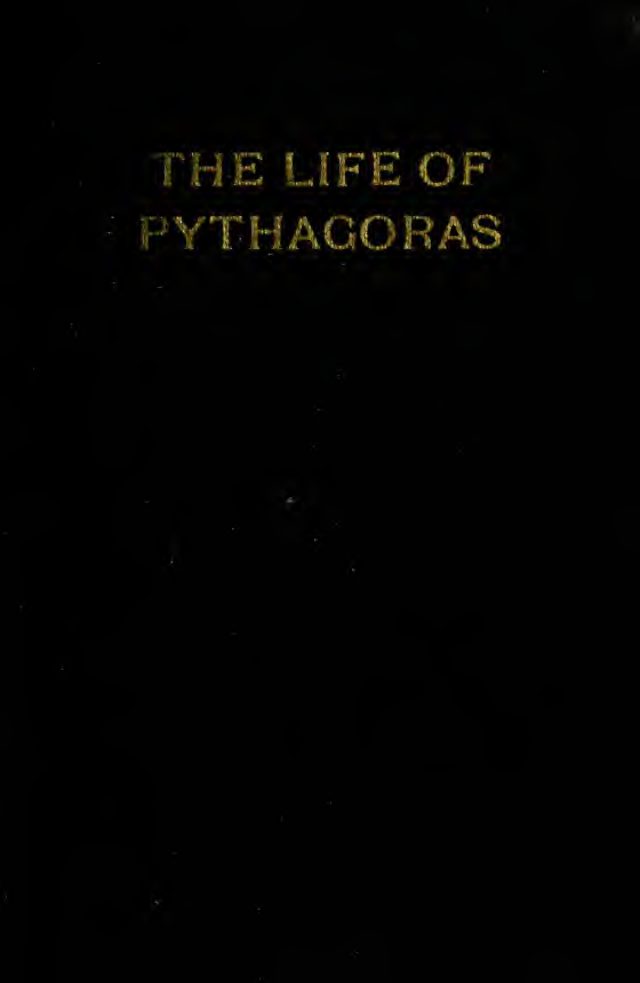
Black cover of a book with gold lettering reading 'THE LIFE OF PYTHAGORAS' in two lines at the top. The rest of the cover is plain black.Book

Secondary source

Life of Pythagoras

Porphyry · c. 270 AD

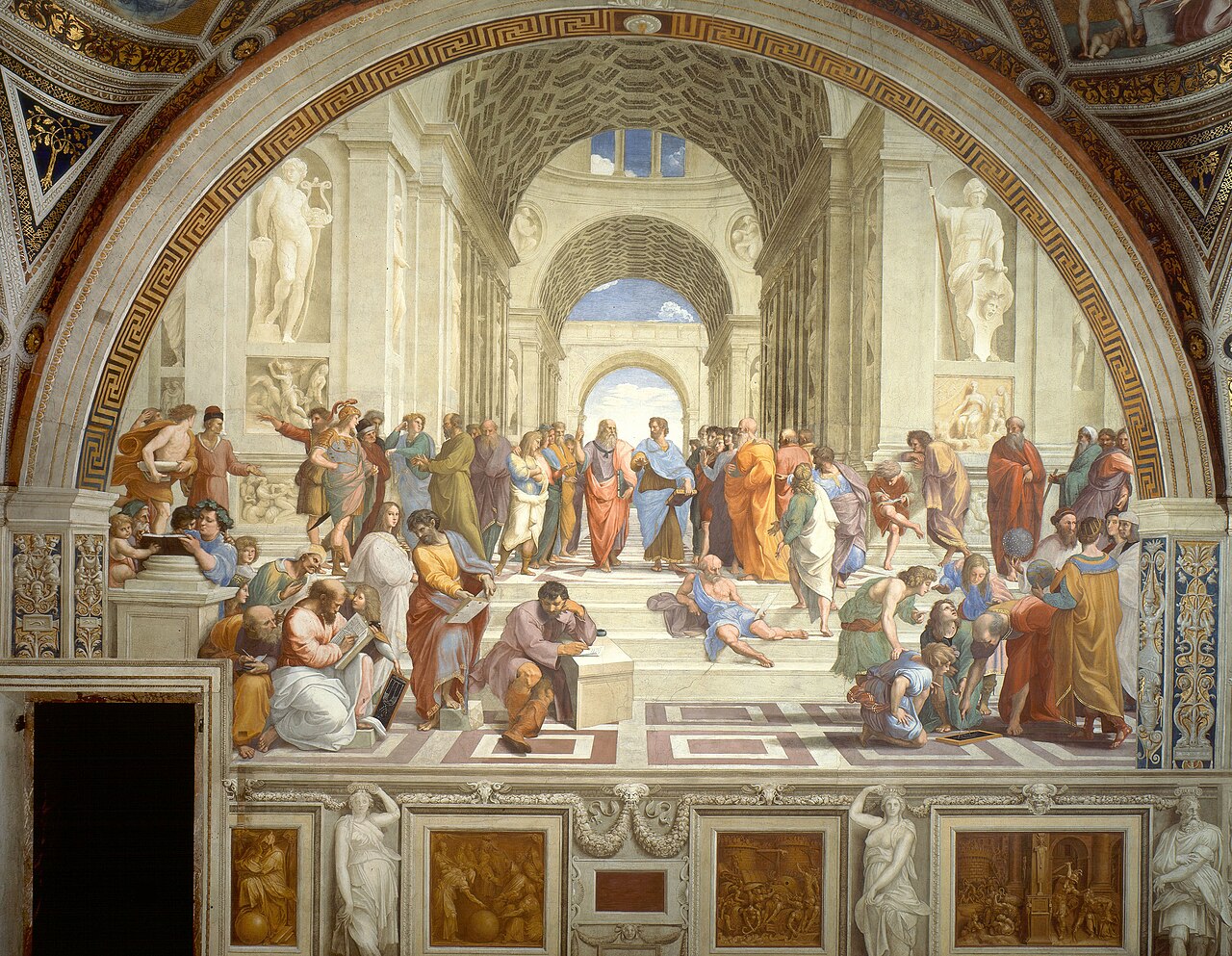
Raphael's fresco The School of Athens: a large Renaissance hall with arched ceiling and statues, filled with robed philosophers and scholars gathered on steps and a tiled floor. Two central figures in red and blue robes walk toward the viewer.Painting

Secondary source

The School of Athens

Raphael · 1509-1511

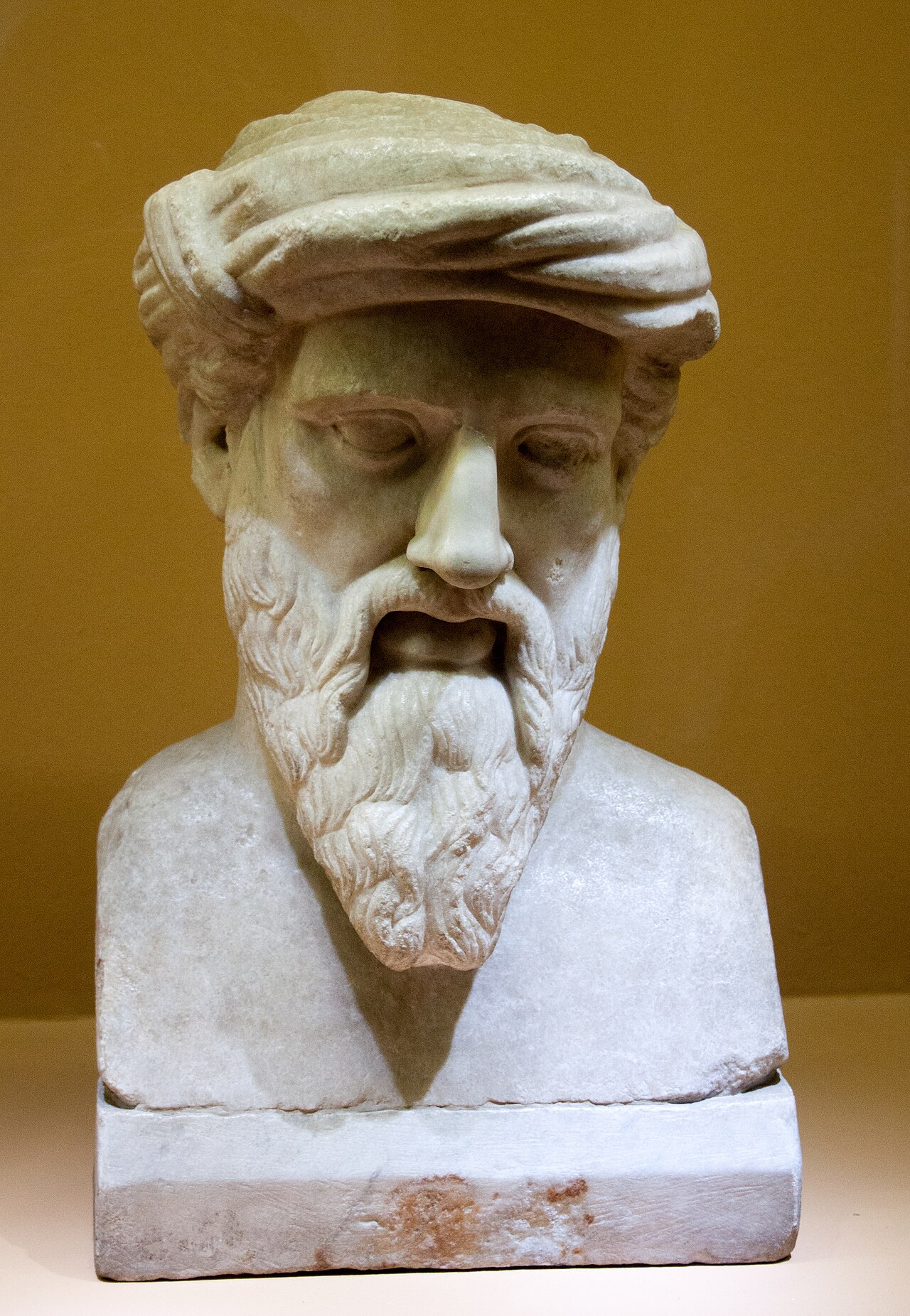
White marble bust of a bearded man wearing a draped turban-like head covering. He has deep-set eyes, a prominent nose, and a full wavy beard. The bust rests on a rectangular marble base against a yellow-ochre wall.Sculpture

Secondary source

Portrait of Pythagoras

2nd-1st century BC (Roman copy)

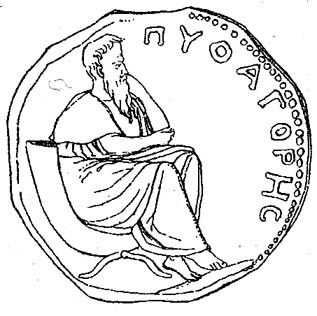
Black-and-white line drawing of a circular medallion showing a seated bearded man in long draped robes, chin resting on his hand. The Greek inscription ΠΥΘΑΓΟΡΗΣ runs around the rim.Artifact

Secondary source

Pythagoras on a Samian Coin

Roman imperial era

Book

Secondary source

The Golden Verses of Pythagoras

Pythagoras (traditionally attributed) · uncertain, possibly 3rd century BCE to 5th century CE

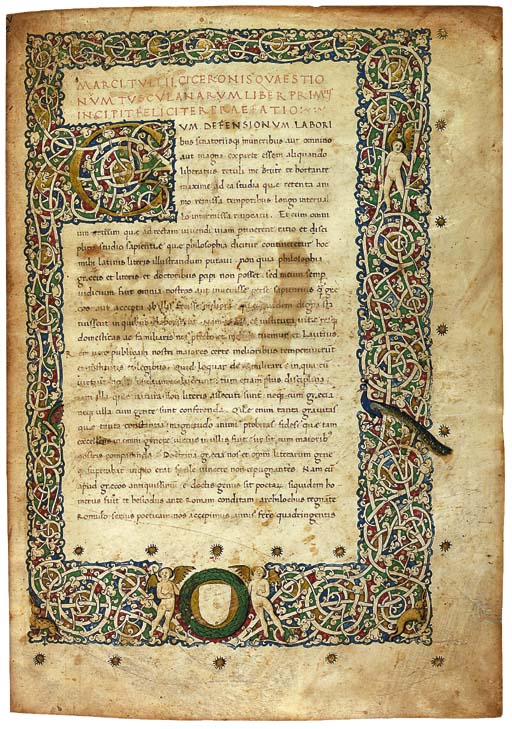
Illuminated manuscript page on vellum with a red-ink rubricated title at the top reading the opening of Cicero's Tusculan Disputations. Decorative borders of interlaced green, red and gold foliage frame the dense black Latin text. Gold and green initial letters and small putti or figures appear in the margins, with a green and gold roundel at the bottom.Book

Primary source

Tusculanae Disputationes

Cicero · c. 45 BCE

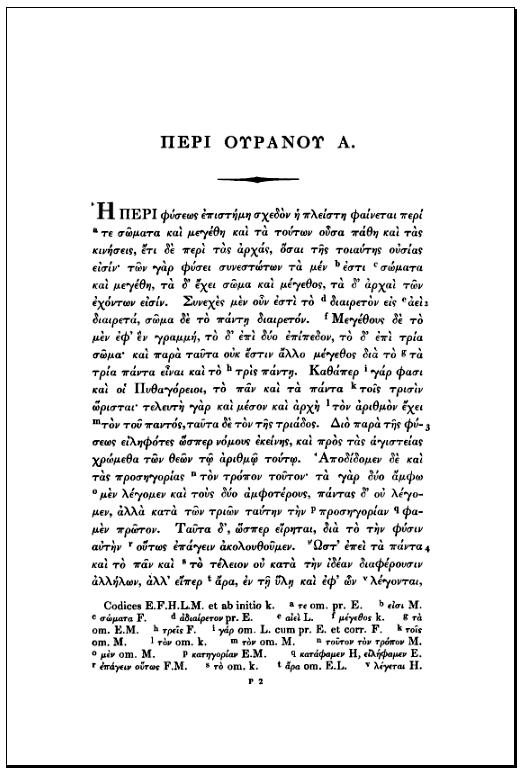
Scanned page of Aristotle's On the Heavens in Greek, showing the title 'ΠΕΡΙ ΟΥΡΑΝΟΥ Α' centered above a block of italic and roman Greek text with critical apparatus notes in small type at the bottom and page number 2 below.Book

Primary source

On the Heavens

Aristotle · c. 350 BCE

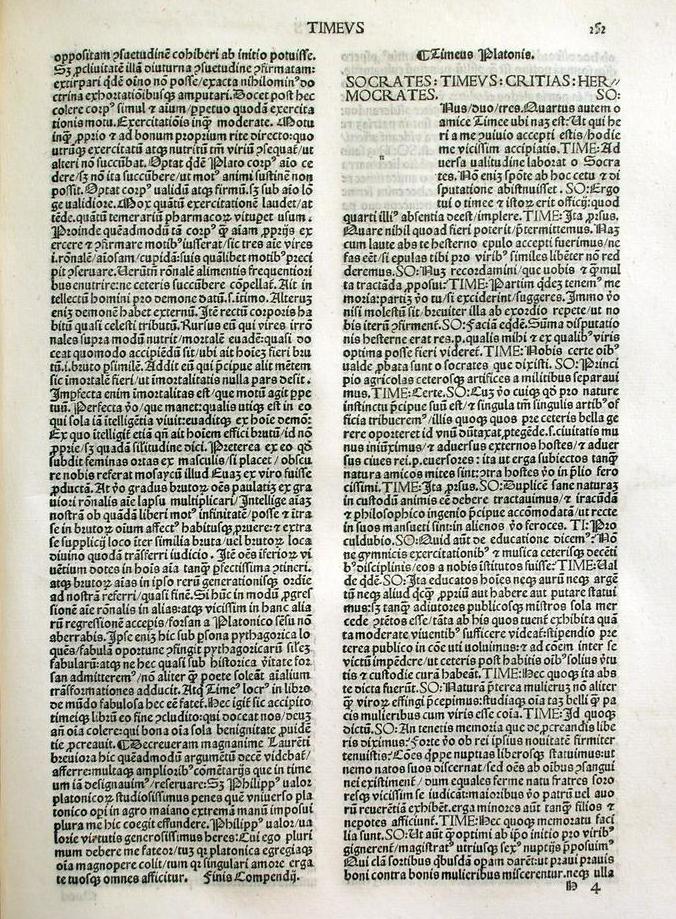
Scanned page from an early printed Latin edition of Plato's Timaeus, page numbered 252 at top right, with a running header reading TIMEUS and the heading Timeus Platonis. Dense two-column black-letter text with marginal notes and a woodcut-style initial, with a dialogue cast list naming Socrates, Timaeus, and Critias.Book

Secondary source

Timaeus

Plato · c. 360 BCE

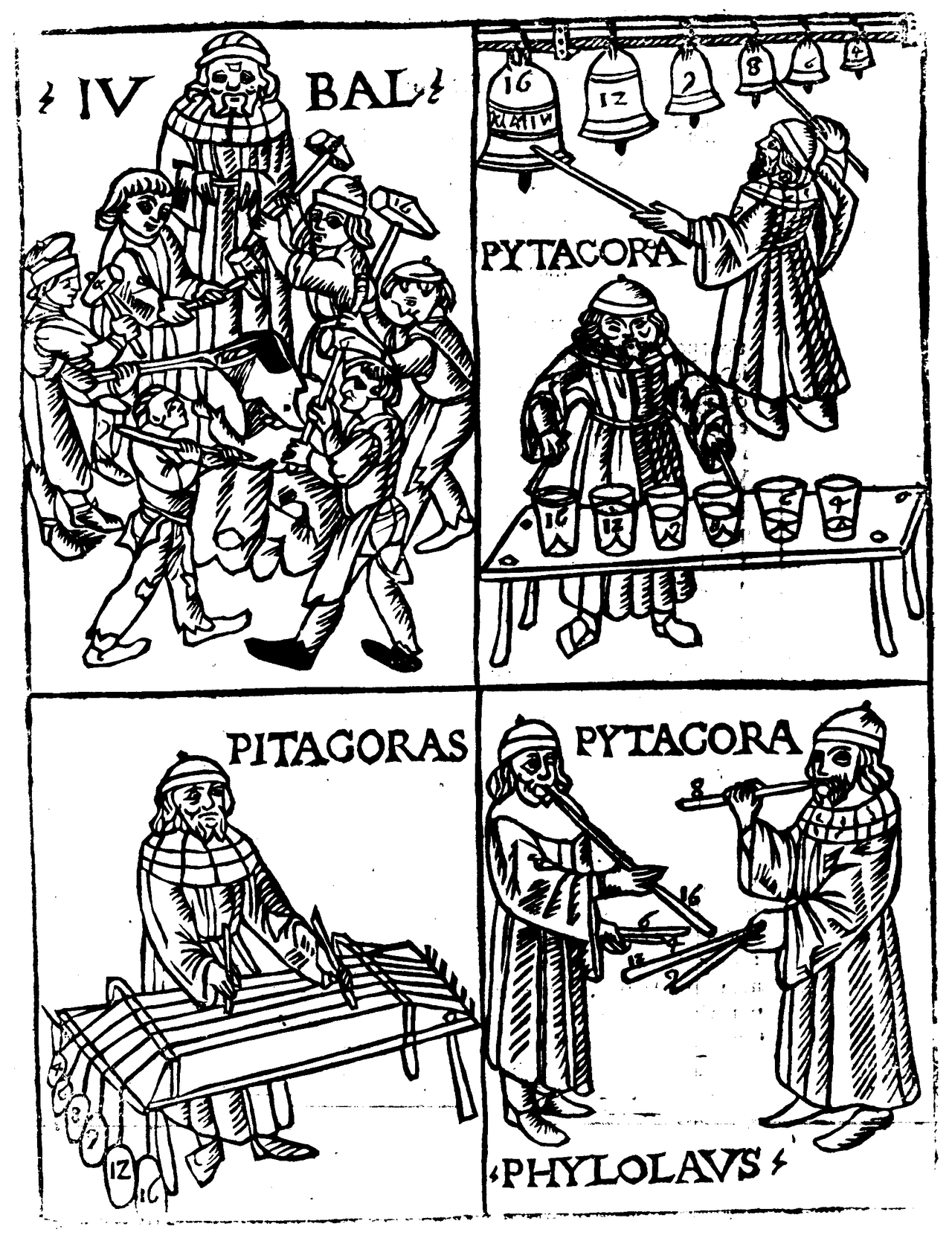
Woodcut with four panels from a Renaissance music treatise. Top left: men with hammers strike anvils, labeled IV BAL. Top right: a man strikes bells labeled 16, 12, 9, 8, 6 while a bearded man in a cap pours into glasses marked with numbers on a table, labeled PYTAGORA. Bottom left: a bearded man plays a monochord-like instrument with weights hanging below, labeled PITAGORAS. Bottom right: two men with pipes and sticks, labeled PYTAGORA and PHYLOLAUS.Painting

Secondary source

Gaffurio Pythagoras Woodcut

Unknown author · 1492

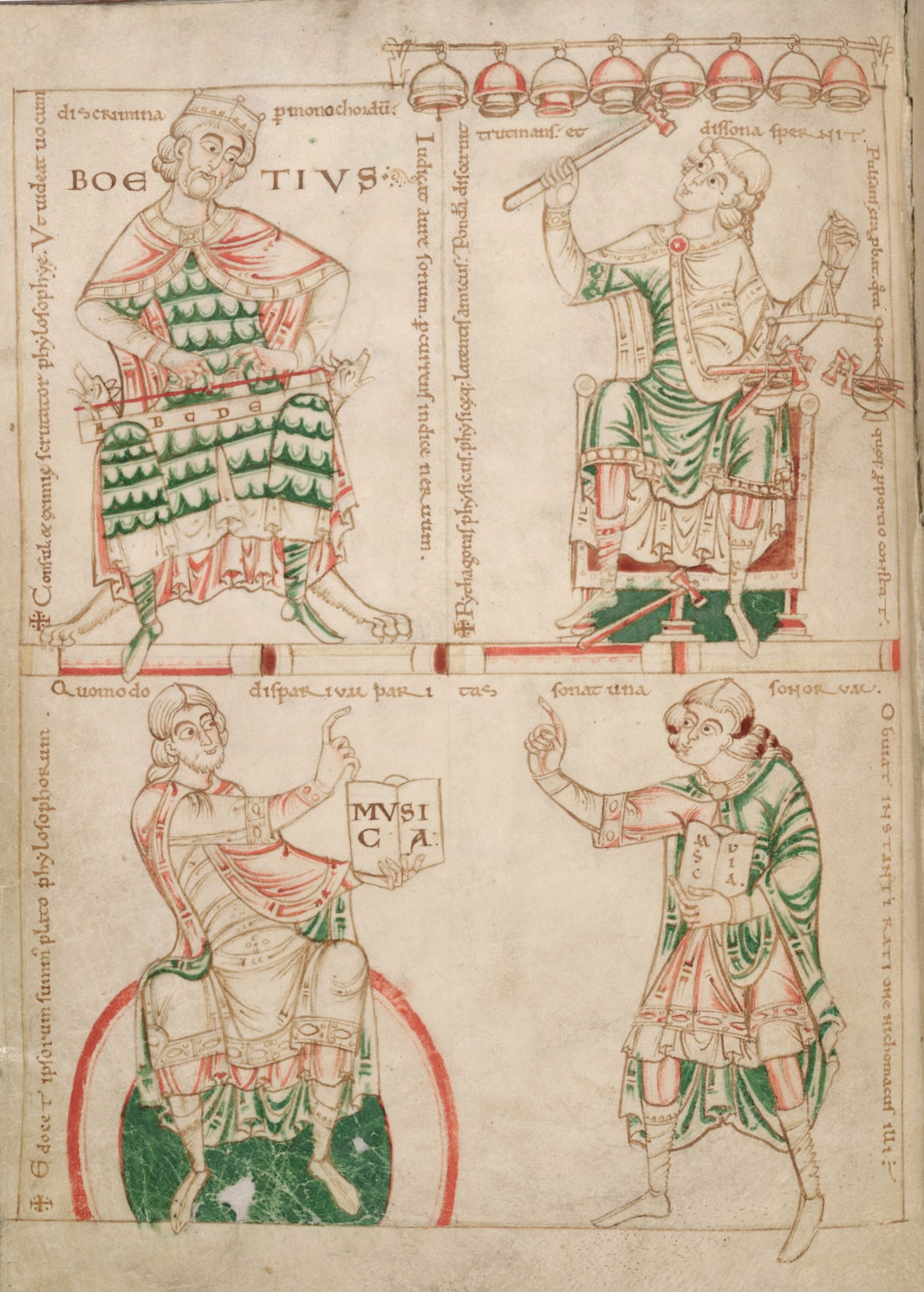
Manuscript page with four framed medieval illustrations of men and labeled text. Top left, a crowned figure with a monochord; top right, a seated man holding a hammer beside bells and scales; bottom left, a man holding a book labeled MUSICA; bottom right, a standing man holding a book labeled MUSICA and pointing upward. Latin inscriptions run between panels.Book

Secondary source

De institutione musica

Boethius · c. 500

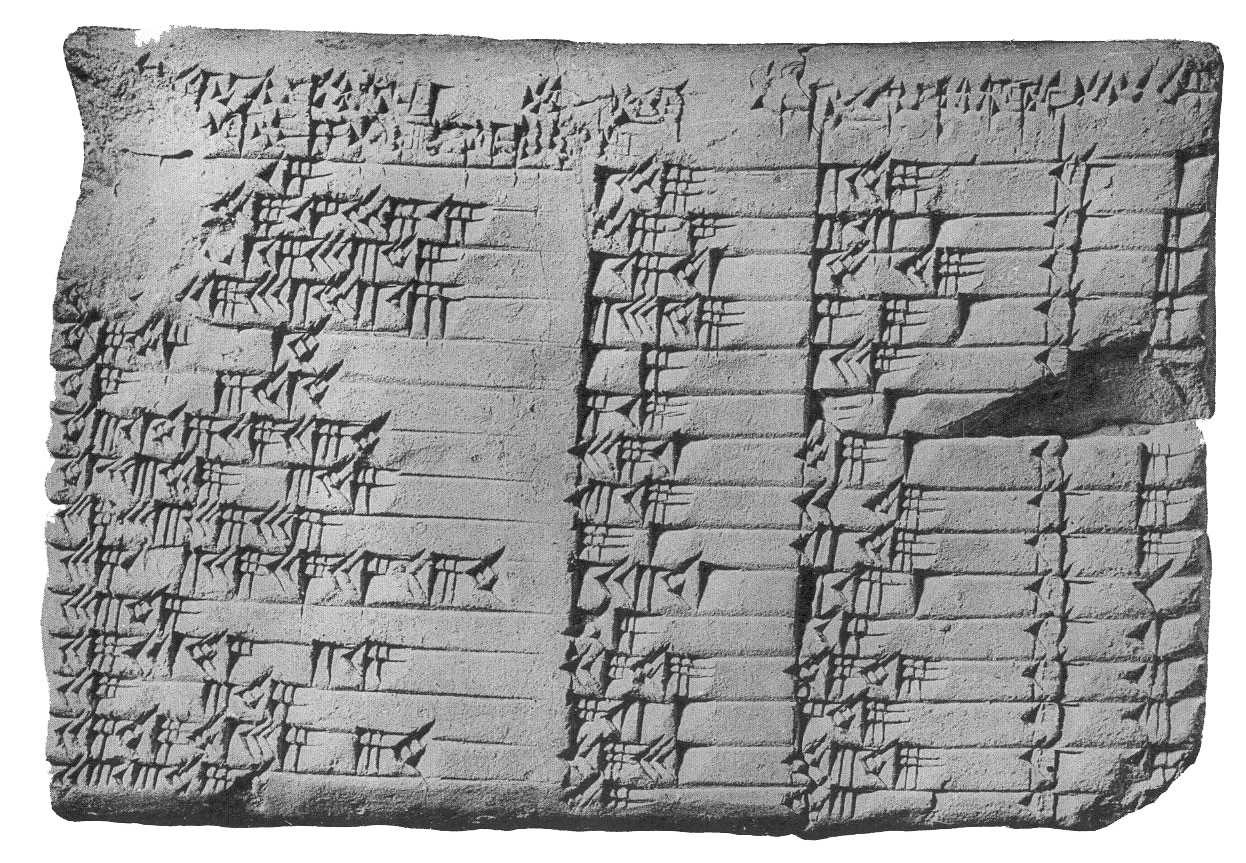
Black and white photograph of a clay tablet covered in cuneiform wedge-shaped script arranged in rows and columns. The tablet is broken on its edges, with the script organized into several vertical columns of numerical entries.Document

Primary source

Plimpton 322

c. 1800 BC

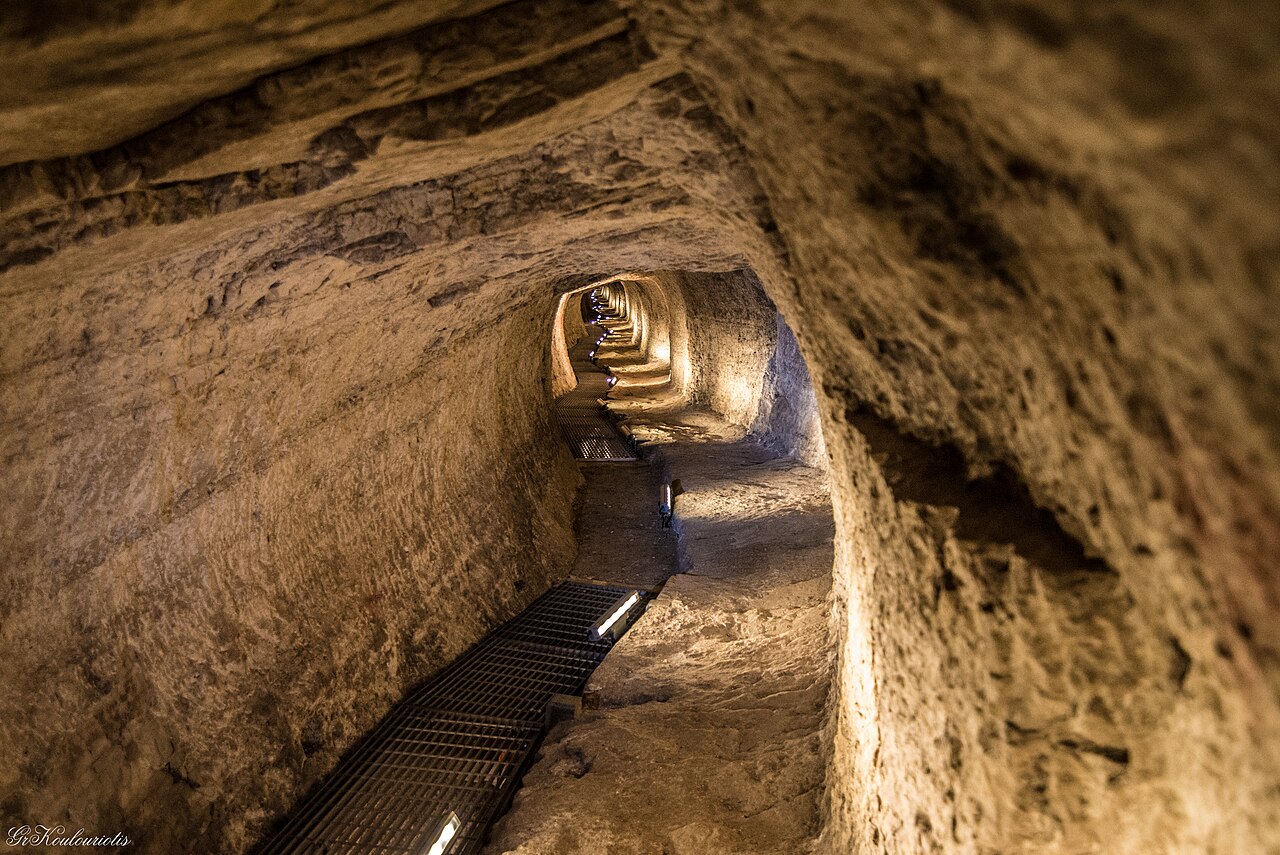
Interior of a narrow rock-cut tunnel with curved, rough stone walls and ceiling. A metal grate walkway runs along the floor on the left, with lights along the path receding into the distance toward a bright opening.Artifact

Primary source

Tunnel of Eupalinos

Eupalinos · 6th century BC

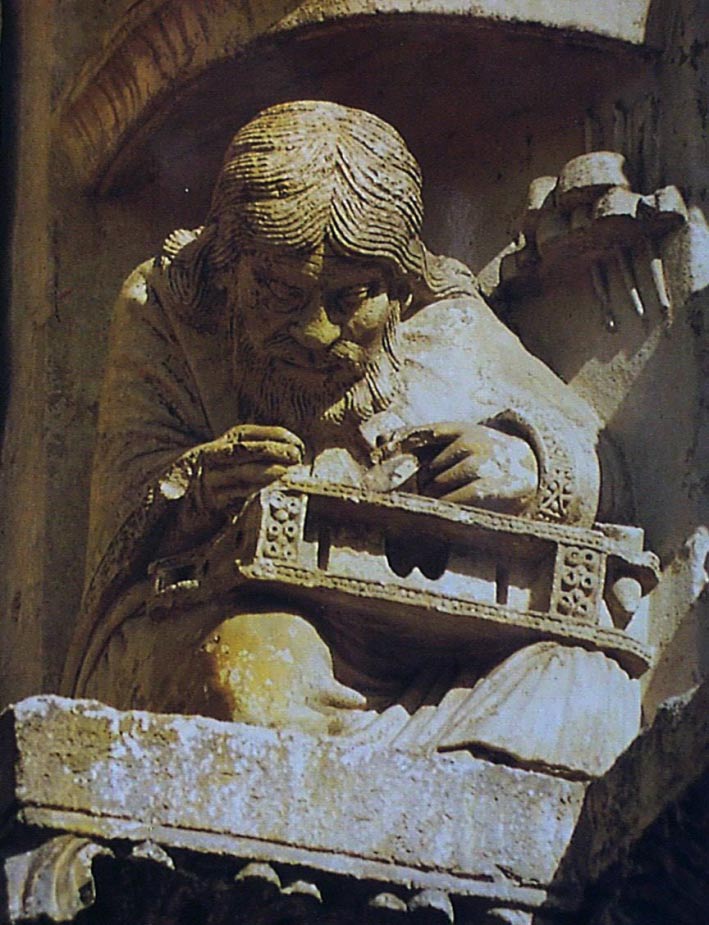
Photo of a weathered stone sculpture of a bearded man with wavy hair and a draped robe, leaning forward and working with both hands on a rectangular box-like instrument with carved panels, set within a carved stone arch.Sculpture

Secondary source

Pythagoras at Chartres Cathedral

Jean-Louis Lascoux

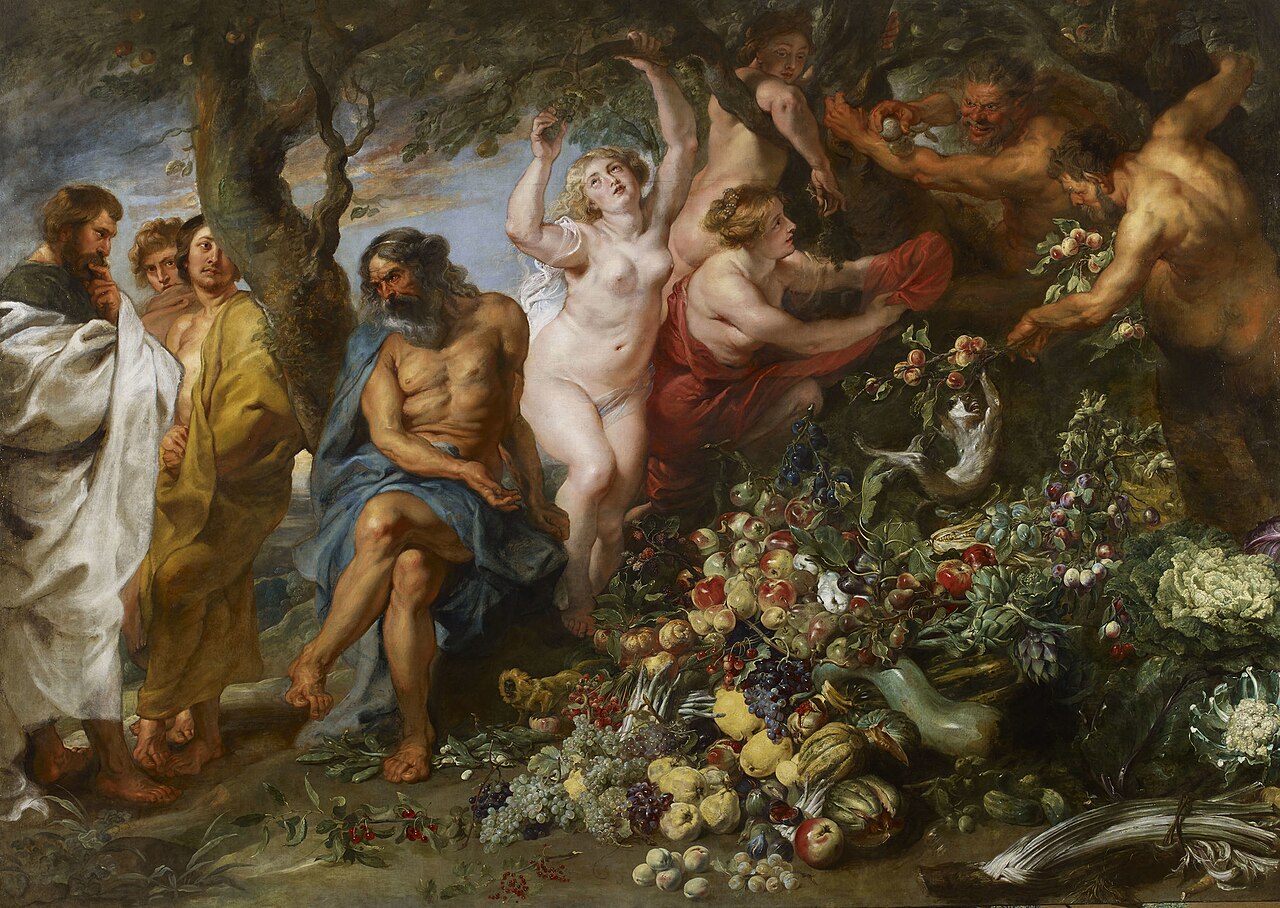
Painting of a classical scene: at left, three men in robes and cloaks, one in white with hand to chin; a bearded seated man with bare torso points toward a heap of fruit and vegetables. A nude woman reaches up into a tree, and a figure in red drapery reaches for fruit. Two figures at upper right pick apples. Foreground: a large still life of fruit and vegetables.Painting

Secondary source

Pythagoras Advocating Vegetarianism

Peter Paul Rubens · 1624

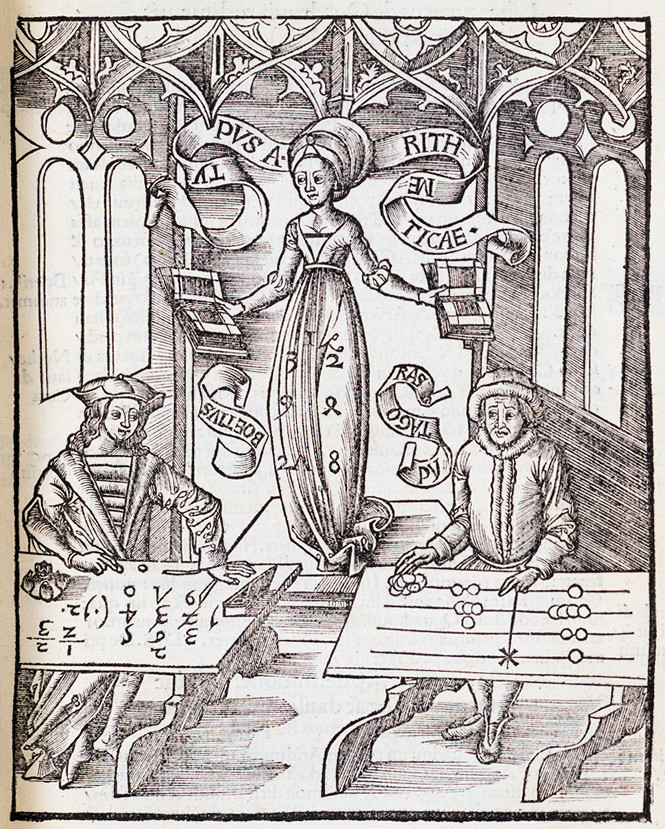
Woodcut from Margarita Philosophica (1503) titled Typus arithmeticae. A crowned female figure labeled Arithmetica stands centrally holding books and scrolls. At left, a seated man writes numerals on a table; at right, a seated man calculates with counters on a reckoning board. Gothic arches frame the scene.Painting

Secondary source

Typus arithmeticae

Gregor Reisch · 1503

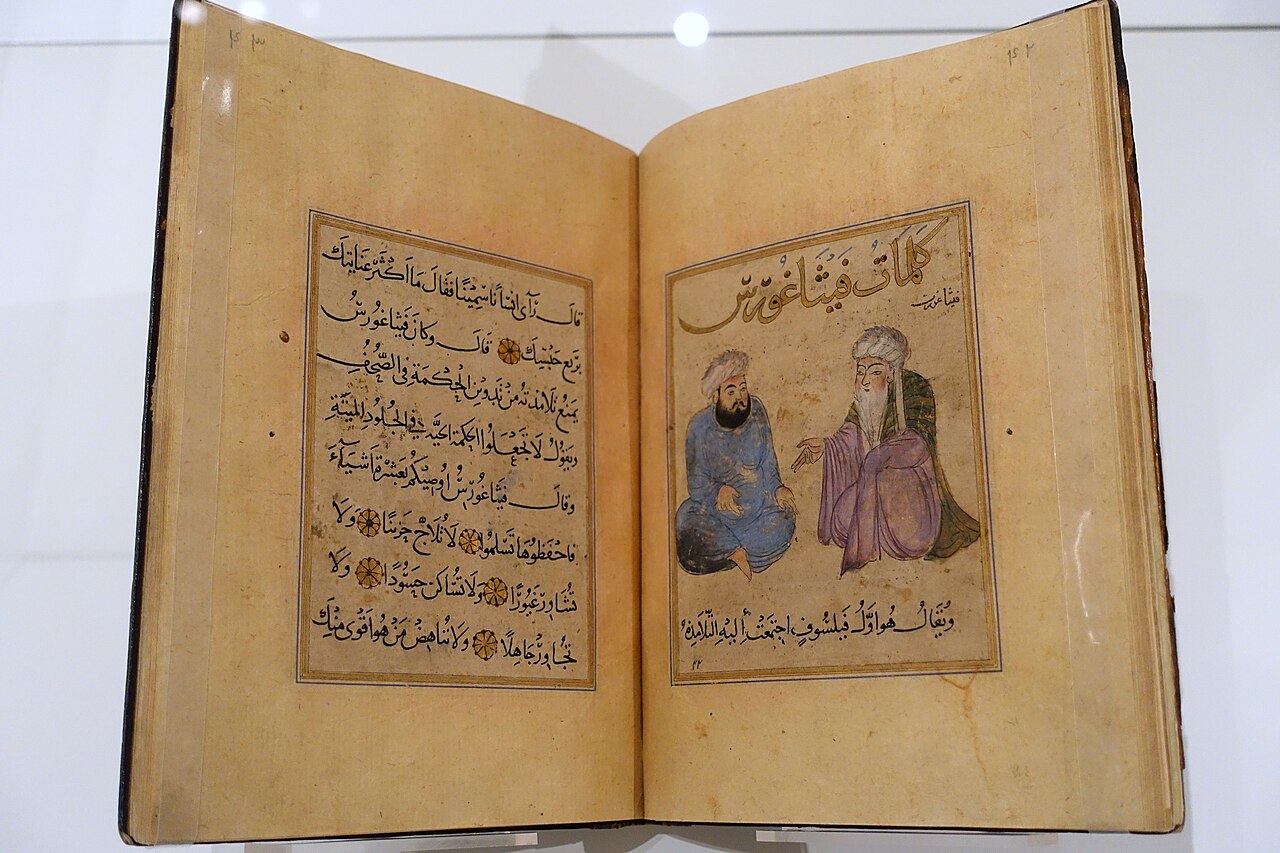
An open illuminated manuscript displayed in a museum case. The left page has Arabic calligraphy in a framed text block with gold rosette markers. The right page has a painted miniature of two bearded men seated in conversation, one in blue and one in purple robes, with Arabic inscription above and below.Book

Secondary source

Sayings of Pythagoras

Yaqut Al-Musta'simi and Mahmud b. Abi'l-Mahasin Al-Qashi · late 13th century AD

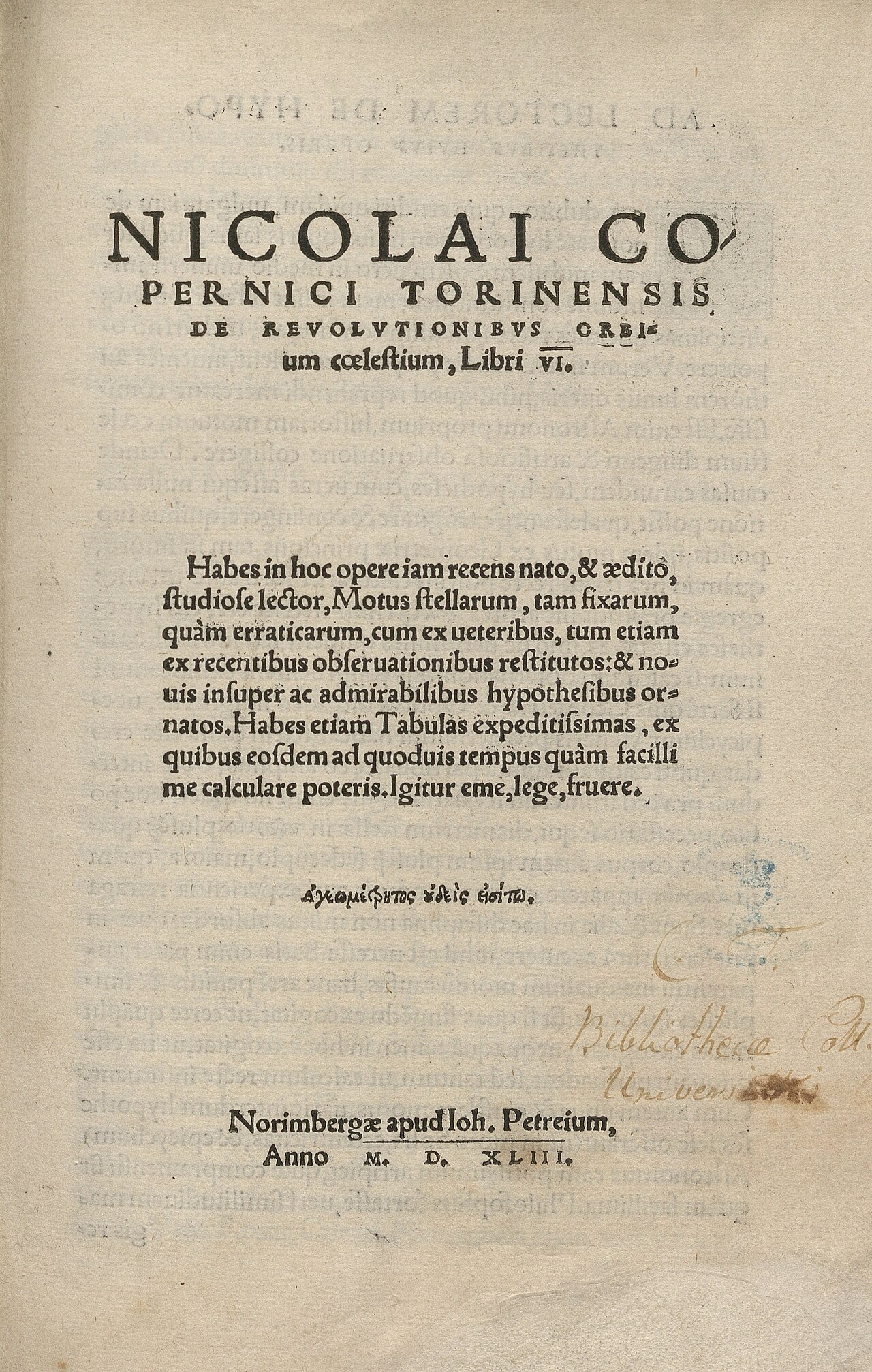
Title page of Nicolaus Copernicus's De revolutionibus orbium coelestium, printed 1543 in Nuremberg by Johann Petreius. Large capitals read NICOLAI COPERNICI TORINENSIS, followed by the book title and an address to the reader in Latin. Handwritten ink marks read Bibliotheca and Univers, and a Greek motto appears below the text.Book

Primary source

De revolutionibus orbium coelestium

Nicolaus Copernicus · 1543

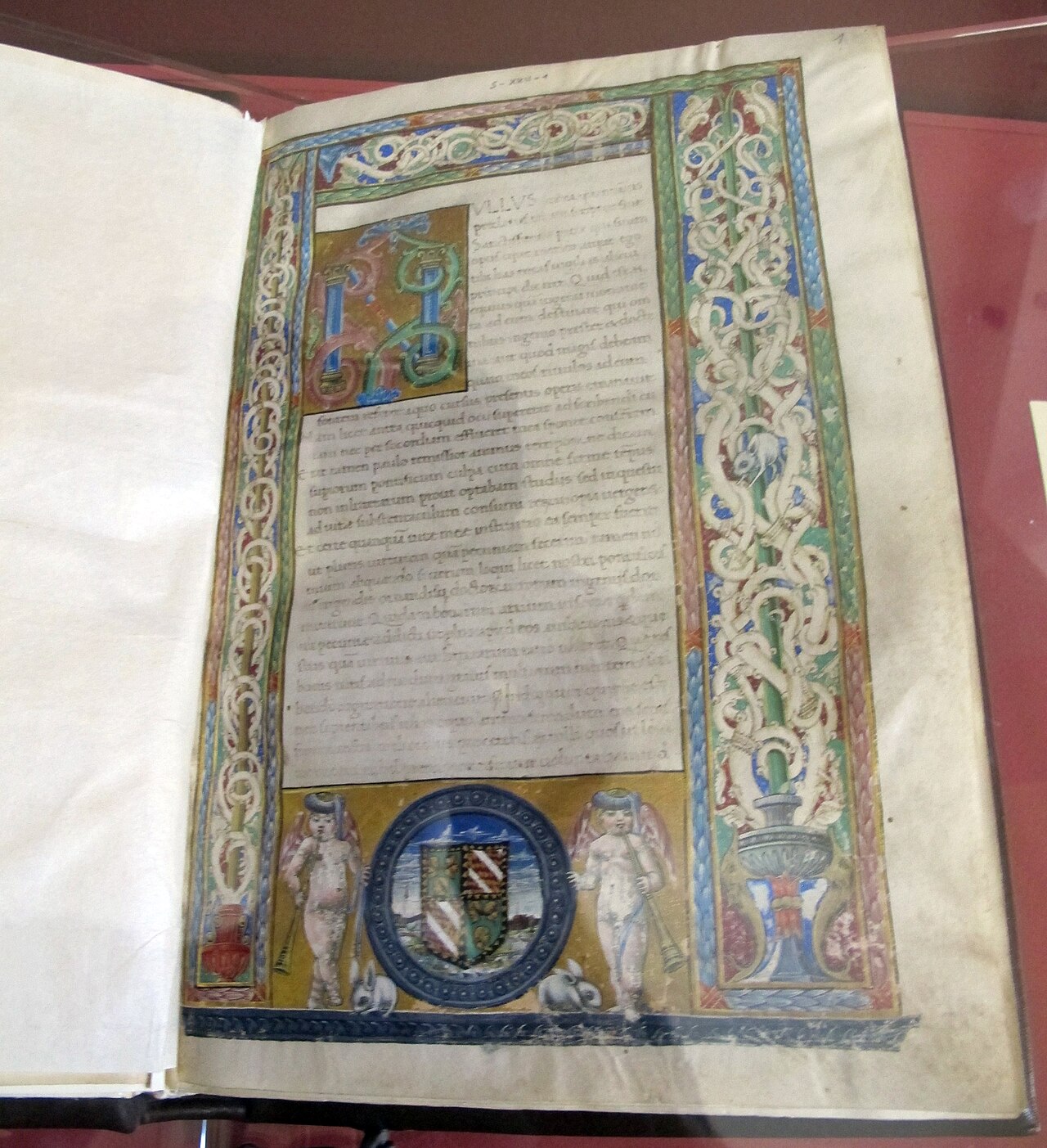
Open illuminated manuscript page on vellum in a display case, with a decorative border of foliage and interlace, a historiated initial, and a central text block in Latin script. A circular coat of arms with angels and rabbits appears at the bottom.Book

Secondary source

Bibliotheca Historica

Diodorus Siculus · 1st century BCE

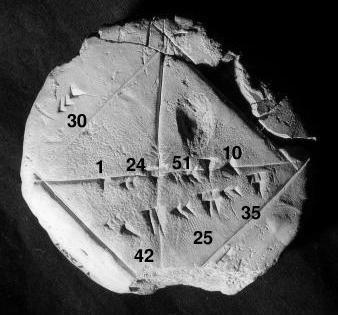
Black and white photograph of a clay tablet, roughly circular with a broken edge, showing cuneiform wedge marks and labeled numbers 30, 1, 24, 51, 10, 35, 25, 42 inscribed in a diagonal and square diagram.Artifact

Primary source

YBC 7289

c. 1800-1600 BC

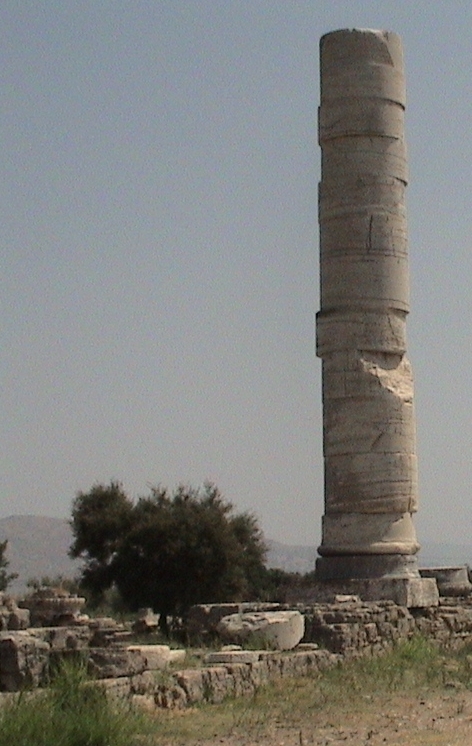
A single tall, weathered marble column rises from a low base of ancient stone blocks, with a small green tree and dry hills in the background under a pale sky. This is the standing column of the Heraion of Samos.Artifact

Primary source

Heraion of Samos

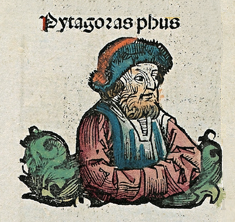
Woodcut-style illustration of a bearded man in a red hat and blue-green robe, with the label 'Pythagoras' above him in a decorative typeface. Green foliage or scrollwork decorates the lower corners of the page.Painting

Secondary source

Pythagoras Inventing Music, Nuremberg Chronicle

Michel Wolgemut; Wilhelm Pleydenwurff

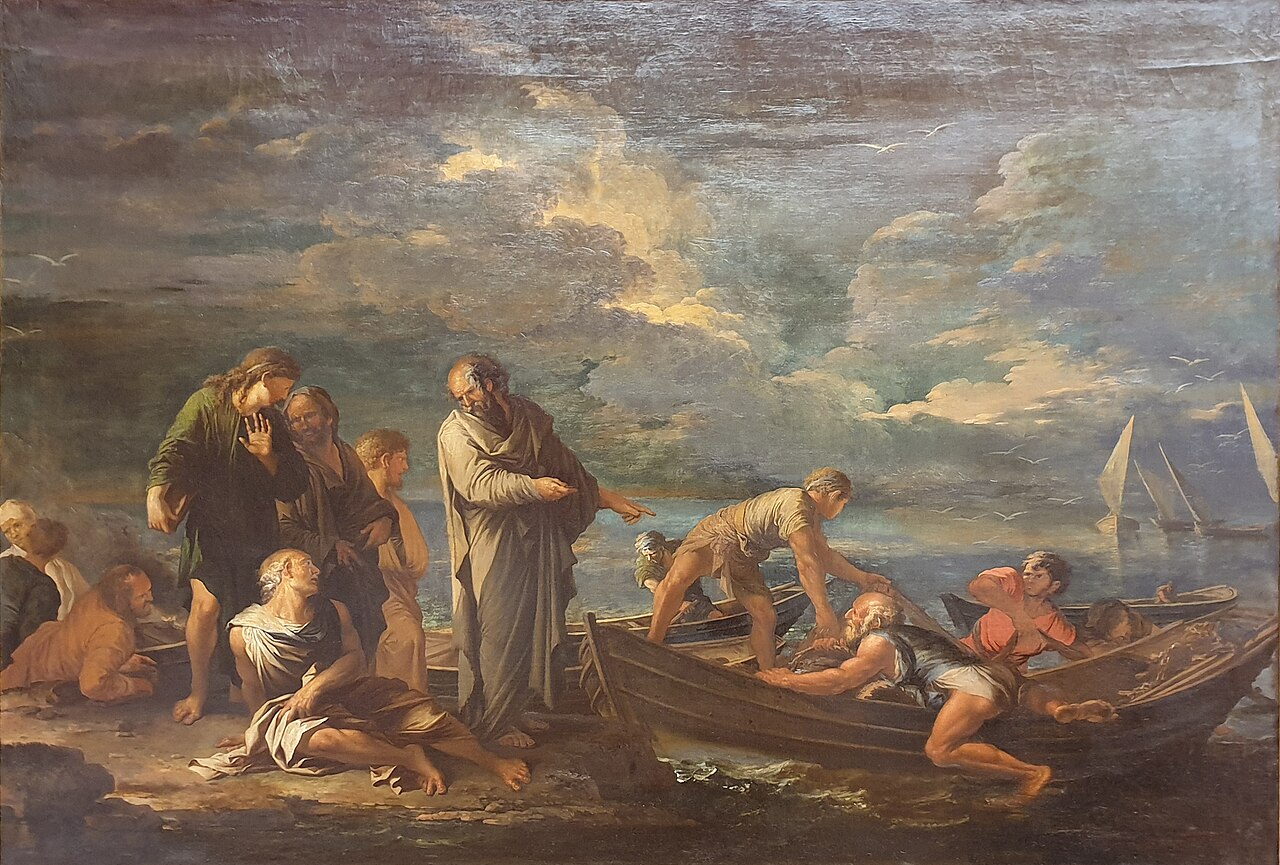
Painting of a shore scene under a dramatic cloudy sky. A bearded man in a grey robe stands center, pointing toward the sea. Figures in a wooden boat on the right are being helped ashore by men; others crowd and sit on the sand at left, with sailboats on the distant water.Painting

Secondary source

Pythagoras and the Fishermen

Salvator Rosa · 1662

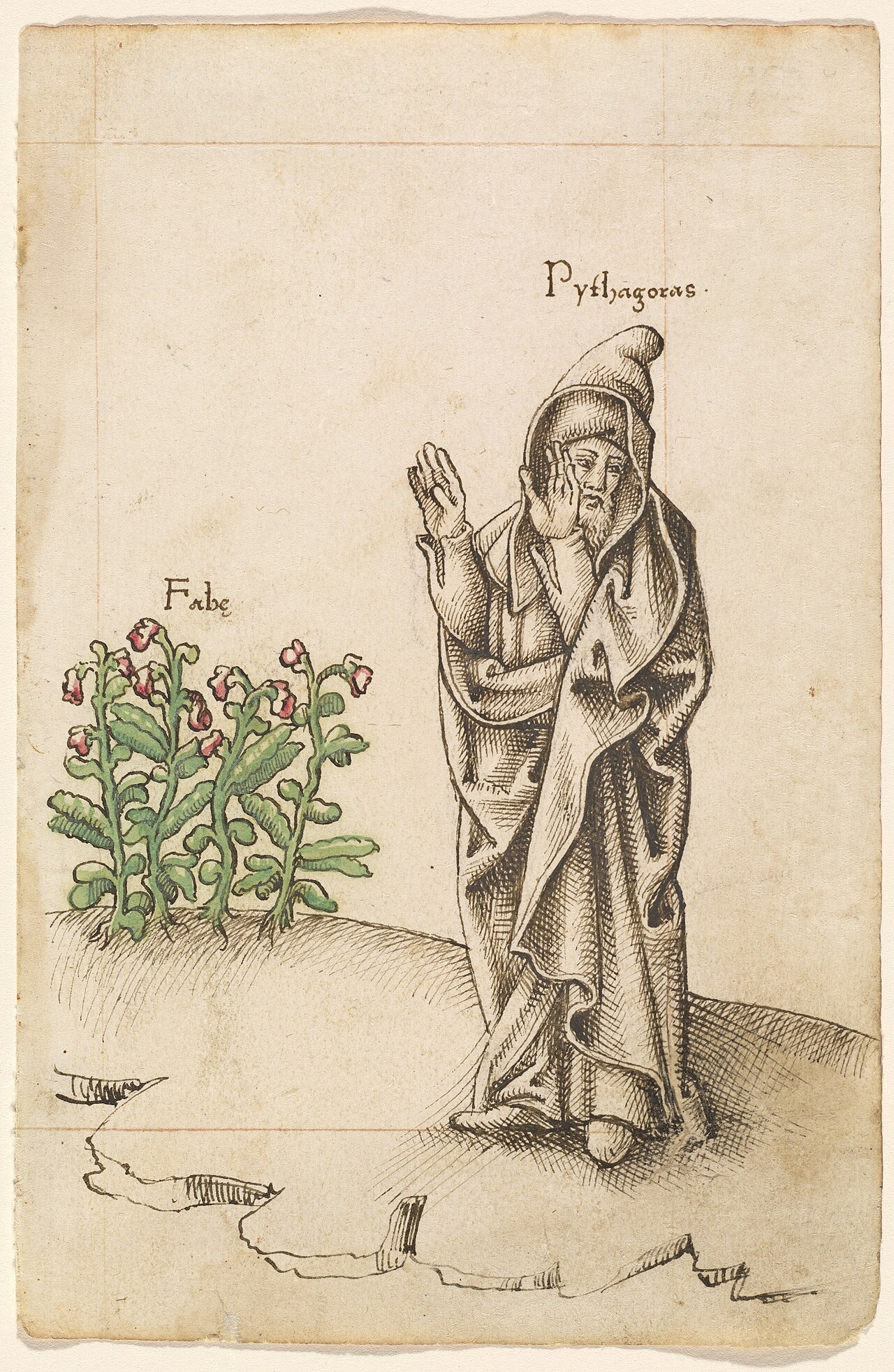
Pen and brown ink drawing with watercolor on paper. A robed, hooded bearded man labeled Pythagoras raises one hand and touches his face beside a green plant with red flowers labeled Fabe (bean). Rough ground line below.Painting

Secondary source

Do Not Eat Beans

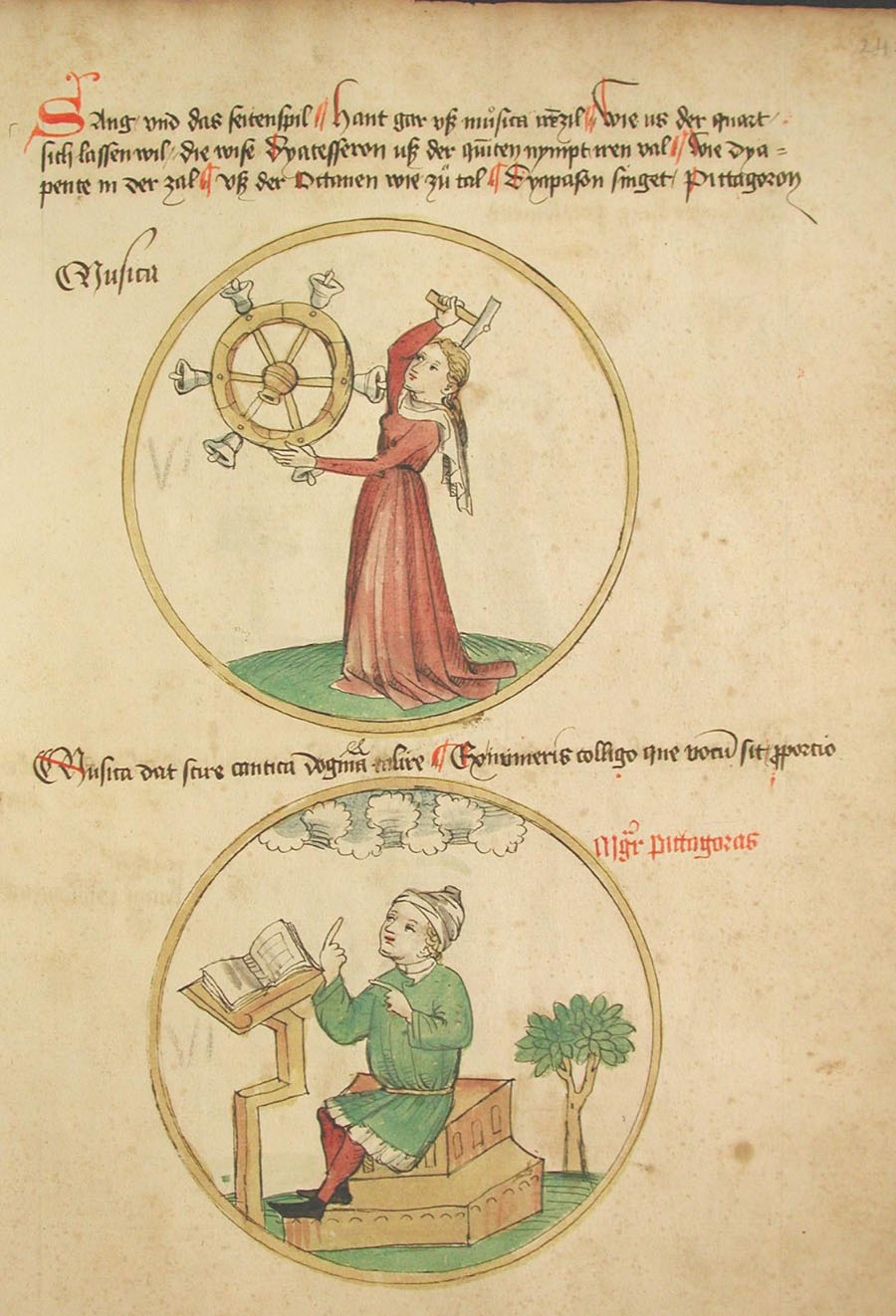
Medieval colored pen drawing on parchment page with German text above. Top circle: a woman in a red dress holds a wheel fitted with hanging bells, representing Musica. Bottom circle: a seated man in green robes points upward while reading an open book on a lectern, with a tree beside him, representing Pythagoras.Painting

Secondary source

The Seven Liberal Arts: Music and Pythagoras

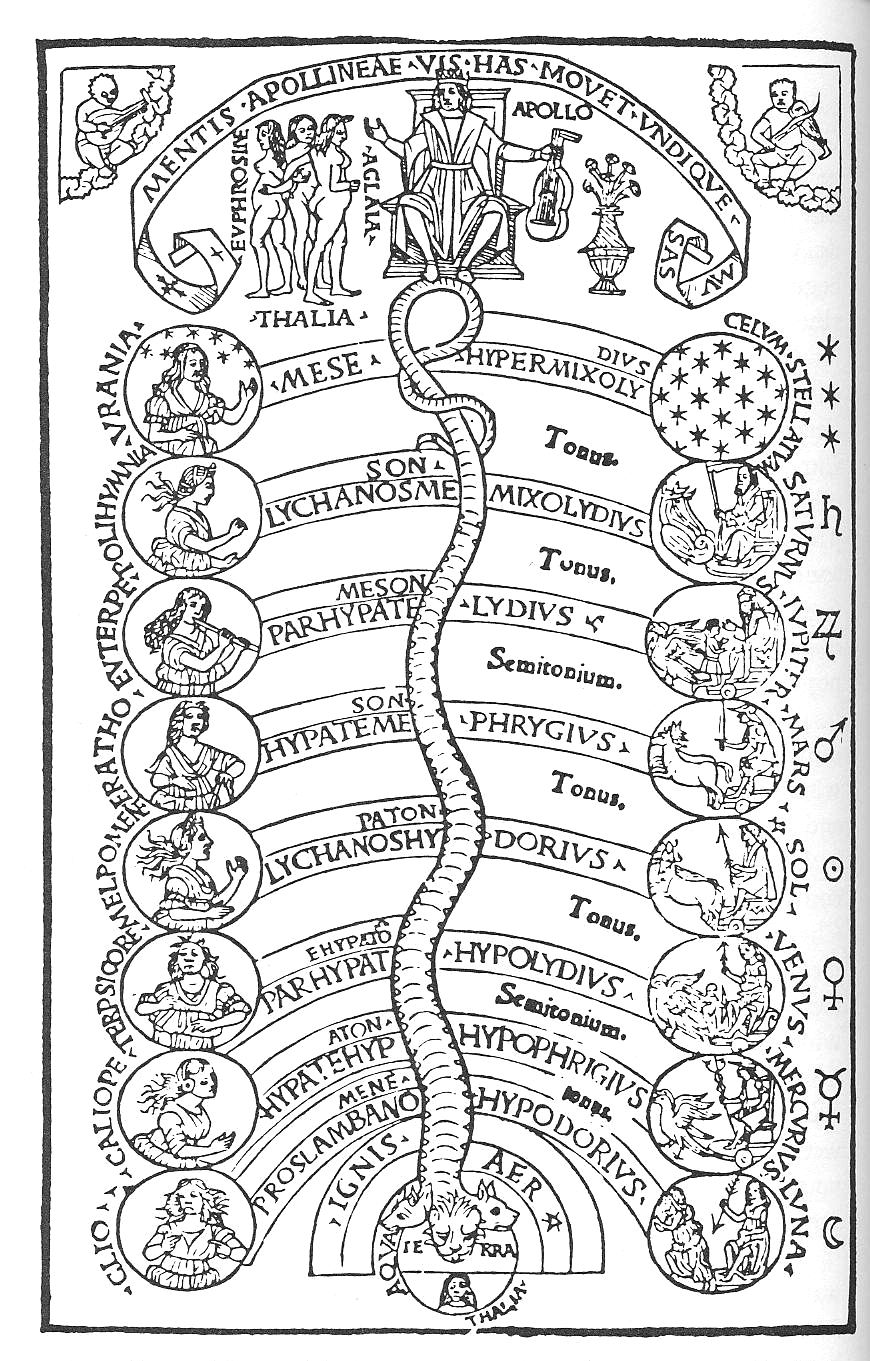
Engraved diagram of the music of the spheres: a central Apollo seated with a lyre, nine Muses in circular medallions down both sides, a serpent-like scale line, planetary symbols and star-filled sphere, Greek and Latin labels, and cherubs in the top corners.Painting

Secondary source

The Music of the Spheres

Guillaume Le Signerre

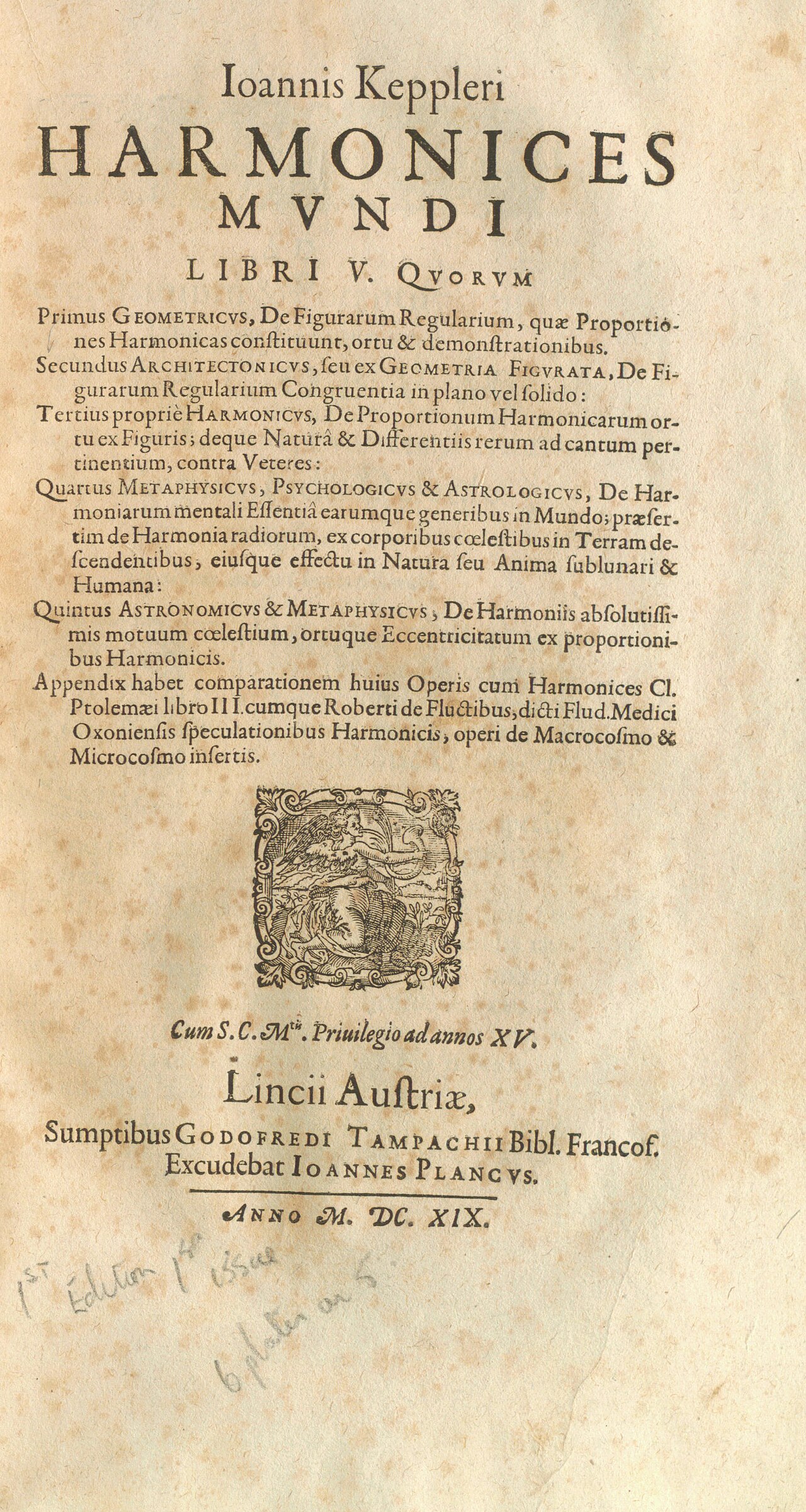
Title page of Johannes Kepler's Harmonices Mundi, 1619, printed in Linz, Austria. It lists the five books in Latin, shows a small woodcut vignette of a winged figure, and bears handwritten notes in pencil at lower left.Book

Primary source

Harmonices Mundi

Johannes Kepler · 1619

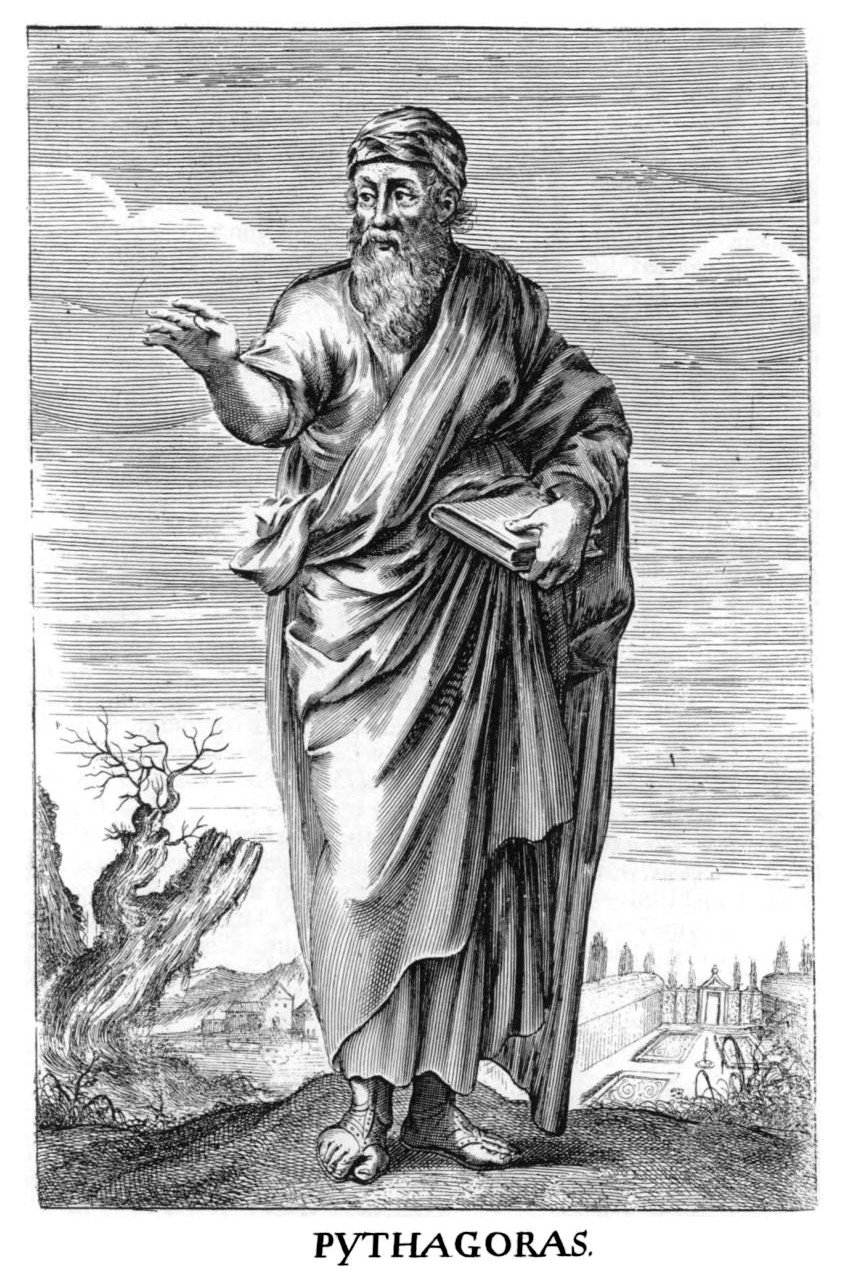
Engraved illustration of a bearded man in a turban and draped robe, standing outdoors with his right hand raised and a book held under his left arm. A bare tree and a garden with a small structure appear behind him. The caption below reads PYTHAGORAS.Painting

Secondary source

Pythagoras in Thomas Stanley's History of Philosophy

Unknown author · 1655

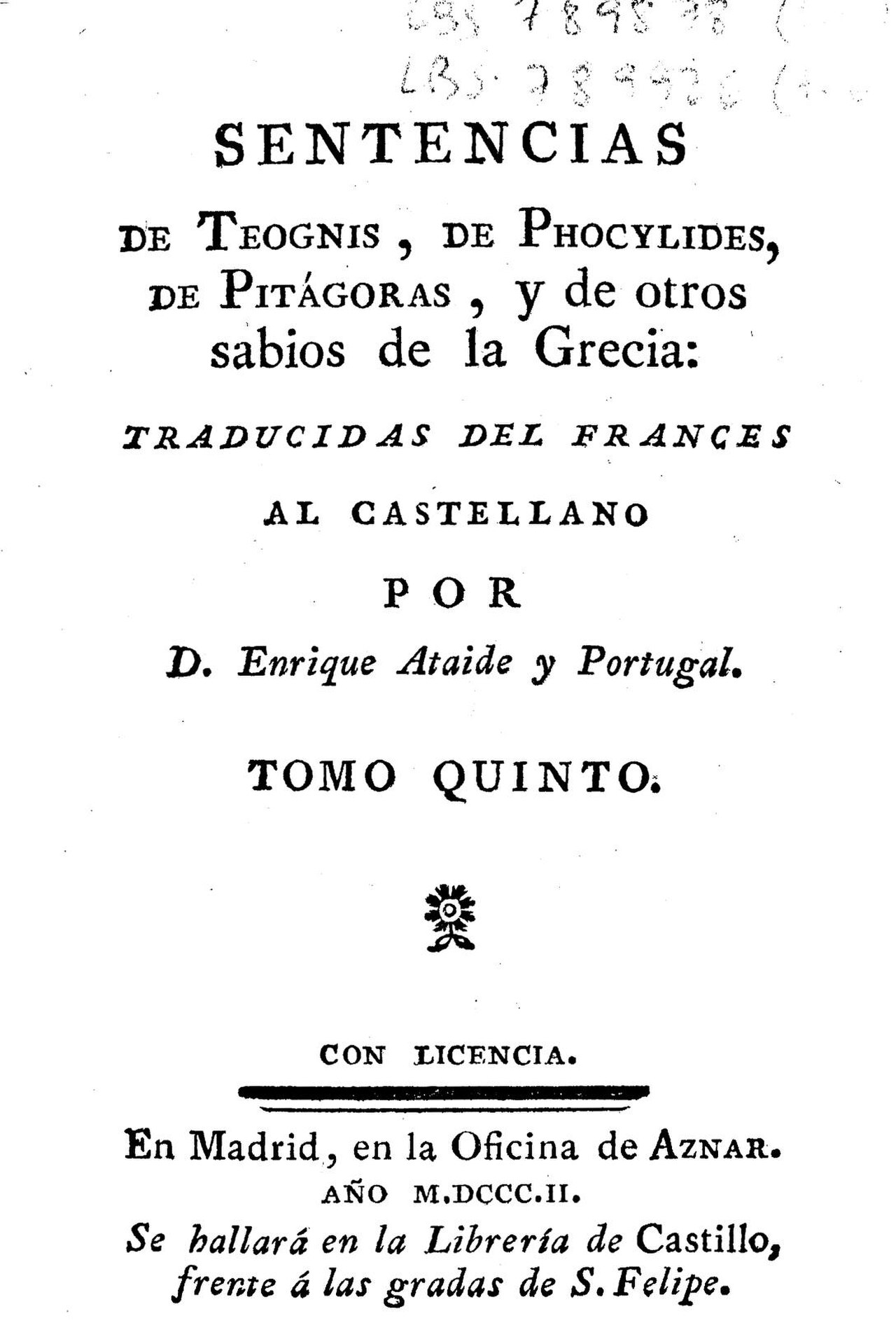
Title page of a Spanish book: 'Sentencias de Teognis, de Phocylides, de Pitágoras, y de otros sabios de la Grecia, traducidas del francés al castellano por D. Enrique Ataide y Portugal, Tomo Quinto', Madrid, Oficina de Aznar, 1802, with a small floral ornament and publisher notes.Book

Secondary source

Sentencias de Teognis, de Phocylides, de Pitágoras y de otros sabios de la Grecia

Theognis of Megara, Phocylides, Pythagoras · 1802

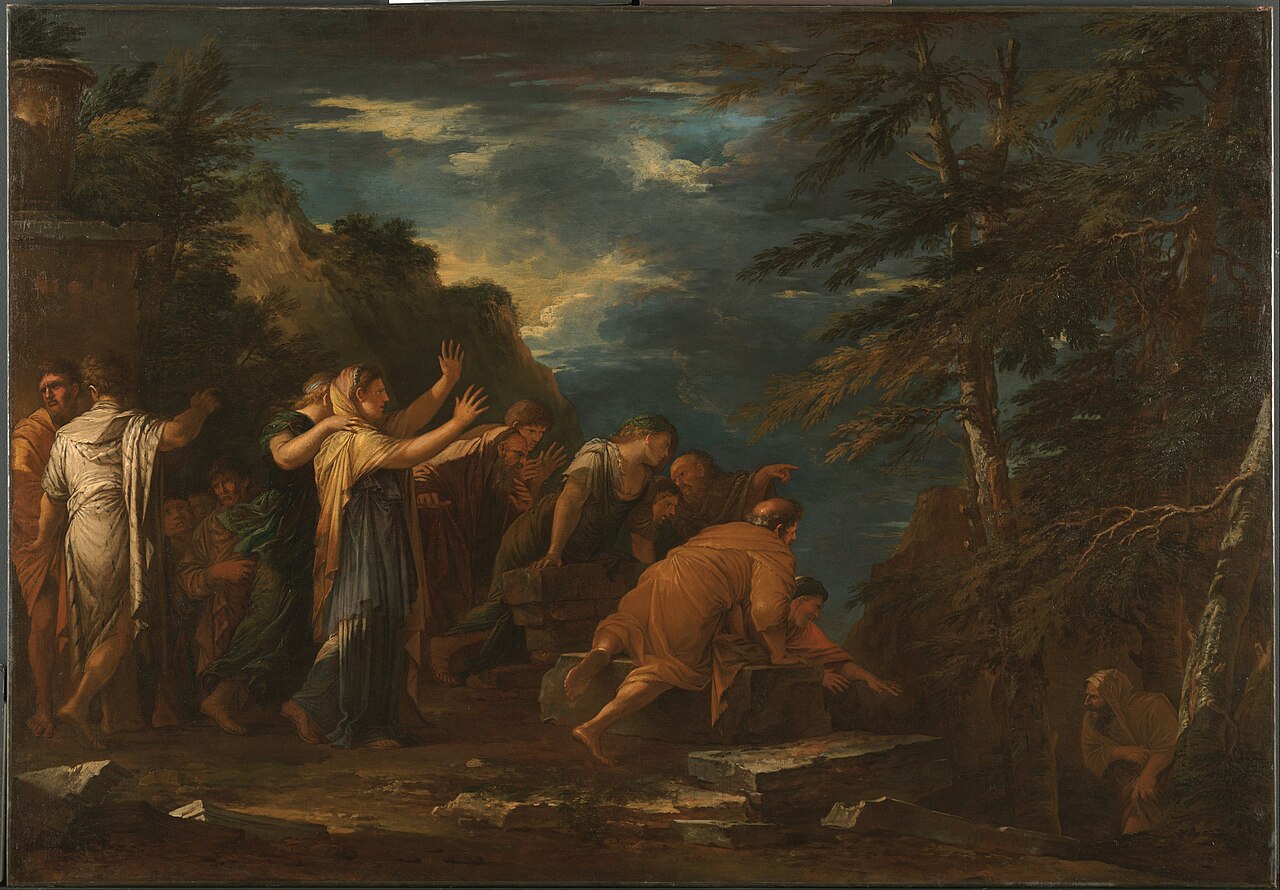
Painting of a dramatic wooded landscape under a stormy sky. Figures in classical robes gather on the left, reaching toward a group of men in the center who emerge from a broken stone opening among rubble. A man crouches at lower right.Painting

Secondary source

Pythagoras Emerging from the Underworld

Salvator Rosa · 1662

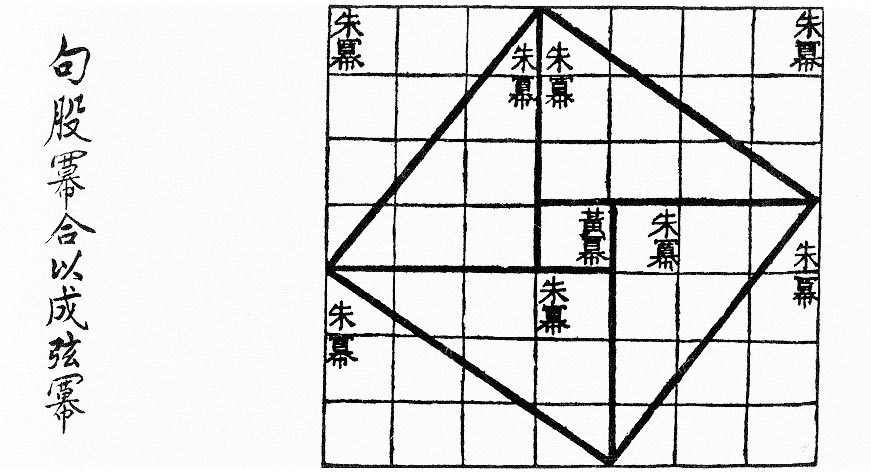
Woodblock-style diagram from the Zhoubi Suanjing: a tilted square on a grid with labeled areas 朱冪 (red power) and a caption in vertical Chinese characters reading 勾股冪合以成弦冪, illustrating the Pythagorean relation.Book

Secondary source

Zhoubi Suanjing

Zhao Shuang · 3rd century AD commentary on an earlier text

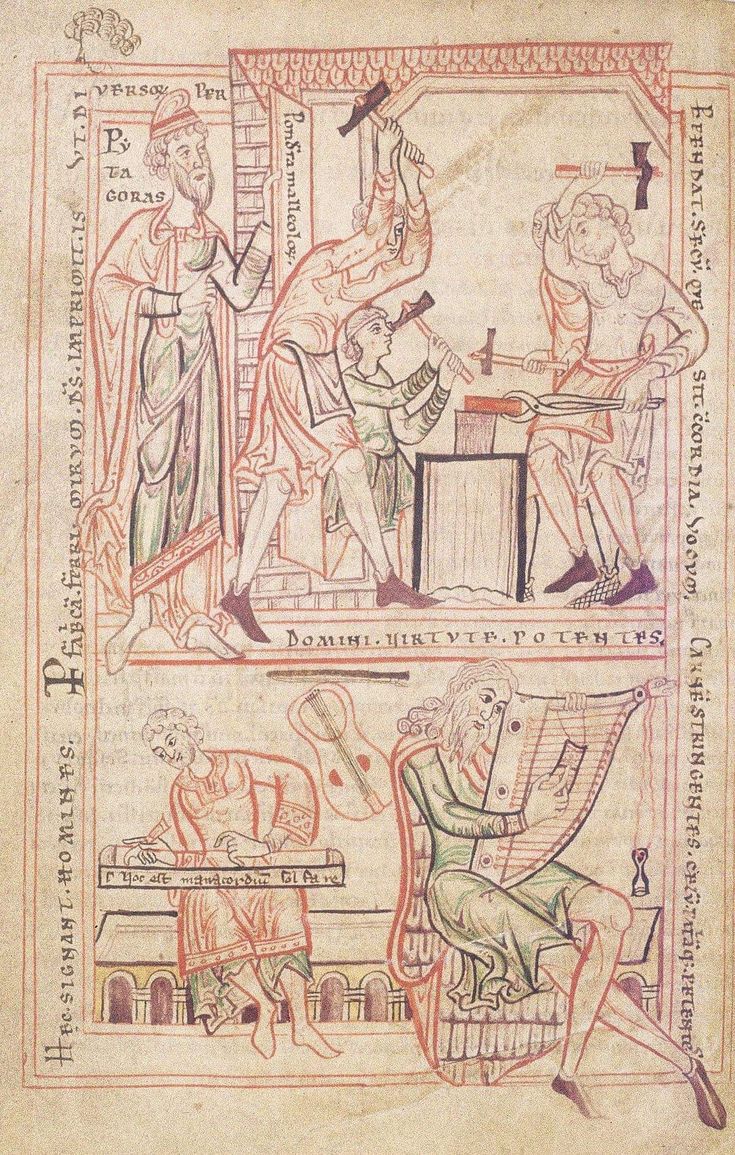
Medieval illuminated manuscript page with four painted scenes in red, green and ochre. Upper left: a bearded figure labeled Pythagoras gestures beside a forge. Upper right: a smith hammers on an anvil. Lower panels: a seated musician plays a bell-like set of tubes, and a harpist plays a harp. Latin inscriptions appear throughout.Painting

Secondary source

Pythagoras in the Forge

unknown artist · c. 1220-1240

The Life of Pythagoras (abridged, 1918)Book

Secondary source

The Life of Pythagoras (abridged, 1918)

Iamblichus · 1918

Book

Secondary source

Nature According to Pythagoras

Enrico Caporali · 1914

Pythagoras and the IndiansBook

Secondary source

Pythagoras and the Indians

Leopold von Schroeder · 1884

Little Journeys: PythagorasBook

Secondary source

Little Journeys: Pythagoras

Elbert Hubbard · 1908

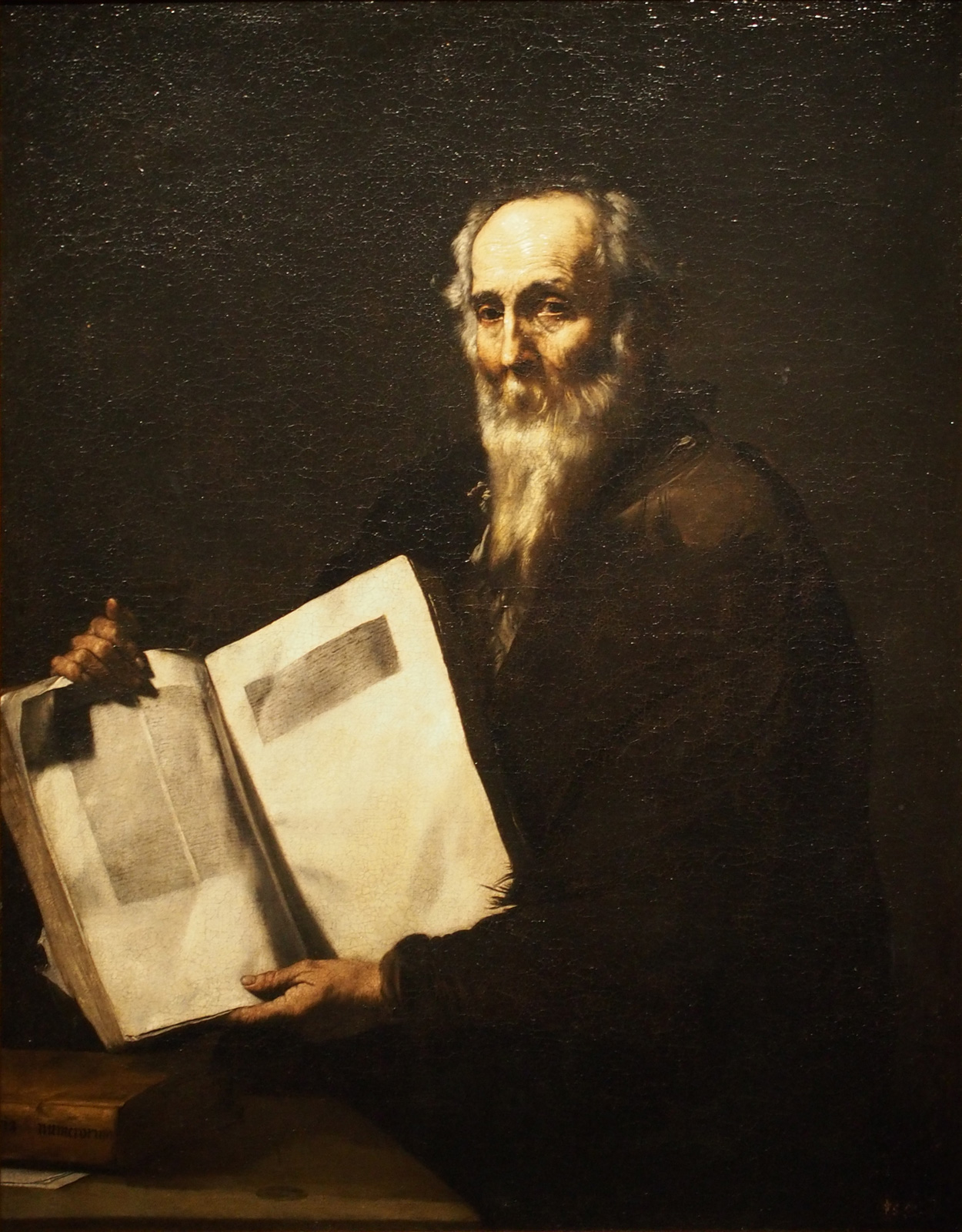
Oil painting of an elderly bearded man with a bald crown and gray hair, wearing a dark robe, holding open a large book with blank pages in his right hand while his left hand rests on the pages. A closed book lies on a table at lower left against a very dark background.Painting

Secondary source

Pythagoras

Jusepe de Ribera · circa 1630

Book

Secondary source

Pythagoras, in Philosophical Works of James Frederick Ferrier

James Frederick Ferrier · 1888

Book

Secondary source

Pythagoras, Encyclopaedia Britannica, 11th edition

1911

Book

Secondary source

Pythagoras and Pythagoreanism, Catholic Encyclopedia

Charles G. Herbermann · 1913

Book

Secondary source

Pythagoras, The New International Encyclopaedia

1902

Book

Secondary source

Refutation of All Heresies, Pythagoras's System of Numbers

Hippolytus (attrib.), translated by John Henry MacMahon · 1885 (translation of a 3rd-century text)

Book

Secondary source

Reflections upon Ancient and Modern Learning, Chapter 8

William Wotton · 1694

Book

Secondary source

The Age of Fable, Chapter XXXIV: Pythagoras

Thomas Bulfinch · 1855

Book

Secondary source

Pythagoras Source Book, Part 2, Chapter 13: Fragments of Aristoxenus

Kenneth Sylvan Guthrie · 1919

Book

Secondary source

A General History for Colleges and High Schools, Chapter 20

Philip Van Ness Myers · 1890

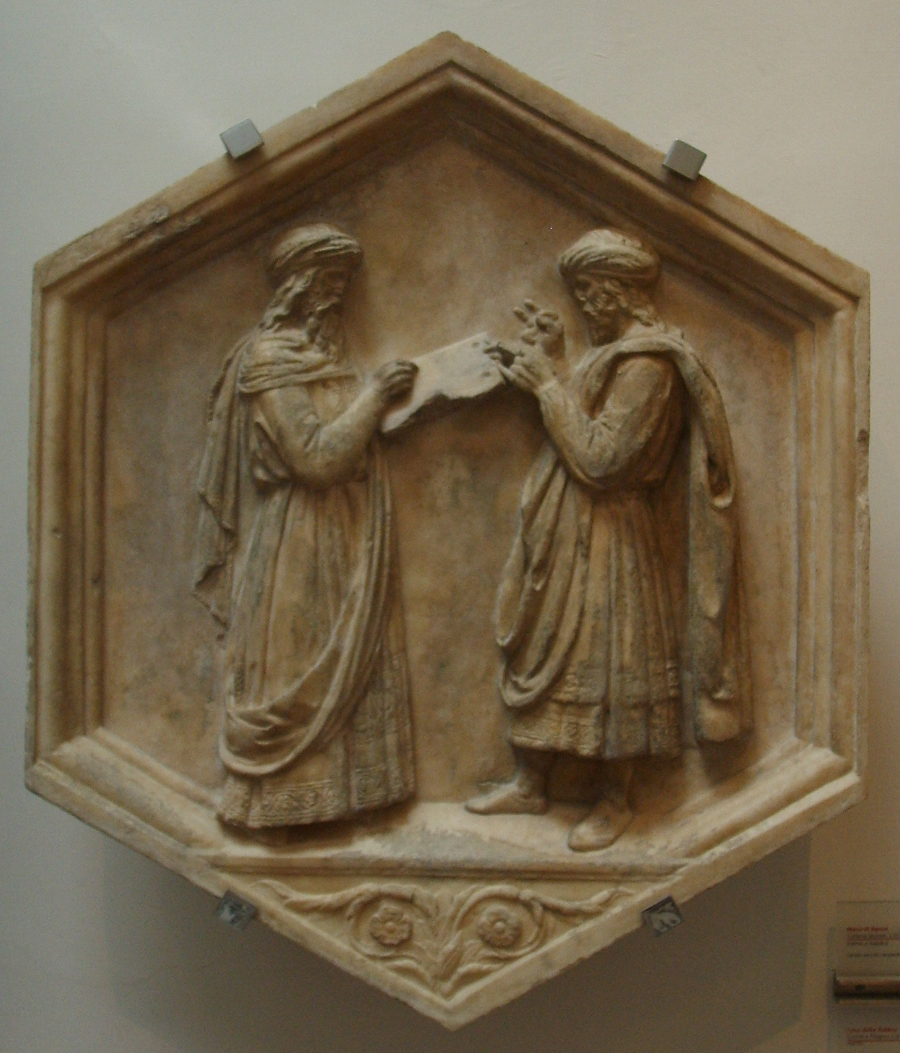
Hexagonal white marble relief panel showing two bearded men in robes and turbans facing each other. The man on the left holds a tablet; the man on the right holds a compass-like tool. A carved garland decorates the bottom point.Sculpture

Secondary source

Euclid and Pythagoras Relief

Luca della Robbia · 1437-1439

Photograph of a marble bust of a bearded man with a receding hairline and curly hair, with a gold-colored panel and ornate carved background behind it.Sculpture

Secondary source

Pythagoras Bust

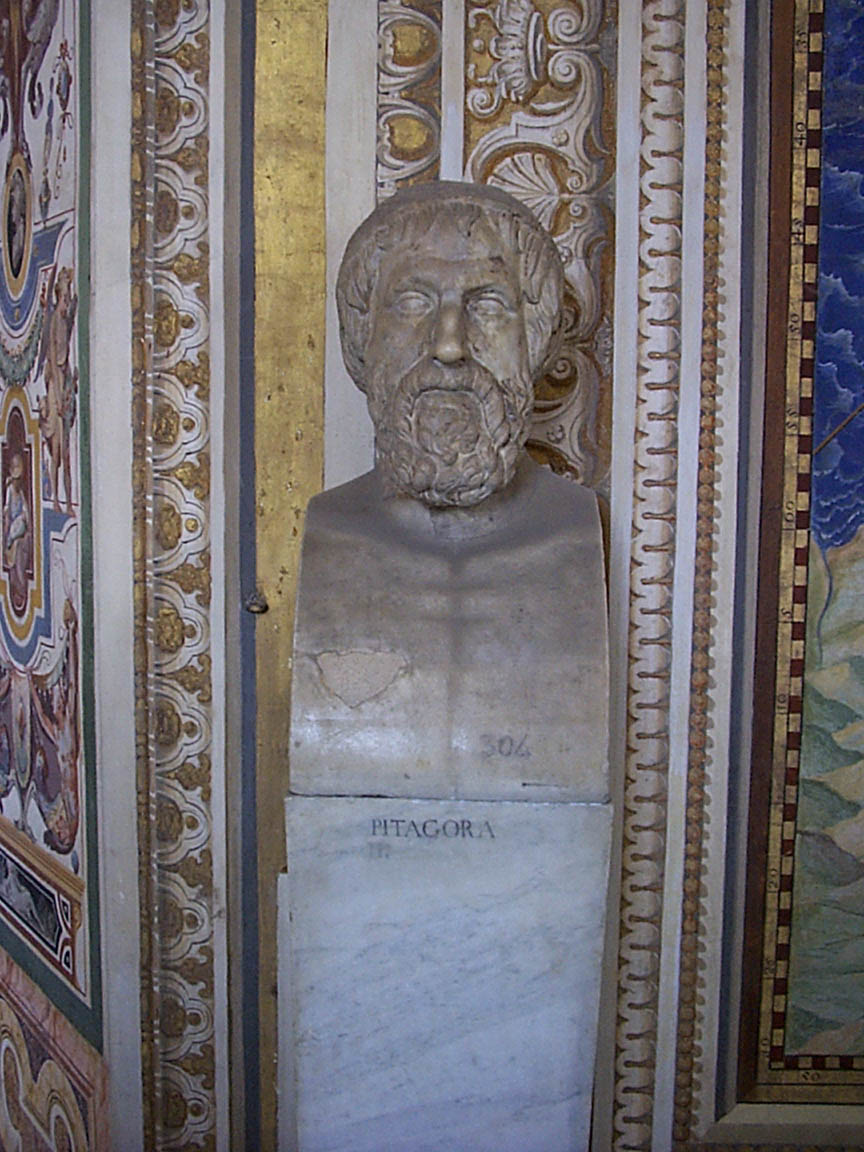
Marble bust of a bearded man with curly hair on a tall pedestal, displayed in an ornate gilded and painted hall. The base is inscribed PITAGORA.Sculpture

Secondary source

Bust of Pythagoras at the Vatican Museum

Unknown (Roman-copy style)

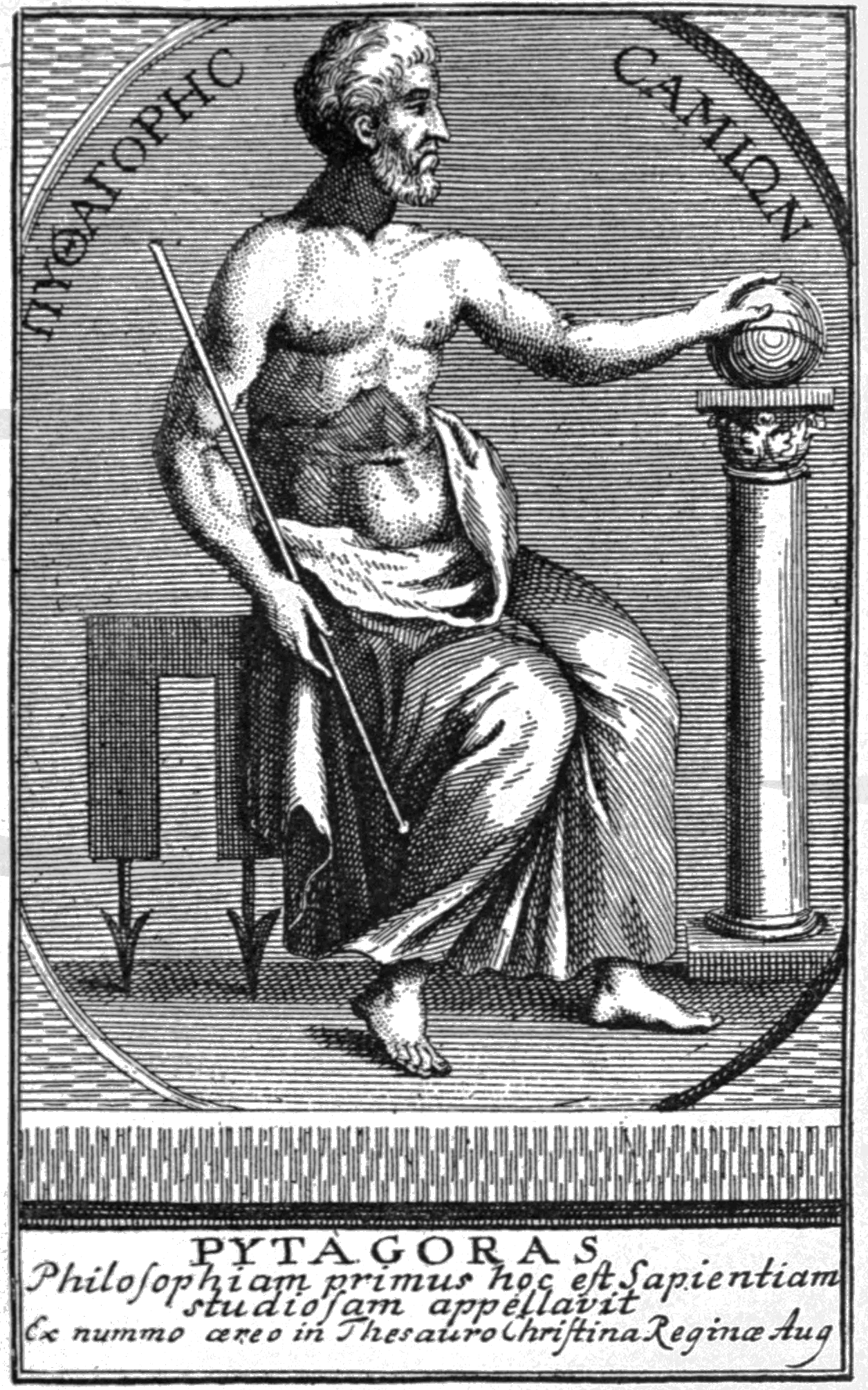
Engraved illustration of a bearded, bare-chested man seated on a stool, holding a staff and reaching toward a globe on a column. Oval frame with Greek lettering and the caption 'PYTAGORAS' with Latin text below.Painting

Secondary source

Pythagoras illustration, Popular Science Monthly

Unknown · 1911

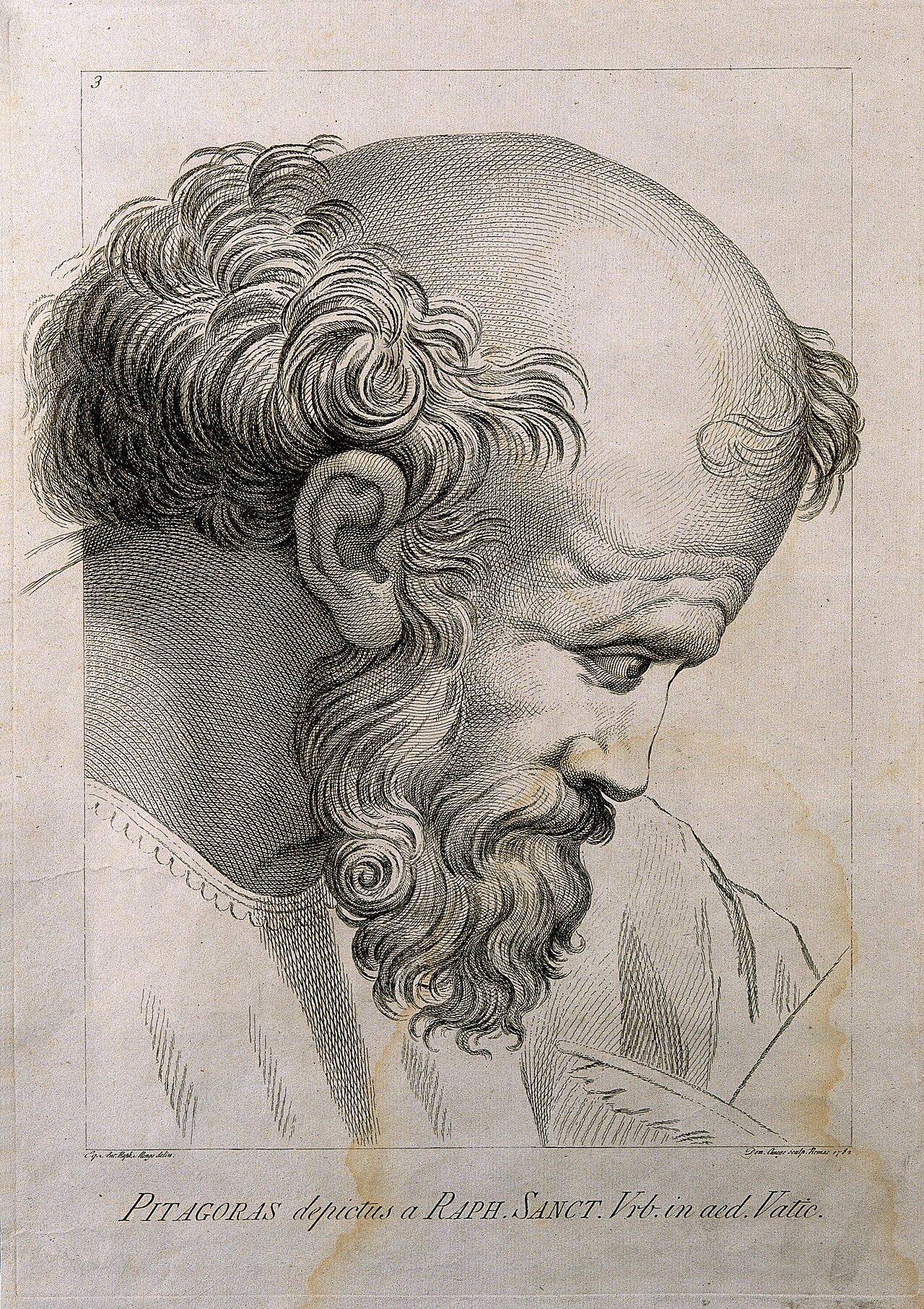
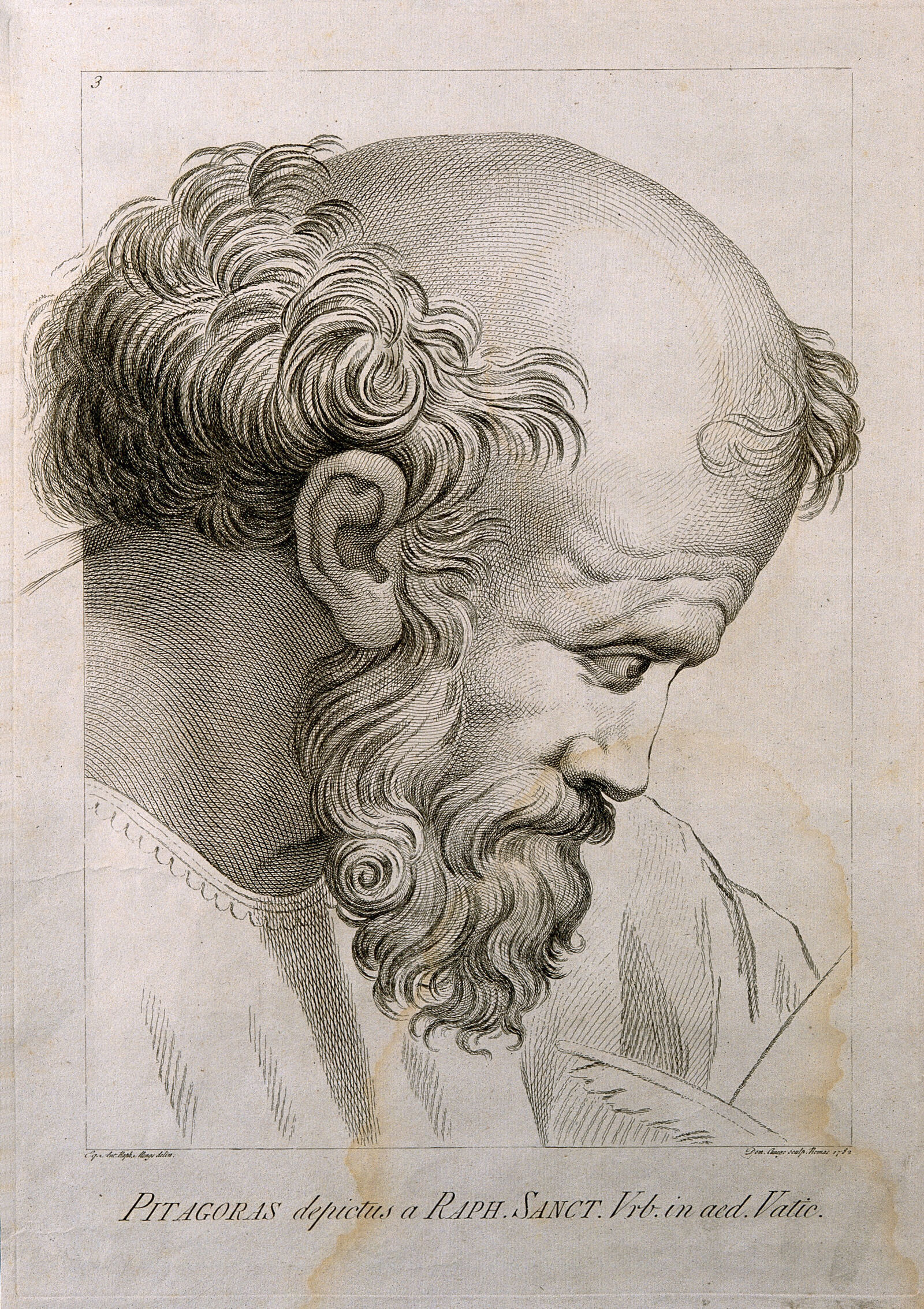
Line engraving of a bald, bearded man in profile facing right, with curly hair at the back and sides, looking down. Caption below reads 'Pythagoras depictus a Raph. Sanct. Urb. in aed. Vatic.' Figure number 3 in upper left corner.Painting

Secondary source

Pythagoras, line engraving by Cunego after Mengs

D. Cunego, after R. Mengs, after Raphael · 1782

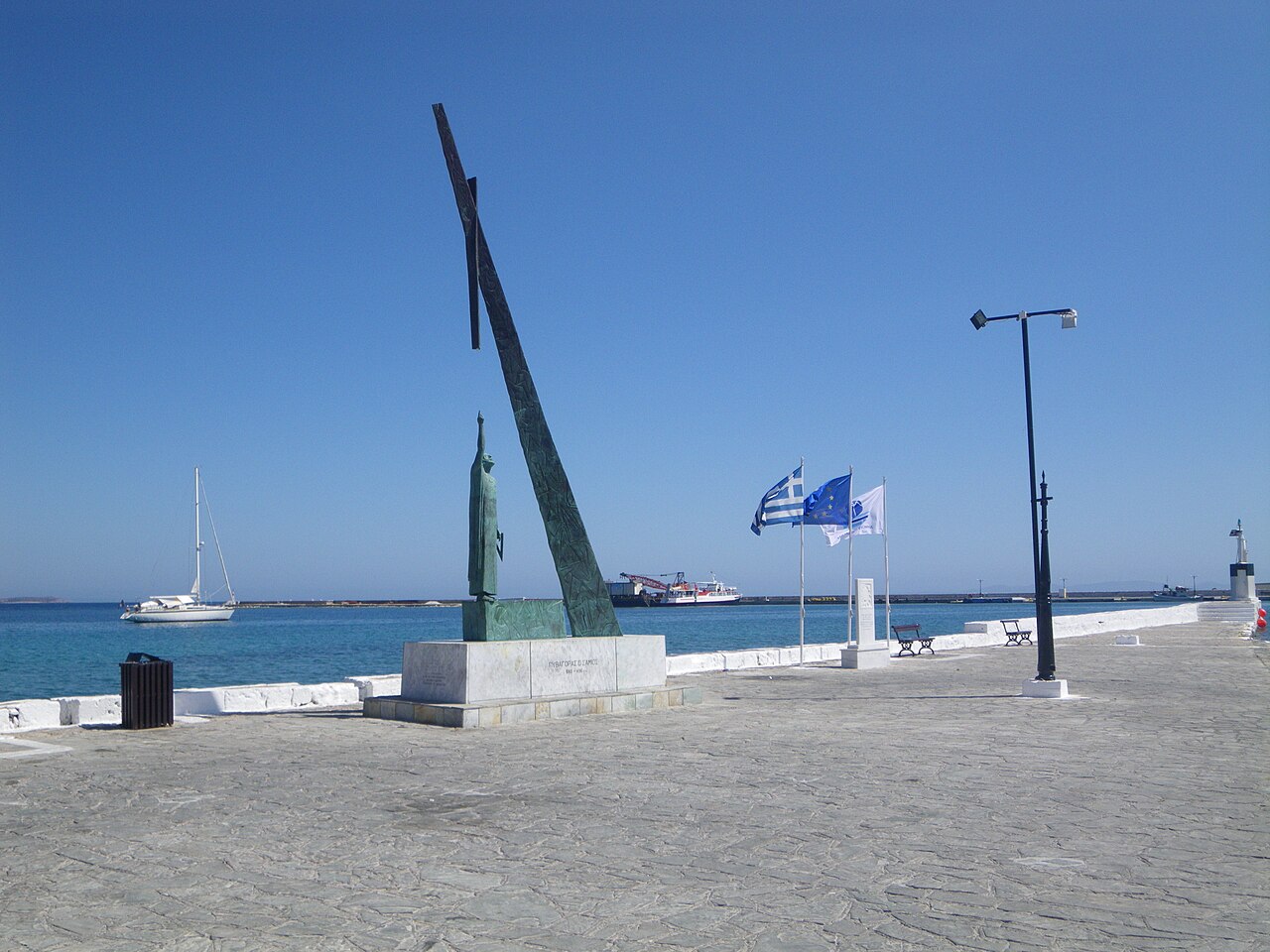
Bronze statue of Pythagoras on a stone plinth beside a tall bronze triangular sculpture leaning on a white pedestal, with a harbour promenade, sea, sailboat, and flags behind it under a clear blue sky.Sculpture

Secondary source

Pythagoras Monument, Pythagoreion, Samos

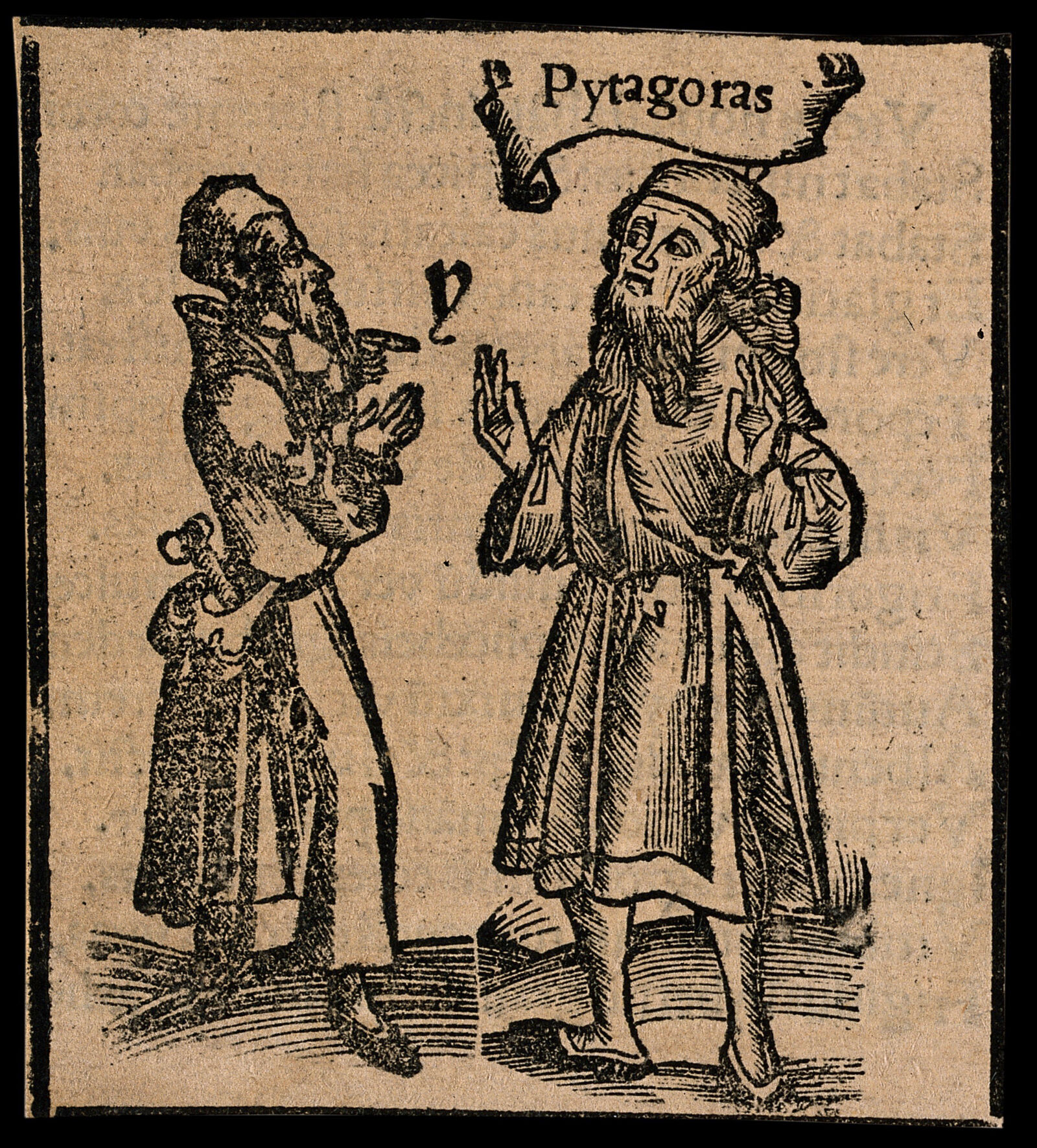
Woodcut print on aged paper showing two bearded men in long robes standing on a ground. The figure on the right, labeled "Pytagoras" on a scroll banner, gestures with raised hands. The figure on the left points upward, facing him.Painting

Secondary source

Pythagoras woodcut, Wellcome Collection

Unknown

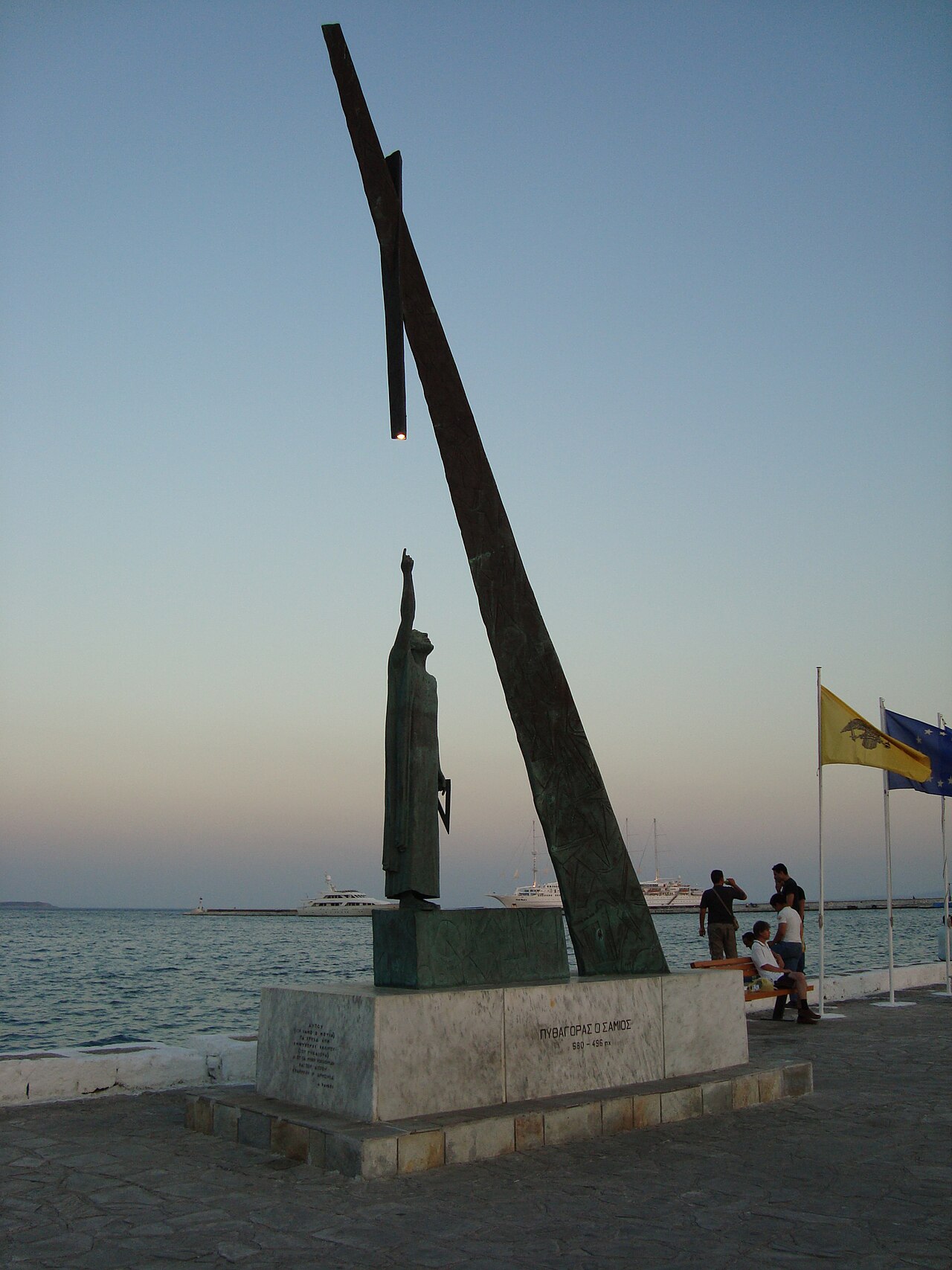
Bronze statue of a standing robed figure with one arm raised, mounted on a green pedestal before a tall, tilted dark metal pillar, on a stone seafront promenade at dusk. Marble base inscribed with Greek text. Boats in harbor, two people on a bench, and flags behind.Sculpture

Secondary source

Statue of Pythagoras, Samos

2008-07-21

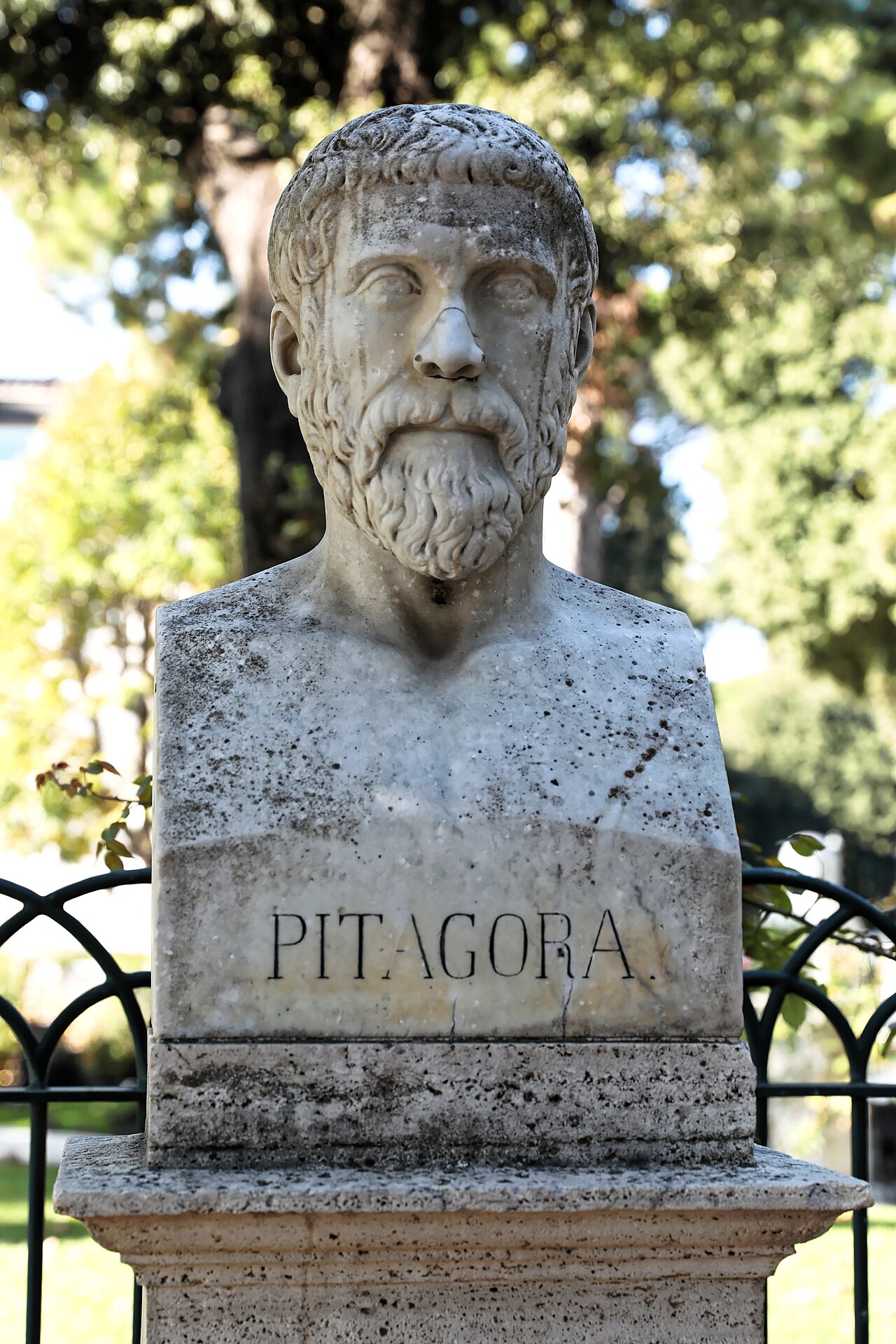
Marble bust of a bearded man with curly hair, mounted on a stone pedestal in a park with trees behind it. The bust's front block is inscribed PITAGORA. A dark iron railing is visible at the left and right.Sculpture

Secondary source

Bust of Pythagoras, Villa Borghese

2017-10-18

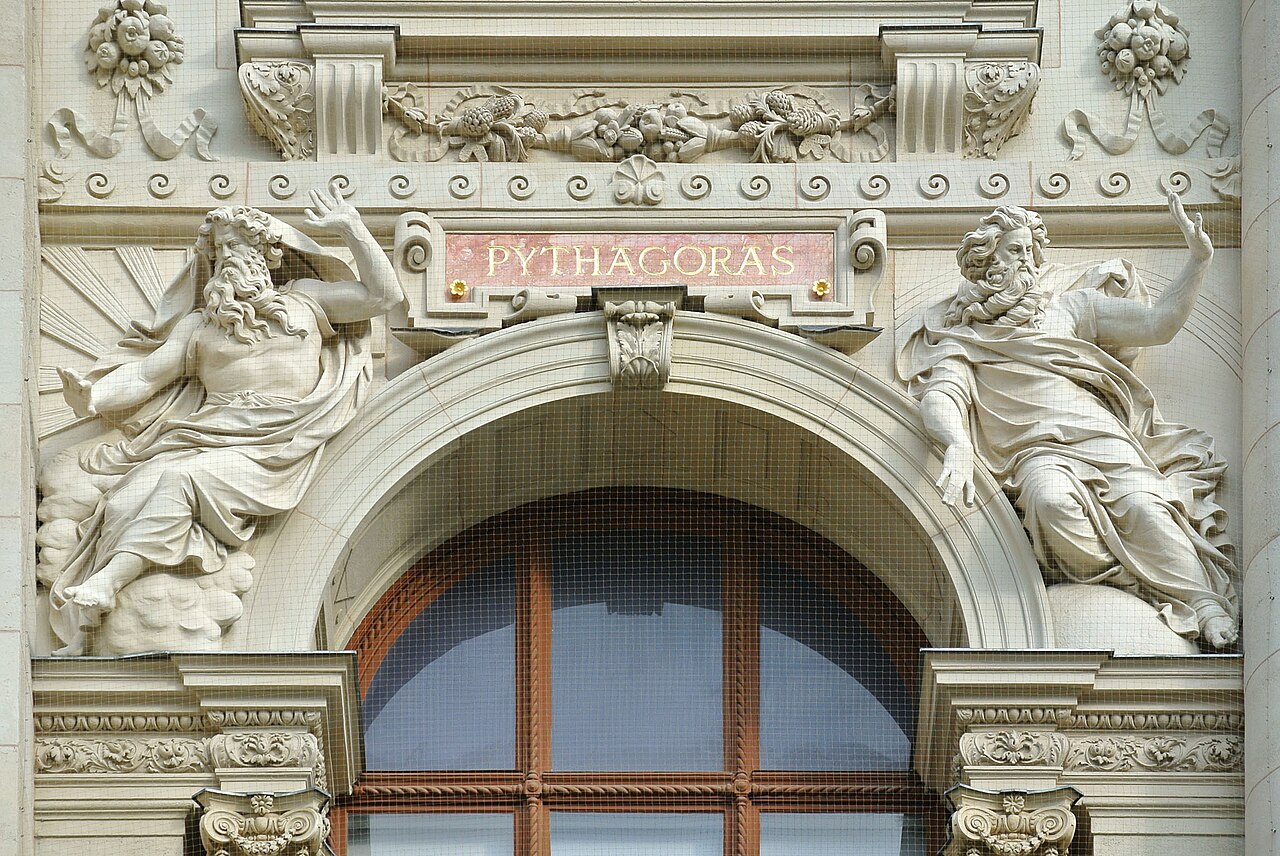
Stone facade above an arched window of a building, with a carved plaque reading PYTHAGORAS between two seated and reclining sculpted figures; a relief of foliage and scrolls decorates the top and sides.Photograph

Secondary source

Pythagoras exhibit at the Naturhistorisches Museum Vienna

Viennpixelart · 26 July 2014

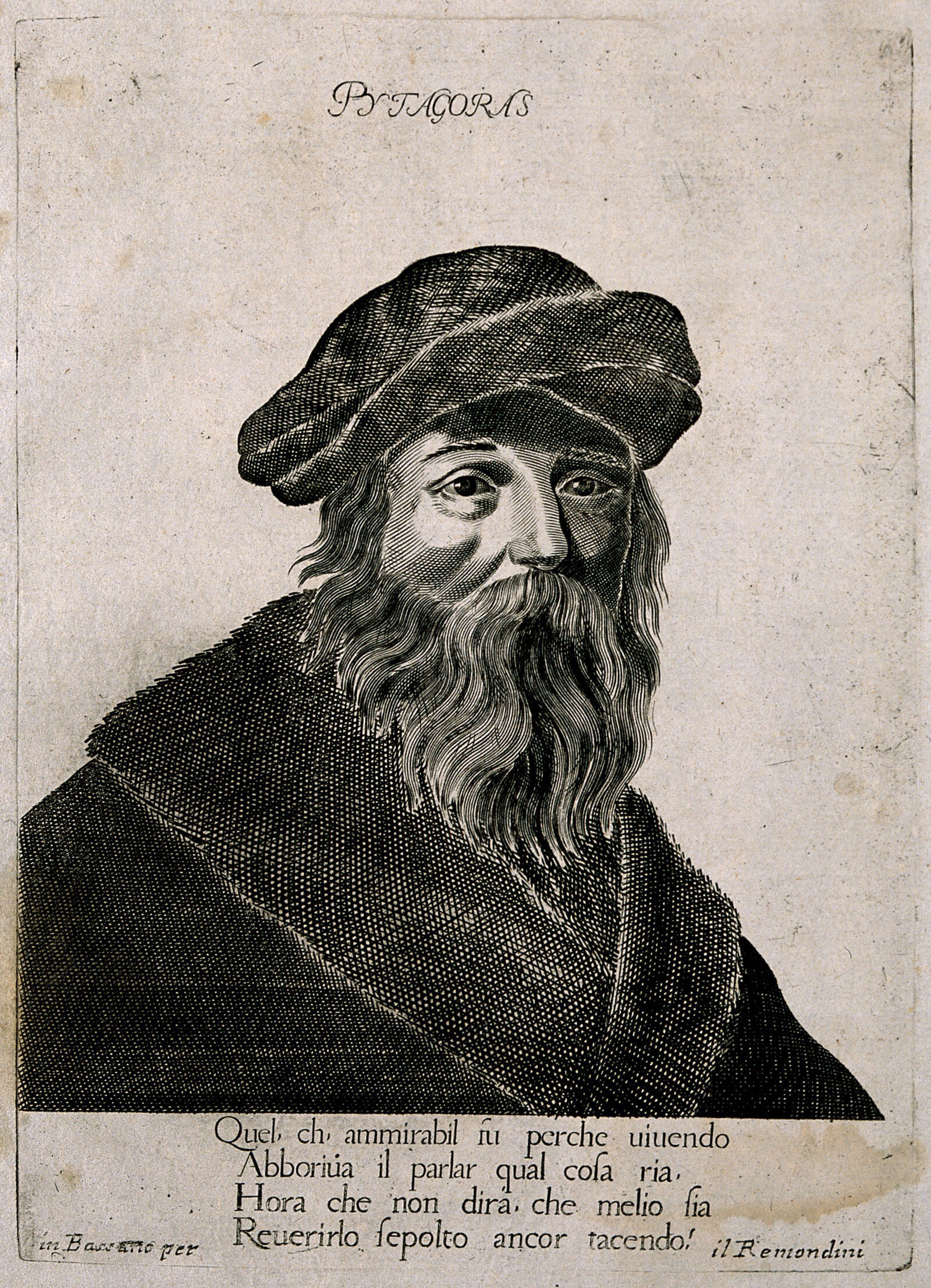
Engraved portrait print of a bearded man wearing a cap with a wide brim and a heavy cloak, turned three-quarters to the viewer. The word PYTHAGORAS is inscribed above, and four lines of Italian verse appear below, with signatures in the lower corners.Painting

Secondary source

Pythagoras etching by Remondini

Remondini

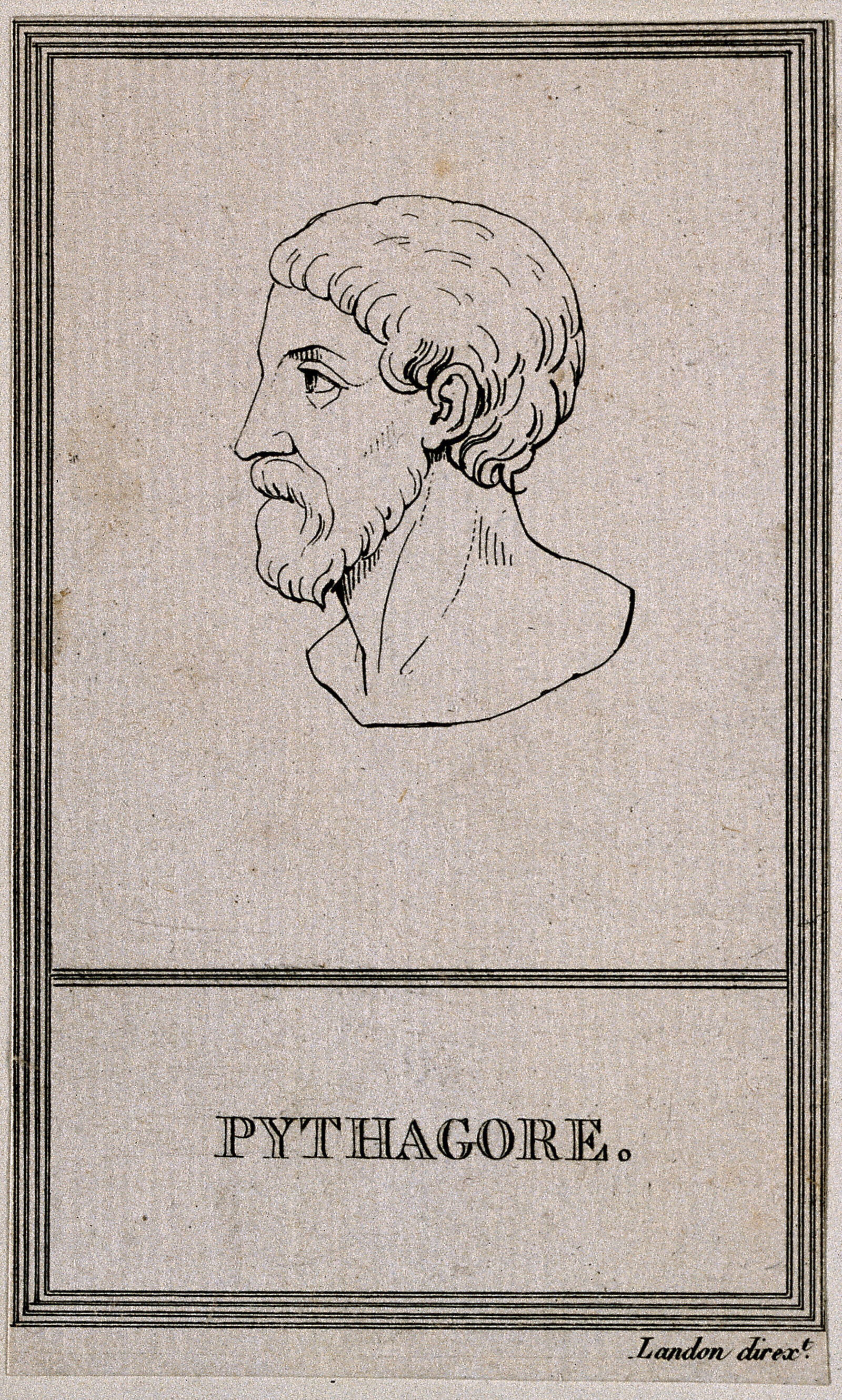
Line engraving in a triple-ruled border of a bust portrait in profile facing left, a bearded man with curly hair and a laurel-like headband, bare shoulders. Below the image is the caption PYTHAGORE. In the lower right corner is the inscription Landon direxit.Painting

Secondary source

Pythagoras line engraving by Charles Paul Landon

Charles Paul Landon · 1800-1899

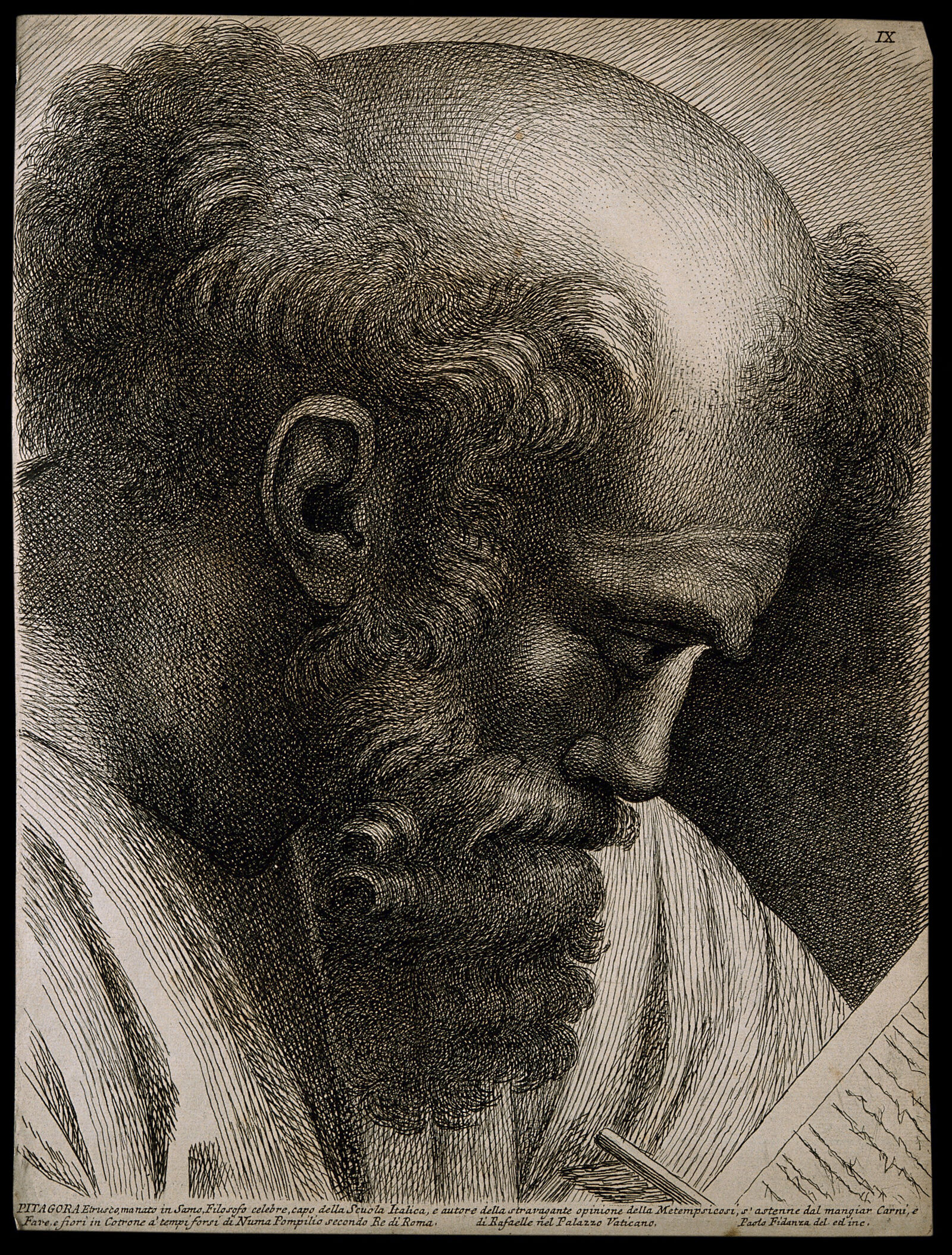
Etching of a bald, bearded older man in profile, head bowed, with curly hair and beard, wearing a draped garment. Roman numeral IX appears top right. Printed caption text lies along the bottom edge.Painting

Secondary source

Pythagoras etching by P. Fidanza after Raphael

P. Fidanza, after Raphael

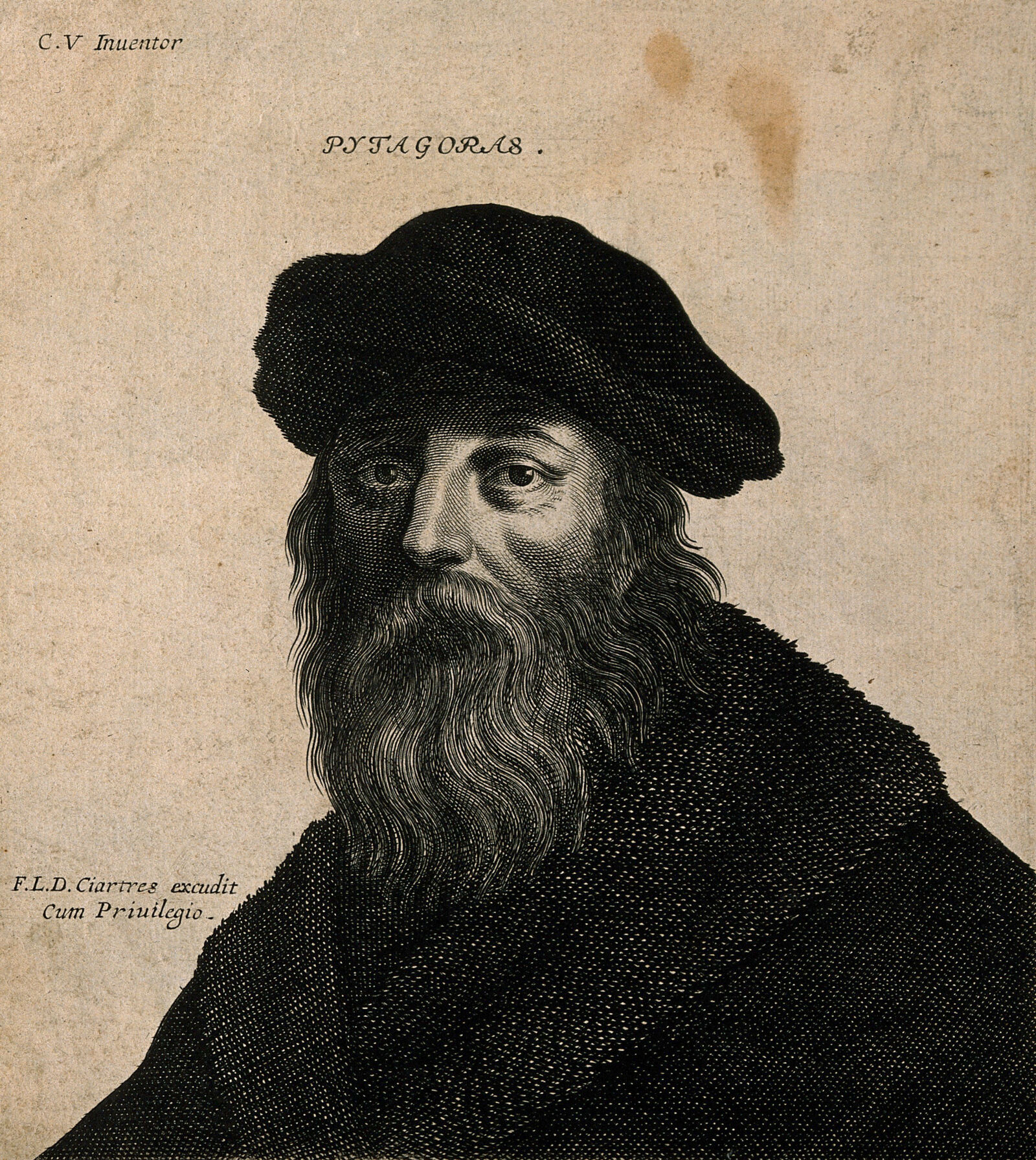
Engraving of a bearded older man in a dark fur-trimmed cap and heavy dark cloak, facing right with a stern gaze. Caption above reads PYTAGORAS. Lower left reads F.L.D. Ciartres excudit Cum Privilegio. Upper left reads C.V Inuentor.Painting

Secondary source

Pythagoras engraving after Claude Vignon

H. David, after Claude Vignon · 1600-1699

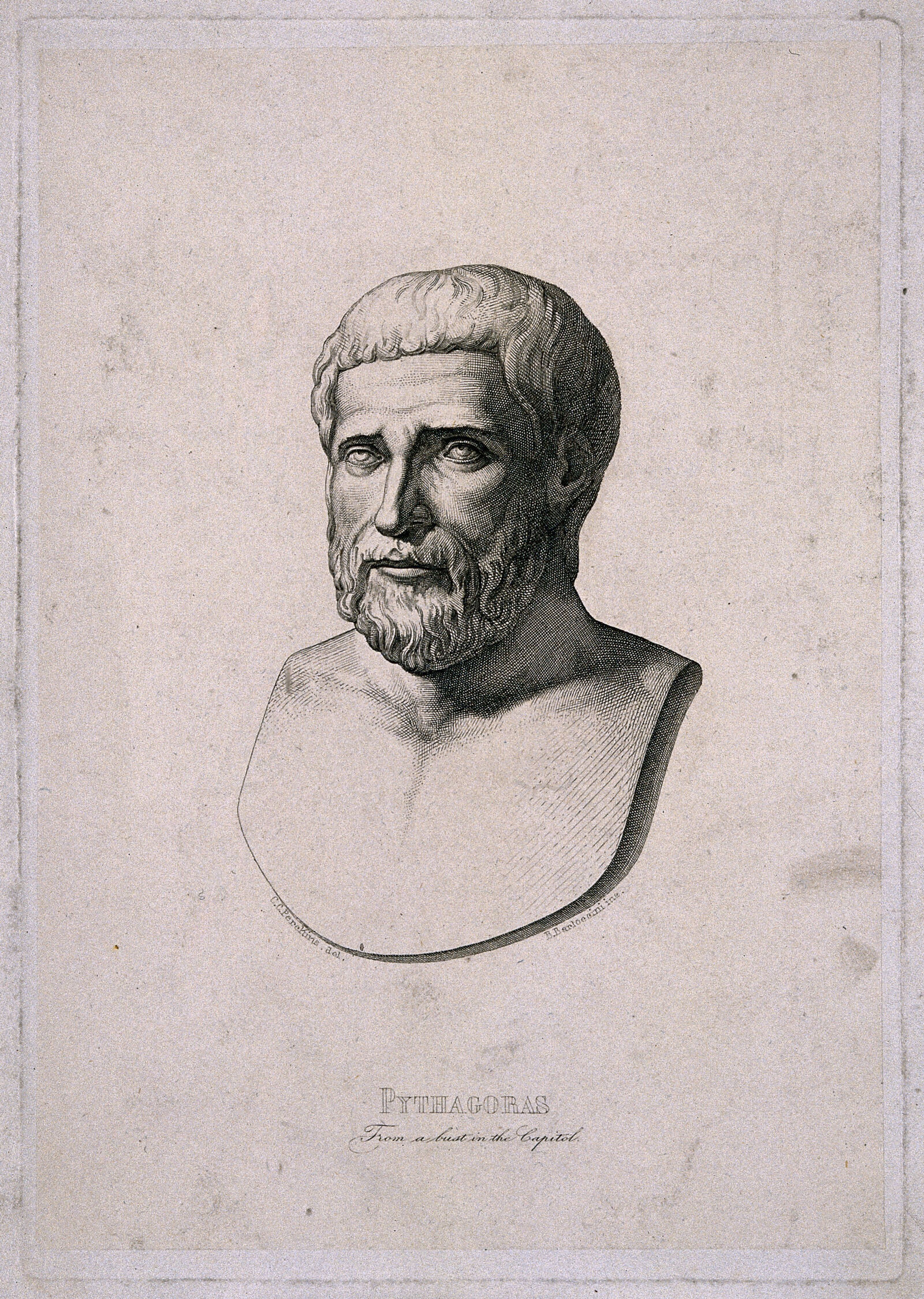
Black and white line engraving of a bearded man's head and bust in profile-turned three-quarter view, with curly hair and beard, on a cream paper. Caption below reads PYTHAGORAS and From a bust in the Capitol.Painting

Secondary source

Pythagoras (engraving after Charles Callahan Perkins)

Charles Callahan Perkins

Line engraving in profile of a bald, bearded older man with curly hair at the back and sides, looking downward, with a draped garment at the shoulder. Italic inscription below reads Pitagoras depictus a Raph. Sanct. Urb. in aed. Vatic.Painting

Secondary source

Pythagoras (engraving by D. Cunego, 1782)

D. Cunego · 1782

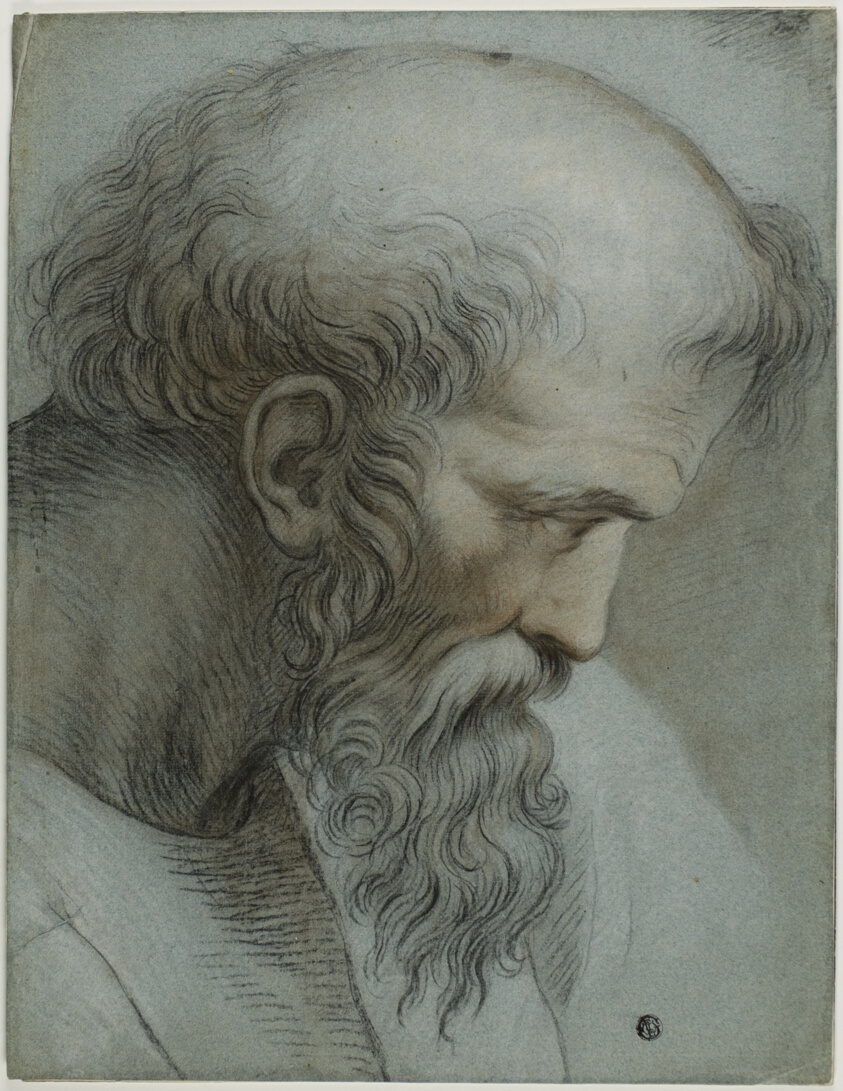
Chalk drawing on blue-grey paper of a bald, bearded older man in profile, head bowed and gazing downward. He has curly hair at the sides, a prominent ear, and a long curled beard over a drapery-covered shoulder.Painting

Secondary source

Head of Pythagoras (chalk drawing after Raphael)

Raphael · 18th century

Book

Secondary source

The Enchiridion of Epictetus and Chrysa Epe of Pythagoras (1872 translation)

Epictetus · 1872

Bygone BeliefsBook

Secondary source

Bygone Beliefs

H. Stanley Redgrove · 1920

An Essay of Transmigration in Defence of PythagorasBook

Secondary source

An Essay of Transmigration in Defence of Pythagoras

Whitelocke Bulstrode · 1692

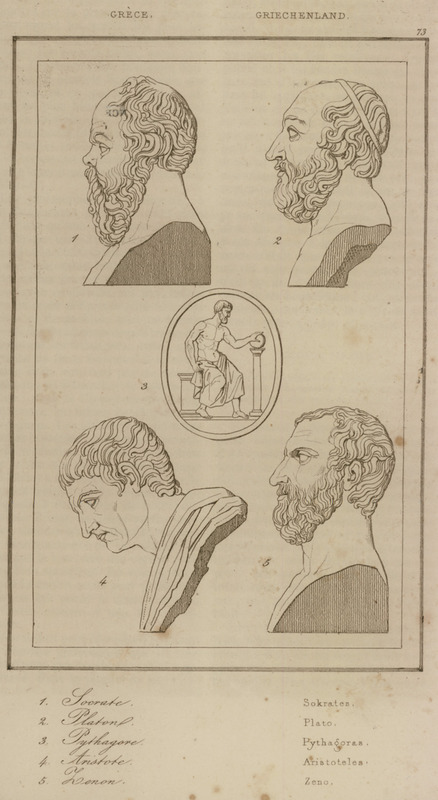
Engraved plate titled Grèce / Griechenland, numbered 73, showing five ancient Greek busts in profile and an oval medallion of a standing figure with a cup. Labels in French and German list Socrate, Platon, Pythagore, Aristote, Zenon.Painting

Secondary source

Plate of Socrates, Plato, Pythagoras, Aristotle, Zeno

François Pouqueville · 1835

Title page of a German school programme in black Fraktur type: 'Die goldenen Sprüche des Pythagoras', translated into German with introduction and notes by P. Hieronymus Schneeberger, kgl. Studienlehrer. Programm zur Schlussfeier des Schuljahres 1861/62 an der Königlichen Studienanstalt zu Münnerstadt. Würzburg, Druck von Friedrich Ernst Thein.Book

Secondary source

The Golden Sayings of Pythagoras, Würzburg edition, 1862

Hieronymus Schneeberger · 1862

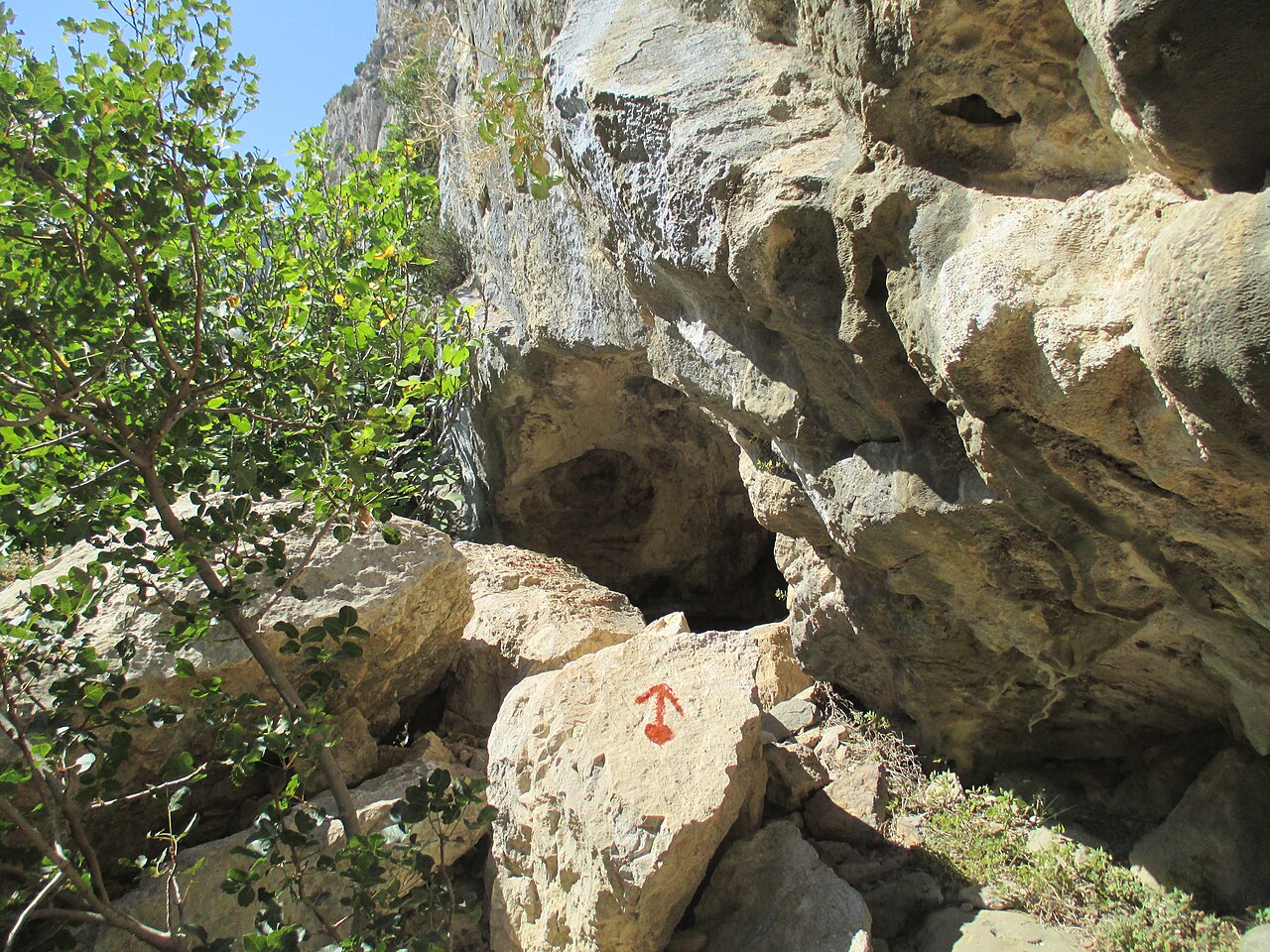
Rocky limestone cliff face with a dark cave opening under an overhang, partly hidden by green shrubs. A large boulder in front has a red arrow painted on it pointing upward, and a blue sky shows at the top left.Photograph

Secondary source

Entrance to Pythagoras Cave, Mount Kerkis, Samos

Tomisti · 2016

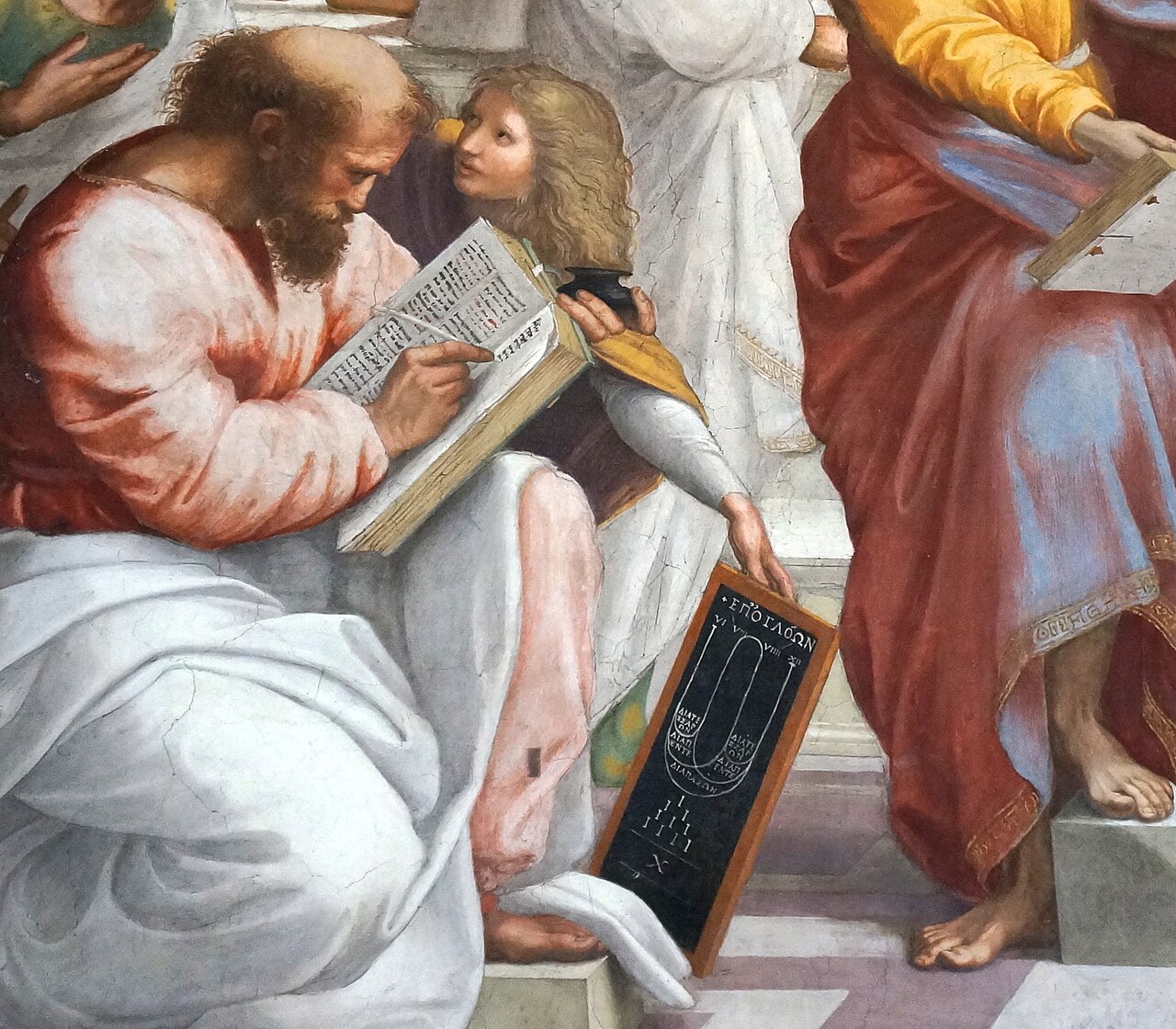
Detail of a Renaissance fresco: a bearded older man in a pink robe and white cloak leans over an open book and points at it, while a young boy with long curly hair looks at him. In front, a chalkboard shows a diagram with Greek lettering and a drawn arch-like shape with notches, plus tally-like marks below. A figure in red and blue robes stands at right.Painting

Secondary source

Detail of Raphael's Stanza showing the epogdoon drawing

Raphael

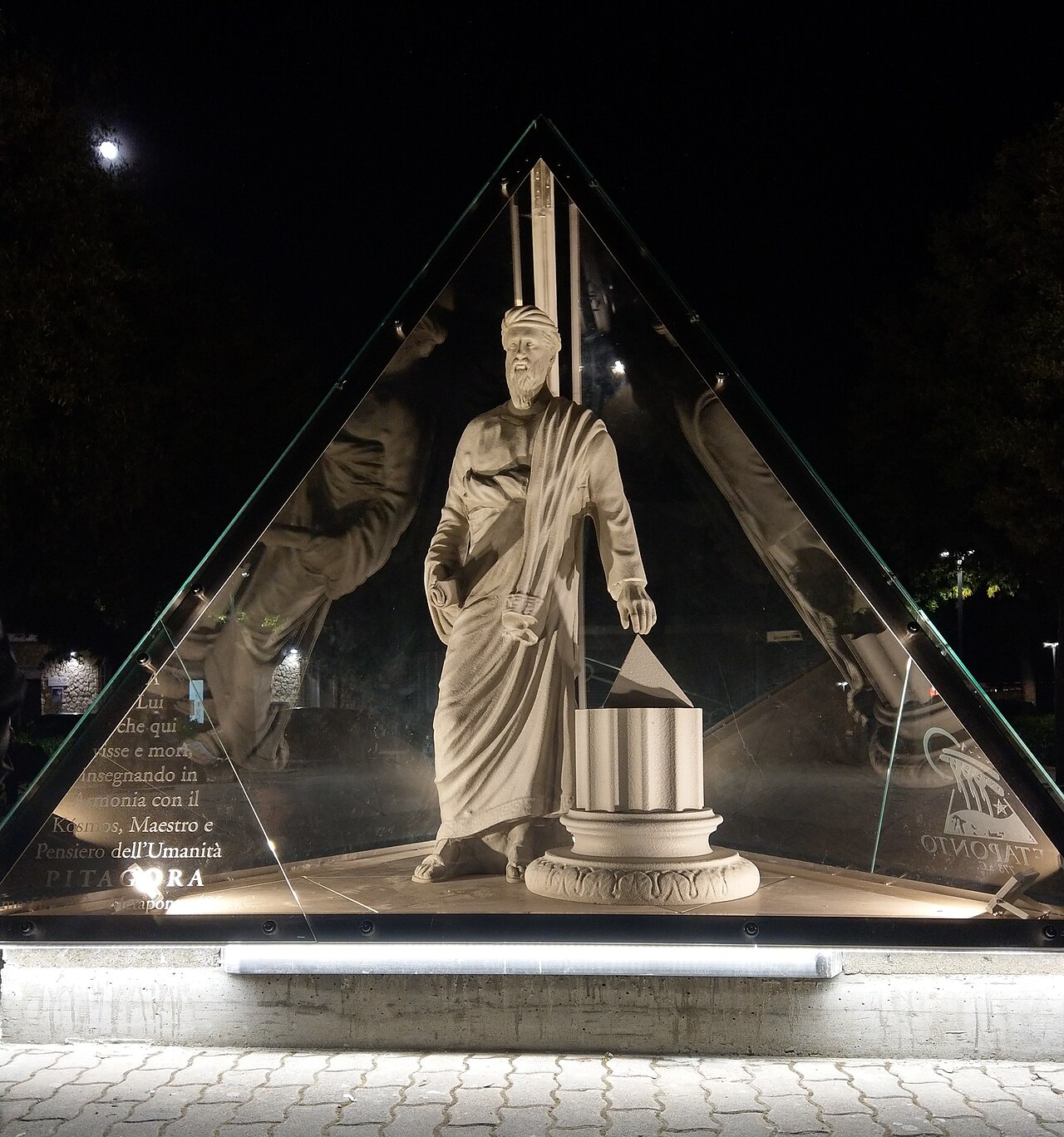
Night photo of a bearded, robed stone statue of Pythagoras standing on a pedestal inside a large glass pyramid, with a small pyramid atop a column beside him. Inscribed text on the glass reads PITAGORA and Italian words.Sculpture

Secondary source

Pythagoras statue, Metaponto, 2019

Giuseppe Barberino · 17 May 2019

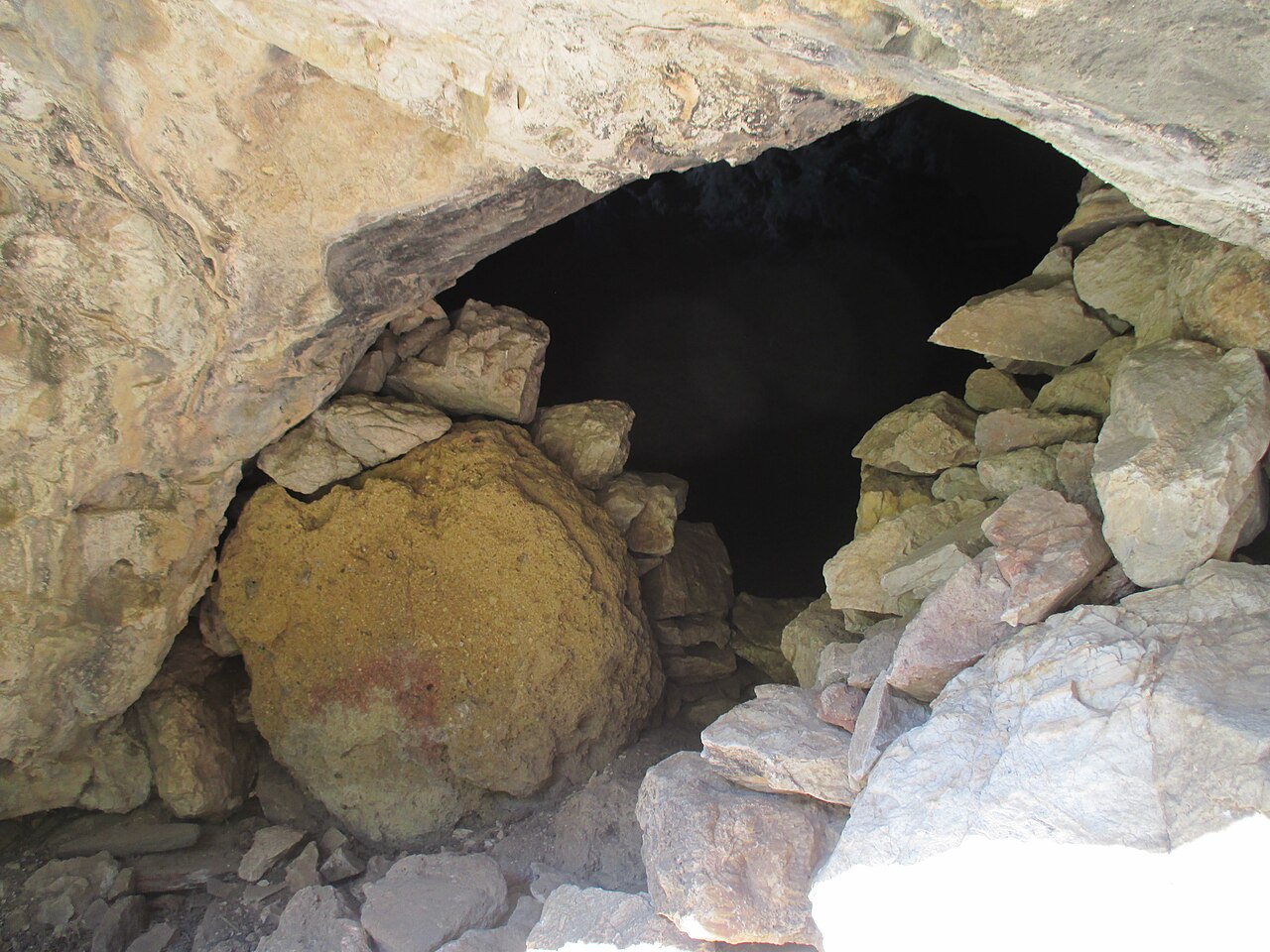
Dark cave entrance framed by a large pale limestone overhang, with rough stone blocks piled along both sides and a large rounded yellowish boulder in the foreground. Bright sunlit rock fills the lower right.Photograph

Secondary source

Pythagoras Cave entrance, Samos

Tomisti · 2016

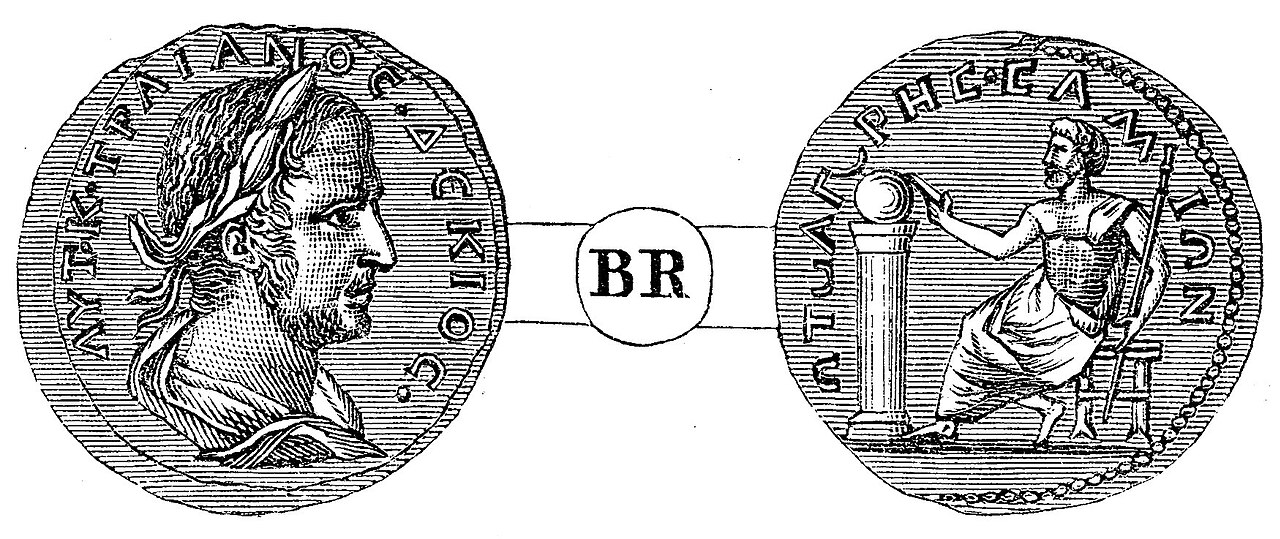
Engraved illustration of two coins side by side, joined by a central circle labeled BR. Left coin: a laureate male bust in profile facing right with Greek lettering around the rim. Right coin: a seated figure beside a column holding an object, with Greek lettering around the rim.Painting

Secondary source

Pythagoras illustration after Samos coin

Ernst Wallis et al · 1875

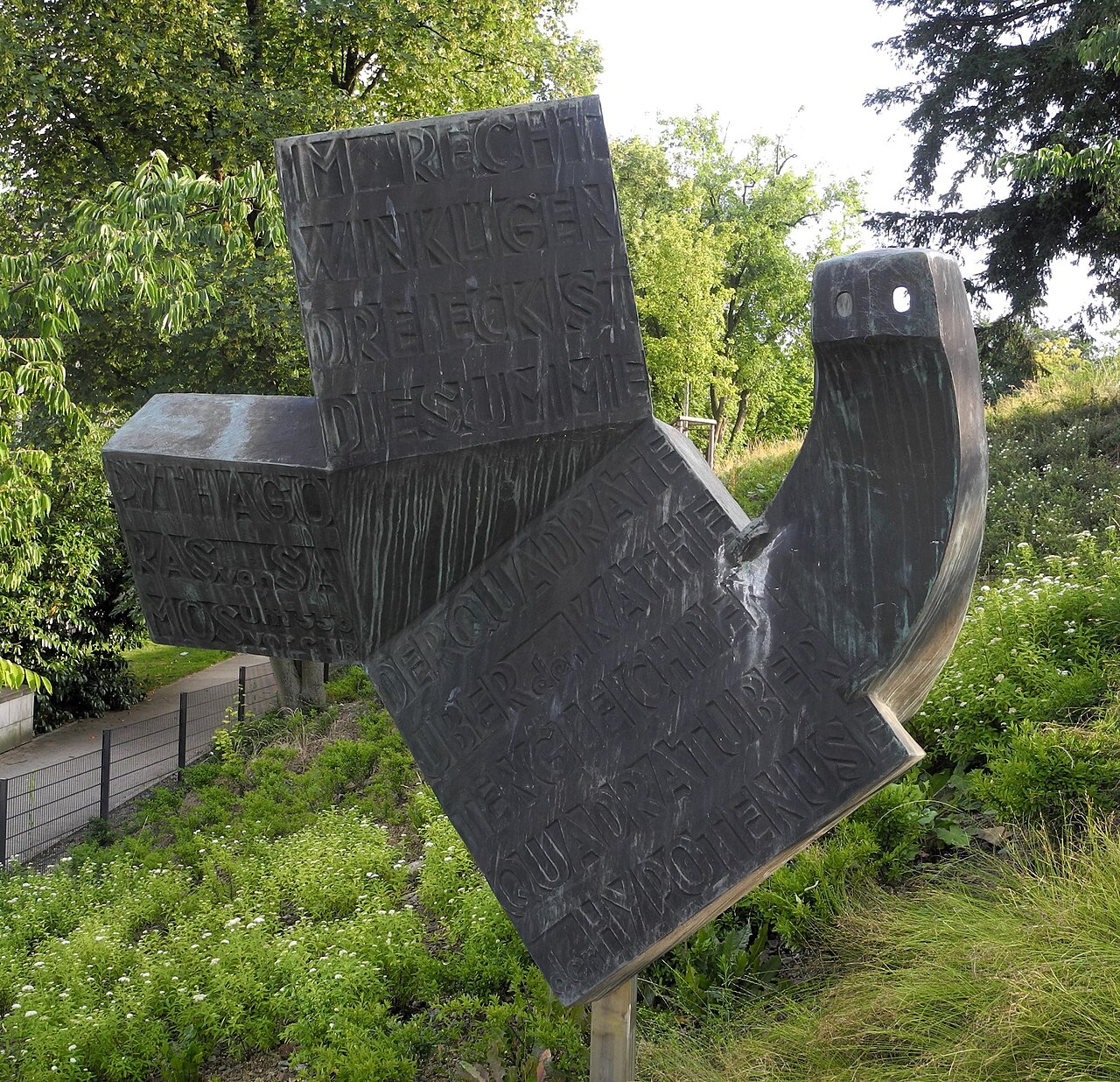
Dark bronze abstract sculpture on a grassy slope with green shrubs and trees behind. Its angular blocks are carved with raised German letters and fragments of words, including a right-angle shape and a curved section with two holes.Sculpture

Secondary source

Pythagoras memorial sculpture, Wuppertal school

Im Fokus · 3 July 2023

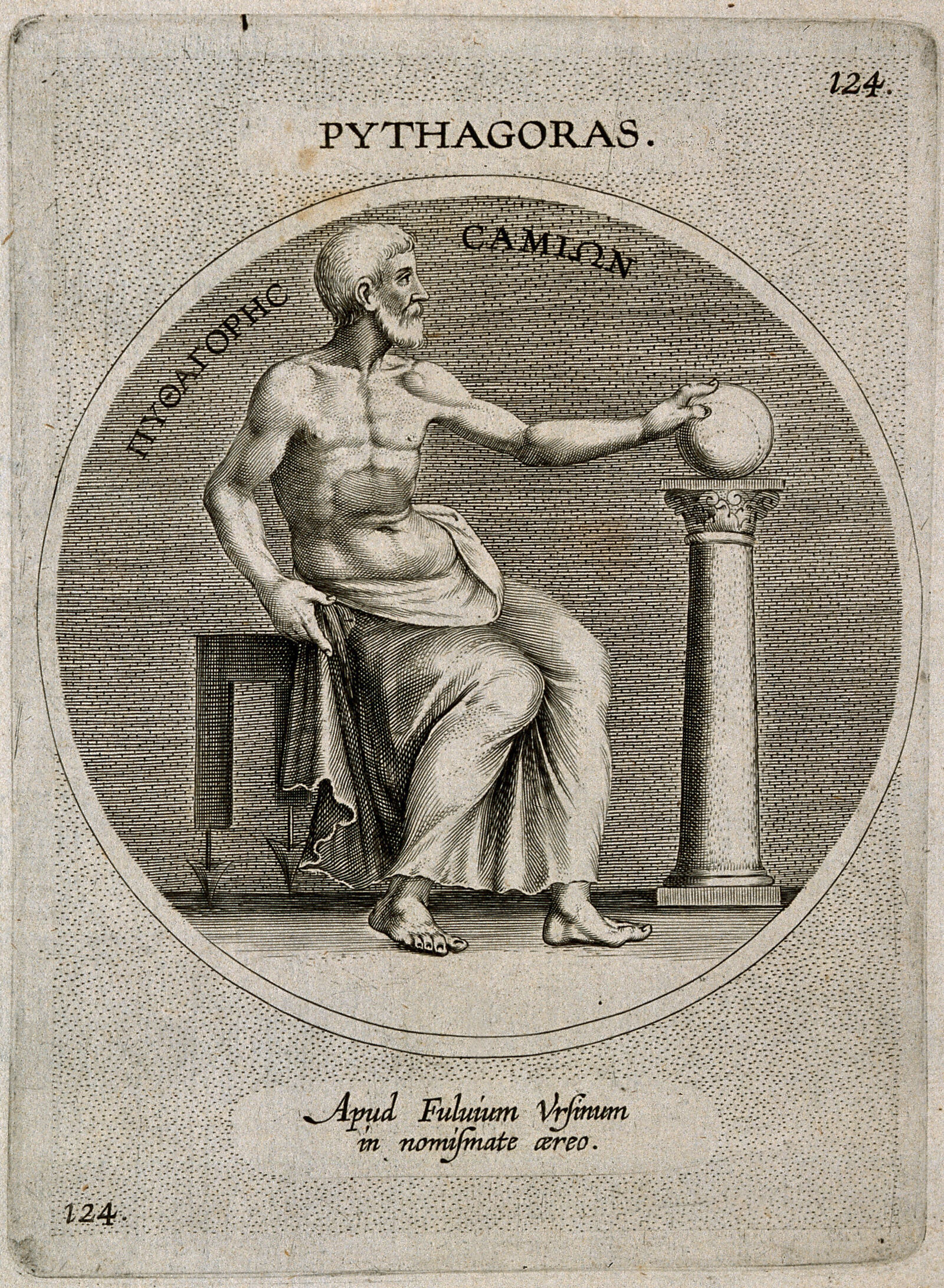
Line engraving of a bearded, bare-chested seated man in draped robes, resting one hand on a sphere atop a Corinthian-style column, with a stool at left. Labeled PYTHAGORAS at top, Greek letters around the oval, and a Latin caption below.Painting

Secondary source

Pythagoras line engraving after brass coin

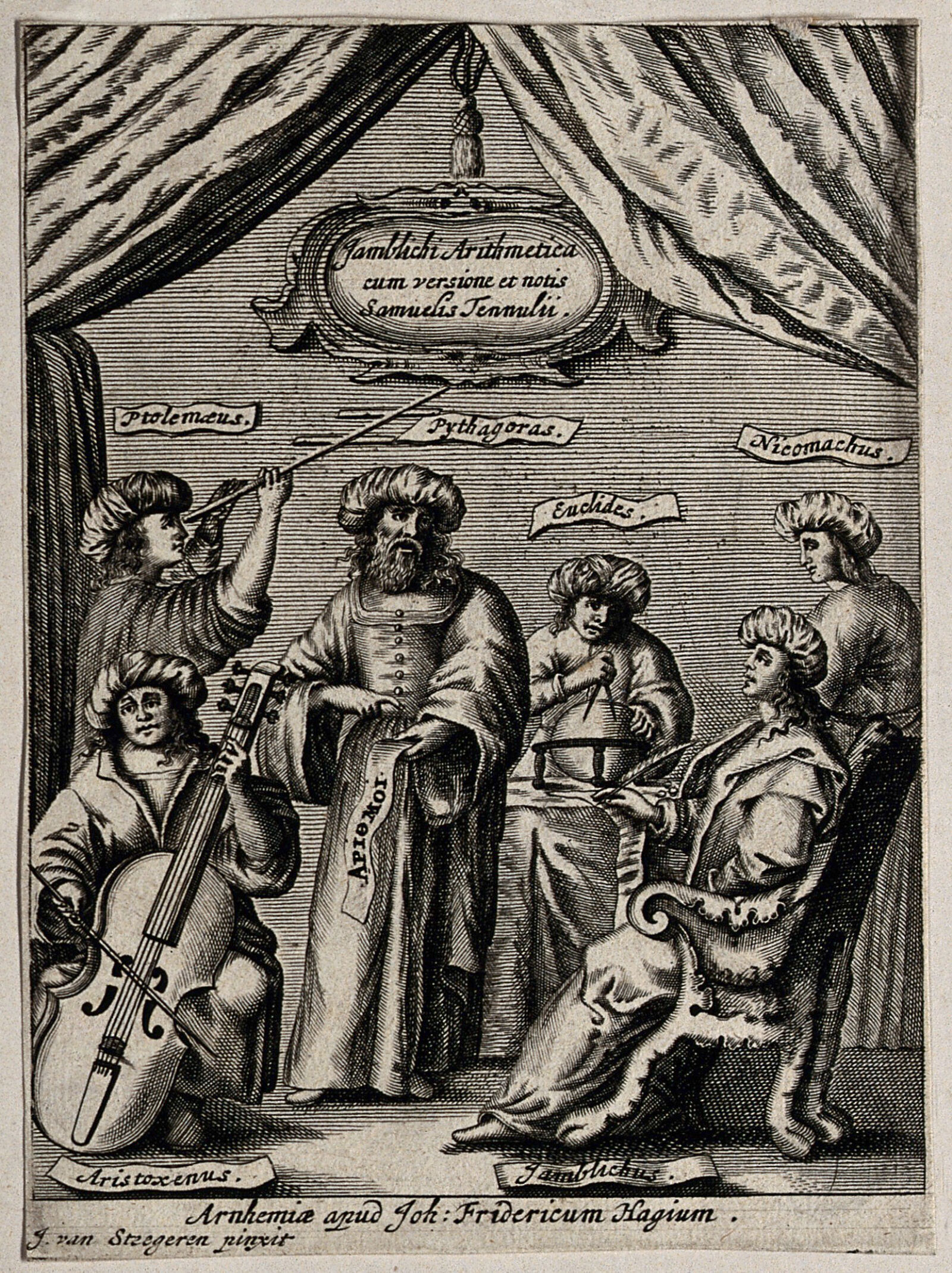
Engraved title page showing six men in period dress around a central bearded figure in a long robe inscribed 'Arithmos', with a cartouche reading 'Iamblichi Arithmetica cum versione et notis Samuelis Tennulii'. Labels name Ptolemaeus, Pythagoras, Euclides, Nicomachus, Aristoxenus and Iamblichus. Imprint reads 'Arnhemiae apud Joh: Fridericum Hagium' and 'J. van Steegeren pinxit'.Painting

Secondary source

Mathematicians title-page engraving

J. van Steegeren · [1667 or 1668]

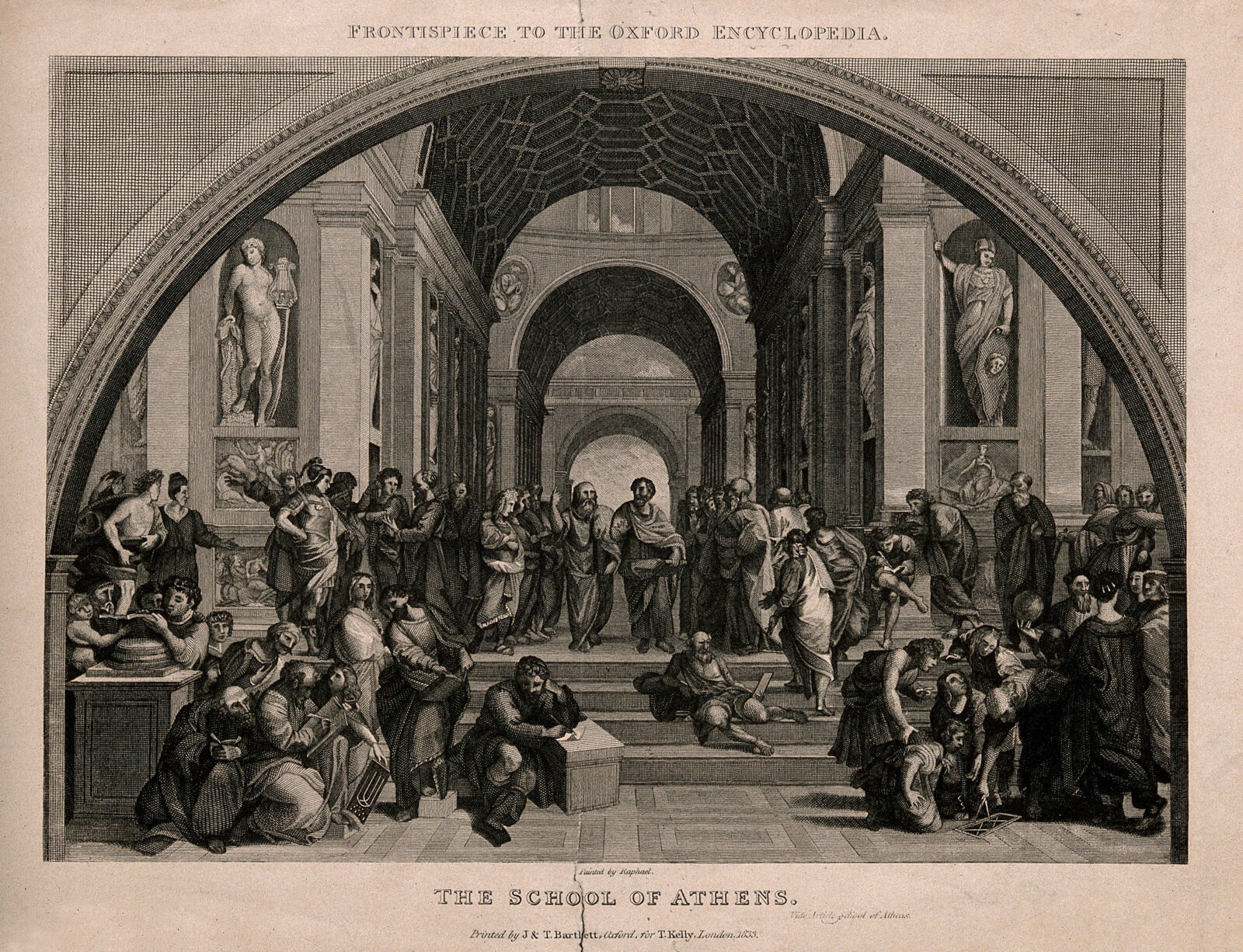
Engraving titled 'The School of Athens' with the inscription 'Frontispiece to the Oxford Encyclopedia' above, showing a grand arched hall with statues in niches and many robed figures gathered on steps and across the floor, some reading, writing, or conversing, with a figure at lower right bending over a diagram on the floor. Printed by J. & T. Bartlett, Oxford, for T. Kelly, London, 1835.Artifact

Secondary source

The School of Athens (1835 engraving by J. & T. Bartlett)

J. & T. Bartlett · 1835

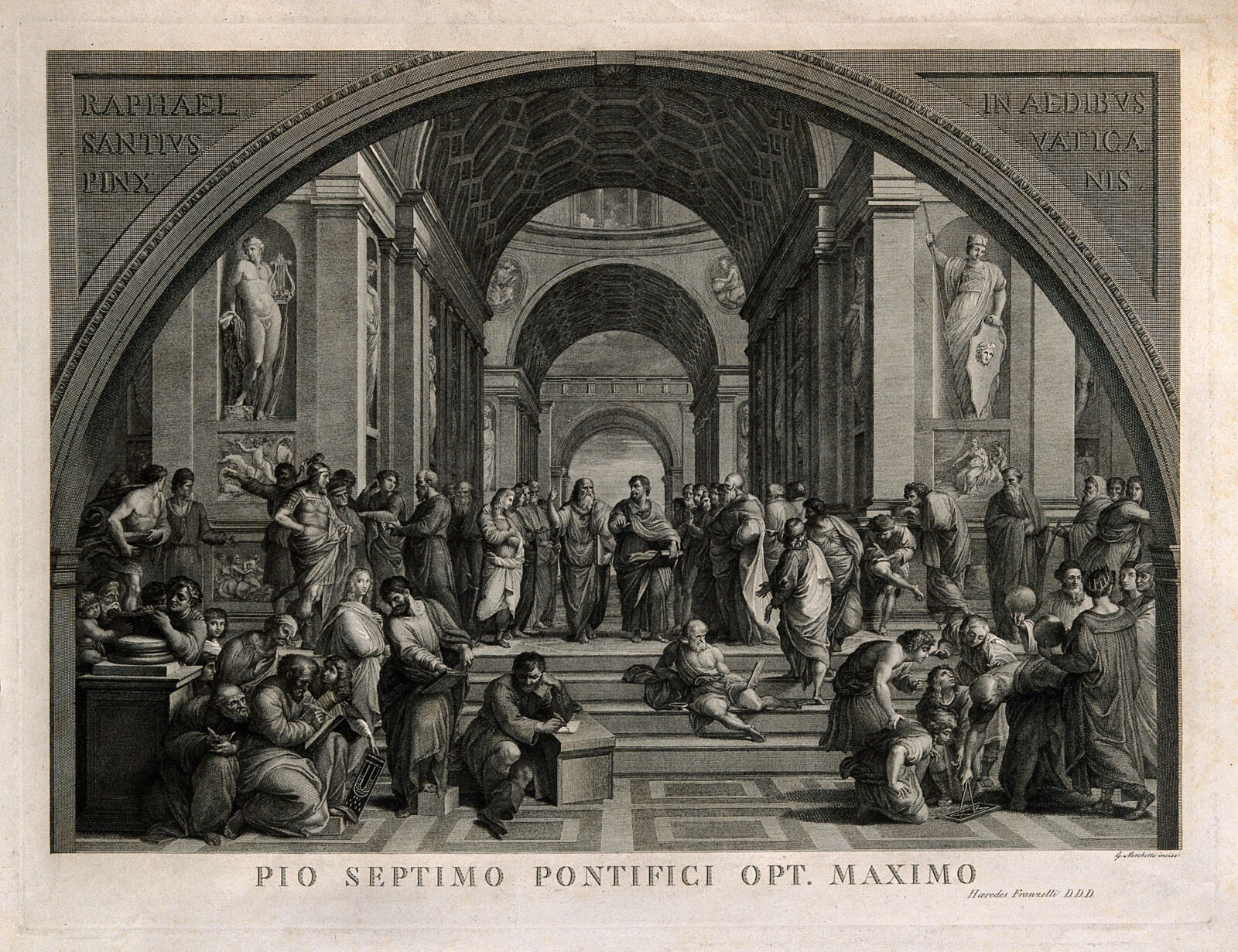
Engraving of a grand classical hall with coffered arches and statues in niches, filled with robed figures gathered on steps and floor. Inscriptions read Raphael Santius Pinx and In Aedibus Vaticanis; caption reads Pio Septimo Pontifici Opt. Maximo.Artifact

Secondary source

The School of Athens (1794 engraving by G. Mochetti)

G. Mochetti · 1794

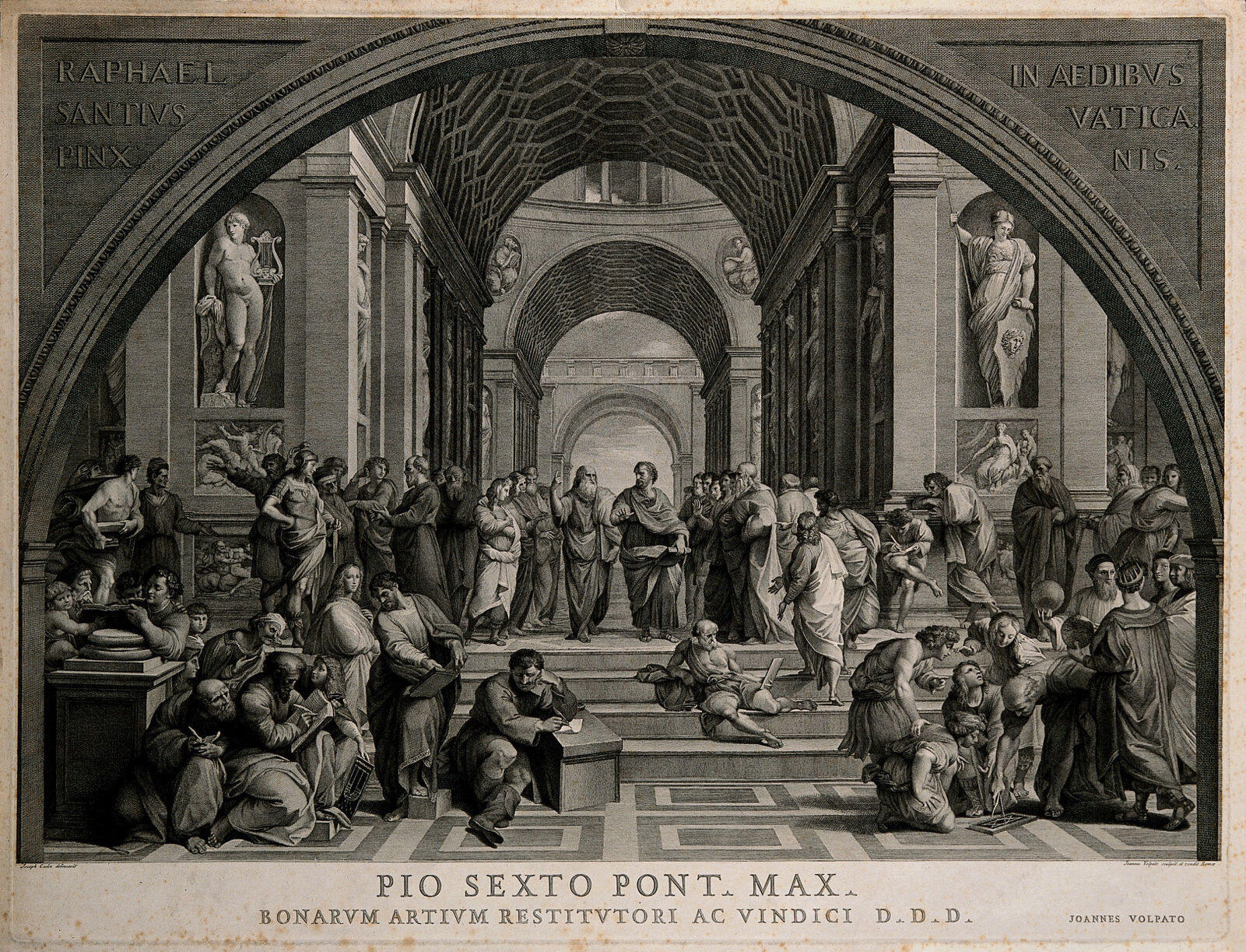
Engraving of Raphael's School of Athens: a grand barrel-vaulted hall with many robed philosophers and students gathered on steps, statues in niches, and an inscription reading Pio Sexto Pont. Max. below. Signed Joannes Volpato.Artifact

Secondary source

The School of Athens (engraving by G. Volpato after Cades)

G. Volpato · between 1700 and 1799

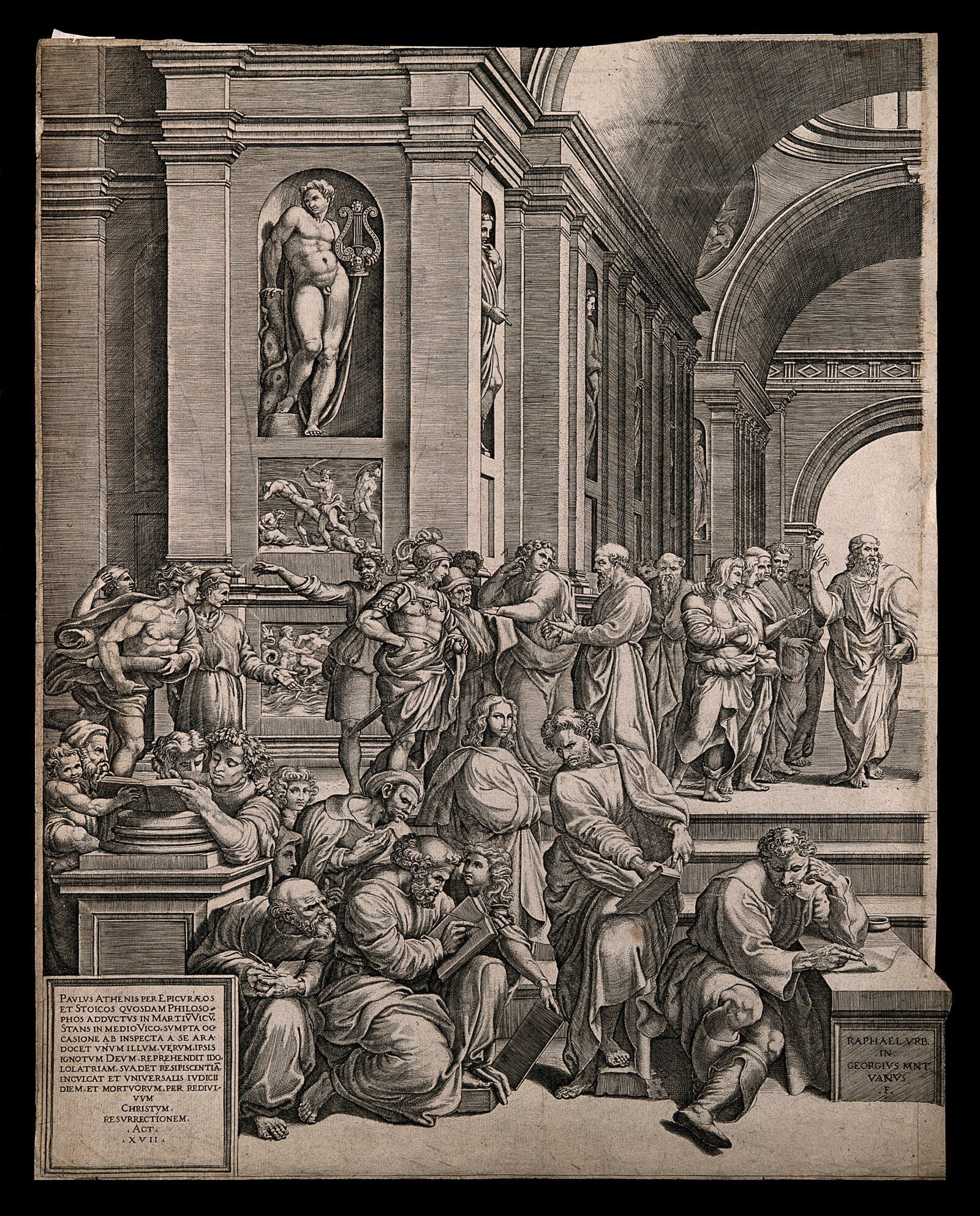
Black and white engraving of an architectural hall with columns and arches, where many robed figures gather around a central group, some seated and writing on the steps. A niche holds a nude statue with a lyre. Latin inscription text sits in the lower left corner and a signature plaque in the lower right.Painting

Secondary source

The School of Athens engraving with Saint Paul

Raphael · 1550

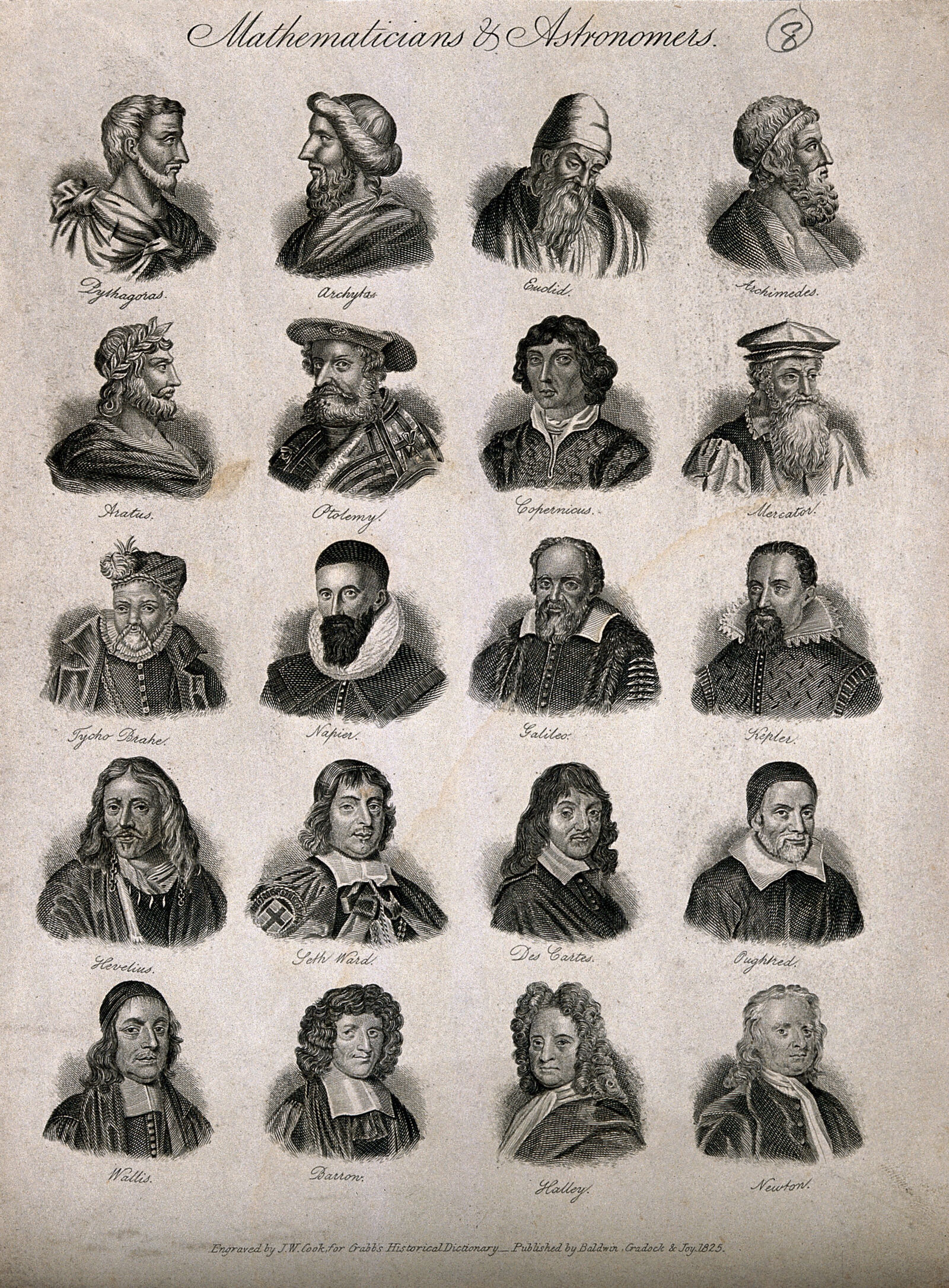
Engraved print titled 'Mathematicians & Astronomers' with twenty oval portrait busts in four rows, each labeled in script, including Pythagoras, Euclid, Ptolemy, Copernicus, Tycho Brahe, Galileo and Kepler. Engraved credit line at the bottom reads Engraved by J.W. Cook, 1825.Artifact

Secondary source

Mathematicians and Astronomers: Twenty Portraits

John William Cook · 1825

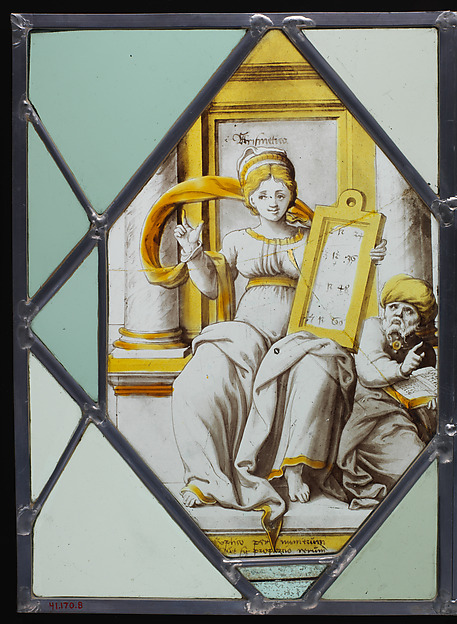
Stained glass panel in a lead framework showing a seated woman representing Arithmetic, holding a tablet of numbers, with a bearded man in a turban beside her reading a book. Pale green and clear glass surround the central octagonal scene, with a Latin inscription along the bottom.Artifact

Secondary source

Figure of Arithmetic with Pythagoras (stained glass panel)

late 18th–mid-19th century

Want the full shelf? Chat with Pythagoras in the app and open the Sources panel — every quote links back to the original.

Use Pythagoras in class

1 assignment · 1 collection

A ready-made assignment and collection from the Humy team and other teachers that feature Pythagoras. Preview any of them, then try it free.

Trusted by educators worldwide

Conversations
375,000+
Real exchanges between students and historical figures
Messages exchanged
4,142,000+
Across every figure, classroom and language
Historical figures
100,000+
Each informed by a curated biography and selected sources
Languages supported
50+
From English and Spanish to Arabic and Korean

Paying customers

Used by 98 schools and universities

Partner school logo
Tecnológico de Monterrey logo
Hyper Island logo
Partner school logo
Chambersburg Area School District logo
Broward County Public Schools logo
Nebo School District logo
National Louis University logo
South Florida PBS logo
Punahou School logo
University of Wisconsin–River Falls logo
Partner school logo
Partner school logo
Archbishop Mitty High School logo
Kingsburg High School logo
Norwalk Public Schools logo
Partner school logo
Connections logo
Partner school logo
Moore Public Schools logo
Partner school logo
Partner school logo
Partner school logo
Partner school logo
Robbinsville Public Schools logo
Partner school logo
Partner school logo
Partner school logo
Tecnológico de Monterrey logo
Hyper Island logo
Partner school logo
Chambersburg Area School District logo
Broward County Public Schools logo
Nebo School District logo
National Louis University logo
South Florida PBS logo
Punahou School logo
University of Wisconsin–River Falls logo
Partner school logo
Partner school logo
Archbishop Mitty High School logo
Kingsburg High School logo
Norwalk Public Schools logo
Partner school logo
Connections logo
Partner school logo
Moore Public Schools logo
Partner school logo
Partner school logo
Partner school logo
Partner school logo
Robbinsville Public Schools logo
Partner school logo
Partner school logo

What educators are saying

“We enjoyed the program last year and used it frequently.”
“My students say it’s a welcome change of pace. I’m not a fan of the “sage on the stage” model, so I try to incorporate research-oriented and self-paced activities. With Humy, students have to take charge of their learning. They’ve become more adept at critical thinking, forming better questions, and improving their reading comprehension. The interview feature has been my go-to tool. I create assignments where students must ask historical figures a set number of questions, then summarize the responses to ensure they’re truly absorbing the material. This approach lets them actively explore the past rather than passively consuming information.”
“Humy has helped me bring historical figures, sometimes long past, to life. When my students interact with these figures in real-time, it eliminates some of the perceived “ancient” characteristics of my curriculum. This has shifted my students’ thinking away from viewing history as abstract or irrelevant. Real-time interactions make historical figures relatable, even allowing students to ask off-topic questions that help put historical lives in a more relevant context for 13-year-olds. The feature I use the most is the interview feature. After teaching a topic, most recently Gandhi and Joan of Arc, I have the students ask pointed, focused questions. We practice good conversation techniques beforehand, teaching them to listen (or read) carefully and formulate thoughtful follow-up questions rather than just interrogating. It helps students practice effective conversation skills.”

FAQ

Frequently asked questions

Who is Pythagoras?
Ancient Greek mathematician and philosopher, known for the Pythagorean theorem. On Humy.ai you can chat with an AI version of Pythagoras that draws on a short biography and 86 historical sources during the conversation — by text or voice, in 42 languages.
Is Pythagoras AI free?
Pythagoras is part of Humy's full library of more than 100,000 figures, which comes with a paid plan. A free account (no credit card) includes 20 messages a month with the free library's figures, so you can try how the conversations work first.
What sources does the Pythagoras AI use?
It draws on a short biography and 86 historical sources (books, paintings and sculptures), including “Lives and Opinions of Eminent Philosophers, Book V (Life of Aristotle)”, “Histories” and “Pythagoras Leaning on a Globe with Four Listeners”. Each source has its own page on Humy.ai.
How historically accurate is the AI version of Pythagoras?
Each figure uses a short biography and a small set of selected historical sources as context (retrieval-augmented generation), so answers stay closer to known material than the model's general knowledge alone. It isn't a citation-grade research tool — like any LLM, the AI can get details wrong or extrapolate. Treat it as a strong starting point for inquiry and cross-reference important claims.
Can I talk to Pythagoras by voice?
Yes. In addition to text chat, you can call Pythagoras and hear their voice respond in real time — useful for auditory learners, interview practice and Socratic dialogue.
Is Humy.ai safe and compliant for schools?
Yes. Humy.ai is used by more than 100 schools, universities and organisations. The platform is FERPA- and GDPR-aligned, supports SSO, and offers an IT-approval pack tailored for school procurement teams.

Ready when you are

Start chatting with Pythagoras now.

20 messages free · No credit card · Available in 50+ languages.