Portrait of Cicero

AI Historical Figure

Cicero

Ancient Roman statesman, orator, and philosopher.

Chat with Cicero via text or voice — in 42 languages, drawing on a curated biography and 85 historical sources. Available 24/7.

Start chatting with Cicero20 messages free · No credit card
Lived
106–43 BCE
From
Italy
Known for
Politics & governmentPhilosophy
Cicero

Cicero

Online · responds in seconds

Hello — I'm Cicero. Ancient Roman statesman, orator, and philosopher. What would you like to ask me?

20 messages free · No credit card · Powered by Humy.ai

Live preview · Switch between 42 languages above · Send a message to continue in the app

Multilingual

Talk to Cicero in 42 languages

Ask Cicero questions in any language below, and the rest of Humy's app speaks it too. Pick yours to open the chat in that language.

Also in German (Austria), German (Switzerland), English (UK), English (Australia), English (Canada).

The sources behind this AI

85 sources · 33 books · 18 speeches · 14 paintings · 8 letters · 5 artifacts · 2 sculptures · 2 documents · 2 photographs · 1 documentary

Cicero doesn’t improvise from thin air. The AI is grounded in 85 curated historical sources students can inspect. Open any of them to see what informs the conversation.

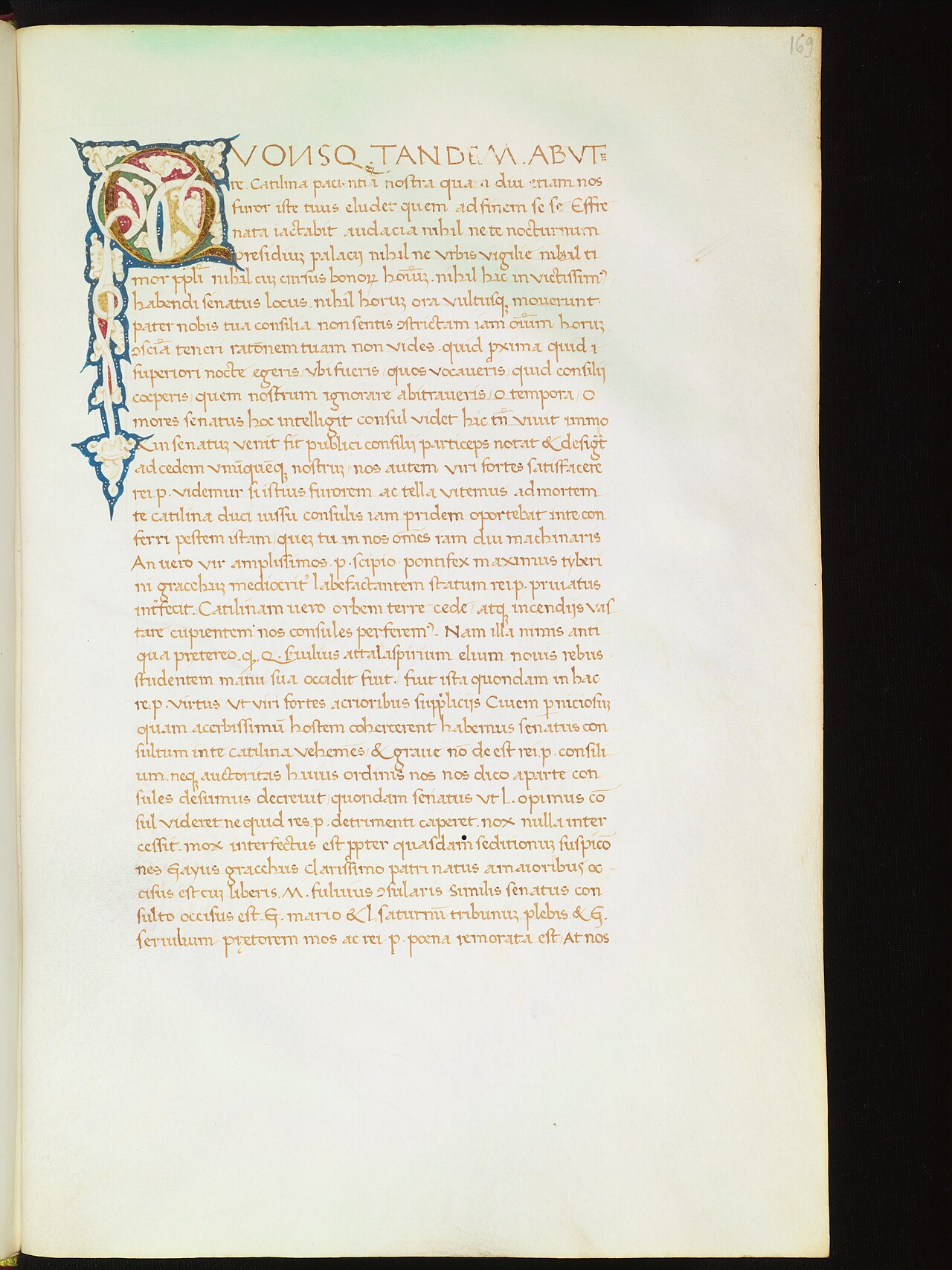
Manuscript page numbered 169 in Latin, handwritten in brown ink with a decorated illuminated initial letter in the upper left in red, green, and blue with gold accents. The text begins with the opening words of Cicero's first Catilinarian oration, 'Quo usque tandem abutere...'.Speech

Primary source

Catiline Orations

Cicero · 63 BCE

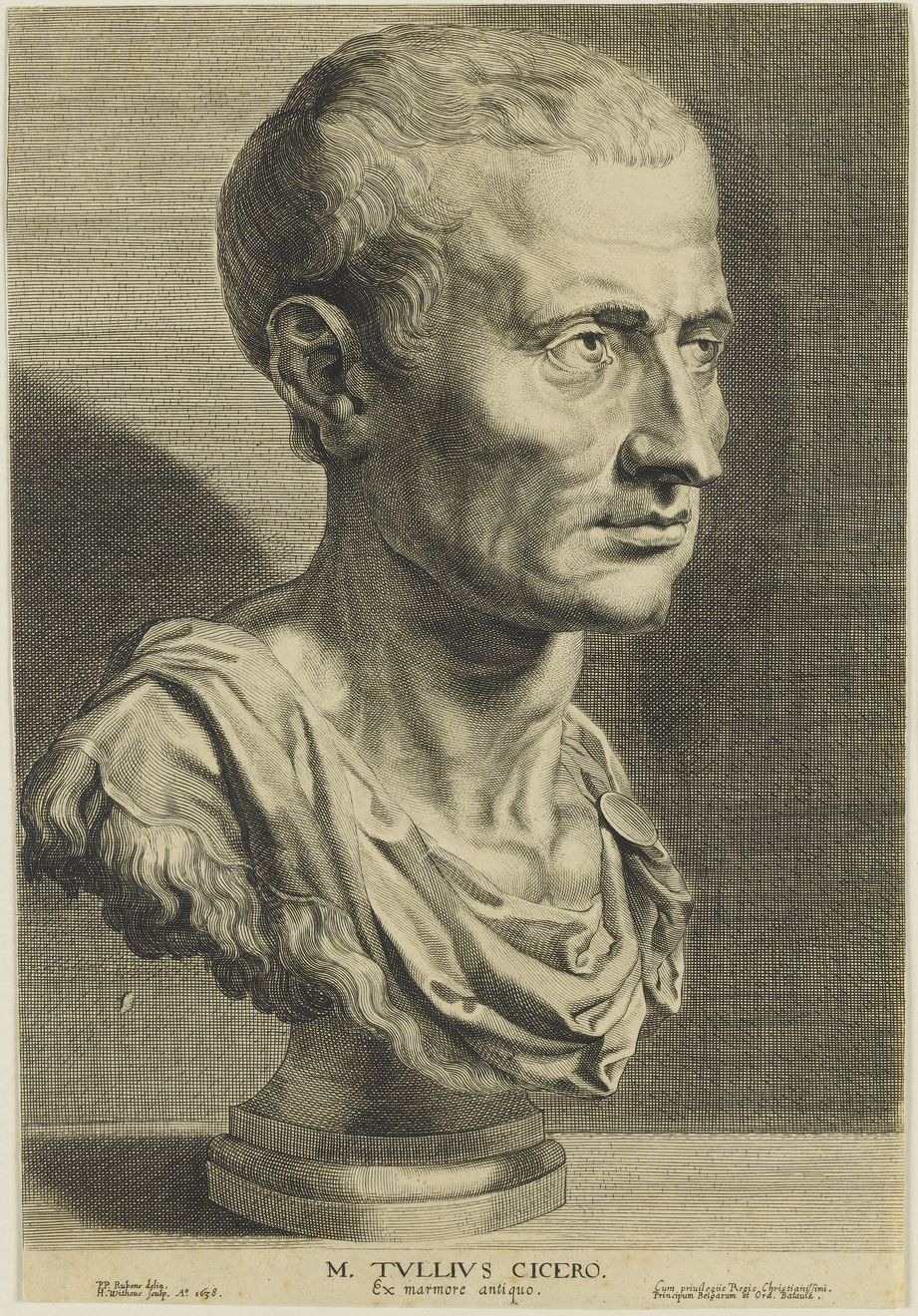
Engraved print of a bust of Marcus Tullius Cicero, shown in three-quarter view facing right. The bust has curly hair, a draped toga over the shoulder, and sits on a round stepped pedestal. Latin caption below reads M. TVLLIVS CICERO, Ex marmore antiquo, with small engraver credits in the bottom corners.Painting

Secondary source

Marcus Tullius Cicero, engraved after antique marble busts

Jan Witdoeck

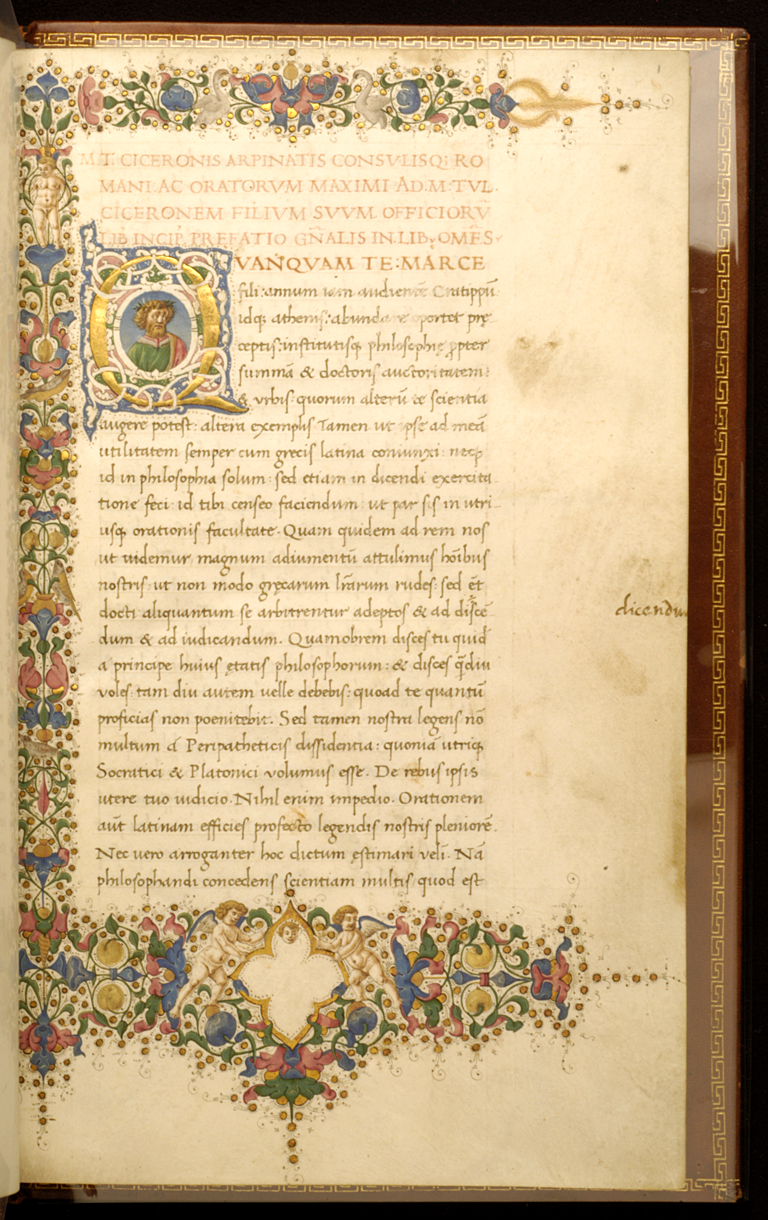
Open manuscript leaf with illuminated Latin text. A decorated initial at left contains a small painted portrait of a bearded man wearing a crown. Ornamental borders in gold, blue, pink, and green frame the page, with cherubs at the bottom. The Latin text is written in brown ink in a formal script.Book

Primary source

De Officiis

Cicero · 44 BC

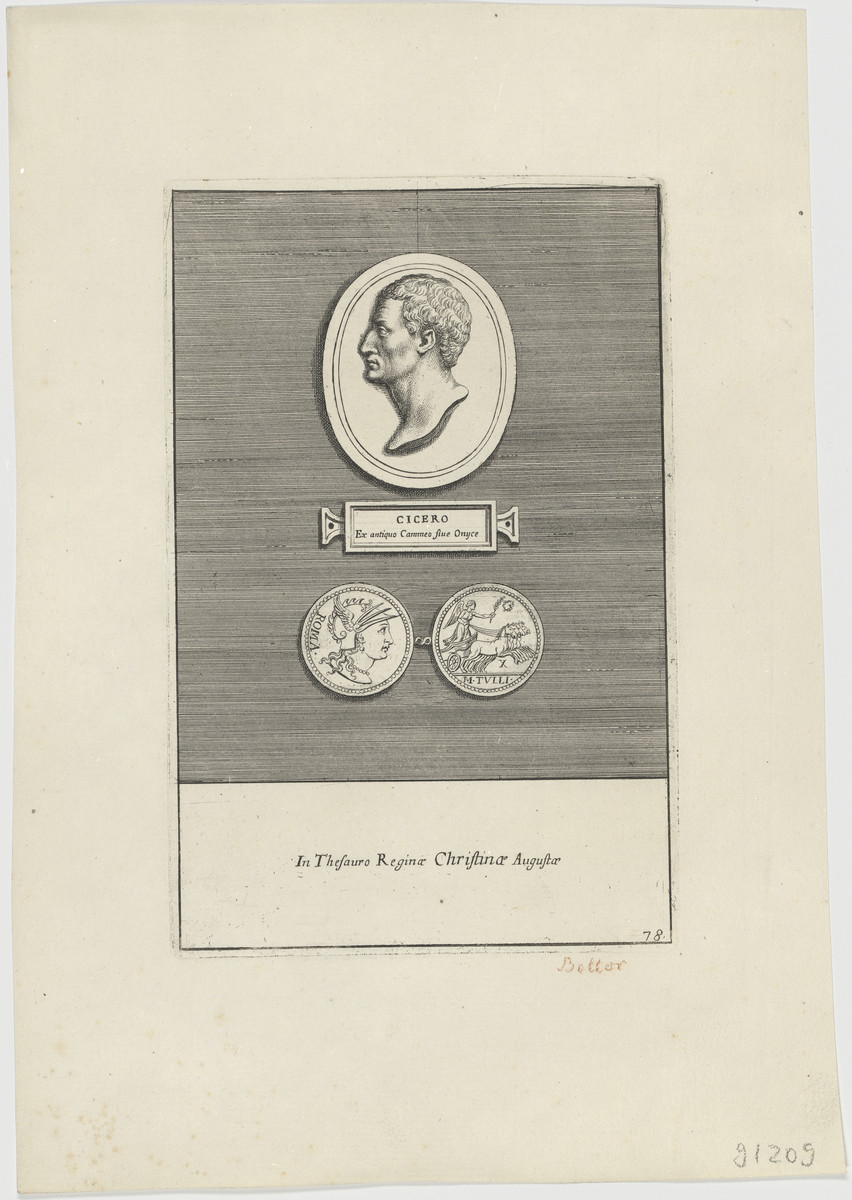
Engraved print on cream paper showing an oval cameo portrait in profile of Cicero, a bald-fronted man with curly hair facing left. Below are a label reading CICERO and two Roman coins, with a Latin inscription at the bottom and the number 78.Painting

Secondary source

Portrait of Cicero (Bildnis des Cicero)

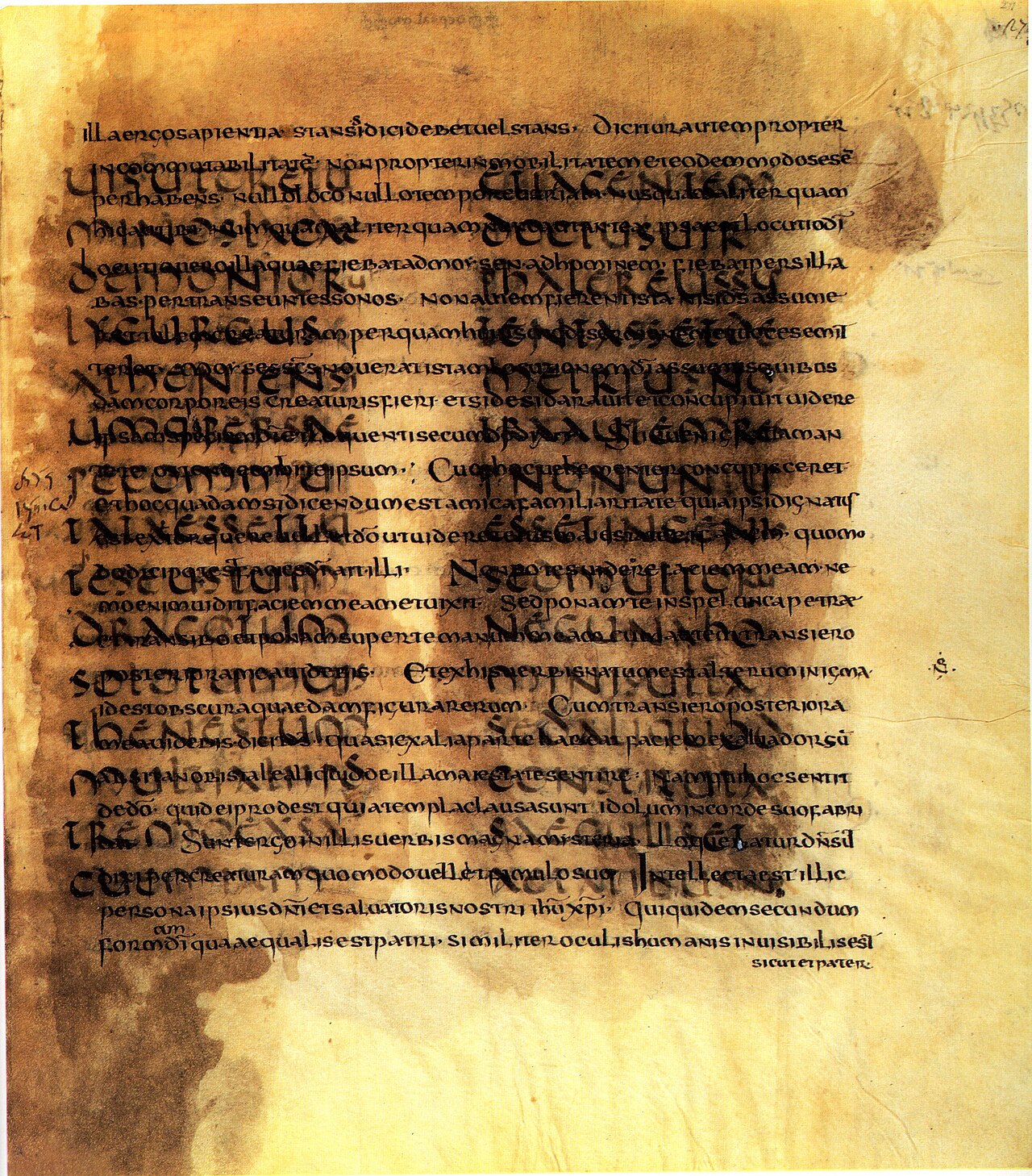
Manuscript page of Latin text in dark brown ink on yellowed parchment, with a faded underlying script visible in the lower layer. Stained and darkened areas across the page, a palimpsest with the upper text dominant.Book

Primary source

De re publica

Cicero · c. 54–51 BC

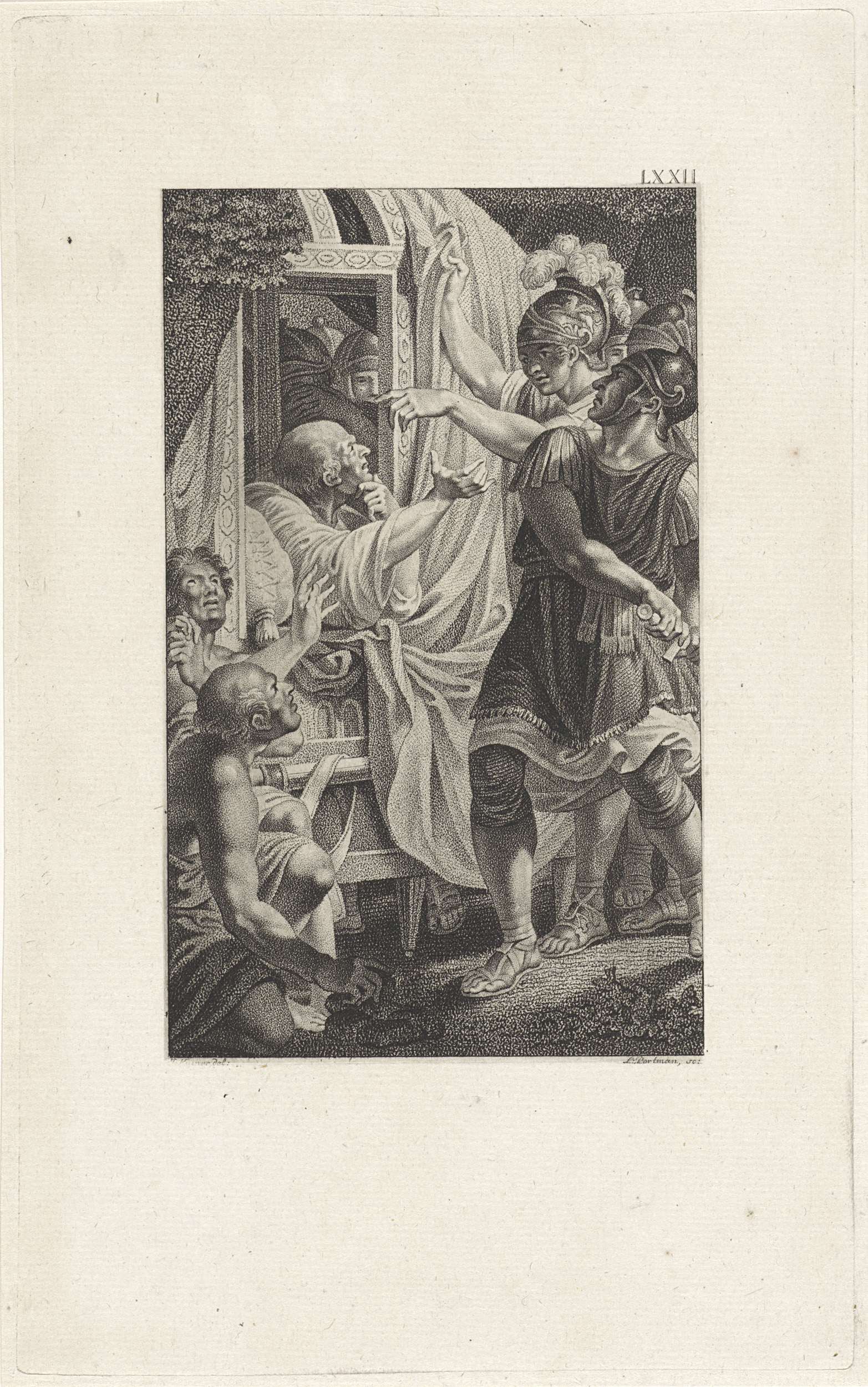
Engraving in stipple style, numbered LXXII at top right. An elderly man in a toga reaches out toward a centurion in plumed helmet and armor who points at him, while soldiers and onlookers gather near a curtained litter and a doorway. A seated figure in the foreground leans forward. Signed in the lower corners.Painting

Secondary source

Death of Cicero

1801

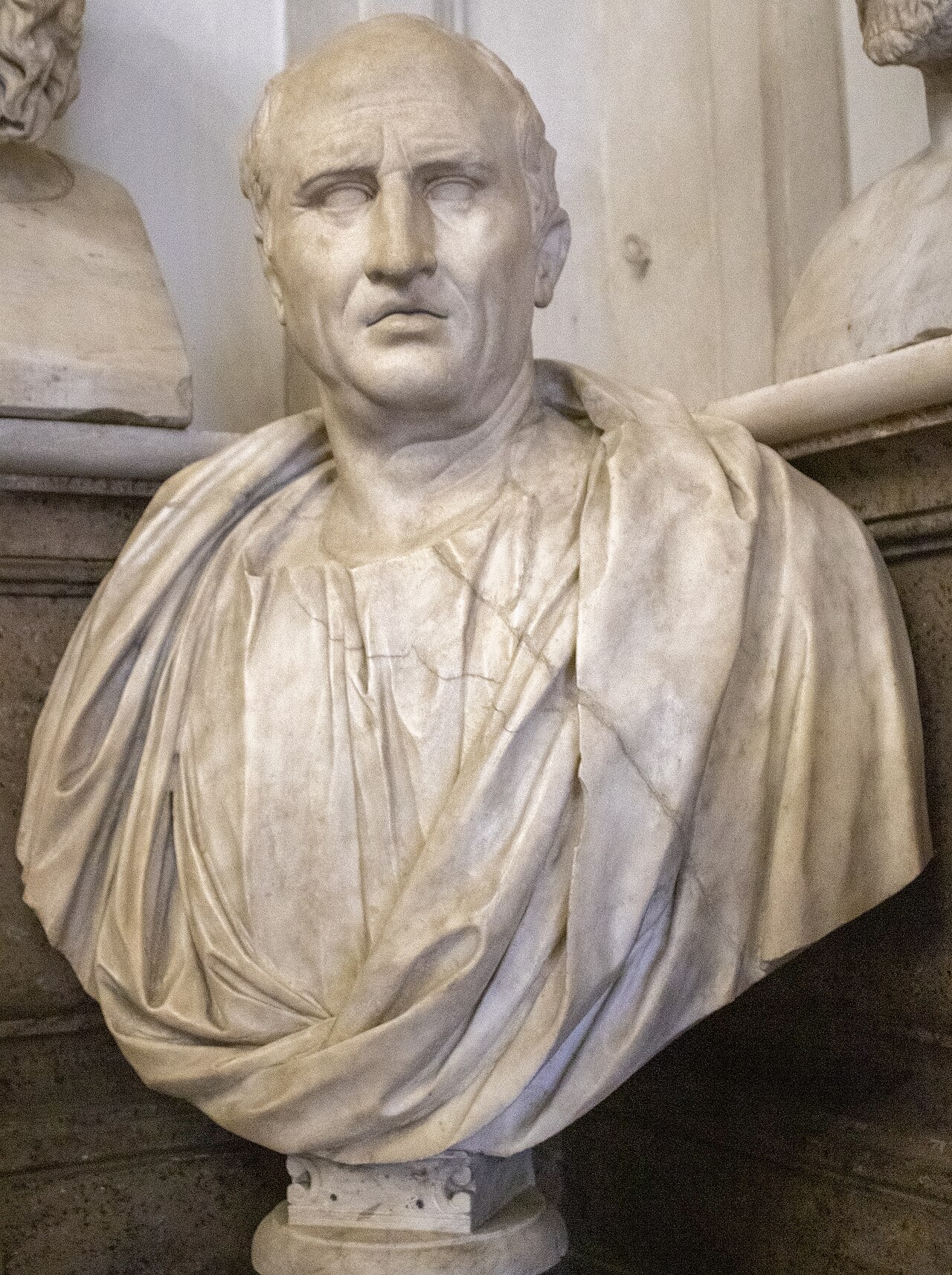
Marble bust of a bald, older man with deep-set eyes, furrowed brow and pursed lips, wearing a draped toga, set on a square plinth and round base. Other sculptures are visible at the edges.Sculpture

Secondary source

Portrait of Cicero

Unknown

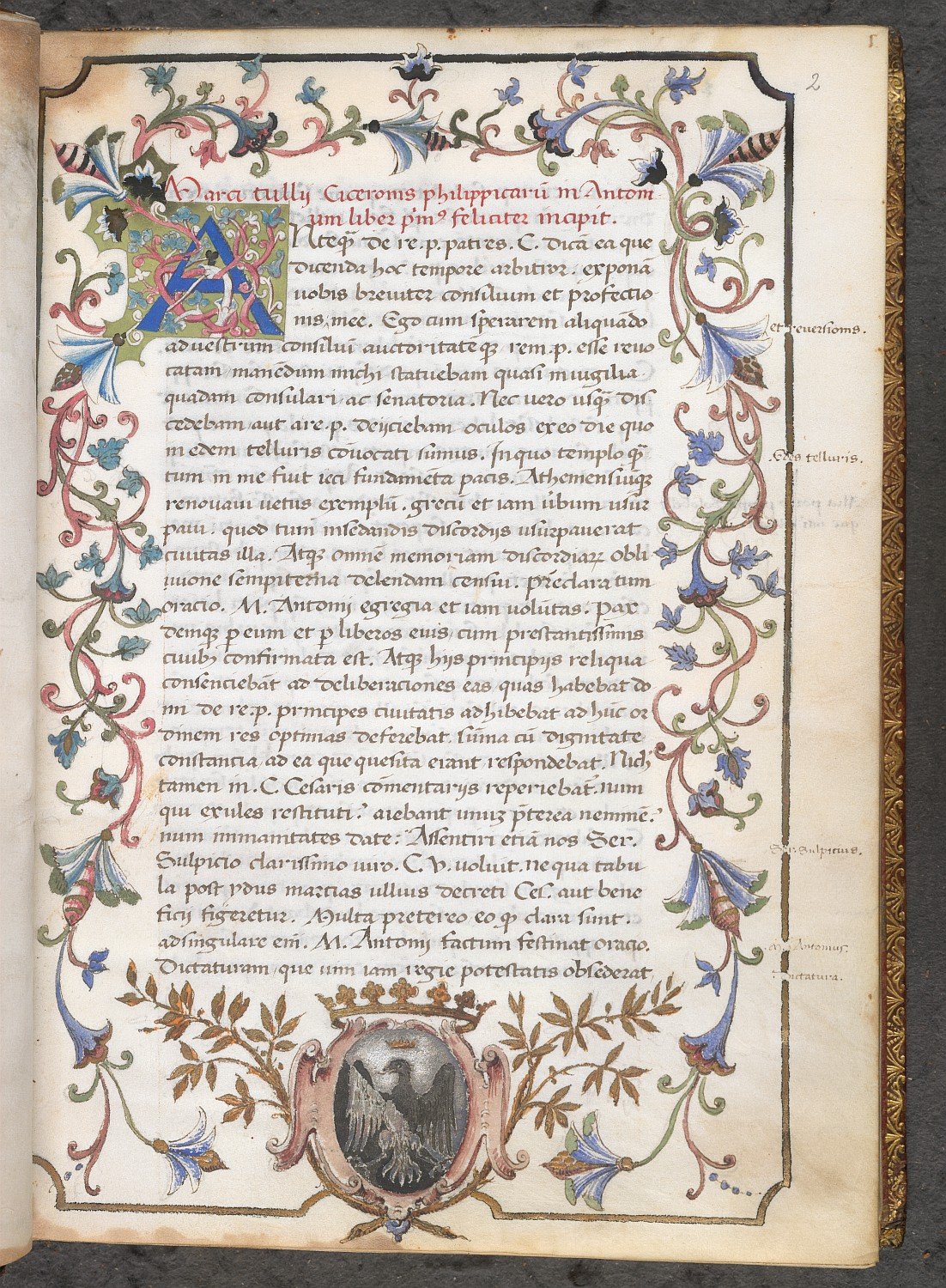
Folio 2 of an illuminated manuscript page with a Latin text block in two columns of script, a decorated initial letter A in blue and gold, and a floral border with a coat of arms at the bottom showing an eagle.Speech

Primary source

Philippics

Cicero · 44-43 BC

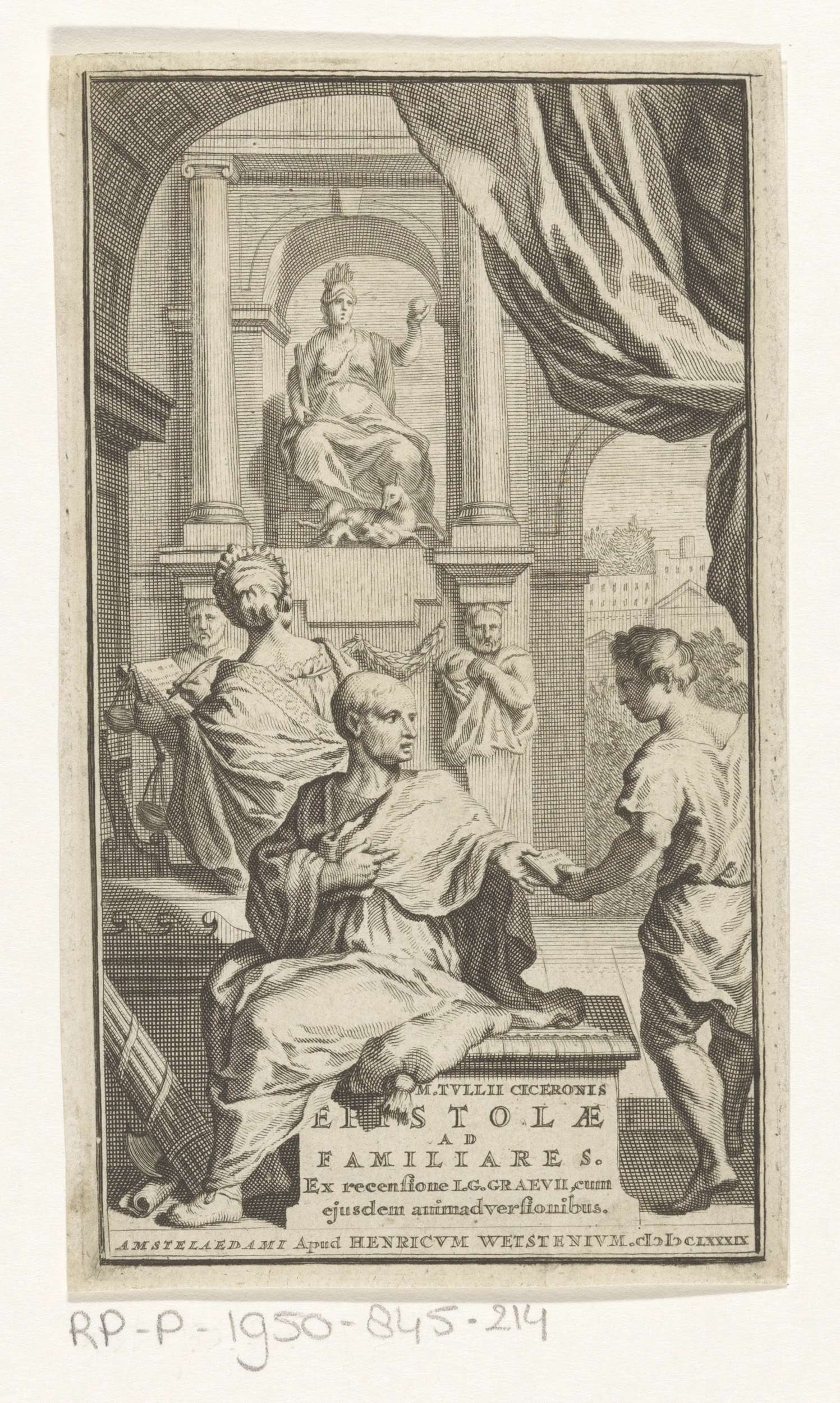
Engraved title page for Cicero's Epistolae ad Familiares, Amsterdam 1689. A seated bald man in a cloak gestures toward a standing woman; a seated woman writes on a tablet; a statue of a seated woman with a lion stands in a niche above. Latin title text is printed at the bottom.Painting

Secondary source

Cicero and a writing woman

1689

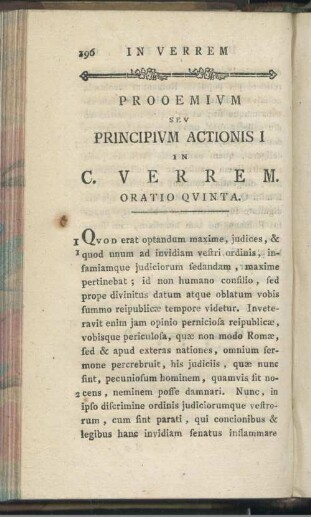
Scanned printed page of an old book, headed 'IN VERREM' at top, with the title 'PRooEMIVM SEV PRINCIPIVM ACTIONIS I IN C. VERREM. ORATIO QVINTA' and body text in Latin beginning 'Quod erat optandum maxime, judices, ...'. Page number 296 at top left.Speech

Primary source

In Verrem

Cicero · 70 BCE

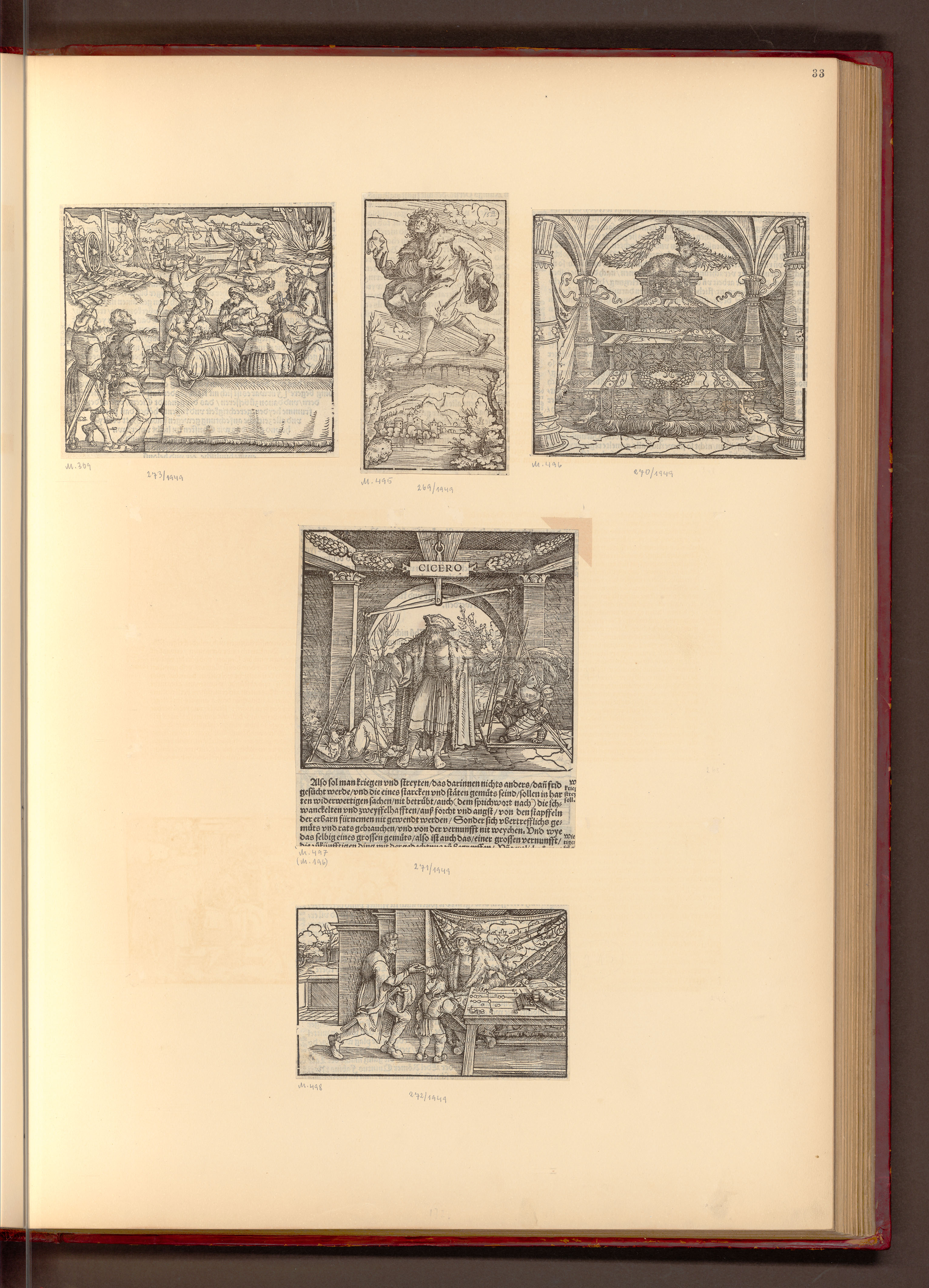
Album page 33 with five woodcut prints. The large central print labelled CICERO shows a bearded man in a robe and hat standing between columns, with a seated figure and a kneeling figure beside him, above German text. Four smaller prints surround it.Painting

Secondary source

Book illustration from Cicero's Officia

1531

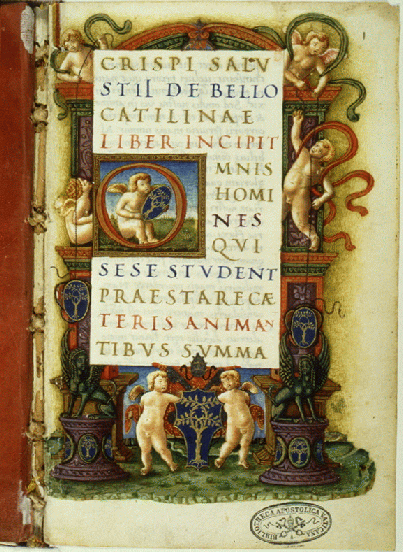
Illuminated manuscript title page with the opening text 'CRISPI SALV STIL DE BELLO CATILINAE LIBER INCIPIT' in red and black capitals, surrounded by painted putti, foliage, and an ornate border; a small roundel shows a putto, and a red-bound spine is visible at left.Book

Secondary source

The Conspiracy of Catiline

Sallust · c. 45 BCE

Book

Secondary source

Life of Cicero

Plutarch

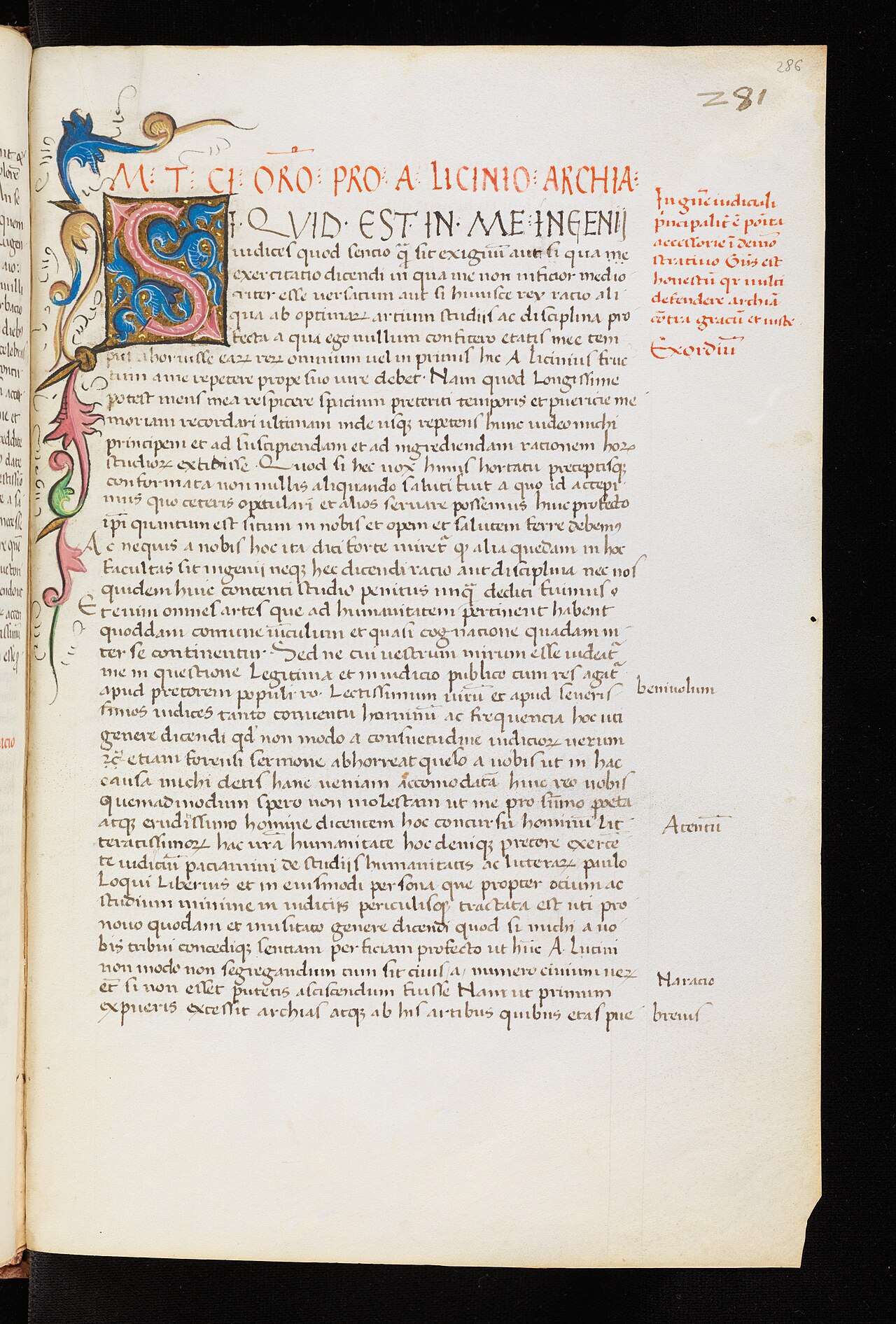
Manuscript page in Latin with a decorated illuminated initial S in blue, pink and gold, red rubricated heading reading M. T. Ciceronis pro A. Licinio Archia, and handwritten black-ink text in columns with marginal annotations in red.Speech

Primary source

Pro Archia Poeta

Cicero · 62 BCE

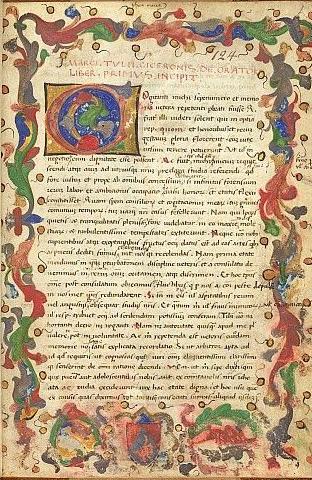
Illuminated manuscript page with a decorated border of green, red, and gold foliage and a large blue and gold initial letter C. A red and blue heading in capitals reads the title of Cicero's De oratore at the top, and the page is filled with dense handwritten Latin text in black ink.Book

Primary source

De Oratore

Cicero · 55 BCE

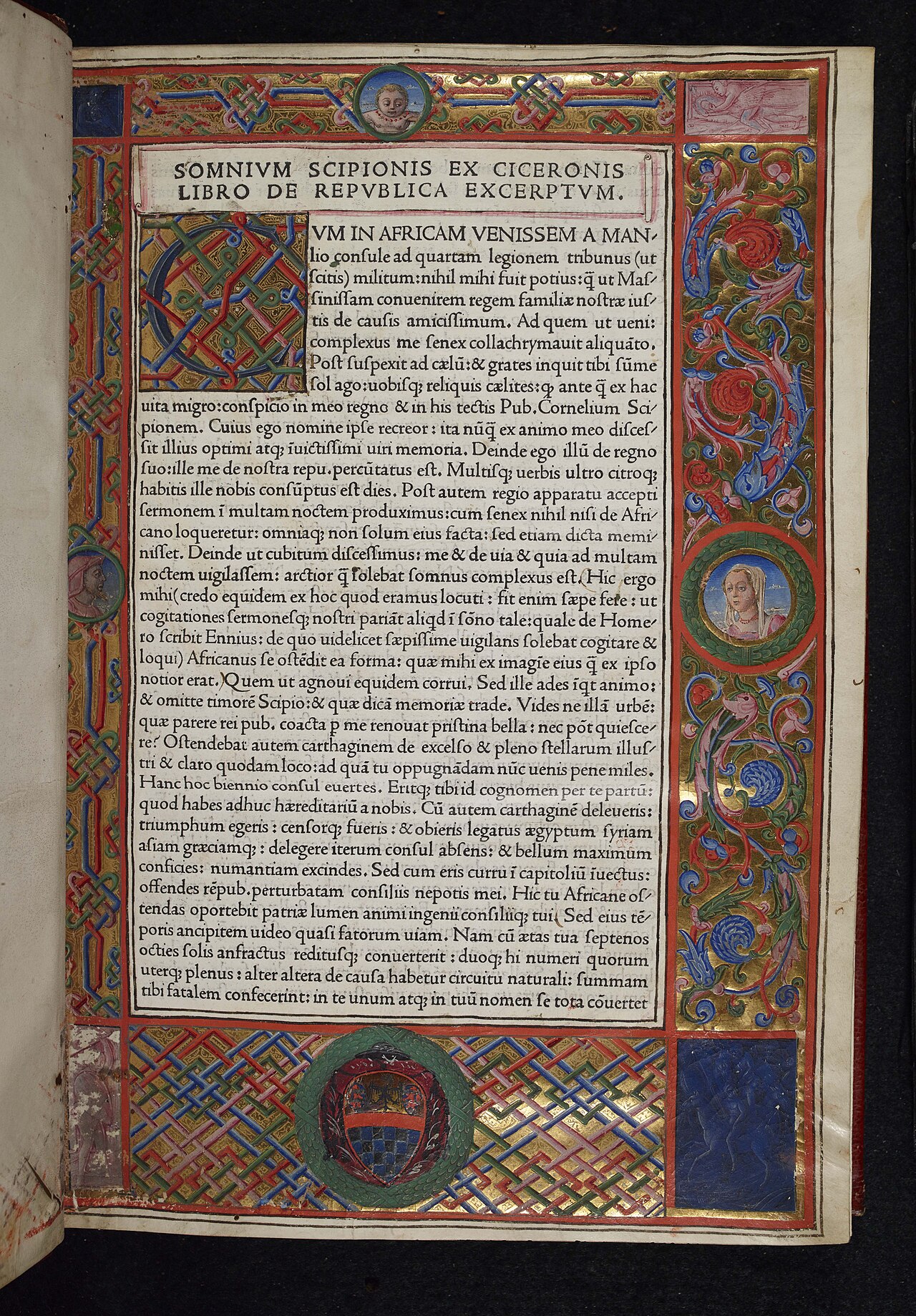
Illuminated book page with the title 'Somnium Scipionis ex Ciceronis libro de re publica excerptum' in red and black, a decorated initial, dense Latin text in columns, interlace borders in gold, red, blue and green, a portrait medallion of a woman on the right, and a coat of arms at the bottom centre.Book

Primary source

Somnium Scipionis

Cicero

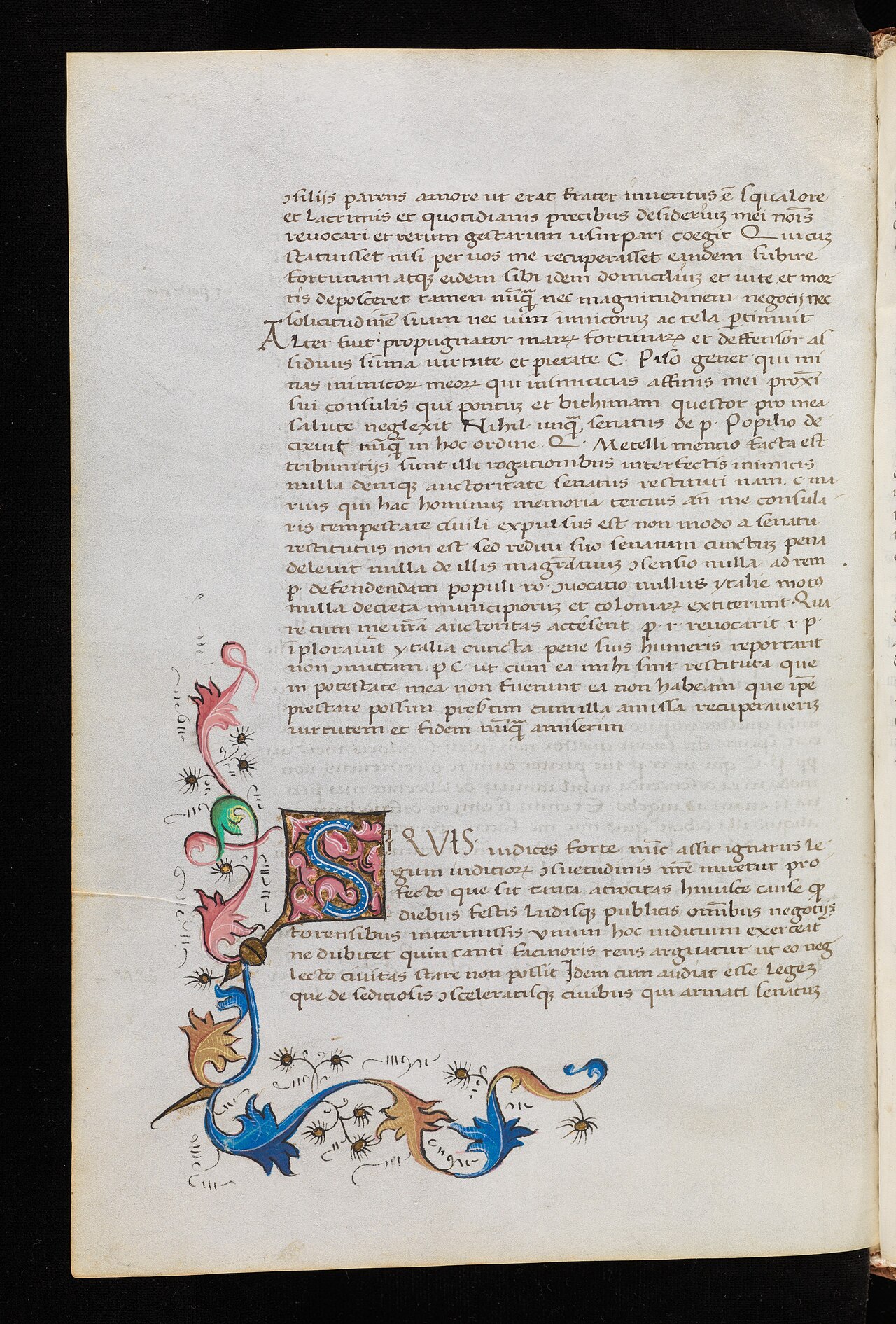
A page of handwritten Latin manuscript in brown ink on pale vellum, with a decorated illuminated initial S in pink, blue and green and sprawling painted foliage and small flowers in the left margin. The text begins with the words 'Sivus' and continues in dense script in the lower half.Speech

Primary source

Pro Caelio

Cicero · 4 April 56 BC

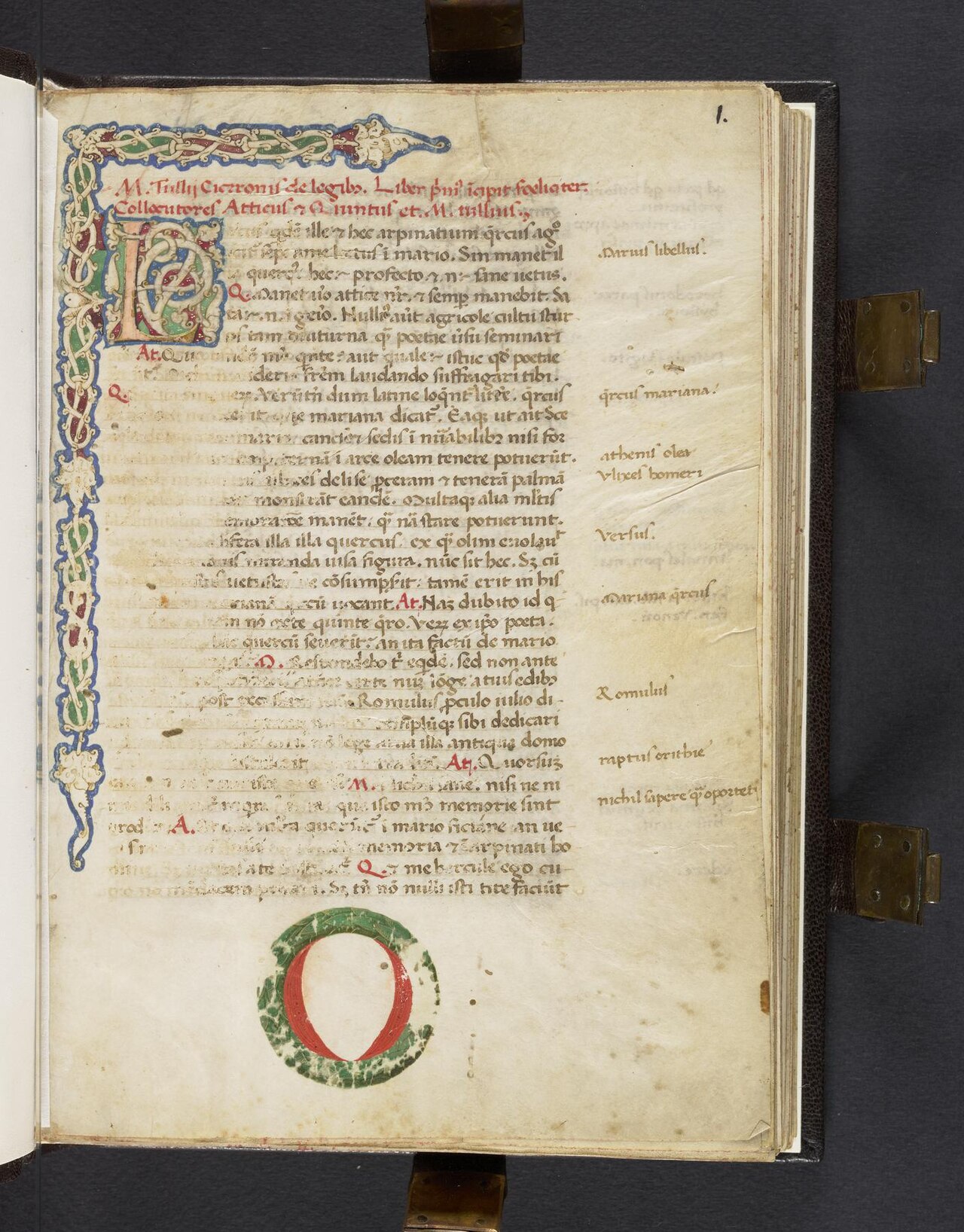
Manuscript page of Cicero's De legibus on vellum, with red rubrics and a decorated initial with green and red foliate border at upper left, a large green and red decorated initial O at bottom, bound between brass clasps, with marginal notes in the right column.Book

Primary source

De legibus

Cicero

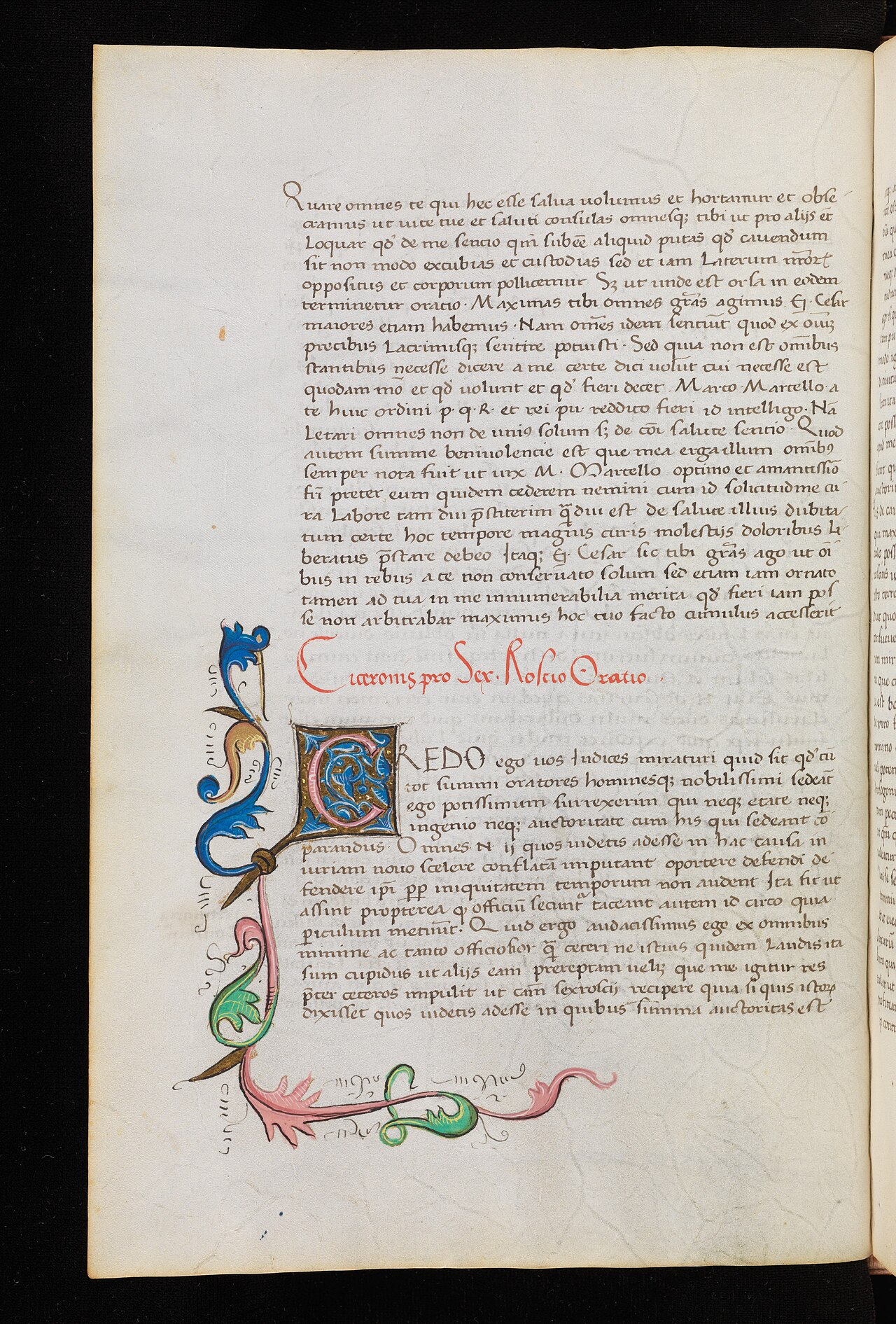
Manuscript page on vellum with handwritten Latin text in brown ink, a red rubricated title reading 'Cicero pro Sex. Roscio Oratio', and a large illuminated initial C in blue, gold and red with pink and green foliage decoration along the left and bottom margins.Speech

Primary source

Pro Roscio Amerino

Cicero · 80 BC

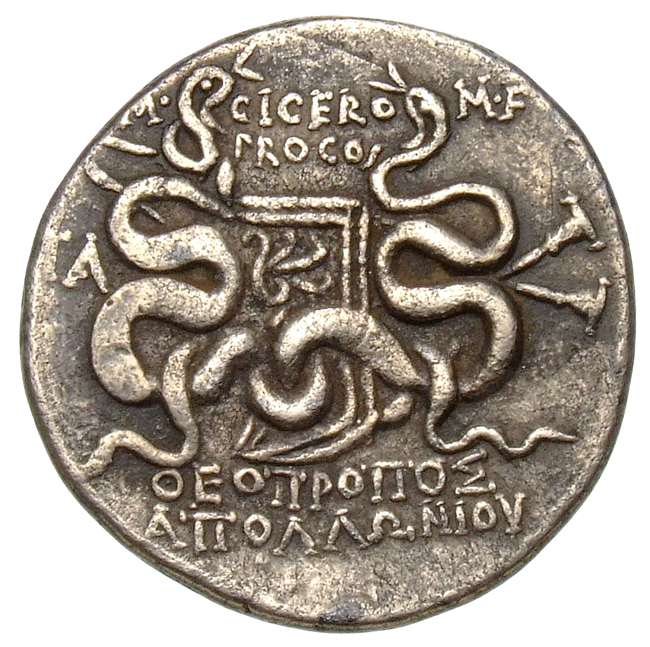
Reverse of a silver cistophor coin. Two intertwined serpents rise on either side of a central quiver. Inscriptions read M CICERO M F PROCOS and a Greek legend around the edge. Left field has a monogram, right field a double flute.Artifact

Primary source

Cistophor of Marcus Tullius Cicero

51-50 BC

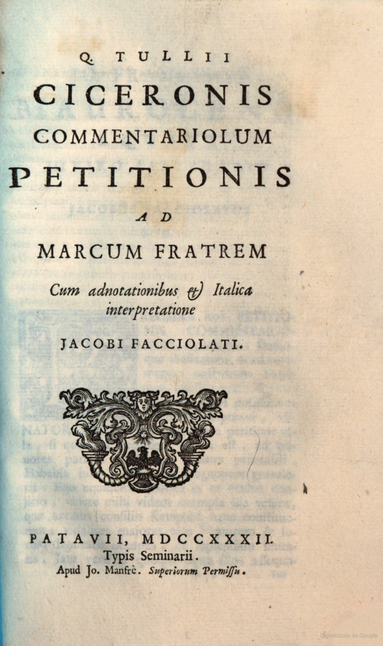
Title page of a 1732 Padua edition of Q. Tullii Ciceronis Commentariolum Petitionis ad Marcum Fratrem, with notes and Italian translation by Jacopo Facciolati. Printed in Patavii, MDCCXXXII, Typis Seminarii, with an ornate engraved emblem below the title text.Letter

Secondary source

Commentariolum Petitionis

Quintus Tullius Cicero · c. 65-64 BC

Photograph of a manuscript page in brown ink Latin handwriting on pale vellum, with a large illuminated initial E in blue, pink and green with gold foliage and small decorative creatures in the left margin. Dark background.Speech

Primary source

Pro Milone

Cicero · 52 BCE

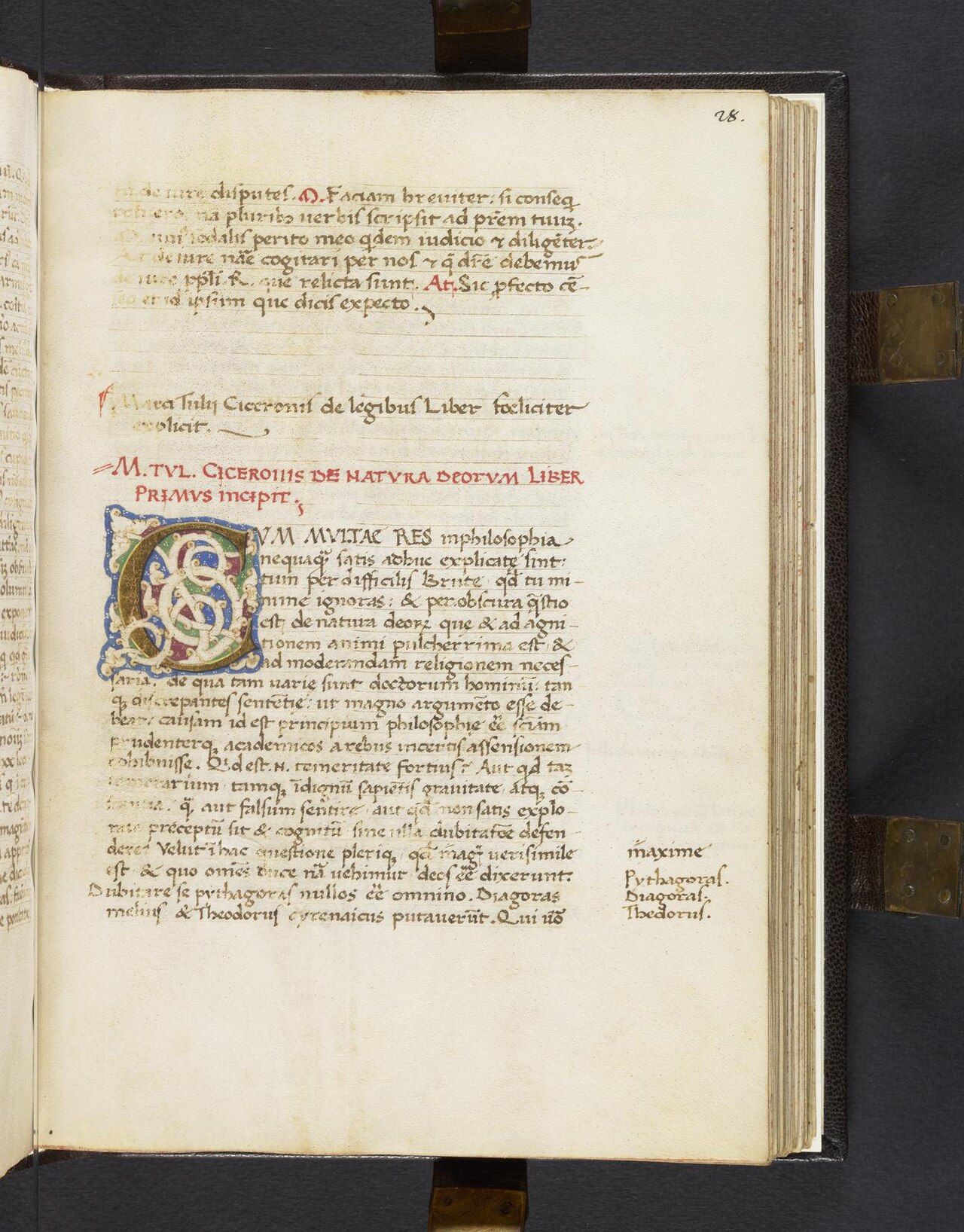
Manuscript page with handwritten Latin text in black ink, red rubrics, and a decorated illuminated initial D in blue, green, and gold. Red heading reads 'M. TVL. CICERONIS DE NATVRA DEORVM LIBER PRIMVS INCIPIT'. Page number 28 at top right, bound in dark leather.Book

Primary source

De Natura Deorum

Cicero · 45 BCE

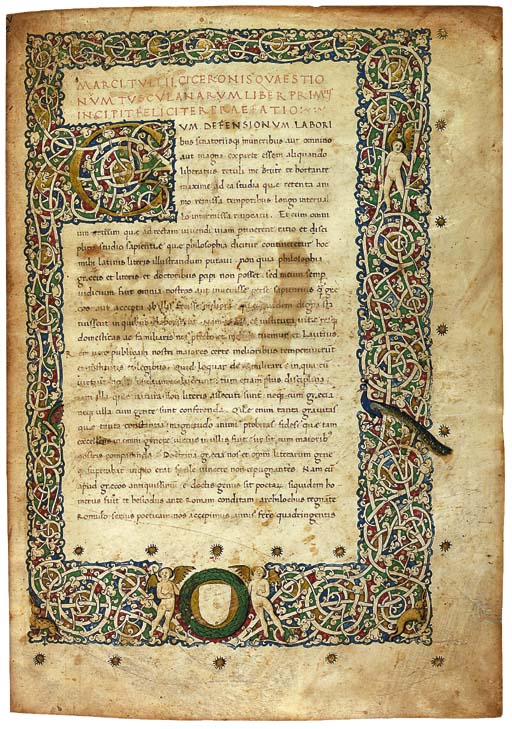
Illuminated manuscript page on vellum with a red-ink rubricated title at the top reading the opening of Cicero's Tusculan Disputations. Decorative borders of interlaced green, red and gold foliage frame the dense black Latin text. Gold and green initial letters and small putti or figures appear in the margins, with a green and gold roundel at the bottom.Book

Primary source

Tusculanae Disputationes

Cicero · c. 45 BCE

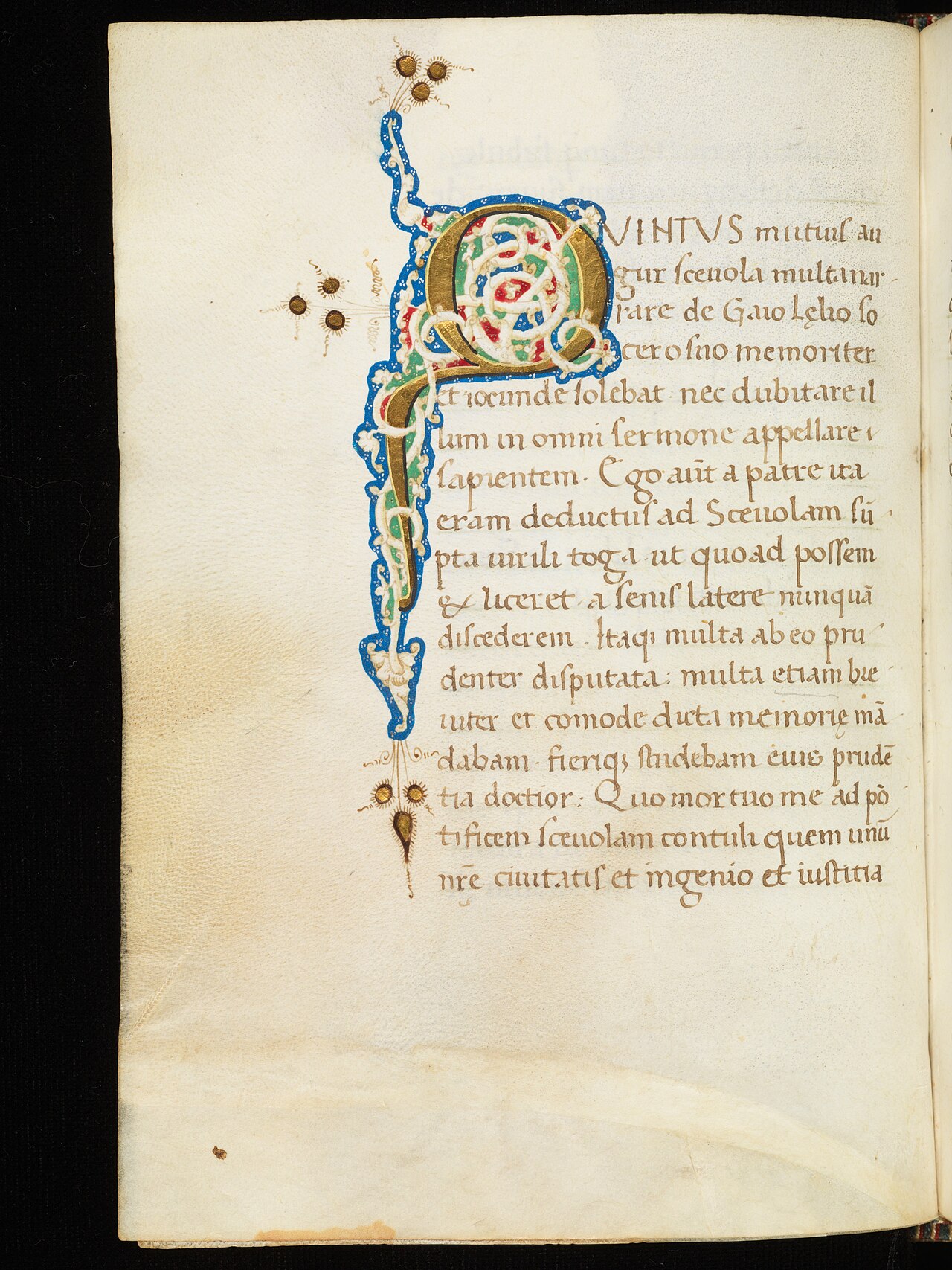
Manuscript page of medieval Latin text in brown ink with a large decorated initial letter P in gold, green, red and blue with white dotted border, and small gold ornamental sprigs at left. The page is on cream vellum against a black background.Book

Primary source

Laelius de Amicitia

Cicero · 44 BCE

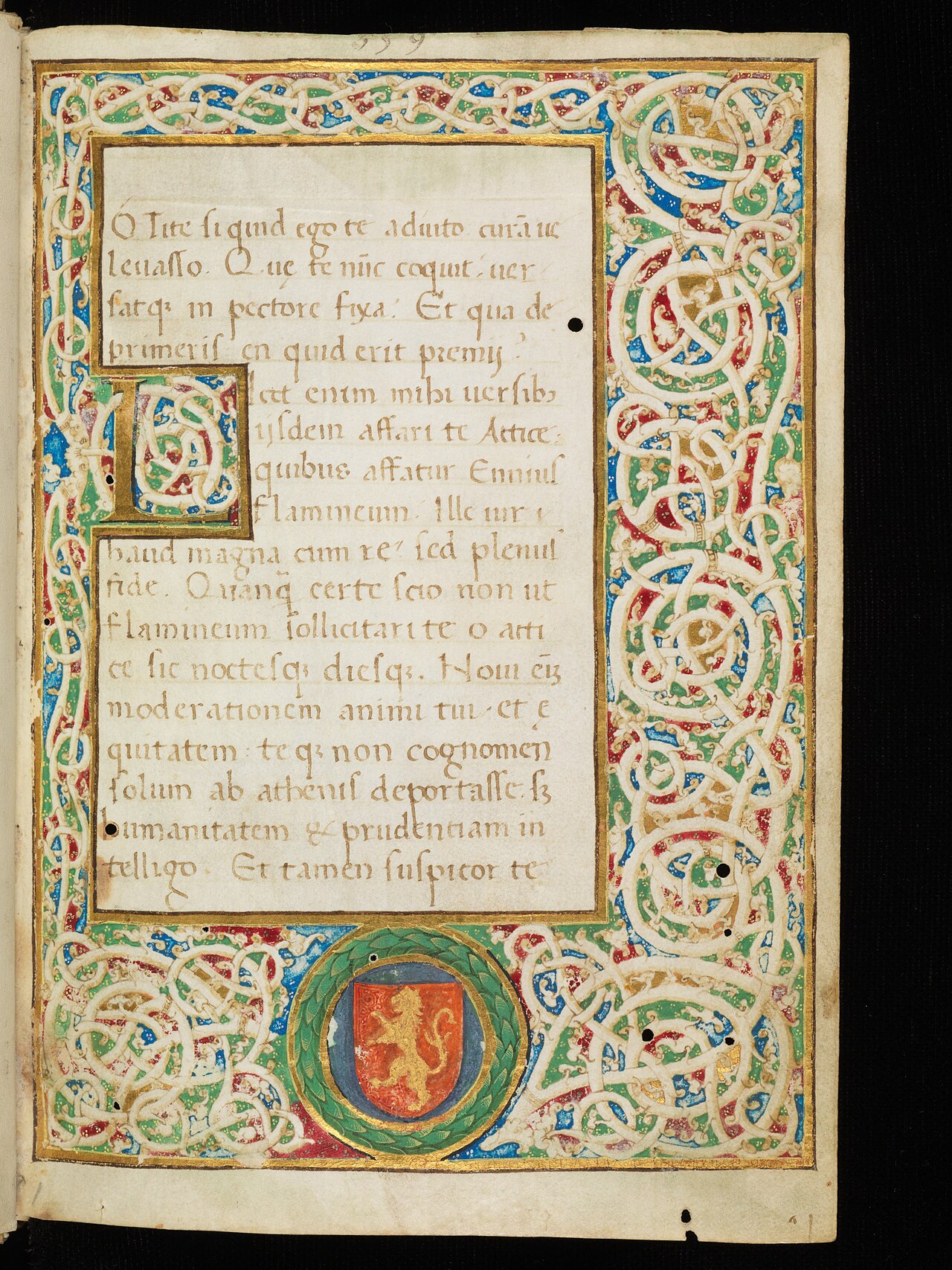
Manuscript page with handwritten Latin text in brown ink inside a gold-ruled text block. The page has green, red, blue and gold interlace borders, a decorated initial letter, and a shield with a gold lion on red at the bottom.Book

Primary source

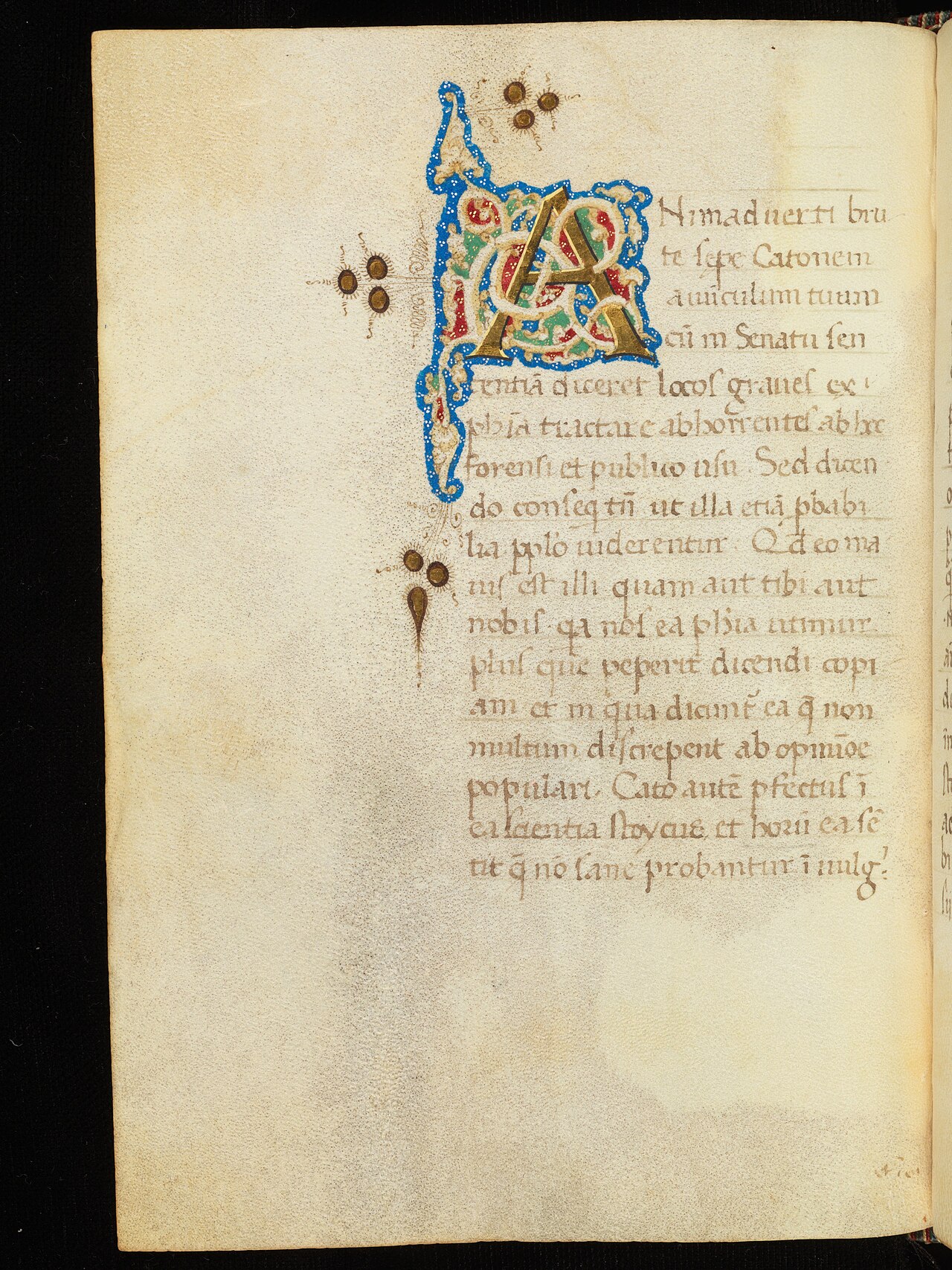
Cato Maior de Senectute

Cicero · 44 BCE

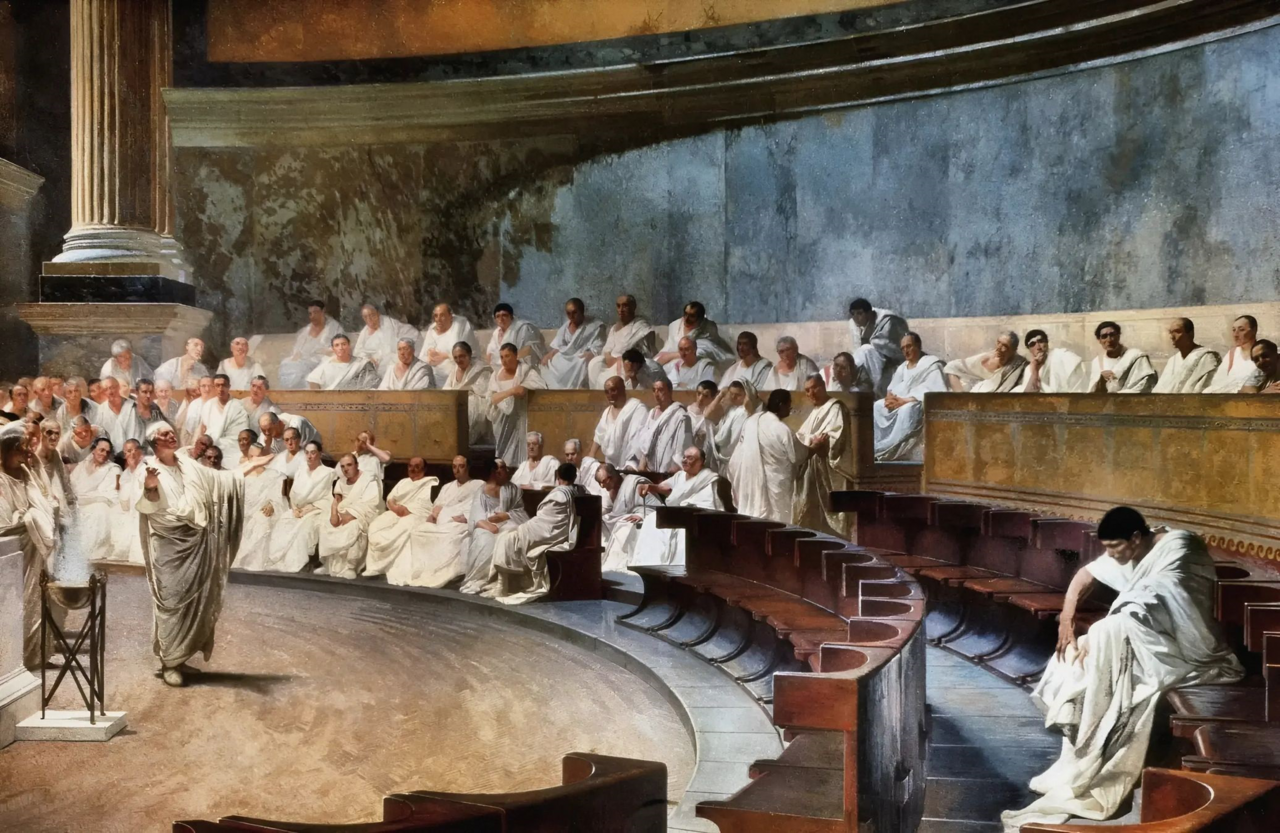
Painting of a Roman senate chamber with a standing orator in white toga gesturing toward a seated man at lower right, while rows of togaed senators sit in tiered curved benches; a column is at left.Painting

Secondary source

Cicero Denounces Catiline

Cesare Maccari · 1880

Letter

Primary source

Epistulae ad Quintum Fratrem

Cicero · c. 60-54 BC

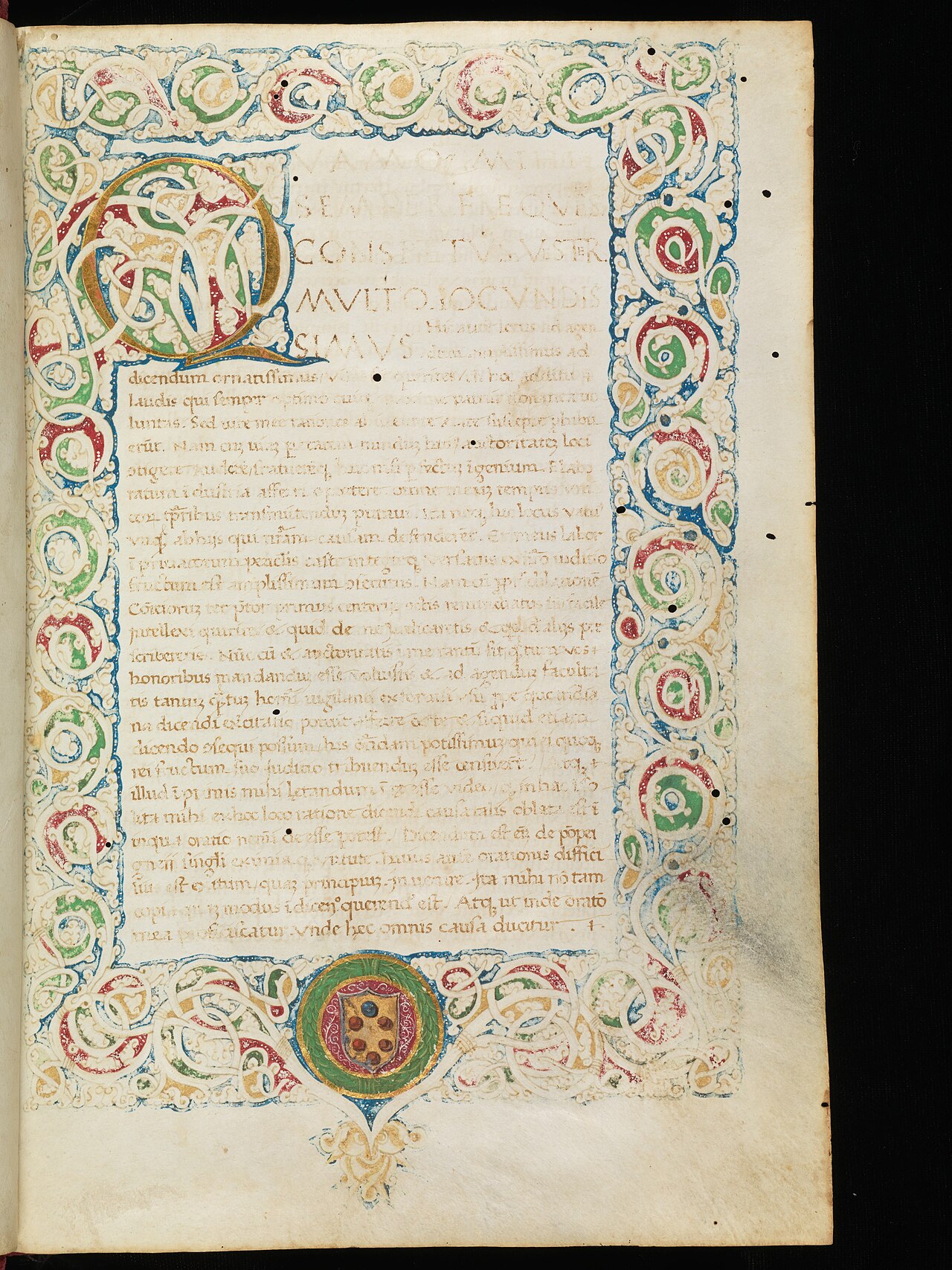
Illuminated manuscript page with a large decorated initial letter and dense Latin text in brown ink, framed by ornate knotwork borders in red, green, blue and gold, with a coat of arms at the bottom center.Speech

Primary source

De Imperio Cn. Pompei

Cicero · 66 BC

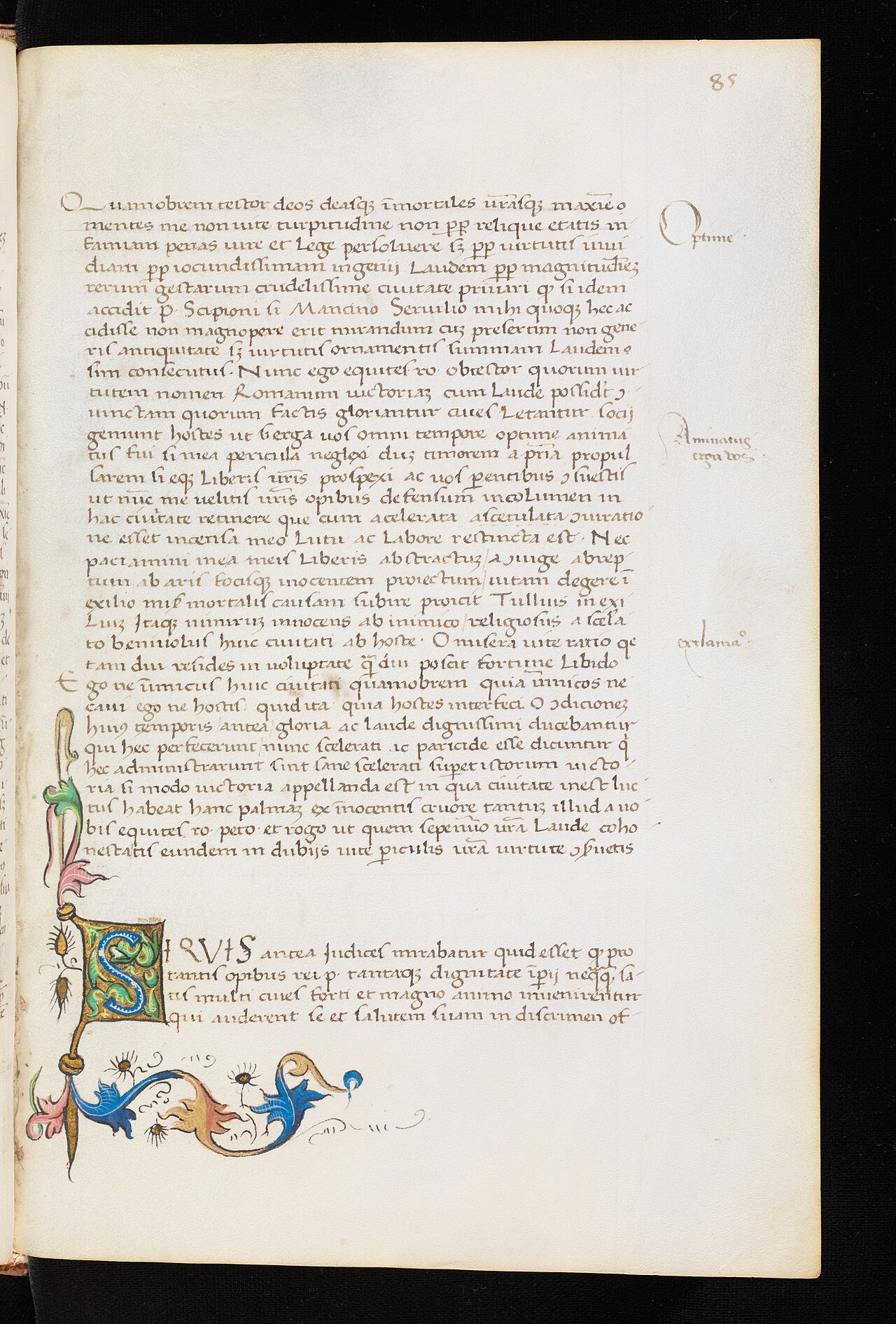
Manuscript page numbered 85 in brown ink, handwritten in Latin in dark brown script with a decorated initial letter S in blue, green and gold with foliage. Marginal notes appear in the right margin. The text is a handwritten Latin oration on a cream parchment page.Speech

Primary source

Pro Sestio

Cicero · 56 BC

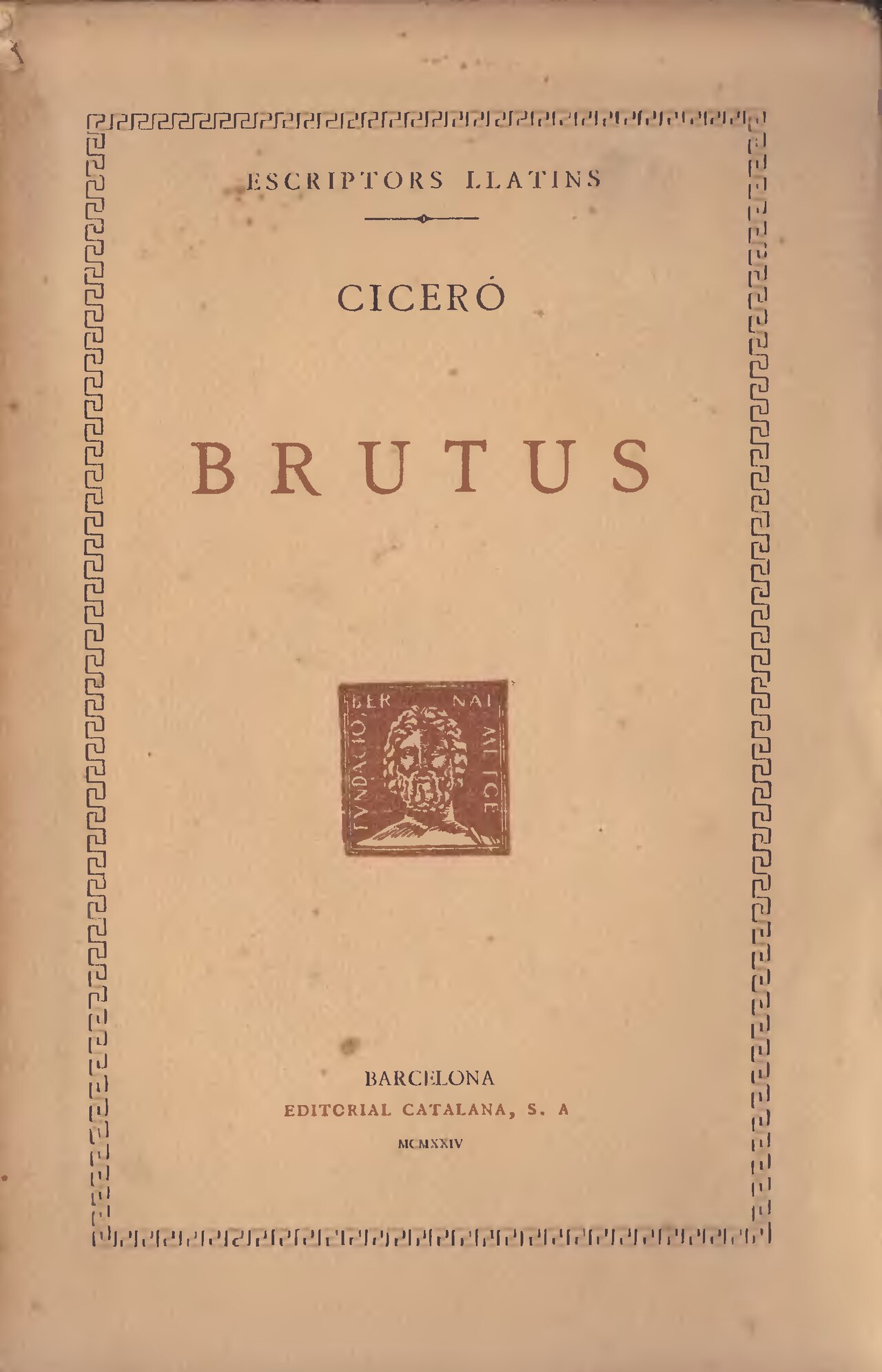
Title page of a 1924 Catalan edition of Cicero's Brutus, published in Barcelona by Editorial Catalana. Top reads 'Escriptors Llatins', then 'CICERÓ', then large 'BRUTUS'. A brown publisher's emblem of a bearded head is in the center, with 'Barcelona', 'Editorial Catalana, S. A', and 'MCMXXIV' at the bottom. A decorative Greek key border frames the page.Book

Primary source

Brutus

Cicero · 46 BC

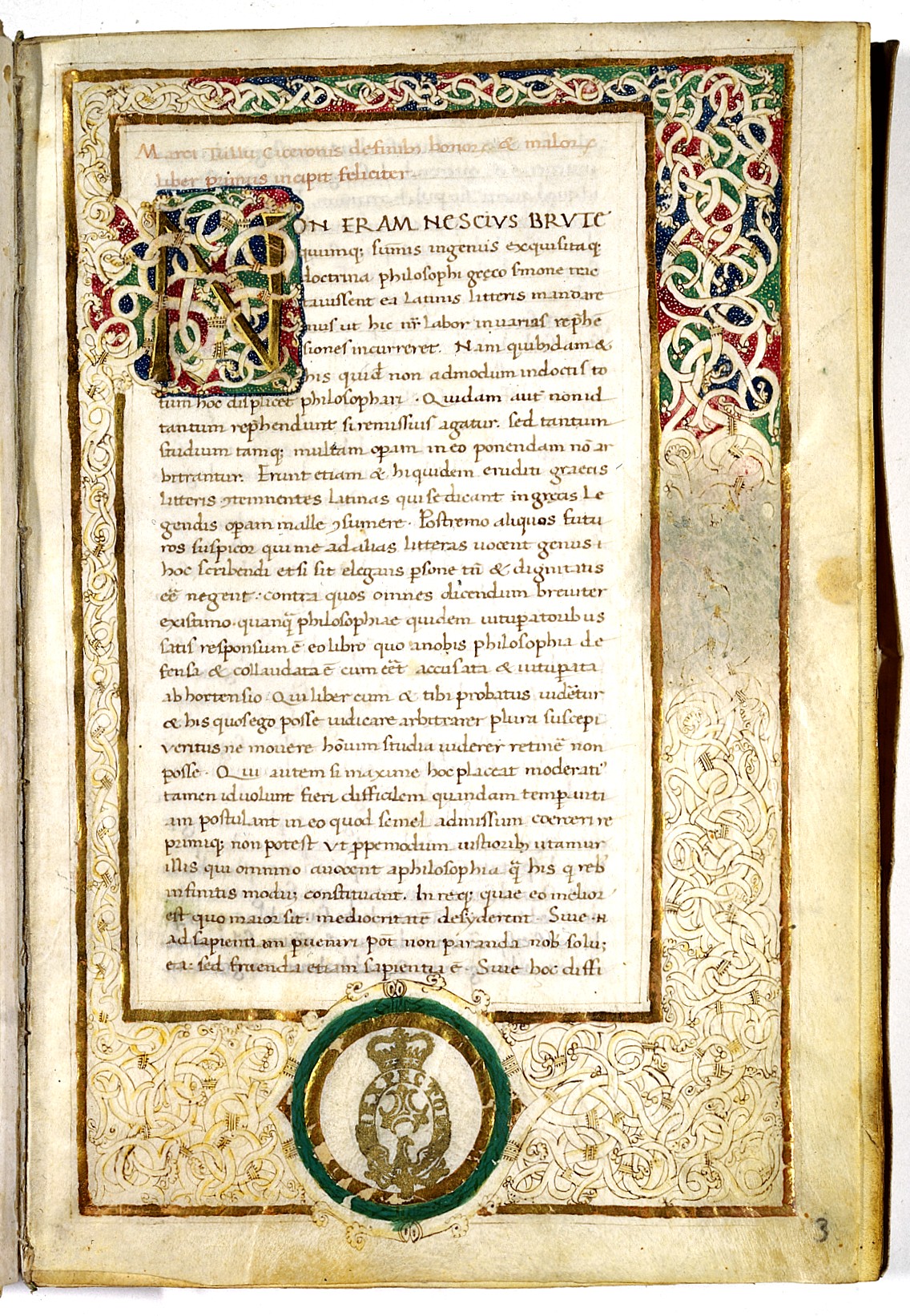
Illuminated manuscript page with Latin text in a formal hand, headed 'Marci Tullii Ciceronis De finibus bonorum et malorum liber primus'. Large decorated initial letter and interlace borders in green, red, blue and gold; a gold-and-green seal-like emblem at the bottom. Page number 3 in the lower right corner.Book

Primary source

De finibus bonorum et malorum

Cicero · 45 BC

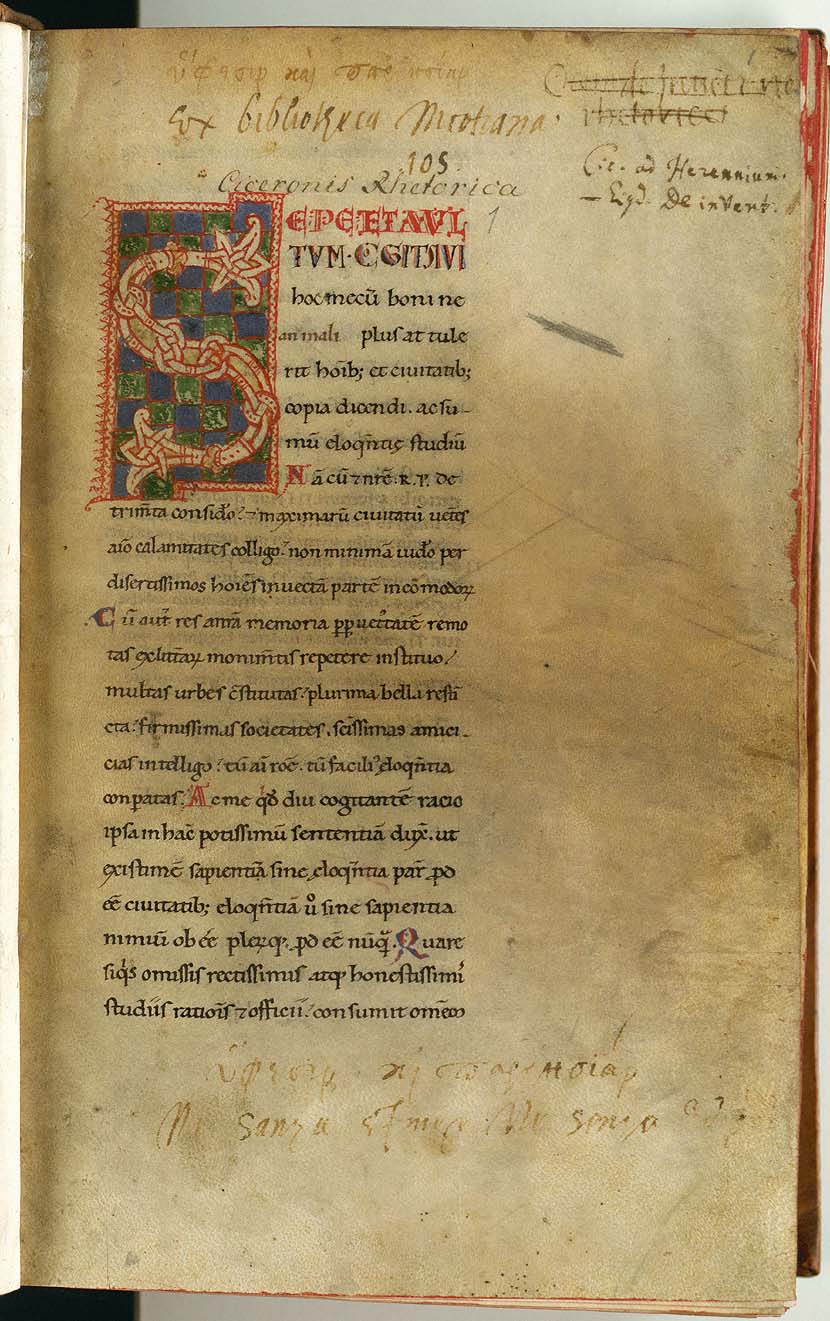
Manuscript page of a medieval Latin text with a large illuminated initial S in red, blue, and green with interlaced decoration. Red and black rubric headings read 'Ciceronis Rhetorica' and the opening lines of the text, with marginal annotations in faded ink.Book

Primary source

De Inventione

Cicero · c. 84-83 BC

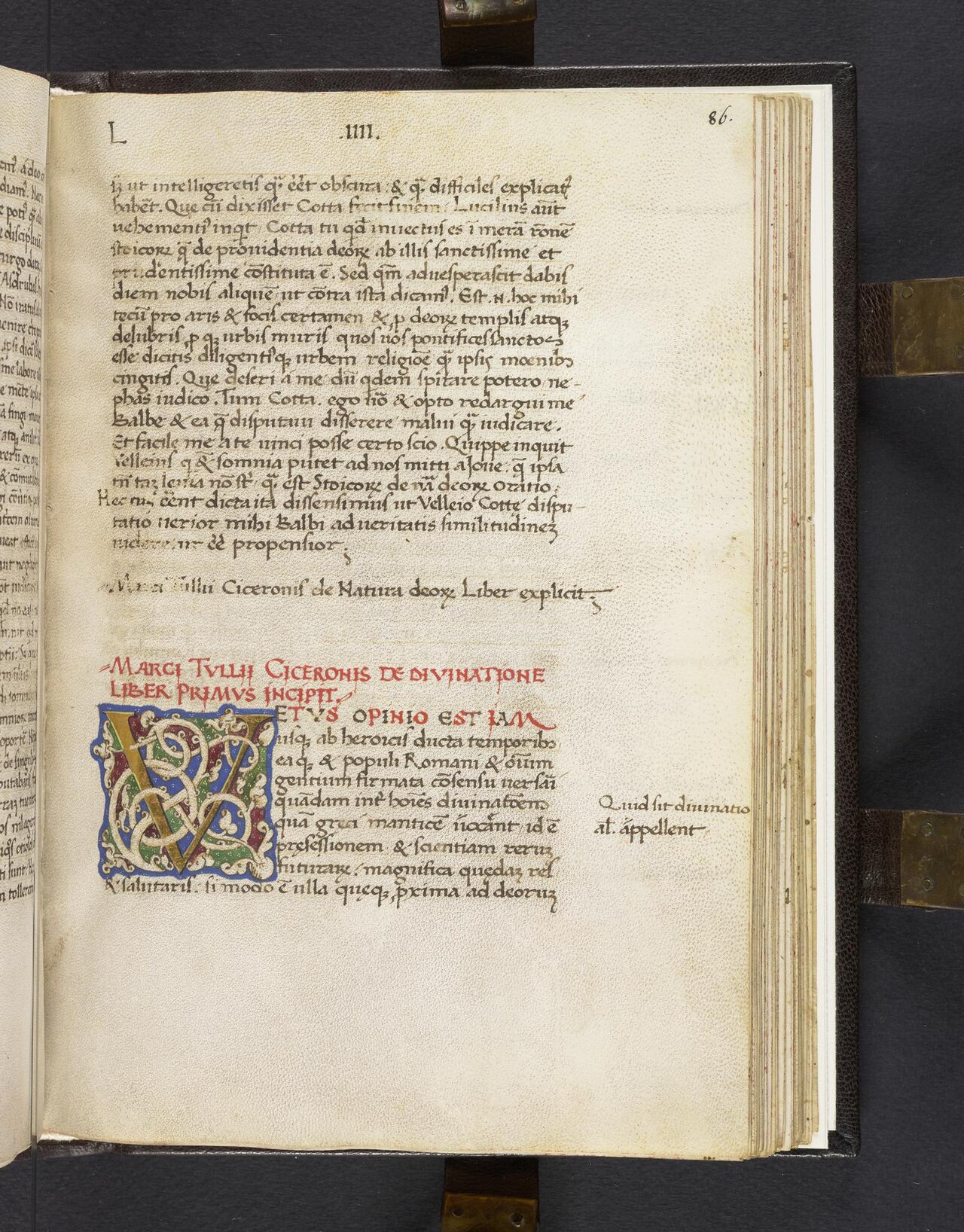
Manuscript page of a medieval hand-written book on cream vellum within a dark leather binding. Top has a red-and-black heading reading 'Marci Tullii Ciceronis de Divinatione Liber primus incipit'. Below is a large decorated initial V with green, red, and gold illumination, followed by dense black handwritten Latin text in columns. Page number 86 at top right.Book

Primary source

De Divinatione

Cicero · 44 BC

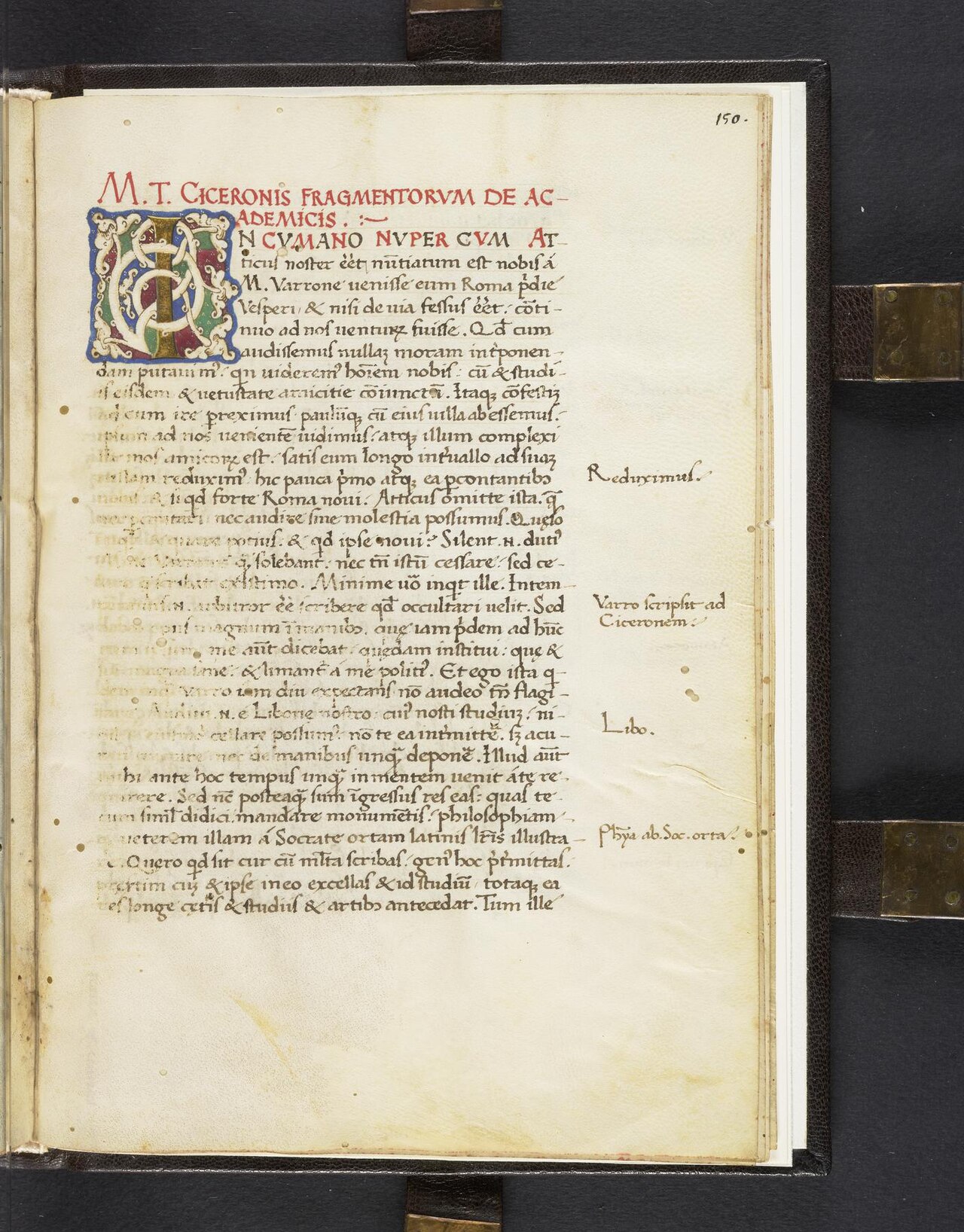
Manuscript page 150 in handwritten Latin with a red heading reading 'M.T. Ciceronis fragmentorum de academicis', an illuminated initial in blue, green, red and gold, and marginal notes on the right. The page is bound in dark leather with brass clasps.Book

Primary source

Academica

Cicero · 45 BC

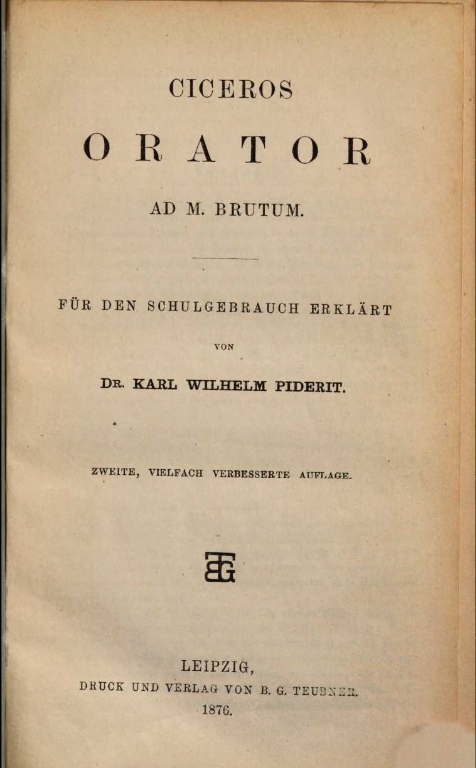
Title page of a book reading 'Ciceros Orator ad M. Brutum', edited for school use by Dr. Karl Wilhelm Piderit, second improved edition. Below is a publisher's emblem, then 'Leipzig, Druck und Verlag von B. G. Teubner, 1876'.Book

Primary source

Orator ad Brutum

Cicero · 46 BC

Book

Primary source

De consulatu suo

Cicero · after 63 BC

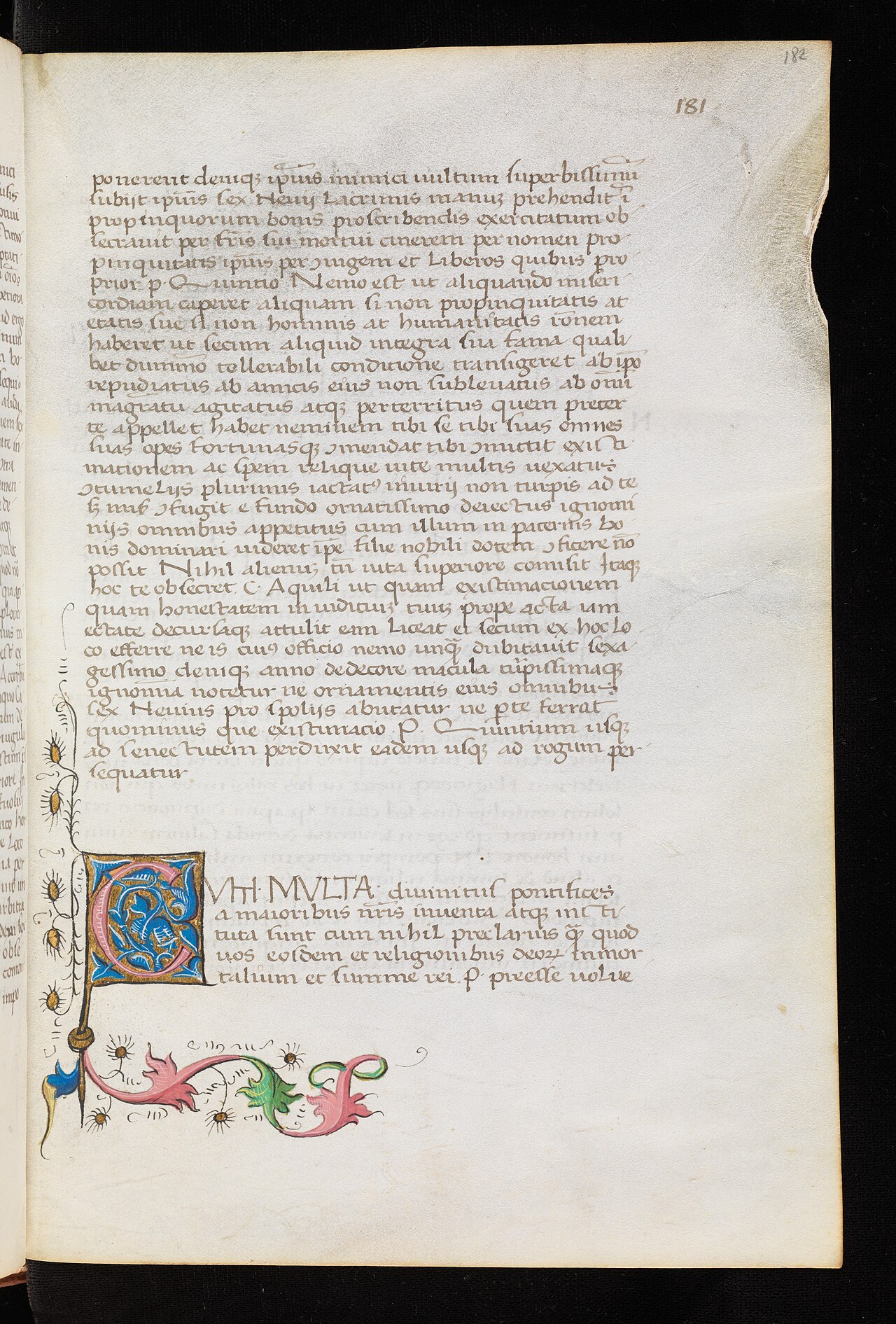
Manuscript page in Latin handwriting with page number 181 at top right, a large decorated illuminated initial letter in blue, gold and pink at lower left with foliage borders, and a line beginning 'QUAM MULTA' below. The text is in dense brown-ink script on parchment.Speech

Primary source

De domo sua

Cicero · 56 BCE

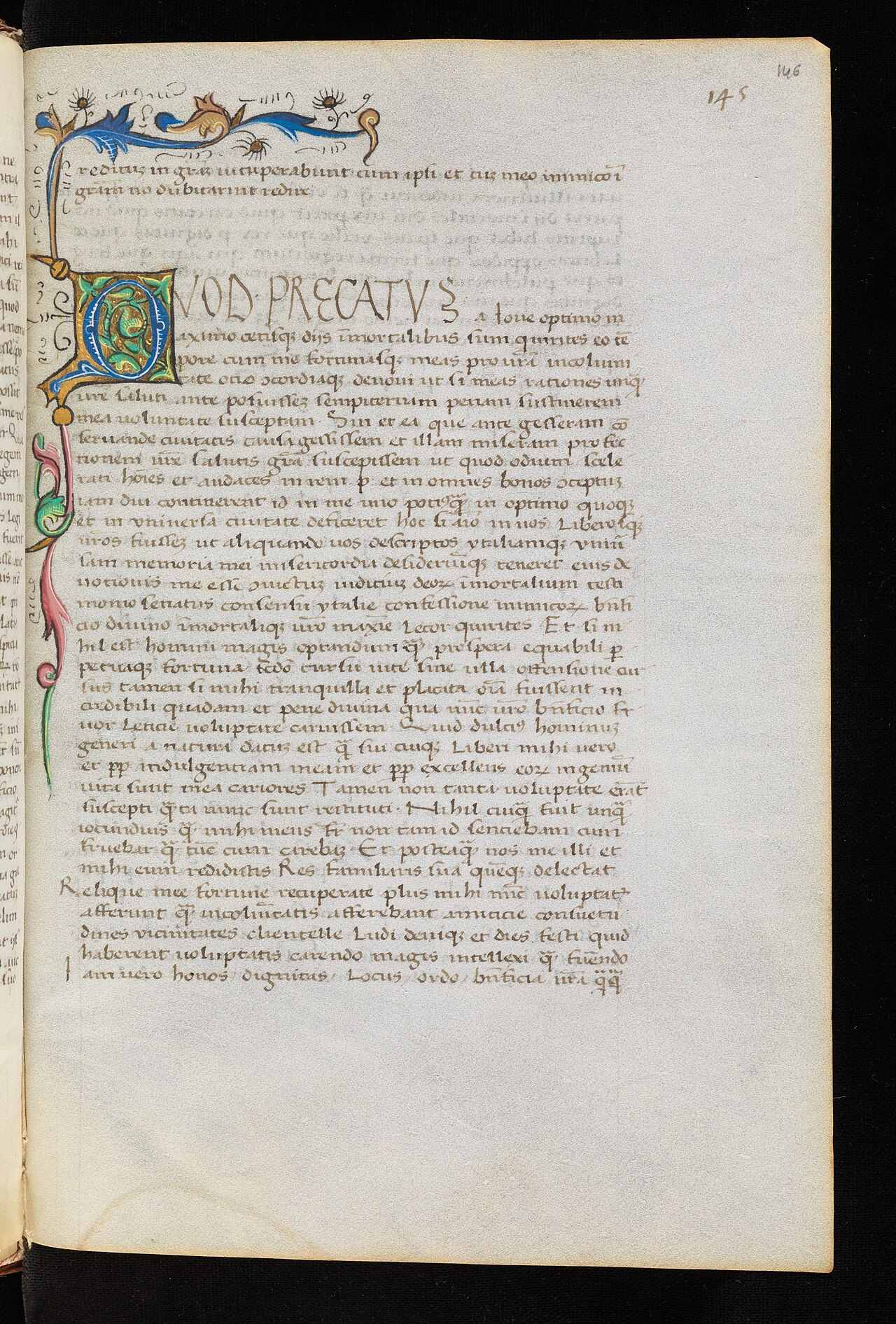
Manuscript page with a decorated initial and blue and gold border at top left, showing handwritten Latin text in brown ink in a medieval book. The page number 145 (and 146 at top right) is written in the margin. A large illuminated capital letter opens the text.Speech

Primary source

Post reditum ad Quirites

Cicero · 57 BCE

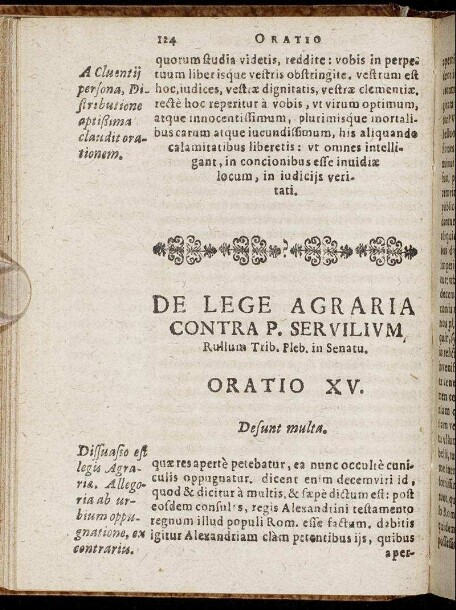
Scanned page from an early printed edition of Cicero's orations, page 124. Running head reads 'ORATIO'. Two-column layout with marginal summaries in italic. Centered heading reads 'DE LEGE AGRARIA CONTRA P. SERVILIUM, Rullum Trib. Pleb. in Senatu.' followed by 'ORATIO XV.' and a subheading 'Desunt multa.' Dense Latin text in roman type with decorative ornamental border above the heading.Speech

Primary source

Agrarian Law speeches

Cicero

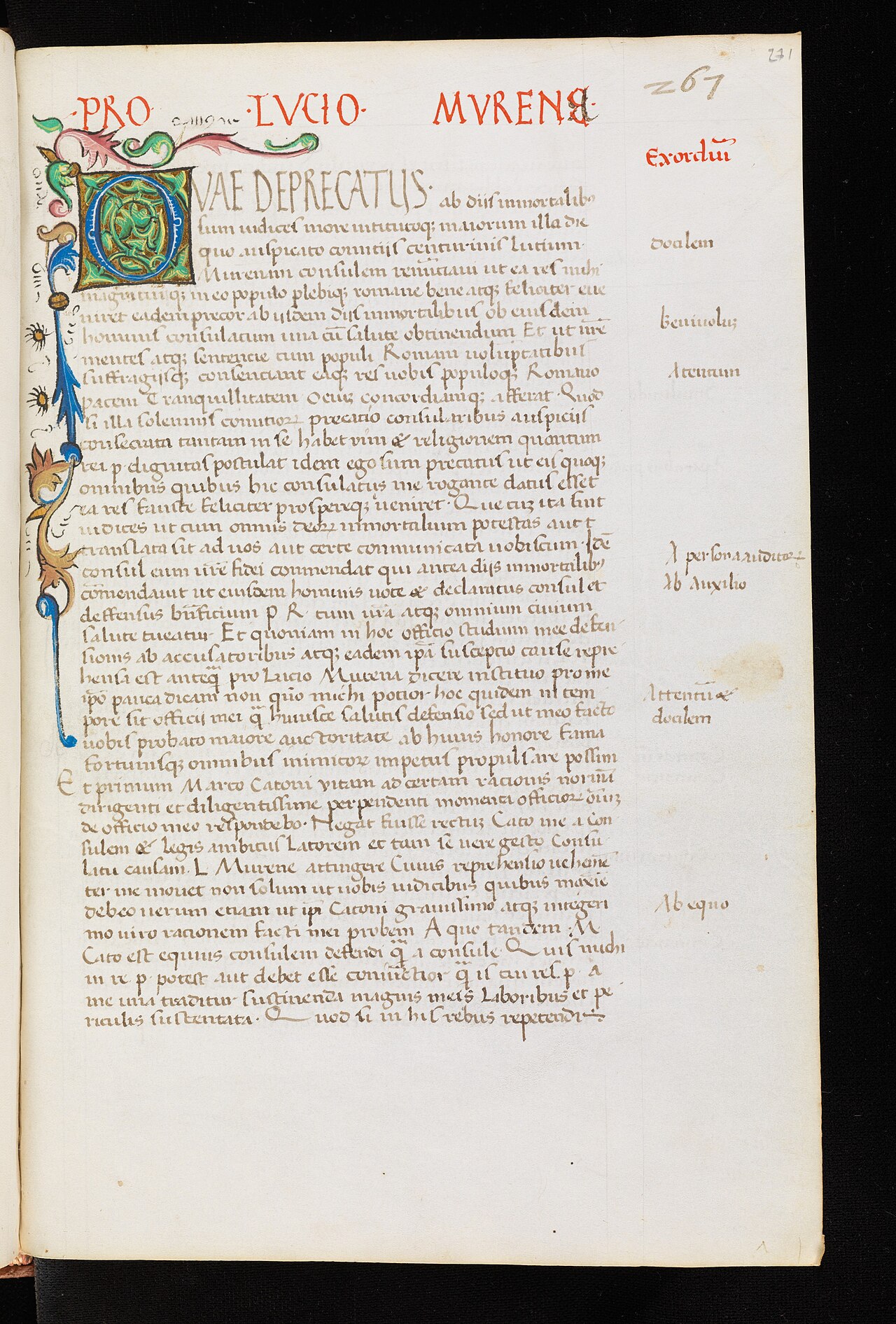
Manuscript page from a 15th-century Italian codex with a painted illuminated initial and red and blue decoration. The running title reads 'PRO LUCIO MURENA' and the Latin text is in brown ink handwriting, with marginal annotations and the page number 267 at the top right.Speech

Primary source

Pro Murena

Cicero

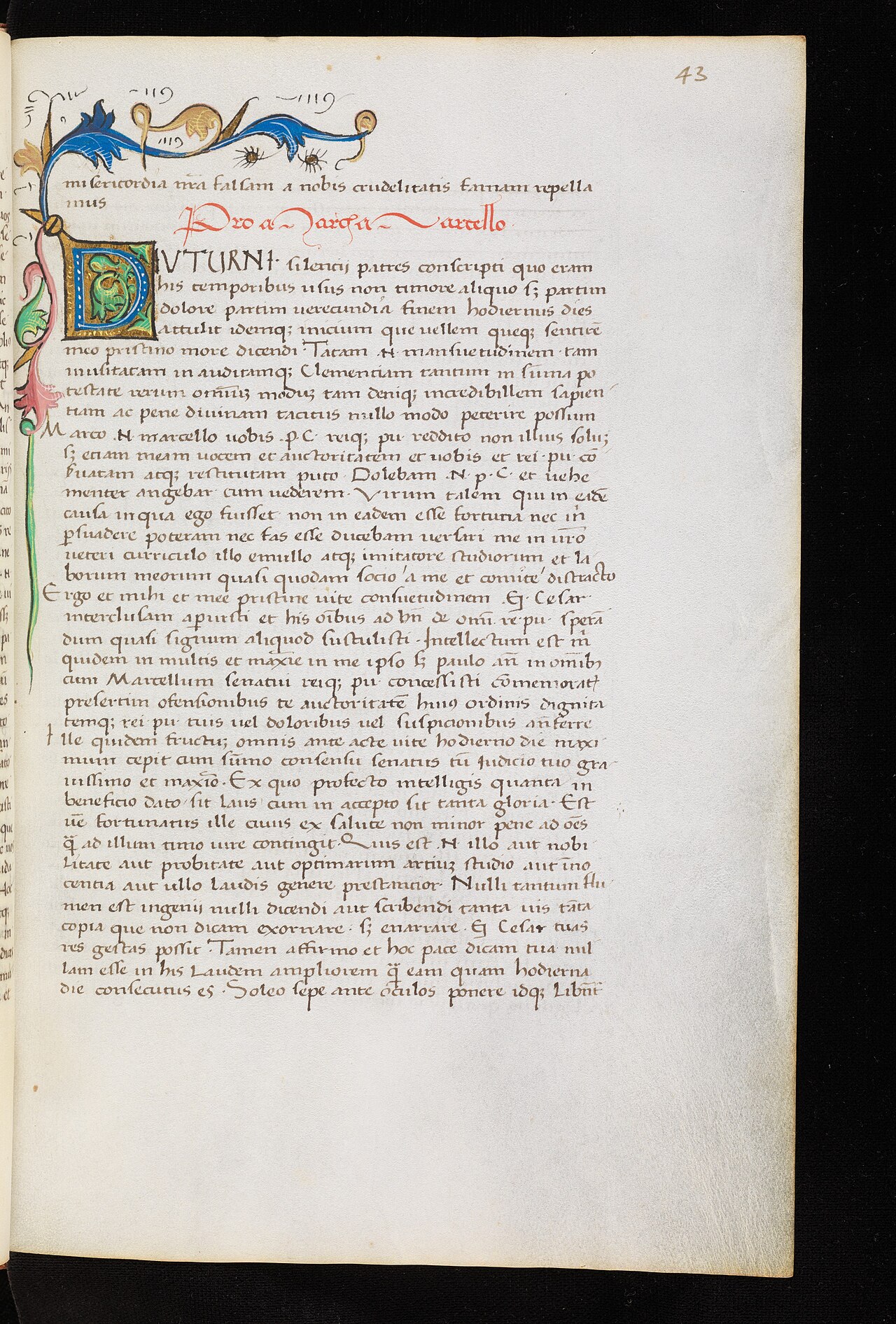
Manuscript page, number 43 in the top right corner, in handwritten Latin script on parchment. Decorated blue and gold initial D with red heading below a blue and gold border. The text is a copy of Cicero's speech Pro Marcello.Speech

Primary source

Pro Marcello

Cicero · 46 BCE

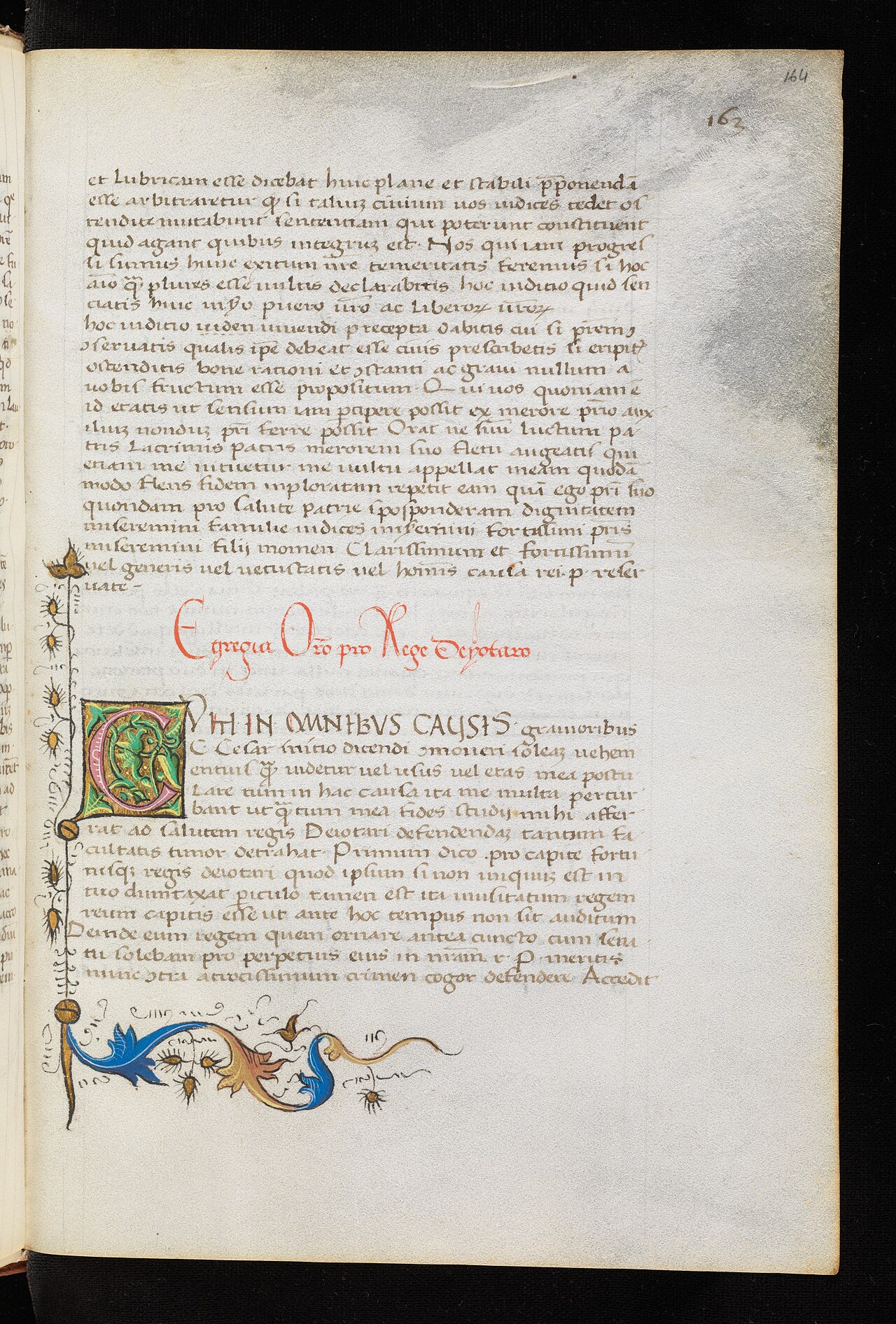
Manuscript page of a 15th-century Italian codex with handwritten brown Latin text in two columns, a red rubric reading 'Egregia oratio pro rege Deiotaro', and an illuminated initial C with green, pink and blue decoration and border foliage. Page numbered 163 and 164 at top.Speech

Primary source

Pro rege Deiotaro

Cicero · 45 BCE

Manuscript page with handwritten Latin text in brown ink on yellowed parchment, beginning with a large illuminated initial in blue, red, green and gold. Black background surrounds the page, with decorative dots in the margin.Book

Primary source

Paradoxa Stoicorum

Cicero · 46 BC

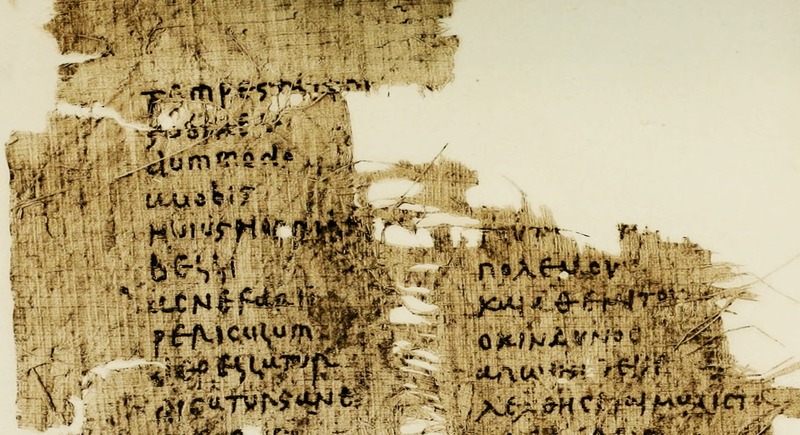
Photograph of a torn, brownish papyrus fragment with faded black ink. Left column shows Latin lines; right column shows Greek lines. The papyrus has ragged edges and missing sections.Document

Secondary source

Papyrus fragment of a speech of Cicero (P.Ryl. I 61)

5th century AD

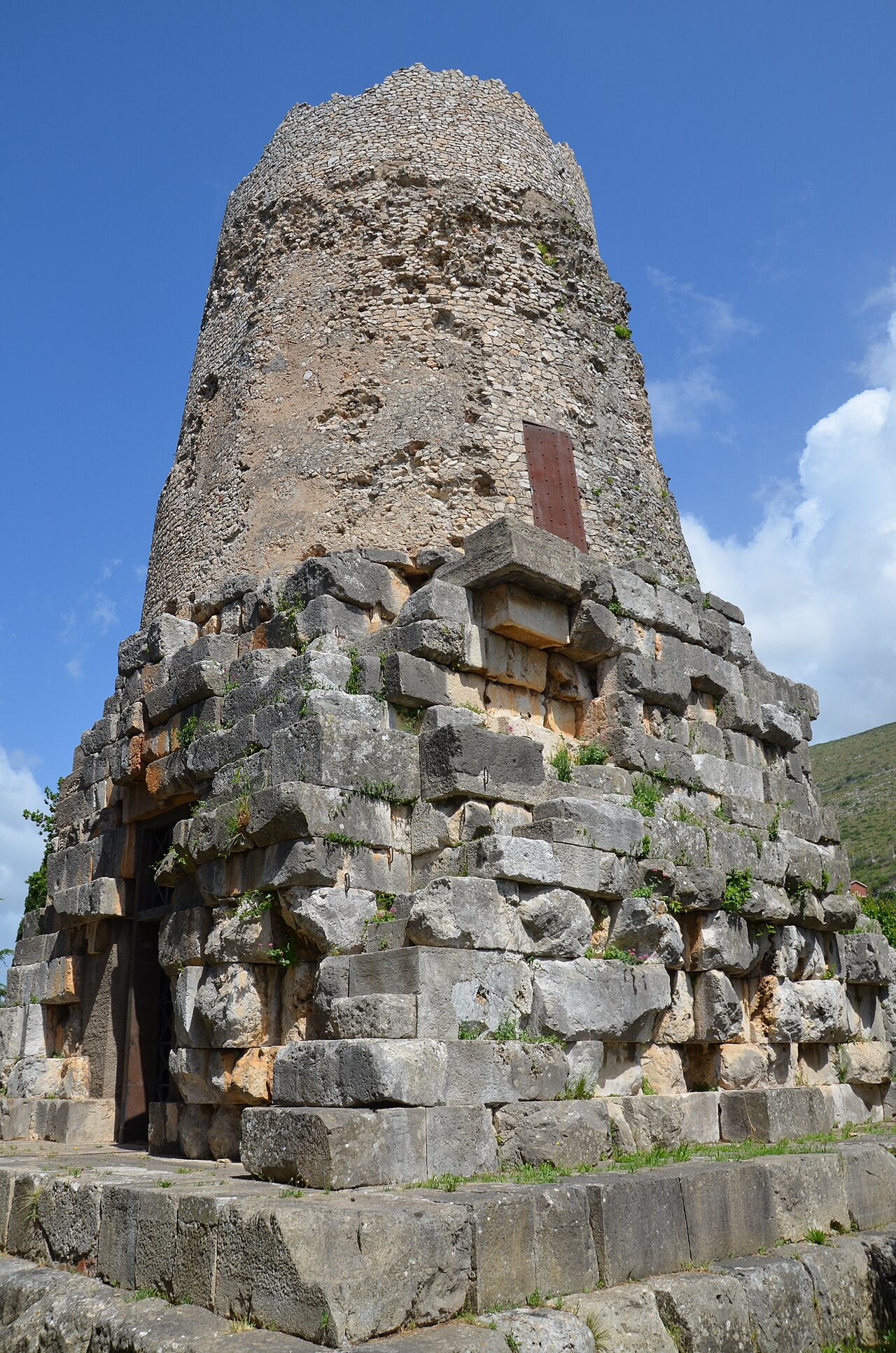
A tall, weathered cylindrical stone tower with a rough, broken top rises above a stepped base of large, cut stone blocks. A small rusty metal door sits in the upper tower wall, and a dark doorway is visible at the lower left. Blue sky and green hills are behind it.Artifact

Secondary source

Tomb of Cicero at Formia

1st century BC

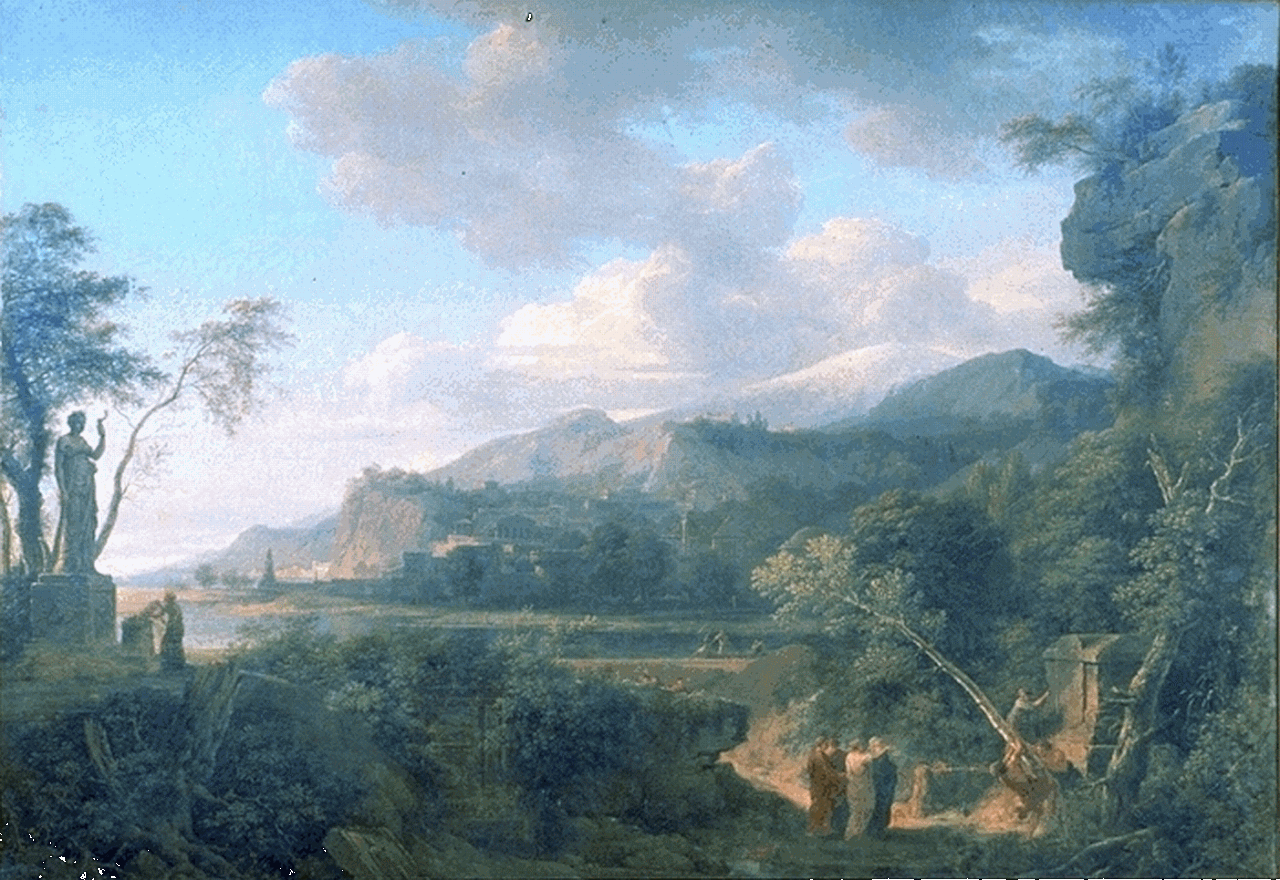
Classical landscape painting: a stone statue on a pedestal at left beside trees, a distant hilltop town and mountains under a blue sky with clouds, and figures in robes near a ruined tomb at lower right among foliage.Painting

Secondary source

Cicero Discovering the Tomb of Archimedes

Pierre-Henri de Valenciennes · 1787

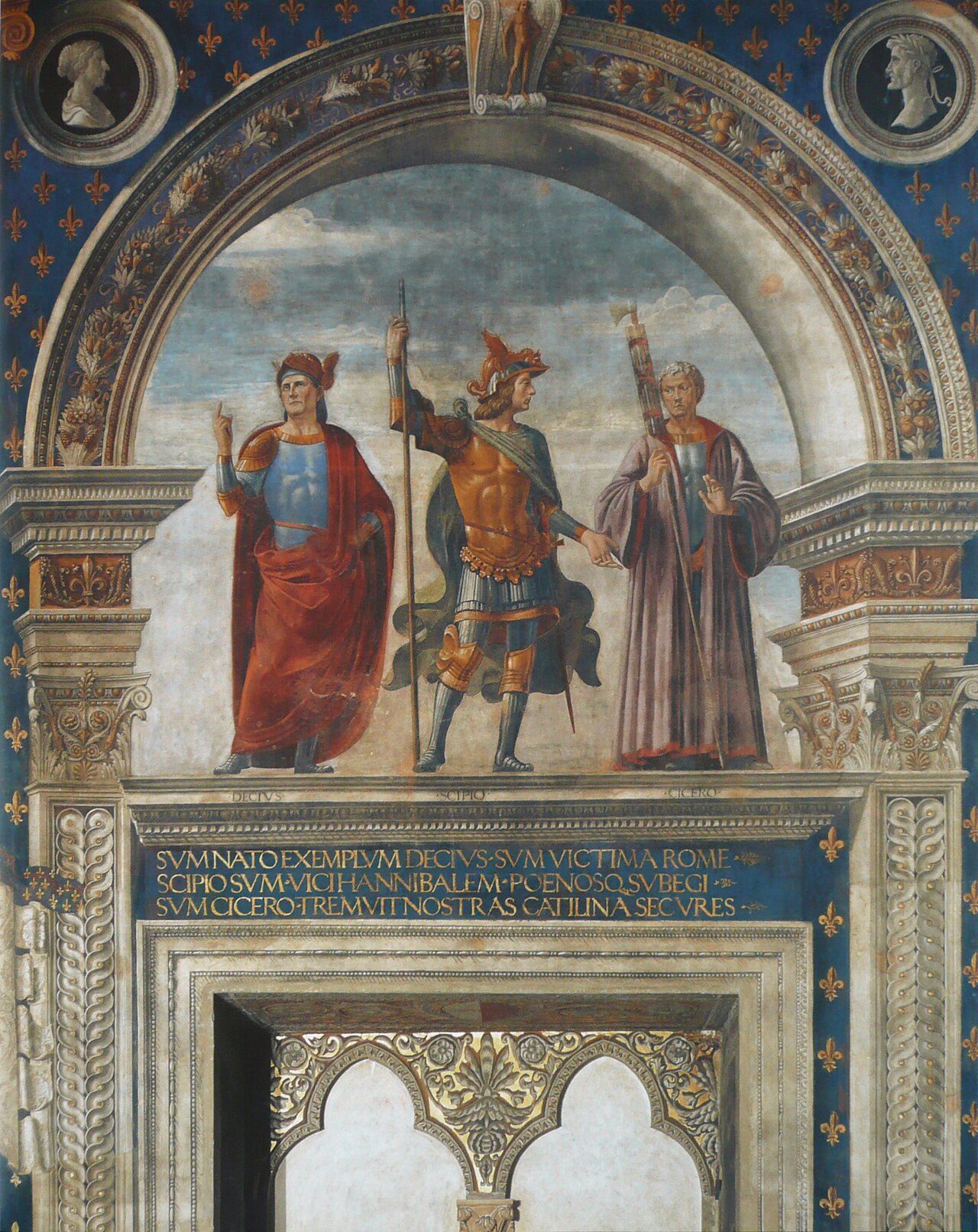
Fresco in an arched niche showing three standing men in ancient-style dress: on the left Decius Mus in a red cloak pointing upward, in the center Scipio in armor and plumed helmet holding a spear, and on the right Cicero in a purple robe holding a fasces. Above are two round medallions with profile busts, and below is a gold-lettered Latin inscription on a blue-patterned wall.Painting

Secondary source

Three Ancient Heroes: Decius Mus, Scipio Africanus and Cicero

Domenico Ghirlandaio · 1480

Letter

Primary source

Letters of Cicero

Marcus Tullius Cicero

Letters to AtticusLetter

Primary source

Letters to Atticus

Cicero · 1912

Book

Primary source

Cicero on Oratory and Orators

Cicero · 1875

Book

Primary source

The Treatises of M.T. Cicero

Cicero · 1853

Book

Secondary source

Cicero of Arpinum: A Political and Literary Biography

E. G. Sihler · 1914

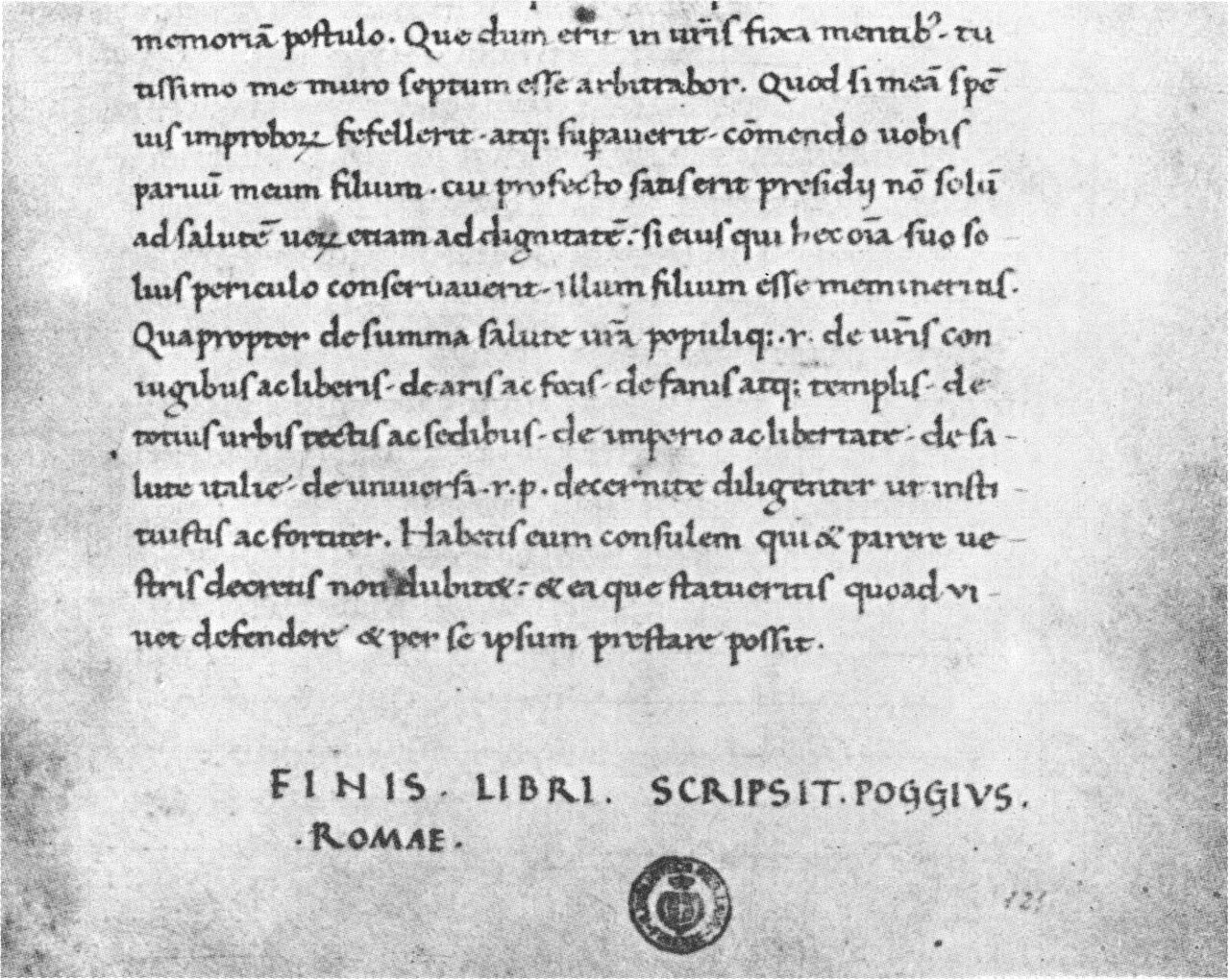
Black-and-white photograph of a manuscript page in Latin humanist script, ending with the colophon 'FINIS LIBRI. SCRIPSIT POGGIVS. ROMAE' and a round seal below, with a folio number at the lower right.Document

Primary source

Cicero's Fourth Catilinarian Oration in Poggio's Manuscript

Poggio Bracciolini · 1425

Book

Primary source

De optimo genere oratorum

Cicero · 46 BC

Book

Primary source

De partitione oratoria

Cicero · 46 BC

Book

Primary source

De fato

Cicero · 44 BC

Book

Primary source

Topica

Cicero · 44 BC

Letter

Primary source

The Letters of Cicero, Vol. 1

Cicero · written 68-52 BC, translation published 1899

Book

Secondary source

Cicero and the Fall of the Roman Republic

James Leigh Strachan-Davidson · 1894

Book

Secondary source

Cicero and His Friends

Gaston Boissier · 1897

Book

Secondary source

Life of Cicero

Plutarch · written in antiquity, this translation 1859

Documentary

Secondary source

Parallel Lives of the Noble Greeks and Romans, Vol. 7

Plutarch

The Speeches of Cicero against Catiline and Antony, and for Murena and MiloBook

Primary source

The Speeches of Cicero against Catiline and Antony, and for Murena and Milo

Marcus Tullius Cicero · 1894

Letter

Primary source

Selected Letters of Cicero

Marcus Tullius Cicero · 1897

The Speech of Cicero for Aulus Cluentius HabitusSpeech

Primary source

The Speech of Cicero for Aulus Cluentius Habitus

Marcus Tullius Cicero · 1858

De Senectute, De Amicitia, Paradoxa, and Somnium Scipionis of CiceroBook

Primary source

De Senectute, De Amicitia, Paradoxa, and Somnium Scipionis of Cicero

Marcus Tullius Cicero · 1876

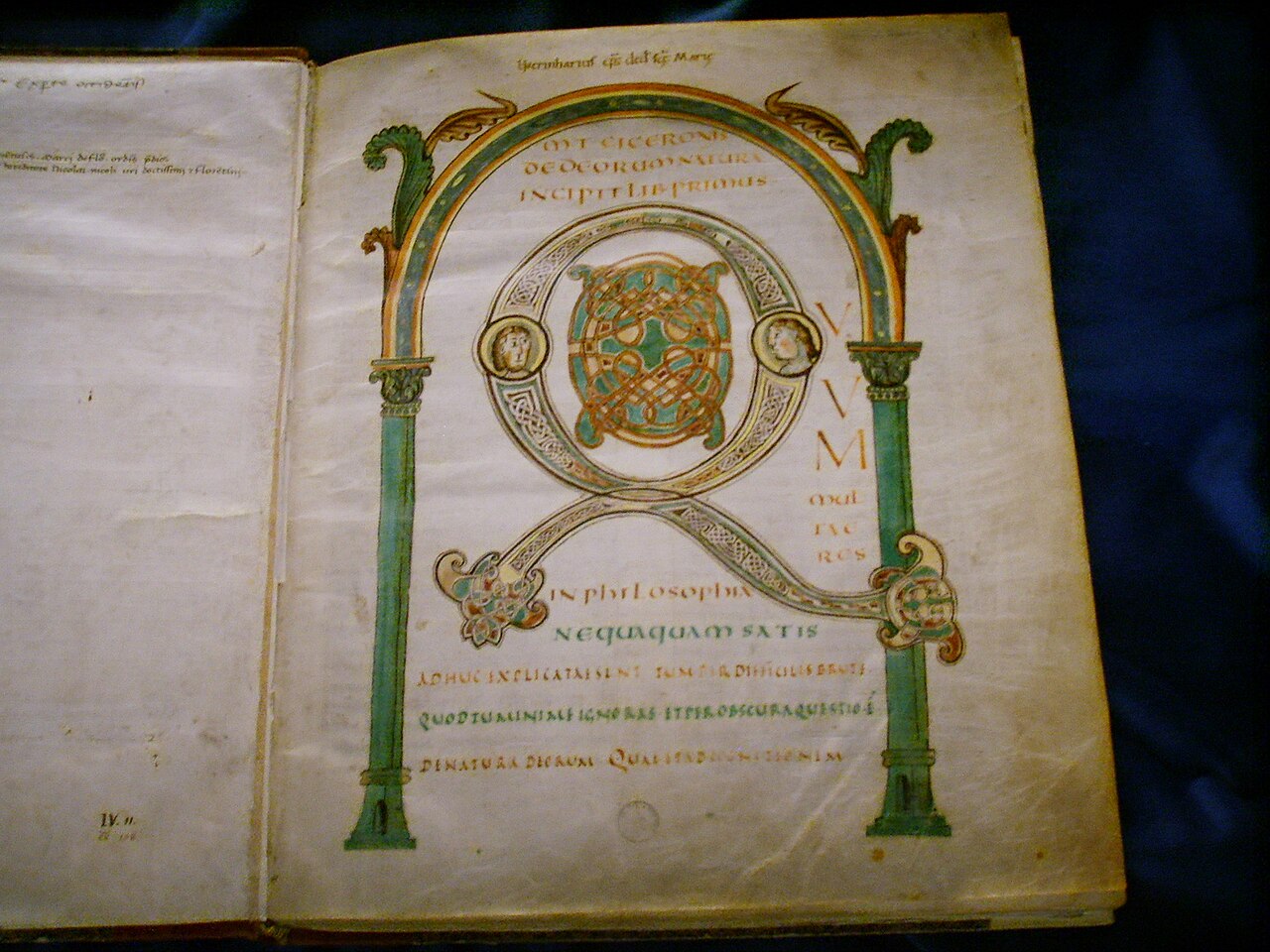
Open illuminated manuscript page with a decorative arched frame in green, orange and gold, a Celtic-knot roundel with two small face medallions, and several lines of Latin script in red and green ink. The left page is blank and aged.Book

Secondary source

Corbie Manuscript of Cicero's Philosophical Miscellany

9th century

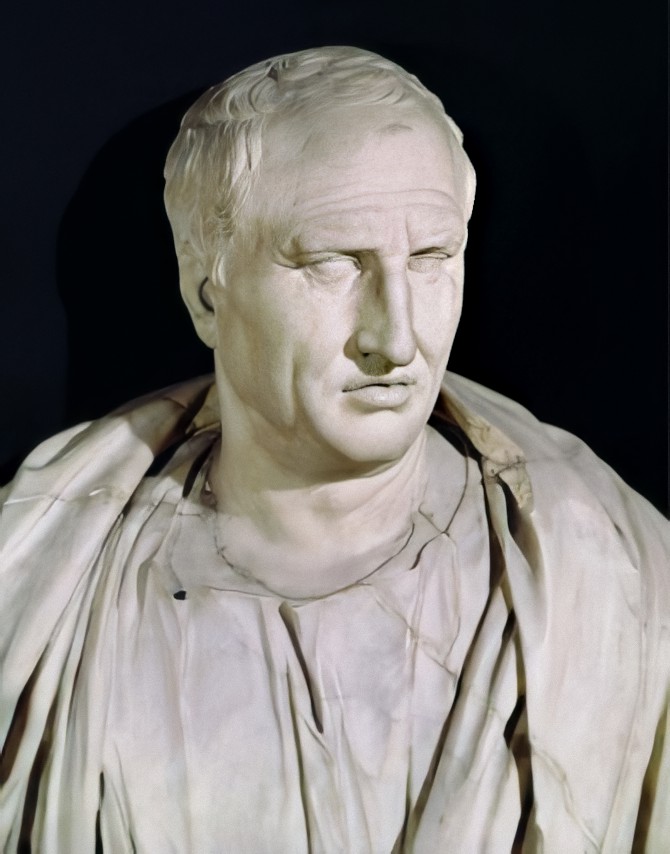
White marble bust of an older man with short, curled hair, a furrowed brow, and a thin mustache, draped in a toga-like garment against a dark background. The bust shows the figure from the chest up.Sculpture

Secondary source

Bust of Cicero

1st century CE

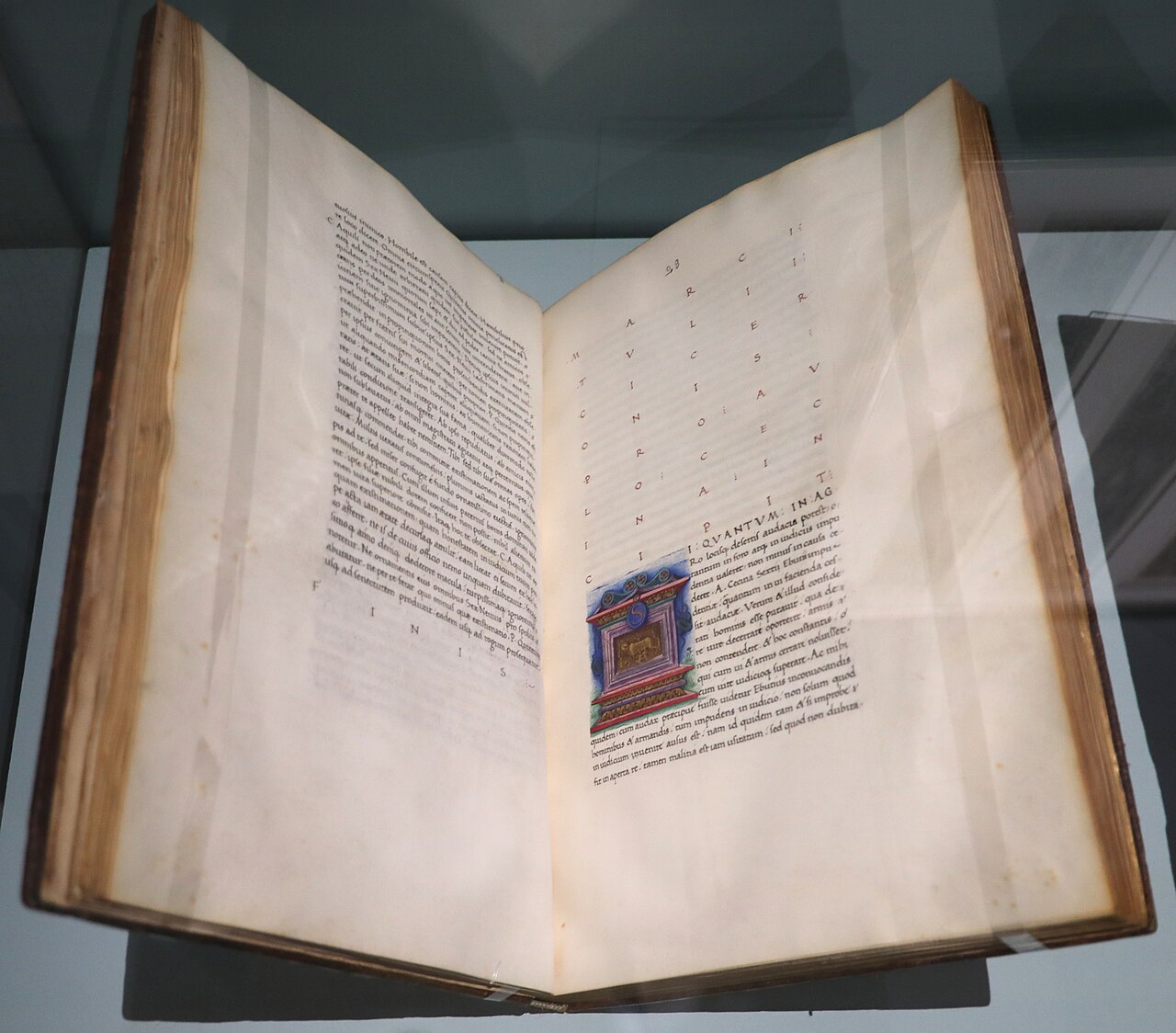
An open bound book displayed in a glass case, showing two pages of handwritten and printed Latin text with red and colored initials. On the right page, a painted illuminated border frame with a small figure and architectural decoration sits beside the text.Book

Secondary source

Illuminated Manuscript of Cicero's Orationes

Francesco Bini · c. 1480-1510

Speech

Secondary source

Latin Reading of Cicero's First Speech Against Catiline

Cicero · 2016

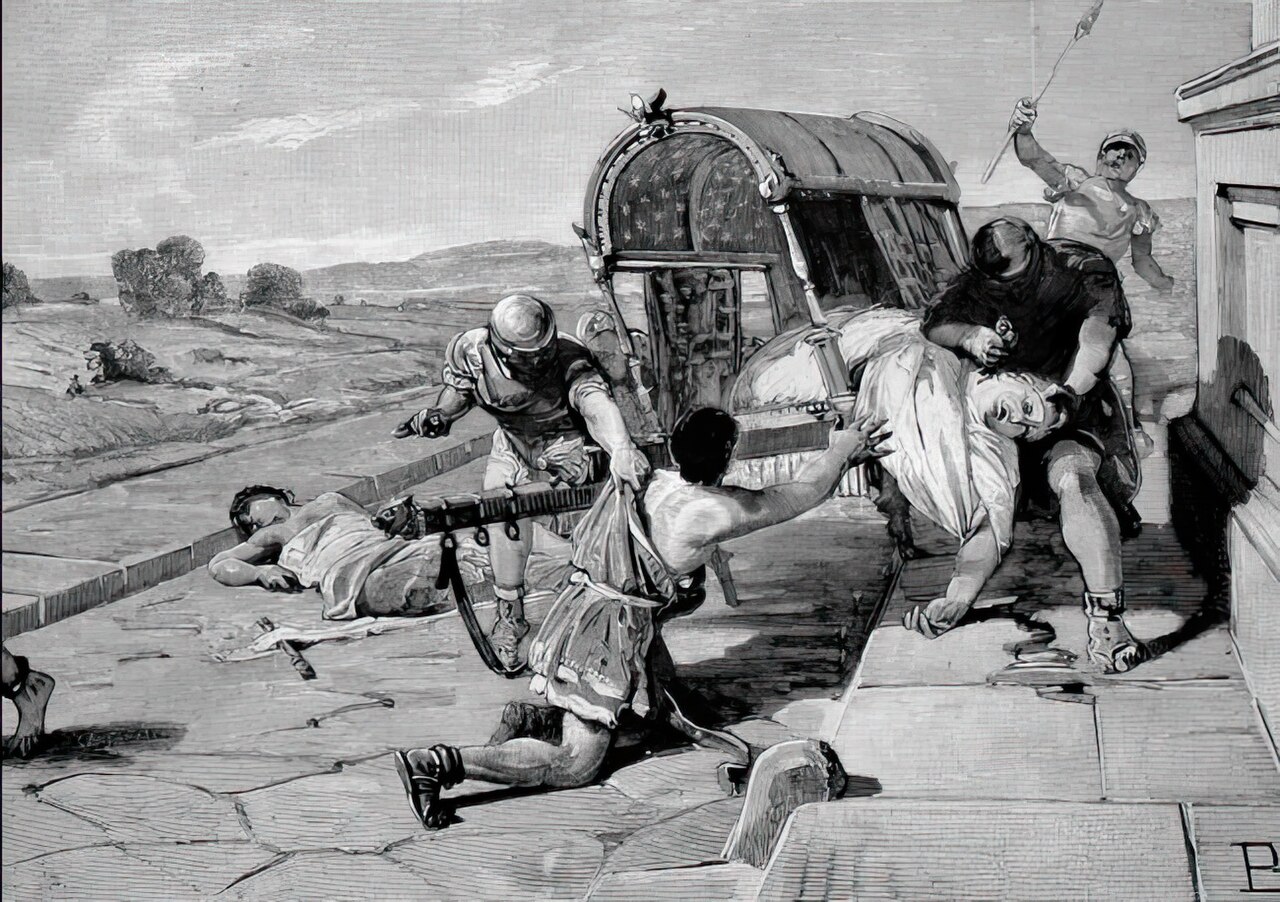
Black-and-white engraved reproduction of a painting of an ancient Roman street scene. A covered litter with a curved roof stands beside a stone road. Armored soldiers seize a man in a light robe, pulling him from the litter. A figure lies on the ground at left, and a soldier raises a spear at upper right.Painting

Secondary source

Cicero Dragged from His Litter and Killed

Lodovico Pogliaghi · 1886

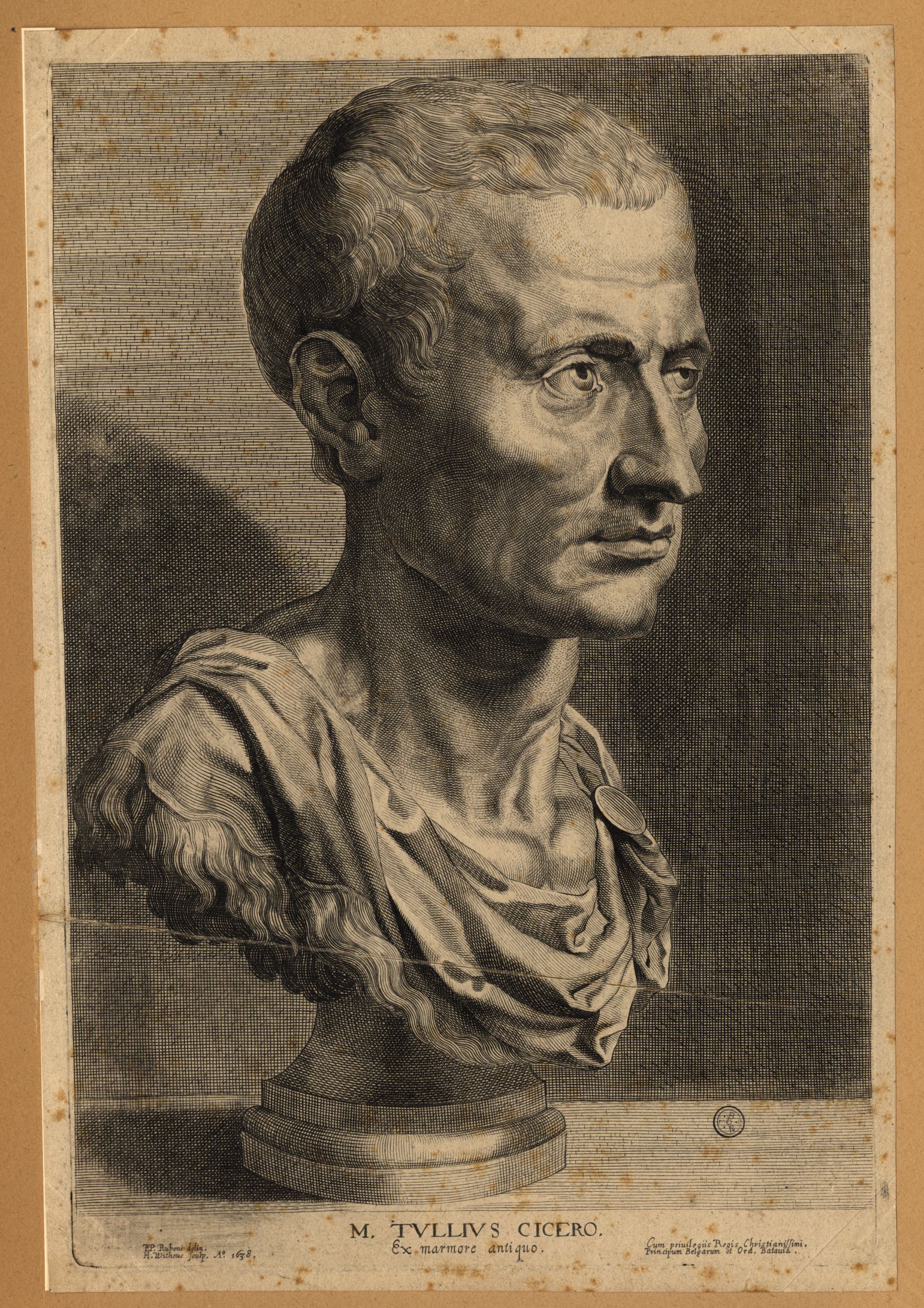
Engraving of a bust of Roman statesman Marcus Tullius Cicero in profile facing right, with curly hair, draped toga, and round base. Caption below reads 'M. Tvllivs Cicero' and 'Ex marmore antiquo', with credits P.P. Rubens delin. and H. Withoos sculp. 1638.Painting

Secondary source

M. Tullius Cicero

Peter Paul Rubens (design); H. Withoos (engraving) · 1638

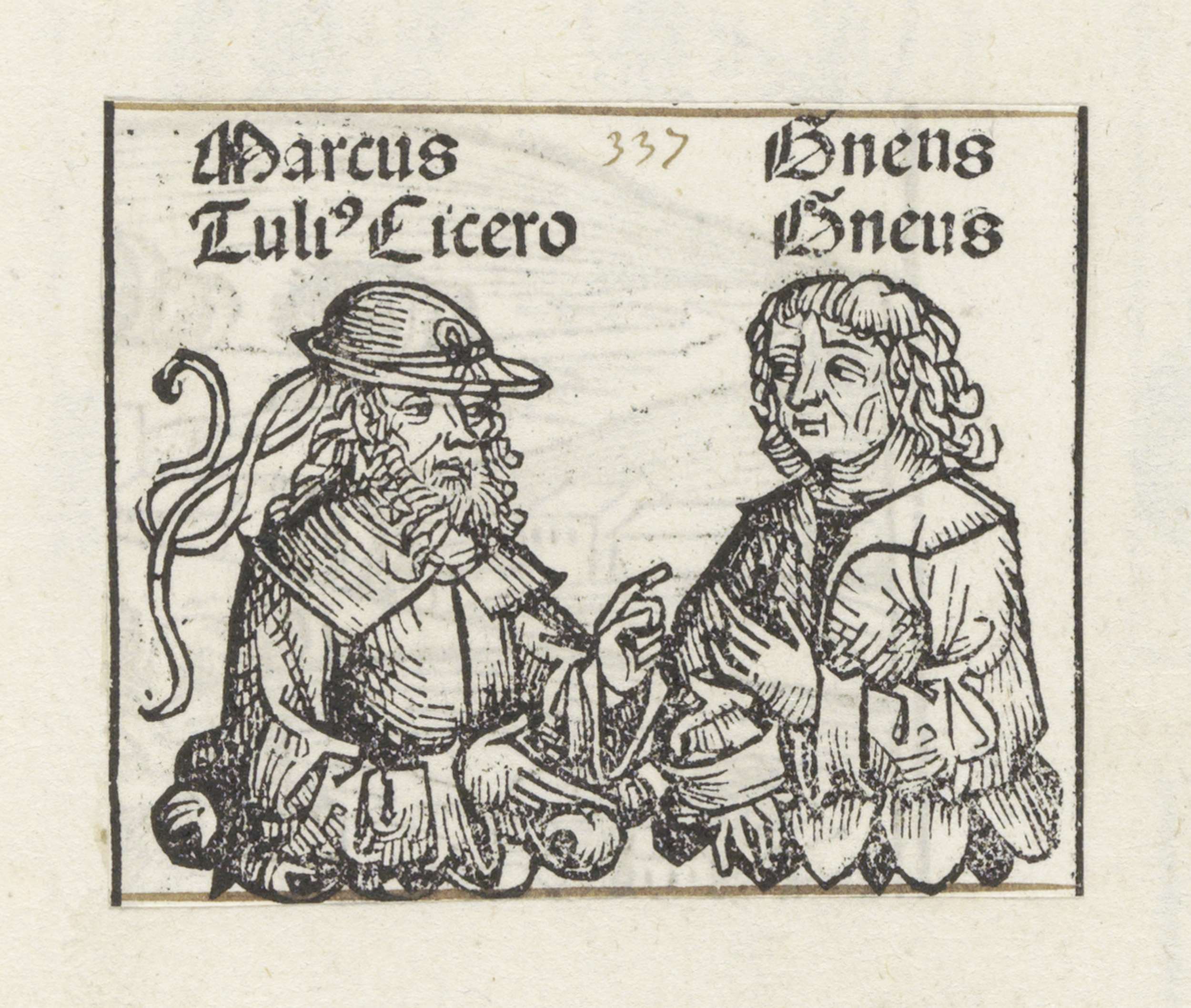
Woodcut from the Nuremberg Chronicle showing two men side by side in profile. On the left, an older bearded man in a wide-brimmed hat and cloak holds a small object toward the other. On the right, a younger man with curly hair in a fur-trimmed garment. Labels above read Marcus Tullius Cicero and Gneus Gneus, with the number 337 handwritten at top.Painting

Secondary source

Cicero and Gaius Antonius Hybrida

Unknown · 1493

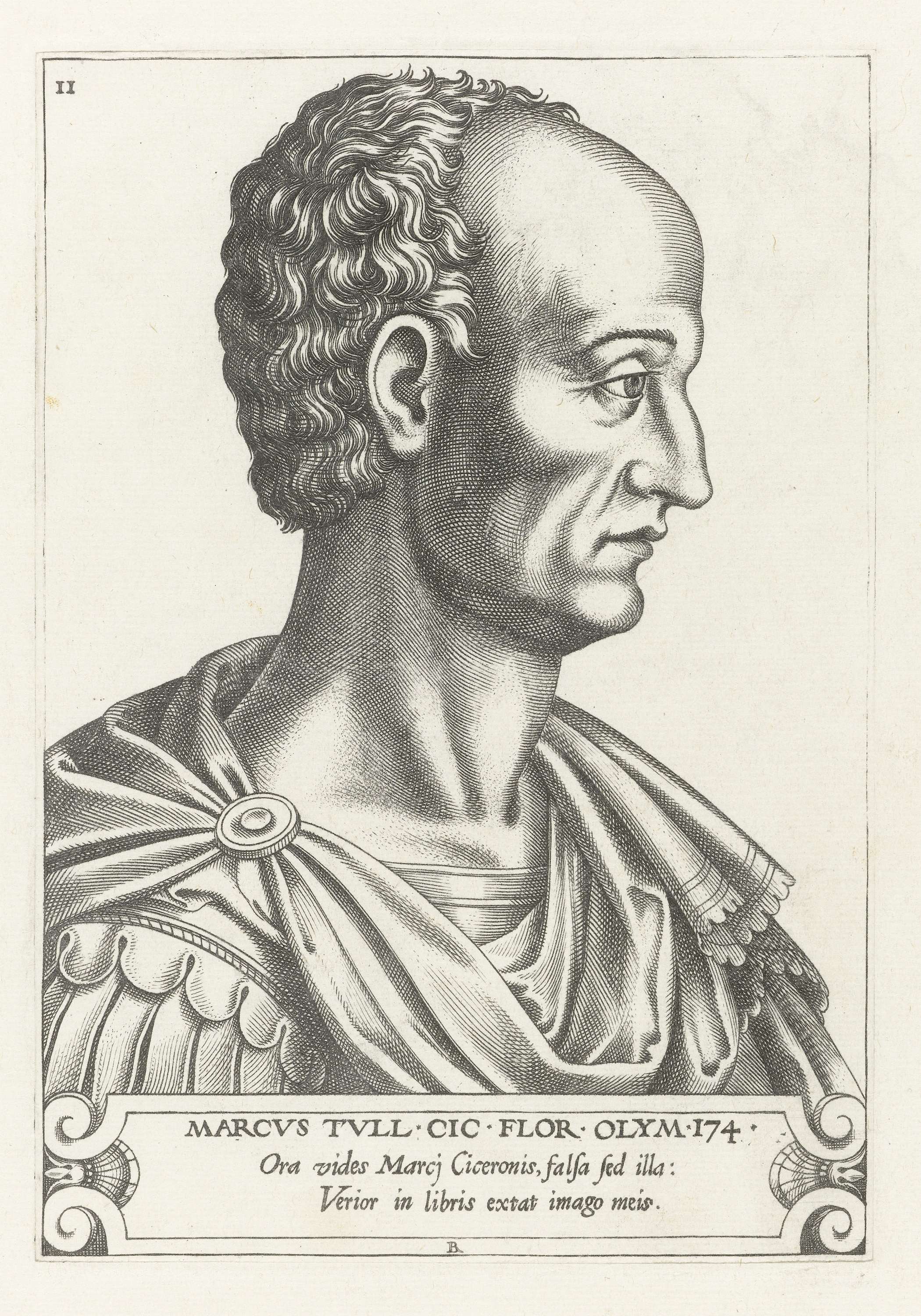
Engraved print in profile of a balding man with curly hair at the sides, wearing a draped toga fastened with a round brooch. Latin caption below reads MARCVS TVLL CIC FLOR OLYM 174 and two lines of verse.Painting

Secondary source

Portrait of Marcus Tullius Cicero

Unknown · 1566

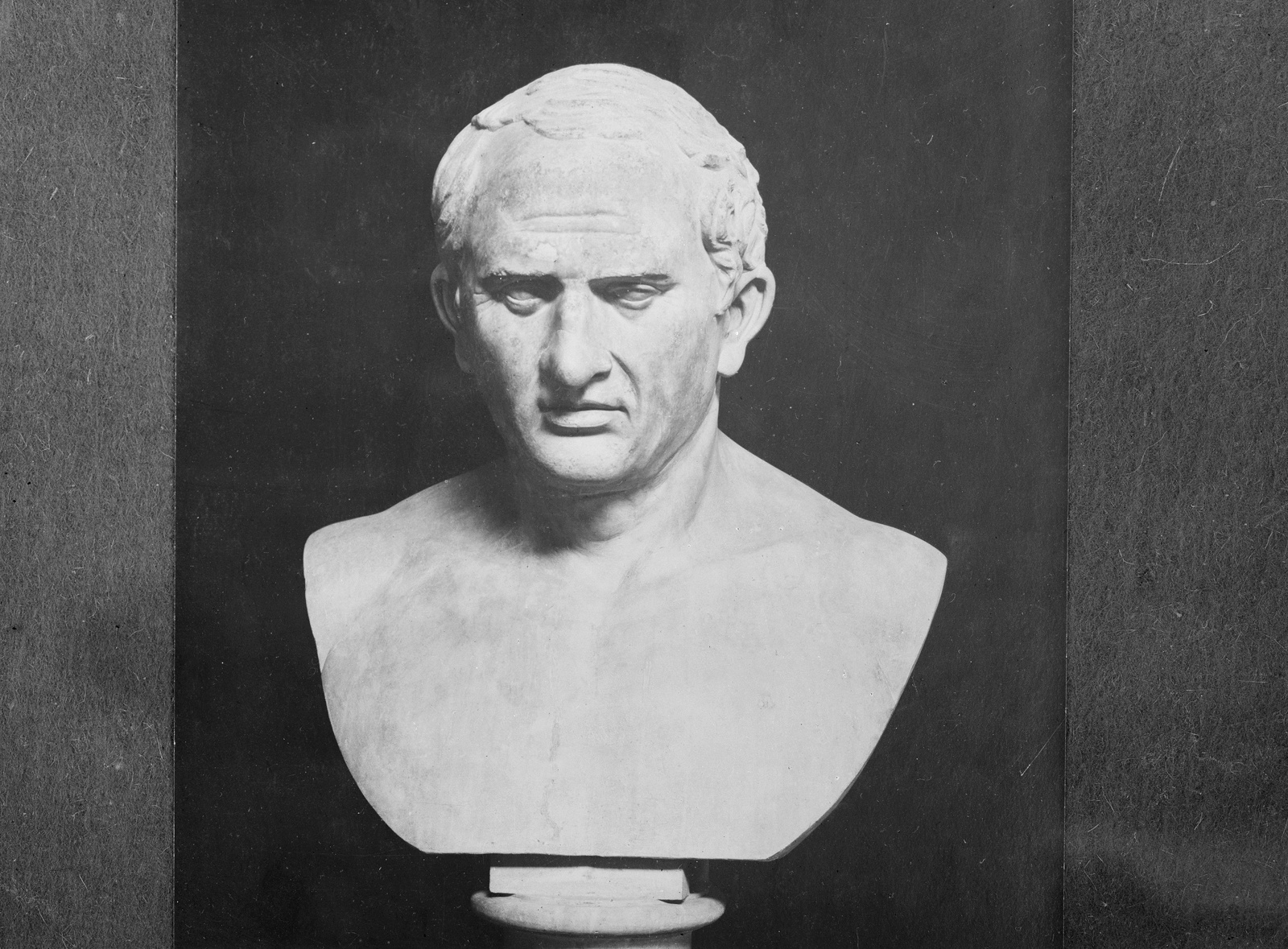
Black and white photograph of a marble bust of a balding man with deeply lined forehead, furrowed brow, and a stern expression, shown on a plain pedestal against a dark background.Photograph

Secondary source

Photograph of Marble Bust of Cicero, Vatican Museums

James Anderson

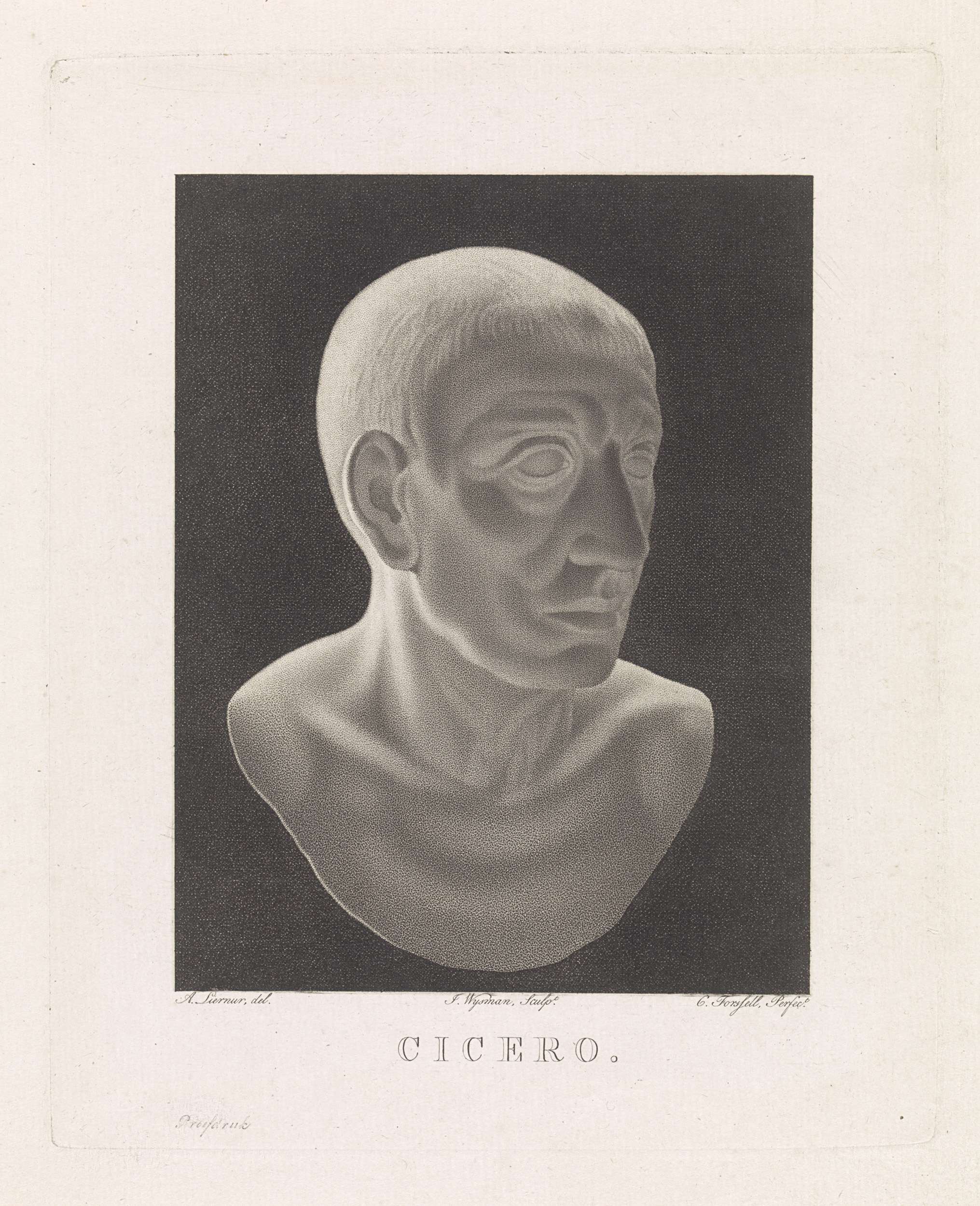
Engraved print titled CICERO showing a bust of a bald man with a stern expression, lit from the left against a dark stippled background, with a bust-length figure and small signatures below. Print is on cream paper.Artifact

Secondary source

Bust of Cicero

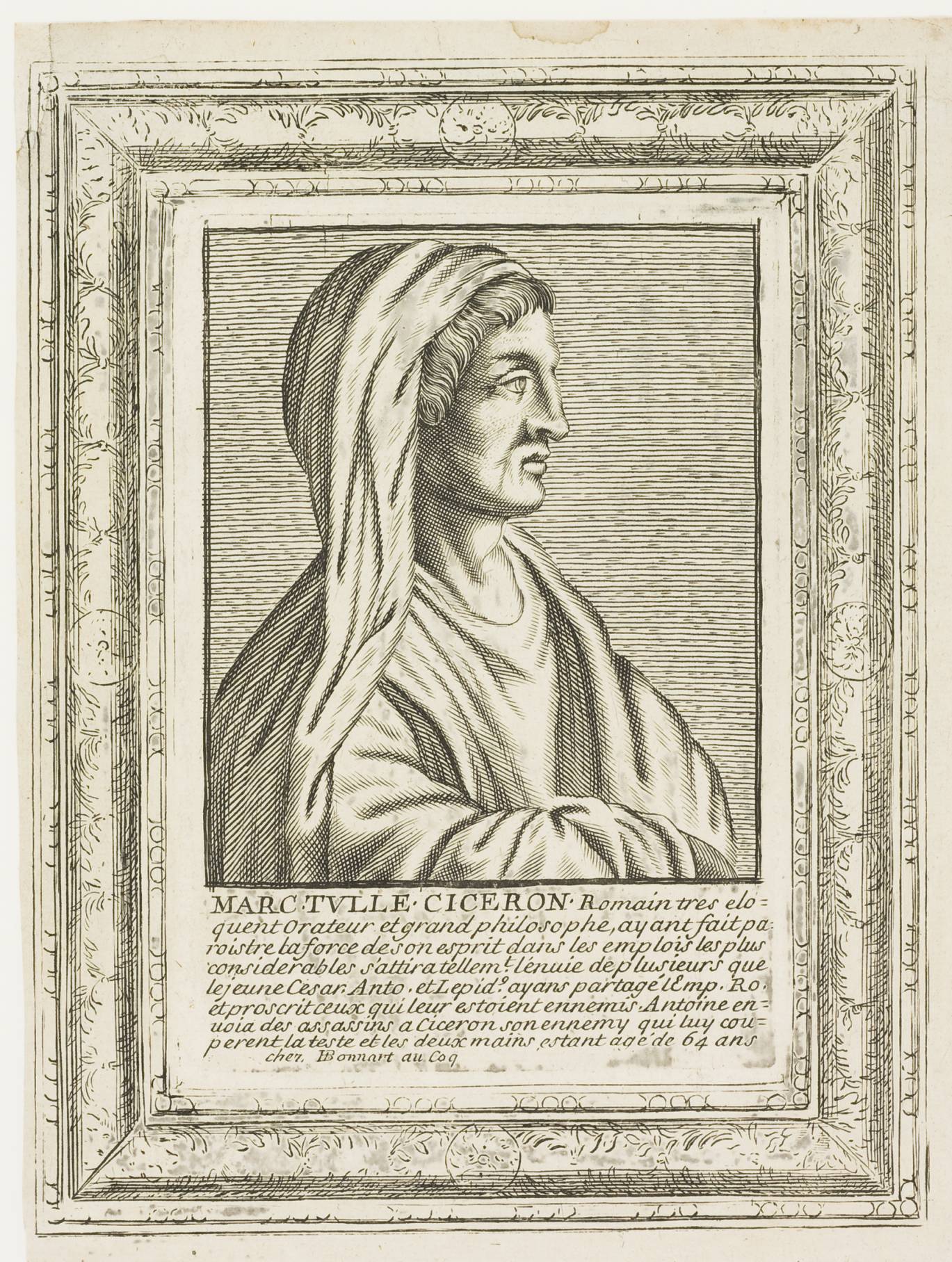
Engraved portrait in profile of a man in a draped hood and robe, facing right, set within an ornate decorative frame. French caption below reads Marc Tulle Ciceron, describing him as a very eloquent Roman orator and great philosopher, with a short account of his death.Painting

Secondary source

Portrait of Marcus Tullius Cicero by Henri Bonnart

Henri Bonnart

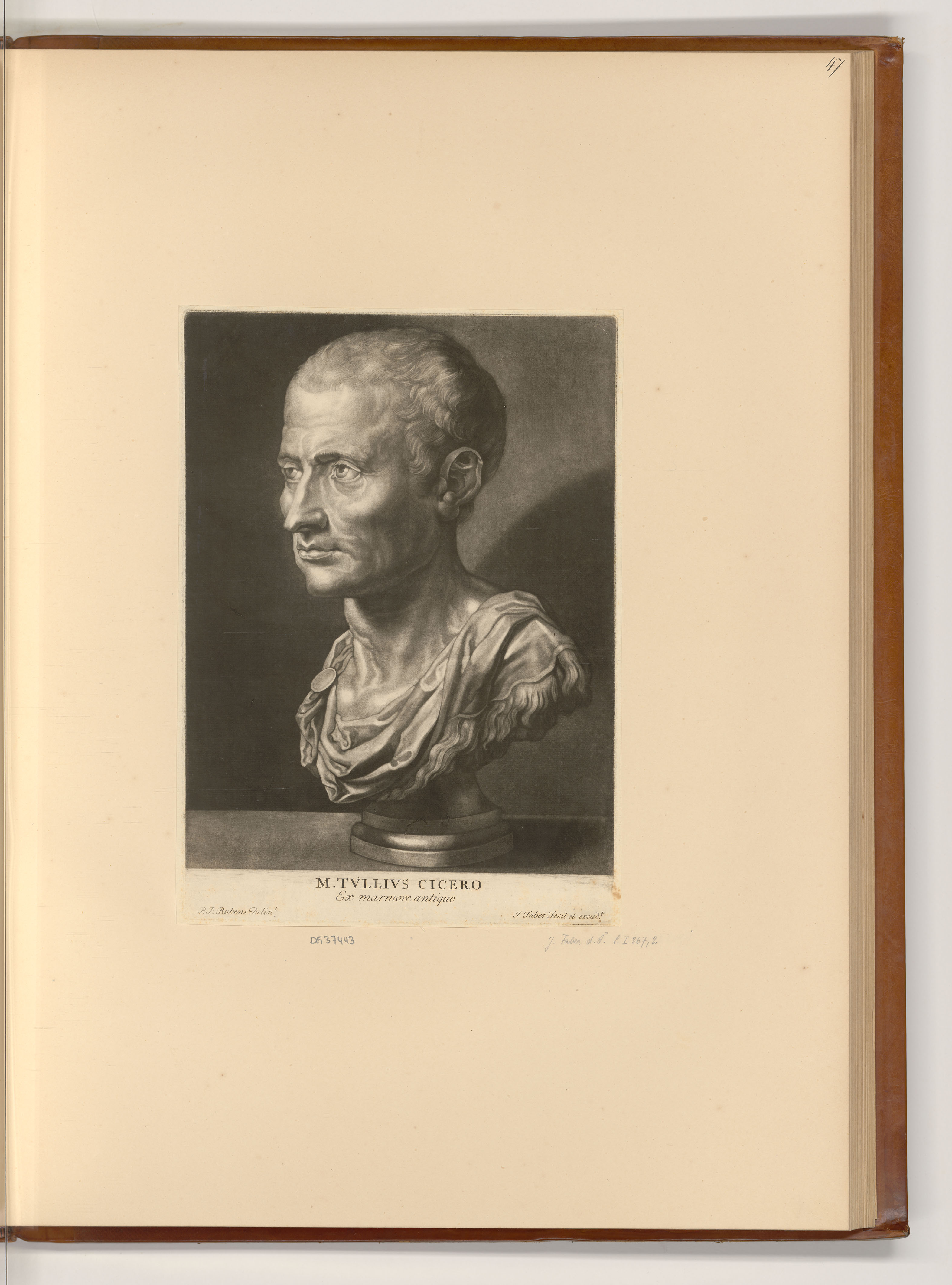
Black-and-white mezzotint print on a cream album page showing a bust of Marcus Tullius Cicero in profile, with a draped toga and brooch, against a dark background. Caption reads 'M. Tullius Cicero, Ex marmore antiquo', with engraver credits 'P.P. Rubens Delin' and 'I. Faber Fecit et excud'.Artifact

Secondary source

Bust of Cicero by John Faber the Elder

John Faber the Elder

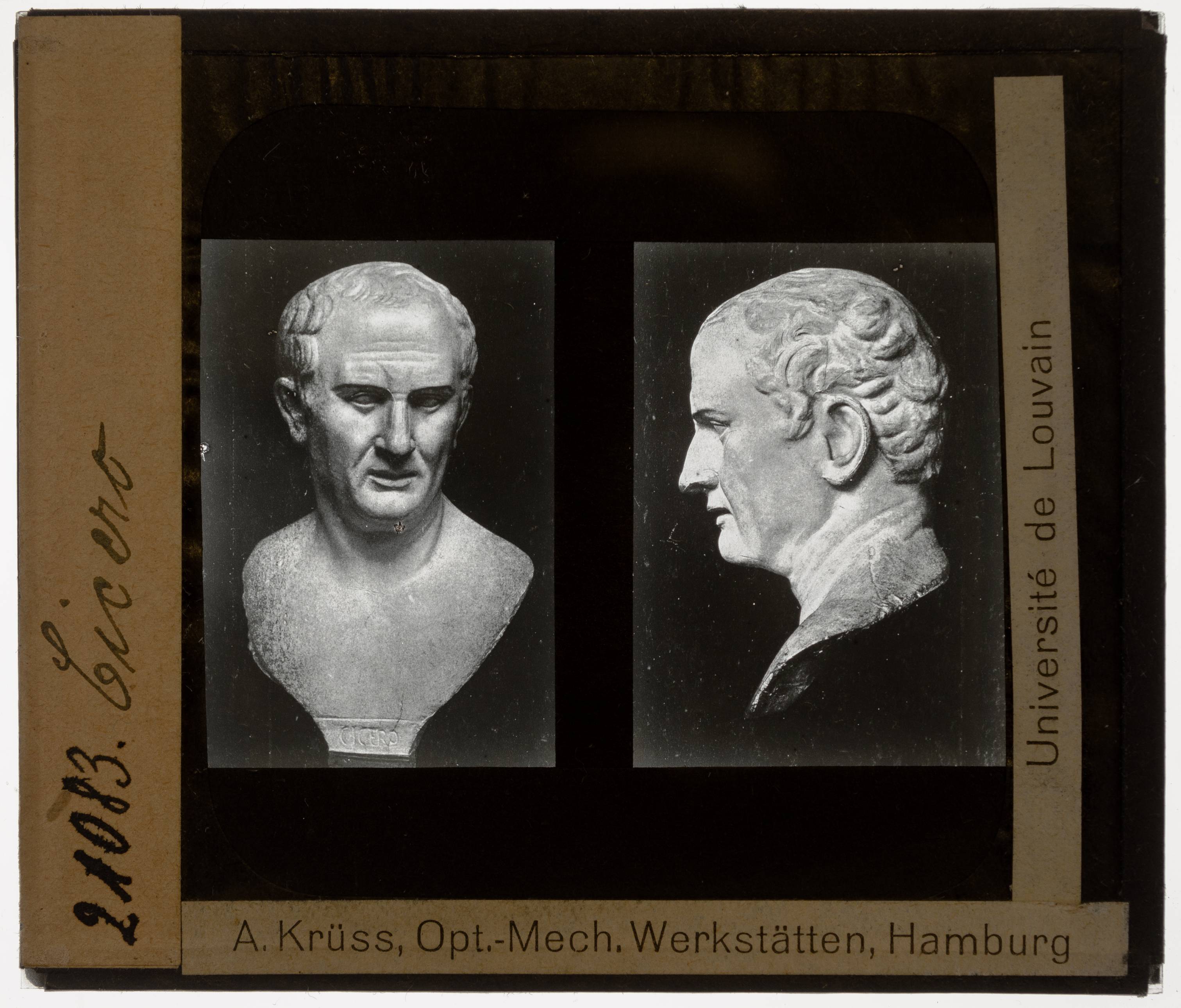
Lantern slide showing two black-and-white photographs of a marble bust of Cicero: a frontal view on the left, with the inscription CICERO on the base, and a profile view on the right. Handwritten label reads 'Cicero' and 'Universite de Louvain'.Photograph

Secondary source

Bust of Cicero, Frontal and Profile

1st century AD (bust); between 1839 and 1939 (slide)

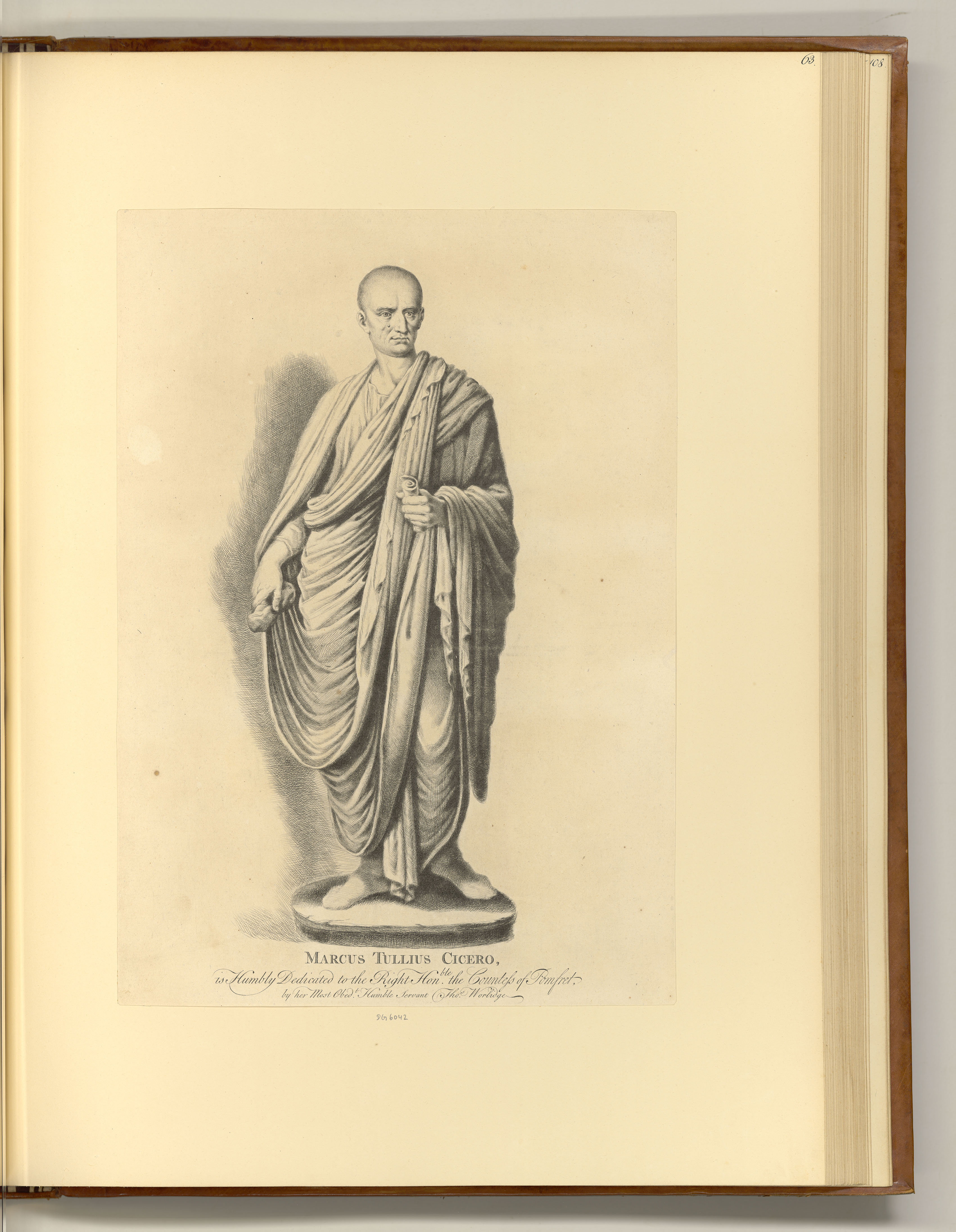
Engraved plate of a standing man in a Roman toga, bald, holding a rolled scroll, on an oval plinth. Printed caption below reads 'Marcus Tullius Cicero' and a dedication to the Countess of Pomfret. The plate is mounted in a bound book with page number 63.Artifact

Secondary source

Marcus Tullius Cicero, Albertina Museum

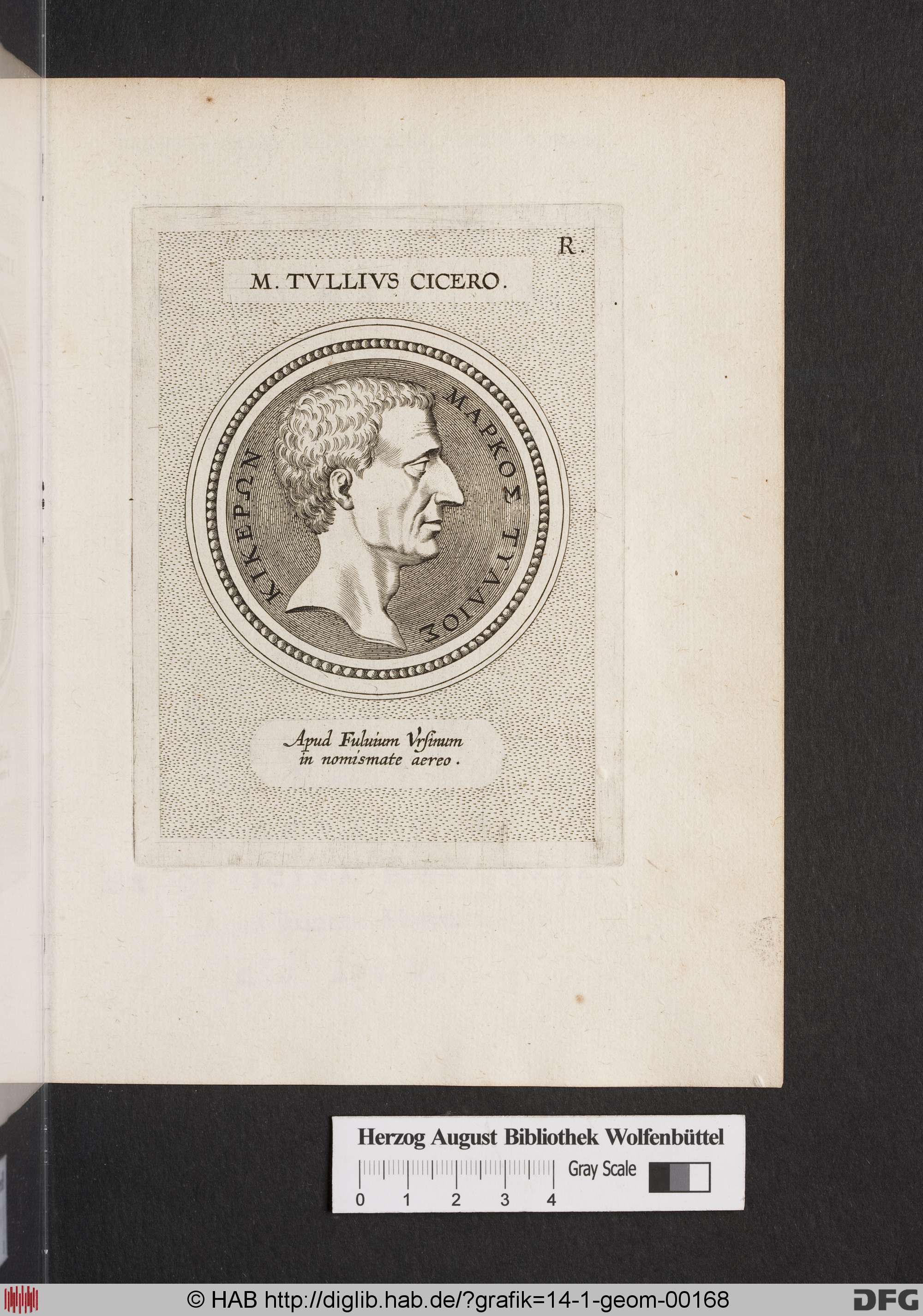
Engraved print of a bust portrait of Marcus Tullius Cicero in profile facing right, inside a beaded roundel with Greek and Latin inscriptions. Above is the caption M. TVLLIVS CICERO, below an italic caption reading Apud Fulvium Ursinum in nomismate aereo. Printed on a cream page with a library label.Painting

Secondary source

Portrait of Marcus Tullius Cicero, Herzog August Library

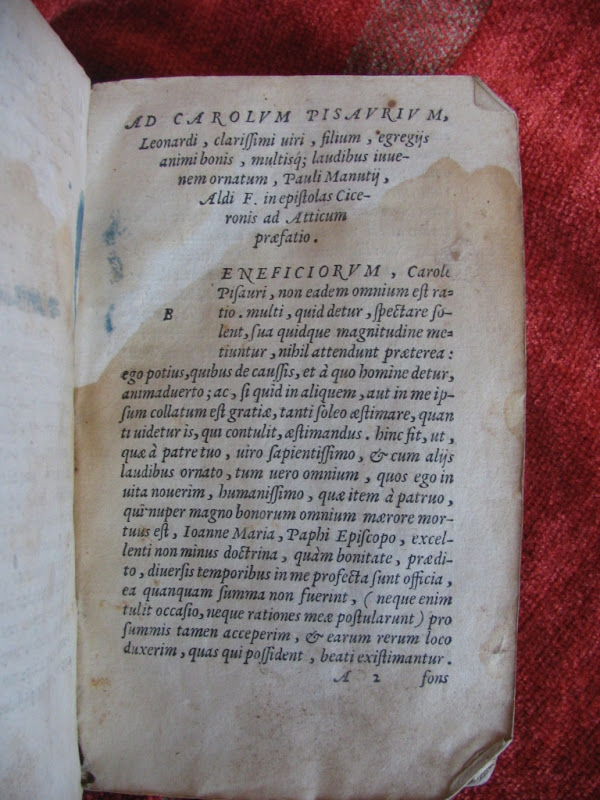
Photo of an open early printed book on a red fabric background. The right page shows a printed preface headed 'AD CAROLVM PISAVRIVM' in old-style typeface, with Latin text in dense columns. The left page is largely blank and shows foxing stains.Letter

Primary source

Epistulae ad Atticum

Cicero · 44 BCE

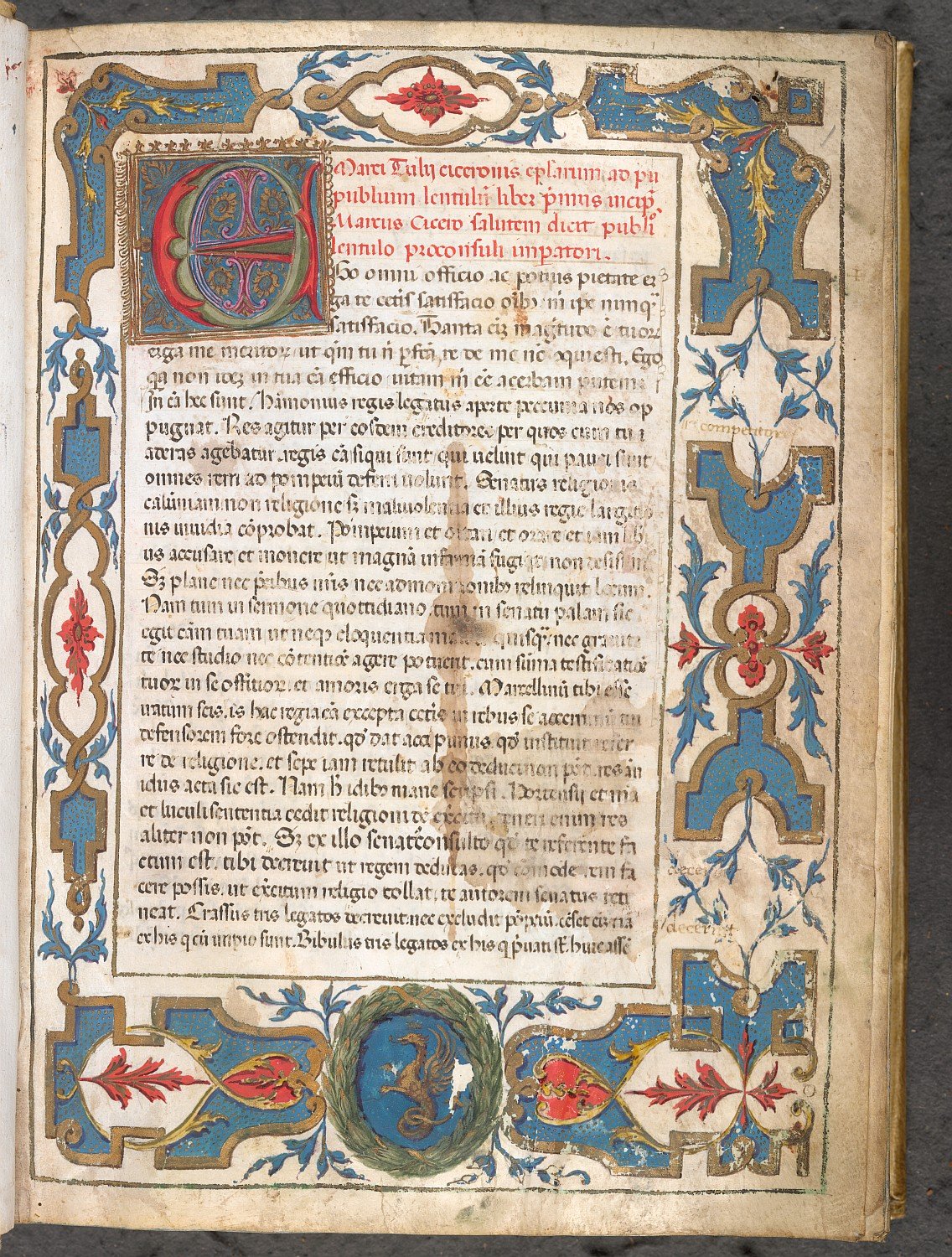
Illuminated manuscript page with a large decorated initial S in red, blue and green at upper left, red and blue rubricated text at the top, and dense black Latin script in columns. The page is framed by blue and gold foliate borders with red flourishes, and a roundel at bottom centre shows a blue and gold dragon in a laurel wreath.Letter

Primary source

Epistulae ad Familiares

Cicero · 62–43 BCE

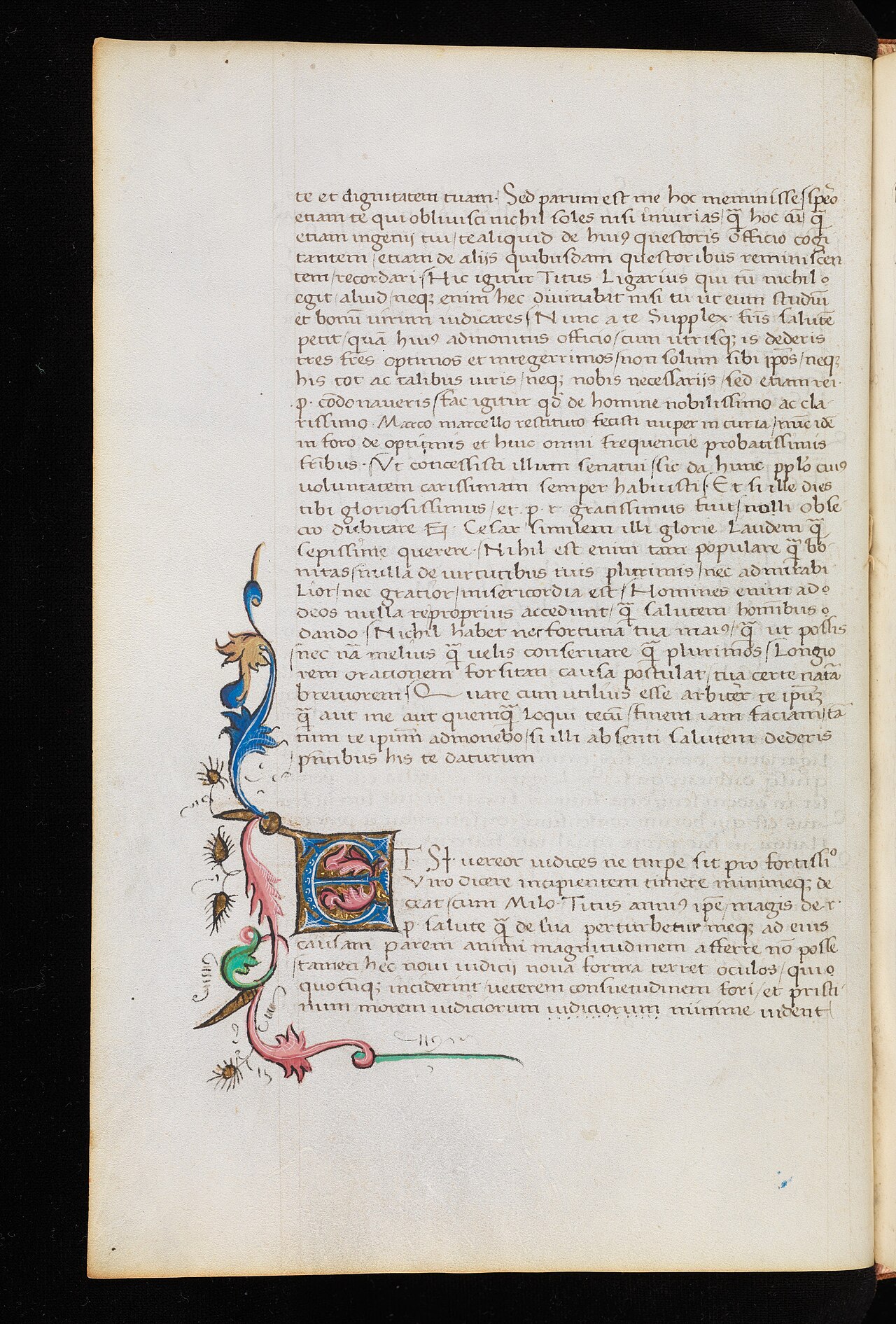
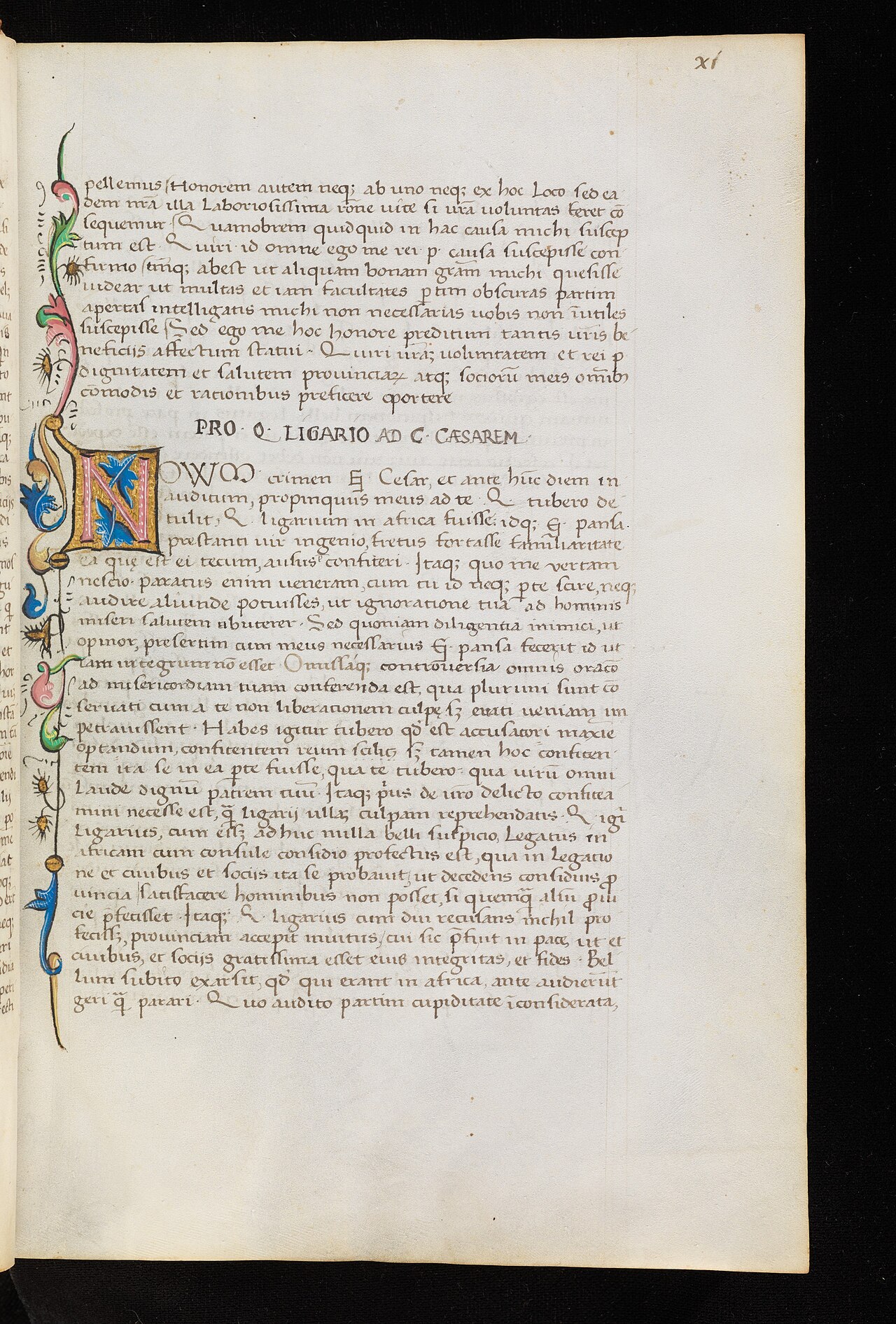
A manuscript page with hand-lettered Latin text in brown ink on vellum, headed 'PRO Q. LIGARIO AD C. CAESAREM' with a large illuminated initial N in pink, blue and gold decorated with foliage in the margin. Page number xi is at top right.Speech

Primary source

Pro Ligario

Cicero · 46 BC

Want the full shelf? Chat with Cicero in the app and open the Sources panel — every quote links back to the original.

Use Cicero in class

1 collection

A ready-made collection from the Humy team that features Cicero. Preview it, then try it free.

Trusted by educators worldwide

Conversations
375,000+
Real exchanges between students and historical figures
Messages exchanged
4,142,000+
Across every figure, classroom and language
Historical figures
100,000+
Each informed by a curated biography and selected sources
Languages supported
50+
From English and Spanish to Arabic and Korean

Paying customers

Used by 98 schools and universities

Partner school logo
Tecnológico de Monterrey logo
Hyper Island logo
Partner school logo
Chambersburg Area School District logo
Broward County Public Schools logo
Nebo School District logo
National Louis University logo
South Florida PBS logo
Punahou School logo
University of Wisconsin–River Falls logo
Partner school logo
Partner school logo
Archbishop Mitty High School logo
Kingsburg High School logo
Norwalk Public Schools logo
Partner school logo
Connections logo
Partner school logo
Moore Public Schools logo
Partner school logo
Partner school logo
Partner school logo
Partner school logo
Robbinsville Public Schools logo
Partner school logo
Partner school logo
Partner school logo
Tecnológico de Monterrey logo
Hyper Island logo
Partner school logo
Chambersburg Area School District logo
Broward County Public Schools logo
Nebo School District logo
National Louis University logo
South Florida PBS logo
Punahou School logo
University of Wisconsin–River Falls logo
Partner school logo
Partner school logo
Archbishop Mitty High School logo
Kingsburg High School logo
Norwalk Public Schools logo
Partner school logo
Connections logo
Partner school logo
Moore Public Schools logo
Partner school logo
Partner school logo
Partner school logo
Partner school logo
Robbinsville Public Schools logo
Partner school logo
Partner school logo

What educators are saying

“We enjoyed the program last year and used it frequently.”
“My students say it’s a welcome change of pace. I’m not a fan of the “sage on the stage” model, so I try to incorporate research-oriented and self-paced activities. With Humy, students have to take charge of their learning. They’ve become more adept at critical thinking, forming better questions, and improving their reading comprehension. The interview feature has been my go-to tool. I create assignments where students must ask historical figures a set number of questions, then summarize the responses to ensure they’re truly absorbing the material. This approach lets them actively explore the past rather than passively consuming information.”
“Humy has helped me bring historical figures, sometimes long past, to life. When my students interact with these figures in real-time, it eliminates some of the perceived “ancient” characteristics of my curriculum. This has shifted my students’ thinking away from viewing history as abstract or irrelevant. Real-time interactions make historical figures relatable, even allowing students to ask off-topic questions that help put historical lives in a more relevant context for 13-year-olds. The feature I use the most is the interview feature. After teaching a topic, most recently Gandhi and Joan of Arc, I have the students ask pointed, focused questions. We practice good conversation techniques beforehand, teaching them to listen (or read) carefully and formulate thoughtful follow-up questions rather than just interrogating. It helps students practice effective conversation skills.”

FAQ

Frequently asked questions

Who is Cicero?
Ancient Roman statesman, orator, and philosopher. On Humy.ai you can chat with an AI version of Cicero that draws on a short biography and 85 historical sources during the conversation — by text or voice, in 42 languages.
Is Cicero AI free?
Cicero is part of Humy's full library of more than 100,000 figures, which comes with a paid plan. A free account (no credit card) includes 20 messages a month with the free library's figures, so you can try how the conversations work first.
What sources does the Cicero AI use?
It draws on a short biography and 85 historical sources (books, speeches and paintings), including “Catiline Orations”, “Marcus Tullius Cicero, engraved after antique marble busts” and “De Officiis”. Each source has its own page on Humy.ai.
How historically accurate is the AI version of Cicero?
Each figure uses a short biography and a small set of selected historical sources as context (retrieval-augmented generation), so answers stay closer to known material than the model's general knowledge alone. It isn't a citation-grade research tool — like any LLM, the AI can get details wrong or extrapolate. Treat it as a strong starting point for inquiry and cross-reference important claims.
Can I talk to Cicero by voice?
Yes. In addition to text chat, you can call Cicero and hear their voice respond in real time — useful for auditory learners, interview practice and Socratic dialogue.
Is Humy.ai safe and compliant for schools?
Yes. Humy.ai is used by more than 100 schools, universities and organisations. The platform is FERPA- and GDPR-aligned, supports SSO, and offers an IT-approval pack tailored for school procurement teams.

Ready when you are

Start chatting with Cicero now.

20 messages free · No credit card · Available in 50+ languages.