Portrait of Seneca

AI Historical Figure

Seneca

Ancient Roman philosopher and statesman.

Chat with Seneca via text or voice — in 42 languages, drawing on a curated biography and 98 historical sources. Available 24/7.

Start chatting with Seneca20 messages free · No credit card
Lived
c. 4 BCE–65 CE
From
Italy
Known for
Politics & governmentPhilosophy
Seneca

Seneca

Online · responds in seconds

Hello — I'm Seneca. Ancient Roman philosopher and statesman. What would you like to ask me?

20 messages free · No credit card · Powered by Humy.ai

Live preview · Switch between 42 languages above · Send a message to continue in the app

Multilingual

Talk to Seneca in 42 languages

Ask Seneca questions in any language below, and the rest of Humy's app speaks it too. Pick yours to open the chat in that language.

Also in German (Austria), German (Switzerland), English (UK), English (Australia), English (Canada).

The sources behind this AI

98 sources · 52 books · 33 paintings · 6 letters · 4 sculptures · 3 documents

Seneca doesn’t improvise from thin air. The AI is grounded in 98 curated historical sources students can inspect. Open any of them to see what informs the conversation.

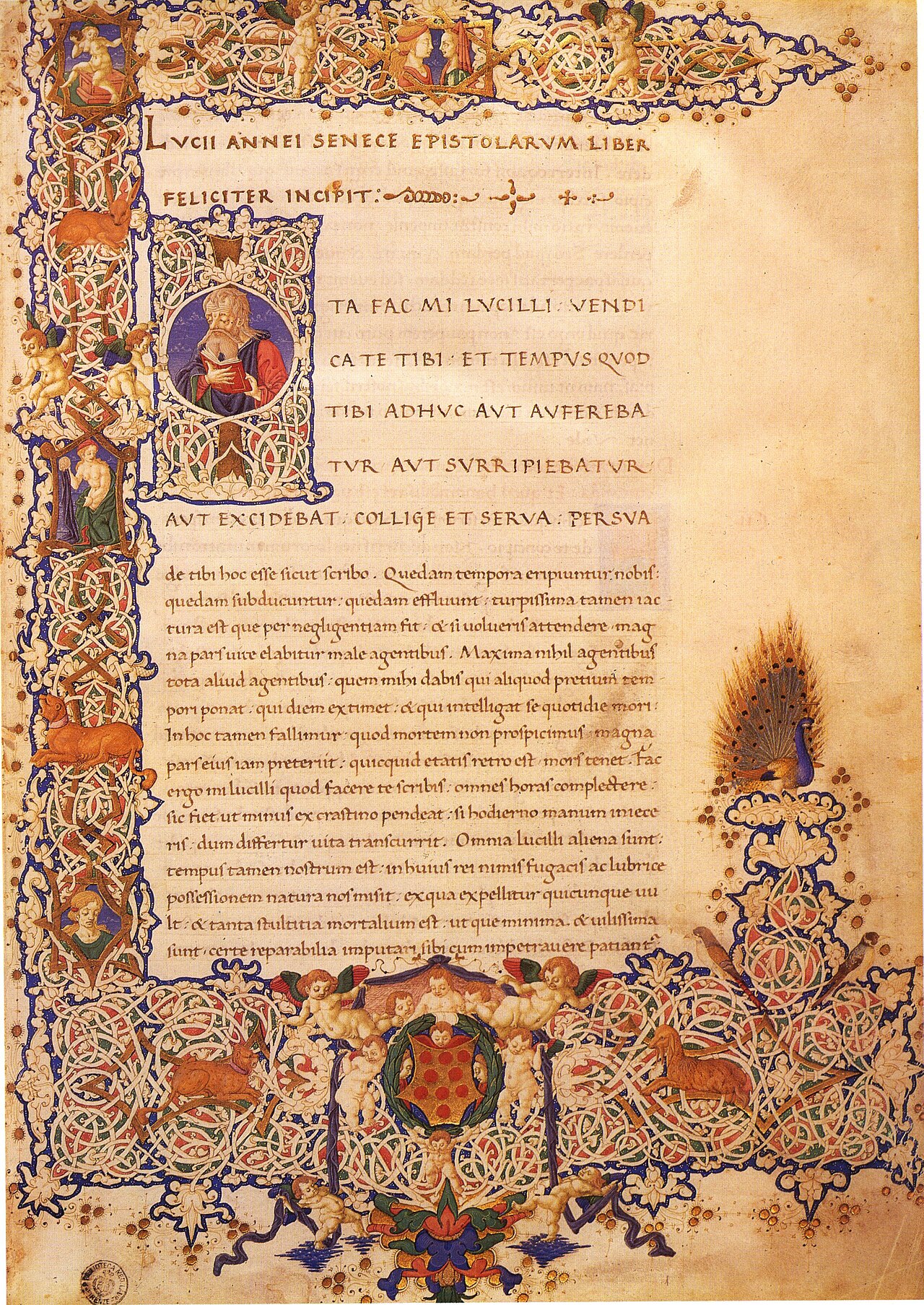
Illuminated manuscript page with Latin text 'Lucii Annei Senece Epistolarum liber feliciter incipit' and ornate borders of vines, putti, animals, a peacock, and a small portrait of a seated author holding a book.Letter

Primary source

Epistulae Morales ad Lucilium

Seneca · c. 62-65 CE

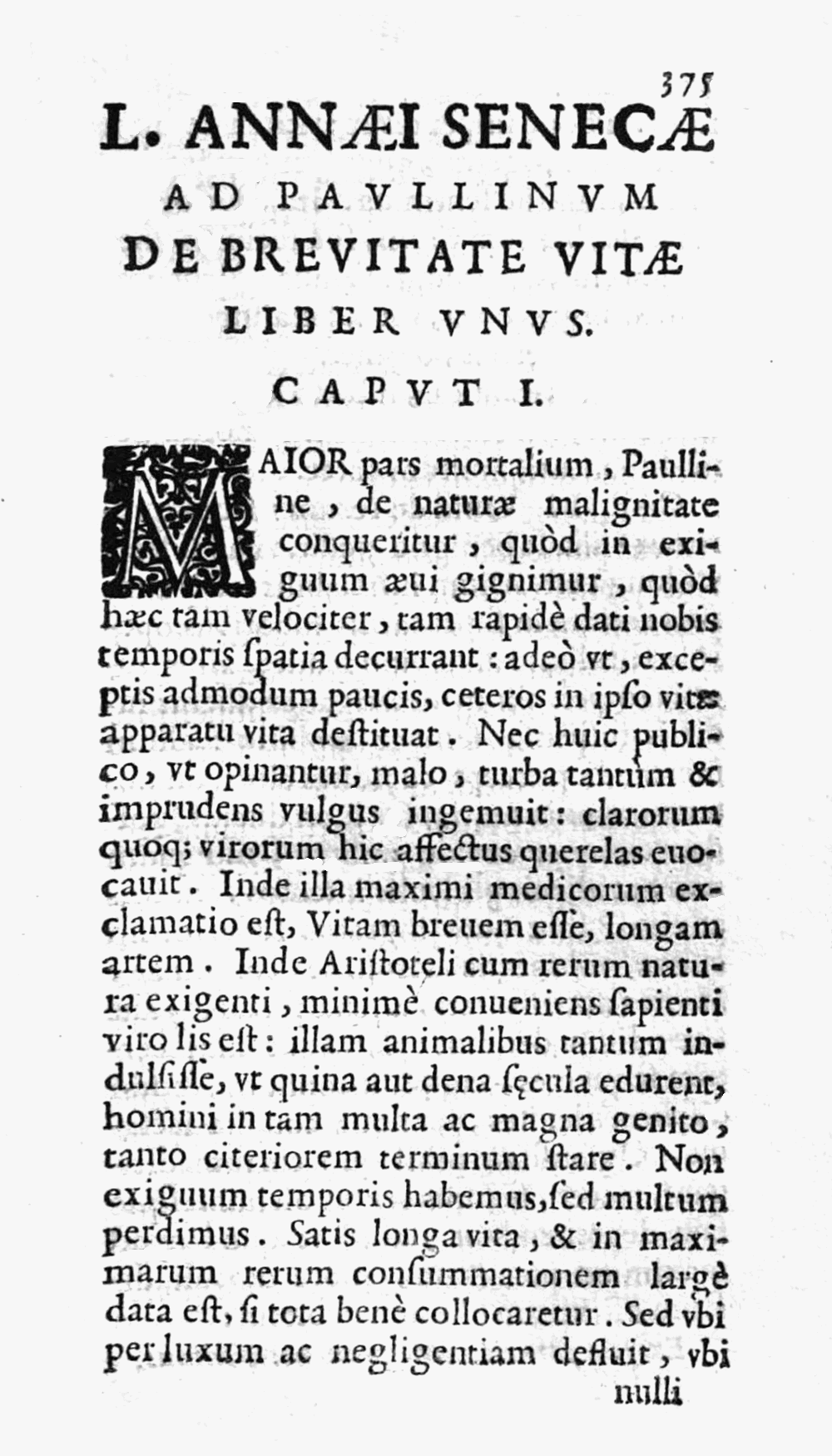
Scanned page 375 of a 1643 Latin edition of Seneca's works. The heading reads L. Annaei Senecae, Ad Paullinum, De Brevitate Vitae, Liber Unus, Caput I. Below is a large decorated initial M followed by dense Latin body text.Book

Primary source

De Brevitate Vitae

Seneca · c. 49 CE

Scanned page of an early printed book, with a running heading reading 'C. Taciti de divo Claudio Caesare liber quintus' in capitals and dense black-letter Latin text in two columns of prose. Library stamps and a handwritten shelf mark appear at the top and on the page.Book

Secondary source

Annals

Tacitus · c. AD 116 or later

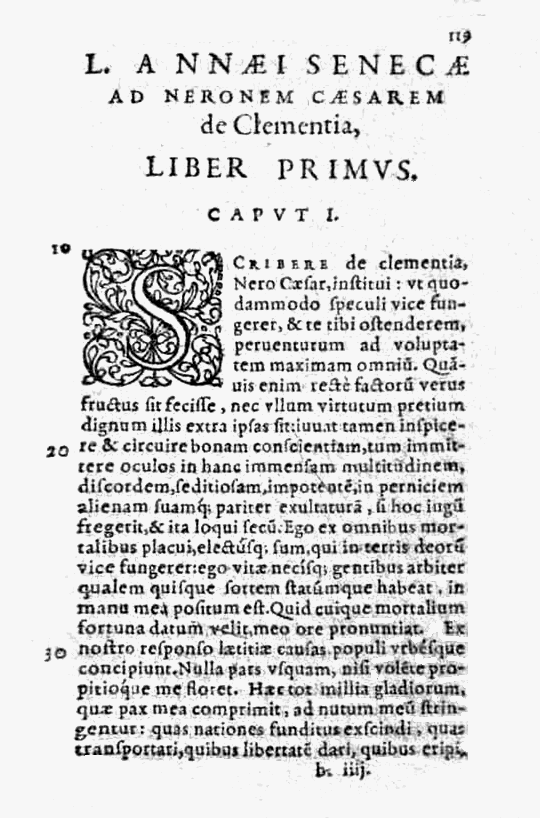
Scanned page 119 of a 1594 Latin edition of Seneca's works. The header reads 'L. Annaei Senecae ad Neronem Caesarem de Clementia, Liber Primus, Caput I.' A decorated initial S opens the Latin text in dense columns of print.Book

Primary source

De Clementia

Seneca · 55-56 CE

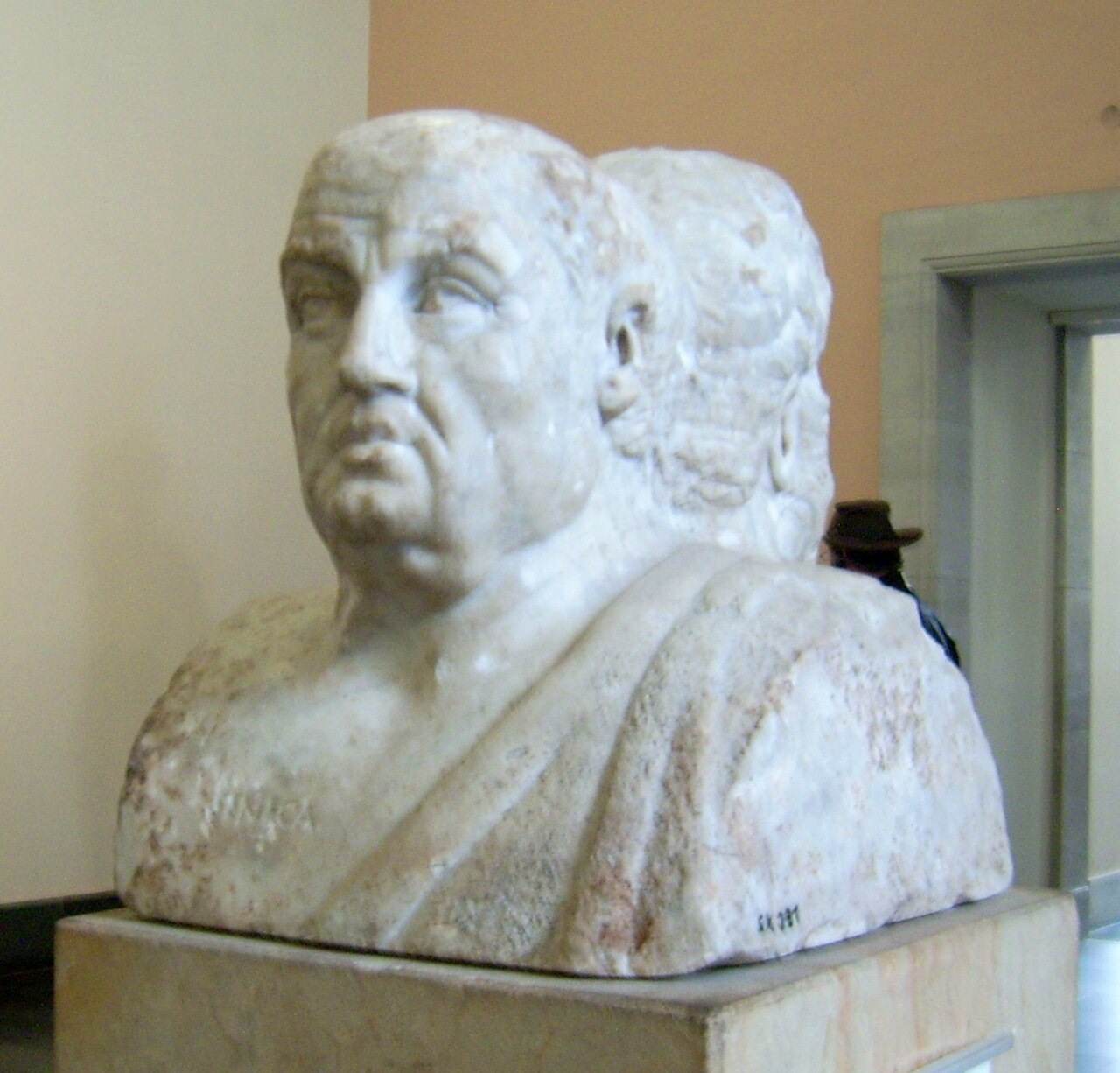
Marble double bust in a museum, showing two bearded and balding male faces joined at the back on one shoulder-length torso draped in a cloak. The front face is older with deep wrinkles; the second face is behind it on the right. Mounted on a pale stone pedestal.Sculpture

Secondary source

Double Herm of Socrates and Seneca

first half of the 3rd century AD

Page from a medieval manuscript with black Latin text in columns, red and blue initials, and a framed illuminated initial showing small figures beside a vessel, with a dog below. Red rubric reads 'Explicit Troas. Incipit Medea'.Book

Primary source

Medea

Seneca · c. 50 CE

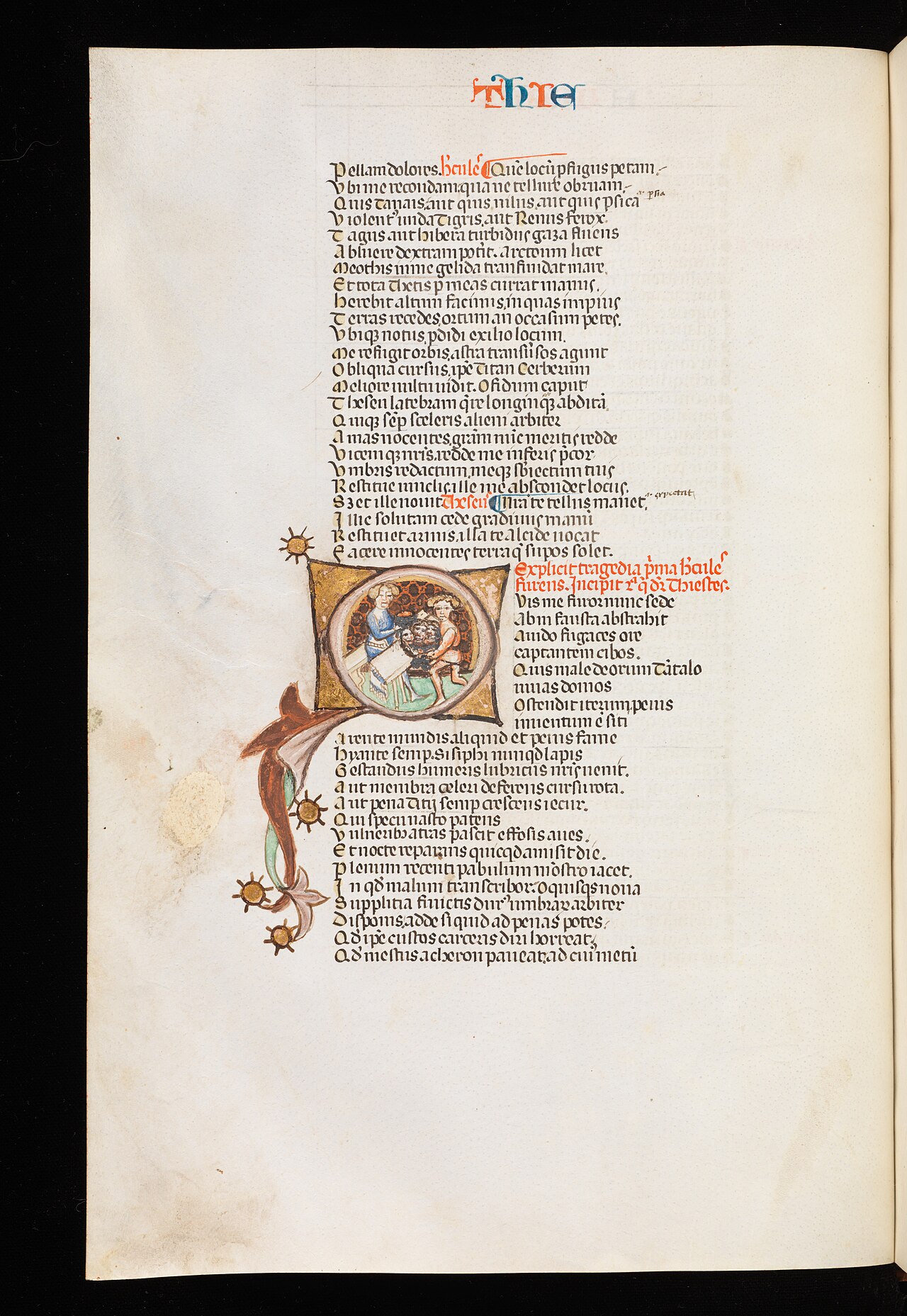
Manuscript page of a medieval Latin codex with dense black-ink text in columns, red rubrics and headings, and a large illuminated initial containing a painted scene of figures around a table with a dish. Decorative gold and red flourishes frame the page, with the word Thyestes in red and blue at the top.Book

Primary source

Thyestes

Seneca · 1st century AD

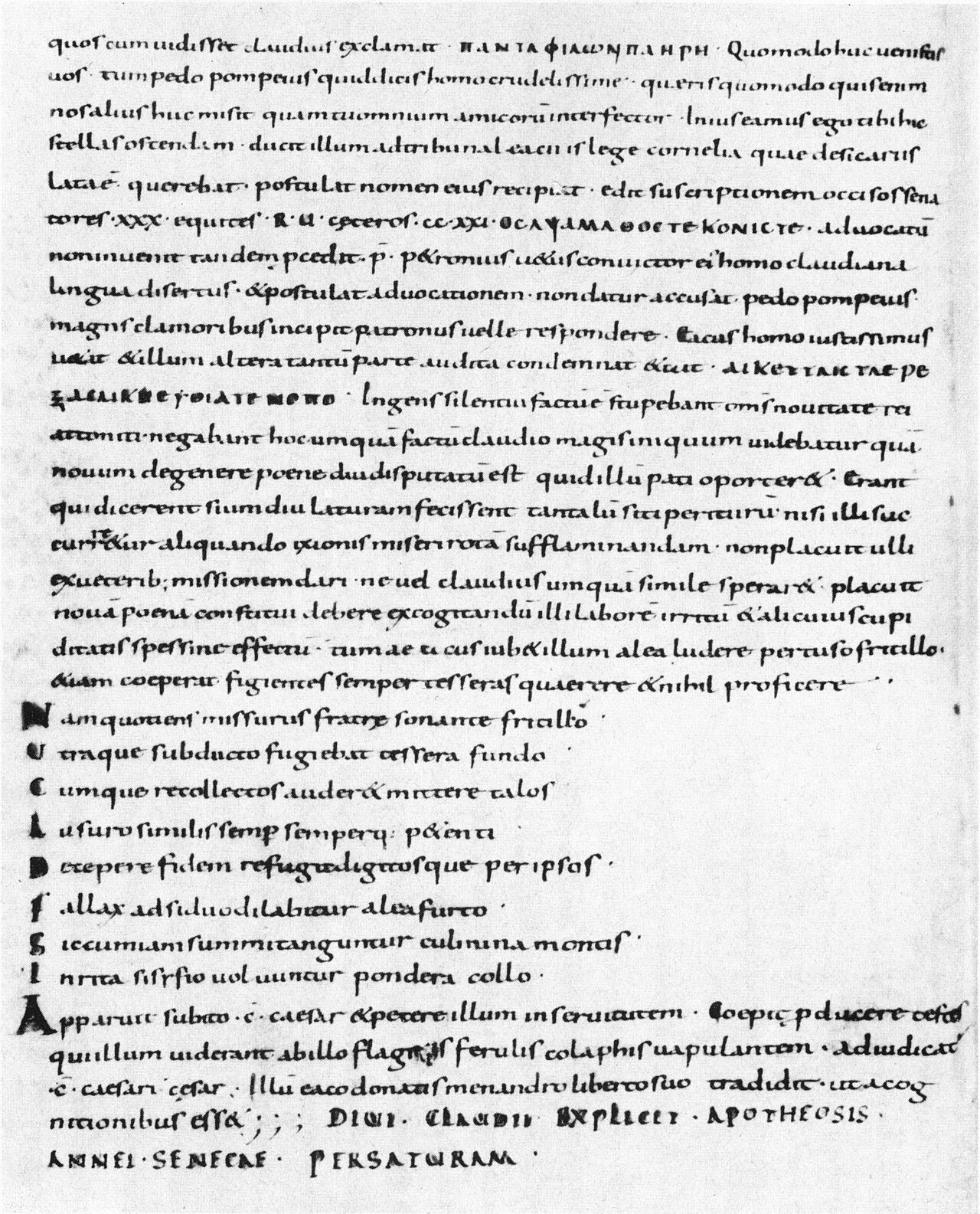
Manuscript page of Latin text in brown ink in a medieval hand, with several lines in larger decorative script and a closing line reading 'DIVI CLAVDII EXPLICIT APOTHEOSIS' followed by 'ANNAEI SENECAE PER SATVRAM'.Book

Primary source

Apocolocyntosis

Seneca · 1st century AD

Letter

Primary source

To Mother Helvia

Seneca · 1st century AD

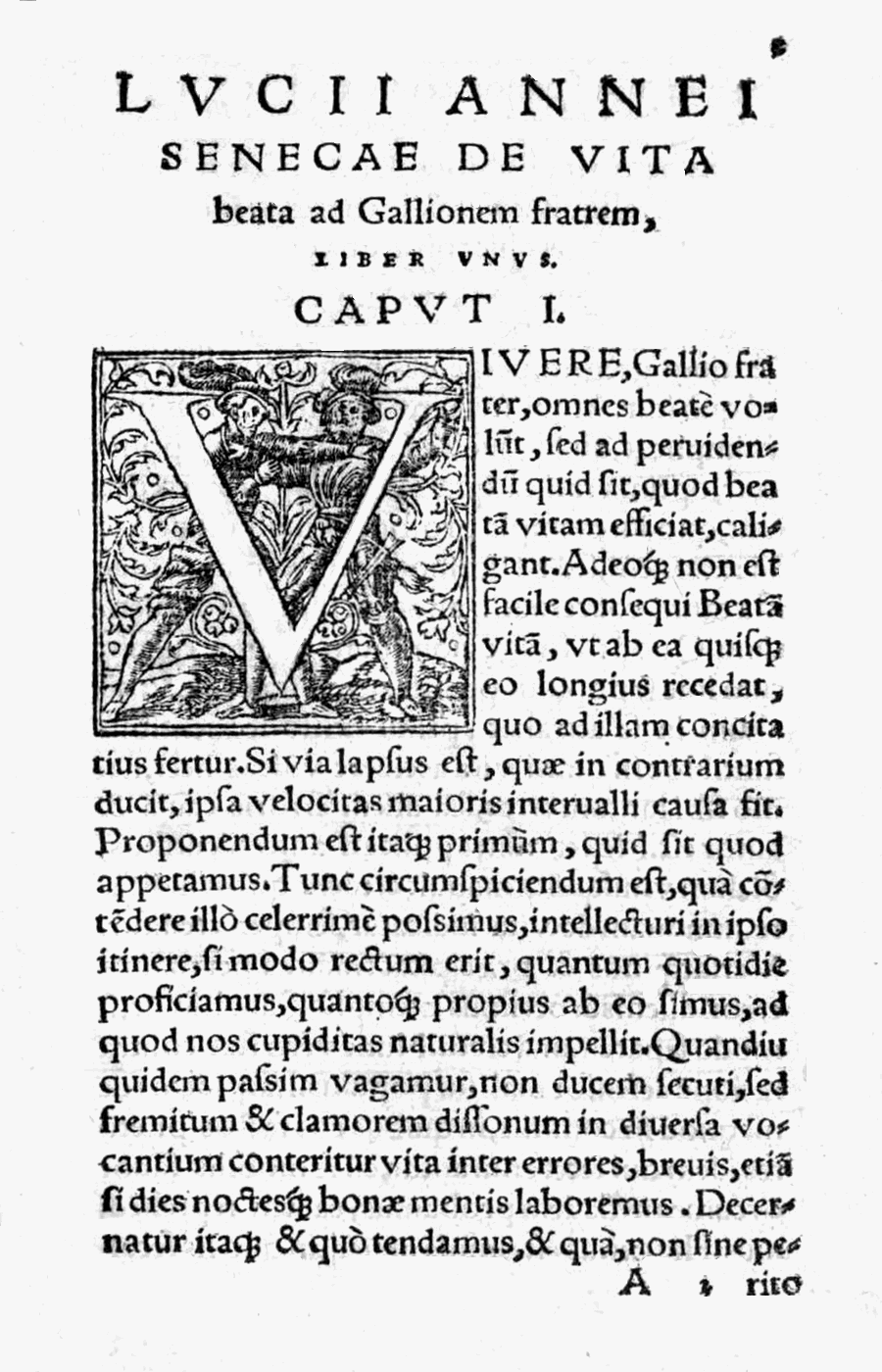
Title page of a printed 1543 edition of Seneca's De Vita Beata, showing the title in capitals, chapter heading CAPUT I, a decorative woodcut initial V with foliage and figures, and the opening lines of Latin text in black type on a white page.Book

Primary source

De Vita Beata

Seneca · c. 58 AD

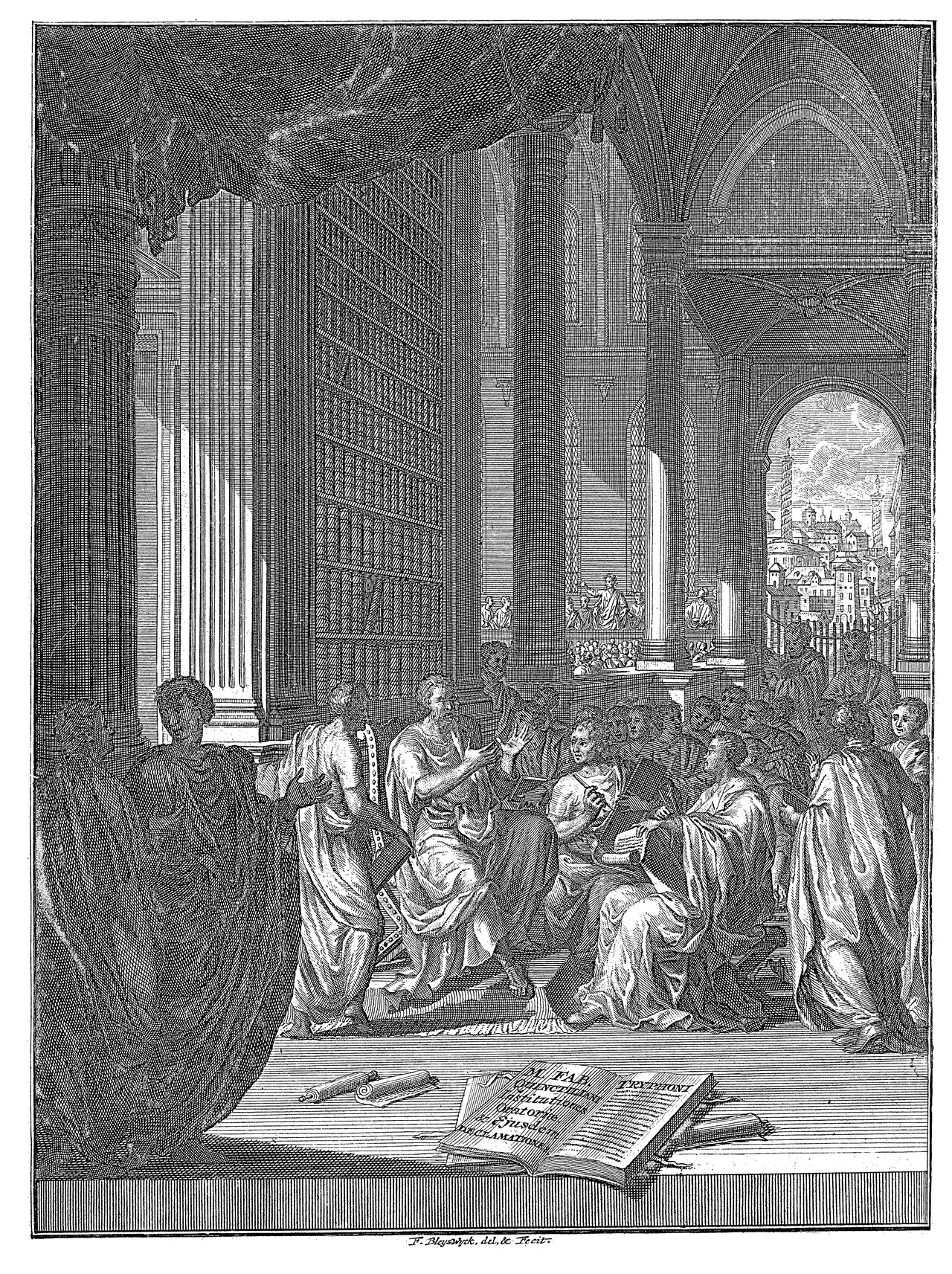
Engraved frontispiece of a book edition: a grand columned hall with bookshelves, a group of robed figures seated and standing in discussion, and an open book in the foreground with a title page inscription. An arched view shows a city outside.Book

Secondary source

Institutio Oratoria

Quintilian · c. 95 AD

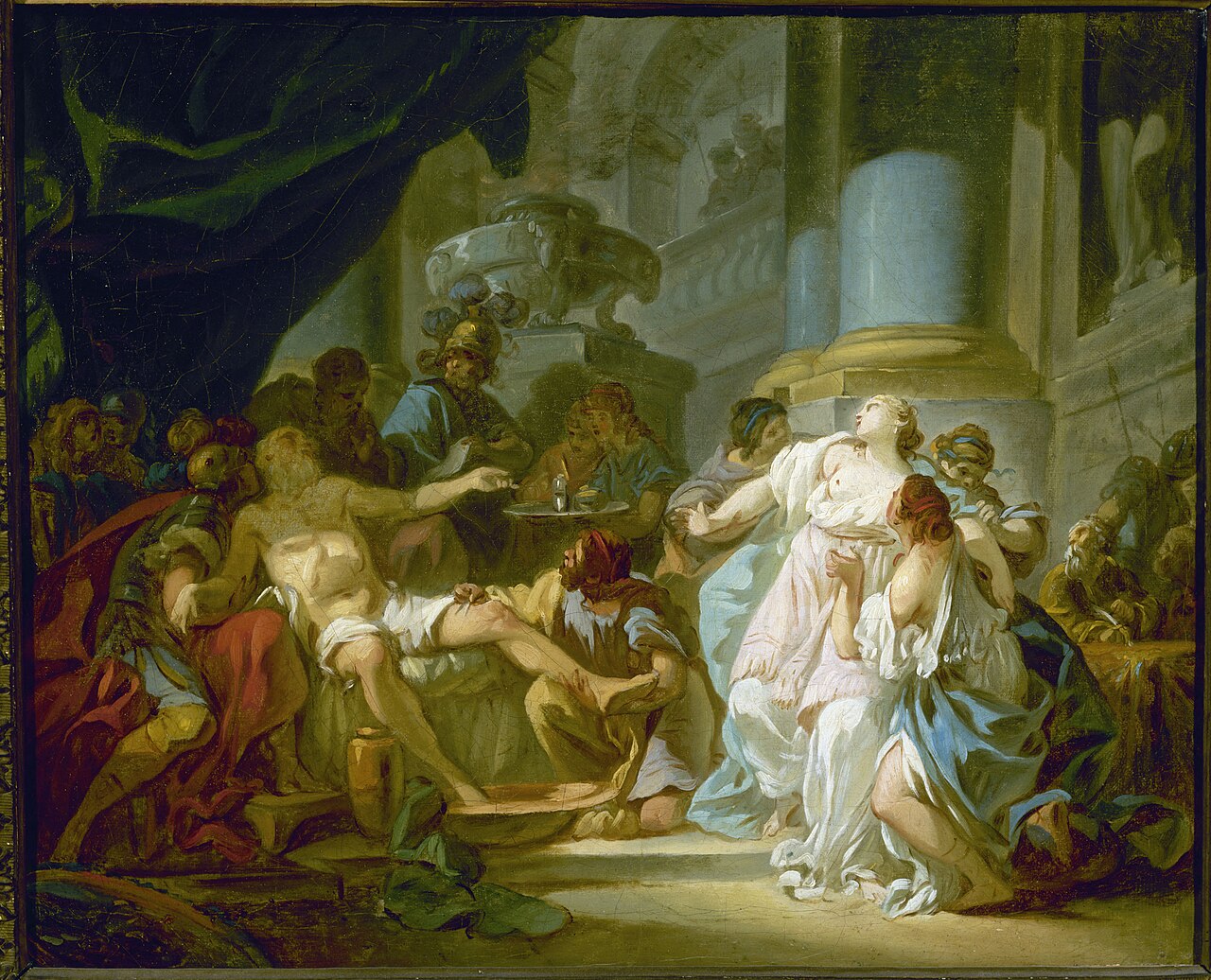
Painting of a classical scene: an elderly, partly undressed man lies propped on a bed or bench while a servant kneels and tends his leg above a basin. Seated and standing figures watch, and two women in white and blue drapery grieve in the right foreground beside a column.Painting

Secondary source

The Death of Seneca

Jacques-Louis David · 1773

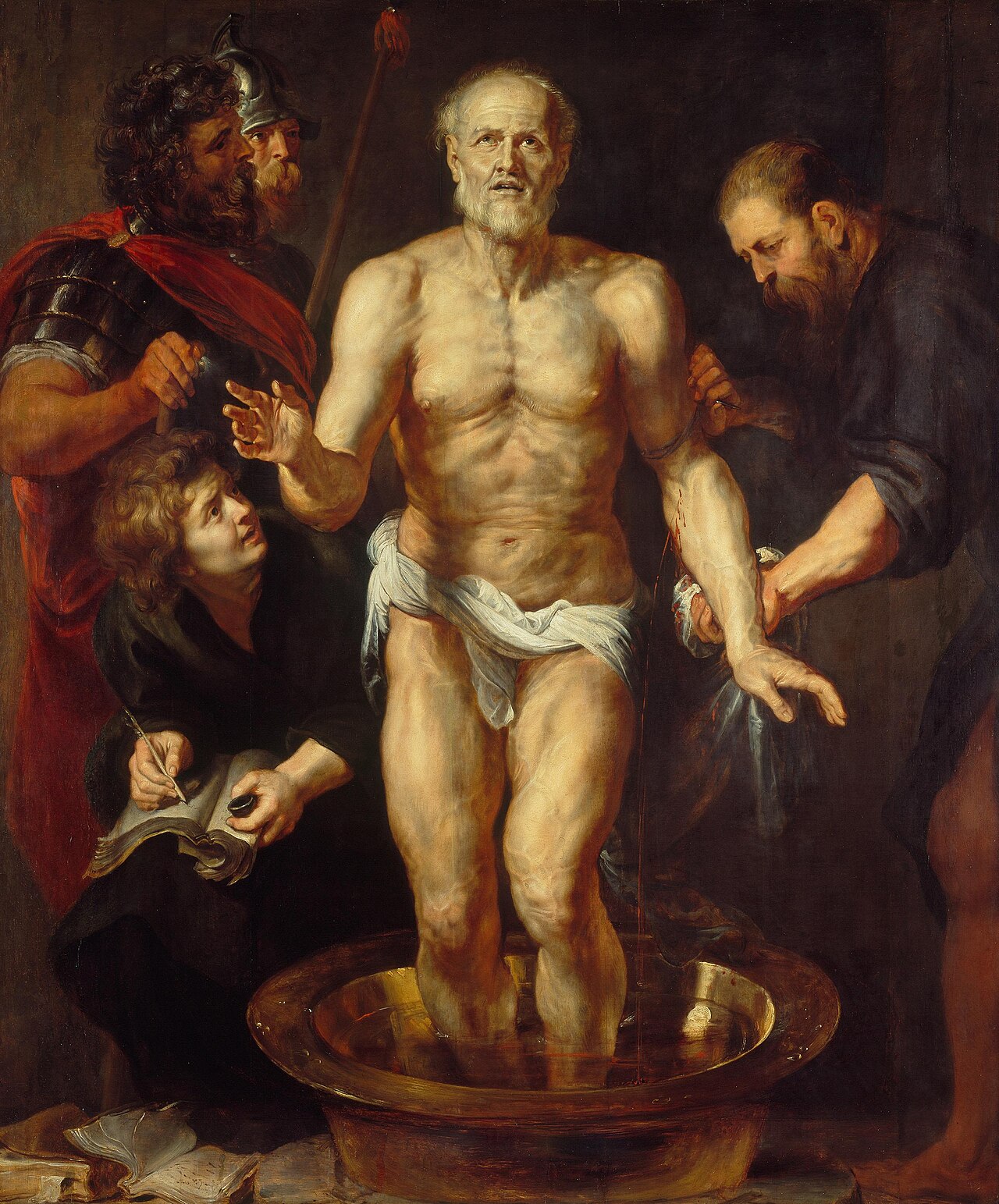
Painting of an elderly, nude bearded man standing in a bronze basin while his arm is cut and bleeds. Two armored soldiers stand behind him at left, and a young man sits at lower left writing in a book with a quill. A bearded man at right opens the vein.Painting

Secondary source

The Dying Seneca

Peter Paul Rubens · 1610

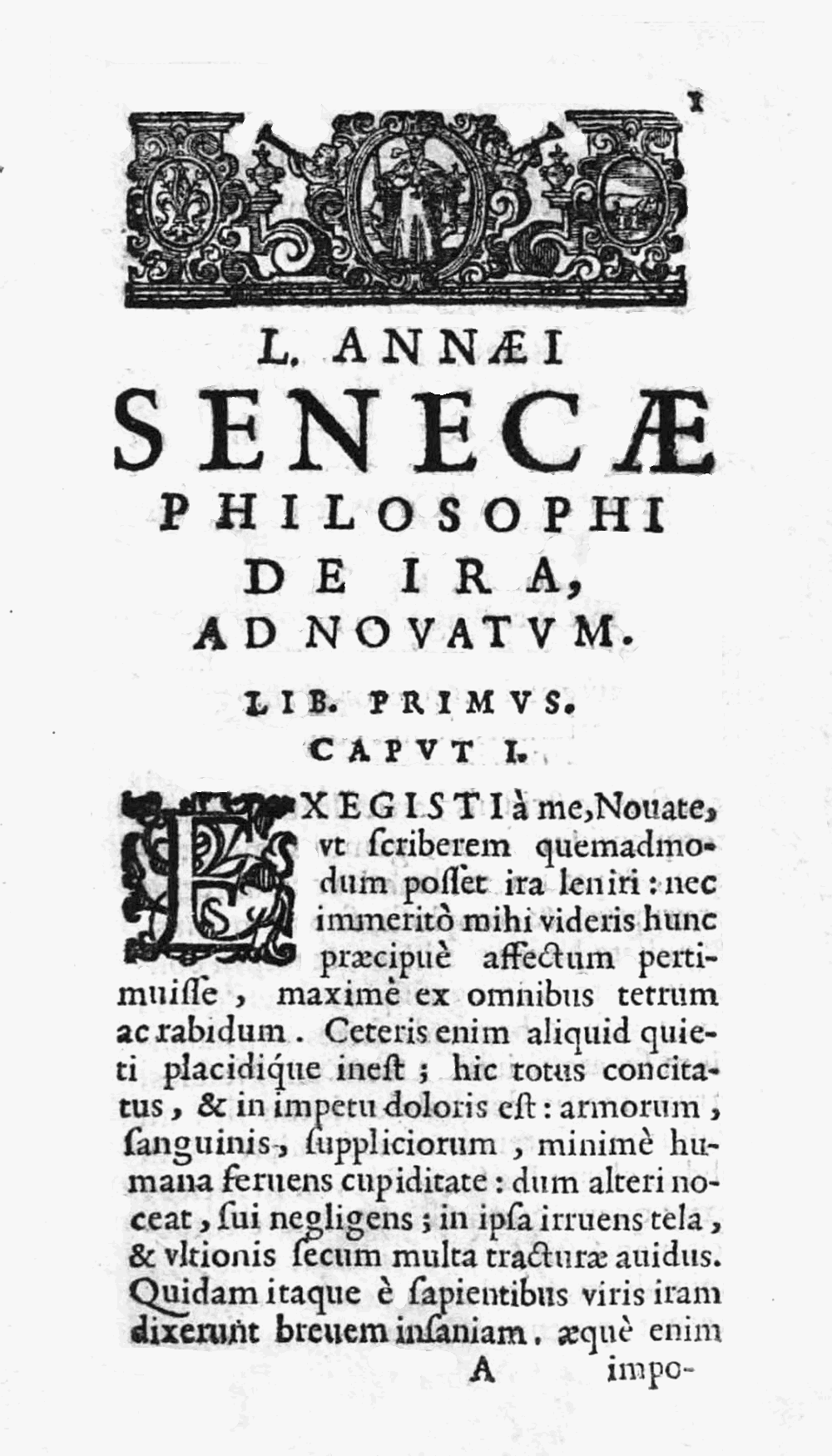
Title page and first page of Seneca's De Ira in a 1643 printed edition. Ornate woodcut header with a central figure, title 'L. Annaei Senecae philosophi De Ira, ad Novatum', 'Lib. Primus, Caput I', and a body of Latin text beginning with a decorated initial E.Book

Primary source

De ira

Seneca

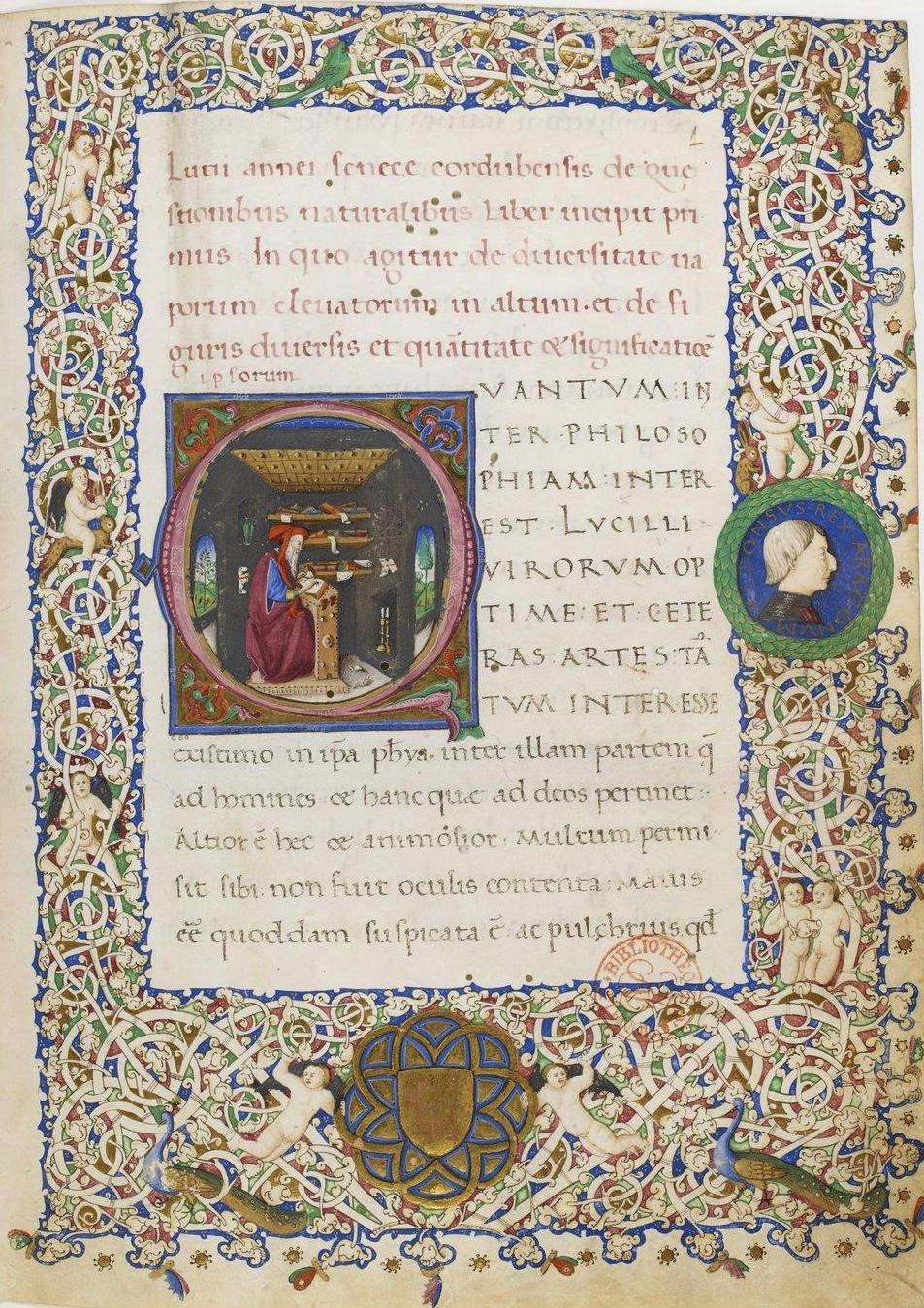
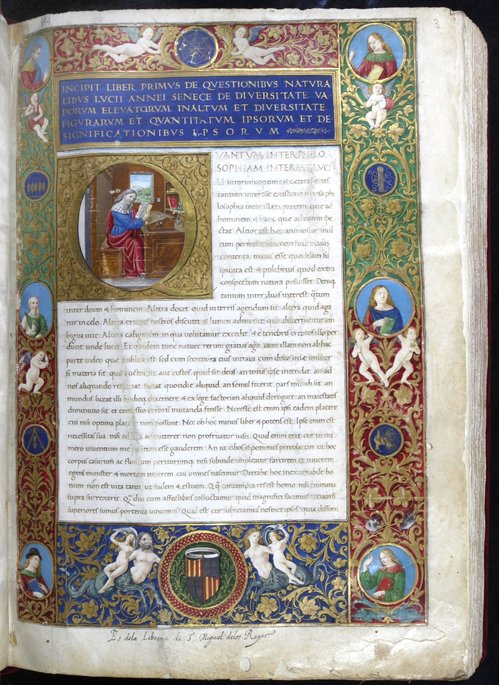
Illuminated manuscript page with a Latin text in red and black ink, surrounded by ornate blue, green, and gold borders with cherubs and birds. An illuminated initial shows a robed scholar at a desk in a study, and a roundel portrait of a man in profile sits at the right margin.Book

Primary source

Naturales quaestiones

Seneca · c. 60-65 AD

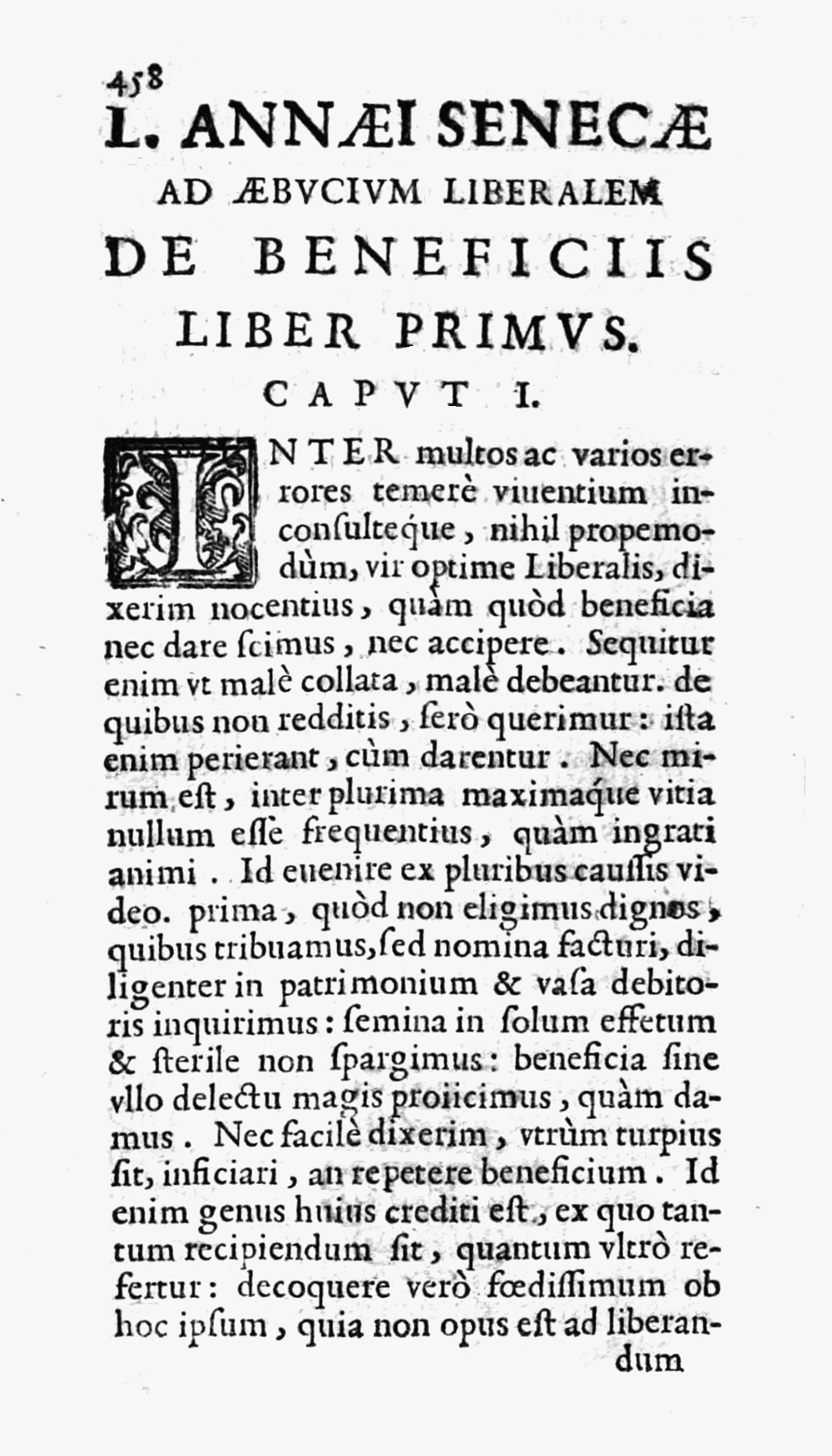
Scanned page 458 from a 1643 printed edition of Seneca's works, showing the title 'L. Annaei Senecae ad Aebucium Liberalem De Beneficiis Liber Primus', 'Caput I', and the opening Latin text beginning with a decorative initial 'I'.Book

Primary source

De Beneficiis

Seneca · c. 56-64 AD

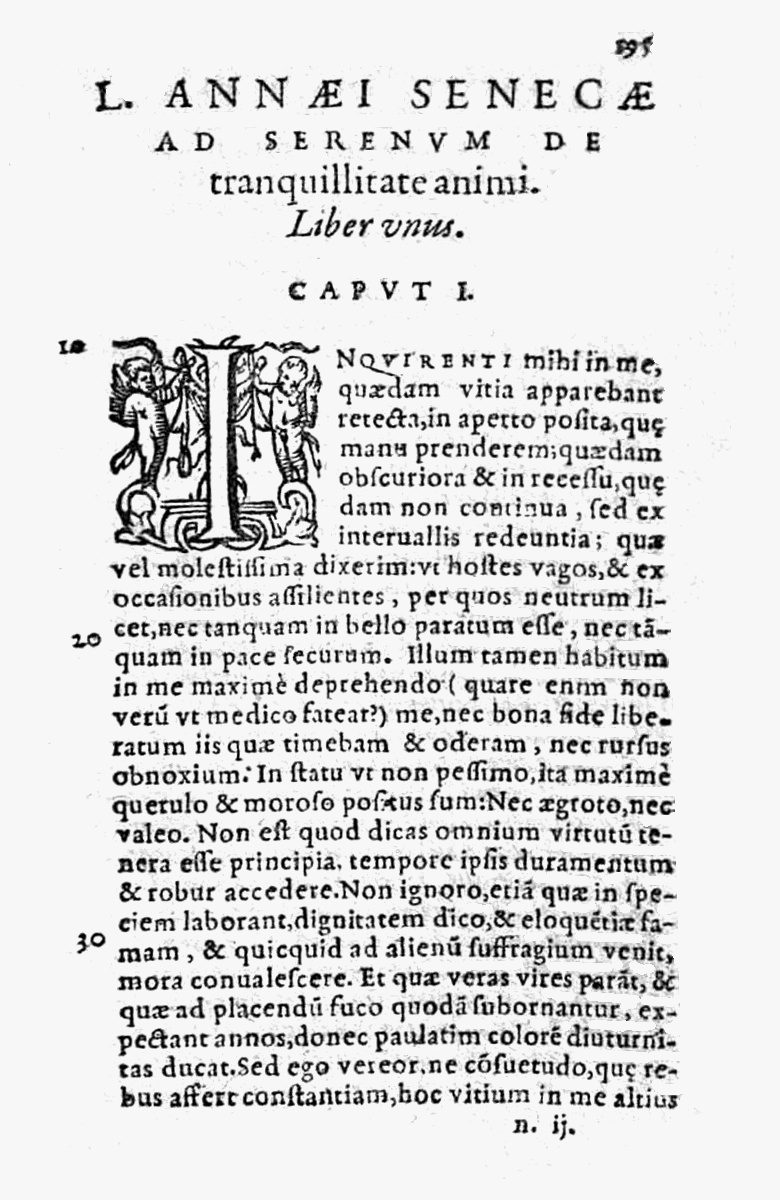
Printed page 395 from a 1594 edition of Seneca's works, headed 'L. Annaei Senecae ad Serenum de tranquillitate animi, Liber unus, Caput I', with a decorated initial letter and dense Latin text in black type.Book

Primary source

De tranquillitate animi

Seneca · c. 49-62 AD

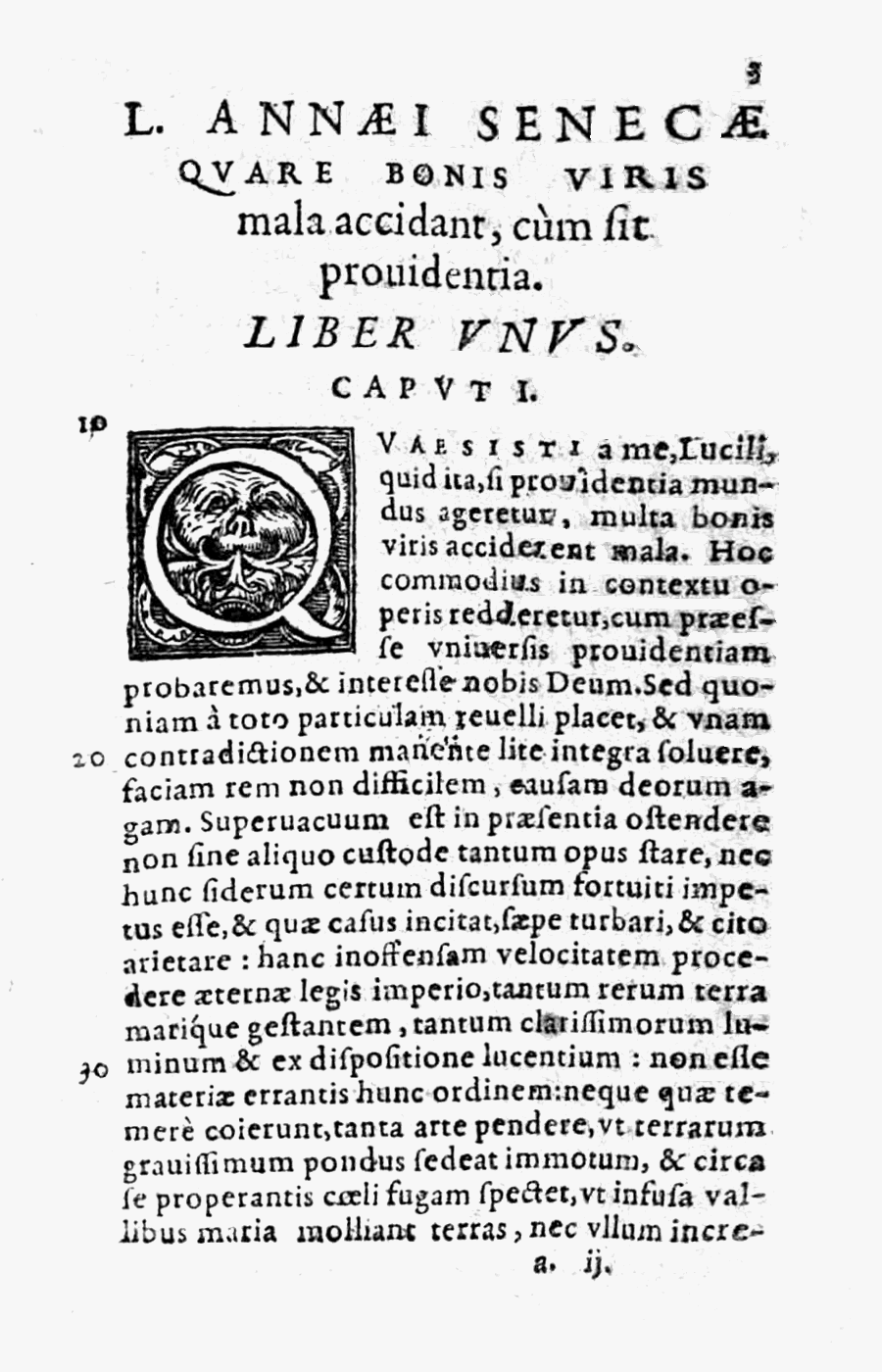
Printed page 3 from a 1594 edition of Seneca's works, headed 'L. Annaei Senecae, Quare bonis viris mala accidant, cum sit providentia', with 'Liber unus' and 'Caput I'. Opens with a decorative woodcut initial Q, followed by Latin body text in black type.Book

Primary source

De Providentia

Seneca · c. 64 AD

Letter

Primary source

To Polybius

Seneca

Letter

Primary source

To Marcia

Seneca

Book

Primary source

Phaedra

Seneca · before 54 AD

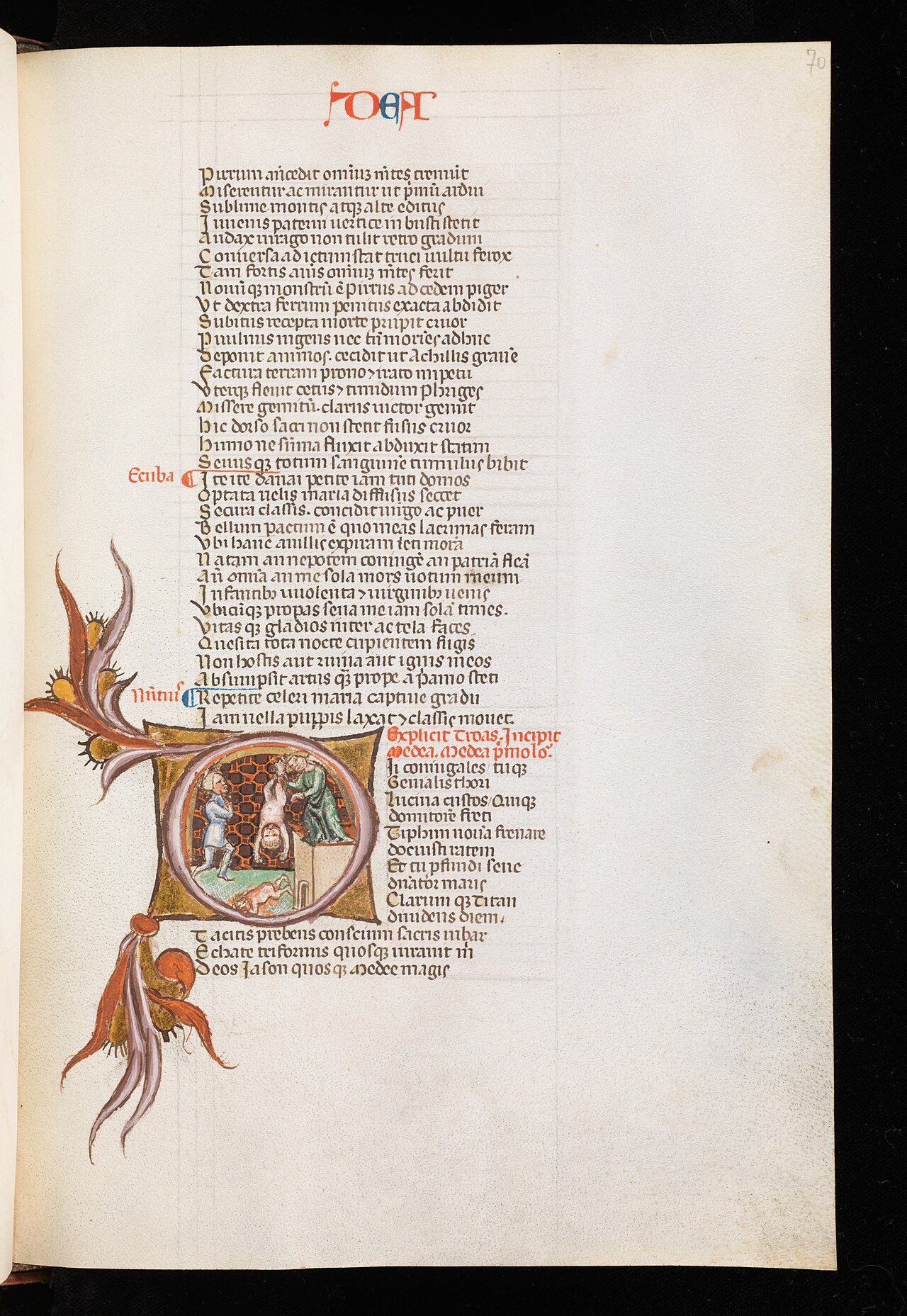
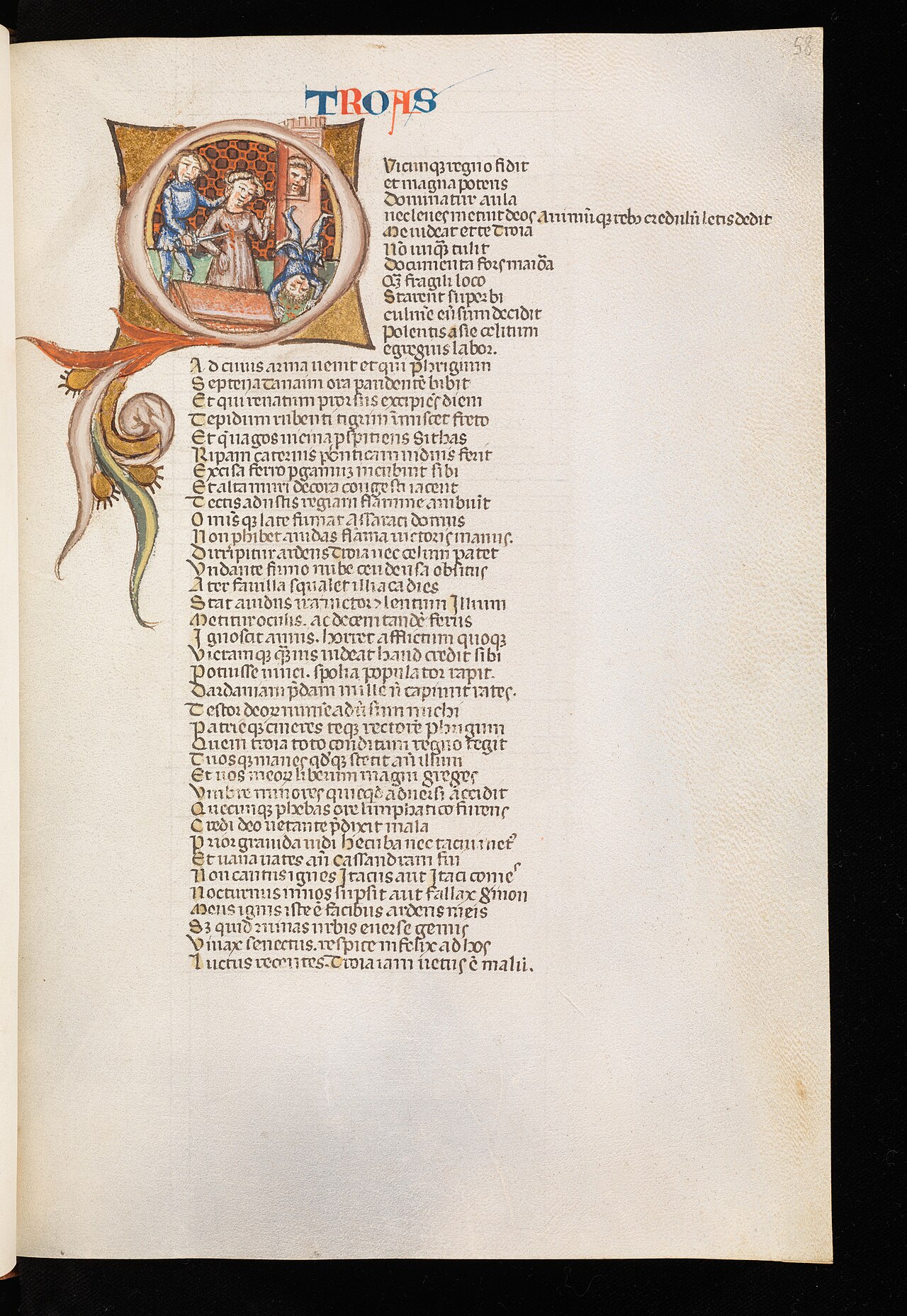
Manuscript page with the heading TROAS in blue and red, a large decorated initial O containing a painted miniature of figures in a room, and about 35 lines of dense black Latin text in columns.Book

Primary source

Troades

Seneca

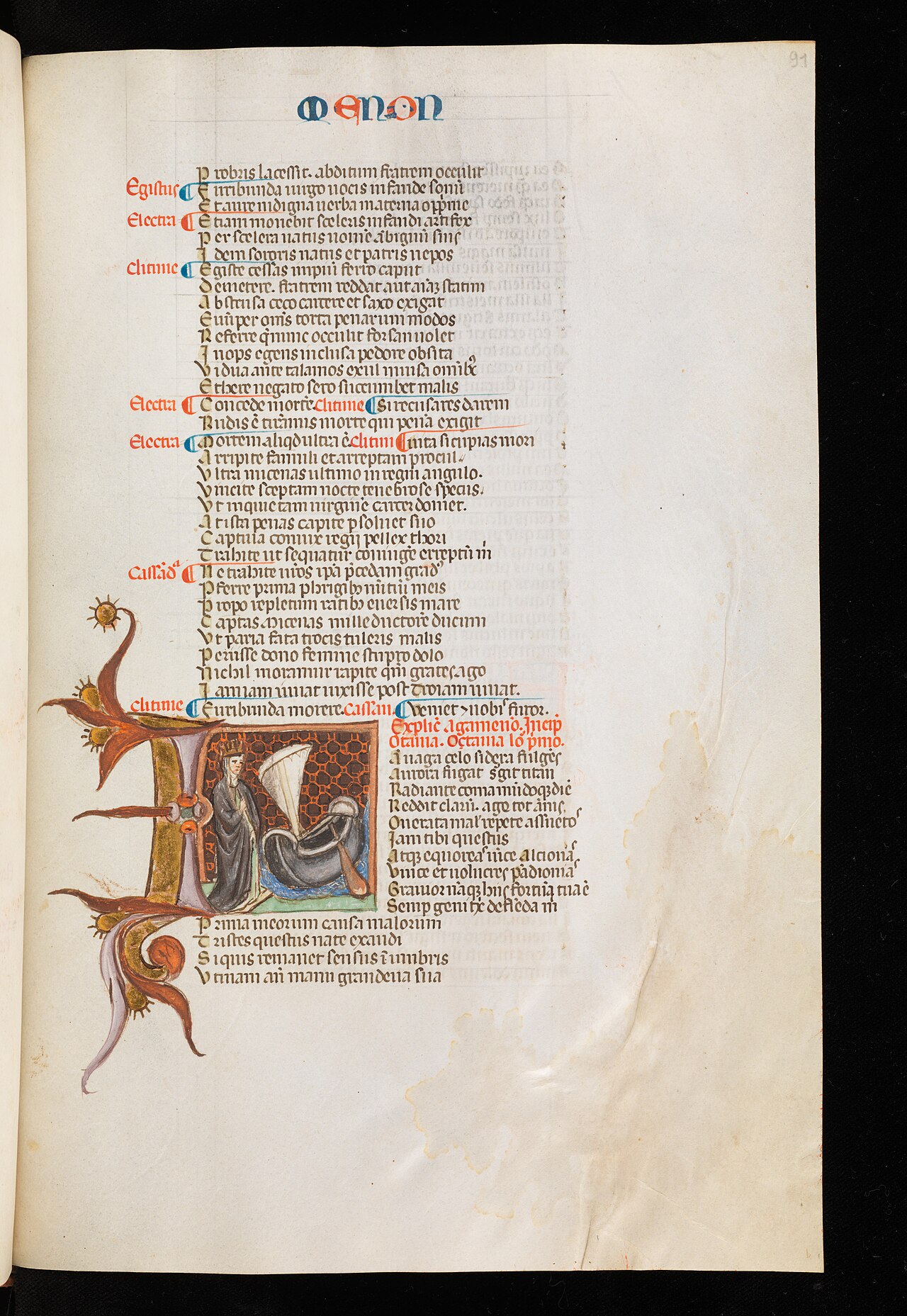
Manuscript page from a medieval codex with the heading 'Octavia' in red and blue ink, dense black-letter Latin text in columns, red and blue initials, and a small painted miniature of a seated figure in a dark robe beside a boat with a sail, set in a gold-decorated initial.Book

Secondary source

Octavia

Pseudo-Seneca

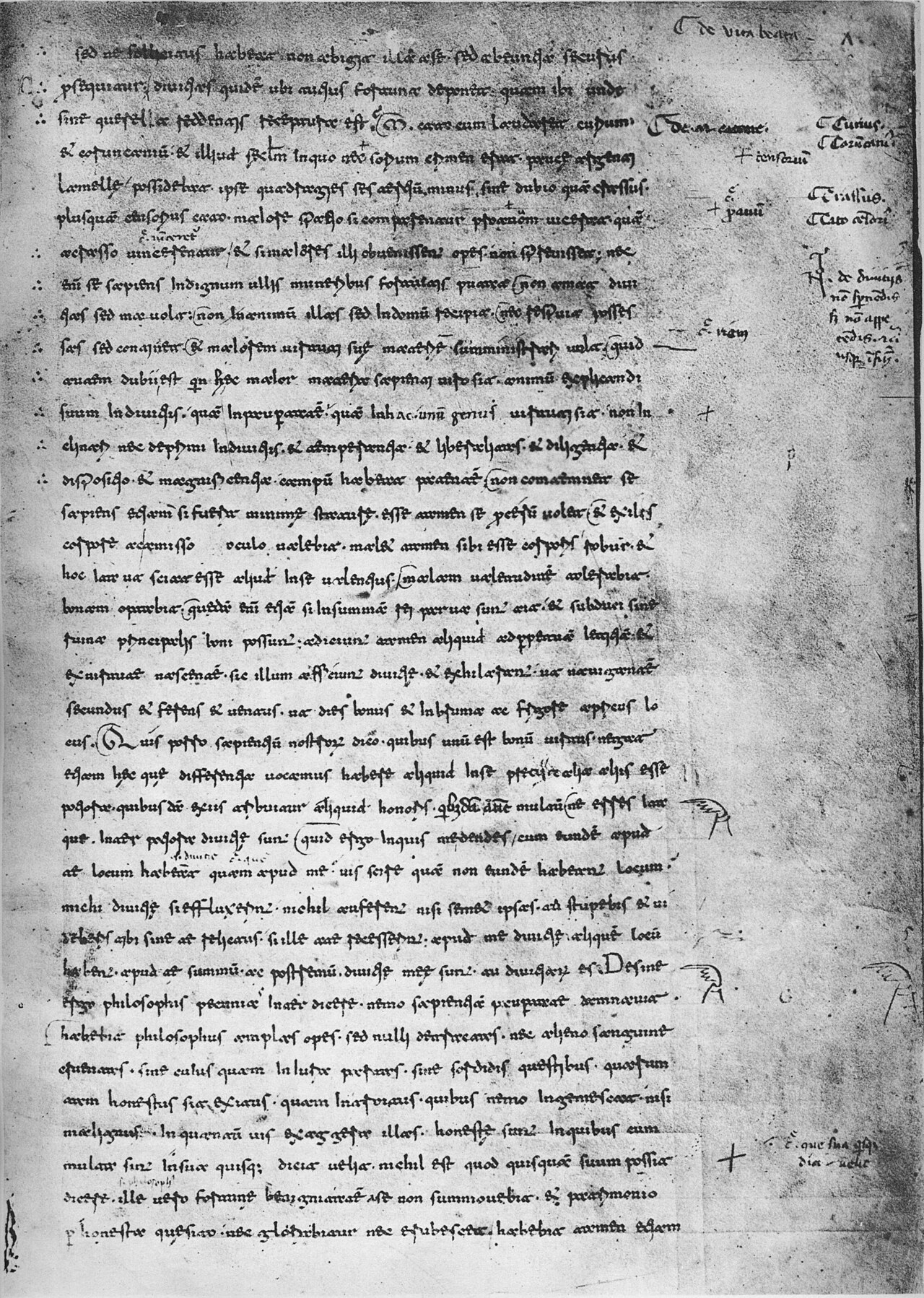
Black-and-white scan of a medieval manuscript page written in dense Latin script in brown-black ink, with marginal annotations and marks at the top right and along the right edge. The text is in long justified lines with some decorative initials and paragraph marks.Book

Secondary source

Seneca the Younger, Dialogues, Milano, C 90 inf

Seneca · 11th century

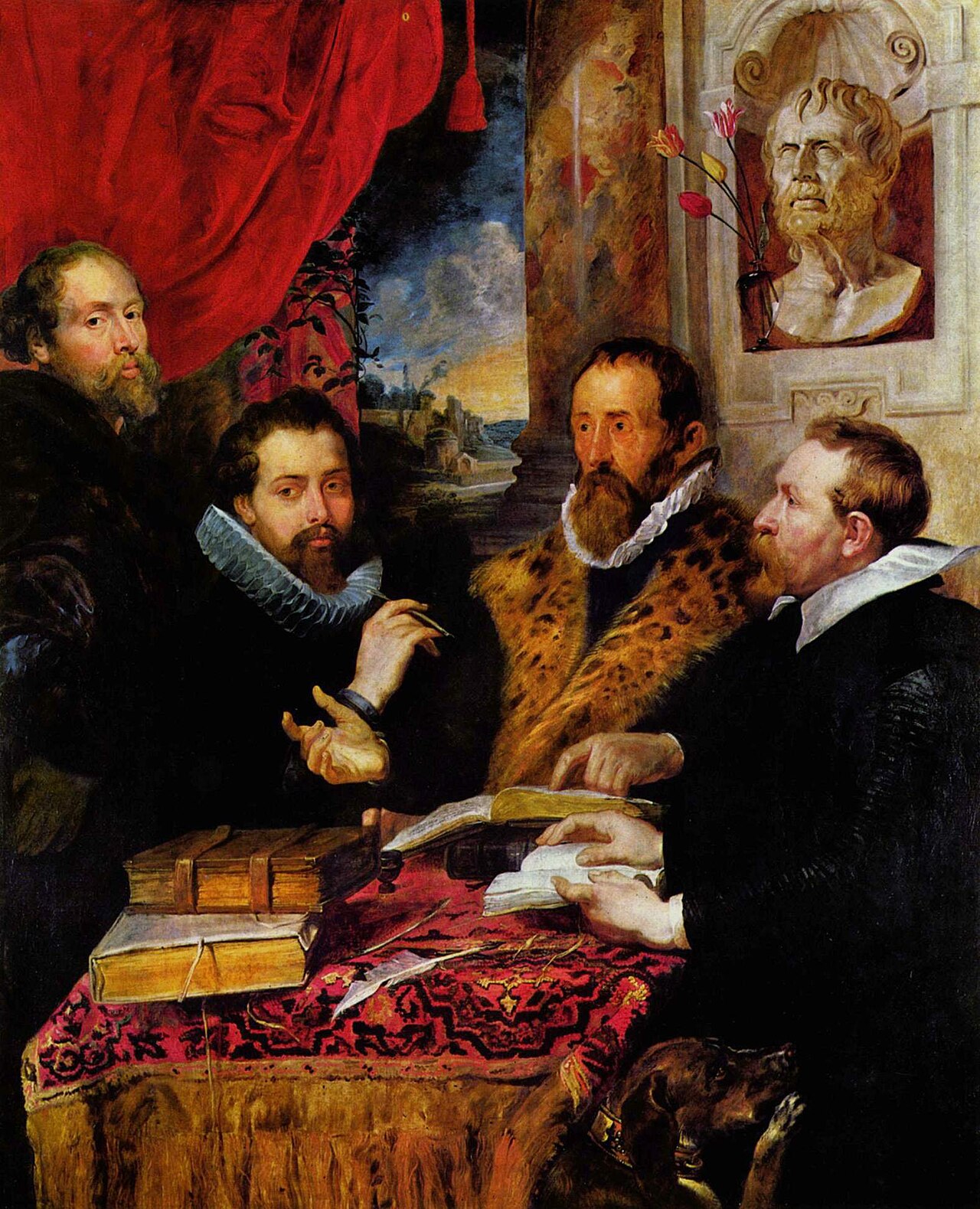
Painting of four bearded men in a study. From left: a man in a dark fur-trimmed cloak, a man in a dark coat with a large white ruff holding a pen, an older man in a fur-collared golden-brown robe with a white ruff, and a man in a dark coat with a white collar at right, seated at a table covered with red cloth, books, and quill pens. A marble bust of a bearded man stands in a niche behind them, a red curtain hangs at left, and a landscape with a tower appears at center. A dark dog sits at lower right.Painting

Secondary source

The Four Philosophers

Peter Paul Rubens · 1611-1612

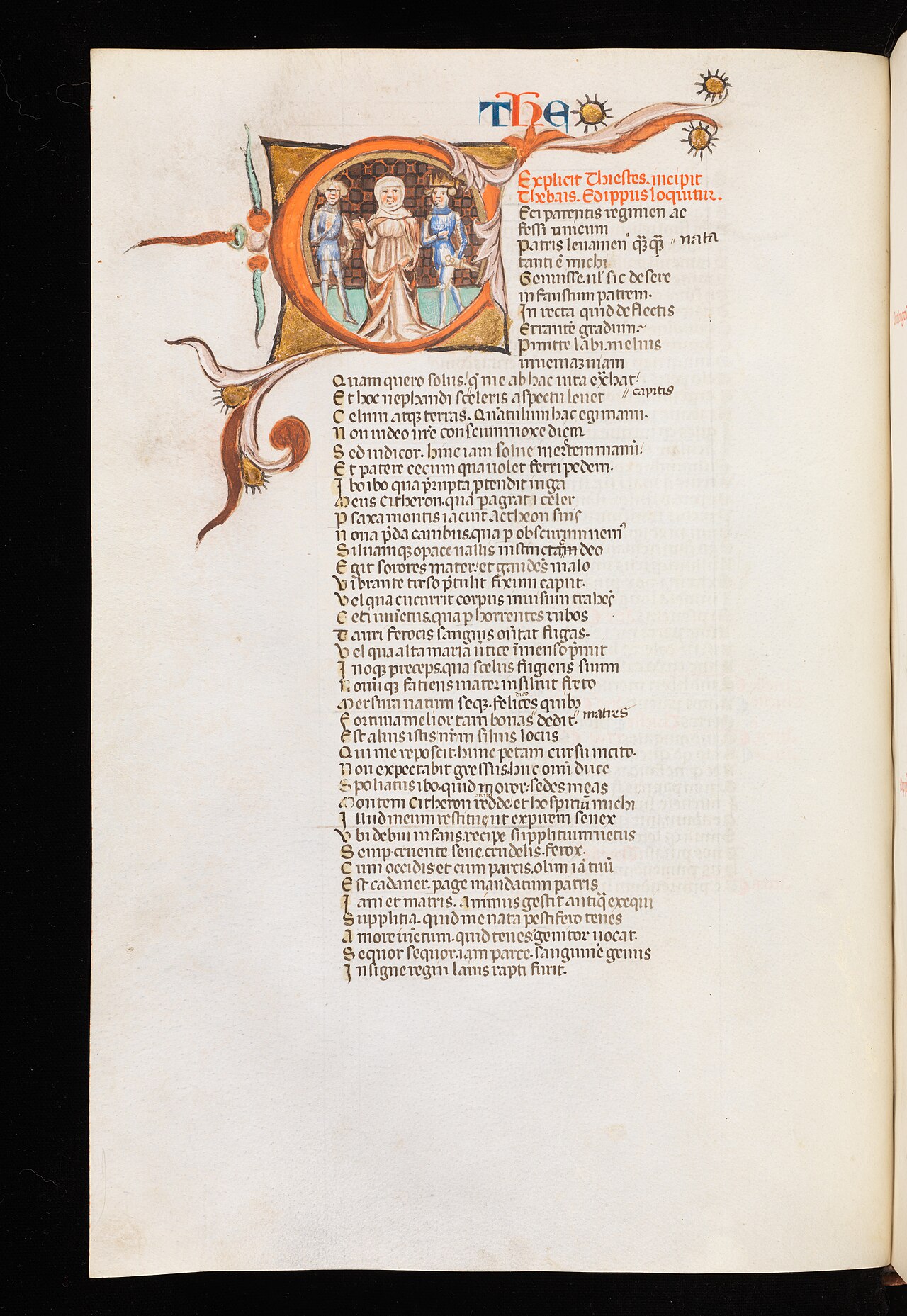
Manuscript page from a medieval codex with dense black Latin text in columns, red and blue rubrics at the top reading a heading, and a large decorated initial letter containing a painted scene of three figures in blue and white robes standing before a brick-patterned background, with gold and red ornament and sun-like decorations in the upper margin.Book

Primary source

Phoenissae

Seneca · 1st century CE (manuscript copy 15th century)

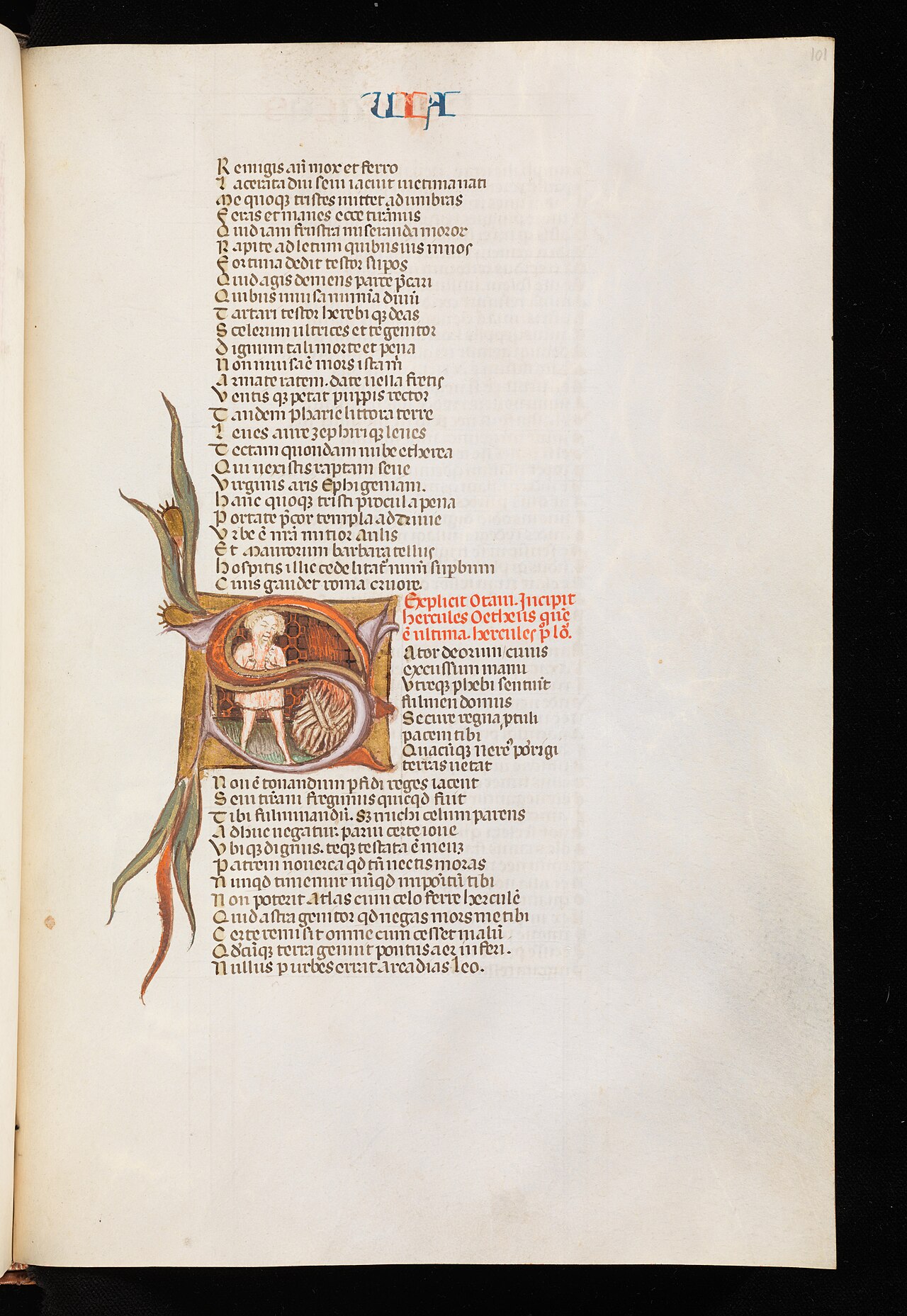
Manuscript page of medieval Latin verse in black text with red rubrics, showing the opening of Seneca's Hercules Oetaeus. A large decorated initial letter contains a small painted figure, a naked man with a club-like object and a lion skin, beside a painted scene. Page number 101 is in the top right corner.Book

Secondary source

Hercules Oetaeus

Seneca (disputed) · 1st century CE (disputed), manuscript copy 15th century

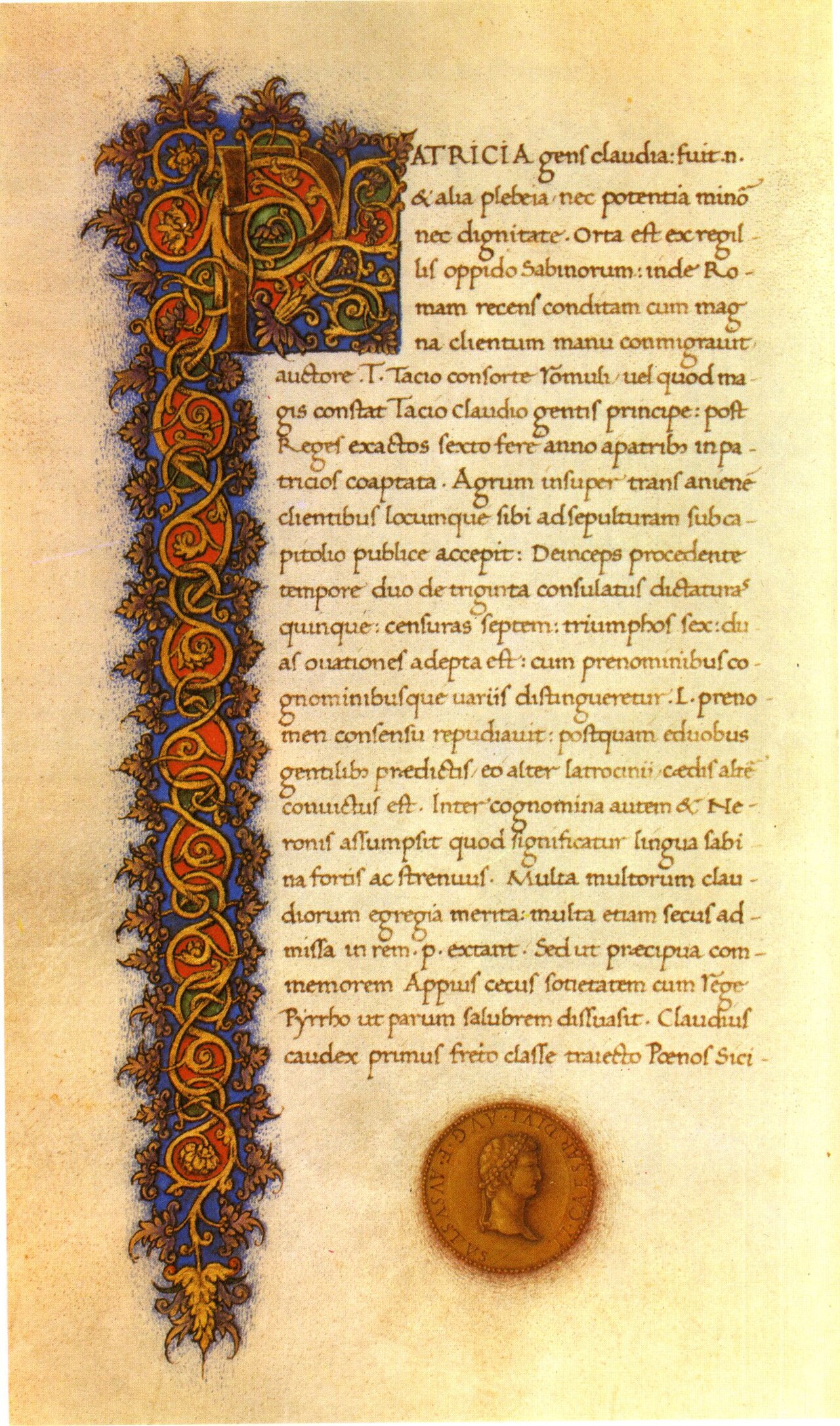
Illuminated manuscript page with a large decorated initial letter P in blue, red, green and gold, with a vertical border of gold scrollwork and foliage. Handwritten Latin text in brown ink fills the page, with a gold-toned medallion portrait of a man in profile at the bottom.Book

Secondary source

The Twelve Caesars

Suetonius · 121 AD

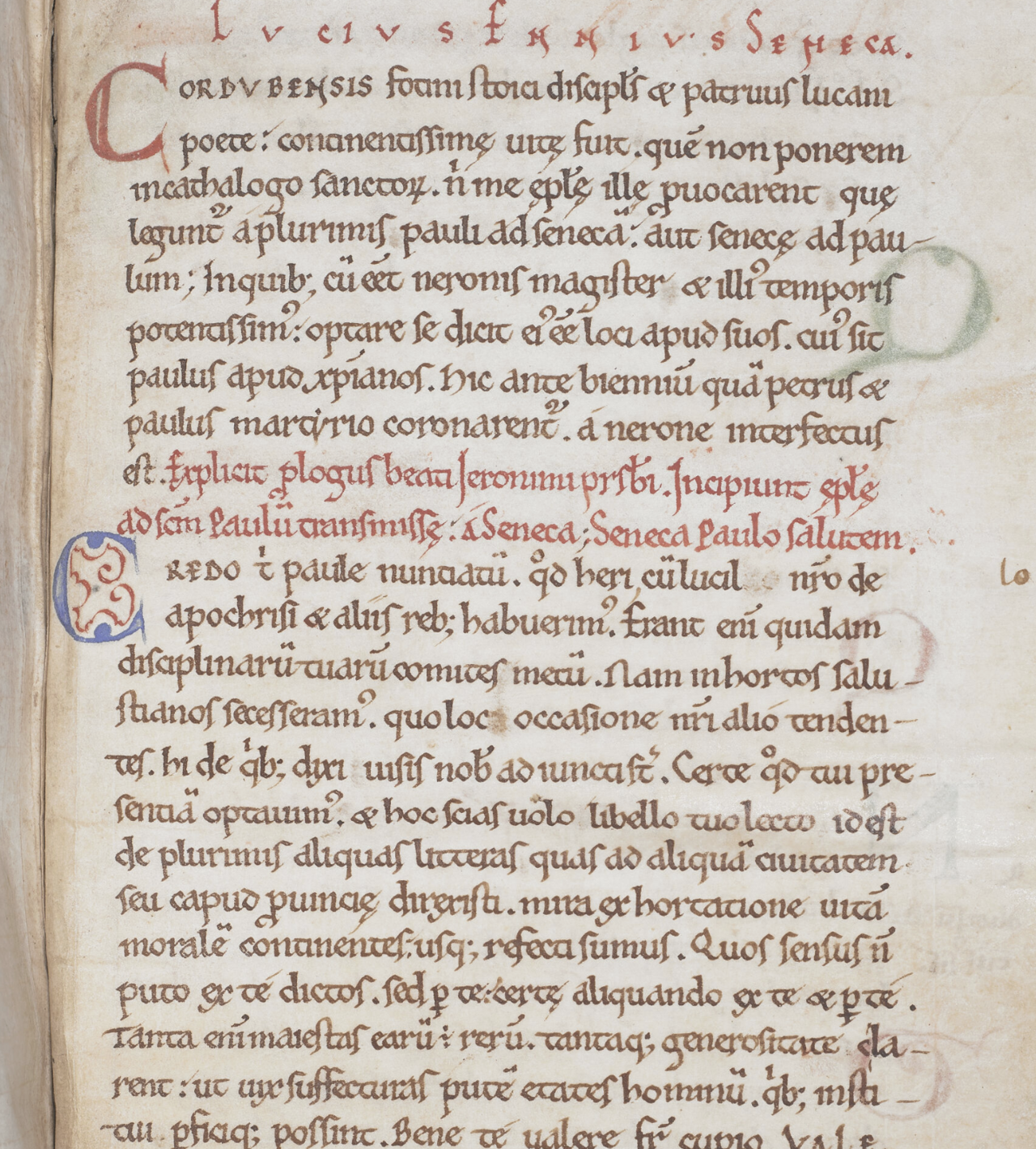
Manuscript page in Latin with red rubrics and black text in a cursive hand, with decorated initial letters. Red heading at top reads 'Lucius Annaeus Seneca', followed by text about Cordubensis and the letter exchange, and a red line reading 'Seneca Paulo salutem' near the middle of the page.Letter

Secondary source

Correspondence of Paul and Seneca

c. 320-380 CE

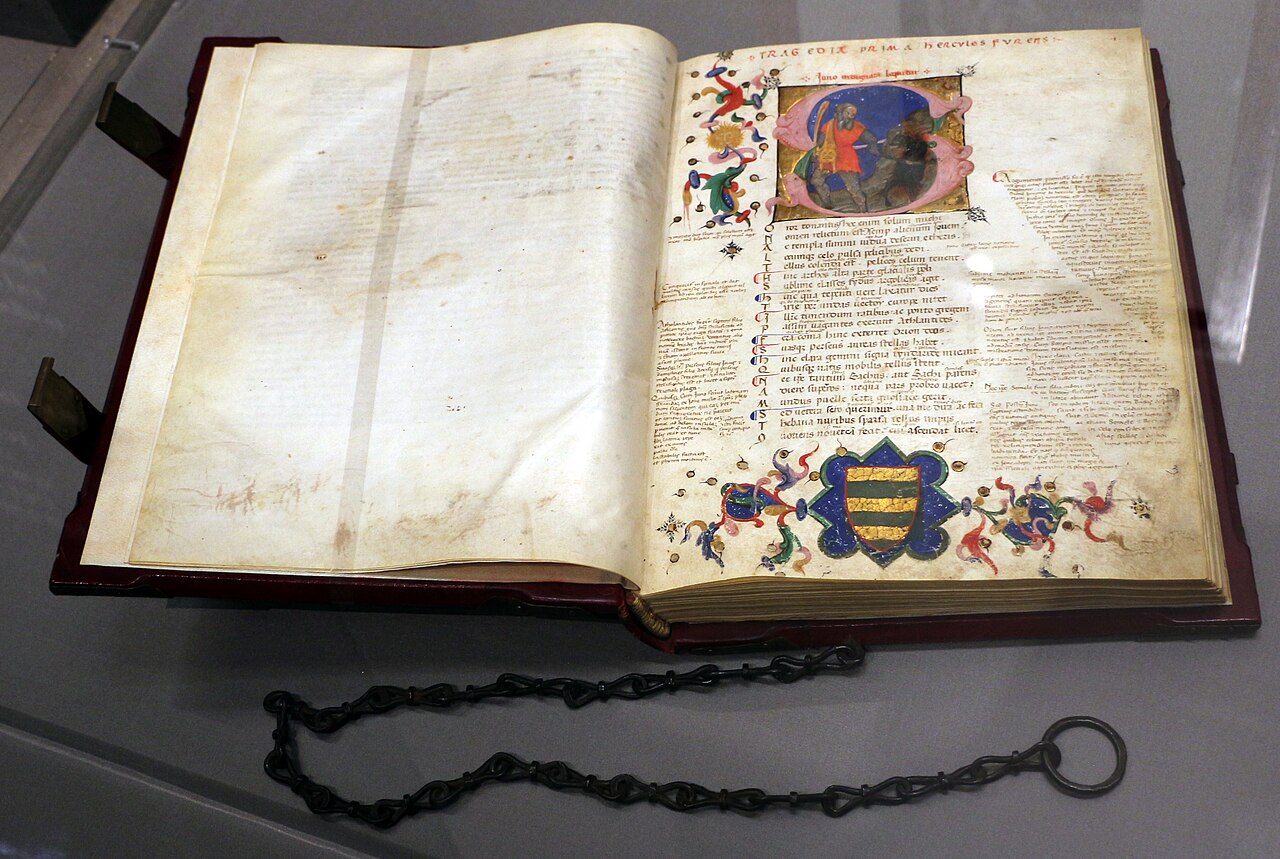
An open illuminated manuscript of Seneca's tragedies lies on a display stand with a red leather binding and an iron chain attached. The right page has a decorated initial with a painting of Hercules dragging Cerberus, a coat of arms with gold stripes on blue, and colorful marginal decoration.Book

Secondary source

Illuminated Manuscript of Seneca's Tragedies

Seneca (text); unknown Bolognese illuminator · c. 1390

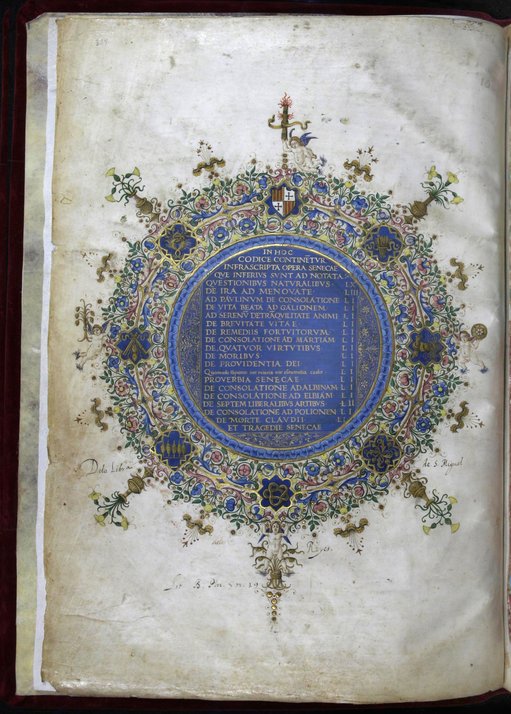
Illuminated manuscript page with a circular gold and coloured decorative border of flowers, branches and emblems, with a coat of arms at the top. Inside the border is a blue panel with gold-lettered Latin text listing the contents of the codex, including works by Seneca such as Proverbia and Tragedies. Ornate gilded and painted decoration surrounds the page on cream parchment.Book

Secondary source

Opera Senecae

Piero Strozzi · 15th century

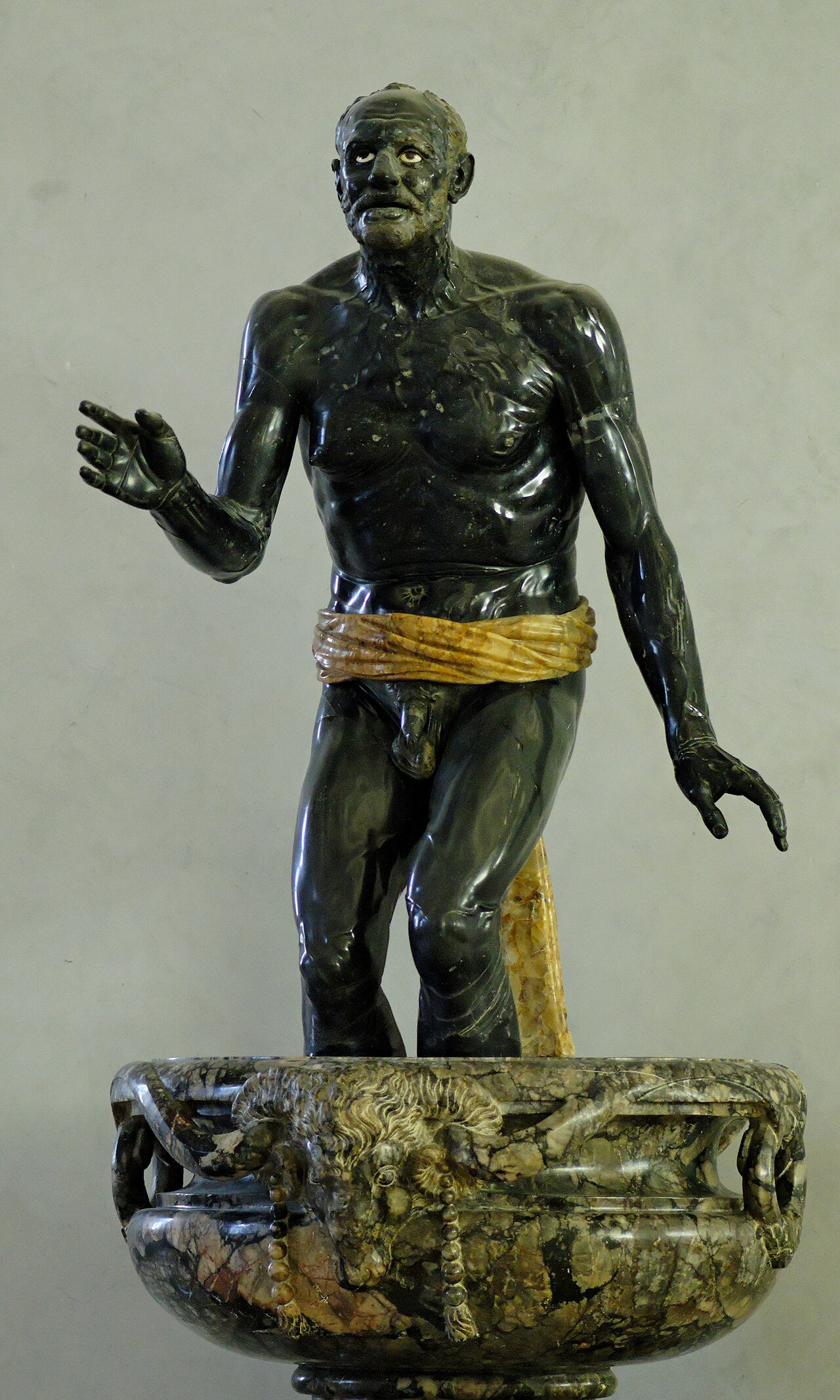
Bronze-dark stone statue of a thin, aged nude man with a bald head, wrinkled face, and open raised left hand, wearing a yellow-and-pink draped cloth around his hips. He stands in a marble basin decorated with a carved ram or lion head and garlands.Sculpture

Tertiary source

The Old Fisherman

c. 200 CE

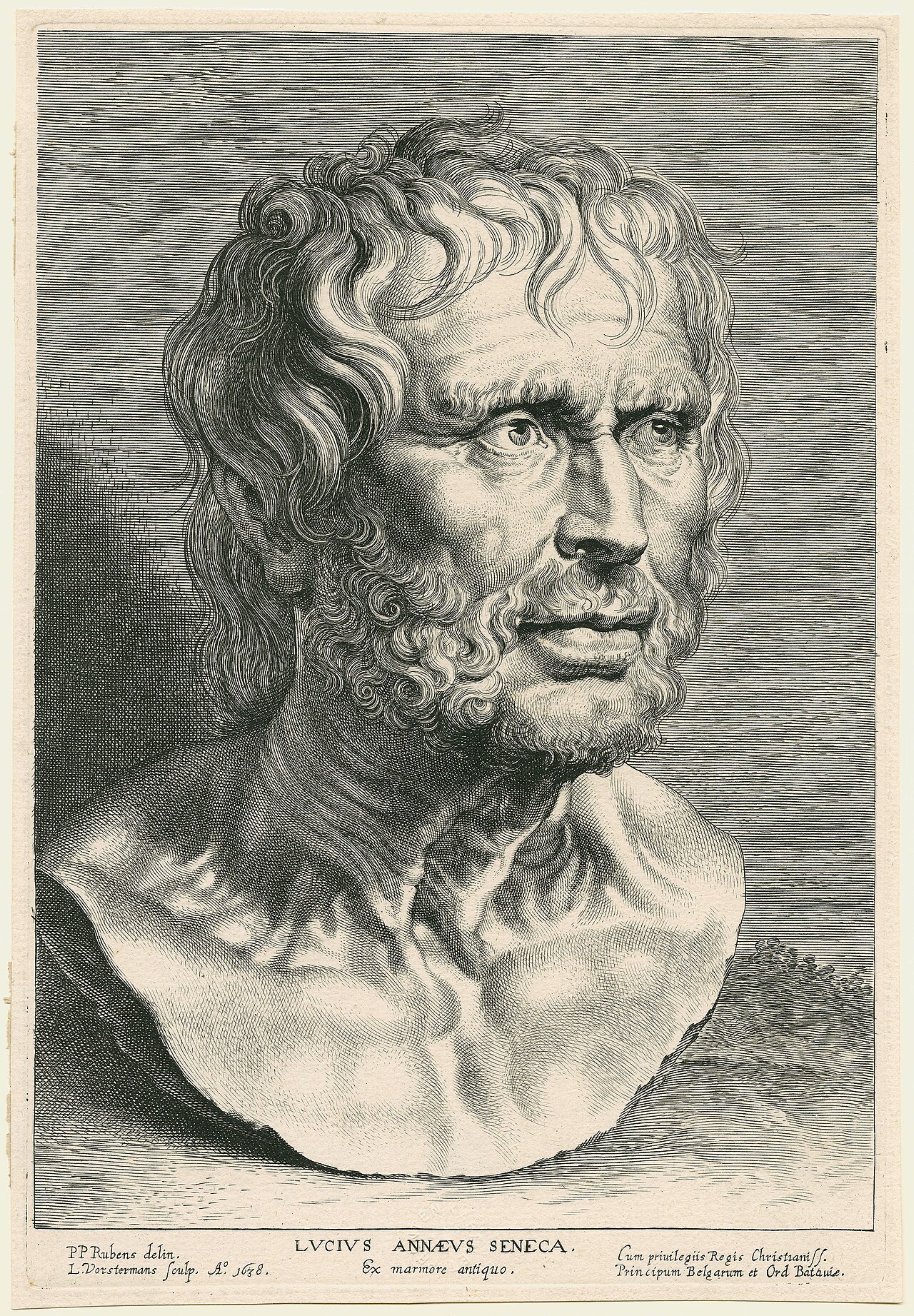
Engraved print of a bearded marble bust of Lucius Annaeus Seneca, with wavy hair and curled beard, shown from the front and turned slightly to the right. Caption reads 'LUCIVS ANNAEVS SENECA' with artist credits below.Painting

Secondary source

Buste van Seneca

Lucas Vorsterman the Elder · 1638

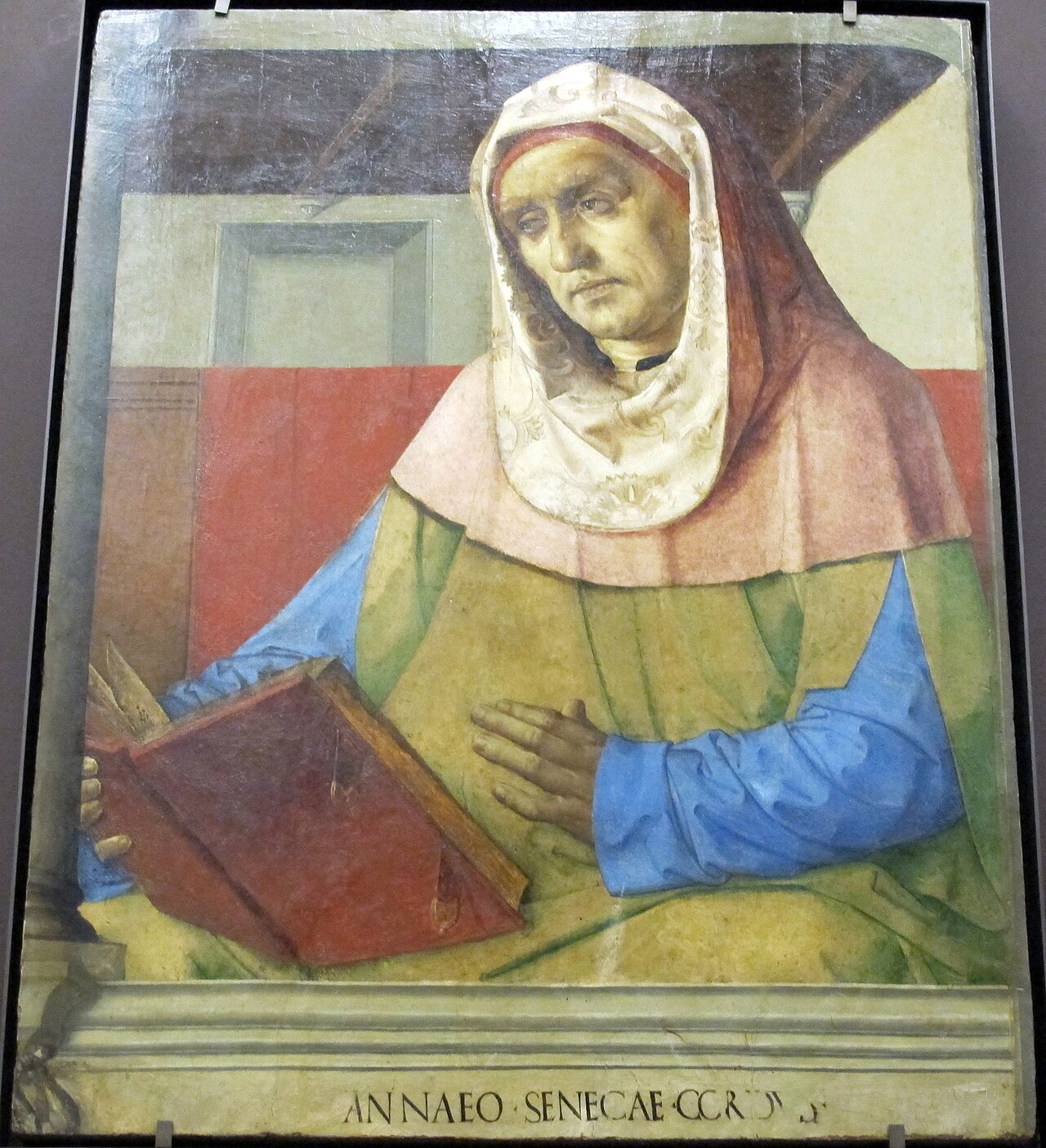
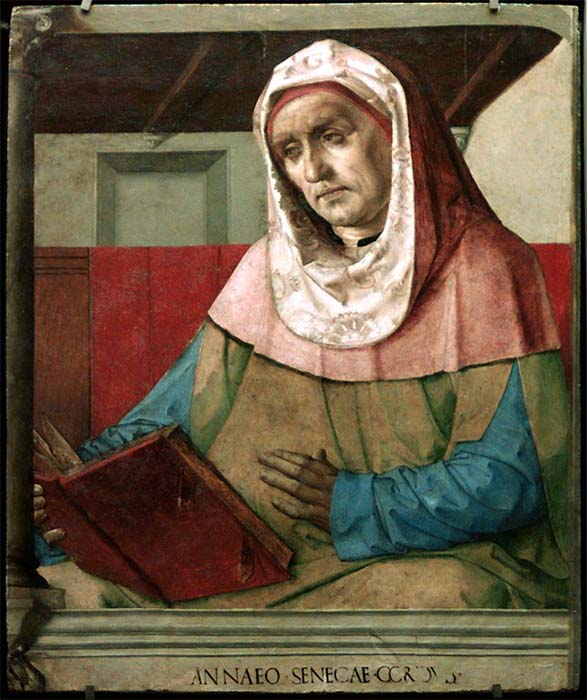
Painting of an elderly figure in a white headscarf and rose-pink hood, with a red-brown book held in the left hand and hands clasped over the chest. Blue sleeves, a green robe, and a dark wall behind. Inscription along the bottom edge reads 'ANNAEO SENECAE CORD'.Painting

Secondary source

Seneca

Justus van Gent · 1476

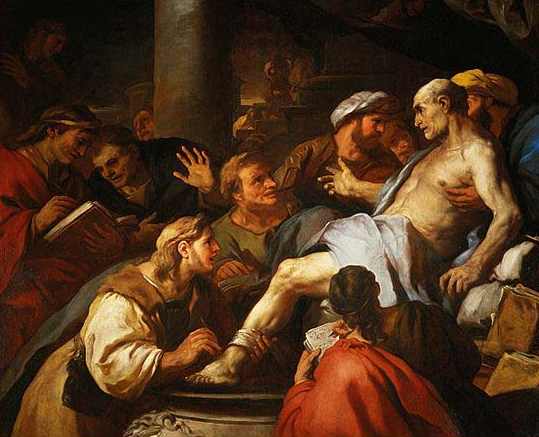
Detail of a painting of an elderly, pale, bald man with a white cloth around his waist, reclining with his arm extended while a woman in white kneels at his feet tying a bandage on his leg. Other figures in red, blue, and green robes gather around, some reading from a book, and a stone column stands behind them in dim light.Painting

Secondary source

Death of Seneca

Luca Giordano · 1684

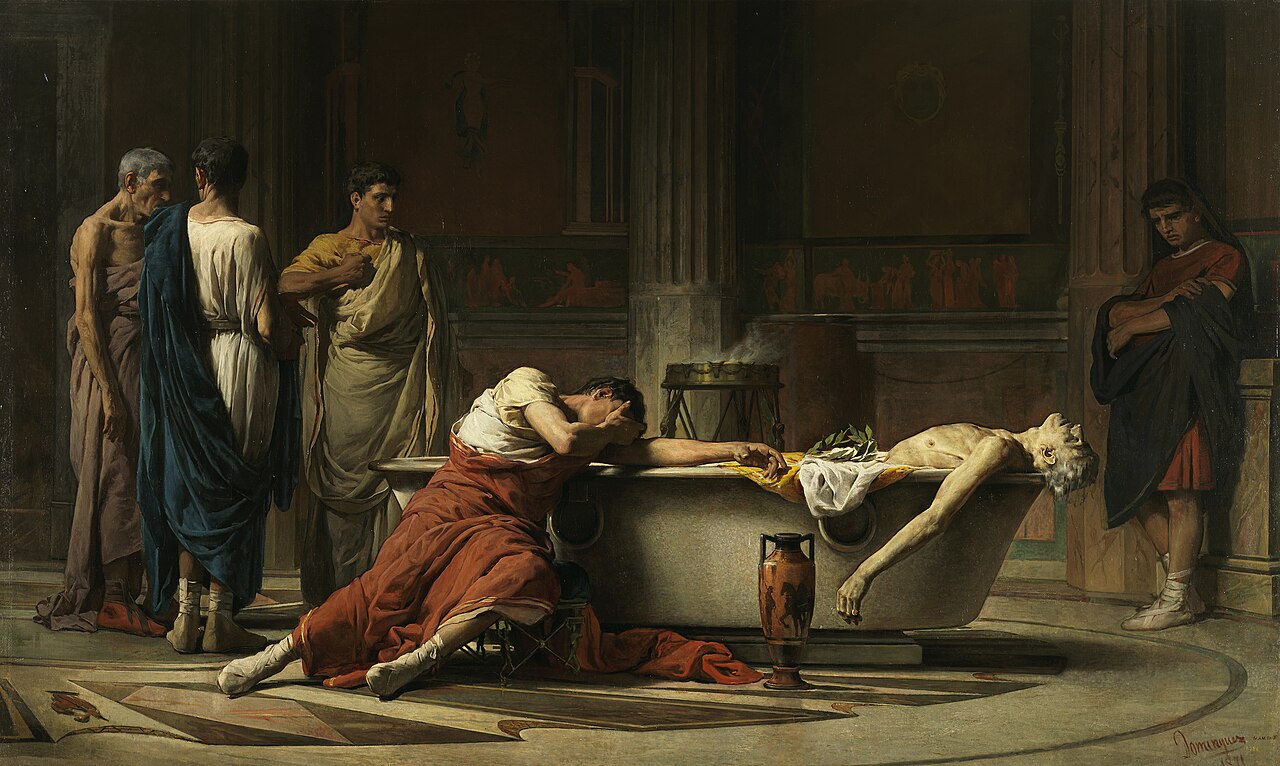
Painting of an ancient Roman interior with marble columns and a tiled floor. In the center, a nude elderly man lies in a bathtub with his arm hanging over the side. A man in a red robe kneels beside the tub, head bowed in grief. Four other men stand at left and right, one in a blue cloak and one in a yellow tunic, and a young servant in red stands at far right.Painting

Secondary source

The Death of Seneca

Manuel Domínguez Sánchez · 1871

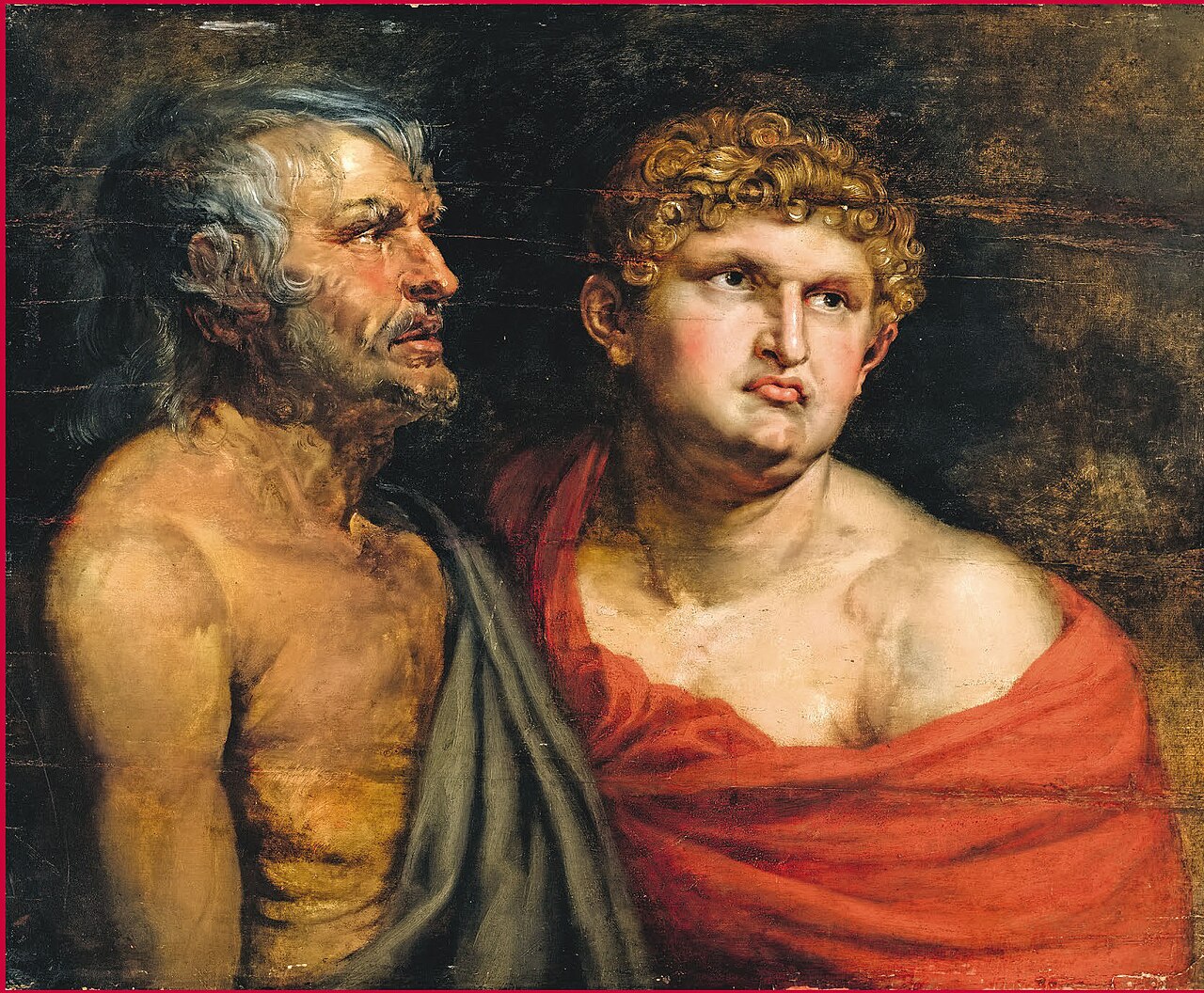
Painting of two men in half-length view against a dark background. On the left, an older bearded man with grey hair, shirtless and wearing a grey cloth, looks to the left. On the right, a younger man with curly golden hair, wrapped in a red drape, pouts and looks upward.Painting

Secondary source

Seneca and Nero

Peter Paul Rubens · 1617

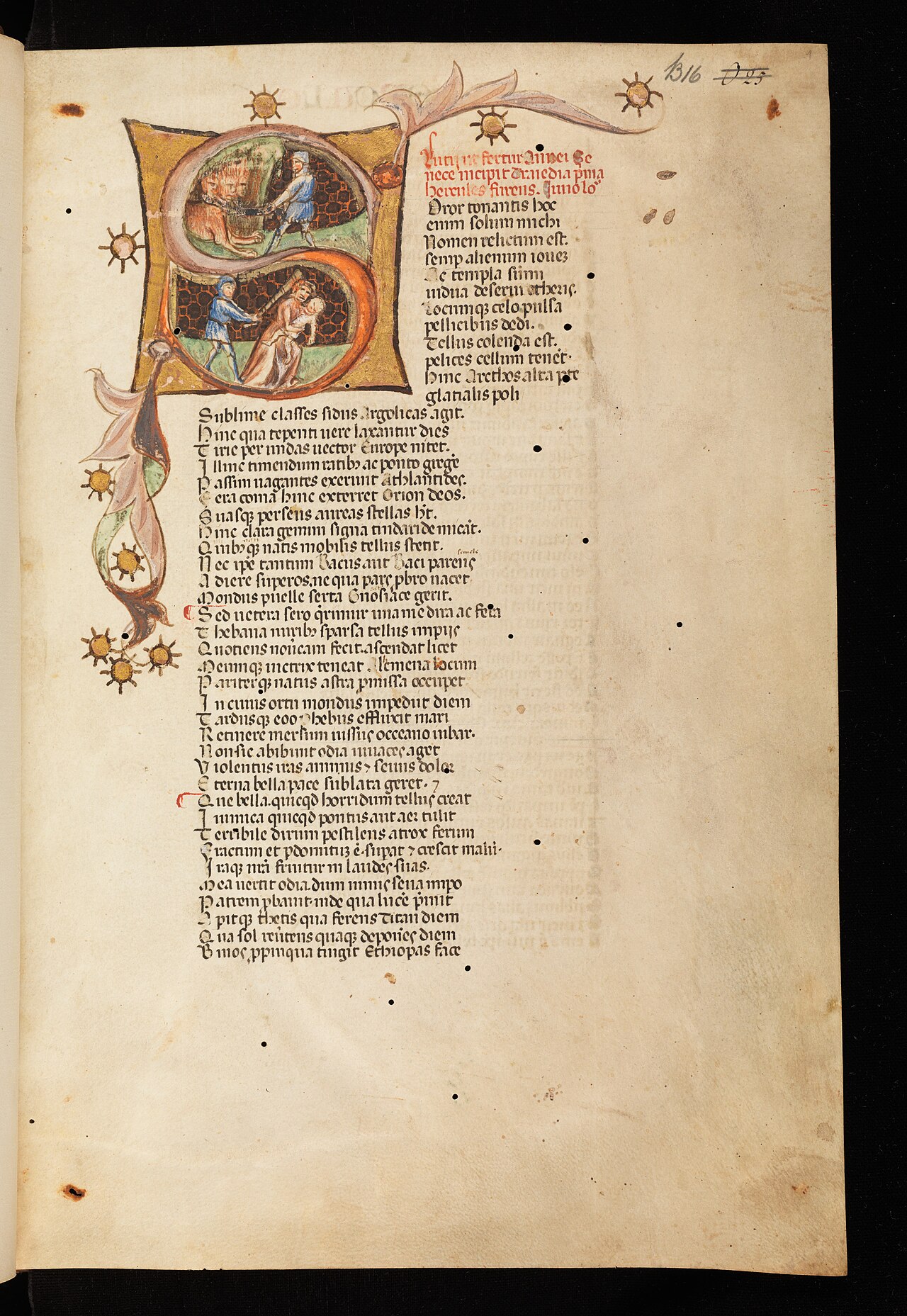
Manuscript page of Seneca's Hercules Furens in Latin, with black-letter text in two columns, red rubric headings, and an illuminated initial S in gold and colors showing a figure with a lion and a figure with a child or woman in a scene. Parchment with ink marks and a page number at top right.Book

Primary source

Hercules Furens

Seneca · 1st century AD (manuscript copy: 15th century)

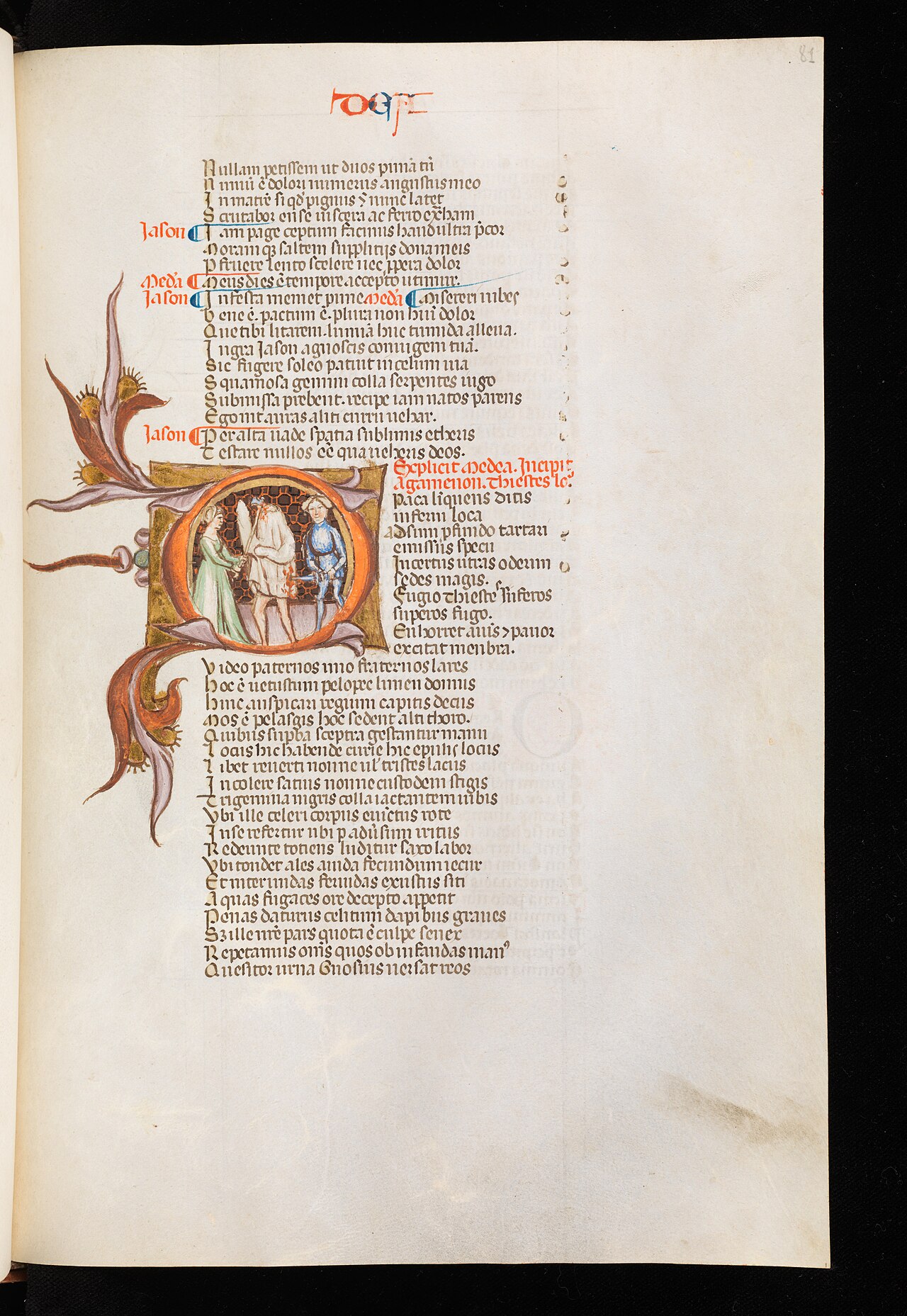
Manuscript page with black-letter Latin text in two columns, red and blue penwork initials, and a large decorated initial O containing a painted miniature of three figures in a dark interior with a honeycomb-like pattern background. The page is numbered 81 at top right and includes the red heading 'Explicit Medea. Incipit Agamenon. Thyestes' in the middle of the text.Book

Primary source

Agamemnon

Seneca · 1st century AD (manuscript copy: 15th century)

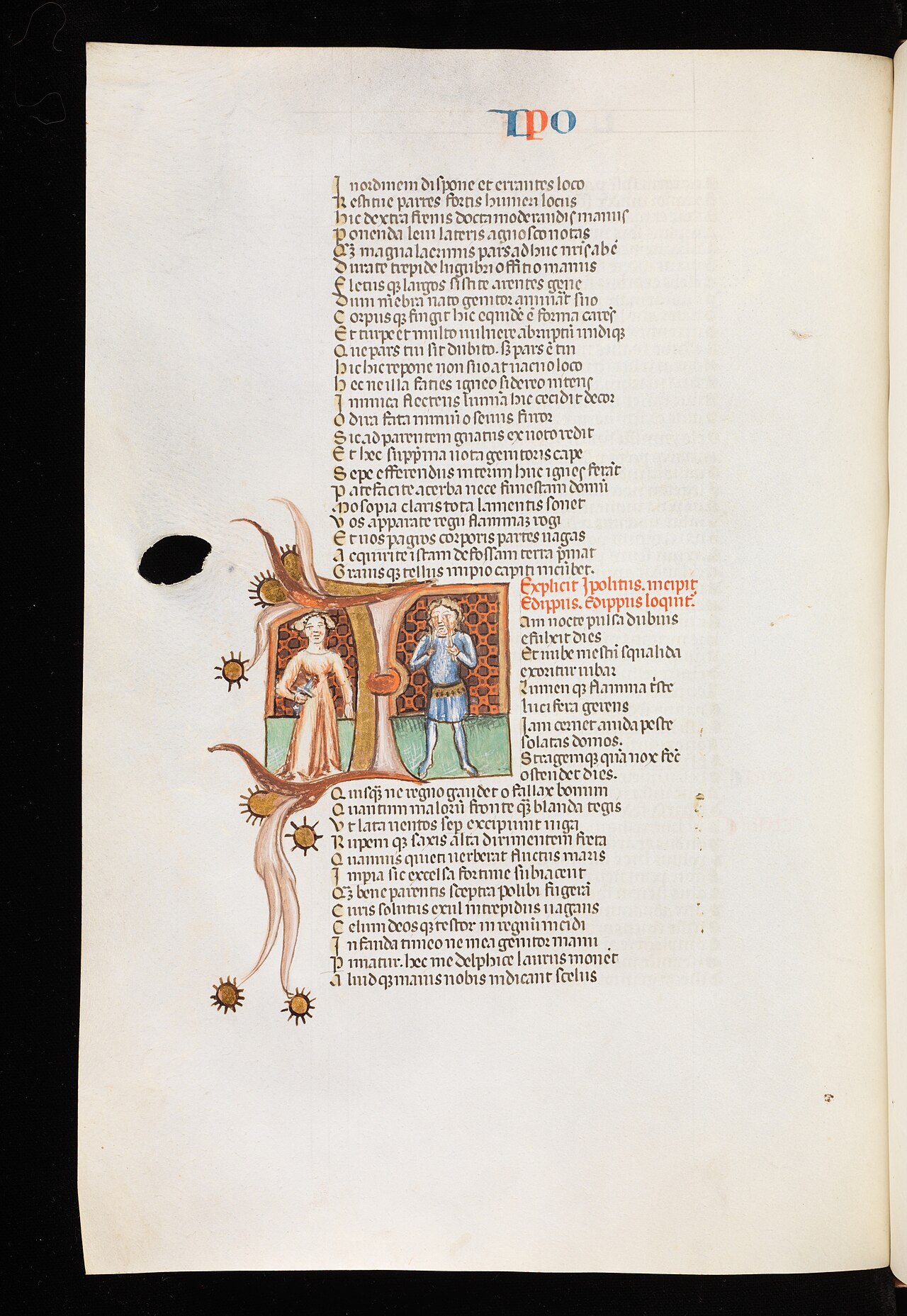
Manuscript page of a medieval Latin codex with dense black-letter text in two columns, red and blue rubrics, and a historiated initial showing two figures in an ornate frame with gold decoration and drolleries. Text reads as Seneca's Oedipus.Book

Primary source

Oedipus

Seneca · 1st century AD (manuscript copy: 15th century)

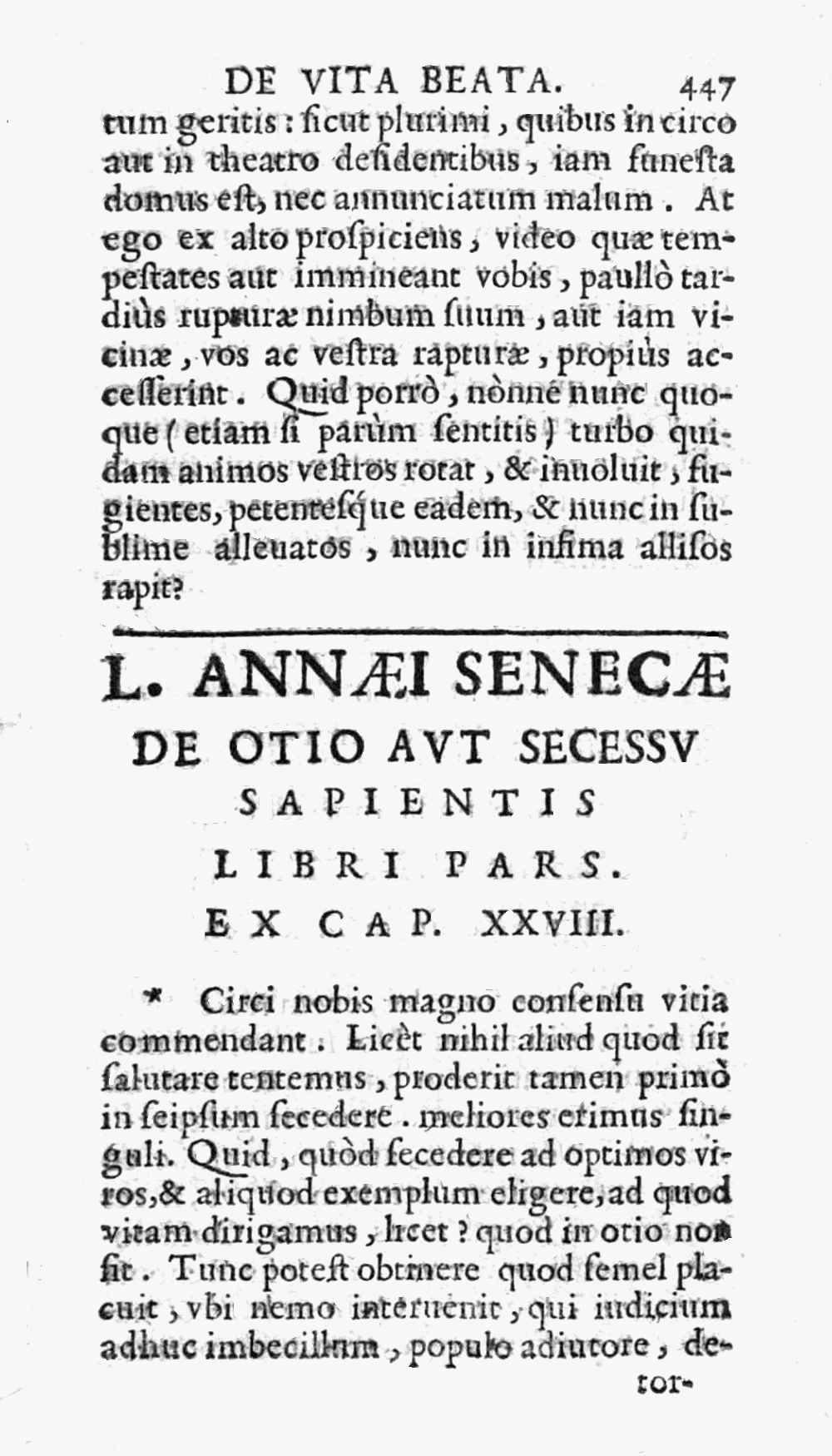
Printed page 447 from a 1643 Latin edition of Seneca's works, headed 'De vita beata' at top. Below a rule, the title 'L. Annaei Senecae De otio aut secessu sapientis libri pars ex cap. XXVIII' and the start of the Latin text of the treatise.Book

Primary source

De otio

Seneca · c. 62 AD (printed edition: 1643)

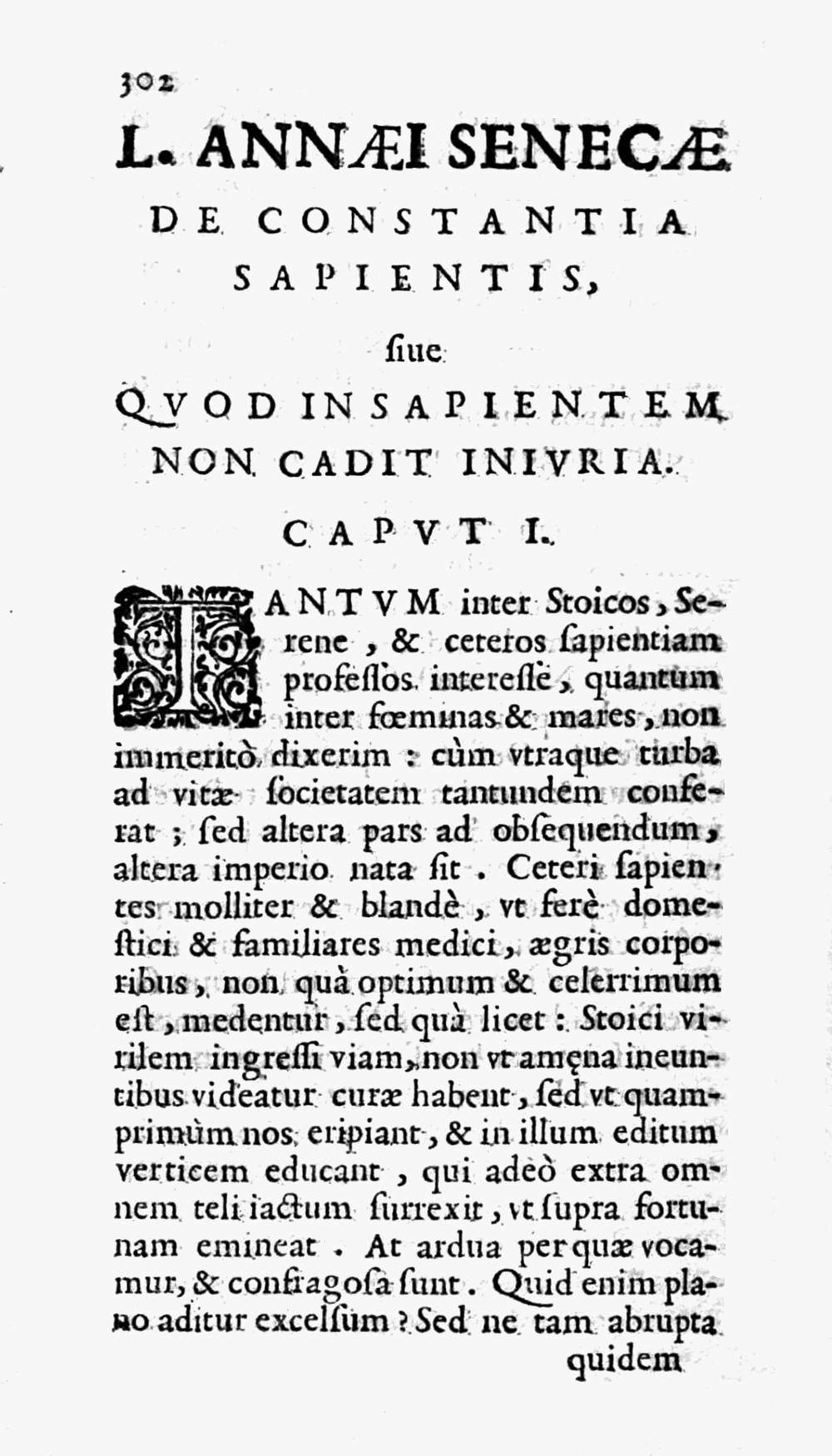
Page 302 of a 1643 printed Latin edition of Seneca's works, headed 'L. Annaei Senecae De Constantia Sapientis, sive Quod insapientem non cadit injuria, Caput I', with a decorated initial letter 'T' starting the Latin text in black-and-white print.Book

Primary source

De constantia sapientis

Seneca · c. 47–62 AD (printed edition: 1643)

Front cover and spine of a red leather-bound book with gold tooling. The spine reads 'L. ANN. SENECÆ OPERA' and 'TOM. I', with gold stars and decorative bands. The front cover centers a gold coat of arms on a shield.Book

Secondary source

Seneca, Opera Omnia (Elzevier edition)

Elzevier · 1639-1640

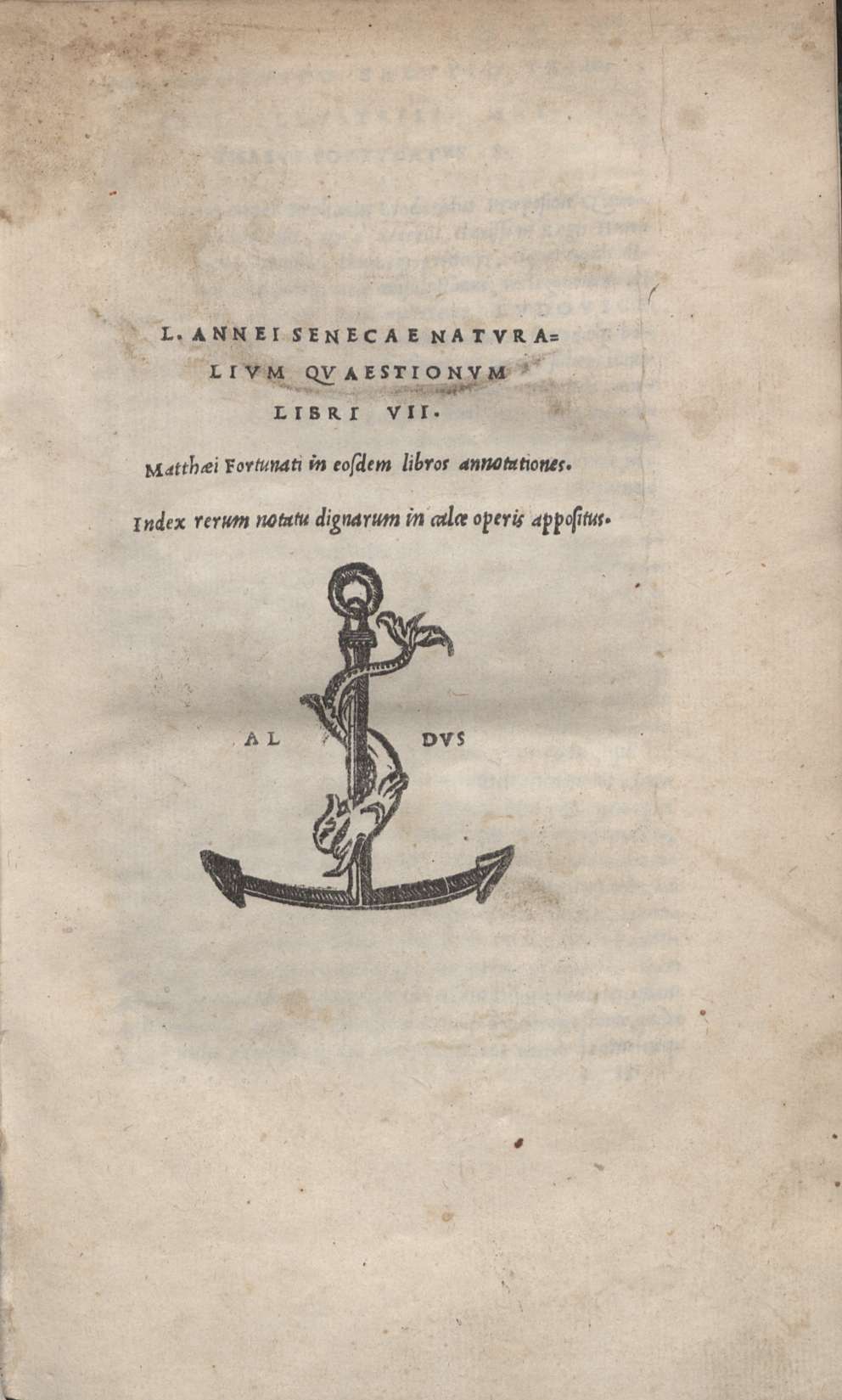
Title page of a printed book with the heading 'L. Annei Senecae Naturalium Quaestionum Libri VII', a line naming annotations by Matthaei Fortunati, and an index note. Below is a woodcut of an anchor entwined with a dolphin, with the letters 'AL' and 'DVS' on either side.Book

Secondary source

Naturales Quaestiones (1522 printed edition)

Lucius Annaeus Seneca · 1522

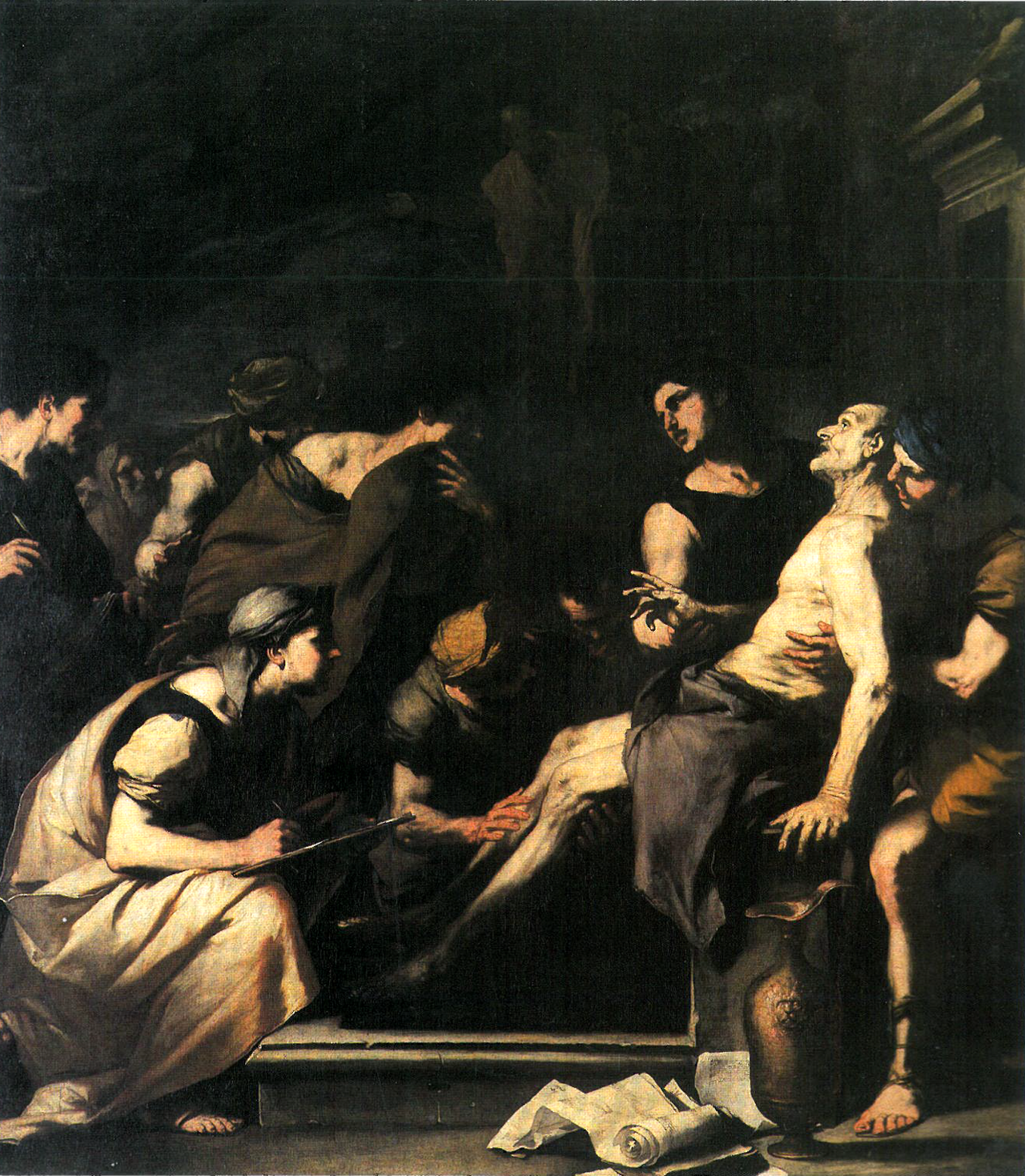
Very dark, heavily damaged black-and-white image with a faint, abraded surface. Pale flaking patches and light vertical cracks cover the area, and faint shapes are barely discernible. It appears to be an infrared or X-ray style scan of a painting's surface.Painting

Secondary source

The Death of Seneca

Giovanni Lanfranco

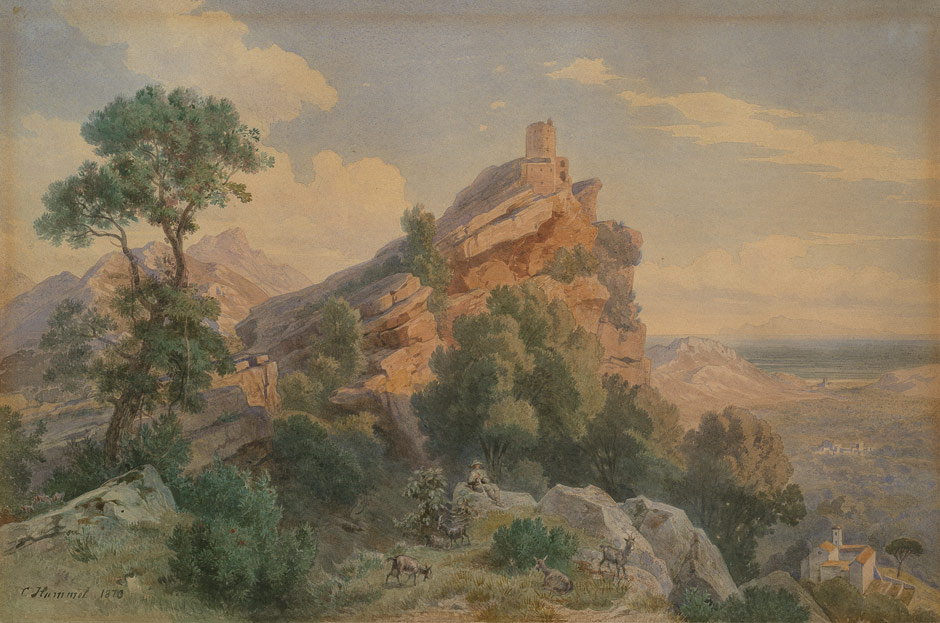
Watercolor landscape of a rocky hilltop with a small stone tower on top, a tall tree on the left, goats and a seated figure in the foreground, a small white building with a red roof at lower right, and a hazy sea on the right horizon. Signed 'C. Hummel 1870' at lower left.Painting

Secondary source

The Tower of Seneca on Corsica

Carl Hummel · 1870

Book

Primary source

Physical Science in the Time of Nero

Seneca · 1910

Book

Primary source

Seneca's Morals of a Happy Life, Benefits, Anger and Clemency

Seneca (translated by Roger L'Estrange) · 1882 (translation; original essays by Seneca, 1st century CE)

Book

Primary source

Apocolocyntosis divi Claudii

Seneca · 1st century CE (text as published 1902)

Book

Primary source

Apocolocyntosis

Seneca (translated by Allan Perley Ball) · 1902 (translation; original by Seneca, 1st century CE)

Nero: From the Death of Burrus to the Death of SenecaBook

Secondary source

Nero: From the Death of Burrus to the Death of Seneca

Robert Bridges · 1894

Book

Secondary source

Introduction to Moral Letters to Lucilius

Richard Mott Gummere · Early 20th century

Book

Secondary source

Introductory Essay to The Tragedies of Seneca

Frank Justus Miller · 1907

Moral EssaysBook

Primary source

Moral Essays

Seneca · 1928

Book

Primary source

Seneca's Tragedies

Seneca · 1917

DialoghiBook

Primary source

Dialoghi

Seneca · 1900

Minor Dialogues, Together with the Dialogue On ClemencyBook

Primary source

Minor Dialogues, Together with the Dialogue On Clemency

Seneca · 1889

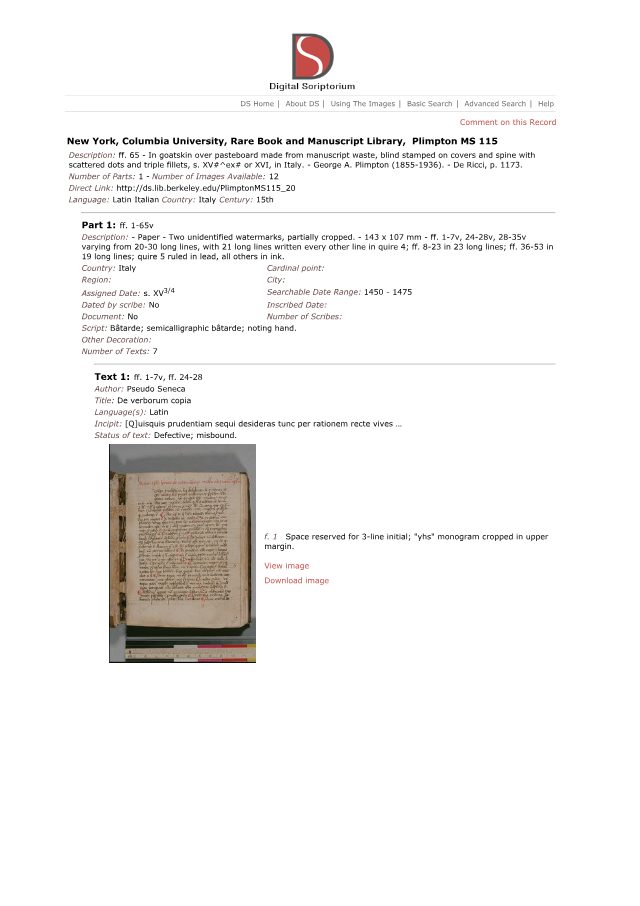
Plimpton MS 115Book

Secondary source

Plimpton MS 115

Pseudo Seneca · c. 1450-1475

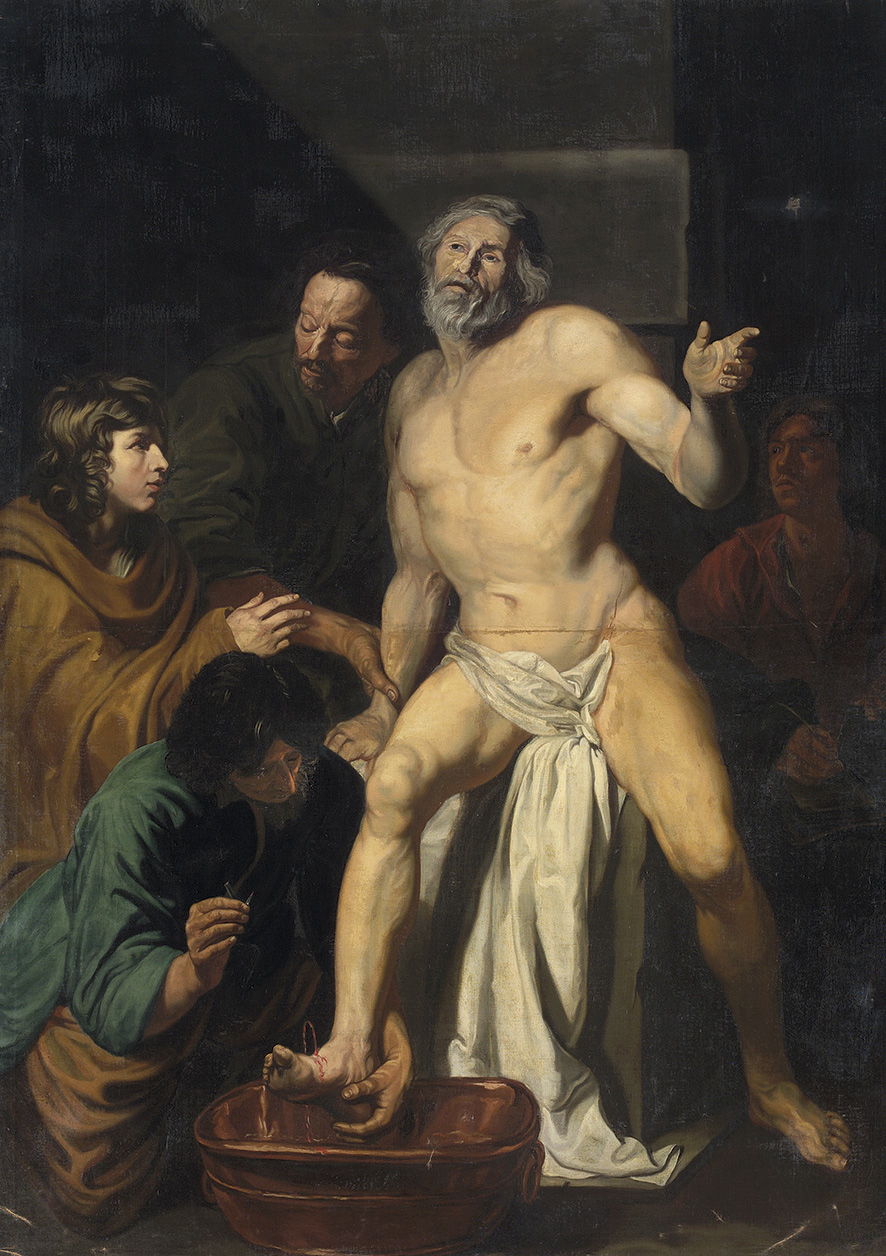
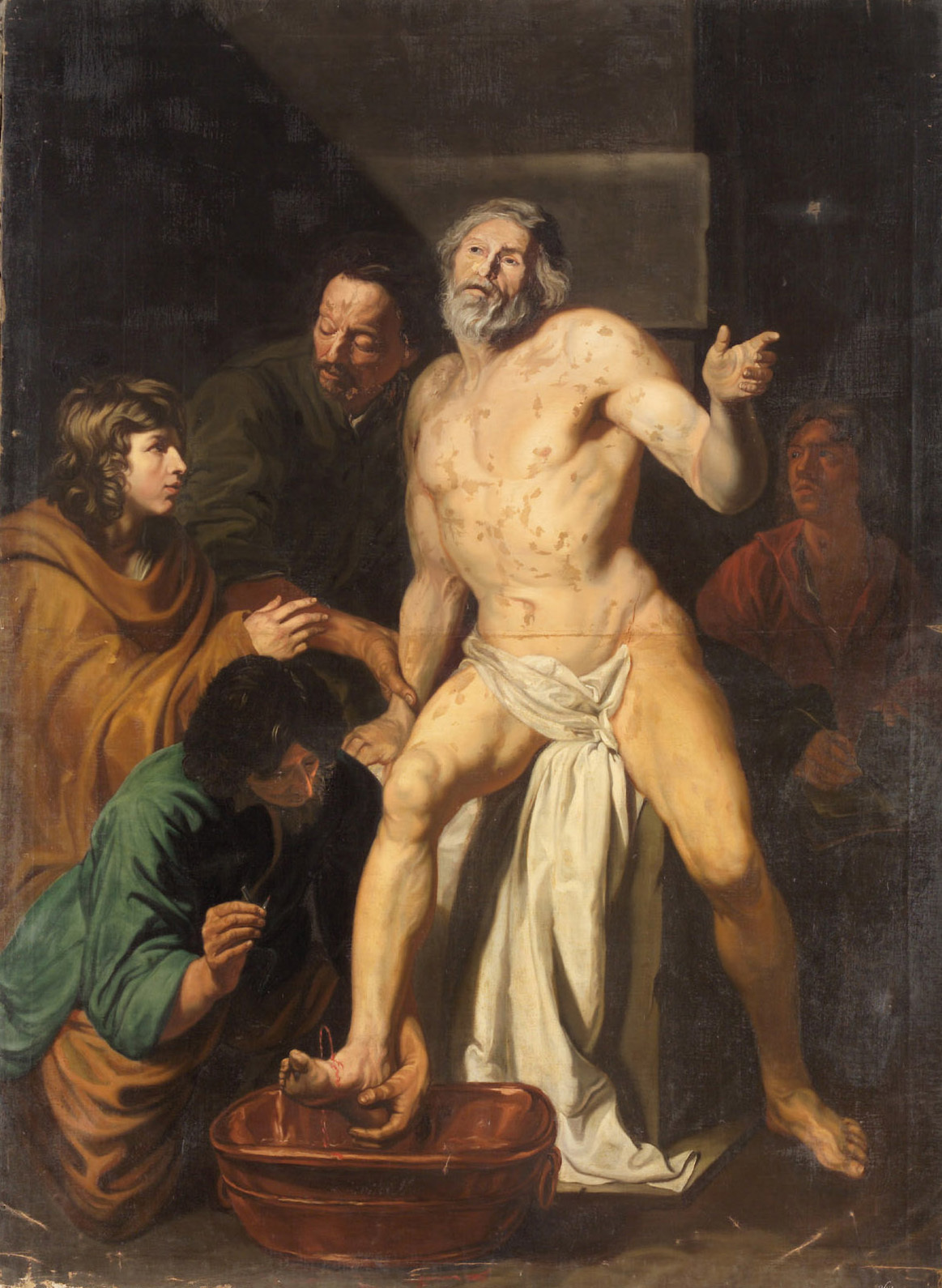
Oil painting of an elderly, muscular bearded man standing nude except for a white cloth around his hips, raising one arm, while a servant kneels at his feet cutting his ankle over a copper basin. Two other men and a seated figure in red watch from the shadows.Painting

Secondary source

The Death of Seneca

Charles Wautier · 17th century, c. 1650

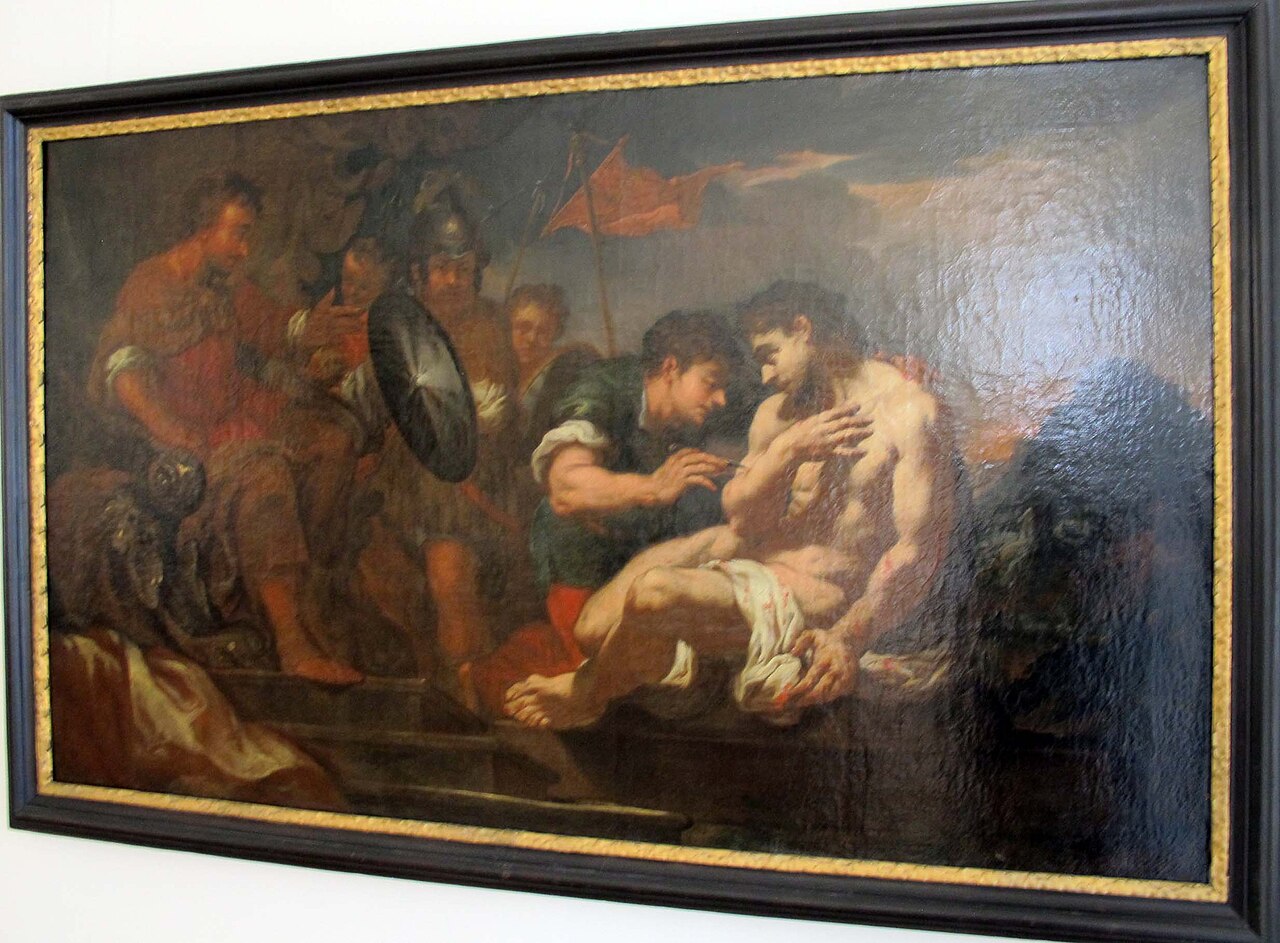
Framed painting in a gold and black frame on a white wall. A shirtless, muscular older man sits on a stone ledge while a younger man in dark green clothing leans in and holds his arm. Armed soldiers with helmets, shields and a red banner stand behind them on the left, under a dark, cloudy sky.Painting

Secondary source

The Death of Seneca

Martino Altomonte

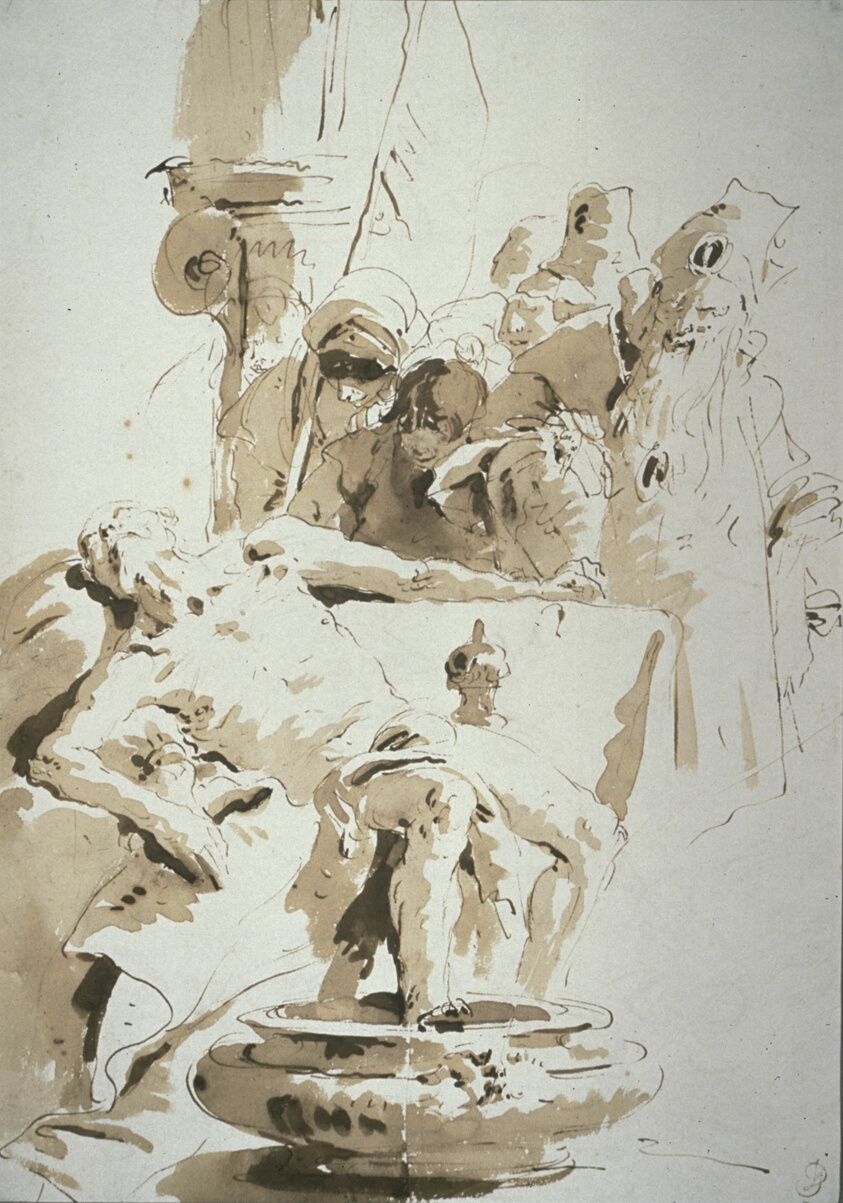
Brown ink and wash drawing on pale paper of a scene with a reclining old man on the left, a figure bending over a stone basin in the foreground, and a group of onlookers in turbans and robes on the upper right, with architectural columns at the top left.Painting

Secondary source

Fantasy on the Death of Seneca

Giovanni Battista Tiepolo · 1735-1740

Letter

Primary source

Letter to Lucilius on Gladiatorial Games

Seneca

Document

Tertiary source

Mozart entry, The Nuttall Encyclopaedia

James Wood · 1900

Book

Tertiary source

Seneca entry in the Encyclopaedia Britannica, 1911

Robert Drew Hicks · 1911

Book

Secondary source

Jerome's biographical entry on Lucius Annaeus Seneca

Jerome · 1885

Book

Secondary source

Translator's preface to Seneca's On Benefits

1887

Black cover of a book with a gold Columbia University Press emblem at center: an open book with the text '1754 COLUMBIA UNIVERSITY PRESS 1893' above a banner reading 'IN LUCE TUA VIDEBIMUS' (partly legible). A crown sits atop the book. Faint marks appear at the lower left edge.Book

Secondary source

The Satire of Seneca on the Apotheosis of Claudius

Allan Perley Ball · 1906

Apocolocyntosis: German translation and analysis by Otto WeinreichBook

Secondary source

Apocolocyntosis: German translation and analysis by Otto Weinreich

Otto Weinreich · 1923

Full page of an illuminated manuscript with gold and coloured borders. A Latin title block in gold capitals sits at top left, with body text in two columns below. Medallion miniatures show a seated scholar writing at a desk, a woman, a child, and small figures at the corners, and a central coat of arms with a crown is at the bottom beside two reclining figures.Document

Secondary source

Opera Senecae II

Piero Strozzi · circa 1487

Front cover of a bright red hardcover book. Top left has white call number text reading PA 6661, .D7, 1802. Near the bottom left is a white Library of Congress barcode label with the number 00002380109.Book

Secondary source

Why good men suffer misfortune (De Providentia)

Lucius Annaeus Seneca · 1802

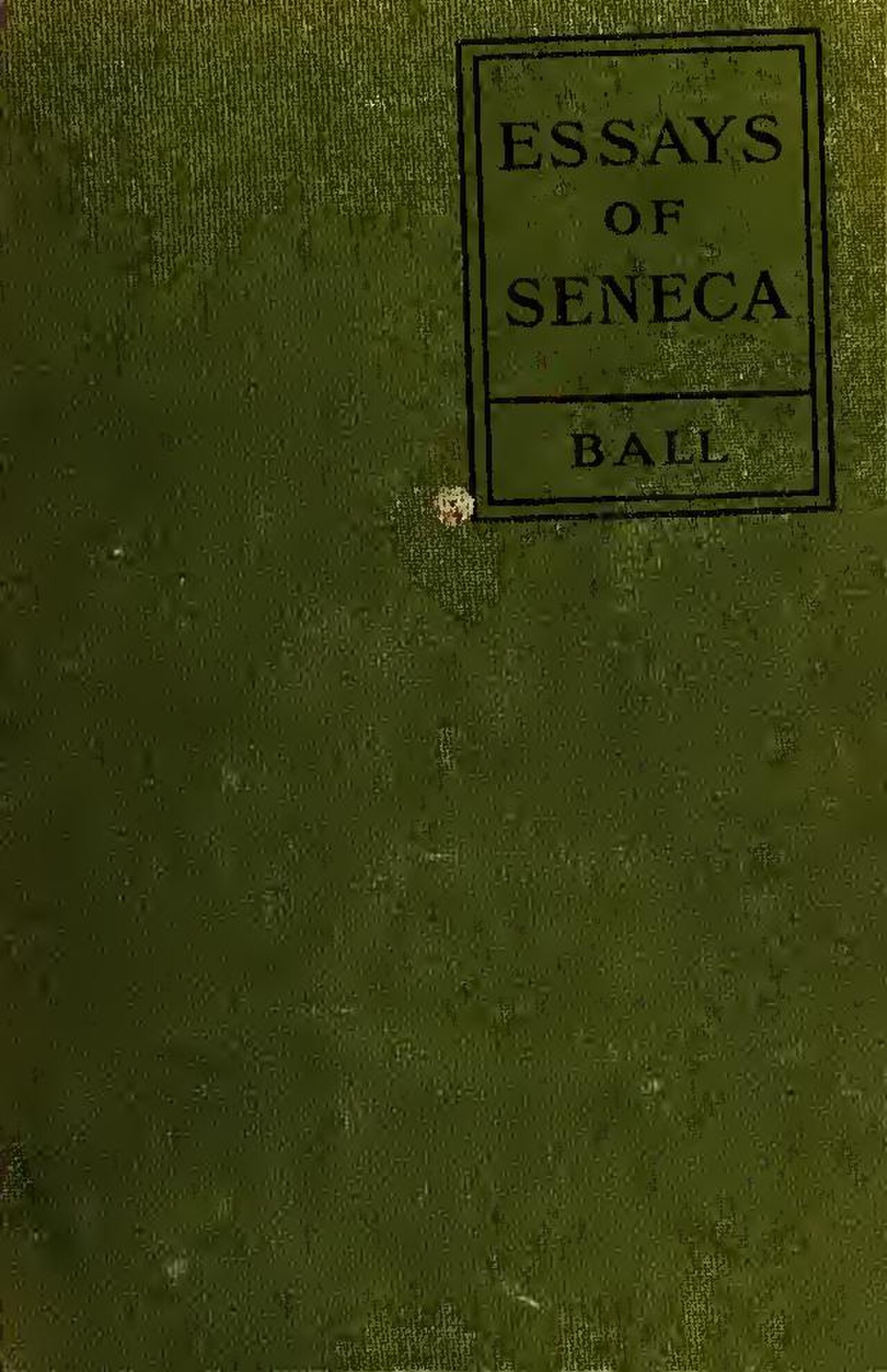
Front cover of a green cloth-bound book. A framed title panel reads 'ESSAYS OF SENECA' with a lower panel reading 'BALL'. The cover shows some stains and wear.Book

Secondary source

Selected Essays and the Satire on the Deification of Claudius

Lucius Annaeus Seneca

Black book cover with a white library label at top reading UC-NRLF with a barcode and the number $8 163 835, and a second white label at lower left with blue handwritten-style numbers reading YC156859.Book

Secondary source

On Benefits

Thomas Lodge

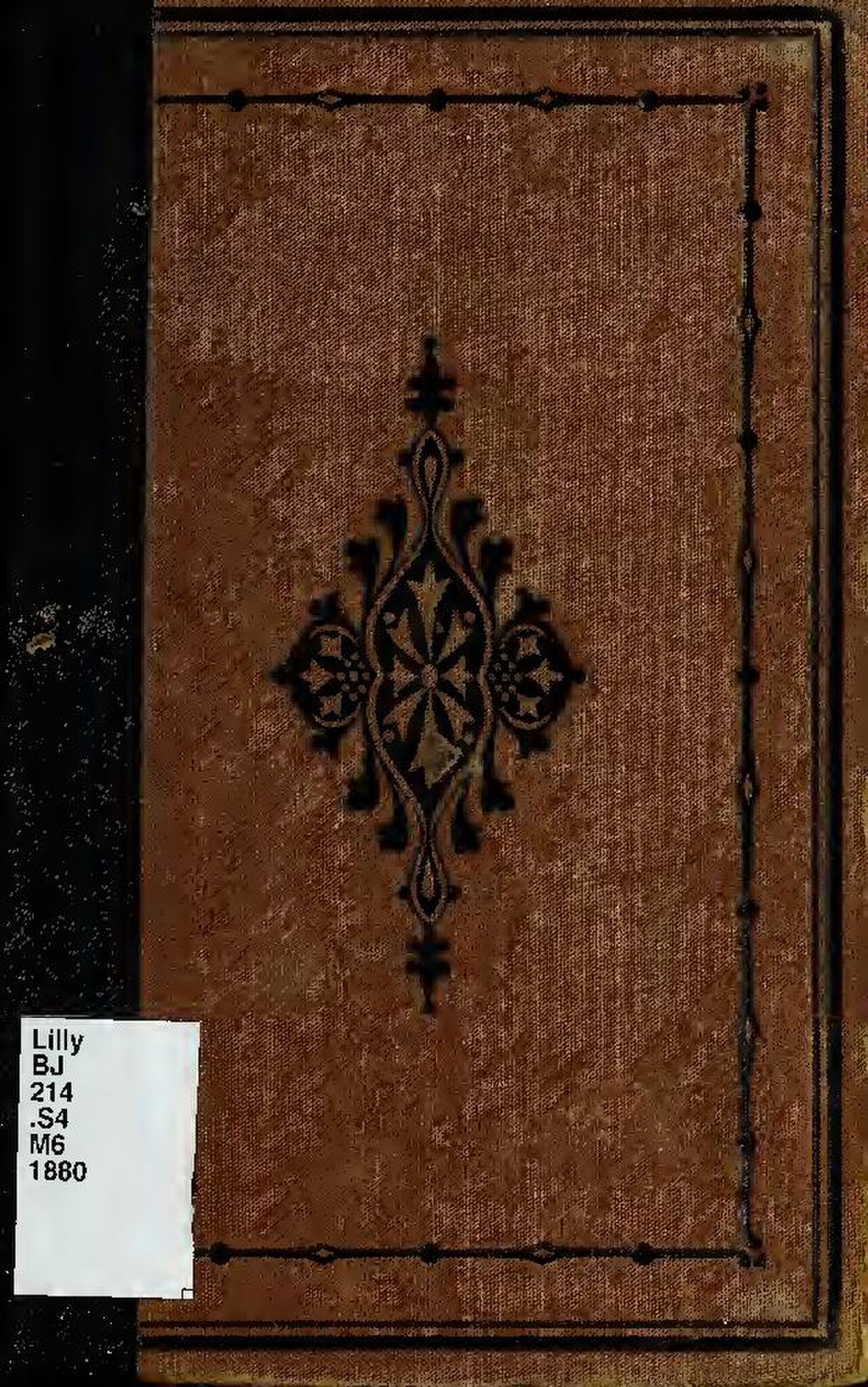
Front cover of a brown cloth-bound book with a black decorative diamond-shaped ornament in the center, a black border line framing the cover, and a white library call-number label at the lower left reading Lilly BJ 214 .S4 M6 1880.Book

Secondary source

Seneca's Morals by Way of Abstract

Roger L'Estrange

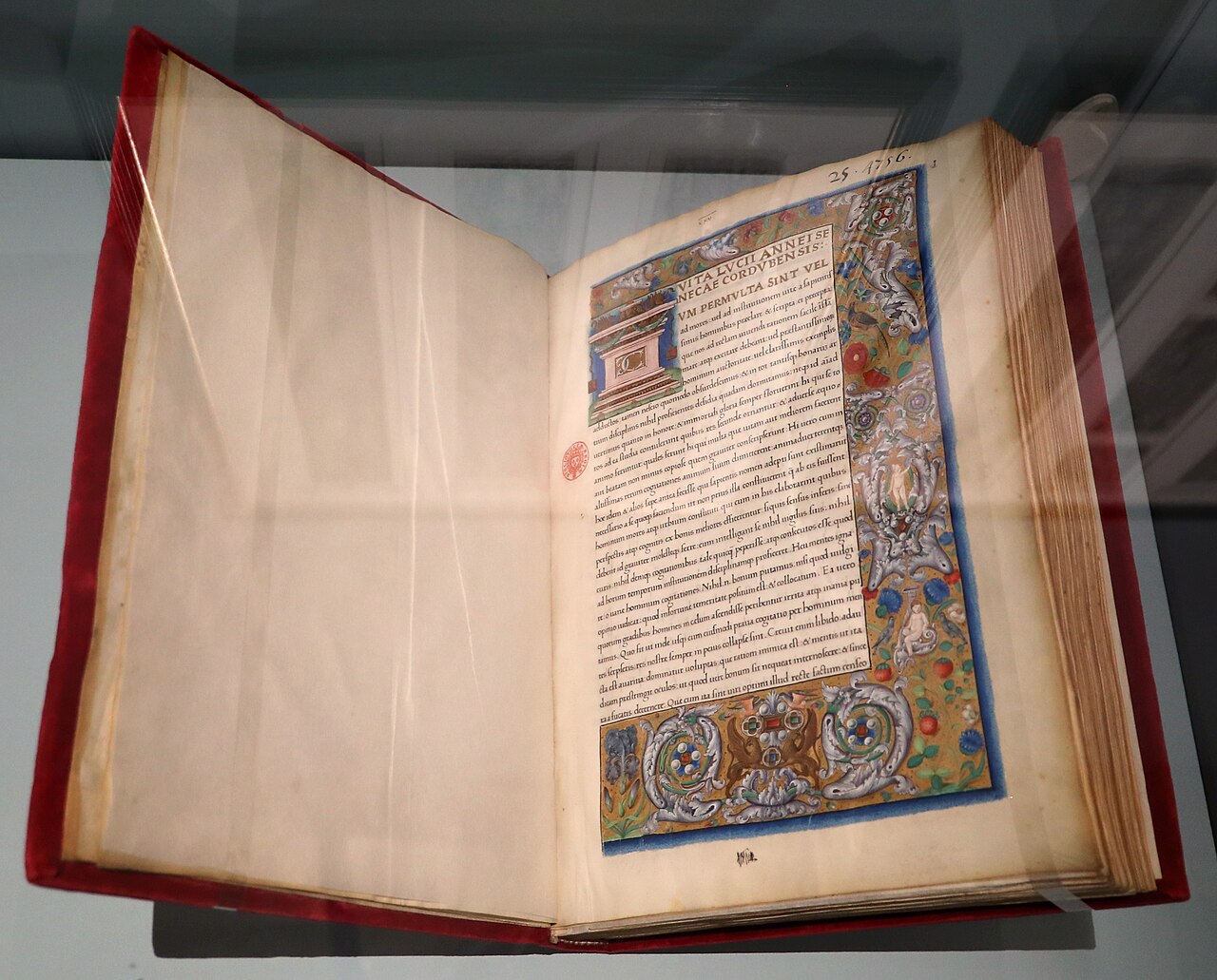
An open red-bound book displayed in a glass case, showing a richly decorated page with a framed printed title block in capitals and dense text, surrounded by ornate painted borders with foliage, grotesque figures, and colored details. The facing left page is blank.Book

Secondary source

Epistulae ad Lucilium, Rouen 1503

1503

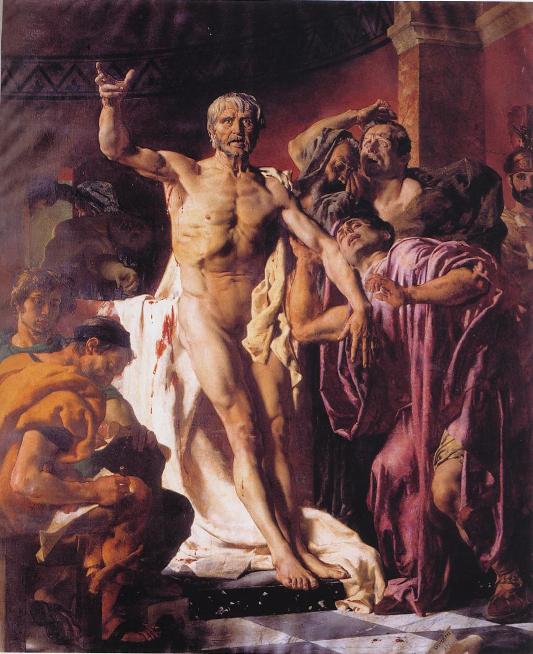
Painting of an elderly, nude, muscular man standing on a dark marble base, one arm raised, with blood running down his legs onto a white cloth. Attendants in robes and a figure in orange cloth at lower left watch and work nearby, under an arched ceiling and a pillar.Painting

Secondary source

La Mort de Seneque

Joseph-Noël Sylvestre · 1875

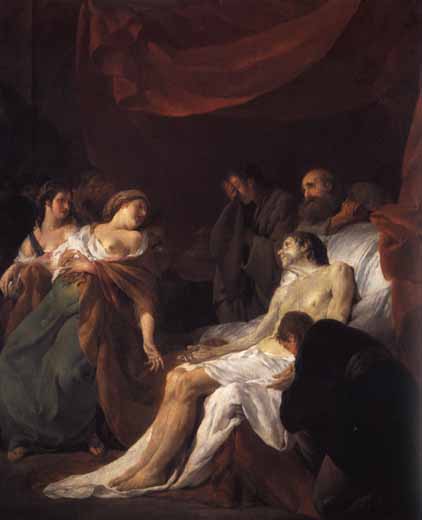
Dark painting of a dying bare-chested older man reclining on a bed with white sheets, surrounded by mourners. A woman in a white blouse and green skirt clutches her chest at left, and a bearded man in a dark cloak covers his face. Red drapery hangs above.Painting

Secondary source

Death of Seneca

Noël Hallé

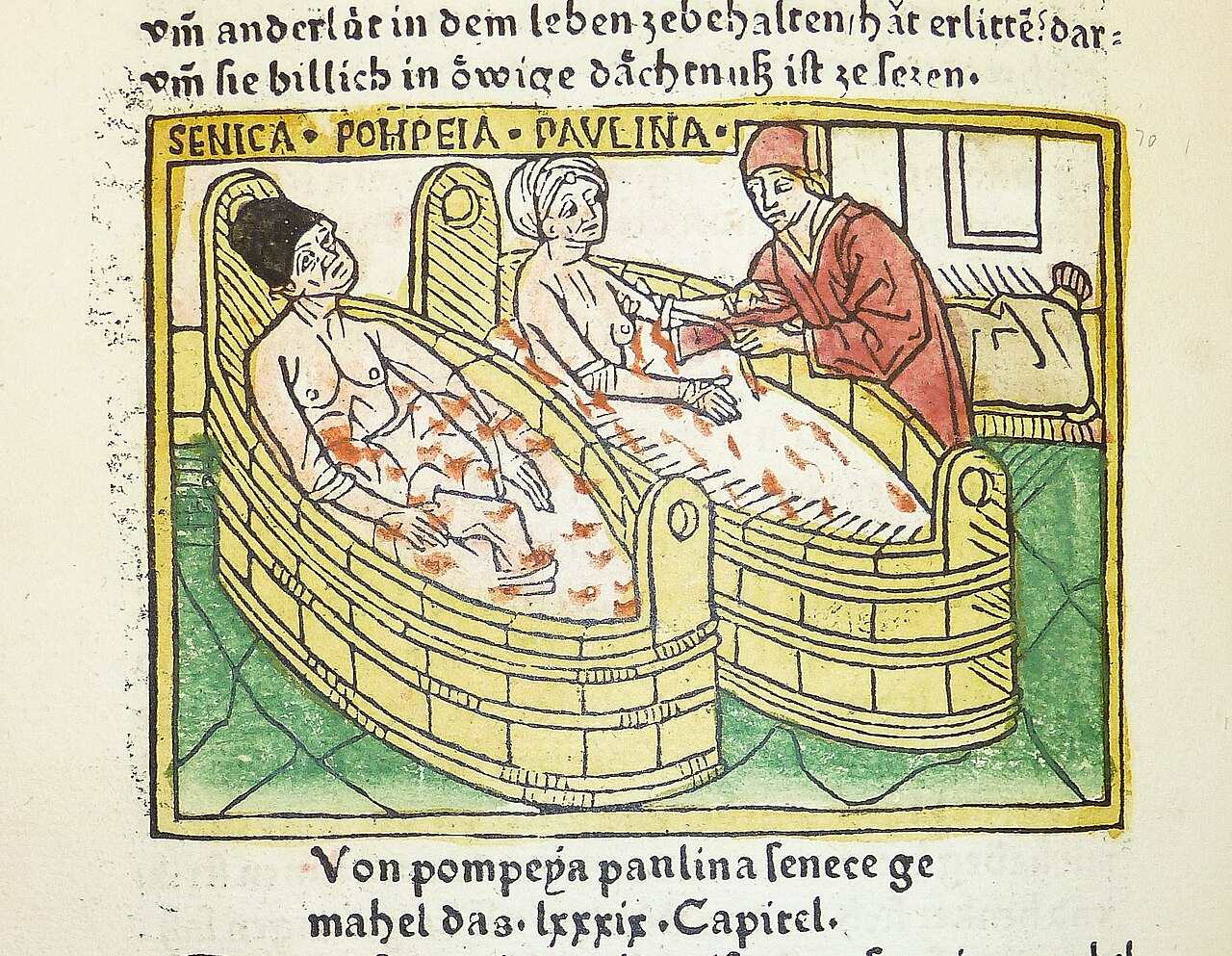
Hand-colored woodcut from an early printed book showing two women in a yellow tub-like bath, with a woman in red attending them. A caption banner reads Senica Pompeia Paulina. German text is printed above and below the image.Book

Secondary source

Woodcut of Seneca's Suicide and Pompeia Paulina's Attempt

Heinrich Steinhöwel (translator); Johannes Zainer (printer) · ca. 1474

Oil painting on wood of an elderly man in a white headcloth and red hood, reading an open red book on a lectern. He wears a green robe and blue sleeves before a red wall and a doorway. Latin inscription along the bottom edge.Painting

Secondary source

Seneca Portrait from the Famous Men Series

Justus van Gent and Pedro Berruguete (attributed) · circa 1474

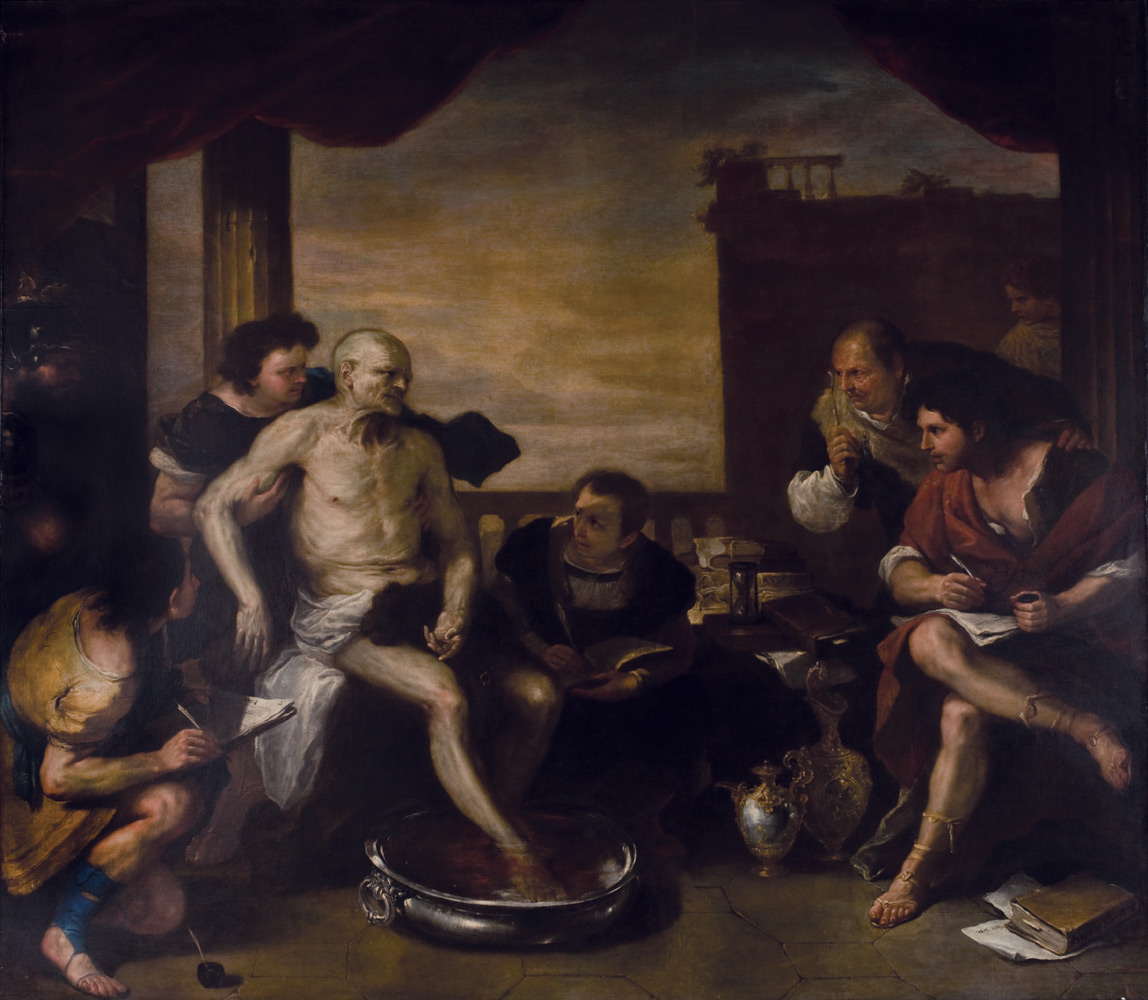
Painting of an elderly, pale, bare-chested man seated on the edge of a metal basin in which his legs are submerged, as attendants and onlookers gather around him in a dim interior with a red curtain above. A man in a red cloak writes on paper at right, and a man in a dark cloak holds a book at center. Books, a jug, and an ornate vessel sit on a table or floor nearby.Painting

Secondary source

The Death of Seneca

Luca Giordano · circa 1660

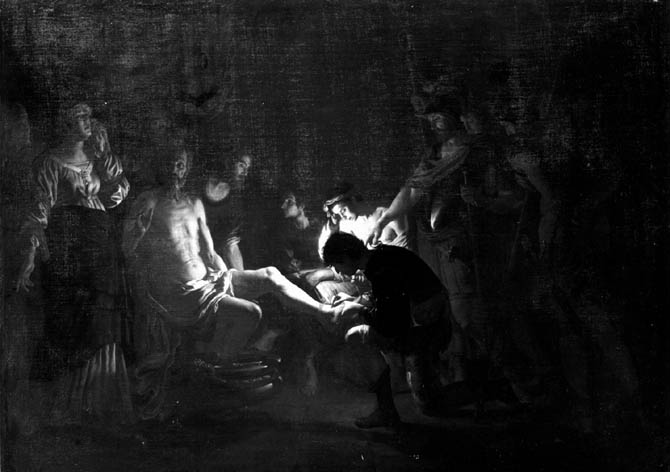
Black-and-white reproduction of a dark baroque painting showing a seated, bare-chested older man in a dim interior, with a figure kneeling at his legs or feet and a crowd of onlookers in shadow around him, lit by a single light source.Painting

Secondary source

The Death of Seneca

Joachim von Sandrart the Elder · 1635

Painting of an elderly, bearded, nude man standing in a dark room, arm raised, while a kneeling man in a green cloak cuts his ankle over a copper basin. Two other men and a young man in a yellow cloak look on.Painting

Secondary source

The Death of Seneca

Jacob van Oost · 1640

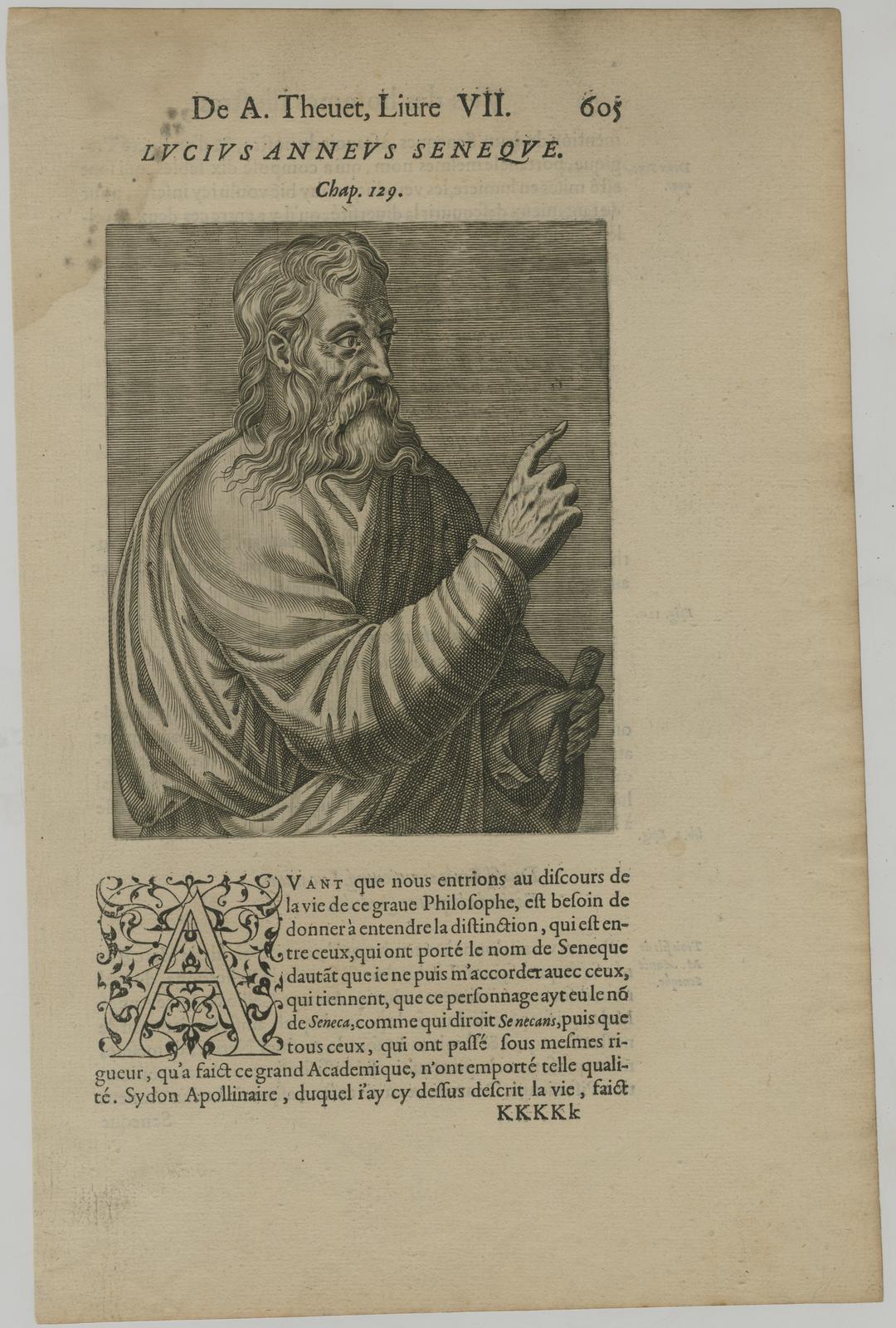
Engraved portrait of a bearded old man in a robe, turned to the right, raising one finger of his right hand. Printed page with a running head reading De A. Theuet, Liure VII, page 605, a chapter title, and a block of French text below with a decorated initial letter.Painting

Secondary source

Portrait of Seneca (engraving in Thevet's Les vrais pourtraits)

1584

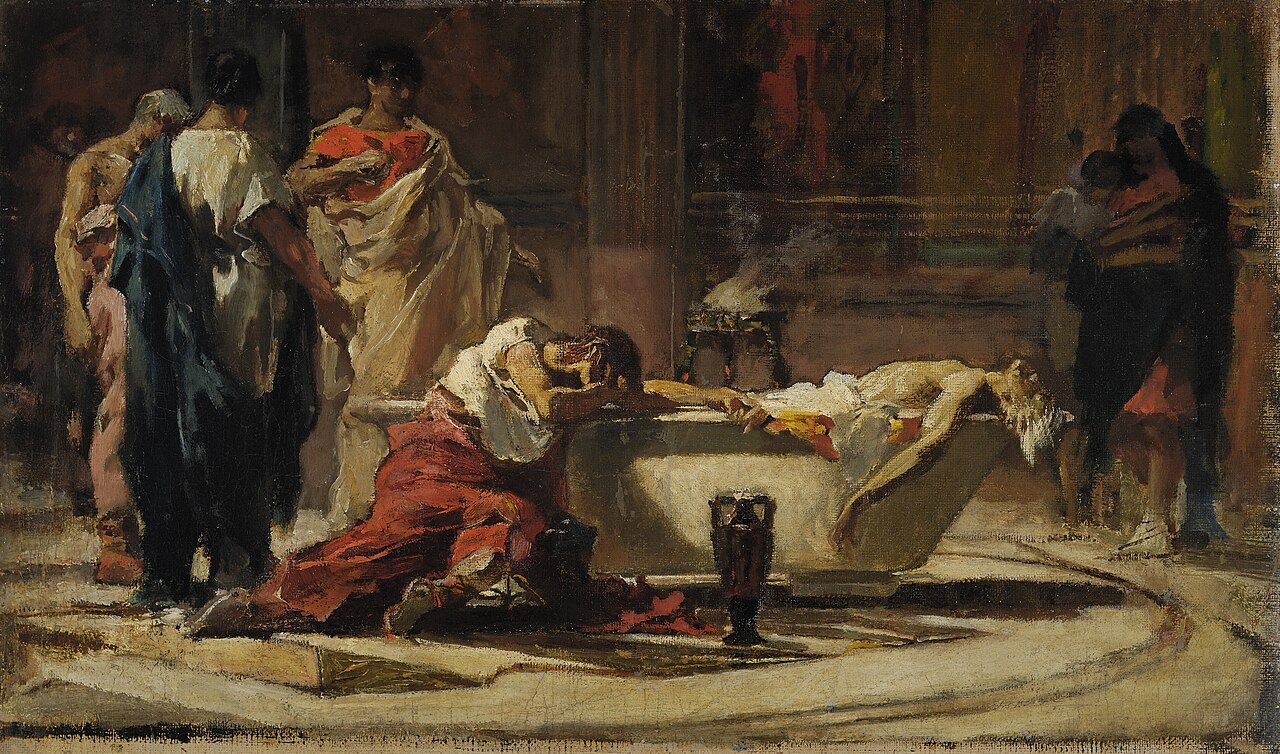
Loose painted sketch of a Roman scene in a marble bath chamber. An elderly bearded man lies back in a marble tub, his arm outstretched. A kneeling woman in a red skirt and white blouse leans over the tub's edge. Standing figures in togas and robes watch from the left and right, and a small incense burner smokes beside the tub. A dark vessel stands on the floor in the foreground.Painting

Secondary source

Sketch for La muerte de Séneca

Manuel Domínguez Sánchez · 1870

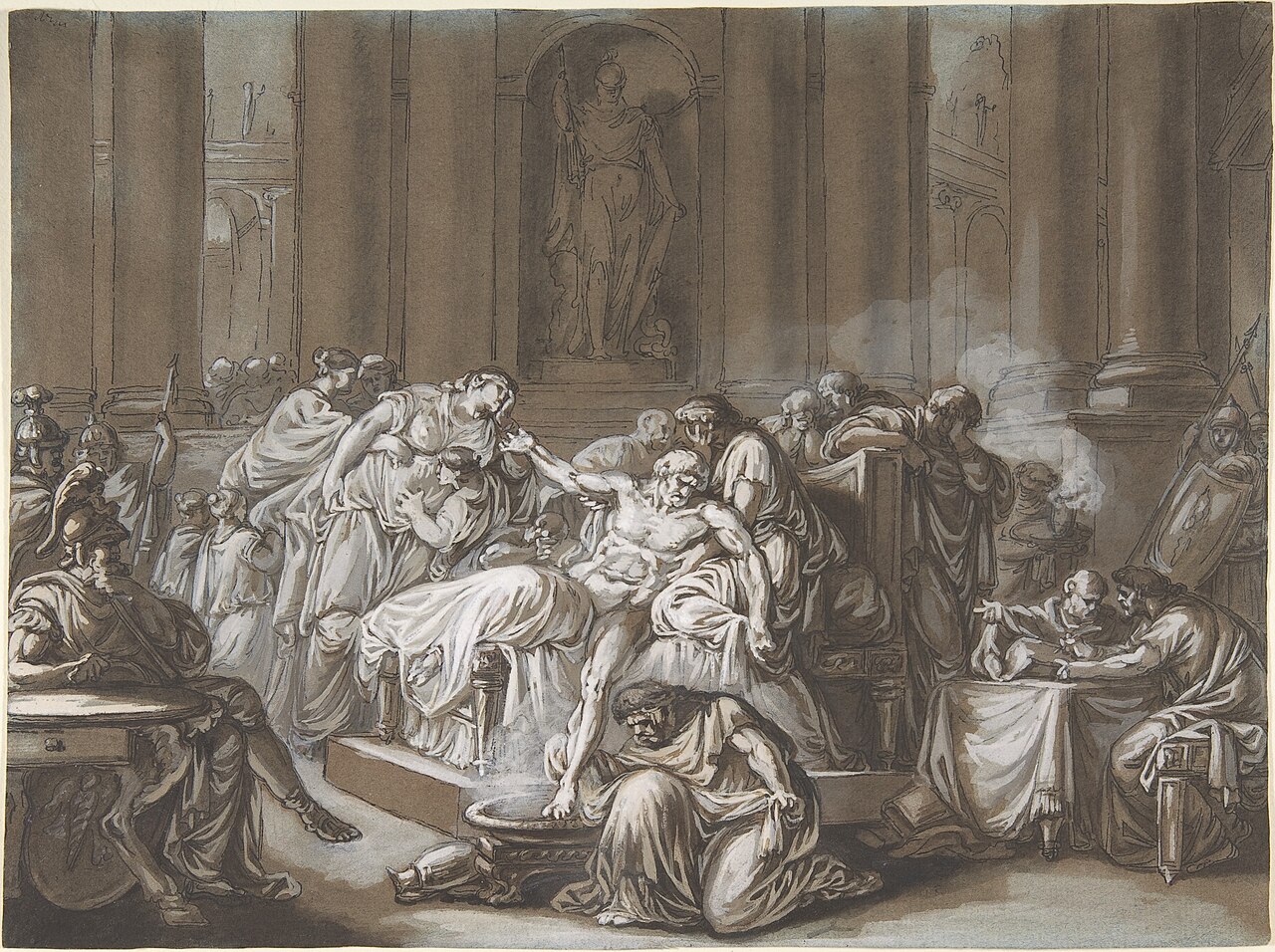
Brown and grey wash drawing of an ancient Roman interior with tall columns and a statue in a niche. A seated, partly nude elderly man is in a bath or tub surrounded by mourners, one kneeling at his feet, while a figure at right works at a table and a soldier sits at left.Painting

Secondary source

The Death of Seneca (drawing by Moitte)

Jean Guillaume Moitte

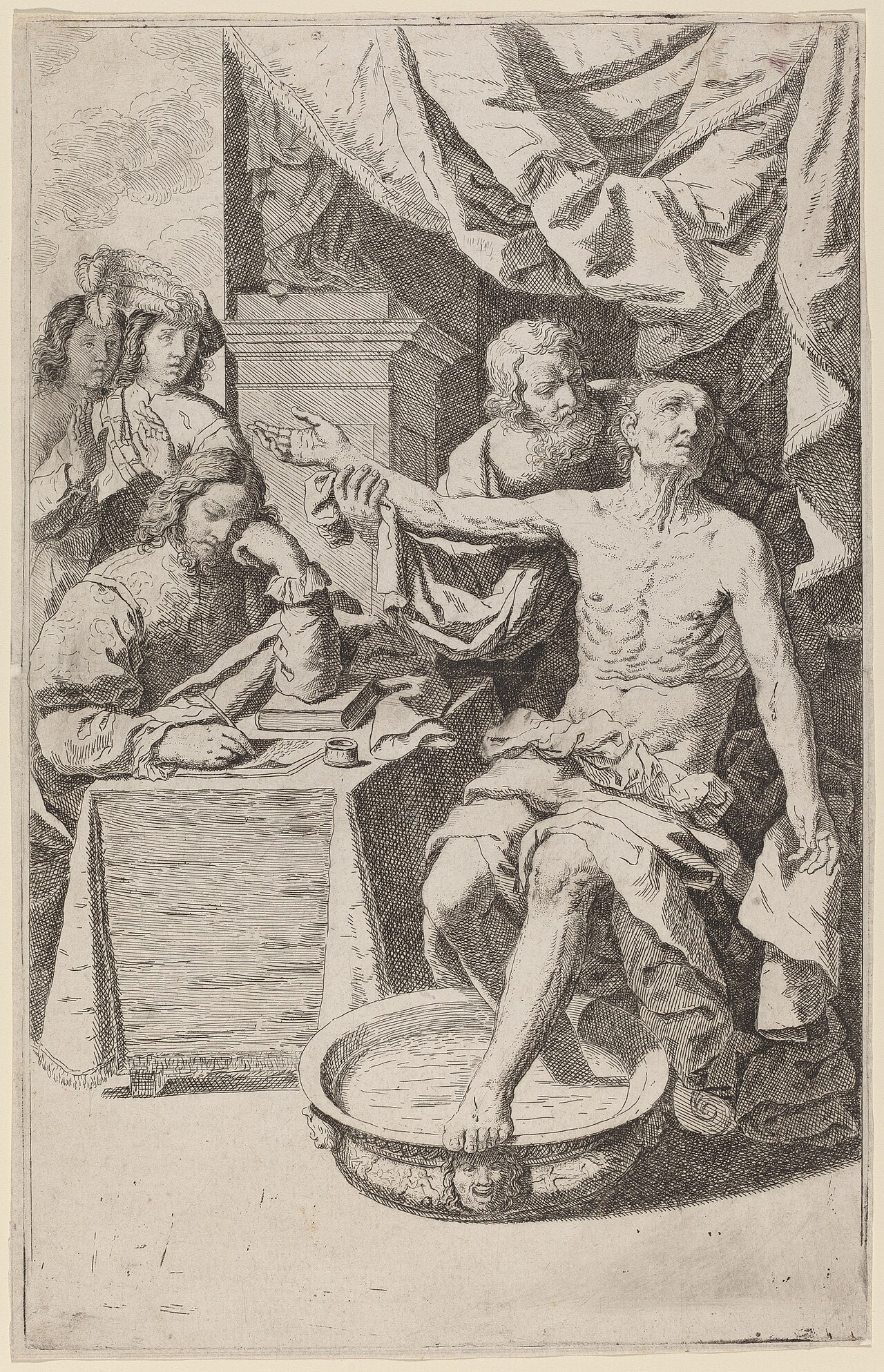
Black-and-white etching of an old, thin, partly nude man seated in a bath with his feet in a basin, lifting a cloth toward a bearded man behind him. At left, a seated man writes at a table while two richly dressed men look on.Painting

Secondary source

The Death of Seneca (etching by Lodovico Lana)

Lodovico Lana

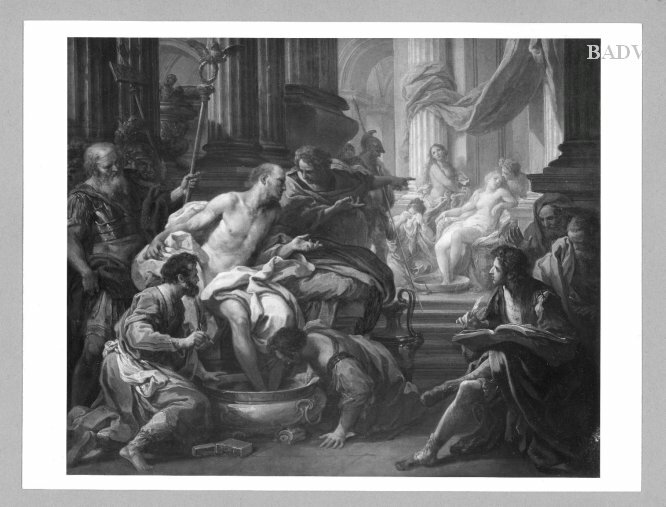
Black-and-white photograph of a painting showing an older nude man seated in a bath basin, with attendants kneeling and standing around him. Behind them, partly nude women sit on steps in a columned hall. A seated man writes at right.Painting

Secondary source

The Death of Seneca (Sebastiano Conca)

Sebastiano Conca · 1635

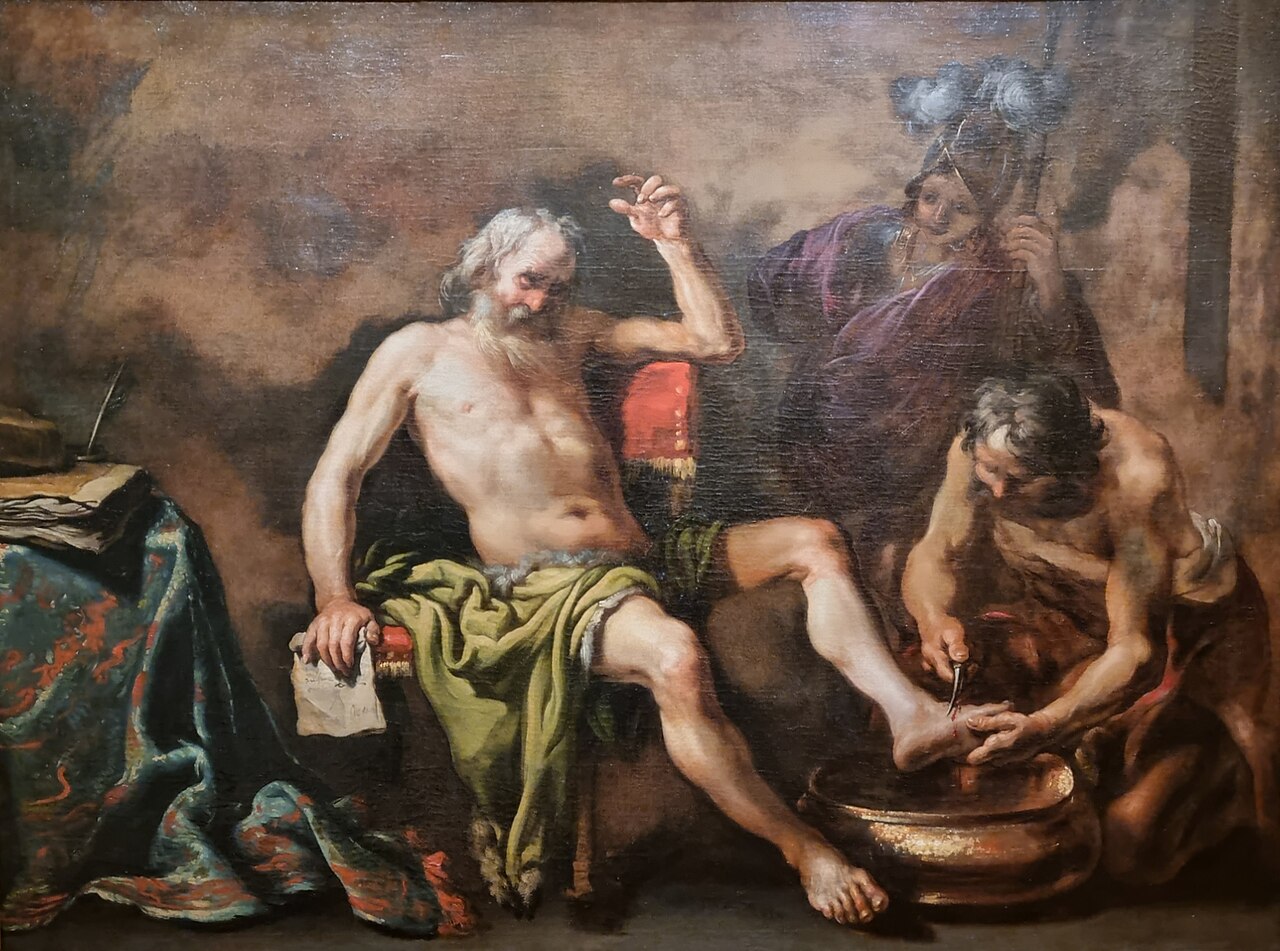
Painting of an elderly, thin, white-bearded man seated nude from the waist up on a stone seat, one hand raised, while a servant in the lower right bends over a copper basin, cutting or tending his bare foot. A figure in purple robes with plumed helmet stands behind. A draped green-and-teal cloth covers a table at left with papers and a quill.Painting

Secondary source

La mort de Sénèque

Claude Vignon · 1626

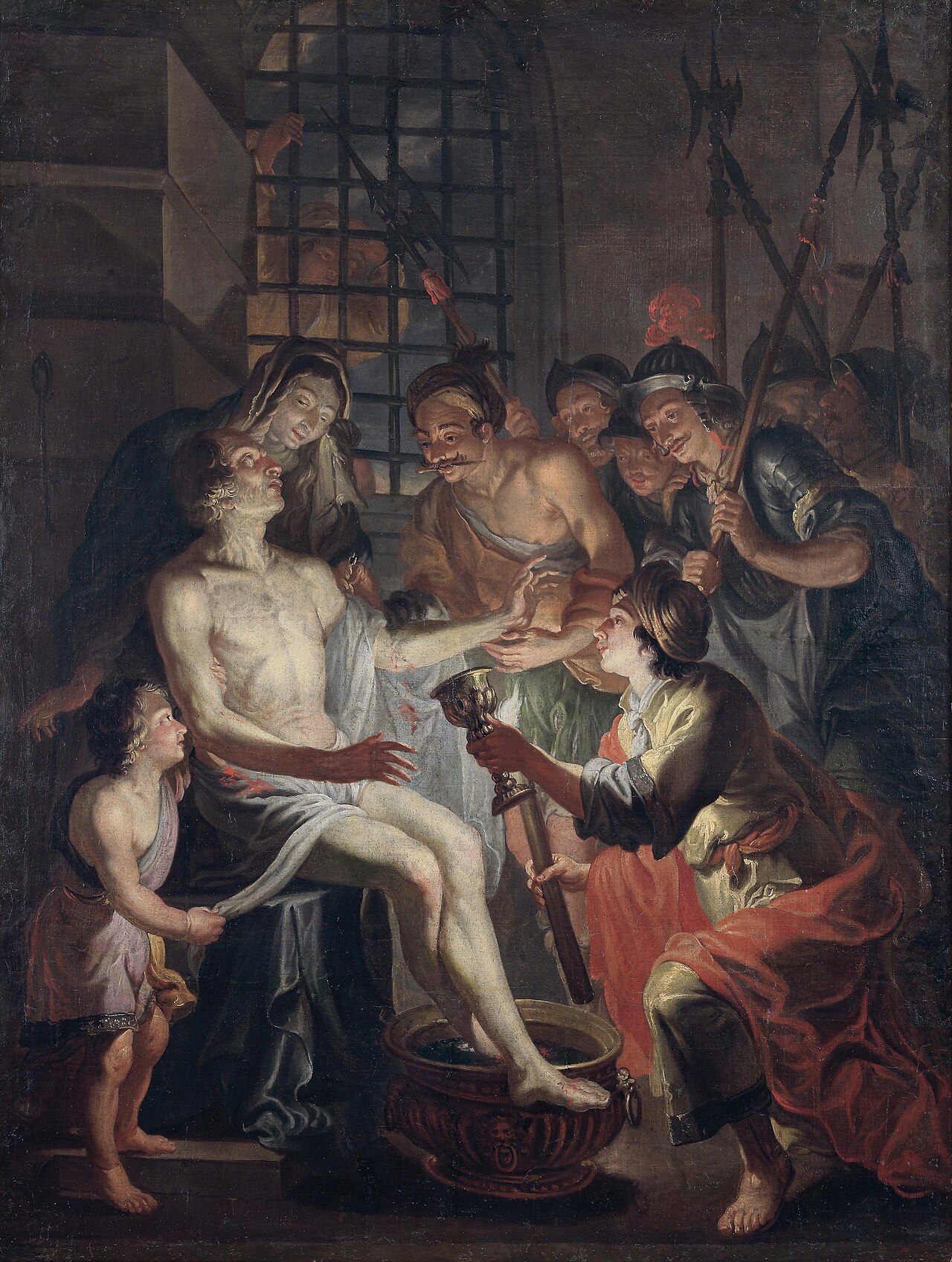
Oil painting of an old, thin, bare-chested man seated on a bench, with a woman in a dark veil behind him, while a young boy at left holds his cloth and a kneeling figure in red robes holds a golden cup and a bowl of water at his feet. Armed soldiers and onlookers stand at right, and a barred window is behind.Painting

Secondary source

The Death of Seneca

Attributed to Jacques de l'Ange / Circle of Matthias Stom · c. 1640 (between 1630 and 1650)

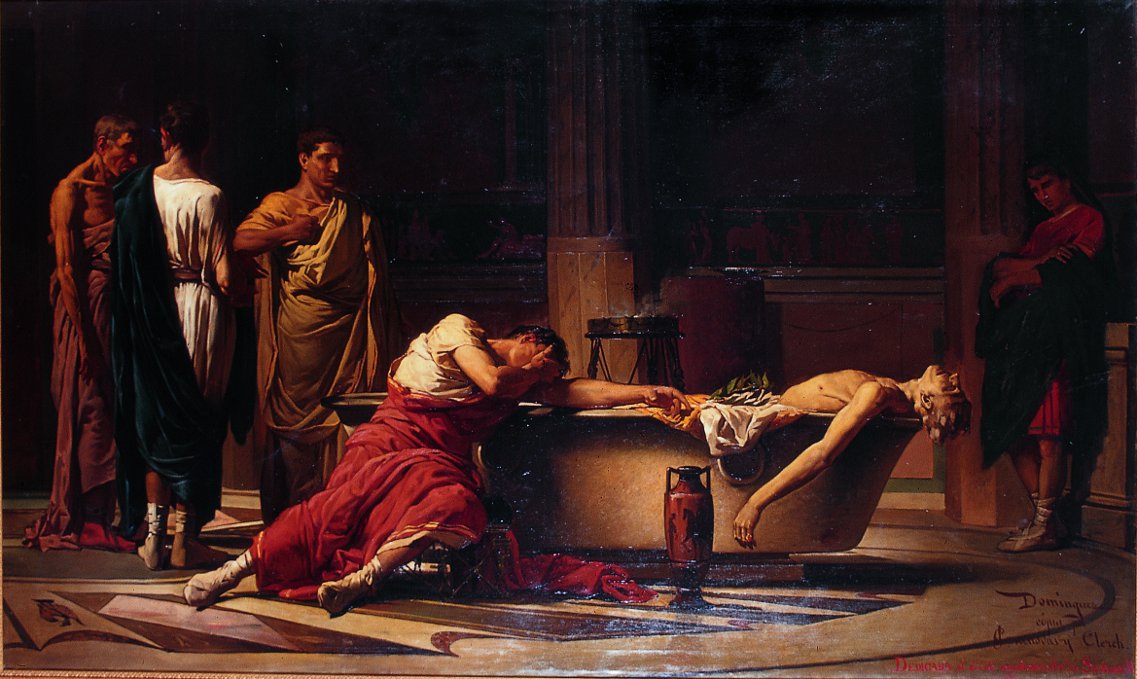
Painting of Seneca's death: a dying old man lies in a marble bath with his arm hanging over the edge, while a grieving younger man in red kneels beside the bath with his face in his hands. Four standing figures in Roman dress look on from the left, and another figure in red stands at the right. A red vase sits on a mosaic floor, and a dark background shows classical architecture.Painting

Secondary source

La mort de Sèneca

Josep Casanovas Clerch · circa 1883

Dark baroque painting of an old, emaciated man reclining and gazing upward while attendants tend to him; a woman in a white dress and headscarf writes on a tablet, and a bronze vessel and scrolls lie at the bottom. Figures emerge from shadow.Painting

Secondary source

Morte di Seneca

Luca Giordano · 1634

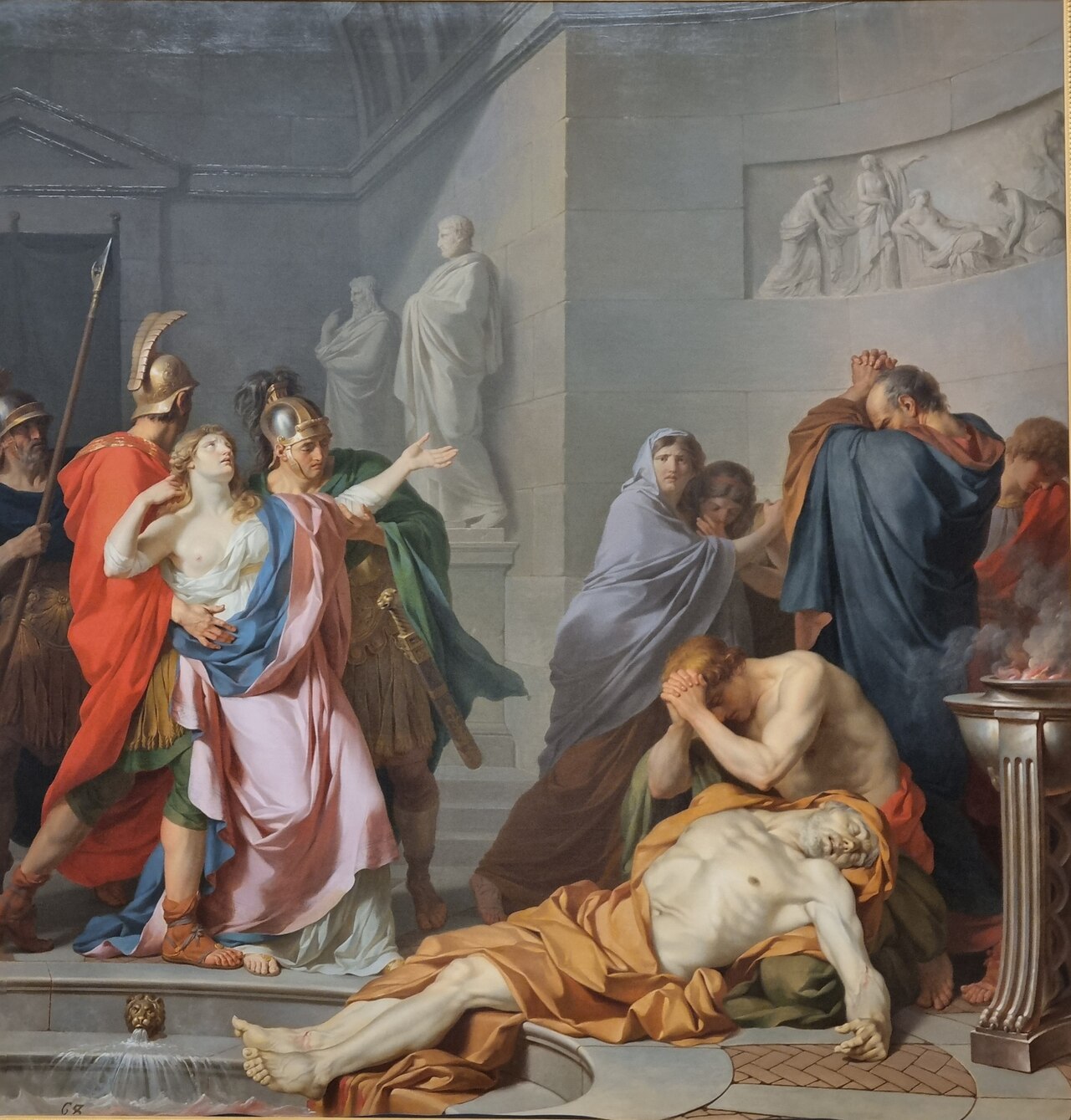
Painting of Seneca's death: an elderly man lies nude on the floor, draped in orange cloth, with a bearded man kneeling beside him. Women in robes and armed soldiers in helmets stand in a stone hall with statues and a relief, and a brazier smokes at right.Painting

Secondary source

La mort de Sénèque

Jean-Charles Nicaise Perrin · 1788

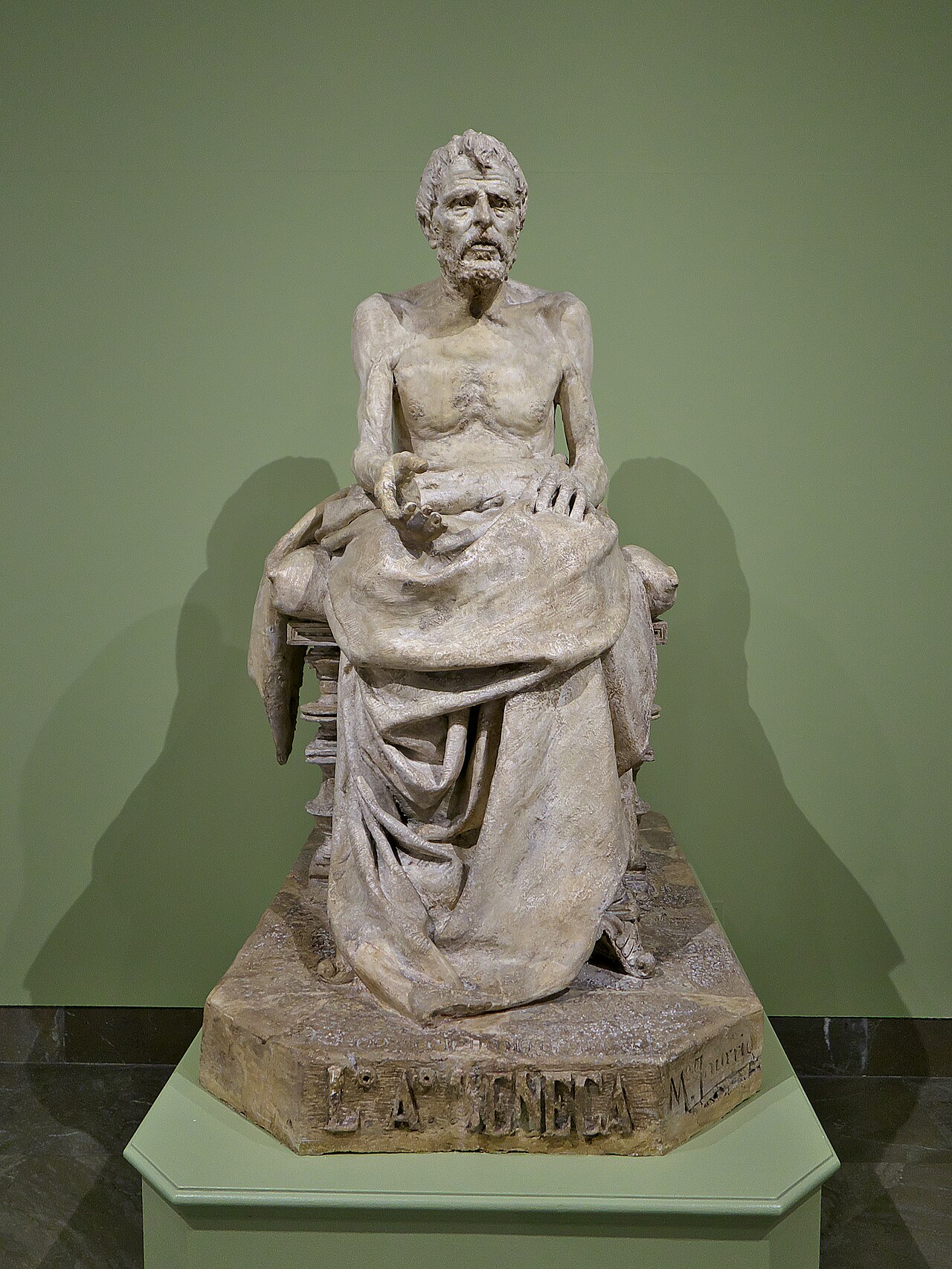
Photo of a pale plaster sculpture of the seated philosopher Seneca, an emaciated bearded old man with a bare chest and a heavy cloth draped over his legs, on a hexagonal base inscribed 'L. A. SENECA' and 'M. Inurria', against a green wall.Sculpture

Secondary source

Seneca

Mateo Inurria · 1894-1895

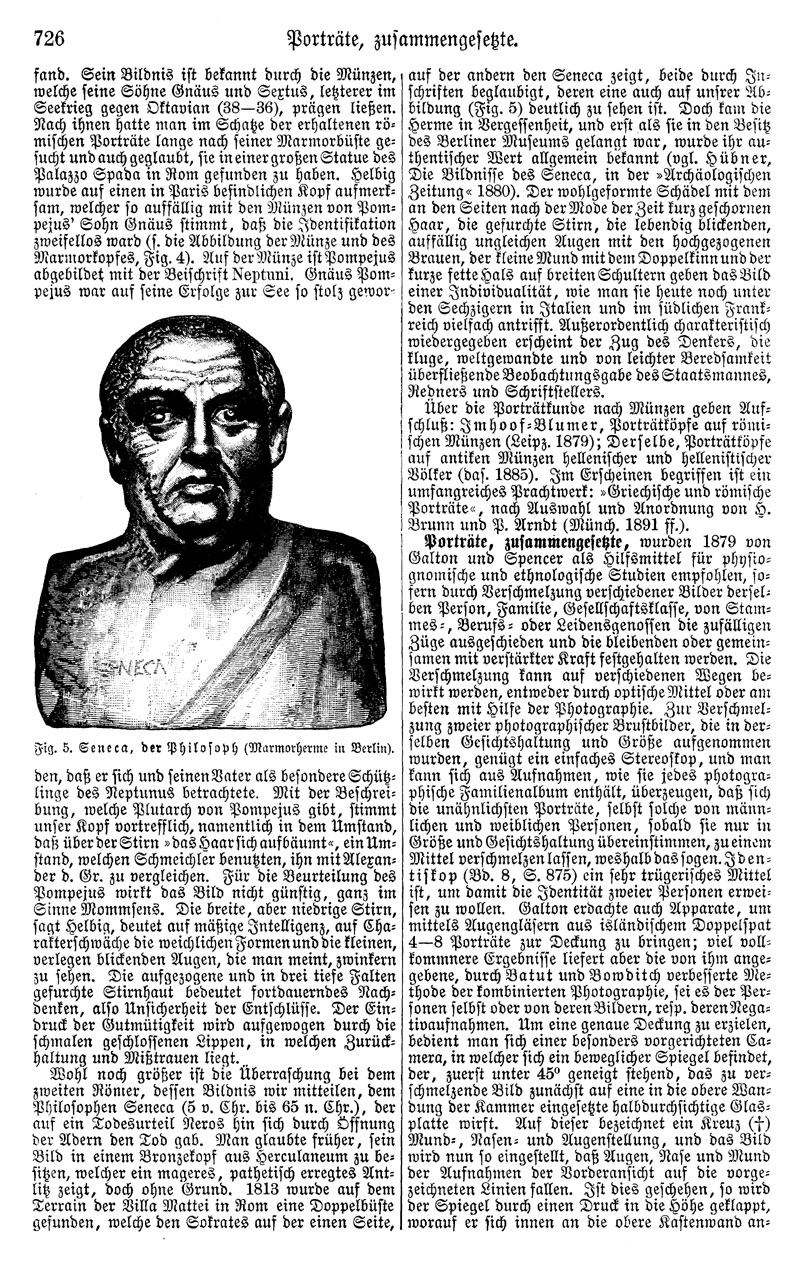
Scanned page 726 of a German encyclopedia in black-letter type, titled 'Porträte, zusammengesetzte'. Two columns of text sit around a woodcut engraving of a bust of Seneca, labeled 'SENECA', with the caption 'Fig. 5. Seneca, der Philosoph (Marmorherme in Berlin).'Document

Secondary source

Meyers Konversationslexikon page with portrait of Seneca

Joseph Meyer · 1885-1890

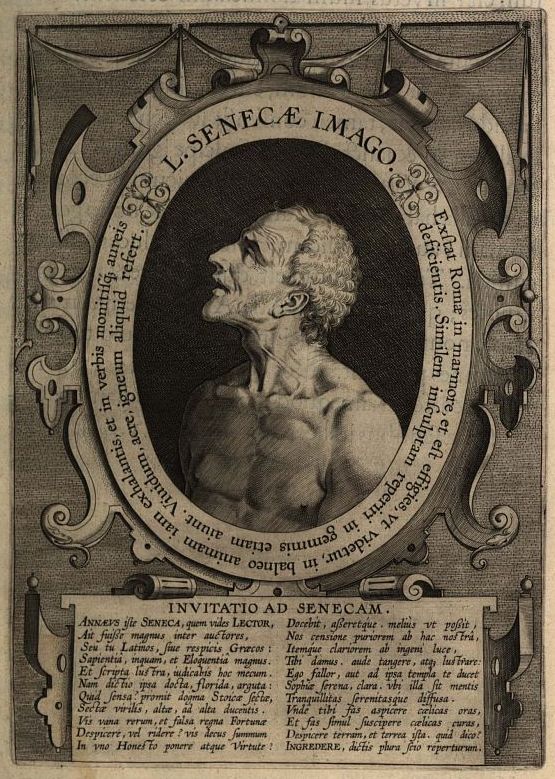
Engraved print of a bust of an elderly bald man with curly hair and bare shoulders, facing left, in an oval frame. Above reads L. SENECAE IMAGO. Latin verses in a decorative border surround it and a Latin text titled INVITATIO AD SENECAM sits below.Painting

Secondary source

Portrait of Seneca the Younger by Theodore Galle

Theodore Galle · 1605

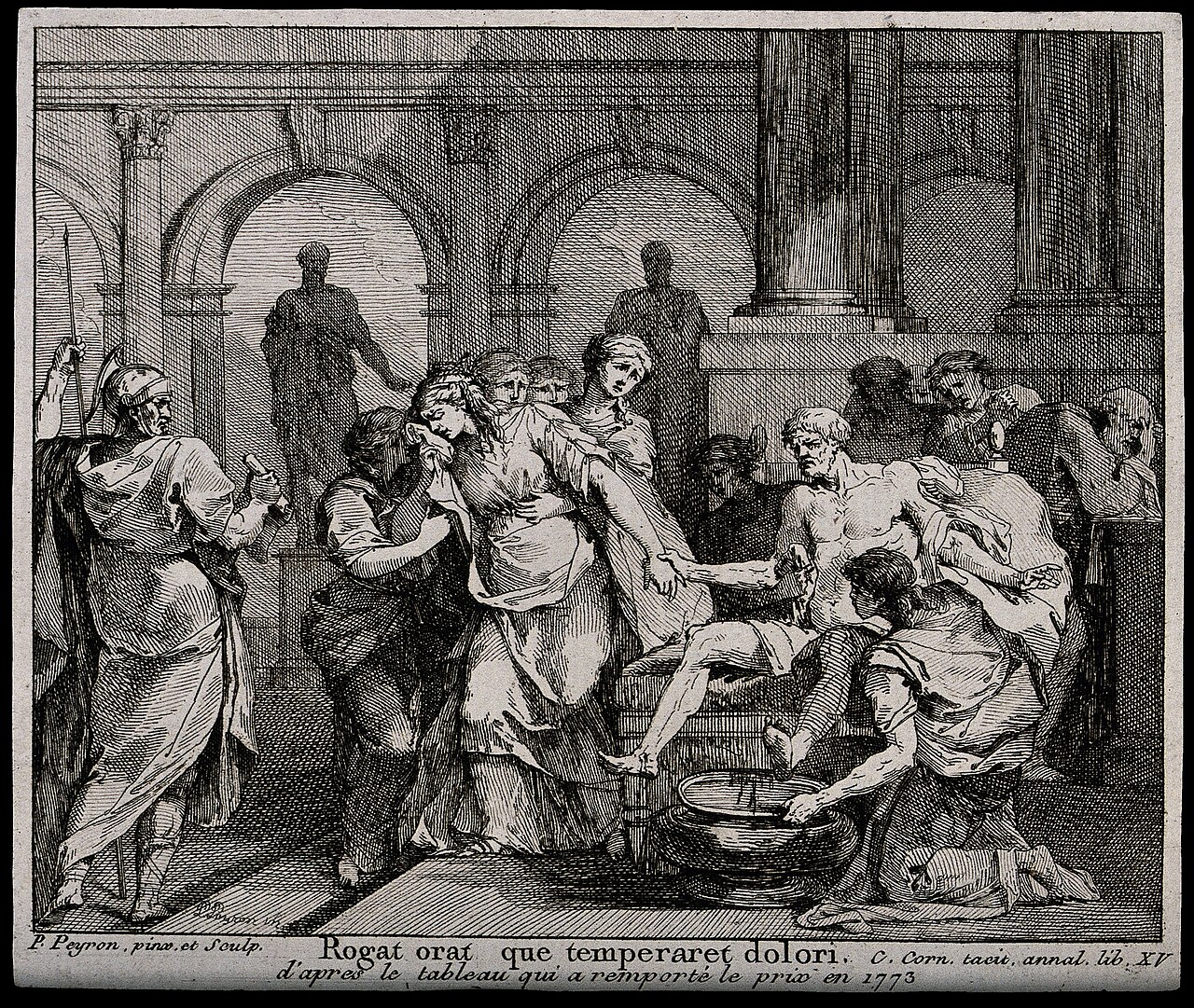
Engraving of a Roman scene in a colonnaded hall with arches and columns. A pale, shirtless older man sits on a bench with his legs in a basin of water, while a woman in a long robe leans toward him, a figure in a cloak stands at left, and onlookers stand at right. Latin caption below reads Rogat orat que temperaret dolori. Signed P. Peyron, pinx. et Sculp.Painting

Secondary source

Seneca committing suicide in a bath

Jean-François-Pierre Peyron · c. 1773

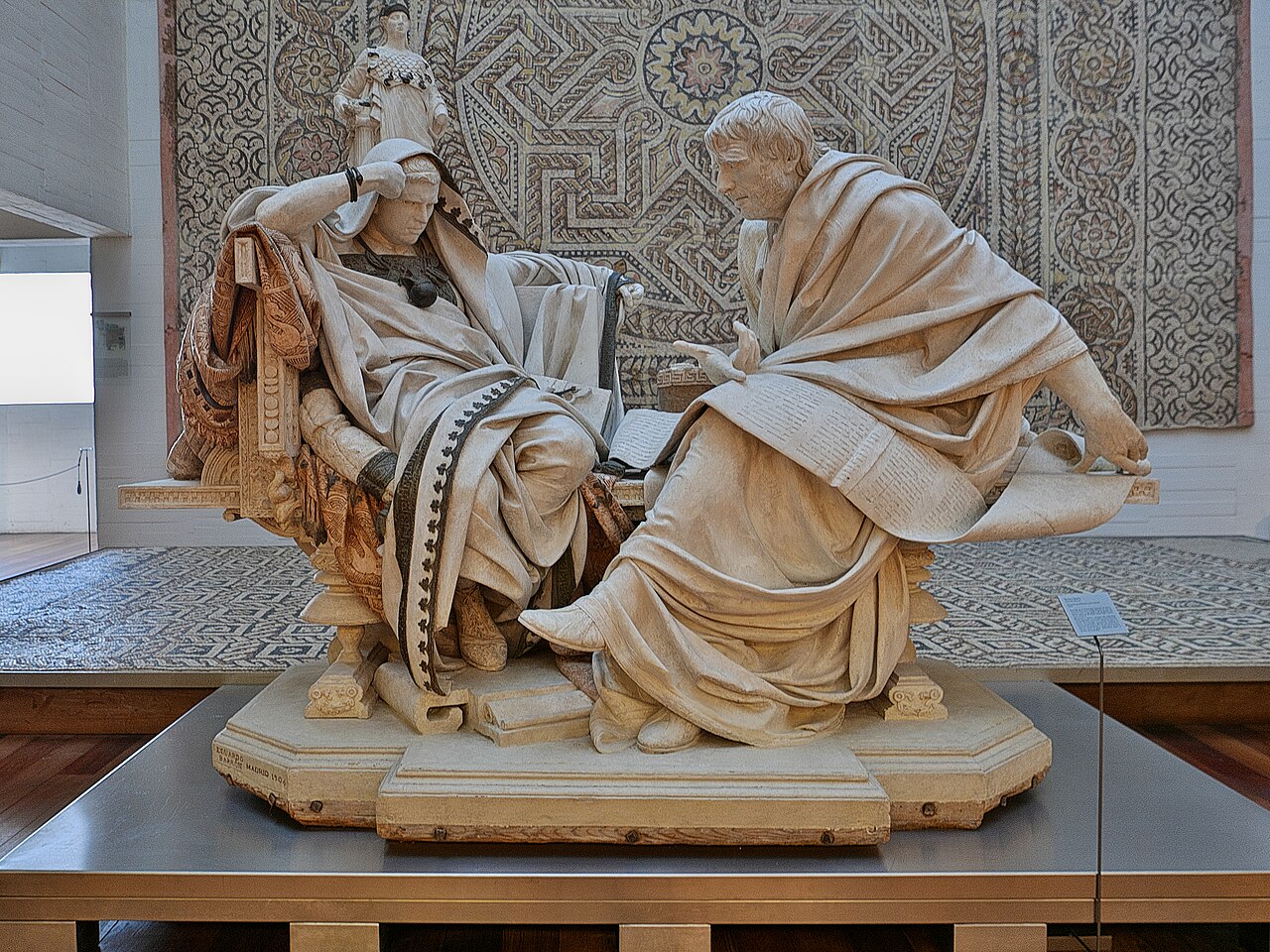
Marble-colored sculpture group on a stepped plinth in a museum hall. A seated figure in a draped robe, one hand on his head, sits on an ornate throne-like chair. Beside him a standing bearded older man in a flowing toga gestures while holding a scroll. A small statue of a woman stands behind the throne, and a mosaic hangs on the wall.Sculpture

Secondary source

Nero and Seneca, plaster sketch by Eduardo Barrón

Eduardo Barrón · 1904

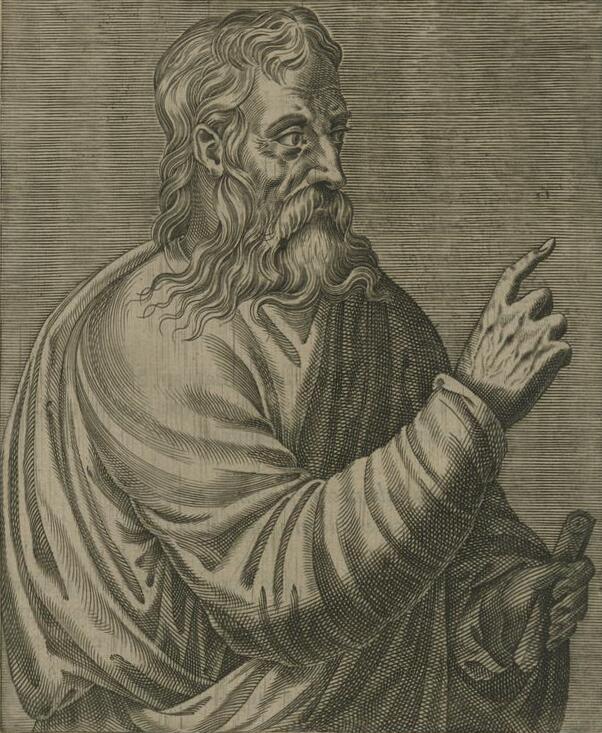
Engraving of a bearded old man in profile facing right, with long wavy hair and a draped robe, raising his right index finger and holding a scroll in his left hand. Fine parallel hatching fills the background.Painting

Secondary source

Portrait of Seneca in Thevet's Les vrais pourtraits

1584

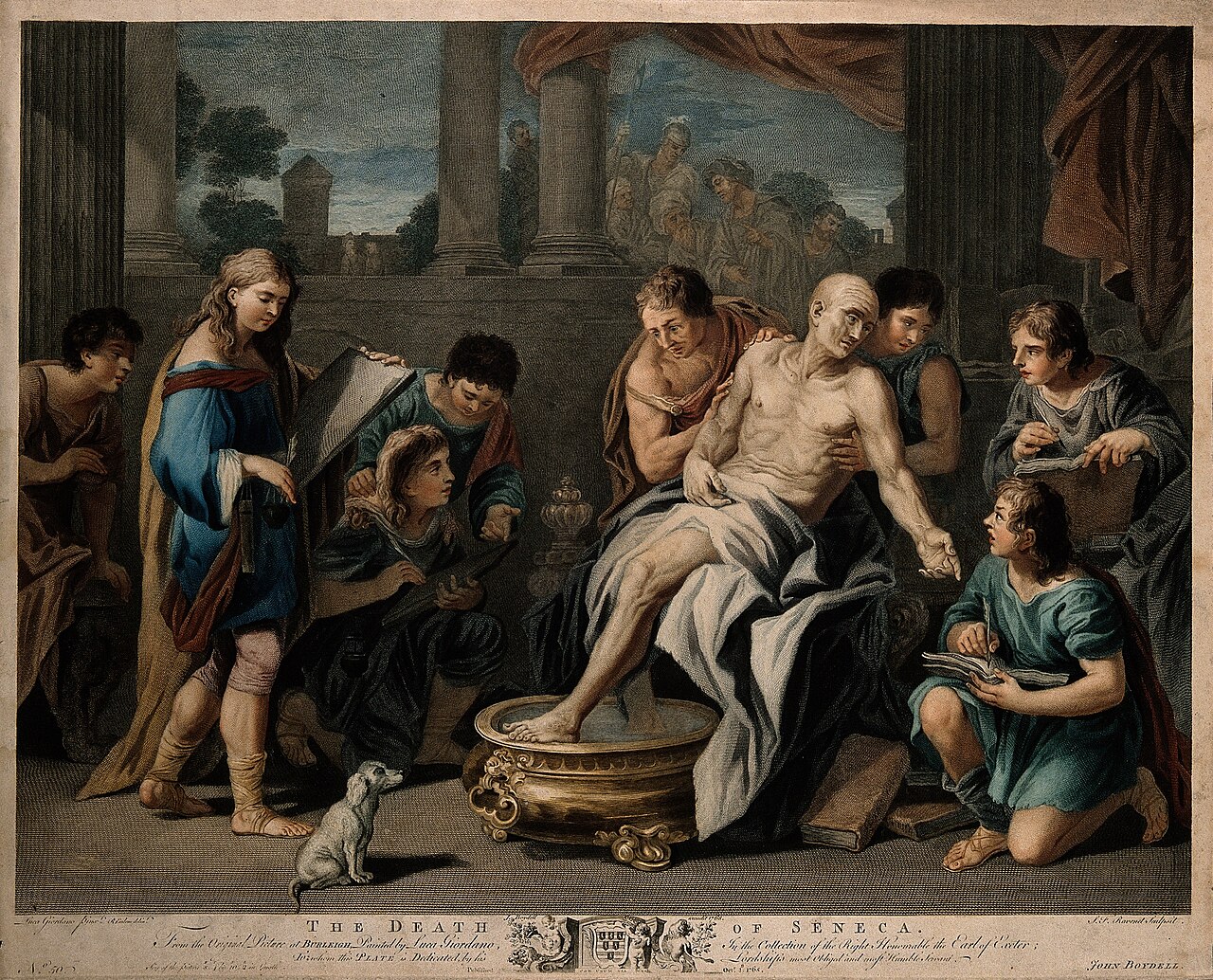
Colored engraving titled The Death of Seneca. A bald, thin old man sits naked from the waist up in a brass basin, his foot in water, while a group of young men and a boy with a dog look on and write. Soldiers and columns stand in the background.Painting

Secondary source

The Death of Seneca, engraving after Luca Giordano

Simon François Ravenet

Want the full shelf? Chat with Seneca in the app and open the Sources panel — every quote links back to the original.

Use Seneca in class

1 collection

A ready-made collection from the Humy team that features Seneca. Preview it, then try it free.

Trusted by educators worldwide

Conversations
375,000+
Real exchanges between students and historical figures
Messages exchanged
4,142,000+
Across every figure, classroom and language
Historical figures
100,000+
Each informed by a curated biography and selected sources
Languages supported
50+
From English and Spanish to Arabic and Korean

Paying customers

Used by 98 schools and universities

Partner school logo
Tecnológico de Monterrey logo
Hyper Island logo
Partner school logo
Chambersburg Area School District logo
Broward County Public Schools logo
Nebo School District logo
National Louis University logo
South Florida PBS logo
Punahou School logo
University of Wisconsin–River Falls logo
Partner school logo
Partner school logo
Archbishop Mitty High School logo
Kingsburg High School logo
Norwalk Public Schools logo
Partner school logo
Connections logo
Partner school logo
Moore Public Schools logo
Partner school logo
Partner school logo
Partner school logo
Partner school logo
Robbinsville Public Schools logo
Partner school logo
Partner school logo
Partner school logo
Tecnológico de Monterrey logo
Hyper Island logo
Partner school logo
Chambersburg Area School District logo
Broward County Public Schools logo
Nebo School District logo
National Louis University logo
South Florida PBS logo
Punahou School logo
University of Wisconsin–River Falls logo
Partner school logo
Partner school logo
Archbishop Mitty High School logo
Kingsburg High School logo
Norwalk Public Schools logo
Partner school logo
Connections logo
Partner school logo
Moore Public Schools logo
Partner school logo
Partner school logo
Partner school logo
Partner school logo
Robbinsville Public Schools logo
Partner school logo
Partner school logo

What educators are saying

“We enjoyed the program last year and used it frequently.”
“My students say it’s a welcome change of pace. I’m not a fan of the “sage on the stage” model, so I try to incorporate research-oriented and self-paced activities. With Humy, students have to take charge of their learning. They’ve become more adept at critical thinking, forming better questions, and improving their reading comprehension. The interview feature has been my go-to tool. I create assignments where students must ask historical figures a set number of questions, then summarize the responses to ensure they’re truly absorbing the material. This approach lets them actively explore the past rather than passively consuming information.”
“Humy has helped me bring historical figures, sometimes long past, to life. When my students interact with these figures in real-time, it eliminates some of the perceived “ancient” characteristics of my curriculum. This has shifted my students’ thinking away from viewing history as abstract or irrelevant. Real-time interactions make historical figures relatable, even allowing students to ask off-topic questions that help put historical lives in a more relevant context for 13-year-olds. The feature I use the most is the interview feature. After teaching a topic, most recently Gandhi and Joan of Arc, I have the students ask pointed, focused questions. We practice good conversation techniques beforehand, teaching them to listen (or read) carefully and formulate thoughtful follow-up questions rather than just interrogating. It helps students practice effective conversation skills.”

FAQ

Frequently asked questions

Who is Seneca?
Ancient Roman philosopher and statesman. On Humy.ai you can chat with an AI version of Seneca that draws on a short biography and 98 historical sources during the conversation — by text or voice, in 42 languages.
Is Seneca AI free?
Seneca is part of Humy's full library of more than 100,000 figures, which comes with a paid plan. A free account (no credit card) includes 20 messages a month with the free library's figures, so you can try how the conversations work first.
What sources does the Seneca AI use?
It draws on a short biography and 98 historical sources (books, paintings and letters), including “Epistulae Morales ad Lucilium”, “De Brevitate Vitae” and “Annals”. Each source has its own page on Humy.ai.
How historically accurate is the AI version of Seneca?
Each figure uses a short biography and a small set of selected historical sources as context (retrieval-augmented generation), so answers stay closer to known material than the model's general knowledge alone. It isn't a citation-grade research tool — like any LLM, the AI can get details wrong or extrapolate. Treat it as a strong starting point for inquiry and cross-reference important claims.
Can I talk to Seneca by voice?
Yes. In addition to text chat, you can call Seneca and hear their voice respond in real time — useful for auditory learners, interview practice and Socratic dialogue.
Is Humy.ai safe and compliant for schools?
Yes. Humy.ai is used by more than 100 schools, universities and organisations. The platform is FERPA- and GDPR-aligned, supports SSO, and offers an IT-approval pack tailored for school procurement teams.

Ready when you are

Start chatting with Seneca now.

20 messages free · No credit card · Available in 50+ languages.