Portrait of Virgil

AI Historical Figure

Virgil

Ancient Roman poet known for his epic poem "The Aeneid.

Chat with Virgil via text or voice — in 42 languages, drawing on a curated biography and 79 historical sources. Available 24/7.

Start chatting with Virgil20 messages free · No credit card
Lived
70–19 BCE
From
Italy
Known for
Literature & writing
Virgil

Virgil

Online · responds in seconds

Hello — I'm Virgil. Ancient Roman poet known for his epic poem "The Aeneid. What would you like to ask me?

20 messages free · No credit card · Powered by Humy.ai

Live preview · Switch between 42 languages above · Send a message to continue in the app

Multilingual

Talk to Virgil in 42 languages

Ask Virgil questions in any language below, and the rest of Humy's app speaks it too. Pick yours to open the chat in that language.

Also in German (Austria), German (Switzerland), English (UK), English (Australia), English (Canada).

The sources behind this AI

79 sources · 45 books · 23 paintings · 3 artifacts · 3 sculptures · 3 speeches · 2 documents

Virgil doesn’t improvise from thin air. The AI is grounded in 79 curated historical sources students can inspect. Open any of them to see what informs the conversation.

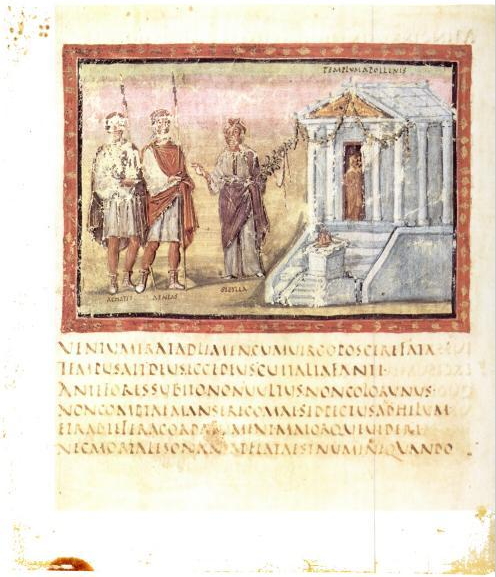
Illuminated manuscript page from a Virgil codex: a framed painting shows two armored men with spears and a woman in a violet robe gesturing toward a white temple with columns and garlands. Below is a block of Latin capital script in several lines.Book

Secondary source

Aeneid

Virgil · 29-19 BCE

Book

Primary source

Aeneid, Book VI

Virgil · 29-19 BCE

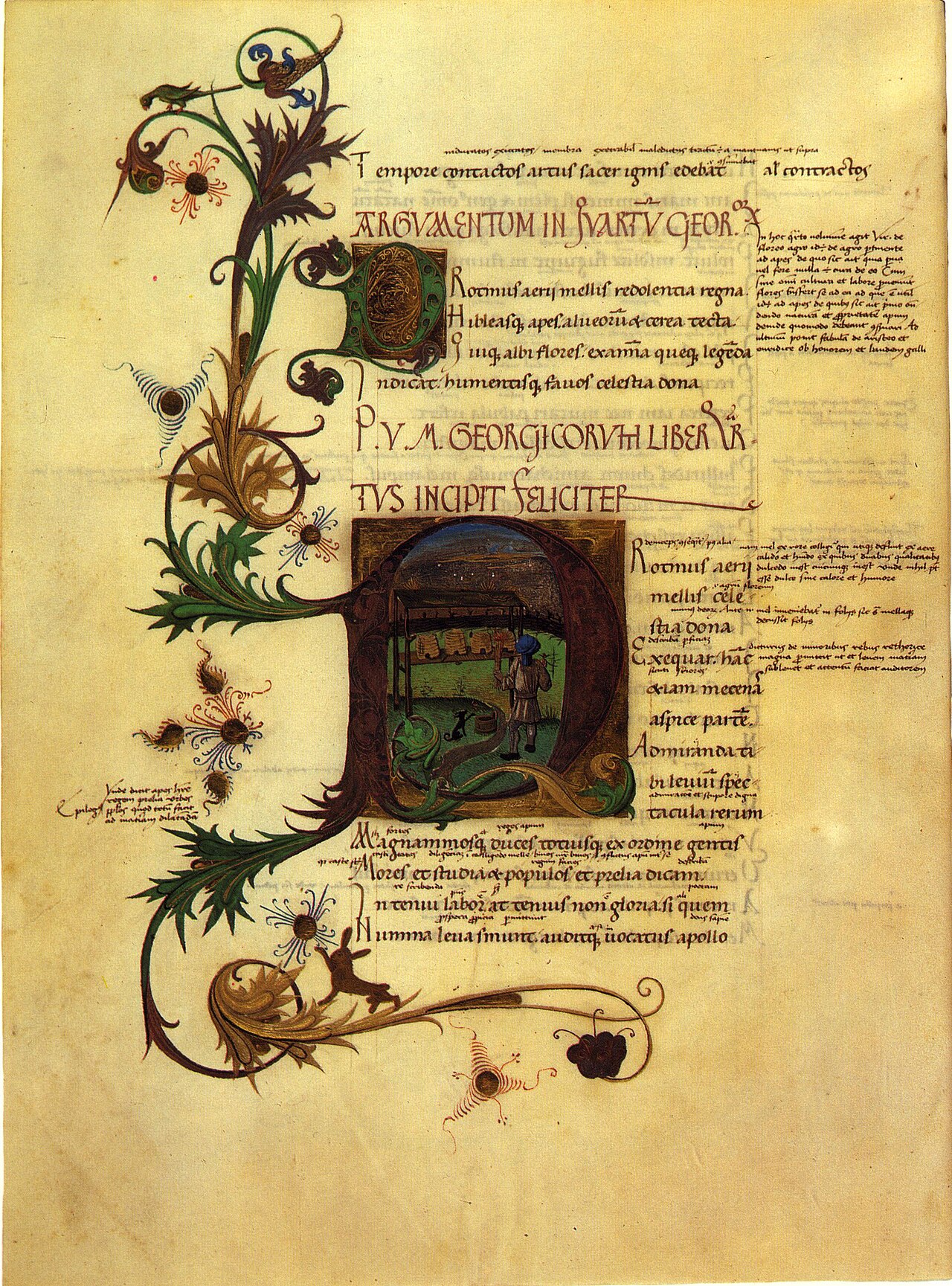
Illuminated manuscript page with a large decorated initial D containing a painted scene of a man in blue hat tending bees near hives under a tree, with green and gold foliage borders and columns of handwritten Latin text.Book

Primary source

Georgics

Virgil · c. 29 BC

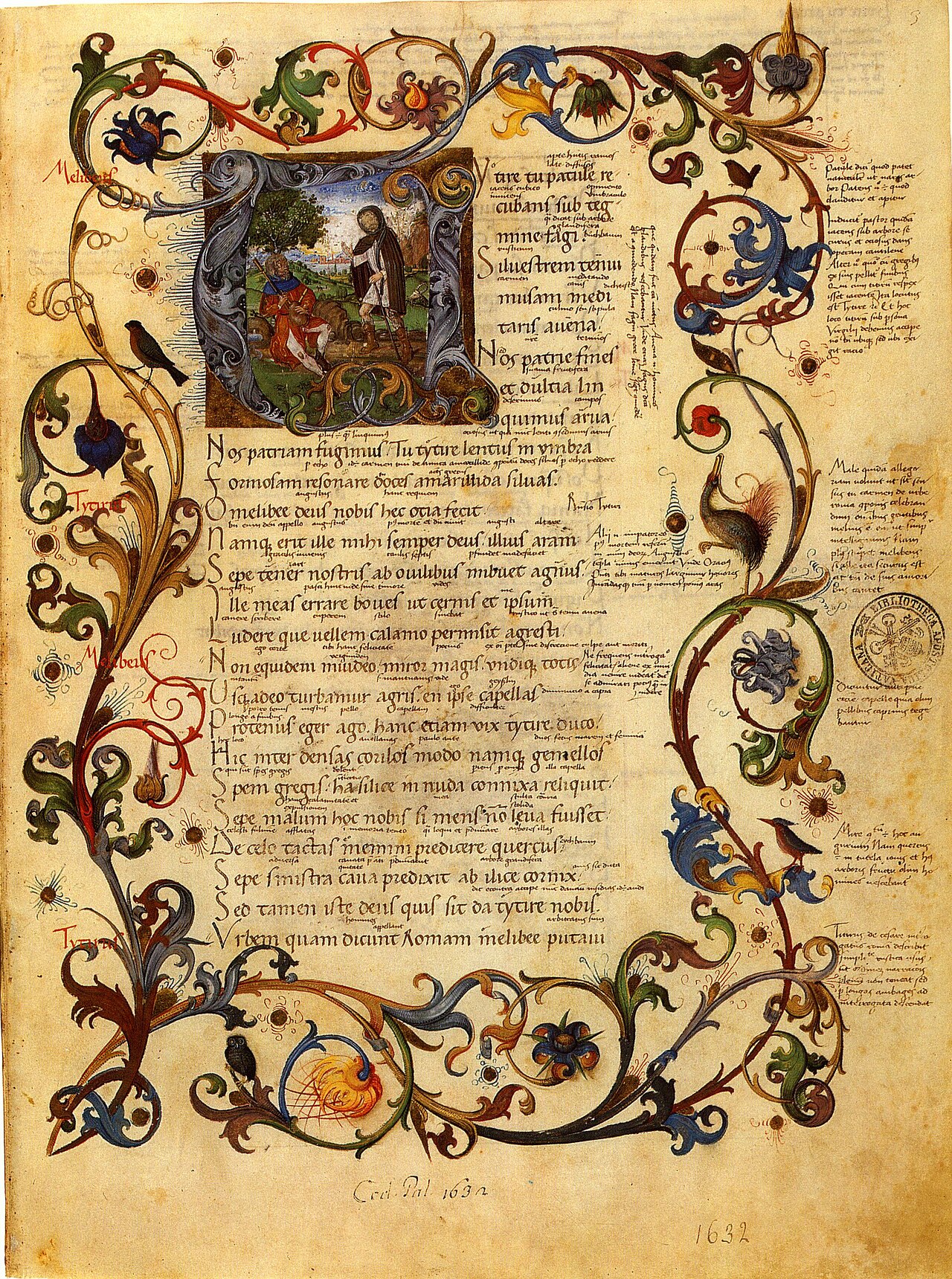
Illuminated manuscript page with Latin text in brown ink, a decorative border of scrolling foliage, birds and flowers, and a framed miniature painting of two shepherd figures in a green landscape. Marginal notes and a red-ink heading appear, with the shelfmark Cod. Pal. 1632 at the bottom.Book

Primary source

Eclogues

Virgil · c. 42-38 BCE

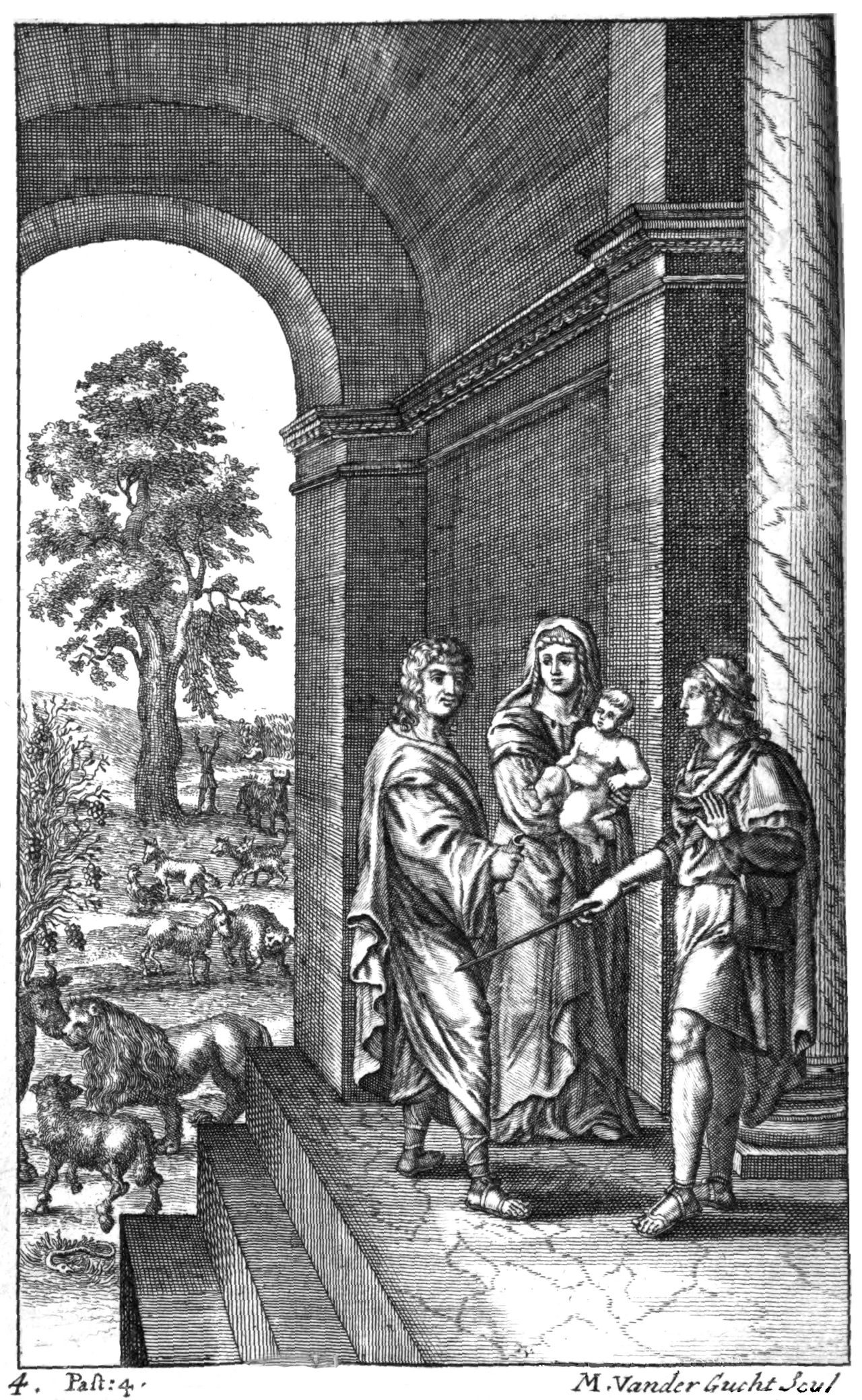
Engraved plate for Pastoral 4 showing a colonnaded arched portico with steps. Three figures stand on the terrace: a bearded man with long hair, a woman holding an infant, and a standing young man in a short tunic. Beyond the arch, a pastoral landscape with a tree, grazing sheep, a lion, and a goat. Caption reads 'Past: 4' and 'M. Vander Gucht Scul'.Book

Primary source

Eclogue 4

Virgil · c. 41 BC

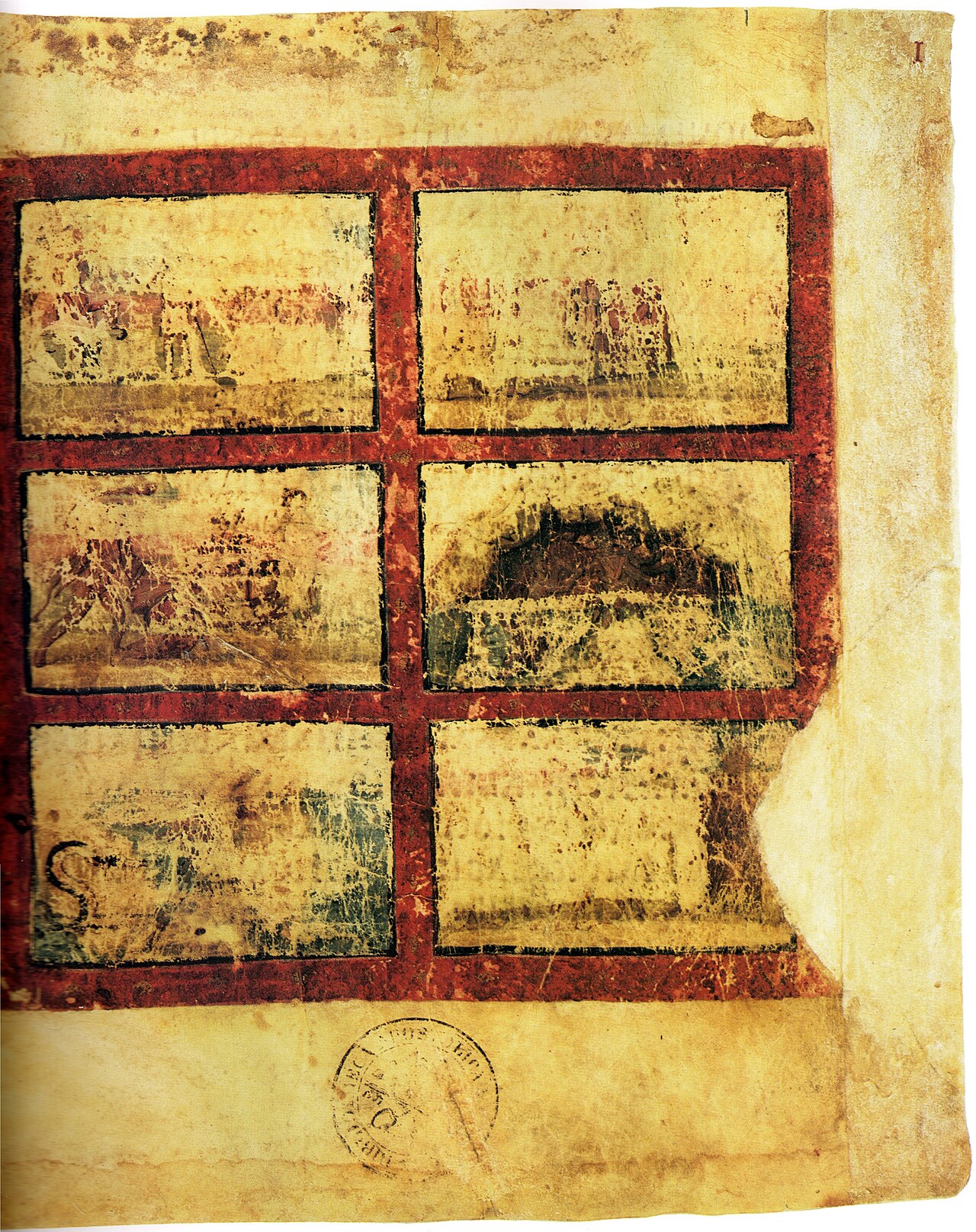
Scan of a page from an old manuscript on aged, yellowed parchment. Six small painted scenes sit in a grid framed by red bands with black borders. The paint is faded and worn, with a circular stamp at the bottom and a roman numeral in the top right corner.Book

Secondary source

Vergilius Vaticanus

c. 400 AD

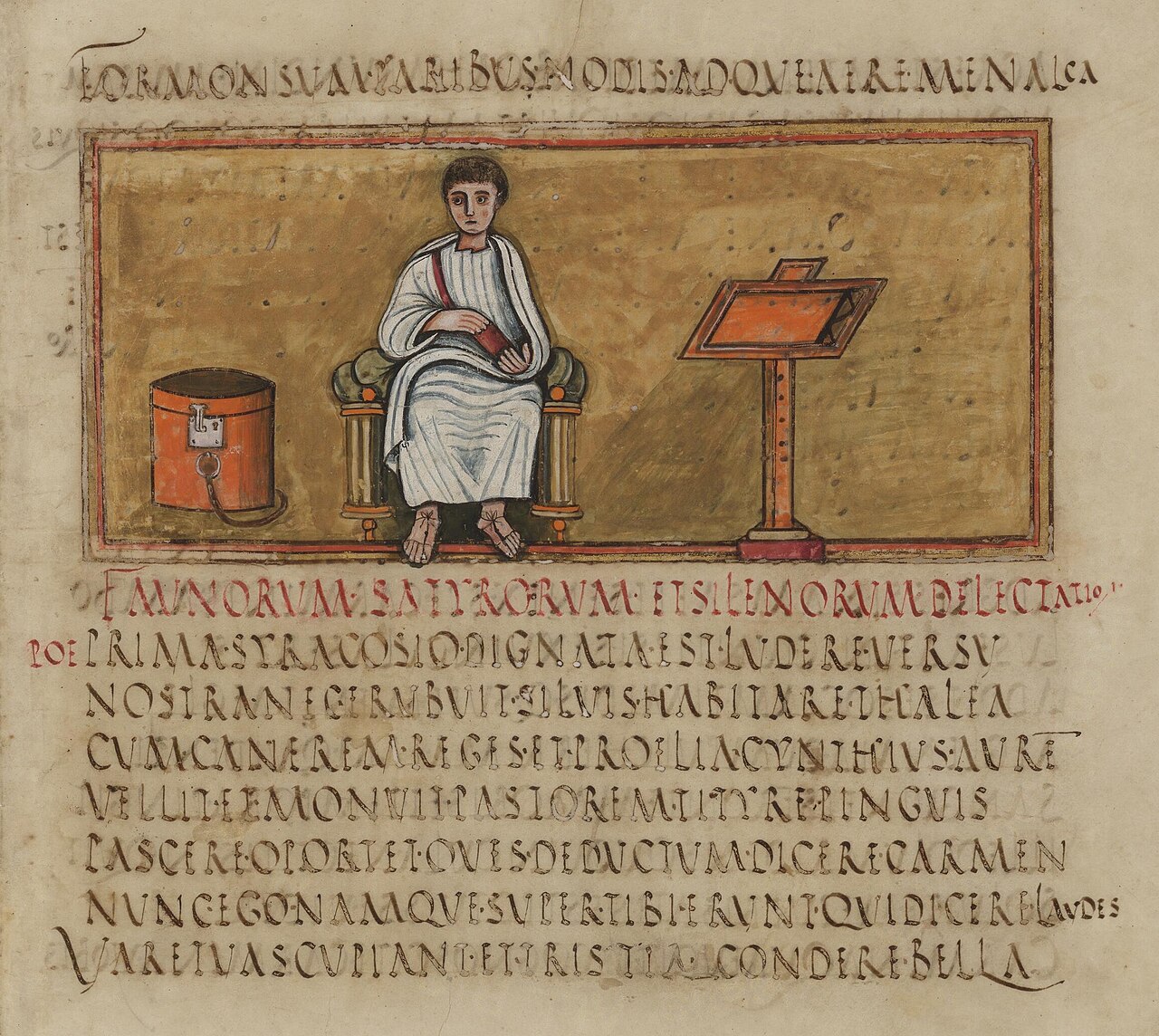
Illuminated manuscript folio with a painted miniature of a seated man in a white robe holding a red book, beside a red chest and a red lectern, above and below lines of Latin text in red and black ink.Painting

Secondary source

Vergilius Romanus

c. 500 AD

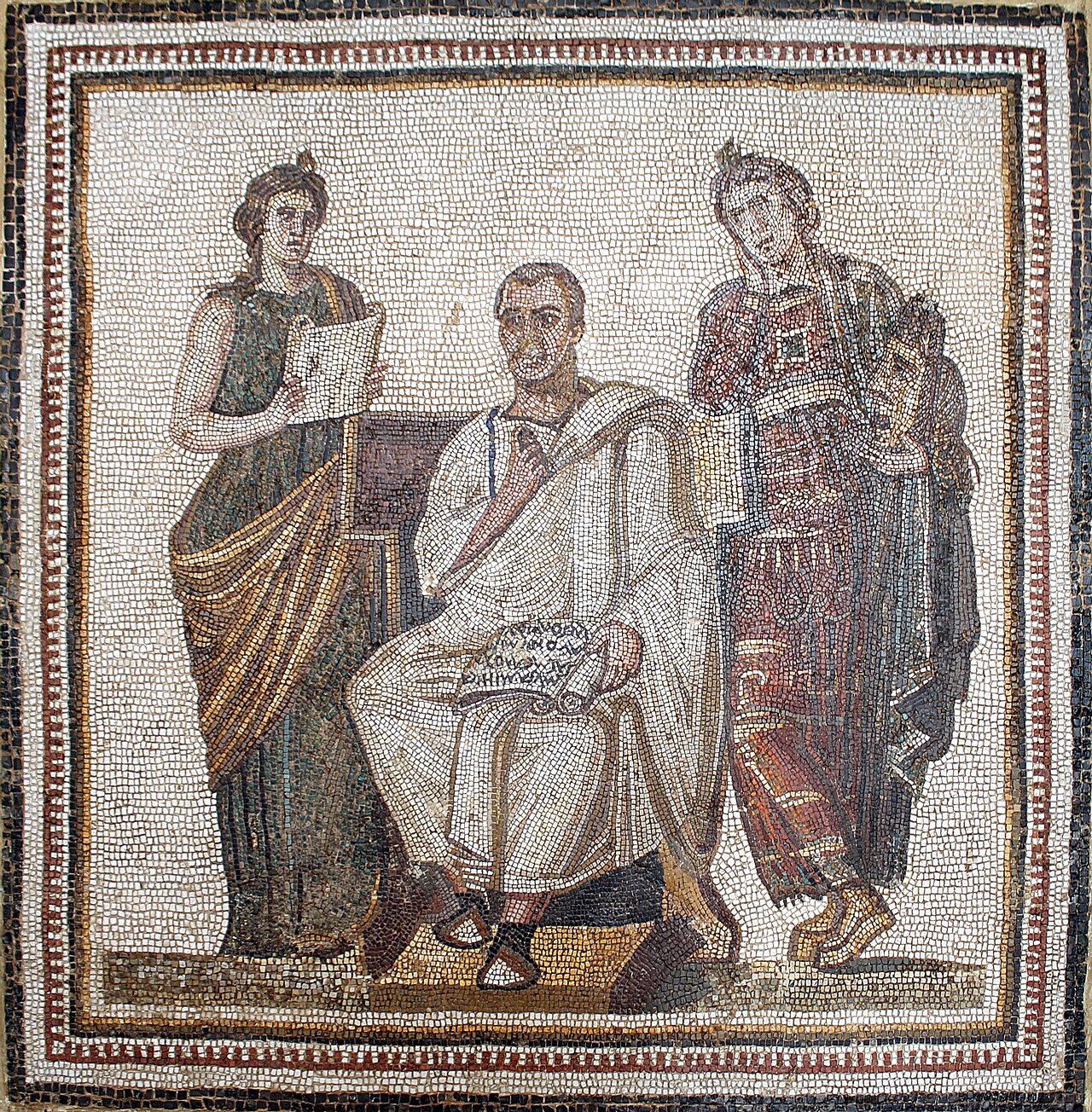
Roman mosaic of a seated man in a white toga holding a scroll, flanked by two standing women in draped robes, one holding a scroll and one with a stylus. Mosaic tesserae in cream, brown, green, and red on a bordered square field.Artifact

Secondary source

Virgil mosaic

3rd century AD

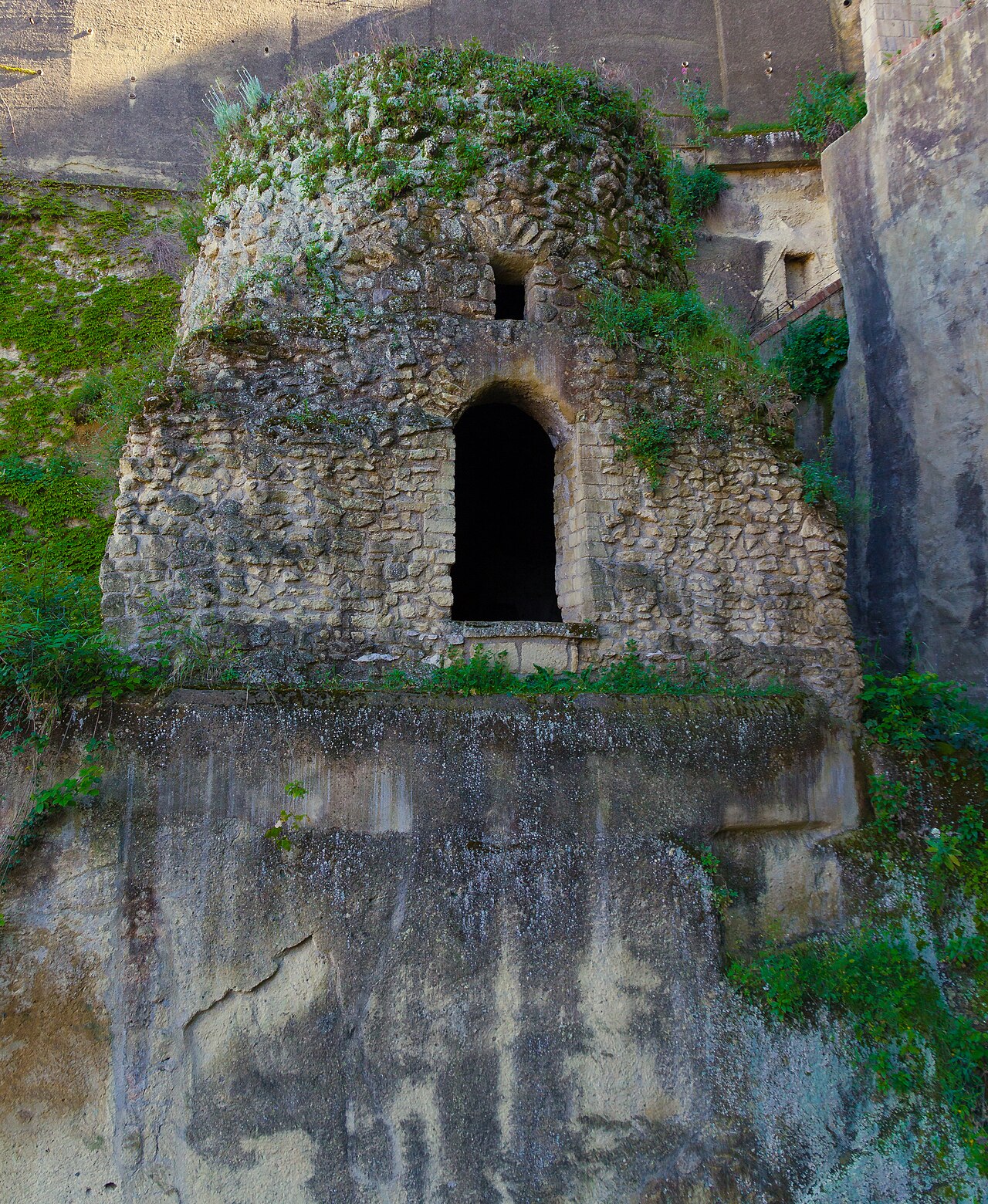
A weathered stone structure with an arched dark doorway set into a rocky cliff face, covered with green plants and moss on top. Stone blocks of irregular shape form the walls, with a smaller window opening above and a concrete-like retaining wall below.Artifact

Secondary source

Tomb of Virgil

Unknown Roman builders · 1st century BC–1st century AD

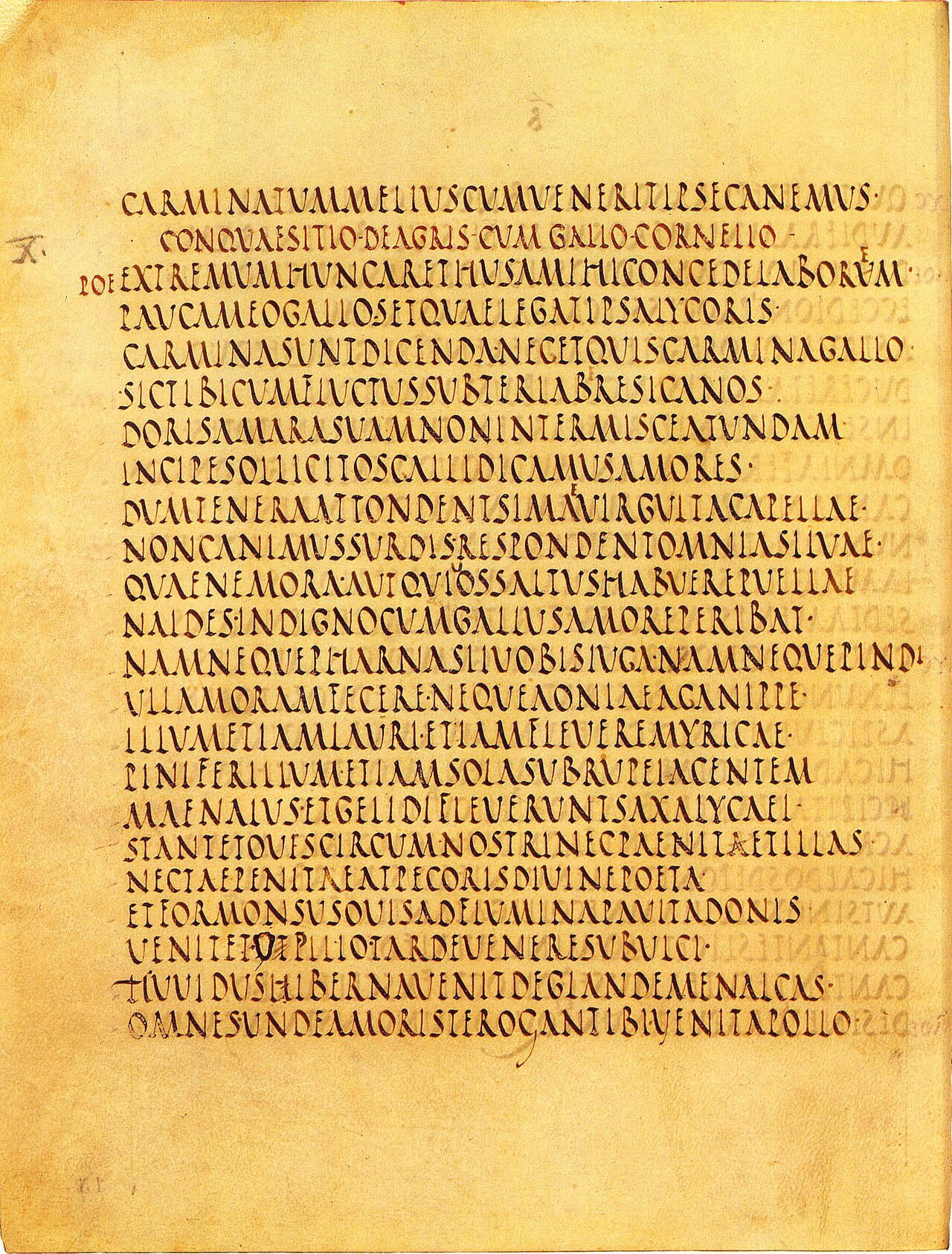
Parchment page of a handwritten Latin manuscript in brown ink, with red-highlighted initial letters and a marginal note. Text lines are in uncial-style script, with a red heading at top and a sketch-like mark in the lower margin.Book

Secondary source

Vergilius Palatinus

Unknown Roman scribe · c. 500 CE

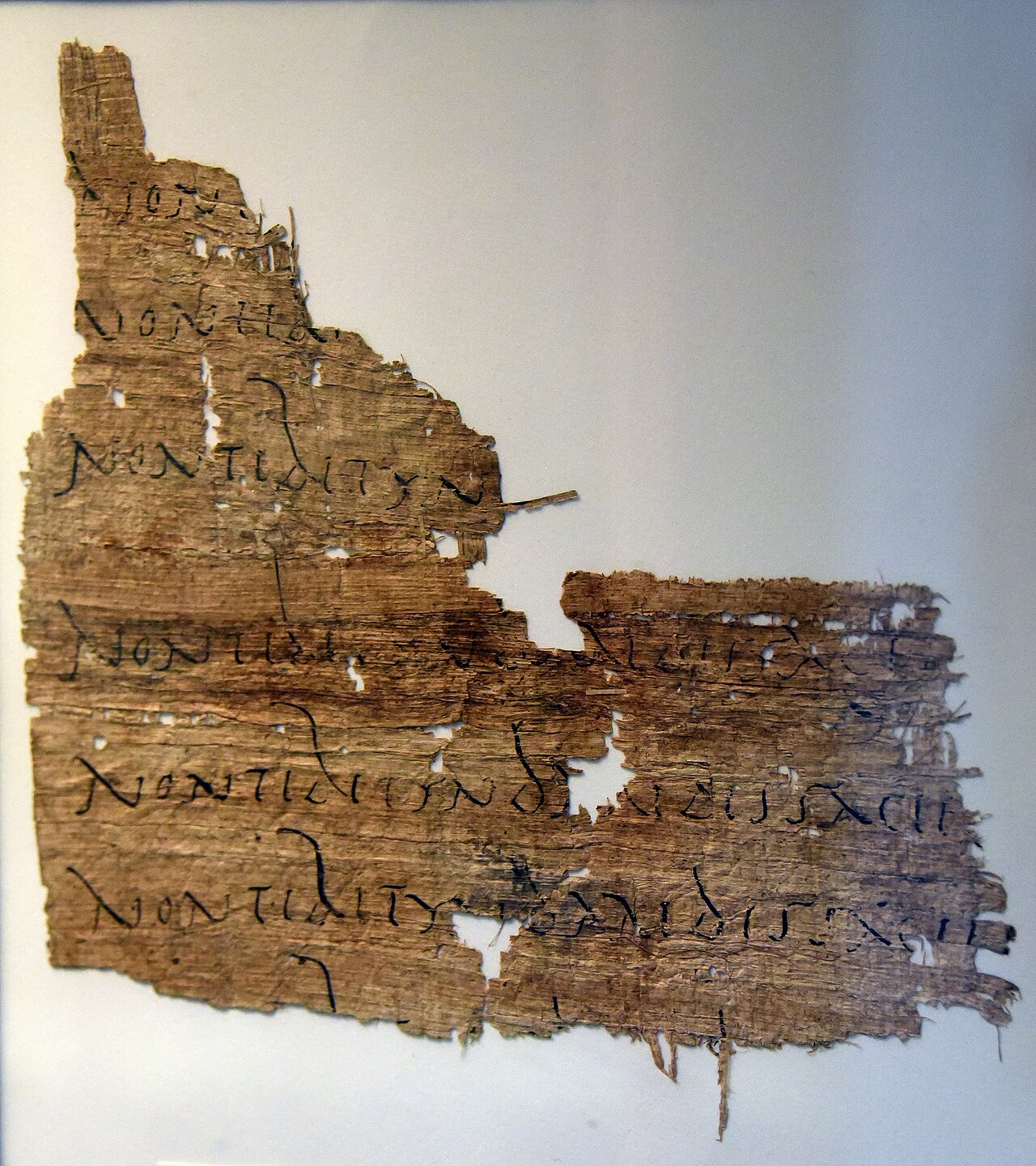
Photo of a torn, brown papyrus fragment mounted against a pale background. Faded dark ink Latin letters in several horizontal lines are visible, with the same line of text repeated across the rows. Holes and tears are visible in the sheet.Document

Primary source

Hawara Papyrus 24

1st century CE

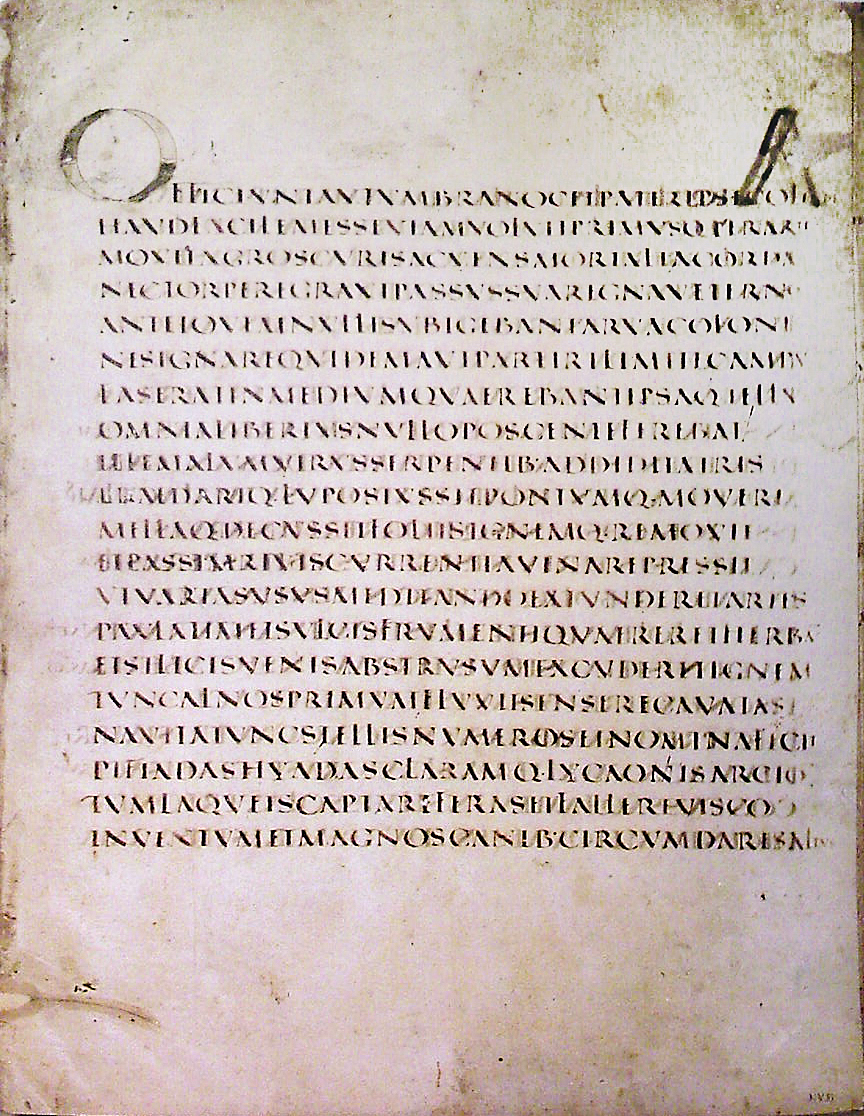
Scan of a manuscript page with a large decorated initial letter at upper left and a large capital letter at upper right. Several lines of dark uncial-style Latin capitals run across the parchment, which is yellowed and worn at the edges.Book

Secondary source

Vergilius Augusteus

c. 4th century CE

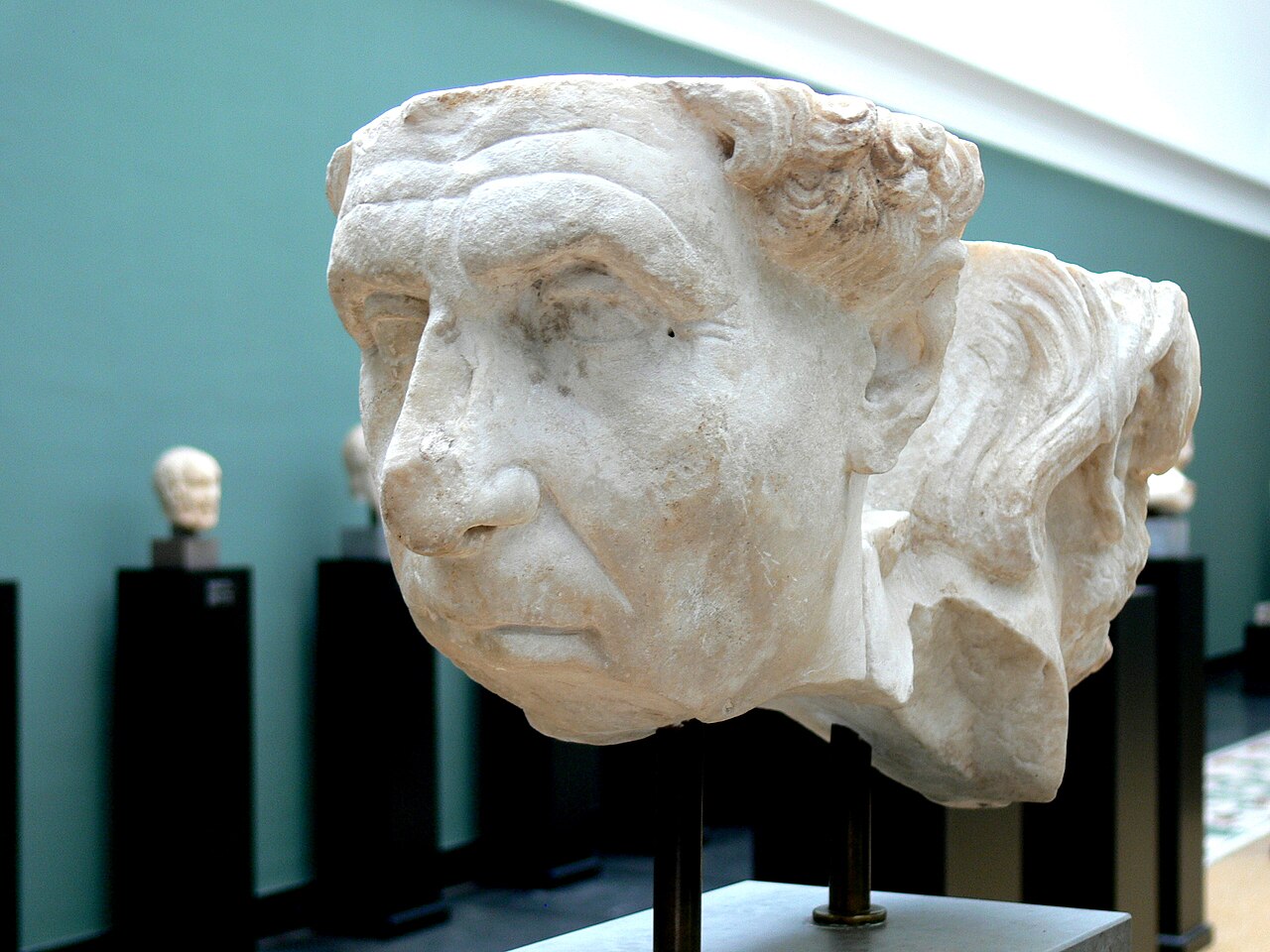
Photograph of a white marble sculpted head of an older man with deeply furrowed brow, heavy-lidded eyes, and a wavy-haired head section at the right, mounted on a metal stand in a museum gallery with other busts in the background.Sculpture

Secondary source

Double Herm of Virgil and Ennius

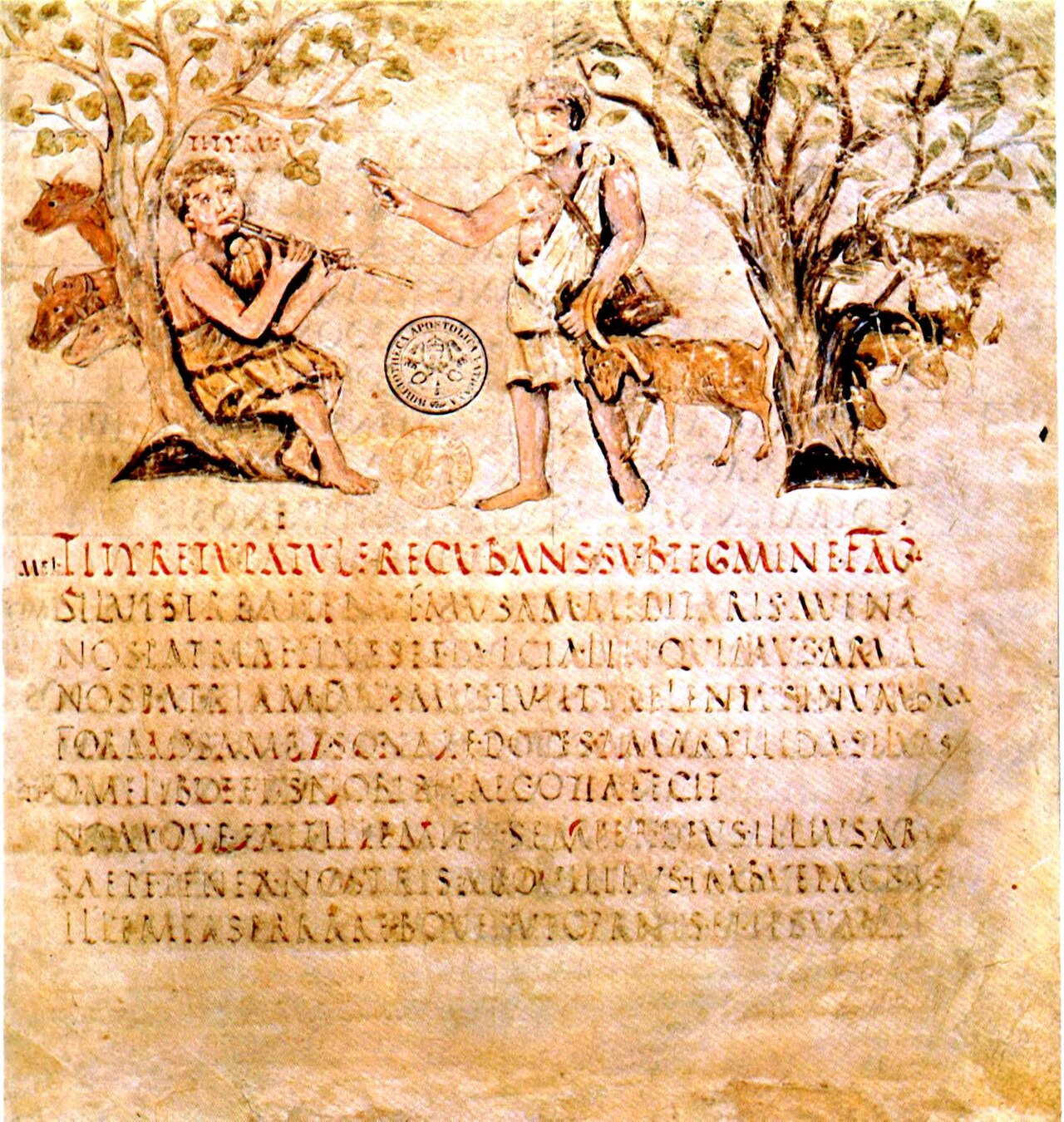
Page from the Vergilius Romanus manuscript showing an illuminated miniature above Latin text. On the left, a seated shepherd plays a pipe under a tree with goats; a standing shepherd with a staff gestures beside a goat. Red and black lettering runs below.Book

Primary source

Eclogue 1

Virgil · c. 41 BC

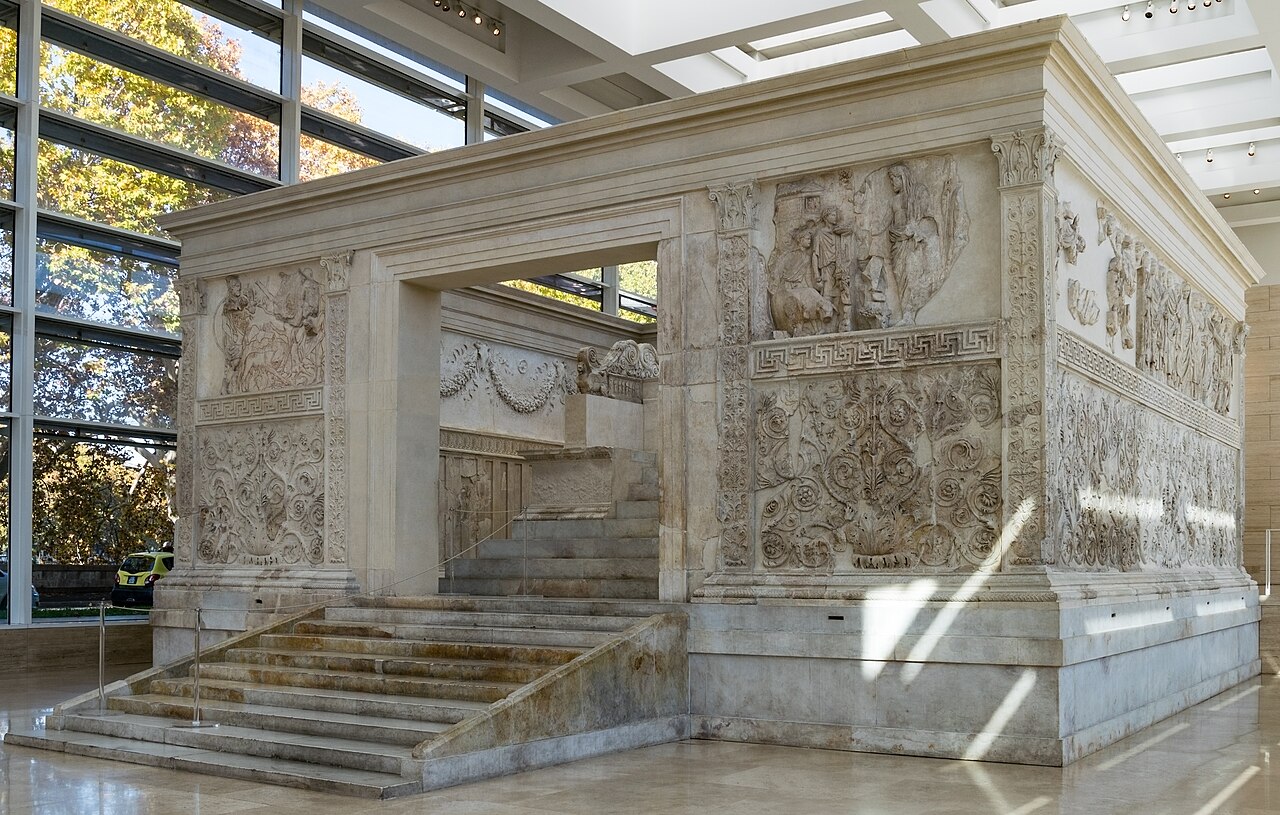
Marble enclosure of the Ara Pacis in a glass-walled museum hall, seen from the southwest. Carved relief panels decorate the walls, with a doorway and a stepped approach at the front.Artifact

Primary source

Ara Pacis

13-9 BCE

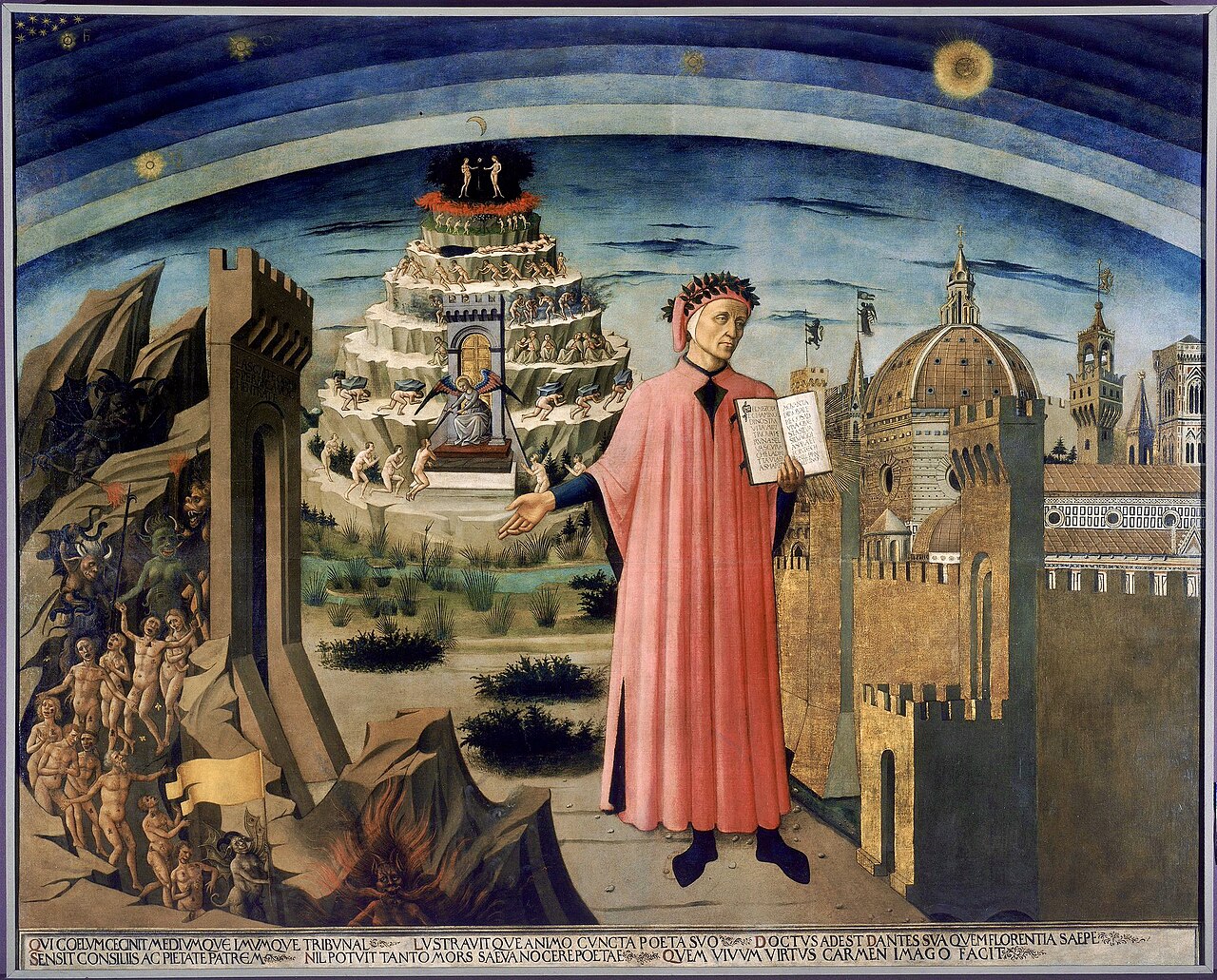
Painting of Dante in a red robe and laurel wreath, holding a book, gesturing toward Hell, Purgatory mountain, and Florence. Nude figures writhe in a lower-left inferno; an inscription runs along the bottom.Book

Secondary source

The Divine Comedy

Dante Alighieri · 1320

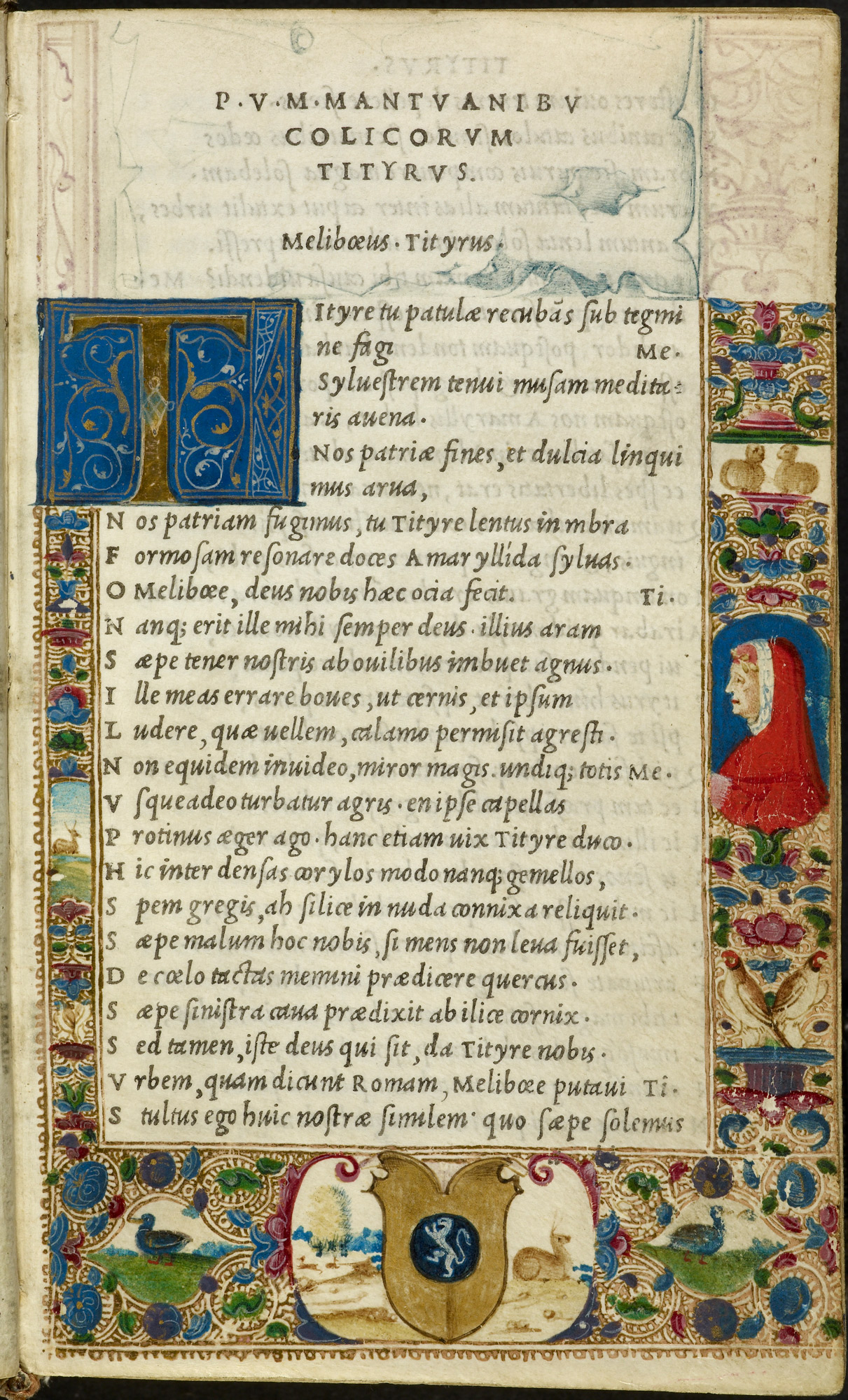
Printed page of a Virgil edition with a title block in capitals, a blue and gold decorated initial letter, a red-robed portrait figure in a side panel, and italic text in columns with floral and animal border decorations.Book

Secondary source

Vergilius, edited by A. P. Manutius, on vellum

Virgil · 1501

Book

Primary source

Eclogue 10

Virgil · c. 42-39 BC

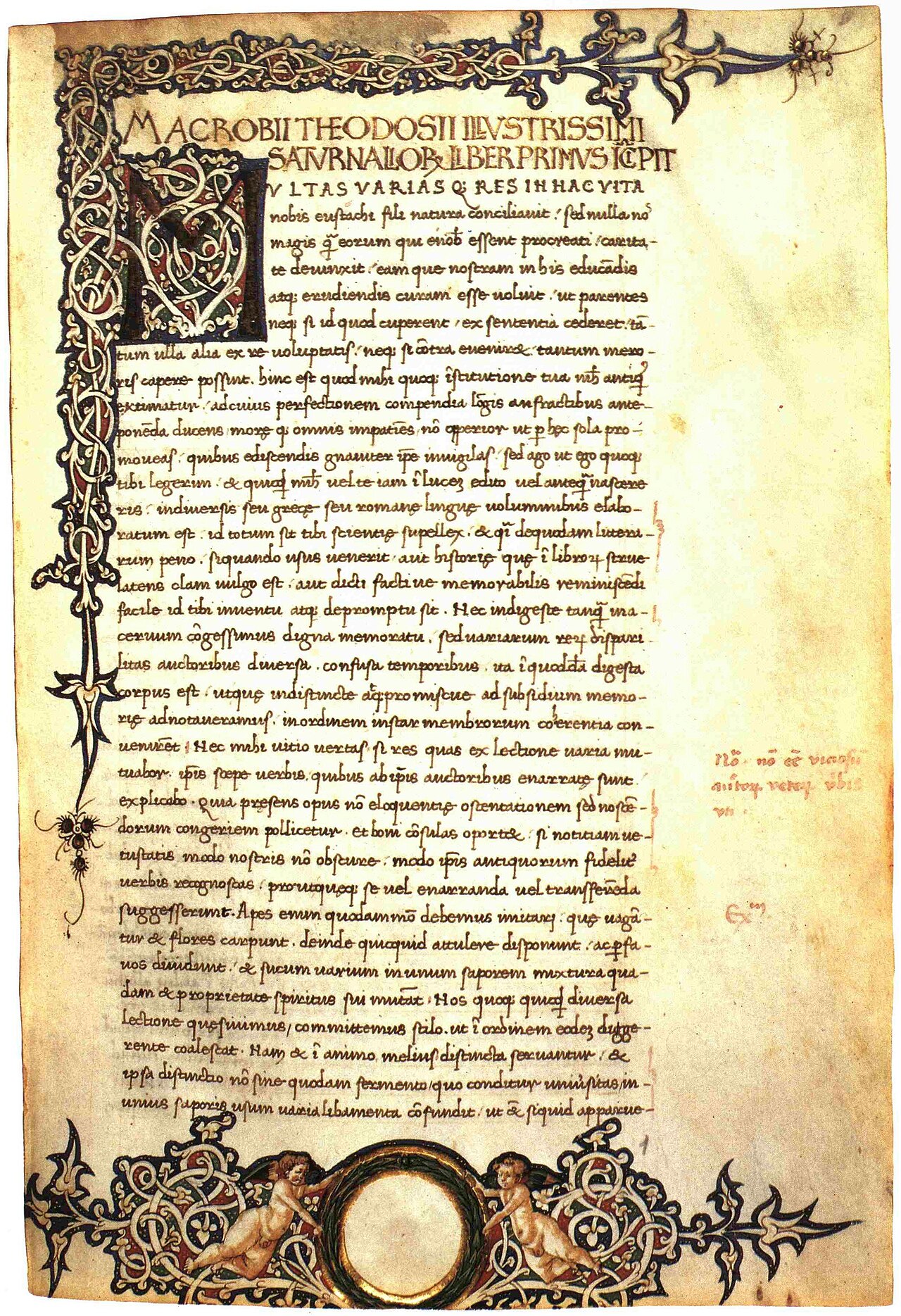
Manuscript page with an illuminated border of foliate and knotwork decoration, a large decorated initial M, and handwritten Latin text in brown ink headed 'MACROBII THEODOSII ILLUSTRISSIMI SATURNALIORUM LIBER PRIMUS INCIPIT'. Two painted putti flank a circular space at the bottom.Book

Secondary source

Saturnalia

Macrobius · c. 401-431 AD

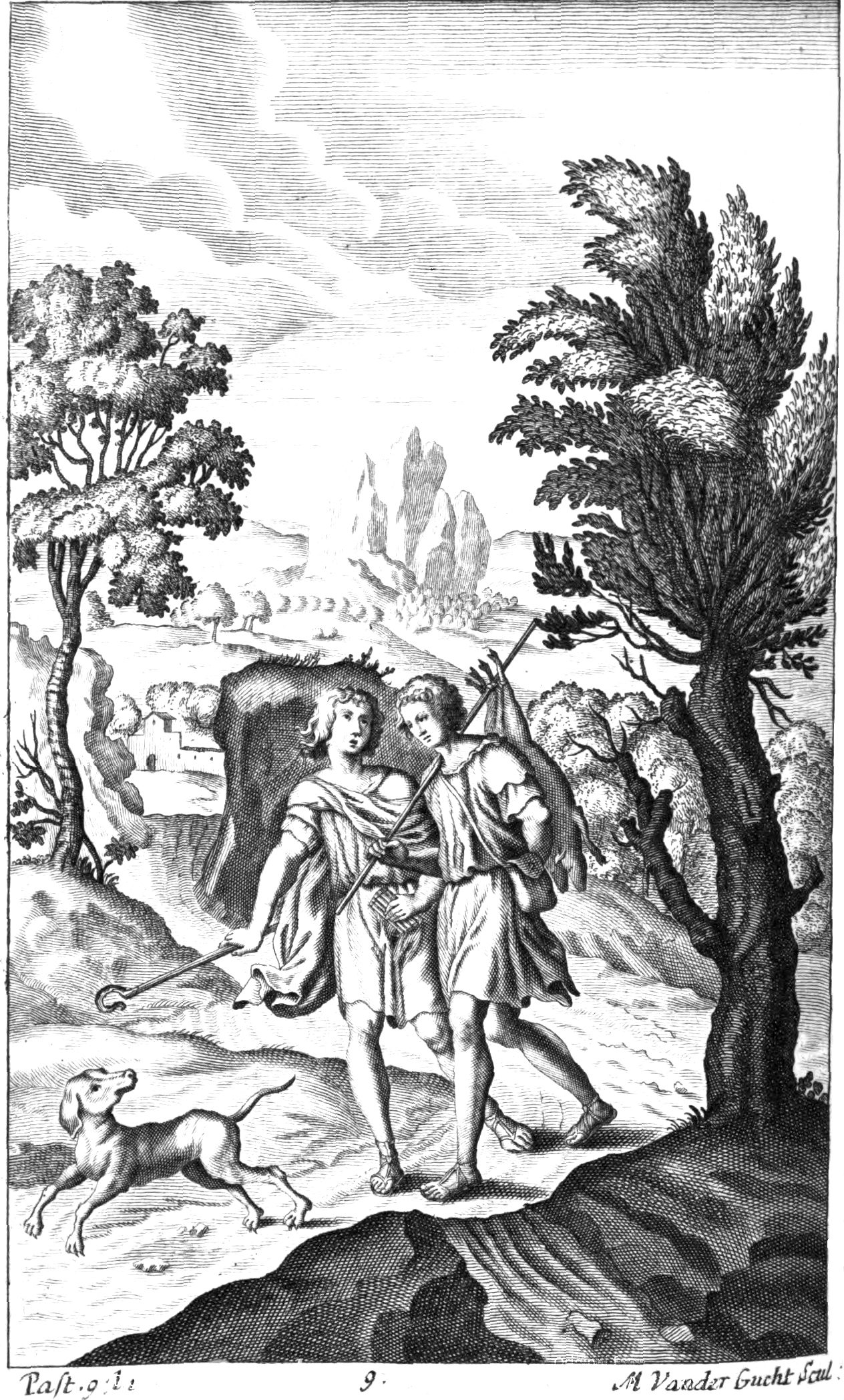
Engraved plate numbered 9 with caption 'Past. 9. 1.' at bottom left and artist credit 'M. Vander Gucht Sculp.' at bottom right. Two young shepherds walk left to right through a wooded landscape; the figure in front holds a crook and the one behind carries a staff over his shoulder. A dog trots at the lower left, and a tall tree stands at right with rocky hills and a building in the distance.Book

Primary source

Eclogue 9

Virgil · c. 40 BC

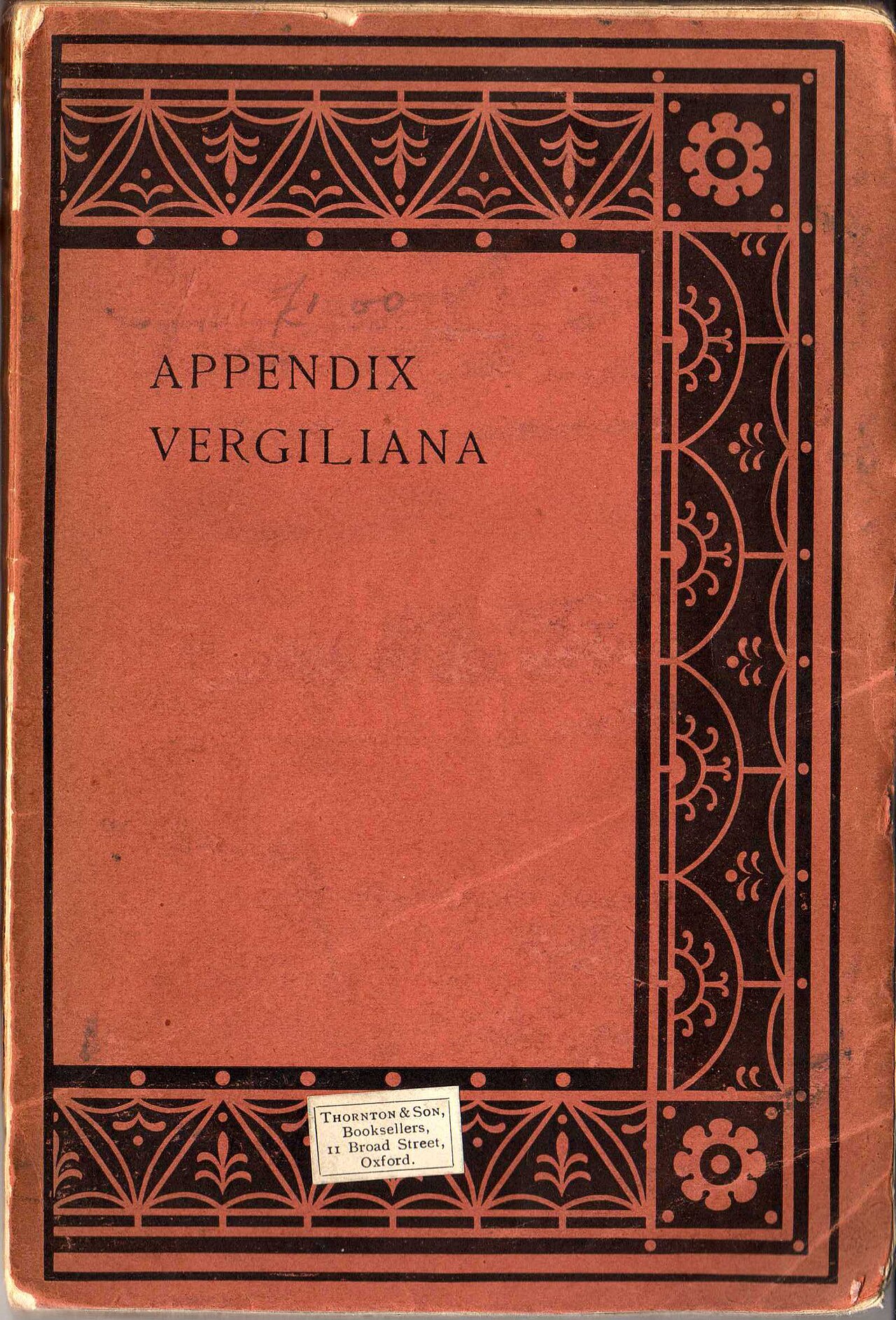
Front cover of a reddish-orange paperback book with dark brown and orange decorative borders. The title reads 'APPENDIX VERGILIANA' in black capitals. A bookseller's label at the bottom reads 'Thornton & Son, Booksellers, 11 Broad Street, Oxford.' Faint handwriting appears near the top.Book

Secondary source

Appendix Vergiliana

1st century AD

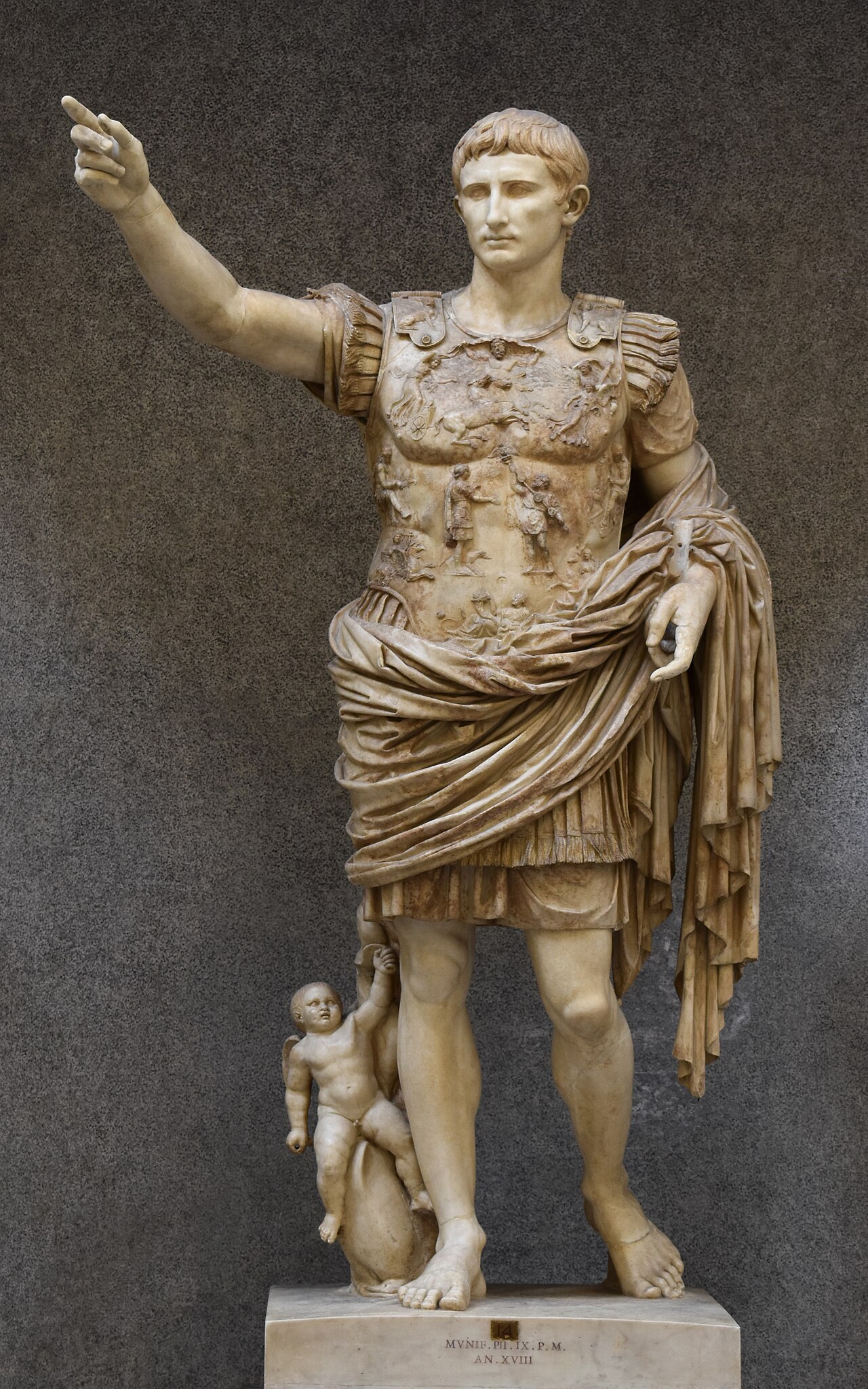
Marble statue of a standing man in armor, right arm raised pointing forward, with a draped cloak over his left arm. A small cupid-like figure with a dolphin stands beside his right leg. Plain dark grey background.Sculpture

Secondary source

Augustus of Prima Porta

c. 19 BCE or later

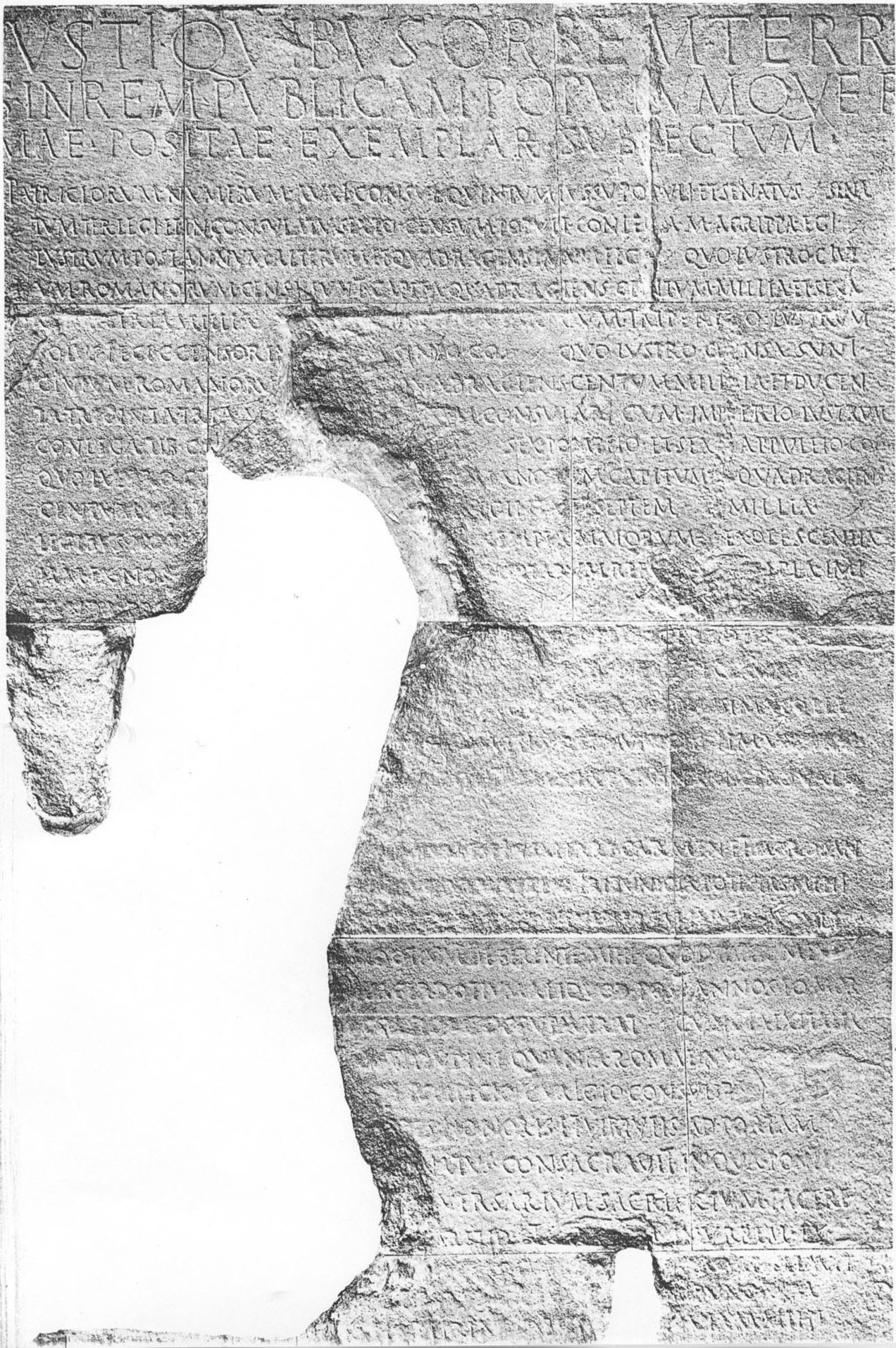
Black-and-white photograph of a large weathered marble inscription in Latin capital letters, arranged in horizontal lines across several panels, with a large white area where stone is missing on the left side.Document

Primary source

Res Gestae Divi Augusti

Augustus · 14 AD

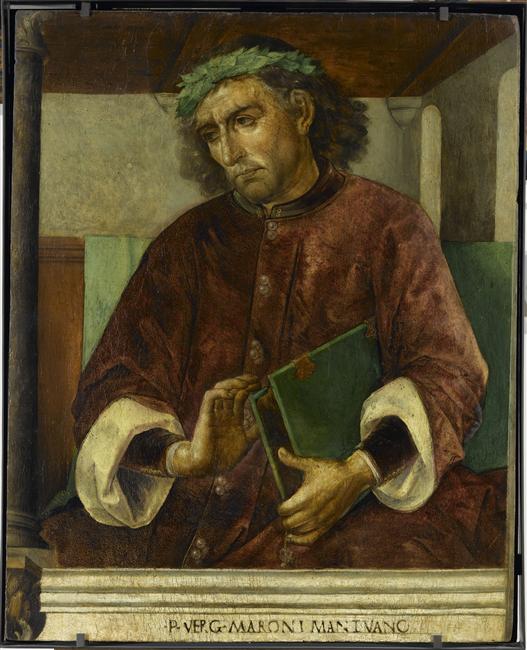
Painted portrait of a man in a laurel wreath and dark red robe with white cuffs, holding a green book, seated in a loggia. Inscription on the ledge below reads P. VERG. MARONI MANTUANC.Painting

Secondary source

Virgil

Pedro Berruguete · 1476

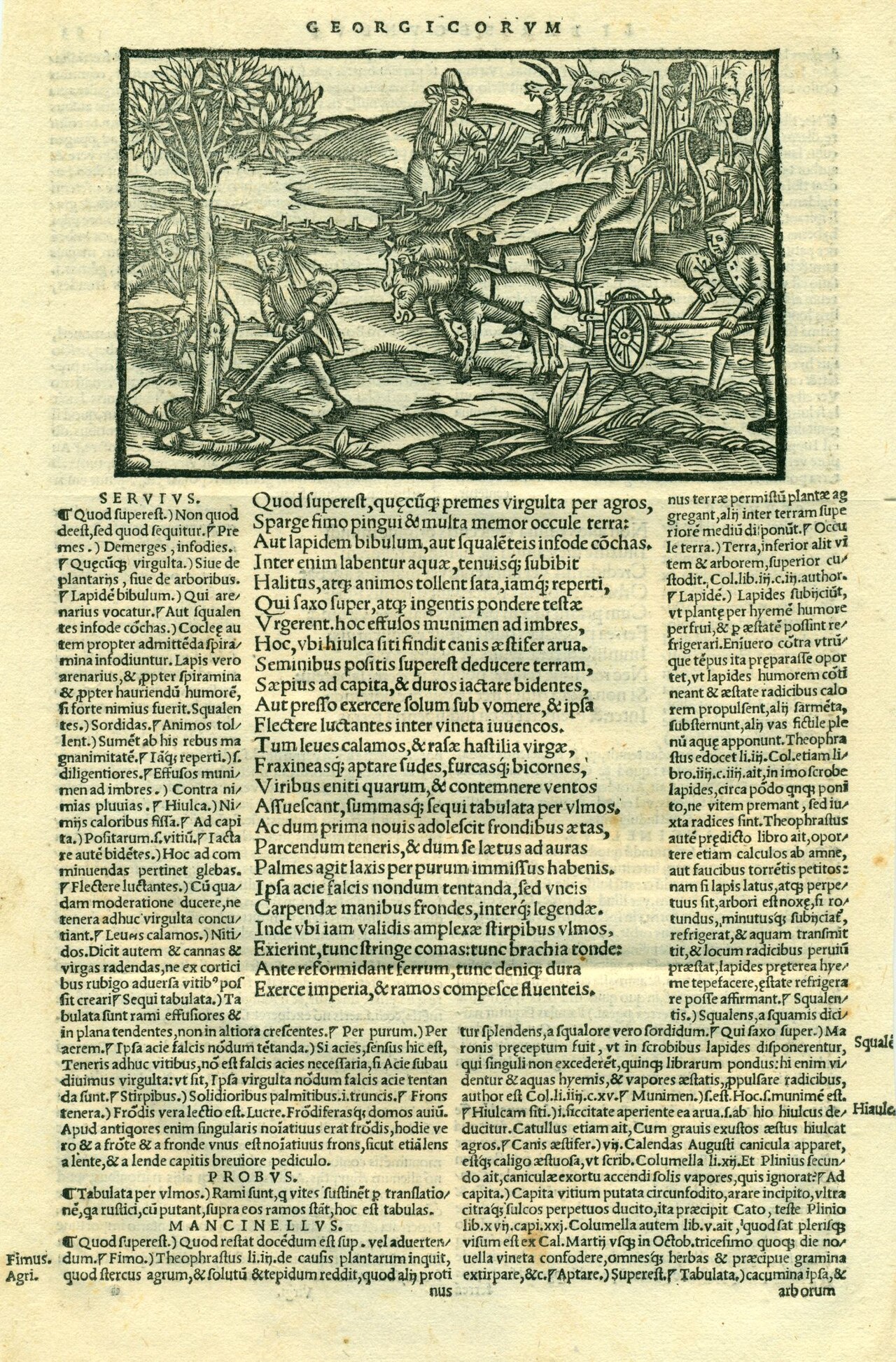
Scanned page from a 1544 Basel edition of Virgil's Georgics, with a woodcut illustration at top showing a farming scene: a man with a mattock near a tree, a plowman driving oxen, a sower, and a goat. Dense Latin text and commentary in columns below.Book

Secondary source

Vergilius, Basel 1544

Anonymous, printed by Hieronymus Curio · 1544

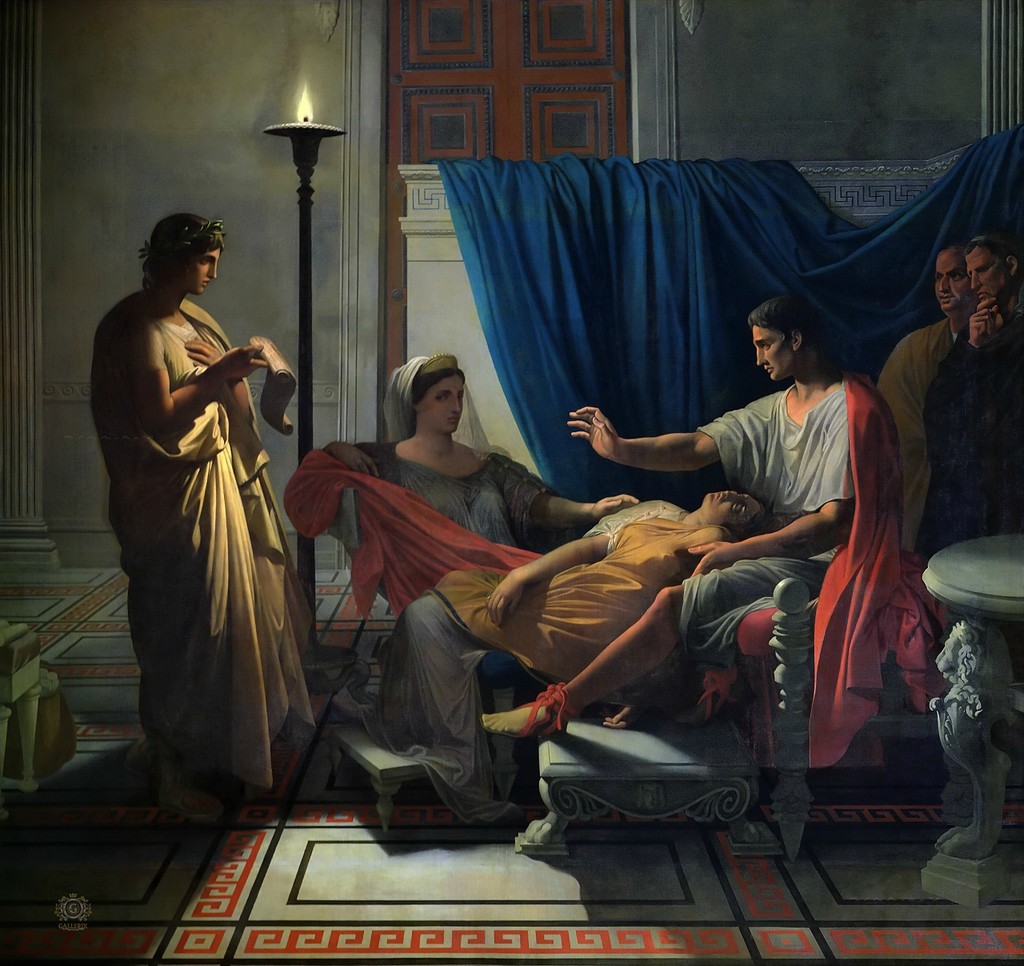
Painting of a laurel-crowned man holding a scroll beside a tall lamp. A young woman in a yellow dress faints back onto a stone bench as a man in a white tunic and red cloak gestures. A veiled woman sits nearby, and two men stand behind a blue drape.Painting

Secondary source

Virgil Reading The Aeneid before Augustus, Livia and Octavia

Jean-Auguste-Dominique Ingres · 1811-1812

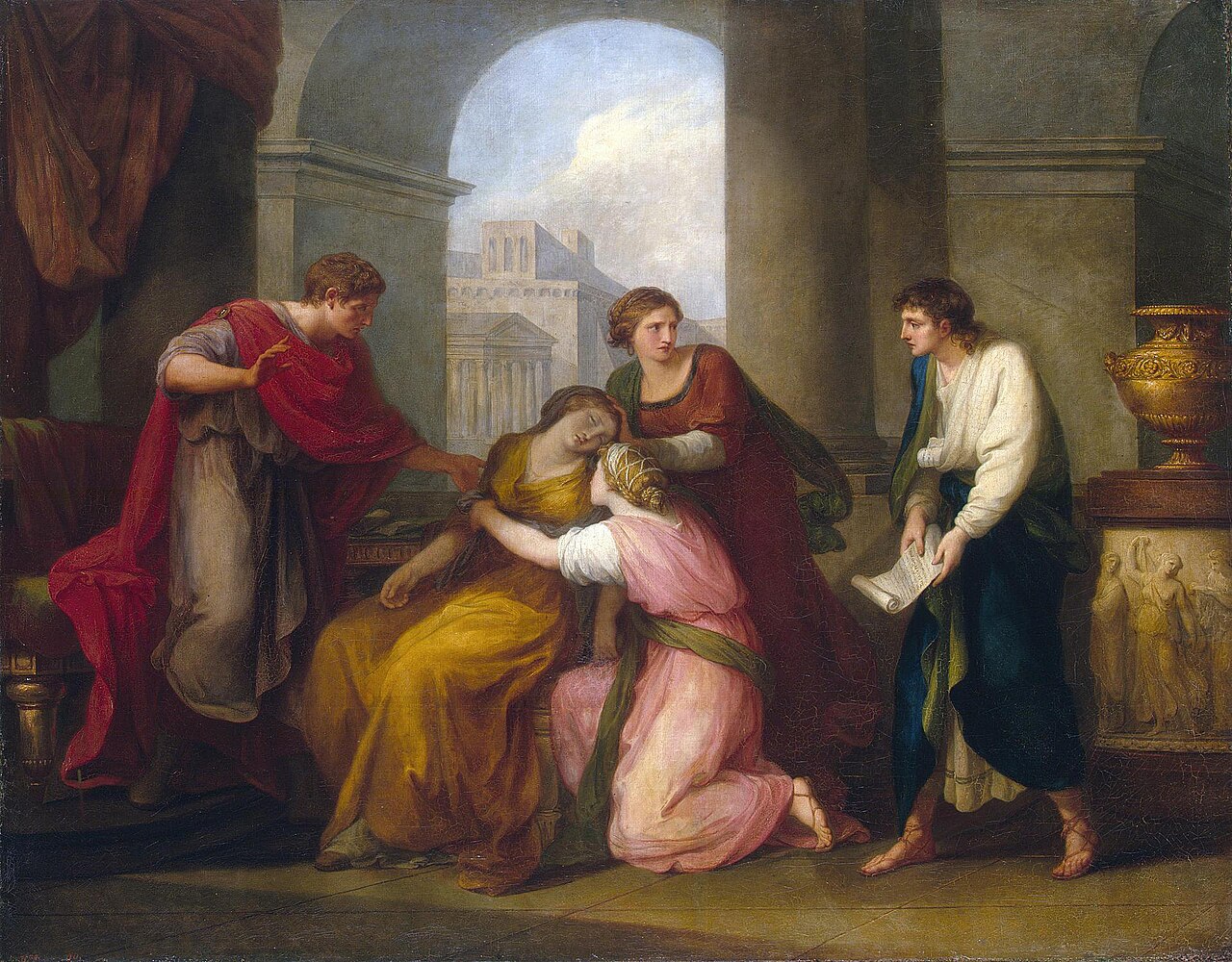
Painting of a scene with four figures in a classical colonnade. A man in a red cloak gestures toward a fainting woman in a yellow gown, who is supported by a kneeling woman in pink. Another woman stands behind them. At right, a young man in white holds a scroll. A gold urn stands on a carved pedestal, and an arch opens onto a view of classical buildings.Painting

Secondary source

Virgil Reading the Aeneid to Augustus and Octavia

Angelica Kauffmann · 1788

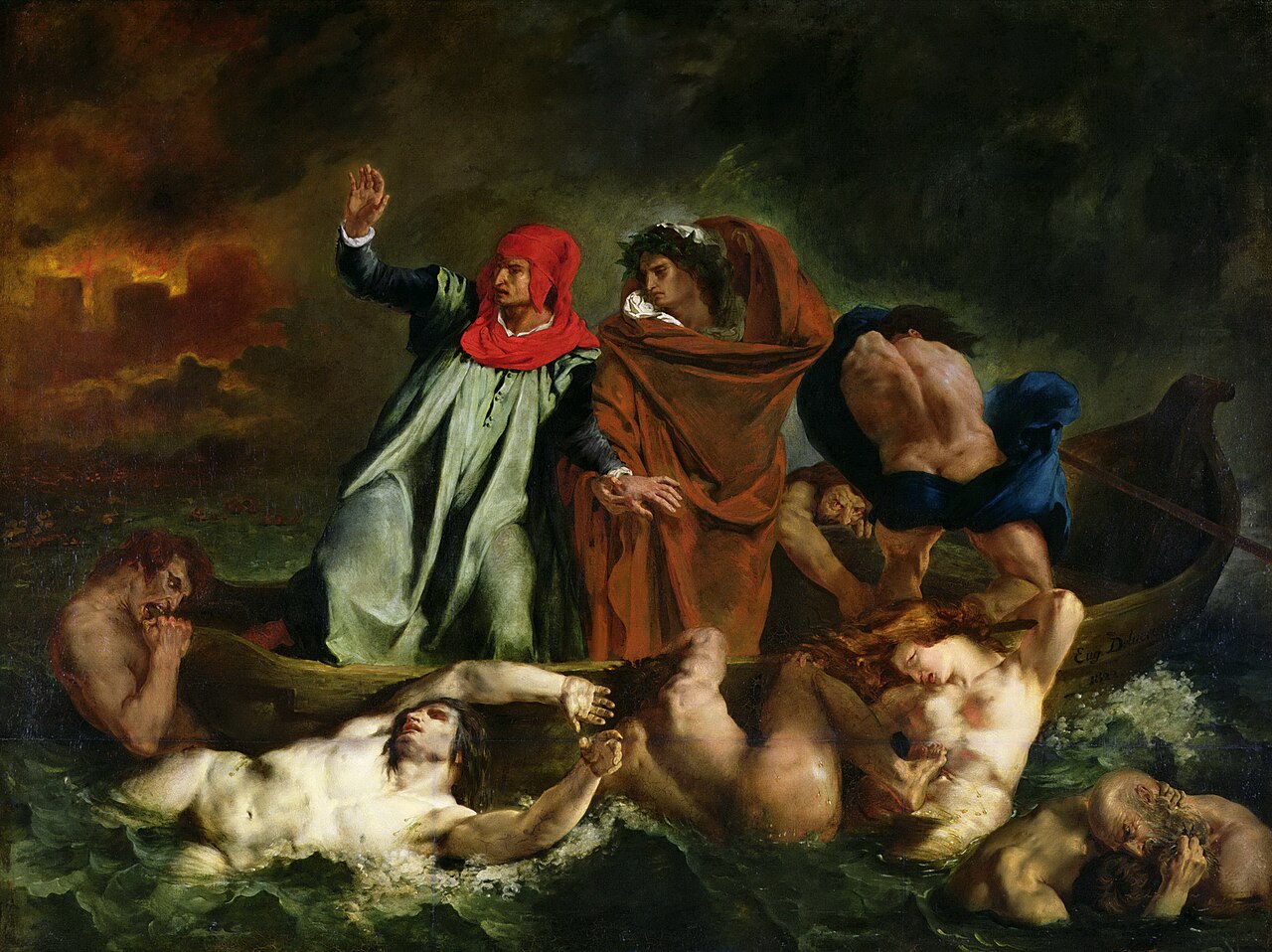
Delacroix's painting The Barque of Dante: a red-hooded figure in green robes raises one arm in a boat on dark, stormy water while a laurel-crowned man in red robes stands beside him. Naked, struggling figures cling to the boat in the water, and a red-lit city glows on the left horizon.Painting

Secondary source

The Barque of Dante

Eugène Delacroix · 1822

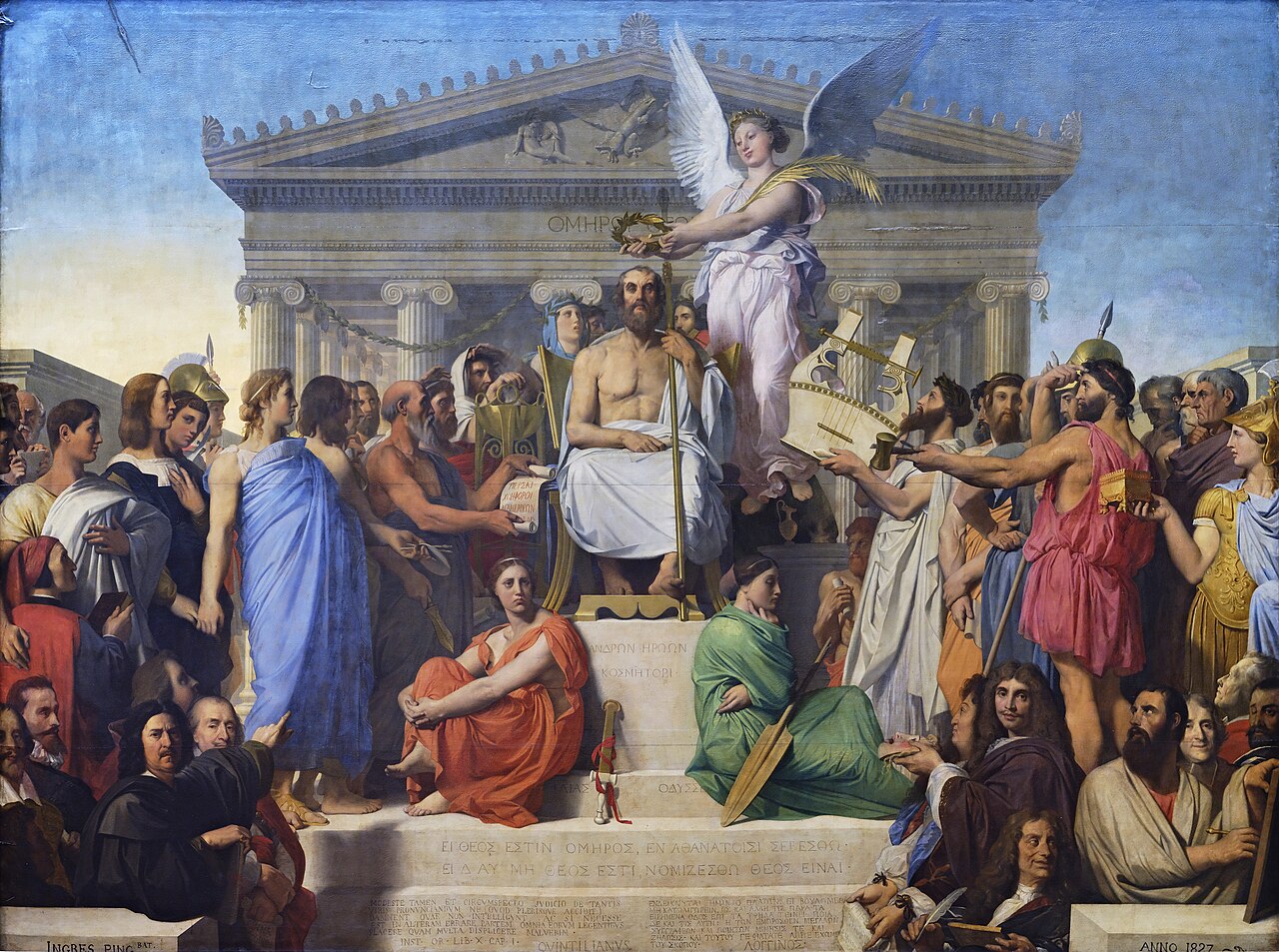
Ingres's painting The Apotheosis of Homer: a seated, bare-chested figure of Homer with a scepter at center, crowned by a winged Victory on a temple facade, surrounded by a crowd of figures from antiquity and later eras, with inscriptions on a stone pedestal below.Painting

Secondary source

The Apotheosis of Homer

Jean-Auguste-Dominique Ingres · 1827

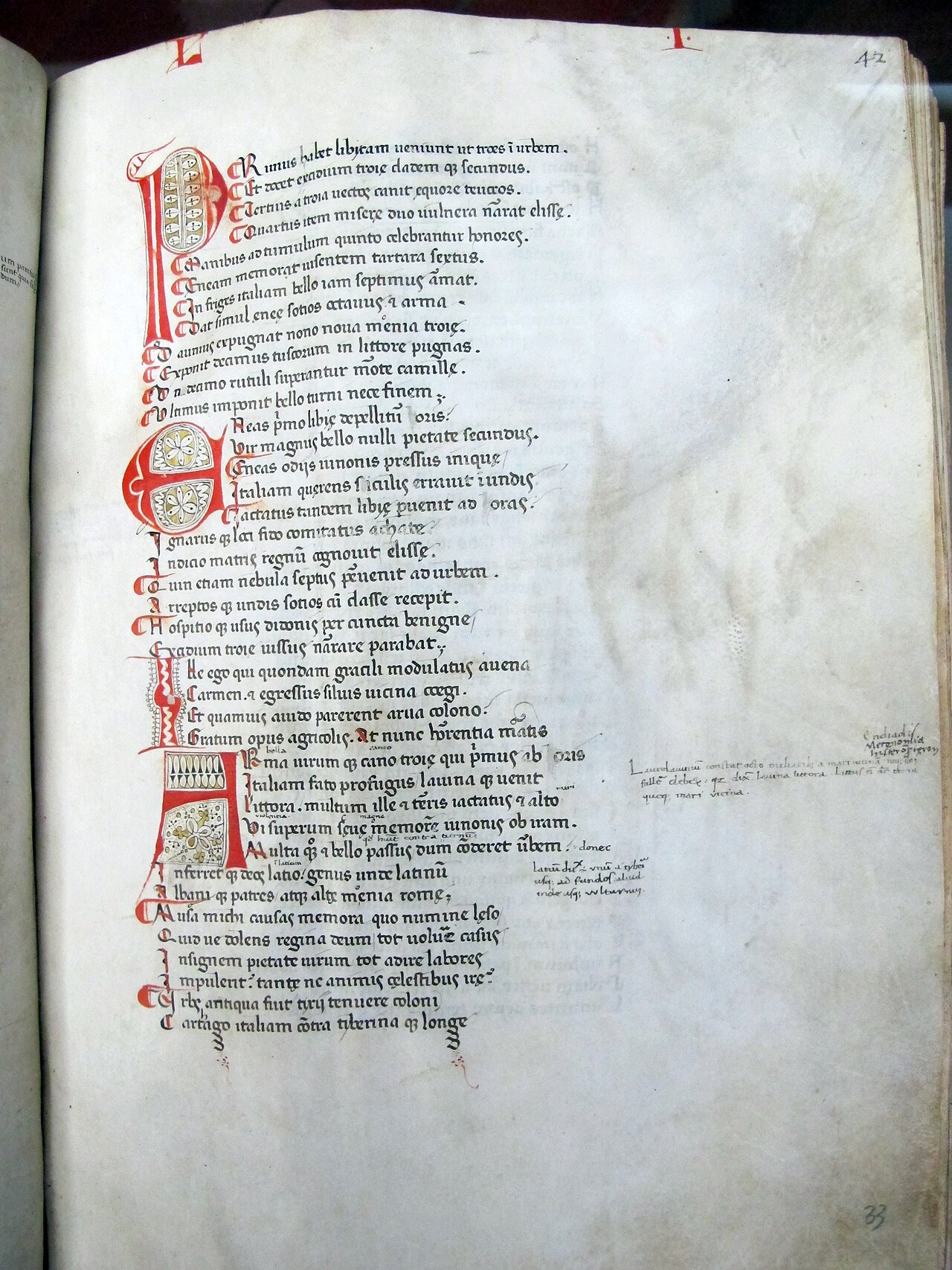
Photograph of a medieval manuscript page of Virgil's Aeneid in Latin, handwritten in black ink on pale vellum. Large red and blue decorated initial letters with gold and white ornament start two sections. Red rubrication, marginal notes, and page number 42 at upper right.Book

Secondary source

Virgil, Opera Omnia (Georgics)

Virgil · c. 1350-1400

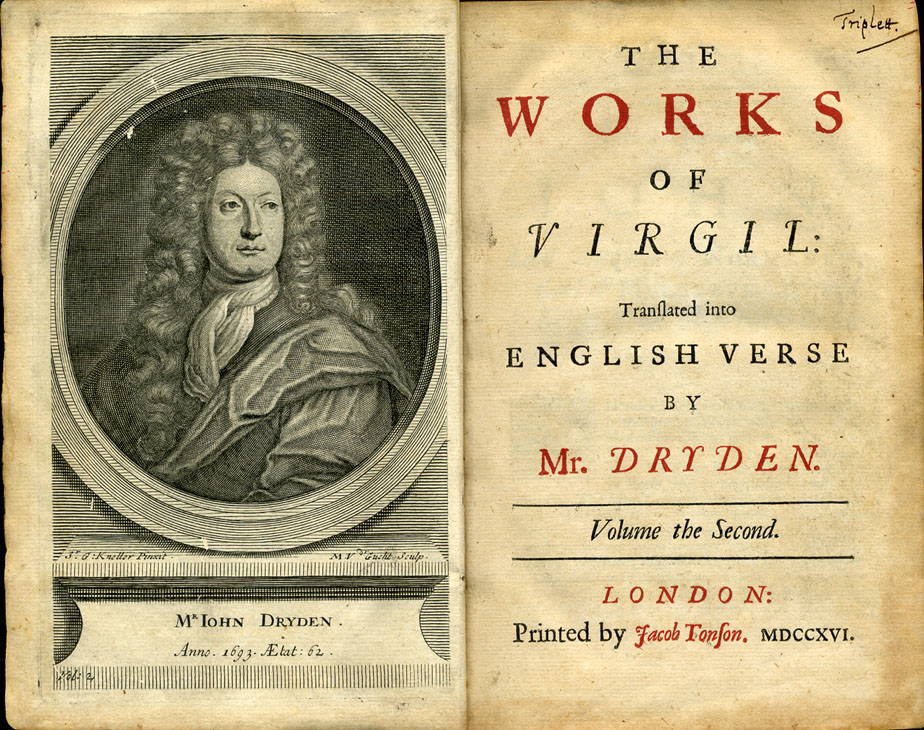
Frontispiece and title page of volume II of an edition of The Works of Virgil. The left page has an oval engraved portrait of a man with long curled wig and cravat, captioned Mr John Dryden. The right page reads The Works of Virgil, translated into English verse by Mr Dryden, London, 1716.Book

Secondary source

The Works of Virgil

John Dryden · 1716

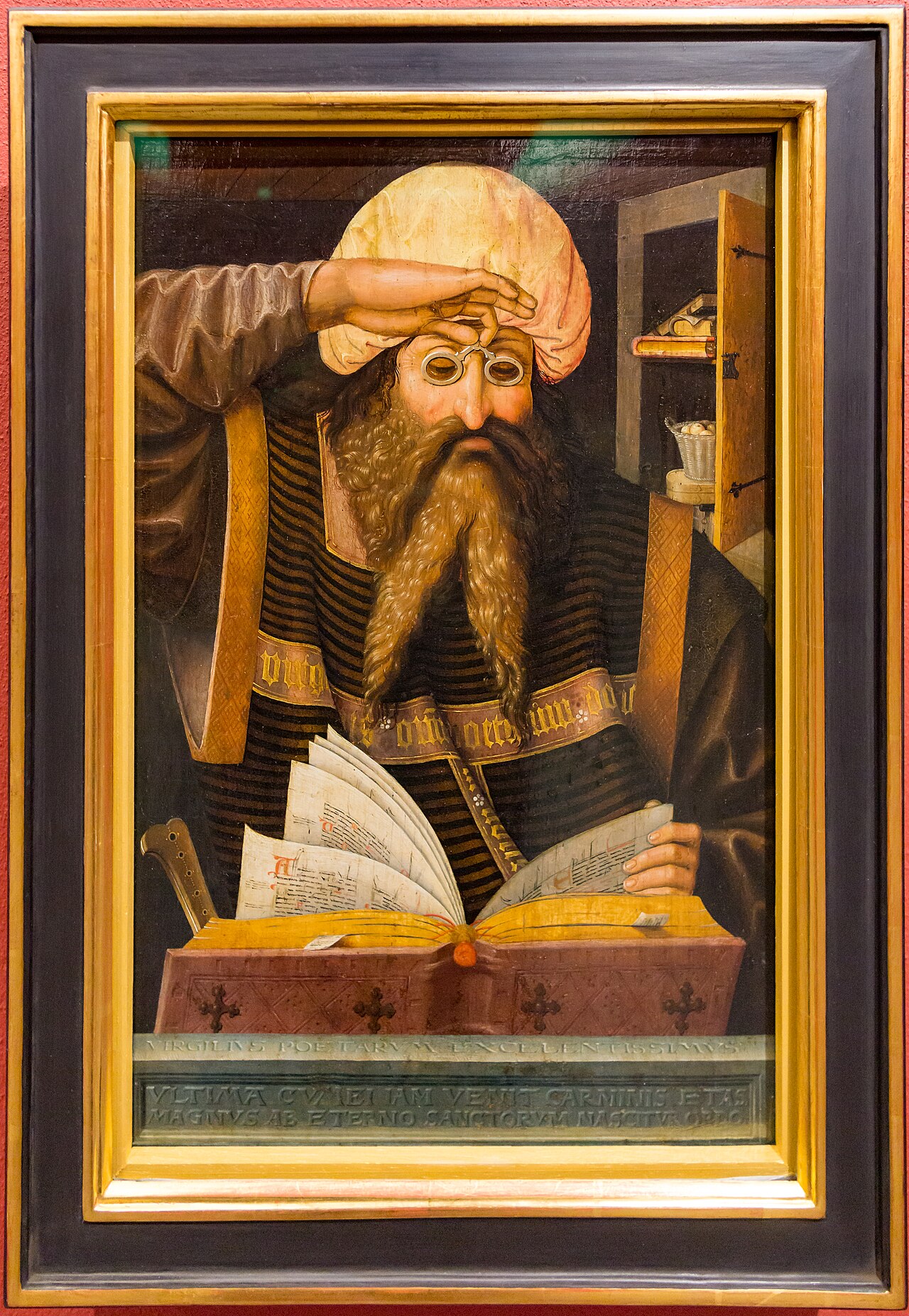
Painting of a bearded man in a striped robe and white turban, wearing spectacles and holding his hand to his brow while reading an open book on a red-draped lectern. A cabinet with books sits behind him. Latin inscriptions are visible below.Painting

Secondary source

Virgil

Ludger tom Ring the Elder · 1538

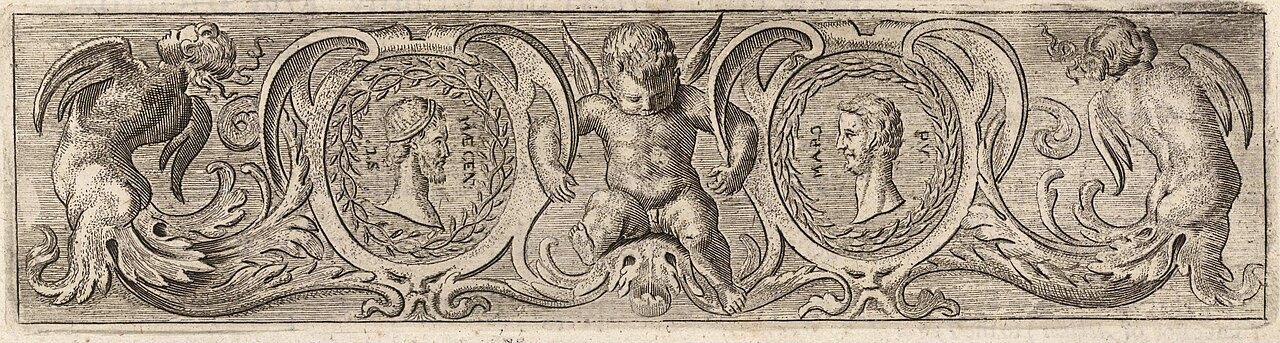
Engraved decorative strip with a central putto seated on a scroll, flanked by two oval medallions with laurel wreaths enclosing profile busts, and scrolling foliage and mythical creatures at the ends. Grey-brown print on cream paper.Painting

Secondary source

Virgil and Maecenas

Wenceslaus Hollar

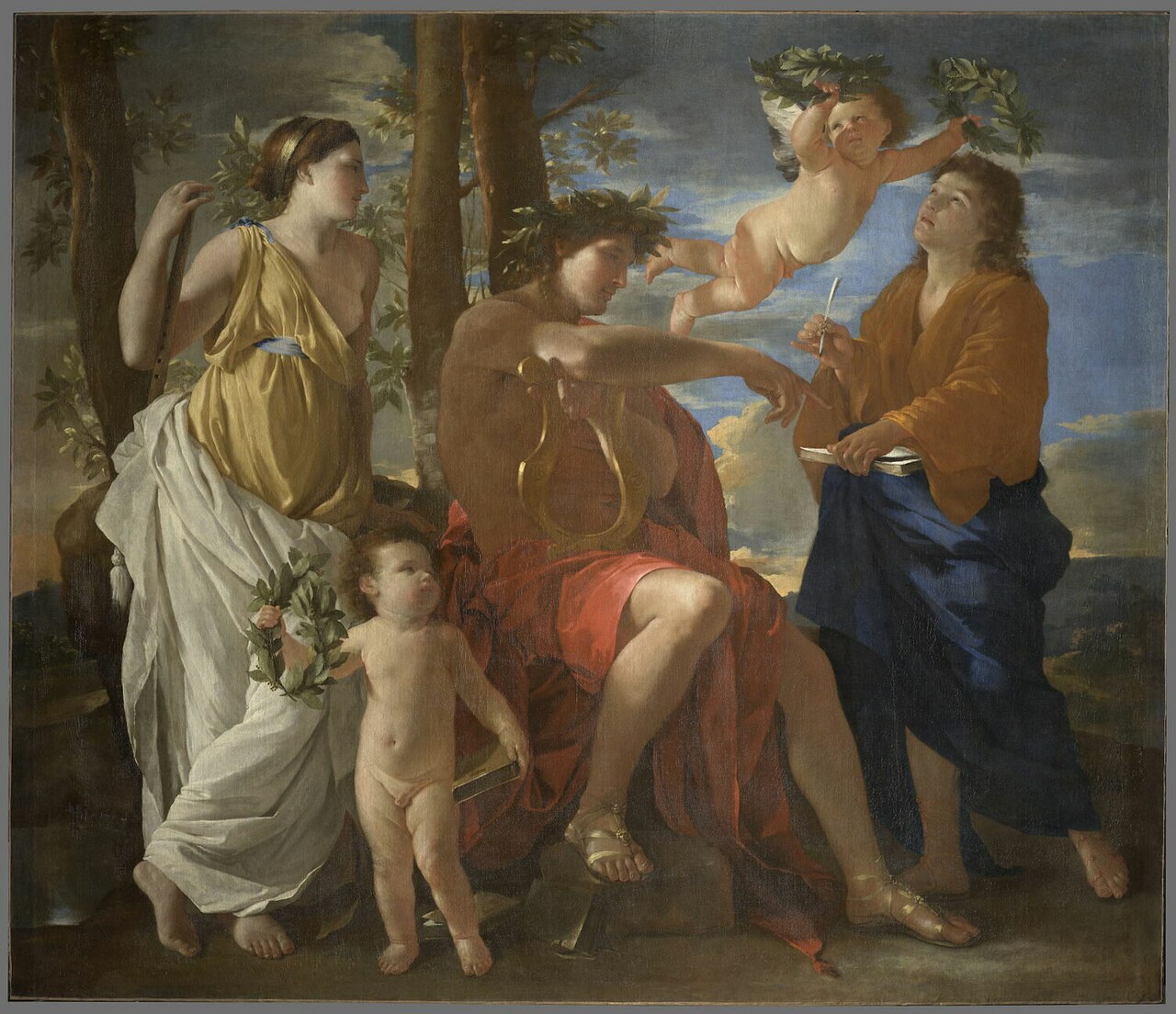
Oil painting of a laurel-crowned god seated playing a lyre, with a young woman in yellow and white drapery, a small child holding laurel, a winged putto above with a laurel wreath, and a standing man in orange and blue writing in a book.Painting

Secondary source

The Inspiration of the Poet

Nicolas Poussin · 1629

Book

Primary source

Aeneidos

Virgil

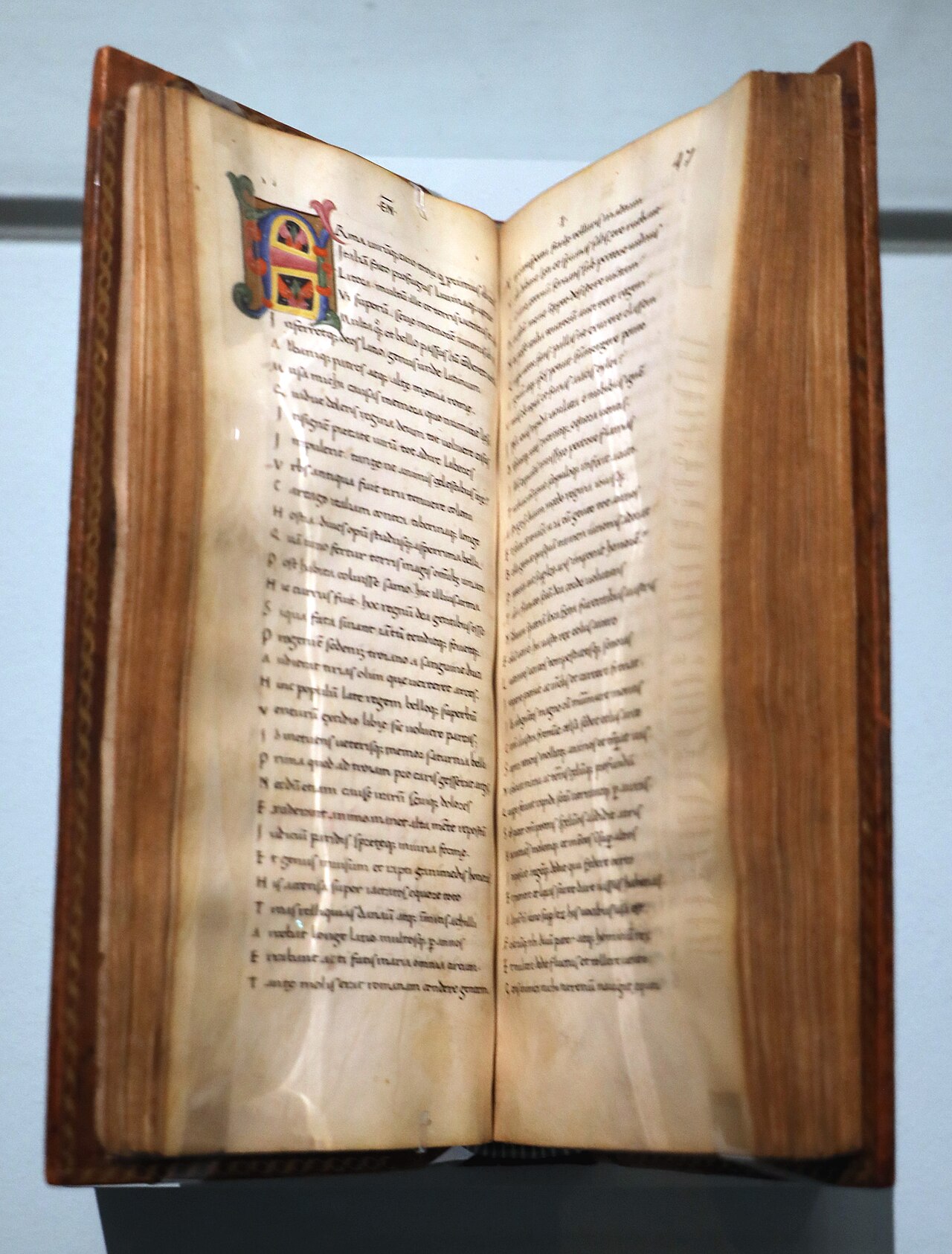
An open book displayed under glass on a stand, showing two pages of Latin text in black script. The left page has a large decorated initial letter in red, blue, yellow and green. Brown leather binding frames the pages.Book

Secondary source

Opera poetica di Virgilio

c. 1400

Vergil in the Middle AgesBook

Secondary source

Vergil in the Middle Ages

Domenico Comparetti · 1895

Book

Secondary source

Virgil: Eclogues, Georgics, Aeneid I-VI

Virgil · 1922

Book

Primary source

Eclogae vel Bucolica

Virgil

Book

Primary source

Aeneis

Virgil · between 29 and 19 BCE

Book

Primary source

The Eclogues of Virgil

E. J. Cardew · 1908

Book

Primary source

The Aeneid of Virgil

John Conington · 1866

Book

Primary source

The Works of Virgil: Pastorals

John Dryden · 1709

Book

Primary source

The Bucolics and Eclogues of Virgil

Virgil · 37 BC

Book

Primary source

Georgicon

Virgil · 29 BC

Book

Primary source

Georgica (LibriVox Latin Reading)

Virgil · 29 BC

Book

Secondary source

Vergil: A Biography

Tenney Frank · 1922

Book

Secondary source

The Roman Poets of the Augustan Age: Virgil

W. Y. Sellar · 1877 (this edition 1897, reprinted 1941)

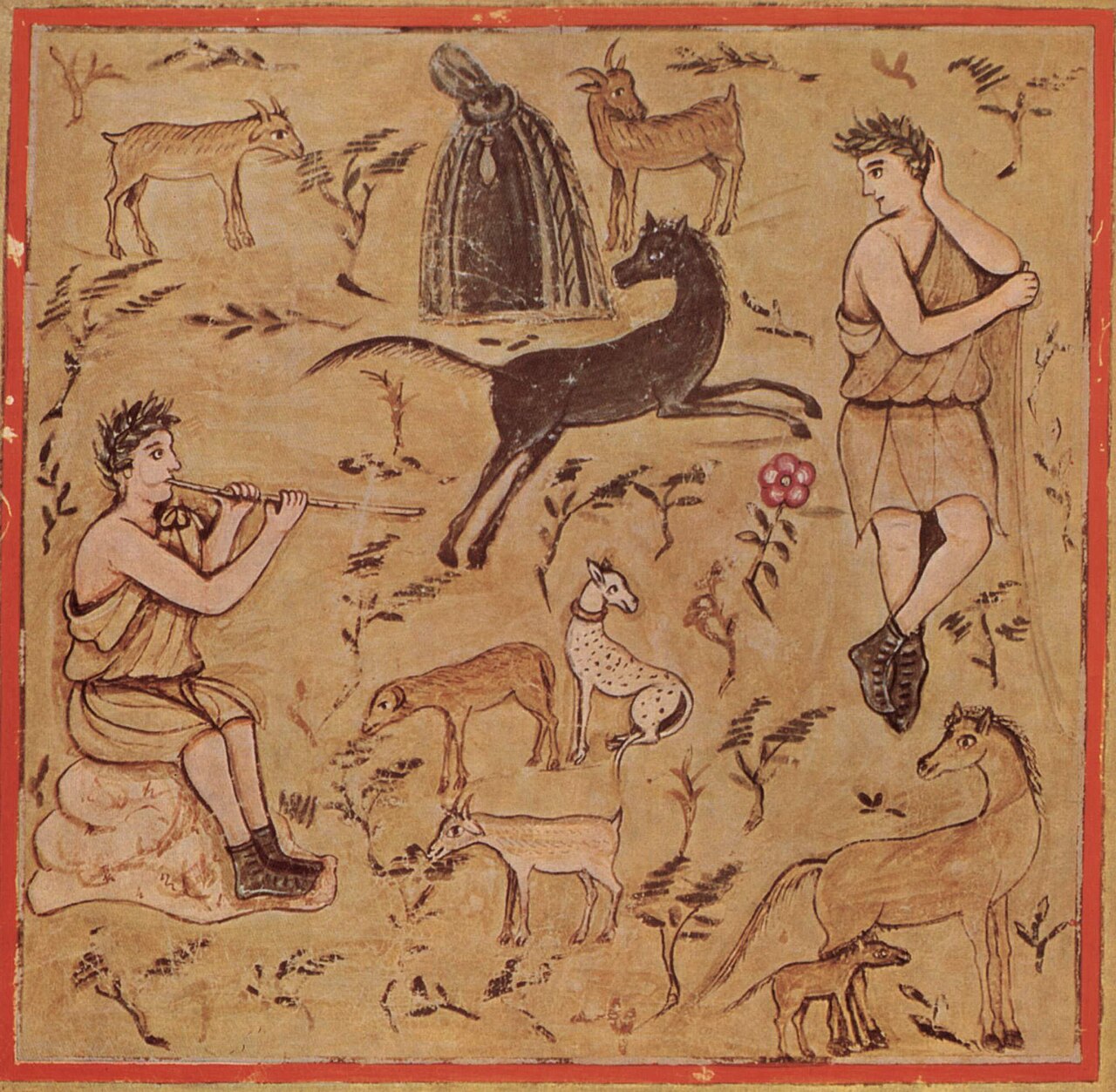
Painted miniature in a red border showing a seated youth in a laurel wreath playing a pipe, a standing youth with a wreath on the right, a dark horse, goats, a dog, a deer, a mare with a foal, a red flower, and a dark domed structure.Painting

Primary source

Georgics Book III Miniature, Vergilius Romanus

Master of the Vergilius Romanus · 5th century

Virgil's Works with English TranslationBook

Primary source

Virgil's Works with English Translation

Virgil · 1916

Book

Secondary source

Aeneis Buch VI, Latin Text with German Metrical Translation

Eduard Norden · 1903

Back cover of a bright orange library book with a white University of Toronto barcode label reading 3 1761 01427181 1 running vertically, and a white call number label reading PA 6807 B7M3 1915 cop.2 ROBA near the bottom.Book

Primary source

The Eclogues and Georgics of Virgil

Virgil (translated by John William Mackail) · 1915

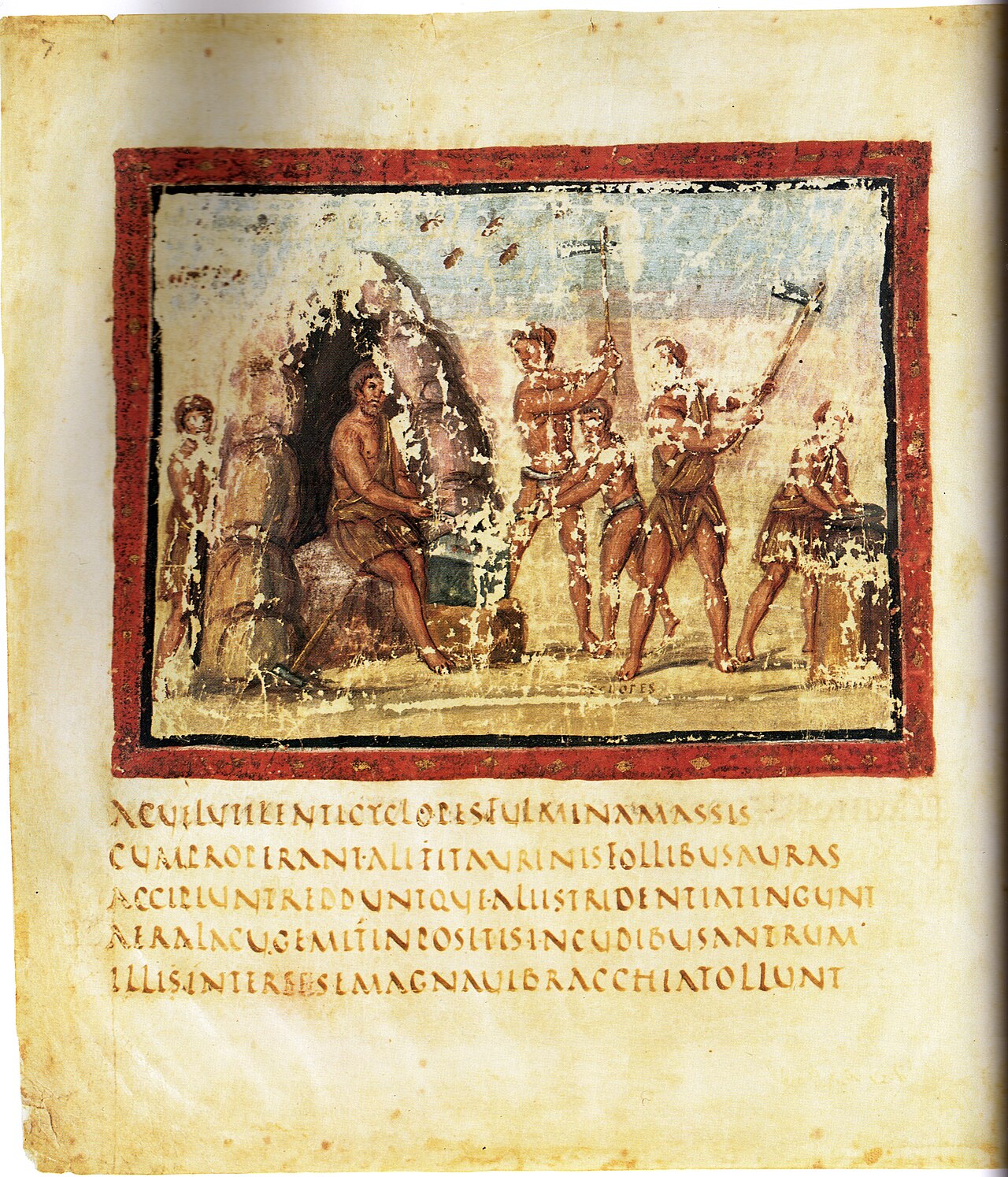
Manuscript page with a painted miniature framed in red and black showing bare-chested Cyclopes working at a forge beside a cave, with a seated figure at left and an enlarged scene of hammering and tools. Below are five lines of faded Latin capital letters on parchment.Painting

Primary source

Vatican Vergil Folio 8v: Cyclops Laboring

Unknown · c. 400 CE

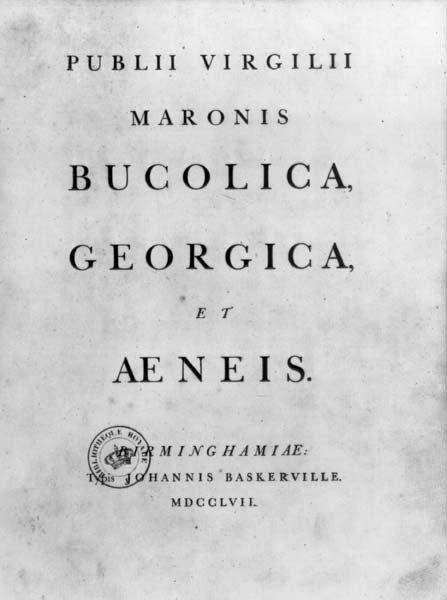
Title page of Baskerville's 1757 Virgil edition. Text reads 'Publii Virgilii Maronis Bucolica, Georgica, et Aeneis', then 'Birminghamiae: Johannis Baskerville, MDCCLVII', with a circular publisher's seal in the lower left.Book

Primary source

Virgil's Poems, Printed by John Baskerville

Virgil (printed by John Baskerville) · 1757

Book

Secondary source

Interpretationes Vergilianae

Henricus Georgii · 1905

Close view of the brown leather cover of a book, with two pairs of brass studs or clasp fittings on the right edge. The leather is worn, mottled orange and reddish-brown, with scuffs and a torn edge at the upper left.Book

Primary source

Riccardiana Virgil Manuscript

Virgil (illuminated by Apollonio di Giovanni and workshop) · c. 1450-1460

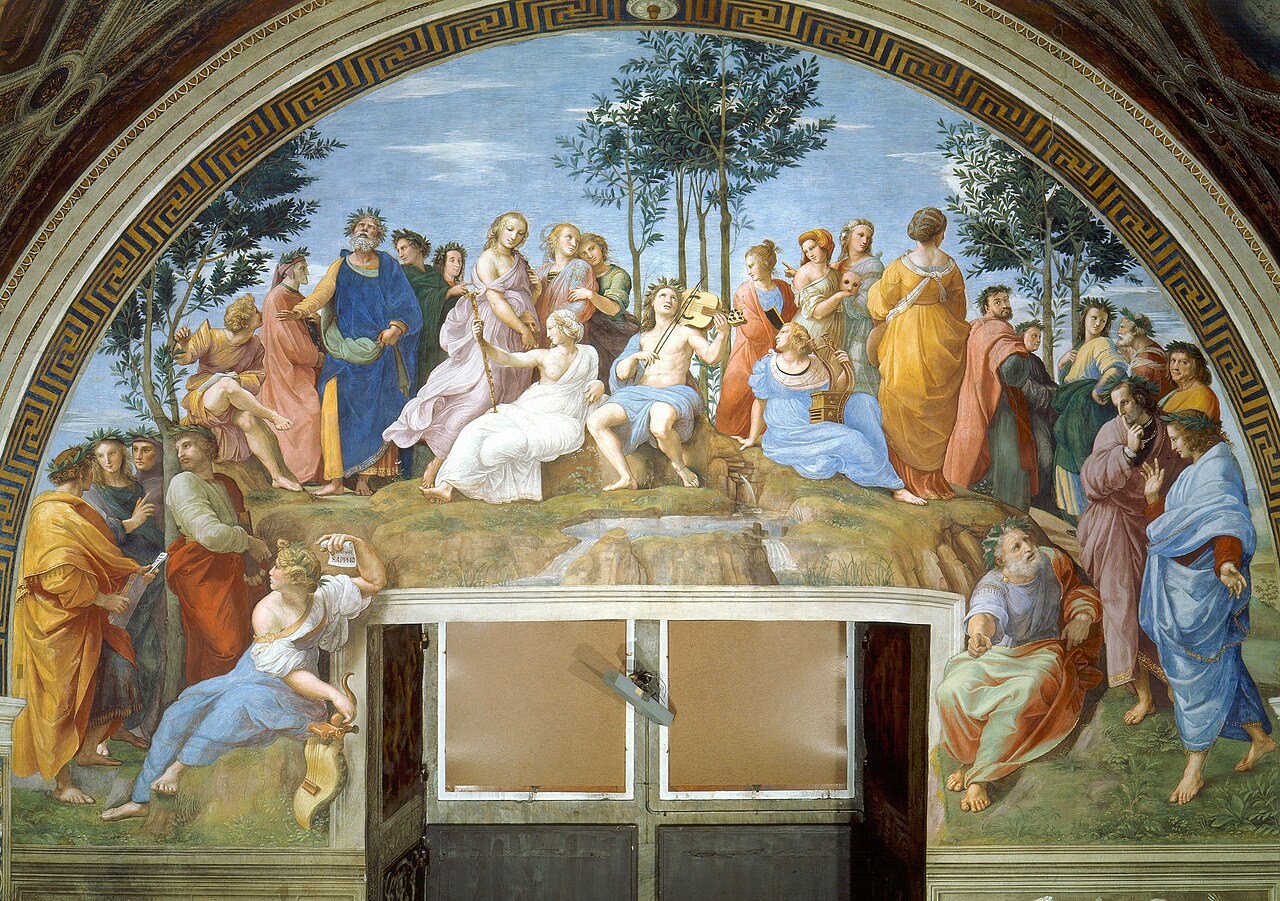
Raphael's fresco The Parnassus in a lunette above a doorway. Apollo plays a violin-like instrument on a hilltop surrounded by the Muses and laurel-crowned poets, some seated, with trees and a sky behind them. Two groups of figures stand on the sides below.Painting

Secondary source

The Parnassus

Raphael · 1511

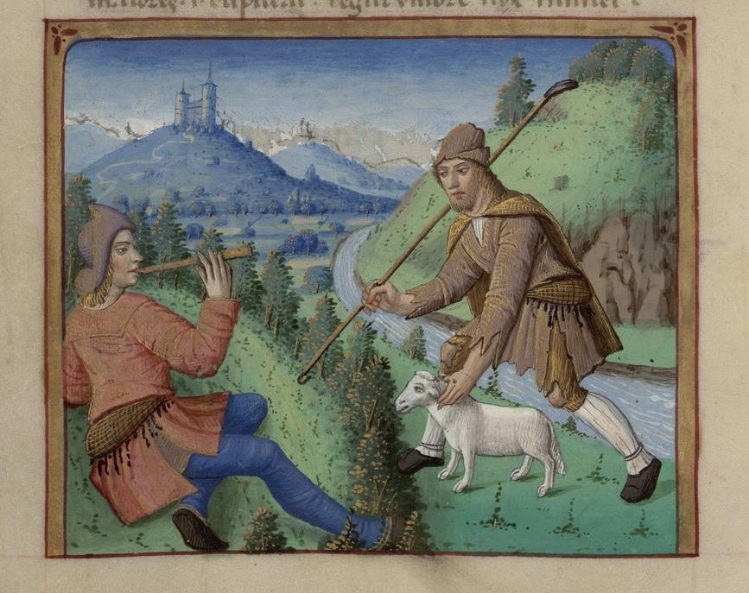
Miniature painting in a medieval manuscript showing two shepherds in a green hilly landscape. On the left, a seated man in a red tunic and blue hose plays a pipe. On the right, a standing man in a brown tunic and hat holds a long staff and a white goat. A castle sits on a distant hill beside a river, under a blue sky.Painting

Secondary source

Meliboeus and Tityrus Miniature

Maître de Robert Gaguin · between 1490 and 1499

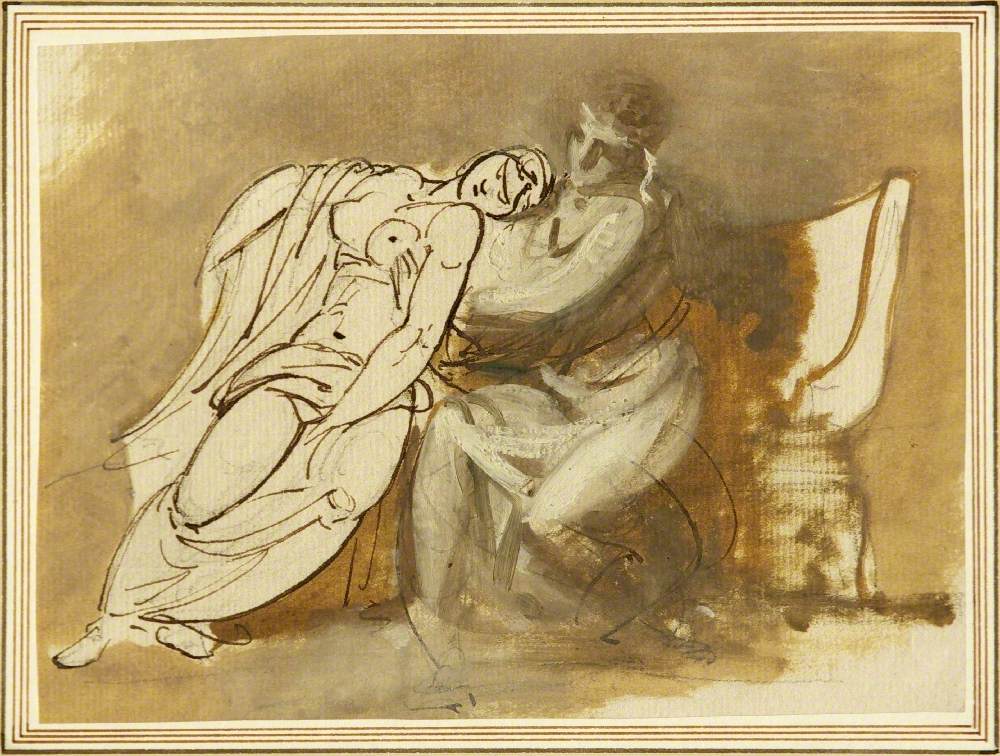
Brown and white ink and wash sketch in a thin gold-lined mount. On the left, a reclining draped female figure, head tilted back, lies across a seated draped male figure whose head is bowed near her. A pale chair stands at right against a dark wash background.Painting

Secondary source

Octavia Fainting at Virgil's Reading of the Aeneid

Samuel Woodforde · c. 1785-1791

Title page of 'In Vergilii carmina commentarii', volume I, Thilo and Hagen edition, Leipzig 1881. Printed text reads VII Grammatici qui feruntur in Vergilii carmina commentarii, recensuerunt Georgius Thilo et Hermannus Hagen, Vol. I, Aeneidos librorum I-V commentarii, recensuit Georgius Thilo. Lipsiae, in aedibus B. G. Teubneri, A. MDCCCLXXXI. Handwritten library numbers and a pale rectangular label appear at top left.Book

Secondary source

Commentary on Virgil's Poems, Volume 1

Servius · 1881 (edition); ancient commentary

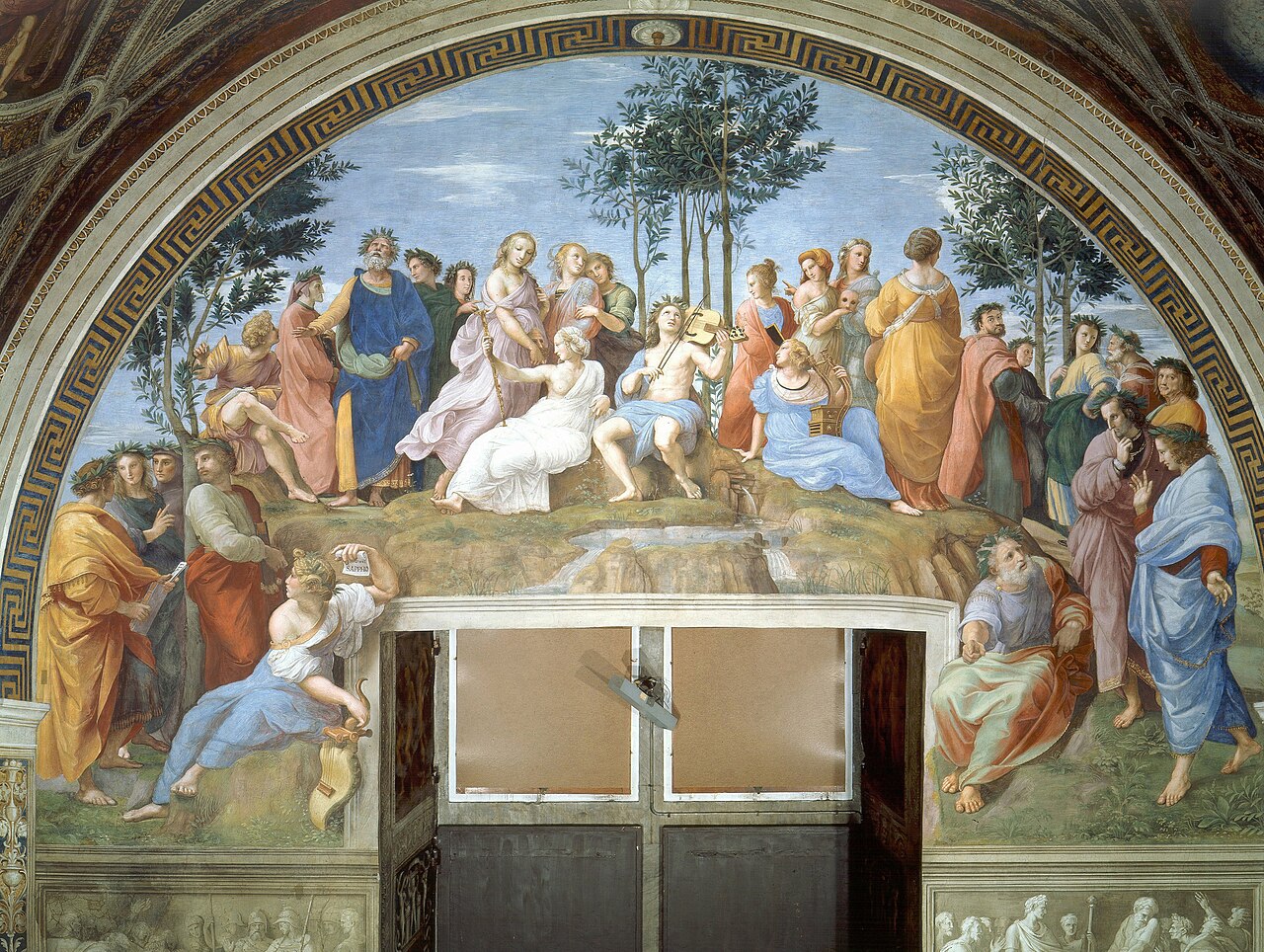
Raphael's fresco The Parnassus: poets and muses gather on a hilltop under laurel and olive trees beneath an arched frame with a Greek key border. Apollo plays a violin in the center, and figures crowd around, with a doorway below.Painting

Secondary source

The Parnassus (fresco)

Raphael · 1511

Book

Secondary source

The Eclogues and Georgics of Virgil

Publius Vergilius Maro (original); translated by John William Mackail · 1910

Book

Secondary source

An Essay on Virgil's Aeneid

Christopher Pitt · 1728

Speech

Secondary source

Aeneid Book XII, LibriVox Latin Reading

Publius Vergilius Maro (text); read by Malone

Speech

Secondary source

The Eclogues, LibriVox Audio Reading

Publius Vergilius Maro; translator unknown · Poems written 42-39 BC; this recording is undated

Speech

Secondary source

The Aeneid, MacKail Prose Translation Audio

Virgil (original); translated by John William MacKail · 1885 (MacKail translation)

Book

Secondary source

Virgil: A Concise Biography

Henry Nettleship · 1879

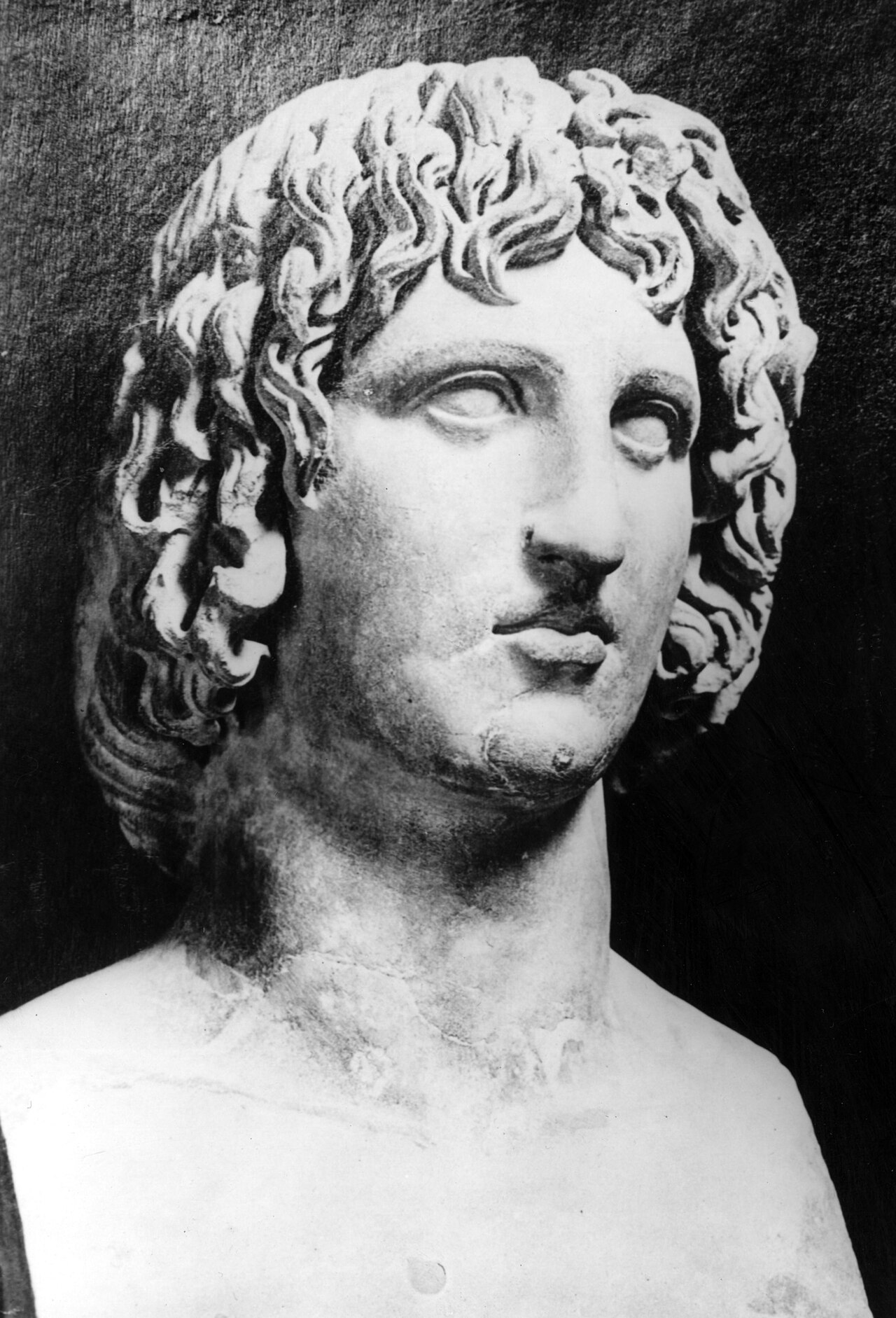
Black-and-white photograph of a marble bust of a man with short, wavy, curled hair, shown from the chest up, turned slightly to the side against a dark background. The face has a calm, serious expression.Sculpture

Secondary source

Bust of Publius Vergilius Maro

Circa 45 BC (uncertain, probably later)

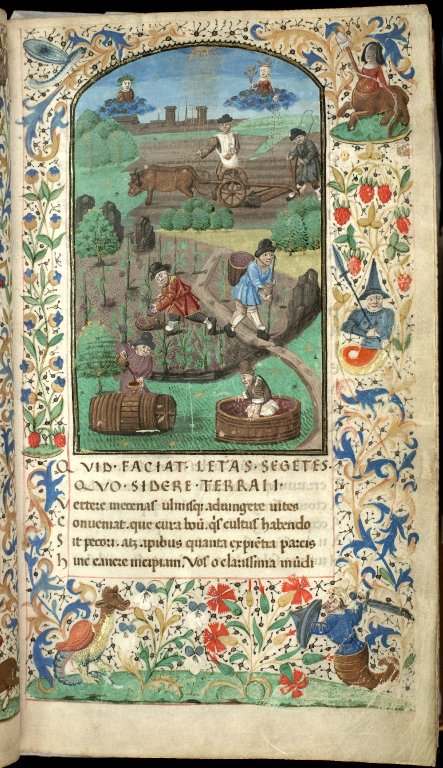
Illuminated manuscript page with a painted miniature of farm labour in an arched frame, showing a plough team of oxen and a farmer, figures tending vines and trees, and two figures in clouds above. Below is Latin text in two columns with decorated borders of flowers, a bird, and small figures.Book

Secondary source

Virgil's Eclogues, Georgics and Aeneid, Edinburgh manuscript

John Colville

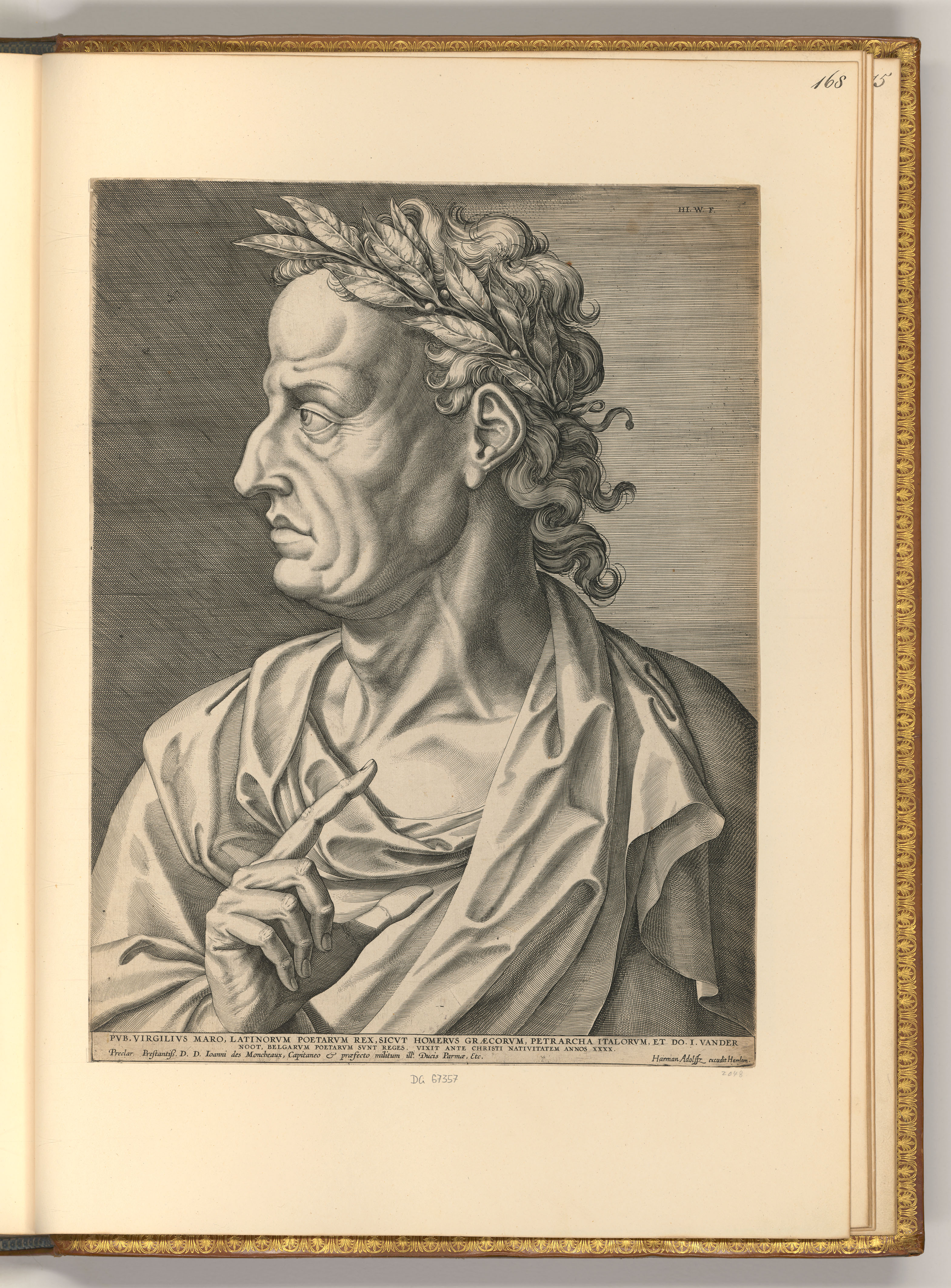
Engraved print in an album of a bearded... no, clean-shaven older man in profile facing left, wearing a laurel wreath and a draped cloak, with his right index finger raised near his chin. Latin inscription runs along the bottom margin.Painting

Secondary source

Portrait of Publius Vergilius Maro, Albertina collection

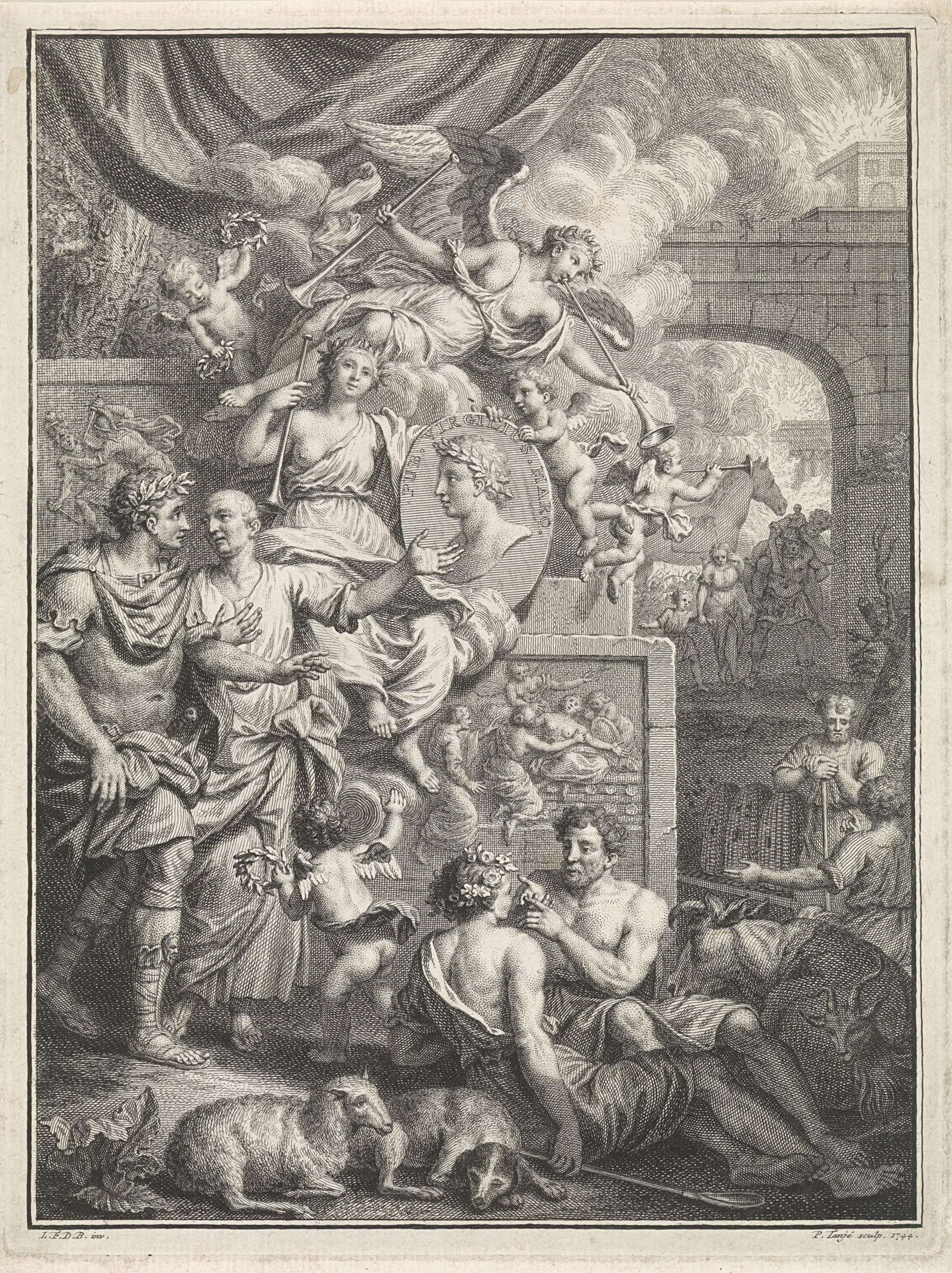
Engraving of an allegorical scene: winged Fame blows a trumpet above a medallion portrait in profile of a laurel-crowned man inscribed P. VIRGILIUS MARO. Figures below include a standing laureate man, a seated man gesturing, a sheep and dog, and cherubs, with burning buildings in the background.Painting

Secondary source

Fame with a relief portrait of Virgil and Aeneid scenes, 1744

1744

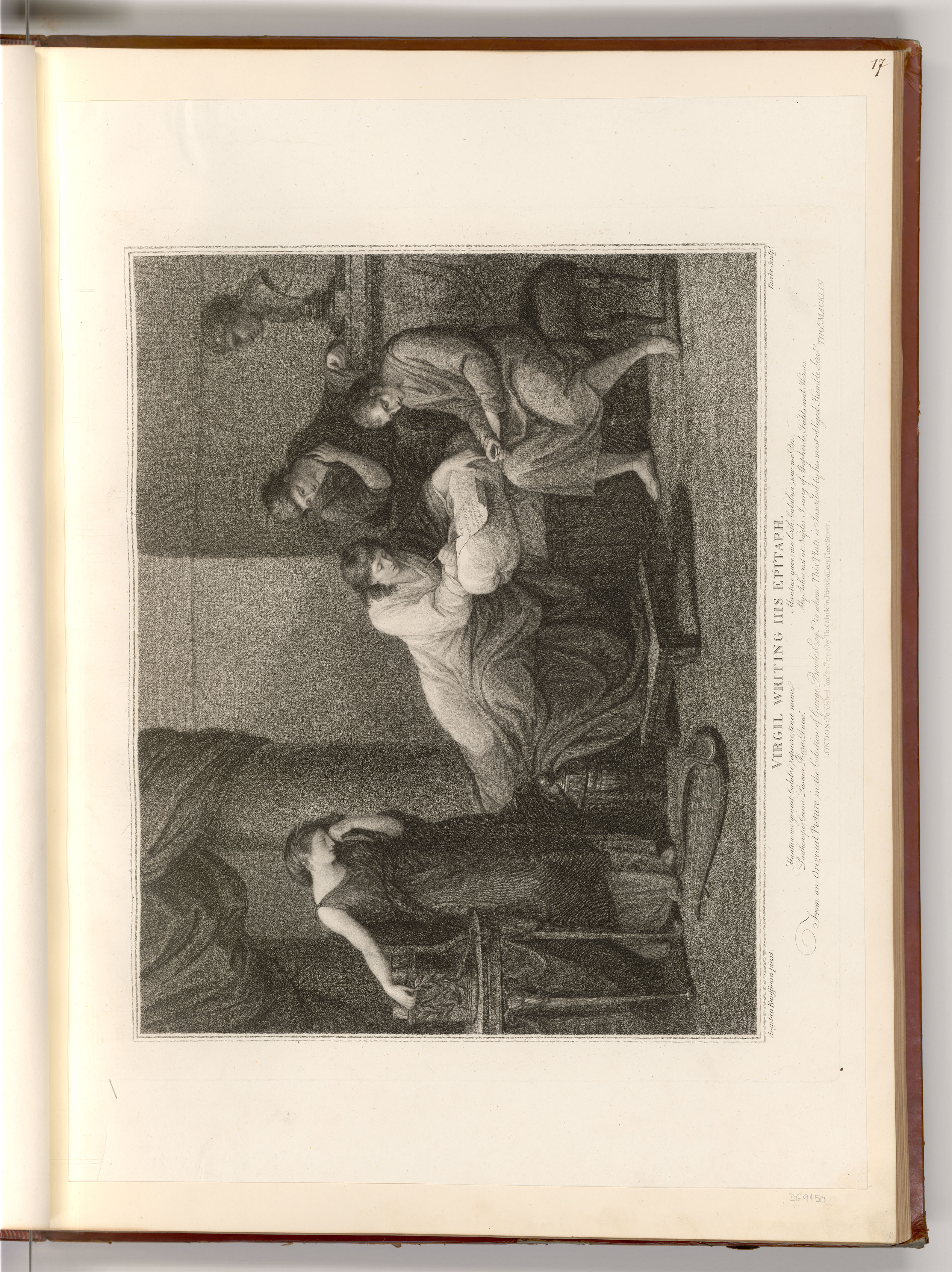
Engraved print titled 'Virgil Writing His Epitaph' on a book page, rotated sideways. A woman seated at a desk holds a scroll and writes, a bust sits on a pedestal behind, two men lean in, and a woman in the foreground rests beside a lyre and laurel wreath.Painting

Secondary source

Virgil Writing His Epitaph

1794

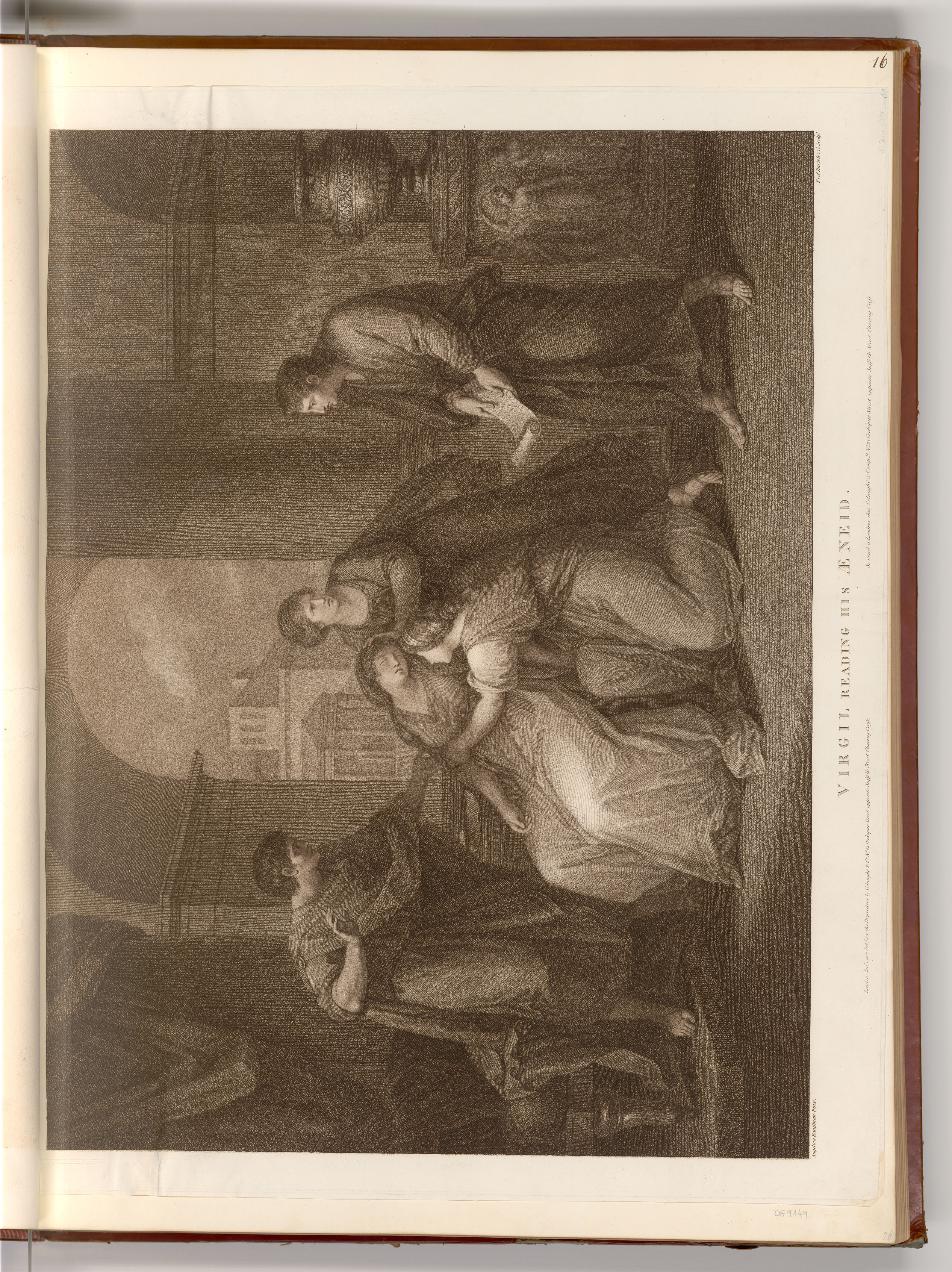
Sepia-toned engraved plate, rotated sideways, titled 'VIRGIL READING HIS AENEID', printed on a book page marked 16. A seated man reads aloud to a standing woman in a long gown, with other figures around them in an interior with a large round window or arch and a bust or statue.Painting

Secondary source

Virgil Reading His Aeneid

1802

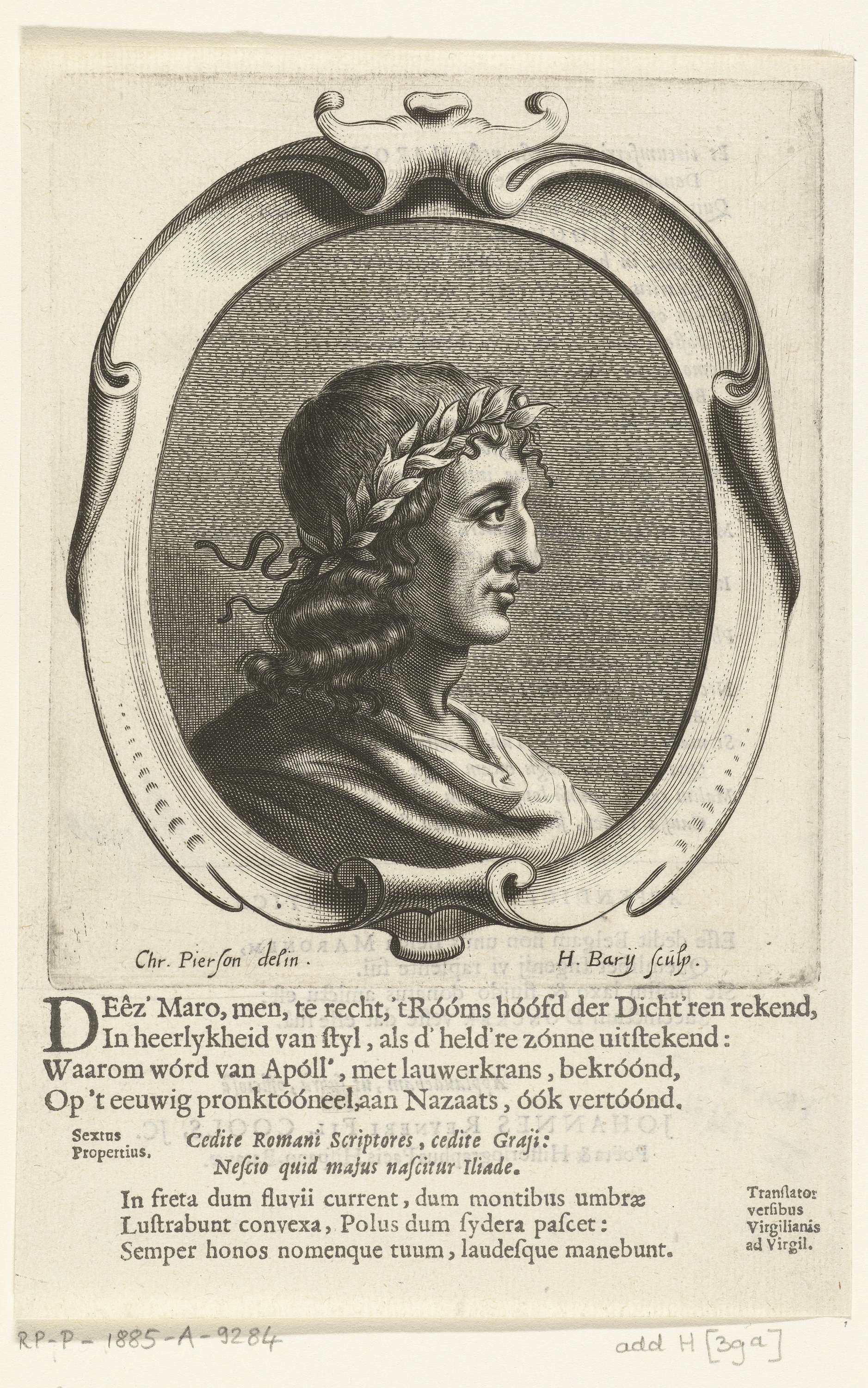
Engraved portrait in profile facing right of a laurel-crowned man with curly hair and draped shoulders, set in an oval within an ornate cartouche frame. Below are Dutch verses and a Latin quotation with credits: Chr. Pierson delin and H. Bary sculp. Inscription numbers RP-P-1885-A-9284 at lower left.Painting

Secondary source

Portrait of Virgil with laurel wreath

H. Bary (engraver); Chr. Pierson (designer)

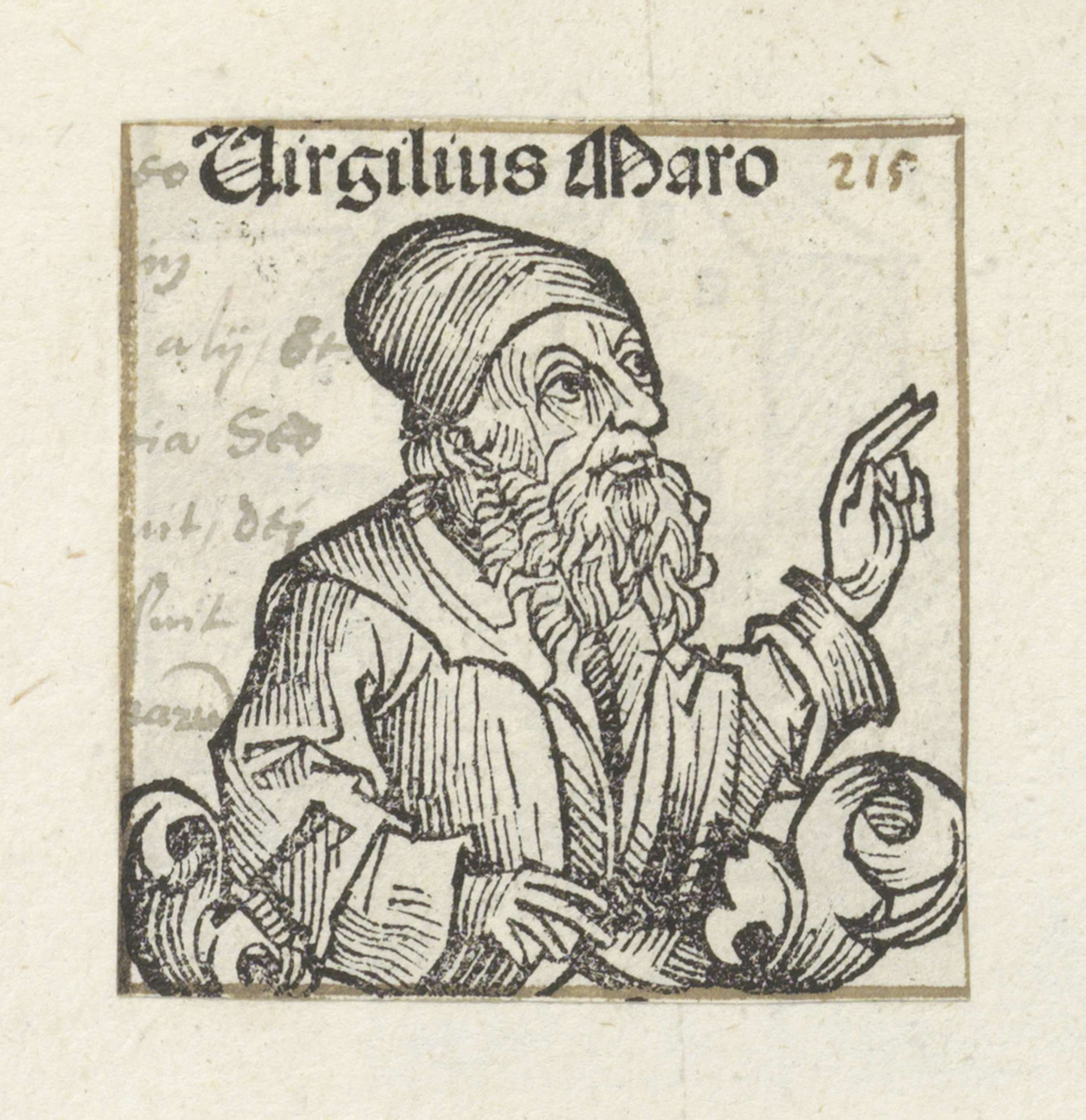
Woodcut print of a bearded old man in a cap and robe, pointing upward with one finger, labeled 'Virgilius Maro' in gothic lettering at the top. Handwritten marginalia appears faintly on the left.Painting

Secondary source

Virgil identified in a 1493 album print

1493

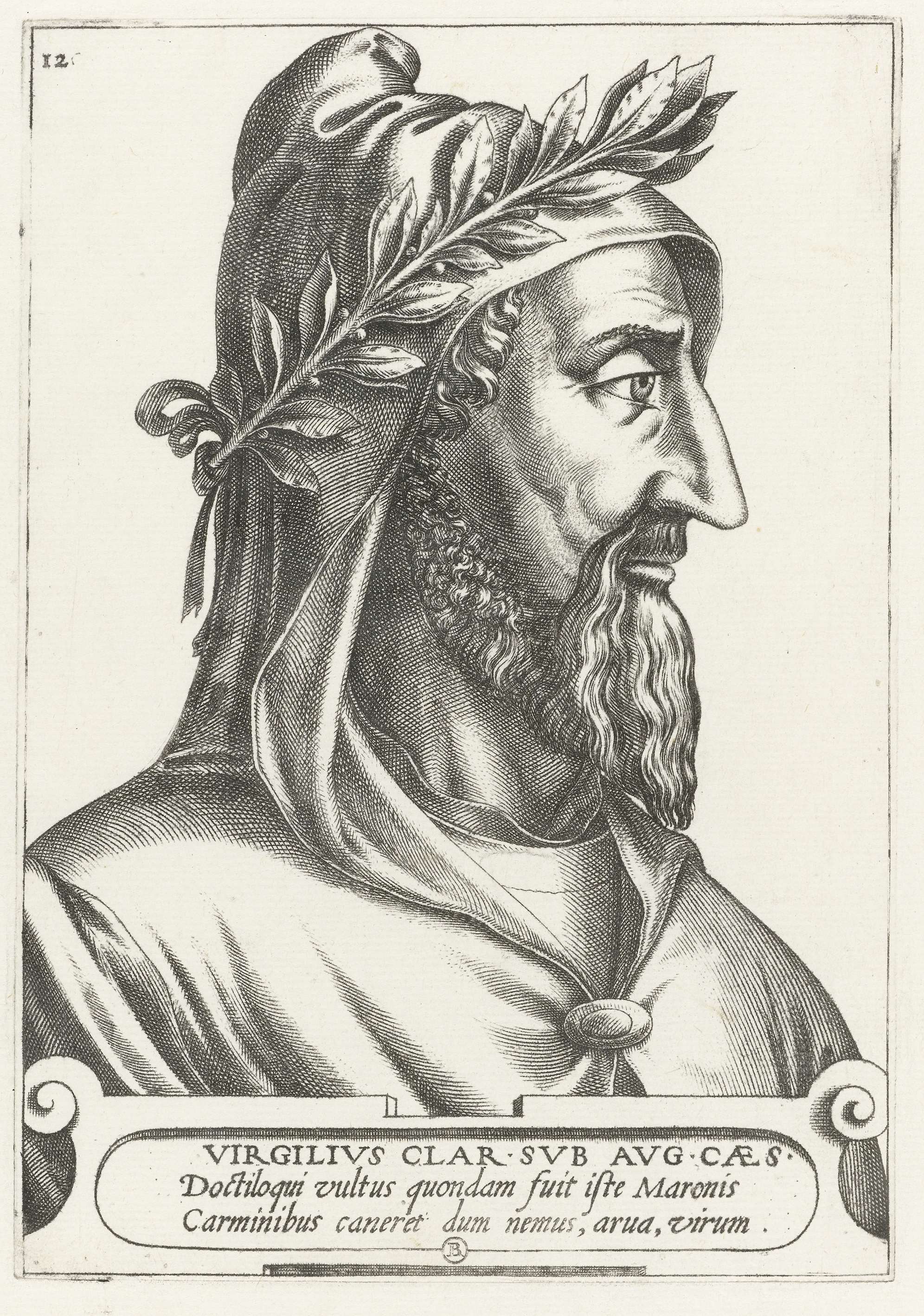
Engraved profile portrait in a bust format of a bearded man with a long nose, wearing a laurel wreath and a hood or cloth over his head, with a caption plaque below reading Virgilius Clar. sub Aug. Caes. in Latin.Painting

Secondary source

Portrait of Publius Vergilius Maro, 1566 print

1566

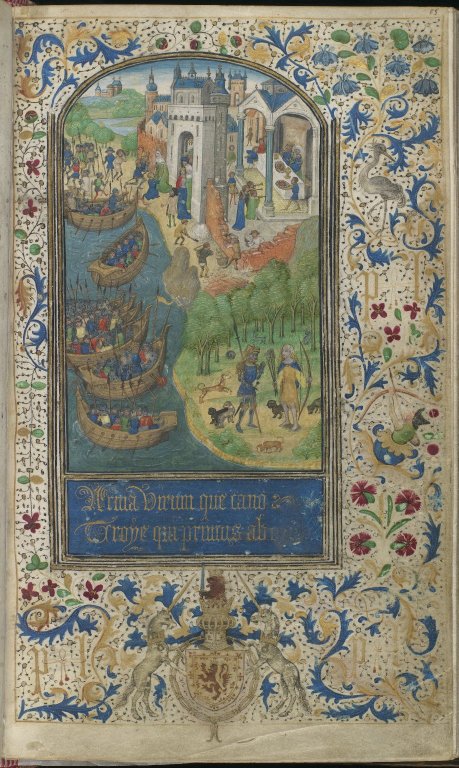
Illuminated manuscript page with a painted miniature in an arched frame showing ships on water, a walled city with towers, and figures on a grassy shore with animals. Below is a blue panel with gold script text, surrounded by ornate gold and blue foliate borders and a coat of arms at the bottom.Book

Secondary source

Virgil manuscript, Edinburgh University MS 195

Florius Infortunatus

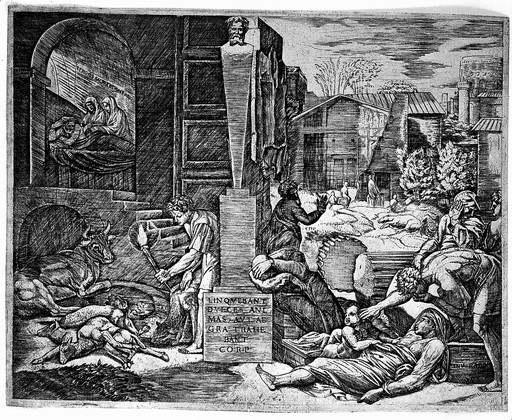
Engraving of a plague scene. In the foreground, a man in a tunic strikes or works at an altar beside a fallen ox, and many bodies lie sprawled on the ground. Figures in the right foreground and a central pedestal with an inscription tablet are visible; a classical bust sits atop a column. In the upper left, a Nativity-like scene appears in an arched niche, and a rustic town with trees and buildings fills the background.Painting

Secondary source

Plague in Phrygia engraving after Raphael

M. Raimondi (engraver), after Raphael (design)

Book

Secondary source

Letters Concerning Poetical Translations

William Benson · 1739

Want the full shelf? Chat with Virgil in the app and open the Sources panel — every quote links back to the original.

Use Virgil in class

1 collection

A ready-made collection from the Humy team that features Virgil. Preview it, then try it free.

Trusted by educators worldwide

Conversations
375,000+
Real exchanges between students and historical figures
Messages exchanged
4,142,000+
Across every figure, classroom and language
Historical figures
100,000+
Each informed by a curated biography and selected sources
Languages supported
50+
From English and Spanish to Arabic and Korean

Paying customers

Used by 98 schools and universities

Partner school logo
Tecnológico de Monterrey logo
Hyper Island logo
Partner school logo
Chambersburg Area School District logo
Broward County Public Schools logo
Nebo School District logo
National Louis University logo
South Florida PBS logo
Punahou School logo
University of Wisconsin–River Falls logo
Partner school logo
Partner school logo
Archbishop Mitty High School logo
Kingsburg High School logo
Norwalk Public Schools logo
Partner school logo
Connections logo
Partner school logo
Moore Public Schools logo
Partner school logo
Partner school logo
Partner school logo
Partner school logo
Robbinsville Public Schools logo
Partner school logo
Partner school logo
Partner school logo
Tecnológico de Monterrey logo
Hyper Island logo
Partner school logo
Chambersburg Area School District logo
Broward County Public Schools logo
Nebo School District logo
National Louis University logo
South Florida PBS logo
Punahou School logo
University of Wisconsin–River Falls logo
Partner school logo
Partner school logo
Archbishop Mitty High School logo
Kingsburg High School logo
Norwalk Public Schools logo
Partner school logo
Connections logo
Partner school logo
Moore Public Schools logo
Partner school logo
Partner school logo
Partner school logo
Partner school logo
Robbinsville Public Schools logo
Partner school logo
Partner school logo

What educators are saying

“We enjoyed the program last year and used it frequently.”
“My students say it’s a welcome change of pace. I’m not a fan of the “sage on the stage” model, so I try to incorporate research-oriented and self-paced activities. With Humy, students have to take charge of their learning. They’ve become more adept at critical thinking, forming better questions, and improving their reading comprehension. The interview feature has been my go-to tool. I create assignments where students must ask historical figures a set number of questions, then summarize the responses to ensure they’re truly absorbing the material. This approach lets them actively explore the past rather than passively consuming information.”
“Humy has helped me bring historical figures, sometimes long past, to life. When my students interact with these figures in real-time, it eliminates some of the perceived “ancient” characteristics of my curriculum. This has shifted my students’ thinking away from viewing history as abstract or irrelevant. Real-time interactions make historical figures relatable, even allowing students to ask off-topic questions that help put historical lives in a more relevant context for 13-year-olds. The feature I use the most is the interview feature. After teaching a topic, most recently Gandhi and Joan of Arc, I have the students ask pointed, focused questions. We practice good conversation techniques beforehand, teaching them to listen (or read) carefully and formulate thoughtful follow-up questions rather than just interrogating. It helps students practice effective conversation skills.”

FAQ

Frequently asked questions

Who is Virgil?
Ancient Roman poet known for his epic poem "The Aeneid. On Humy.ai you can chat with an AI version of Virgil that draws on a short biography and 79 historical sources during the conversation — by text or voice, in 42 languages.
Is Virgil AI free?
Virgil is part of Humy's full library of more than 100,000 figures, which comes with a paid plan. A free account (no credit card) includes 20 messages a month with the free library's figures, so you can try how the conversations work first.
What sources does the Virgil AI use?
It draws on a short biography and 79 historical sources (books, paintings and artifacts), including “Aeneid”, “Aeneid, Book VI” and “Georgics”. Each source has its own page on Humy.ai.
How historically accurate is the AI version of Virgil?
Each figure uses a short biography and a small set of selected historical sources as context (retrieval-augmented generation), so answers stay closer to known material than the model's general knowledge alone. It isn't a citation-grade research tool — like any LLM, the AI can get details wrong or extrapolate. Treat it as a strong starting point for inquiry and cross-reference important claims.
Can I talk to Virgil by voice?
Yes. In addition to text chat, you can call Virgil and hear their voice respond in real time — useful for auditory learners, interview practice and Socratic dialogue.
Is Humy.ai safe and compliant for schools?
Yes. Humy.ai is used by more than 100 schools, universities and organisations. The platform is FERPA- and GDPR-aligned, supports SSO, and offers an IT-approval pack tailored for school procurement teams.

Ready when you are

Start chatting with Virgil now.

20 messages free · No credit card · Available in 50+ languages.