


Secondary sourceArtifact3rd century AD
Virgil mosaic
3rd century AD
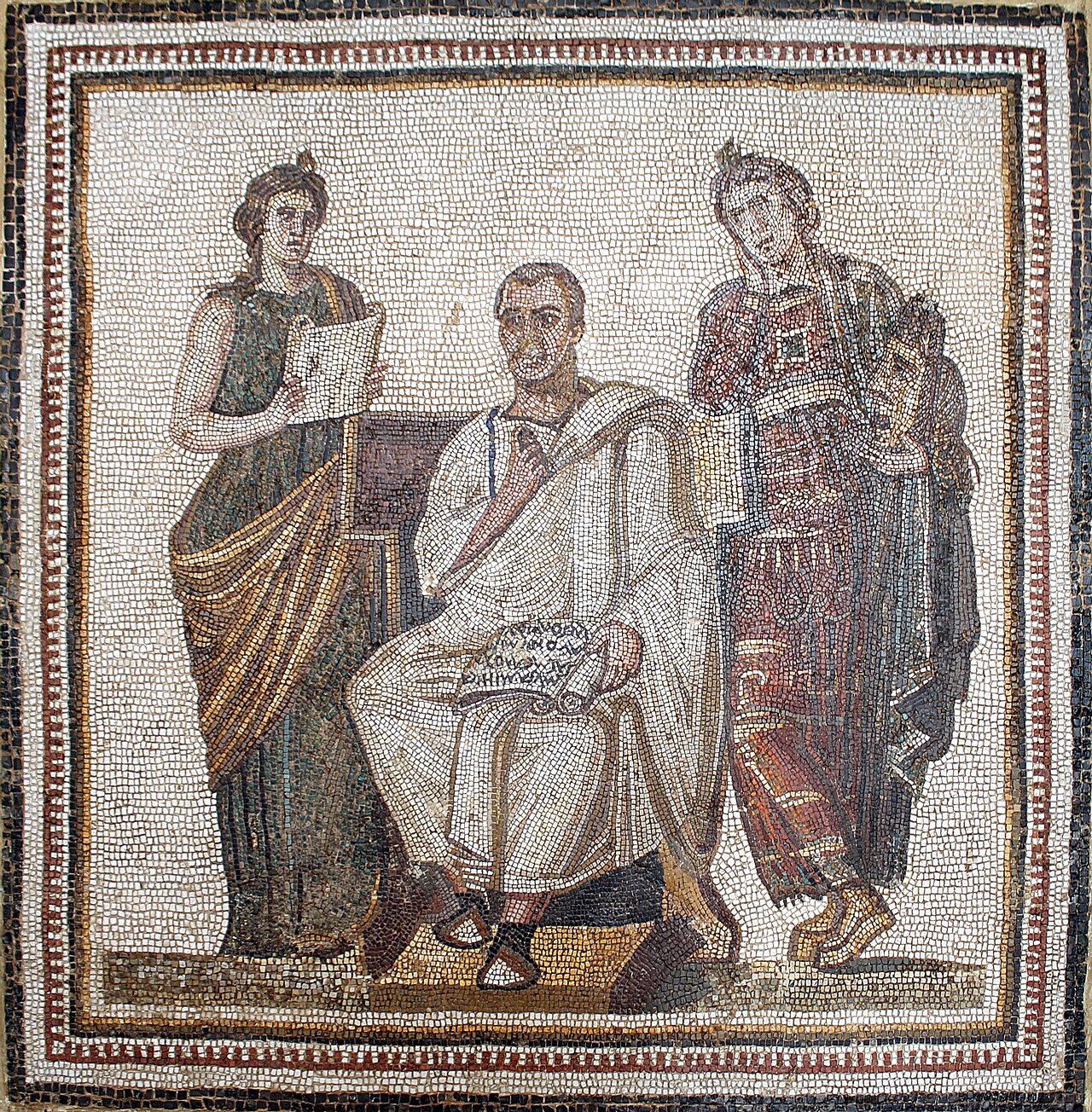
A 3rd-century Roman mosaic from Hadrumetum showing Virgil seated with the Aeneid between the Muses Clio and Melpomene, the oldest known portrait of the poet.
The oldest known portrait of Virgil, showing how later Romans imagined and honored the poet.
About this source
What it is
This mosaic was made around the 3rd century AD in the Roman city of Hadrumetum (modern Sousse, Tunisia) and discovered in 1896. It is now held in the Bardo National Museum in Tunis and shows Virgil seated in a white toga, holding a scroll inscribed with a line from his Aeneid.
Why it matters
Virgil is flanked by two Muses: Clio, muse of history, and Melpomene, muse of tragedy. It is the oldest surviving portrait of Virgil, made centuries after his death, likely commissioned by a wealthy admirer of his poetry. It shows how widely and deeply Virgil's work was admired across the Roman world, far from Rome itself.
Look closer
- Why might the mosaic's owner have chosen to show Virgil with these particular two Muses?
- What does the choice of a line from the Aeneid tell us about which parts of Virgil's work mattered most to Roman audiences?
- How reliable can this image be as a likeness of Virgil, given it was made long after his death?
This artifact is part of the curated material that grounds the AI version of Virgil on Humy.ai — when students ask about related events, the AI can quote it and cite it.
Ready when you are
Start chatting with Virgil now.
20 messages free · No credit card · Available in 50+ languages.