


Secondary sourcePainting
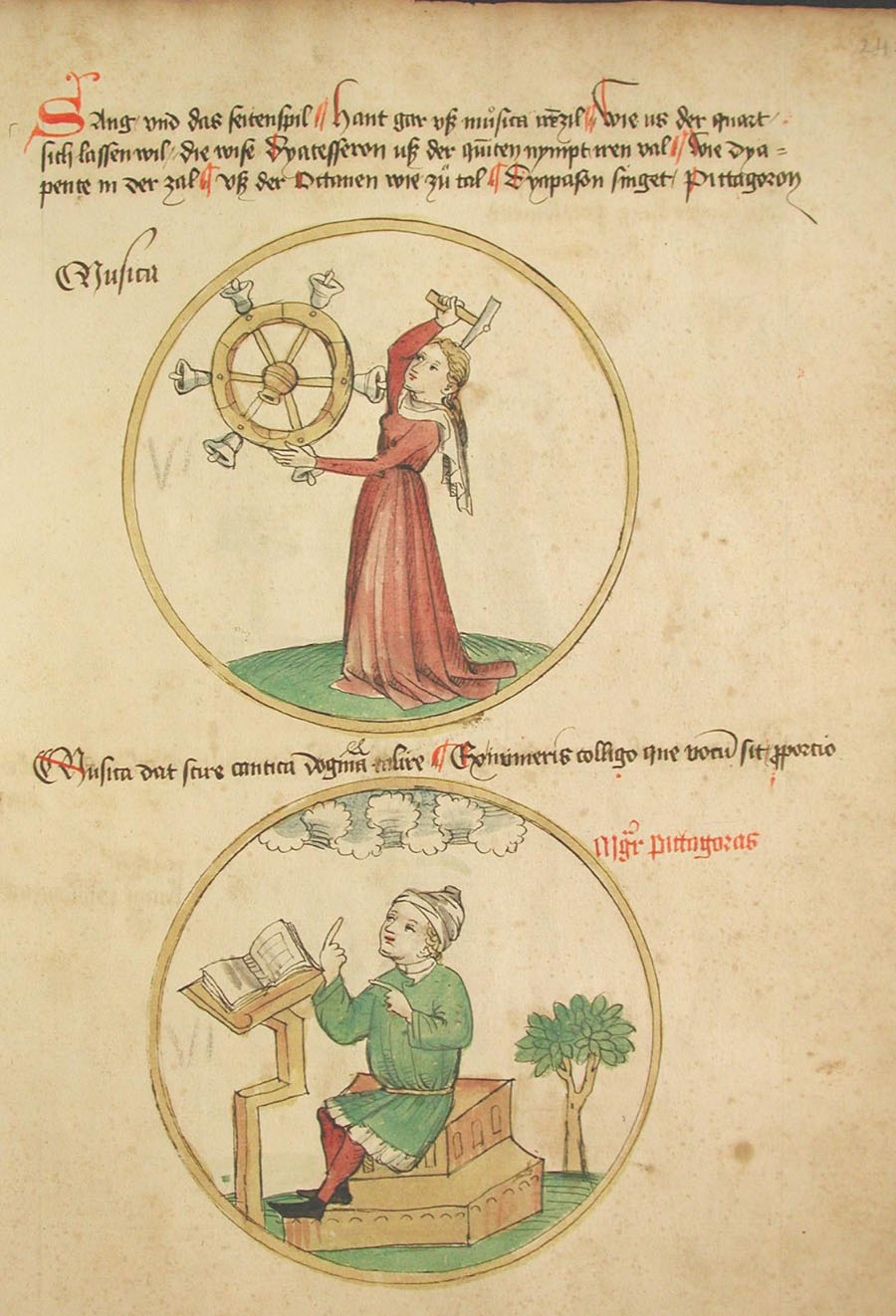
The Seven Liberal Arts: Music and Pythagoras
A medieval colored drawing pairing the allegory of Music with Pythagoras, reflecting his place in the medieval school curriculum.
Shows Pythagoras honored as the traditional founder of music theory within the medieval liberal arts curriculum.
About this source
What it is
This is a medieval colored pen drawing on parchment, held at the University Library in Salzburg. It shows two circular scenes: a woman representing Musica holding a wheel of bells, and below her a seated man identified as Pythagoras, pointing upward while reading from a book.
Why it matters
In medieval education, the seven liberal arts included Music, and Pythagoras was traditionally credited as a founder of music theory through his study of numerical ratios. Pairing him directly with the personification of Music shows how central his legendary discoveries were to how later scholars organized and taught knowledge.
Look closer
- Why is Pythagoras placed beneath the figure representing Music rather than beside her?
- What do the objects each figure holds (bells, a book) tell you about their symbolic roles?
- How does this image show the lasting influence of Pythagoras centuries after he lived?
This painting is part of the curated material that grounds the AI version of Pythagoras on Humy.ai — when students ask about related events, the AI can quote it and cite it.
More Pythagoras sources
Meet the AI Pythagoras → Book
Secondary source
Lives and Opinions of Eminent Philosophers, Book V (Life of Aristotle)
Diogenes Laërtius · c. 3rd century CE
 Book
Secondary source
Histories
Herodotus · c. 440 BCE
 Book
Secondary source
Metaphysics
Aristotle · c. 400 BCE
 Book
Secondary source
Life of Pythagoras
Porphyry · c. 270 AD
 Painting
Secondary source
The School of Athens
Raphael · 1509-1511
Ready when you are
Start chatting with Pythagoras now.
20 messages free · No credit card · Available in 50+ languages.