


Primary sourceArtifactc. 1800-1600 BC
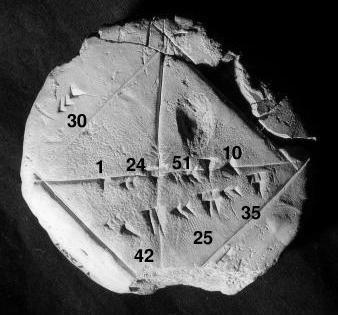
YBC 7289
c. 1800-1600 BC
A Babylonian clay tablet computing the diagonal of a square, showing mathematical knowledge related to the Pythagorean theorem long before Pythagoras.
This Babylonian tablet shows the mathematical idea behind the 'Pythagorean' theorem was known well before Pythagoras's lifetime.
About this source
What it is
This small round clay tablet, known as YBC 7289, was made by a student in southern Mesopotamia sometime between 1800 and 1600 BC. It shows a square with its diagonals and a highly accurate numerical approximation of the square root of 2. It is held at the Yale Babylonian Collection.
Why it matters
The tablet proves that the mathematical relationship later named the Pythagorean theorem was known and used over a thousand years before Pythagoras was born. It is a reminder that many ideas credited to famous Greek names were already known in other, older civilizations.
Look closer
- What does this tablet suggest about who really deserves credit for the 'Pythagorean' theorem?
- Why might Pythagoras's name have become attached to an idea with such a long earlier history?
- What kind of person made this tablet, and what does that tell you about ancient education?
This artifact is part of the curated material that grounds the AI version of Pythagoras on Humy.ai — when students ask about related events, the AI can quote it and cite it.
More Pythagoras sources
Meet the AI Pythagoras → Book
Secondary source
Lives and Opinions of Eminent Philosophers, Book V (Life of Aristotle)
Diogenes Laërtius · c. 3rd century CE
 Book
Secondary source
Histories
Herodotus · c. 440 BCE
 Book
Secondary source
Metaphysics
Aristotle · c. 400 BCE
 Book
Secondary source
Life of Pythagoras
Porphyry · c. 270 AD
 Painting
Secondary source
The School of Athens
Raphael · 1509-1511
Ready when you are
Start chatting with Pythagoras now.
20 messages free · No credit card · Available in 50+ languages.