


Secondary sourceBookc. 500
De institutione musica
Boethius · c. 500
A treatise by the Roman scholar Boethius that retells how Pythagoras discovered harmonic ratios by listening to blacksmiths' hammers.
Preserves and spreads the legend of Pythagoras's discovery of musical ratios to medieval readers.
About this source
What it is
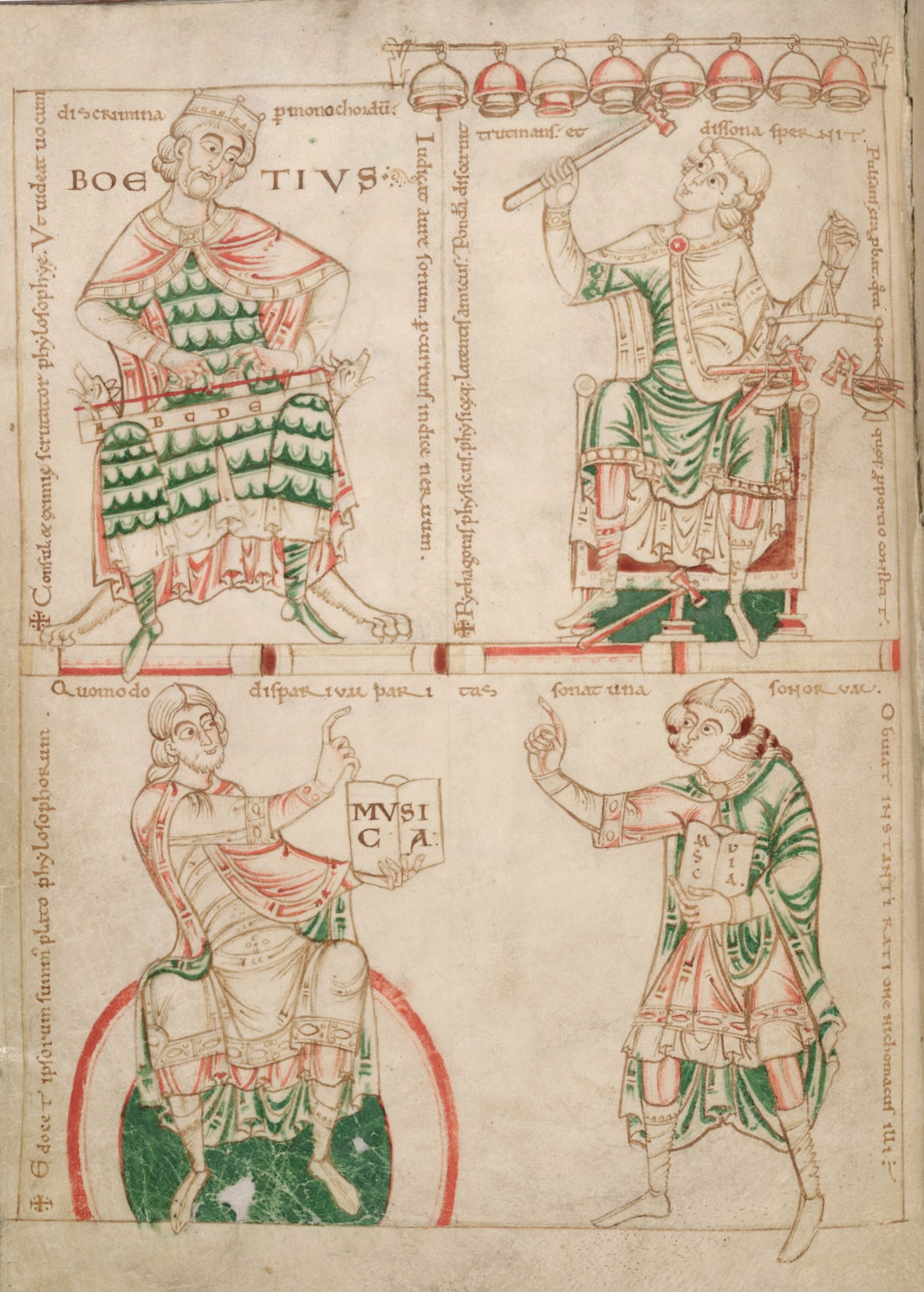
De institutione musica is a treatise written by Boethius around the year 500. It survives in manuscripts such as this illustrated page held at Cambridge University Library, which shows Boethius, Pythagoras, Plato and Nicomachus in separate panels.
Why it matters
Boethius's retelling of Pythagoras discovering musical ratios by listening to blacksmiths' hammers became the standard story for medieval scholars. Through this text, Pythagoras was remembered for centuries as the founder of music theory, long after his own writings had been lost.
Look closer
- Why do you think Boethius chose to link Pythagoras's name to a story about hammers and bells?
- What does it tell us that this manuscript places Pythagoras among other famous thinkers like Plato?
- How reliable do you think a story is when it is retold centuries after the person lived?
This book is part of the curated material that grounds the AI version of Pythagoras on Humy.ai — when students ask about related events, the AI can quote it and cite it.
More Pythagoras sources
Meet the AI Pythagoras → Book
Secondary source
Lives and Opinions of Eminent Philosophers, Book V (Life of Aristotle)
Diogenes Laërtius · c. 3rd century CE
 Book
Secondary source
Histories
Herodotus · c. 440 BCE
 Painting
Secondary source
Pythagoras Leaning on a Globe with Four Listeners
 Book
Secondary source
Metaphysics
Aristotle · c. 400 BCE
 Painting
Secondary source
Boethius and Pythagoras
1521
Ready when you are
Start chatting with Pythagoras now.
20 messages free · No credit card · Available in 50+ languages.