


Secondary sourceArtifact1835
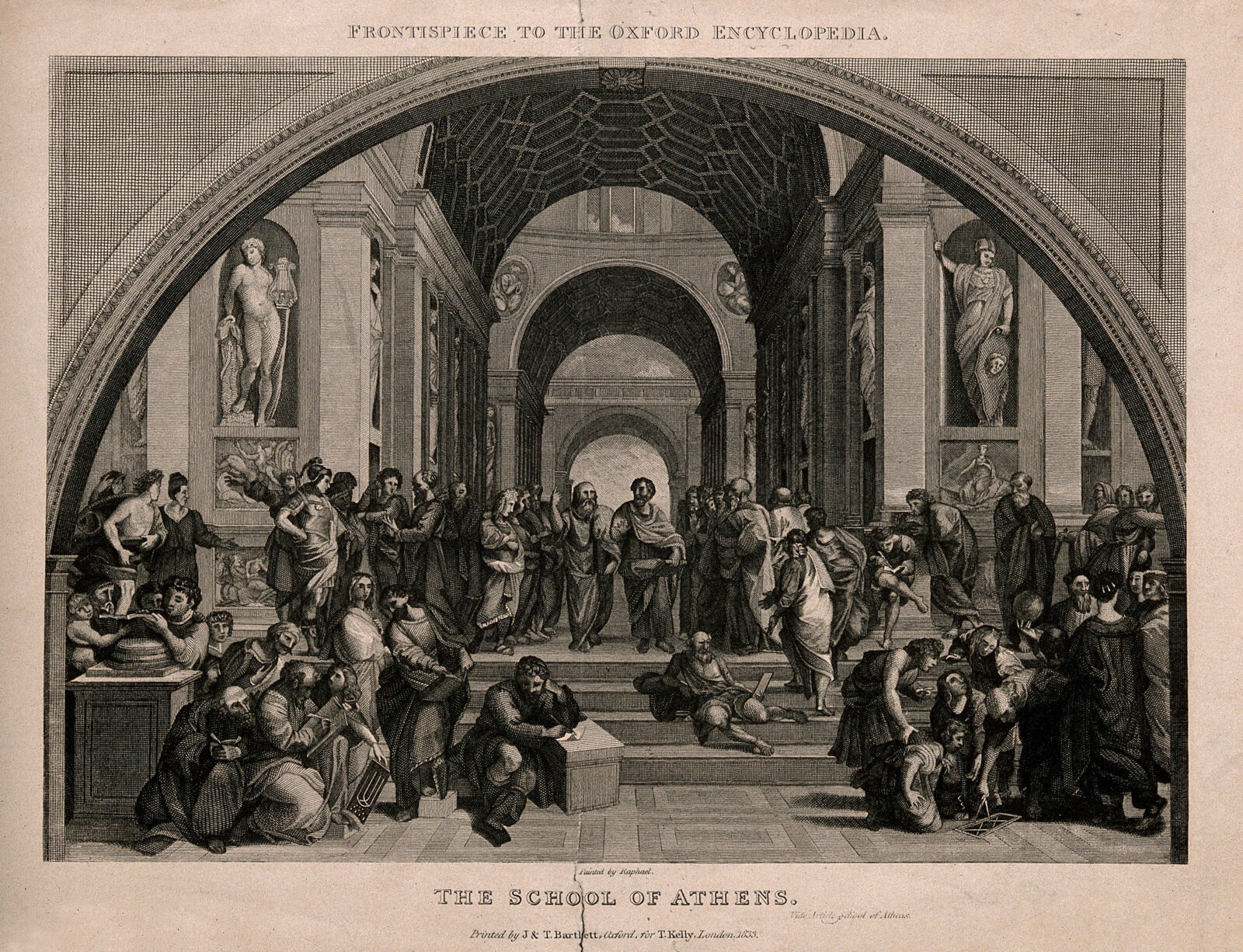
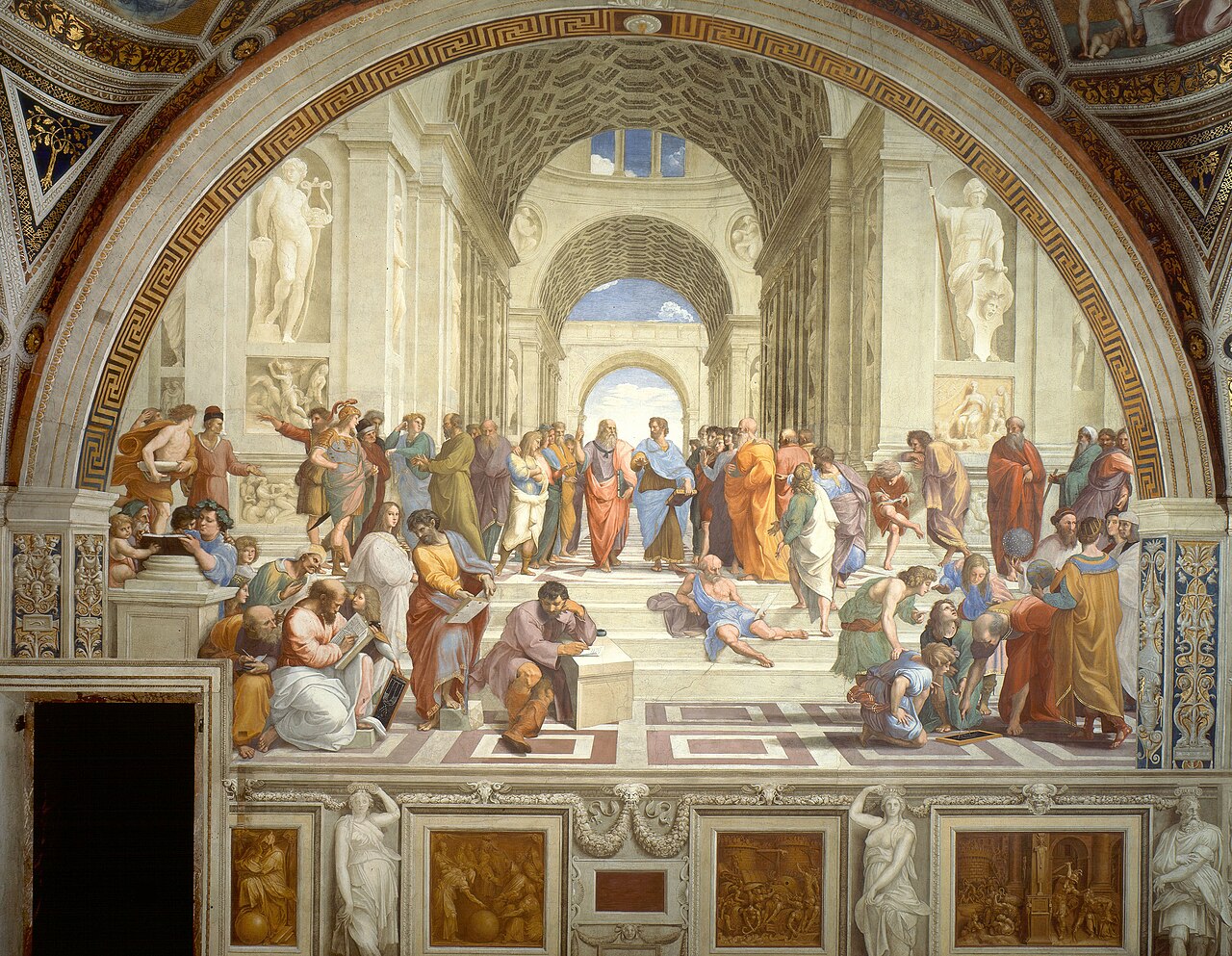
The School of Athens (1835 engraving by J. & T. Bartlett)
J. & T. Bartlett · 1835
An 1835 engraving after Raphael's painting The School of Athens, showing a crowd of ancient philosophers in a grand hall. The curator's note lists Pythagoras among them.
Shows Pythagoras as one of the ancient philosophers in a later engraving of Raphael's School of Athens, a popular image of ancient thinkers.
About this source
What it is
This is an 1835 engraving by J. and T. Bartlett, printed in Oxford for T. Kelly of London. It reproduces Raphael's painting The School of Athens and carries the inscription 'Frontispiece to the Oxford Encyclopedia'. The print shows a grand arched hall with statues in niches and many robed figures gathered on steps and across the floor, some reading, writing or talking. A figure at lower right bends over a diagram on the floor. The curator's note says Pythagoras is among the philosophers shown. The print is held by the Wellcome Collection in London.
Why it matters
Engravings like this one carried Raphael's imagined crowd of Greek thinkers into books and classrooms. Readers who met Pythagoras here saw an image made by artists centuries after he lived, not a record of his appearance. The print shows how later generations pictured ancient philosophy as a shared, public conversation.
Look closer
- Which figures are placed near the centre, and how does the composition show who is important?
- Why might an encyclopedia choose this scene as its frontispiece?
- What does this print leave out about what Pythagoras actually taught or wrote?
This artifact is part of the curated material that grounds the AI version of Pythagoras on Humy.ai — when students ask about related events, the AI can quote it and cite it.
More Pythagoras sources
Meet the AI Pythagoras → Book
Secondary source
Lives and Opinions of Eminent Philosophers, Book V (Life of Aristotle)
Diogenes Laërtius · c. 3rd century CE
 Book
Secondary source
Histories
Herodotus · c. 440 BCE
 Book
Secondary source
Metaphysics
Aristotle · c. 400 BCE
 Book
Secondary source
Life of Pythagoras
Porphyry · c. 270 AD
 Painting
Secondary source
The School of Athens
Raphael · 1509-1511
Ready when you are
Start chatting with Pythagoras now.
20 messages free · No credit card · Available in 50+ languages.