


Secondary sourceBook3rd century AD commentary on an earlier text
Zhoubi Suanjing
Zhao Shuang · 3rd century AD commentary on an earlier text
An ancient Chinese mathematical and astronomical text containing an independent proof of the right-triangle relation known in the West as the Pythagorean theorem.
Shows that the theorem associated with Pythagoras's name was proven independently in ancient China.
About this source
What it is
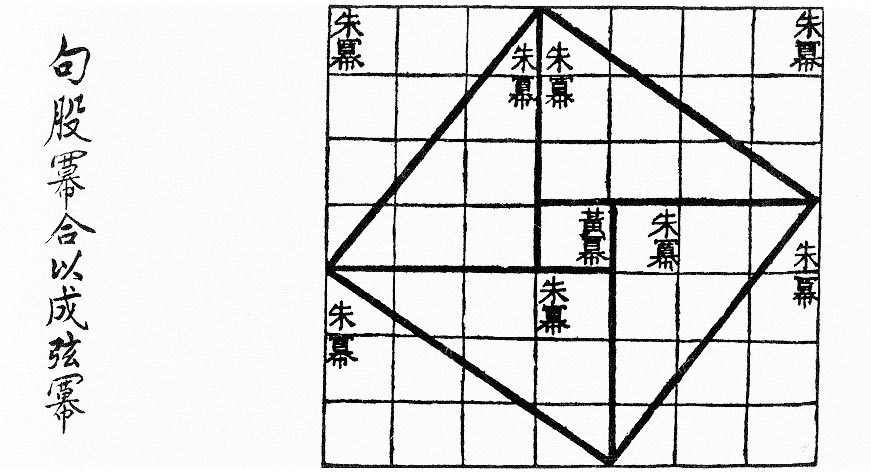
The Zhoubi Suanjing is an ancient Chinese treatise on mathematics and astronomy. Its final form dates from around the Eastern Han period, though it claims older origins. In the 3rd century, the scholar Zhao Shuang added a commentary with a diagram proving the 'gougu' theorem, the Chinese version of the right-triangle relation, for a 3-4-5 triangle.
Why it matters
This text shows that the mathematical relationship associated with Pythagoras's name was discovered and proven independently in China, by scholars such as Zhao Shuang, separately from the Greek tradition. It reminds students that important ideas are often found in more than one culture.
Look closer
- Why might two different cultures discover the same mathematical relationship without contact?
- What does the diagram's method of proof tell you about how ancient Chinese mathematicians thought about shapes and space?
- Why do we call this the 'Pythagorean theorem' in the West, even though it was known elsewhere too?
This book is part of the curated material that grounds the AI version of Pythagoras on Humy.ai — when students ask about related events, the AI can quote it and cite it.
More Pythagoras sources
Meet the AI Pythagoras → Book
Secondary source
Lives and Opinions of Eminent Philosophers, Book V (Life of Aristotle)
Diogenes Laërtius · c. 3rd century CE
 Book
Secondary source
Histories
Herodotus · c. 440 BCE
 Book
Secondary source
Metaphysics
Aristotle · c. 400 BCE
 Book
Secondary source
Life of Pythagoras
Porphyry · c. 270 AD
 Painting
Secondary source
The School of Athens
Raphael · 1509-1511
Ready when you are
Start chatting with Pythagoras now.
20 messages free · No credit card · Available in 50+ languages.