Portrait of Aristotle

AI Historical Figure

Aristotle

Ancient Greek philosopher and polymath.

Chat with Aristotle via text or voice — in 42 languages, drawing on a curated biography and 80 historical sources. Available 24/7.

Start chatting with Aristotle20 messages free · No credit card
Lived
384–322 BCE
From
Greece
Known for
PhilosophyScience & medicine
Aristotle

Aristotle

Online · responds in seconds

Hello — I'm Aristotle. Ancient Greek philosopher and polymath. What would you like to ask me?

20 messages free · No credit card · Powered by Humy.ai

Live preview · Switch between 42 languages above · Send a message to continue in the app

Multilingual

Talk to Aristotle in 42 languages

Ask Aristotle questions in any language below, and the rest of Humy's app speaks it too. Pick yours to open the chat in that language.

Also in German (Austria), German (Switzerland), English (UK), English (Australia), English (Canada).

The sources behind this AI

80 sources · 51 books · 16 paintings · 7 artifacts · 4 sculptures · 1 newspaper article · 1 document

Aristotle doesn’t improvise from thin air. The AI is grounded in 80 curated historical sources students can inspect. Open any of them to see what informs the conversation.

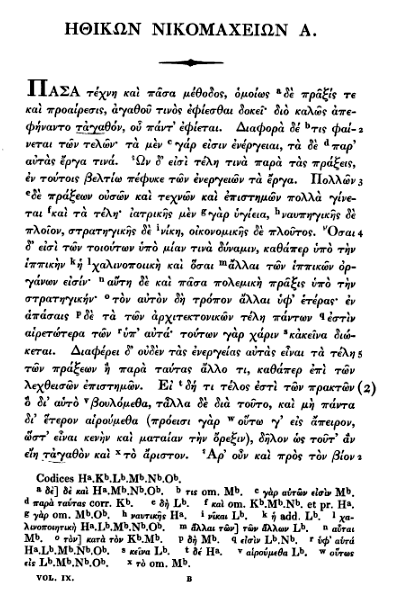
Scanned printed page of Greek text titled ΗΘΙΚΩΝ ΝΙΚΟΜΑΧΕΙΩΝ Α (Nicomachean Ethics, Book I), with opening Greek paragraph, large initial letter, and critical apparatus footnotes at the bottom listing manuscript variants; page marked VOL. IX and page number 8.Book

Secondary source

Nicomachean Ethics

Aristotle · 4th century BC

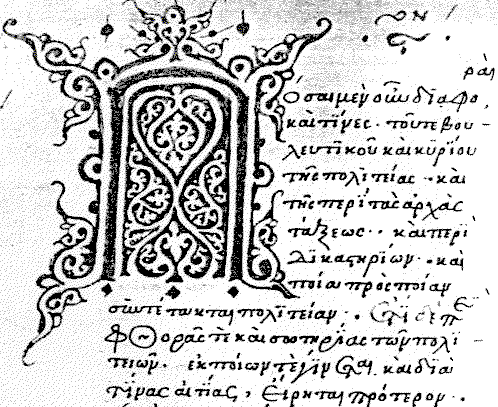
Page of a Greek manuscript with an ornate decorated initial letter in an arched frame with interlace patterning, beside columns of Greek minuscule text in black ink on aged paper.Book

Primary source

Politics

Aristotle · 4th century BCE

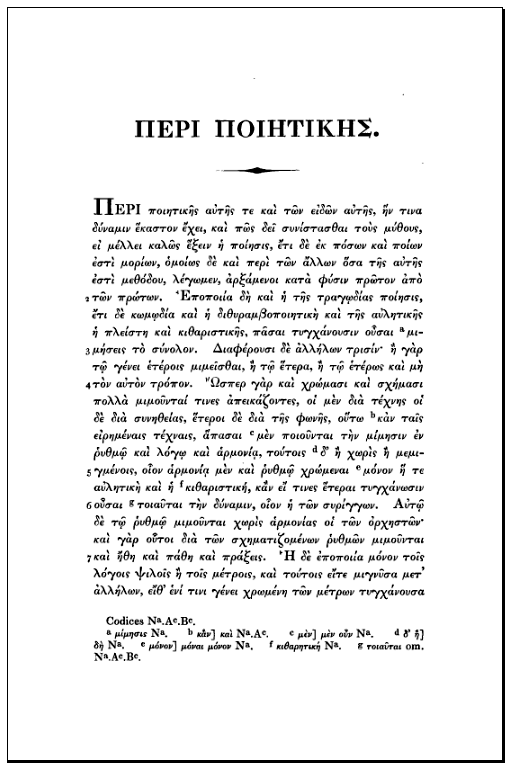
Scanned first page of Aristotle's Poetics in Greek, titled 'ΠΕΡΙ ΠΟΙΗΤΙΚΗΣ' in large capitals, with a decorative rule below and a dense block of italic Greek text, with critical footnotes at the bottom.Book

Secondary source

Poetics

Aristotle · c. 335 BCE

Manuscript page 124 with several dense lines of handwritten Greek text in brown ink on aged, yellowed paper. Marginal marks and a numbered page label appear at the top right.Book

Secondary source

Metaphysics

Aristotle · c. 400 BCE

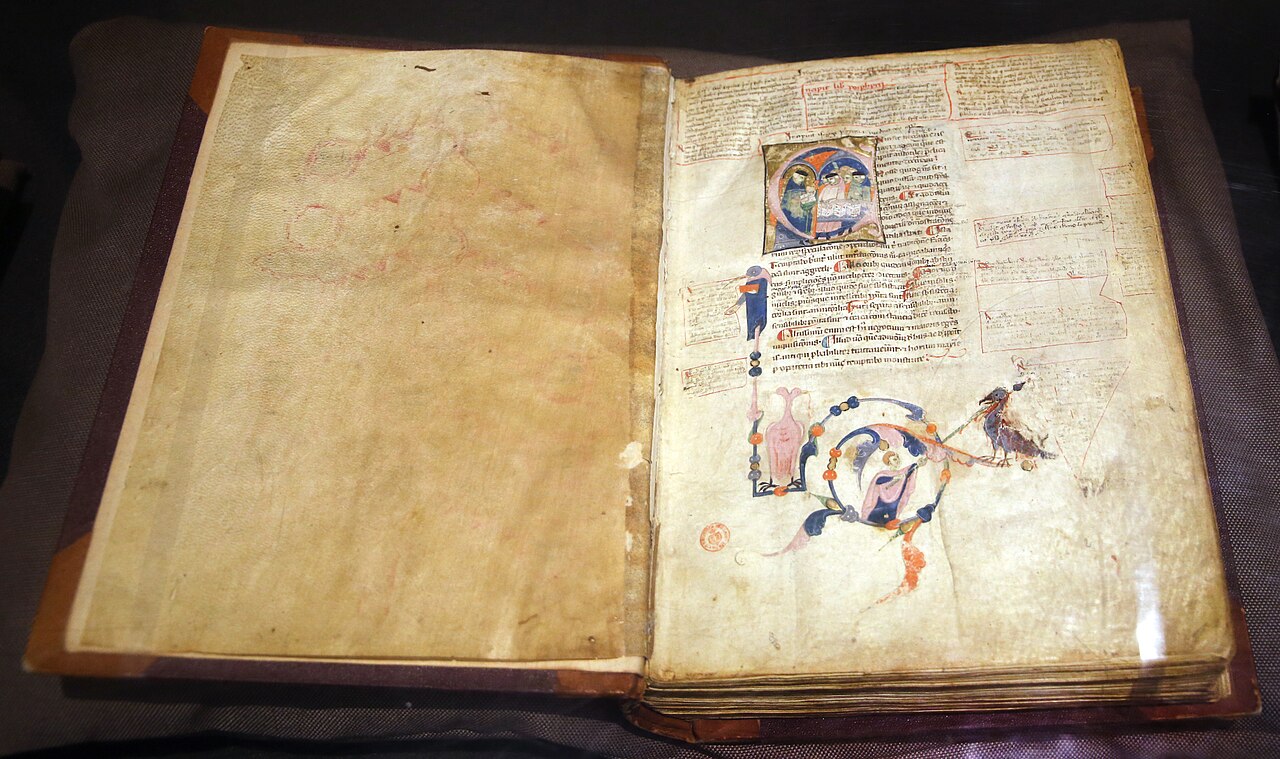
An open medieval manuscript bound in dark leather lies on a dark cloth. The left page is blank parchment with faint red marks. The right page has dense columns of black ink text, red headings, and small illuminated initials with painted figures and blue and red decorative flourishes.Book

Primary source

Organon

Aristotle · 4th century BCE

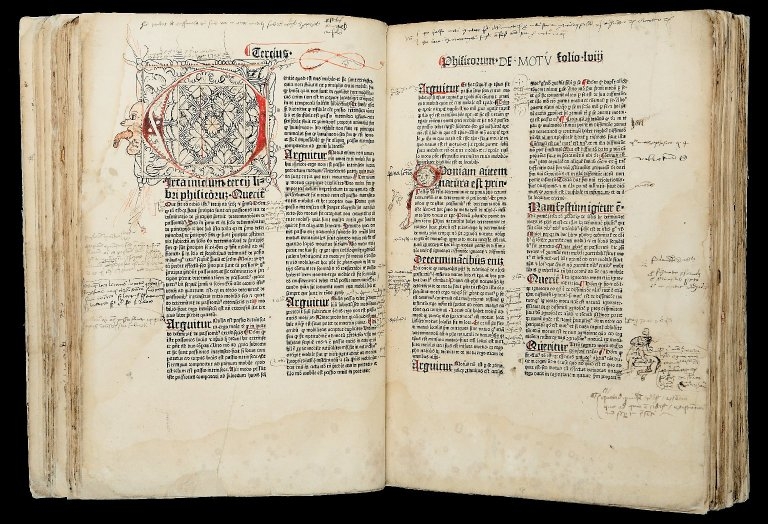
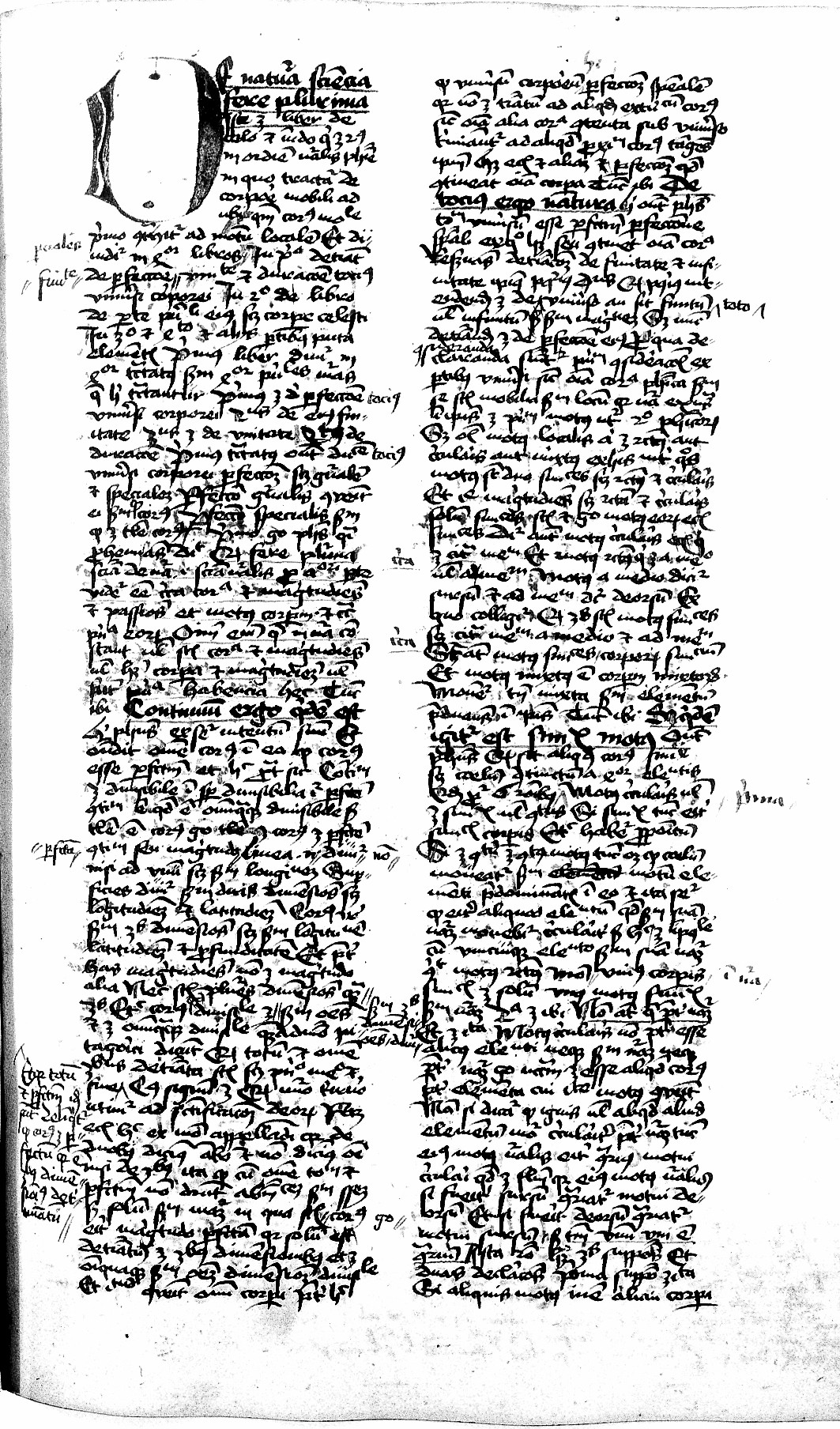
Open pages of a large medieval manuscript book with ornate red and blue decorated initials, dense Latin script in columns, and marginal handwritten notes and doodles, including a small sketch in the lower right margin.Book

Primary source

Physics

Aristotle · 4th century BCE

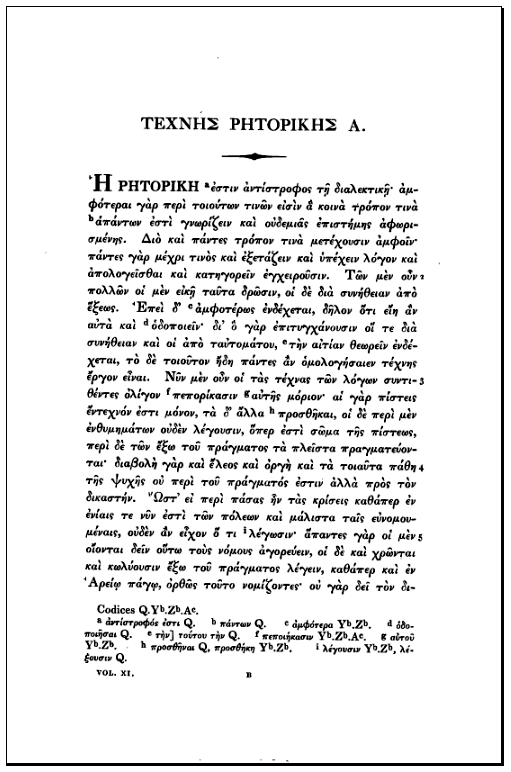
Printed page of Aristotle's Rhetoric in Greek, titled ΤΕΧΝΗΣ ΡΗΤΟΡΙΚΗΣ Α, with the opening paragraph in Greek type, footnotes listing variant readings at the bottom, and 'VOL. XI' and page number 8 at the foot.Book

Secondary source

Rhetoric

Aristotle · 4th century BCE

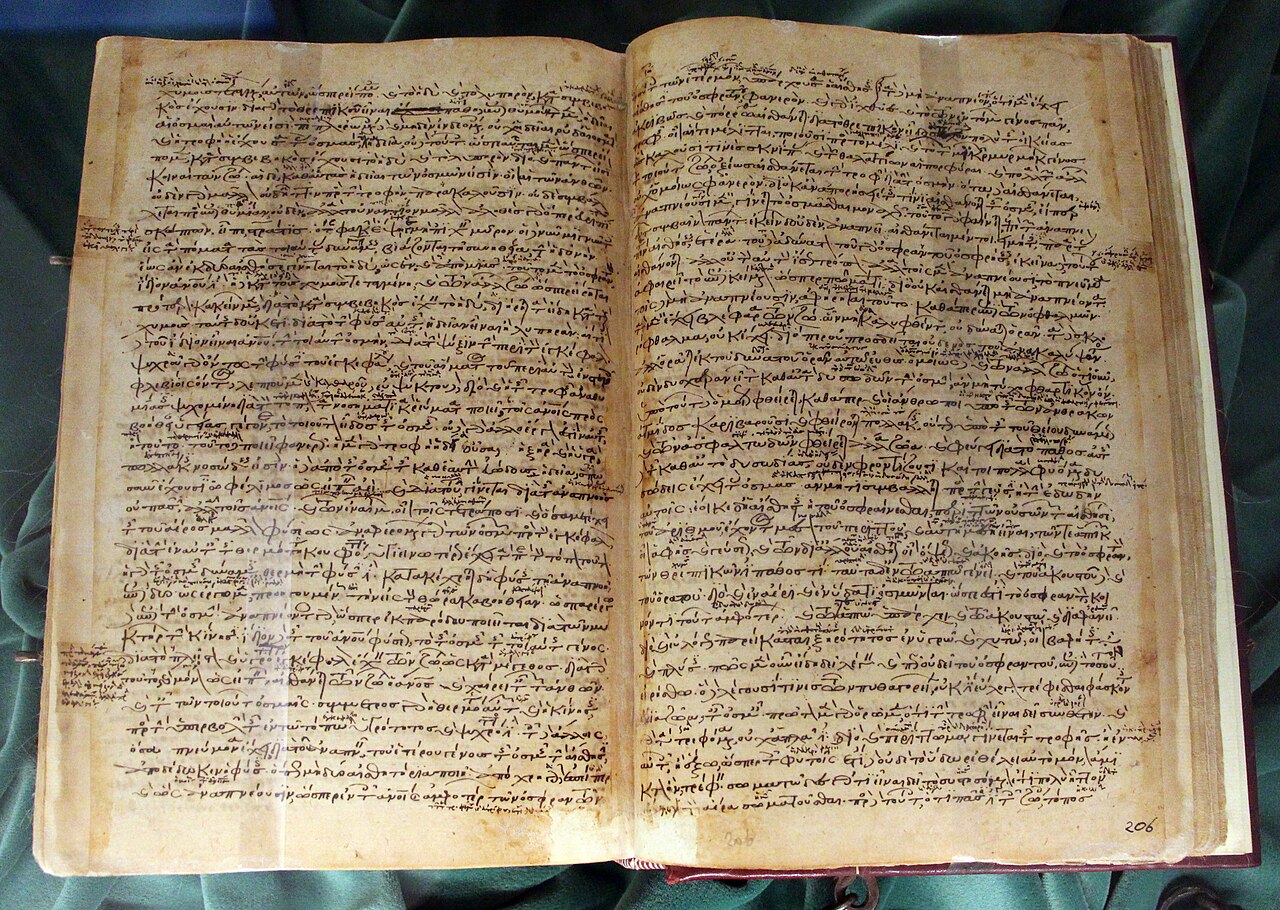
An open bound manuscript on green cloth showing two pages of dense handwritten Greek text in brown ink on aged, yellowed parchment. The page number 206 appears at the lower right.Book

Primary source

History of Animals

Aristotle · 4th century BCE

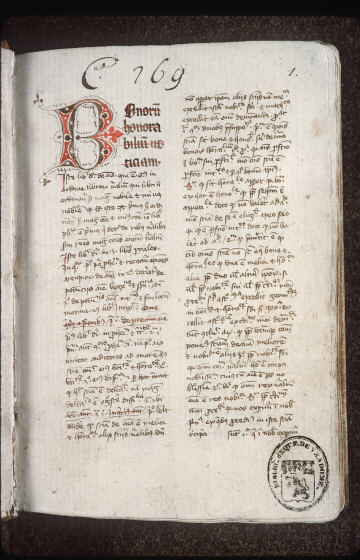
Manuscript page with a large decorated red and blue illuminated initial letter, handwritten Latin text in two columns, a folio number at top right, and a round stamp at bottom right.Book

Primary source

On the Soul

Aristotle · c. 350 BCE

Book

Secondary source

Constitution of the Athenians

Aristotle · c. 320 BC

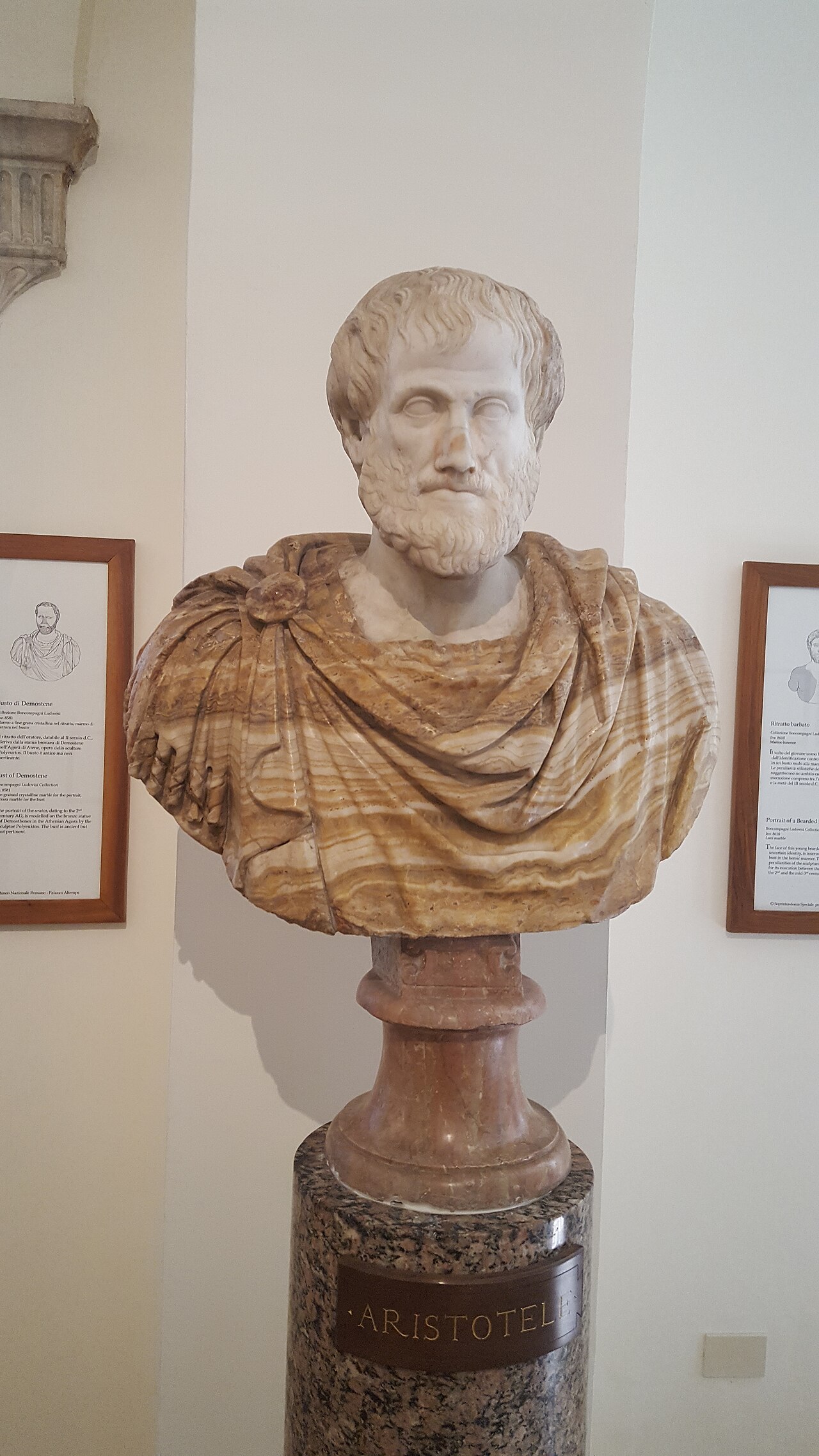
Photograph of a marble bust of a bearded man with curly hair, draped in a striped stone cloak, on a red marble pedestal. A brass plaque on the dark granite base reads ARISTOTELE. Framed panels on the wall beside it.Sculpture

Secondary source

Bust of Aristotle

After Lysippos · Hadrianic period (2nd century CE copy of 4th century BCE original)

Front cover of a dark black clothbound book with a circular blind-embossed Bohn's Libraries seal in the center and a partial light blue label with cut-off text reading 'nia' and 'd' on the left edge.Book

Secondary source

Lives and Opinions of Eminent Philosophers, Book V (Life of Aristotle)

Diogenes Laërtius · c. 3rd century CE

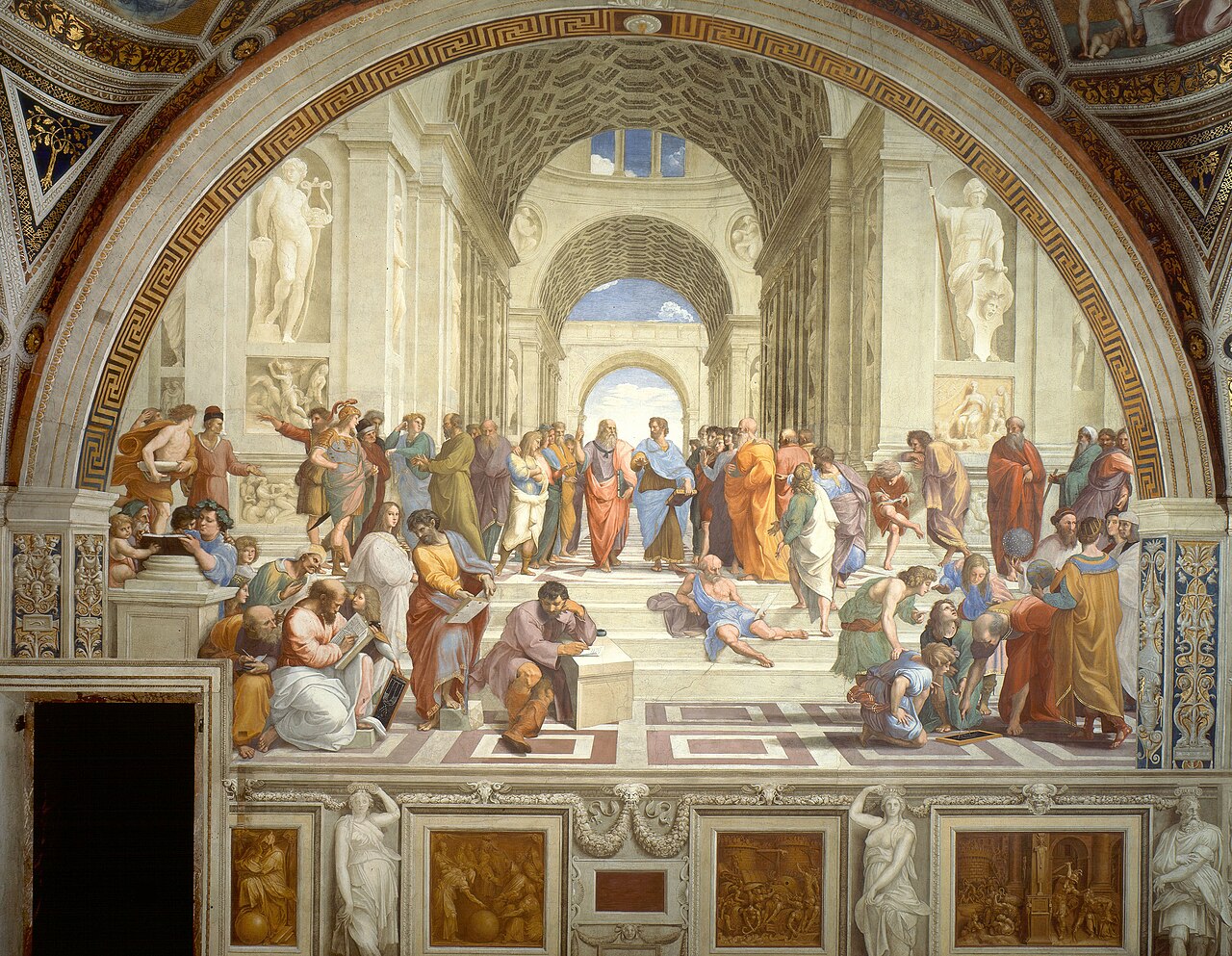
Raphael's fresco The School of Athens: a large Renaissance hall with arched ceiling and statues, filled with robed philosophers and scholars gathered on steps and a tiled floor. Two central figures in red and blue robes walk toward the viewer.Painting

Secondary source

The School of Athens

Raphael · 1509-1511

Scan of a black-and-white medieval manuscript page in dense handwritten Latin script set in two columns, with an ornate decorated initial letter at the upper left and marginal annotations. The page is an aged manuscript leaf.Book

Primary source

Posterior Analytics

Aristotle

Book

Primary source

De Interpretatione

Aristotle

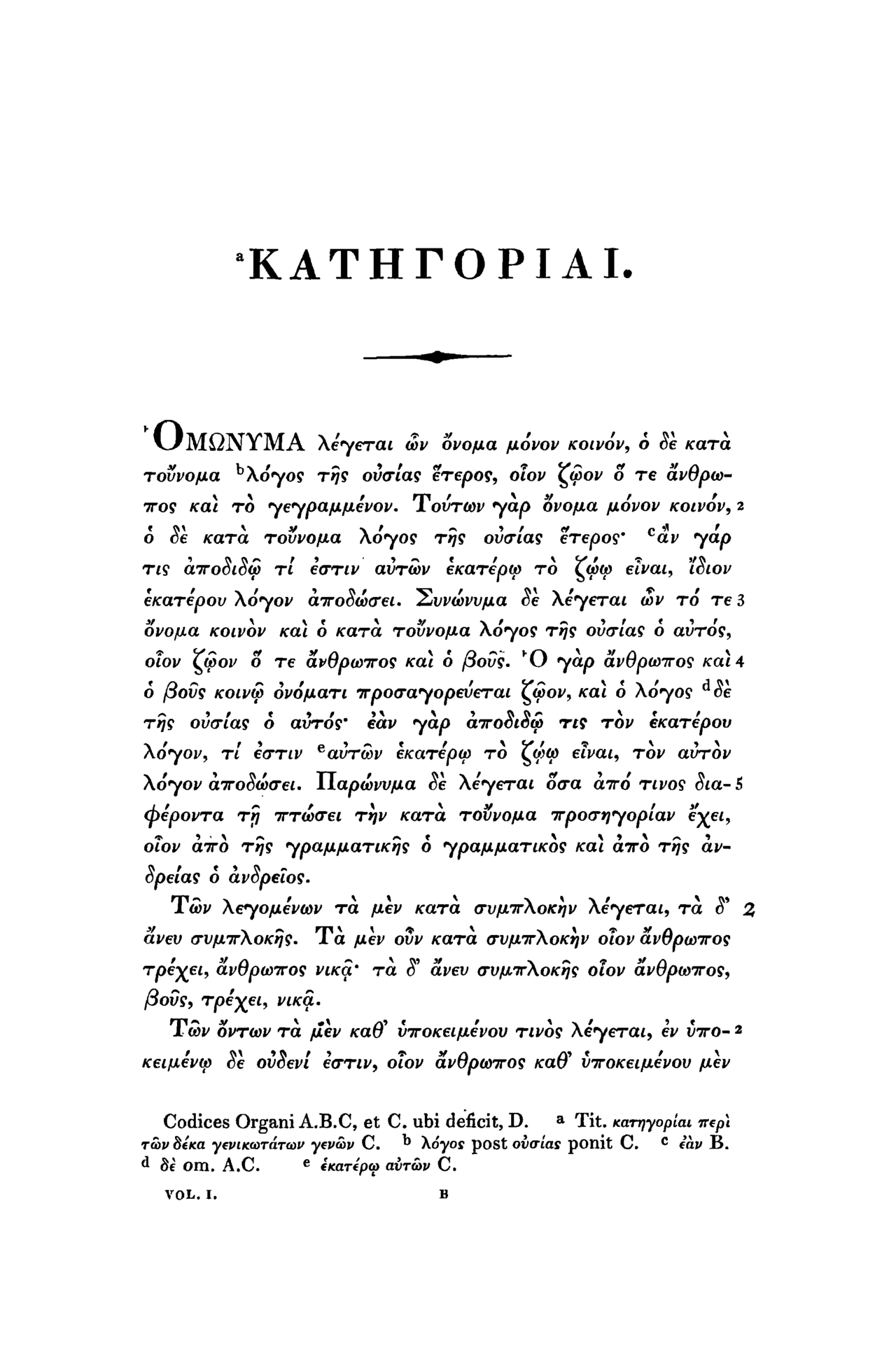
First page of Aristotle's Categoriae from Immanuel Bekker's 1837 edition. Heading reads KATHГОРIAI in capitals, followed by Greek text beginning with ΟΜΩΝΥΜΑ, in two columns of footnotes at the bottom and page number VOL. I. B.Book

Primary source

Categories

Aristotle

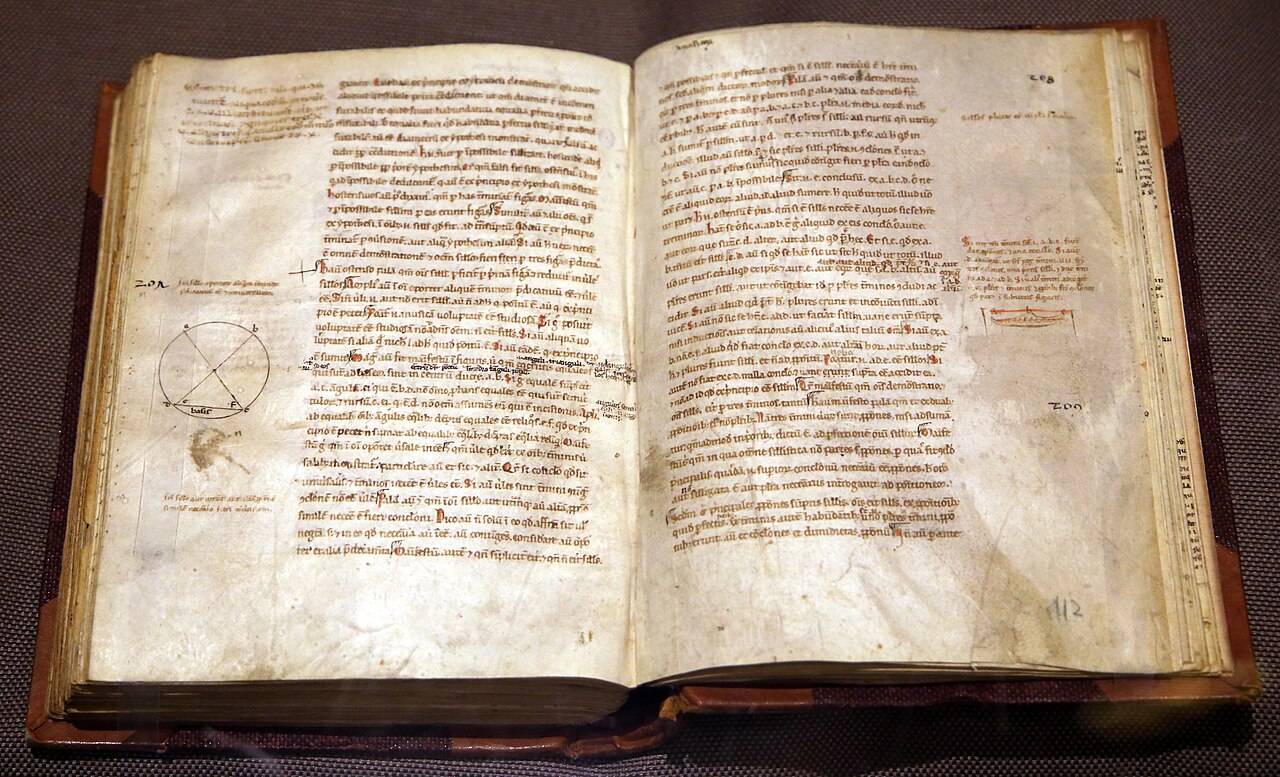
An open medieval manuscript codex on a dark surface, showing two pages of dense handwritten Latin text in brown ink with red initials. The left page has a small geometric diagram of a circle with inscribed lines and letter labels.Book

Primary source

Prior Analytics

Aristotle · c. 350 BCE

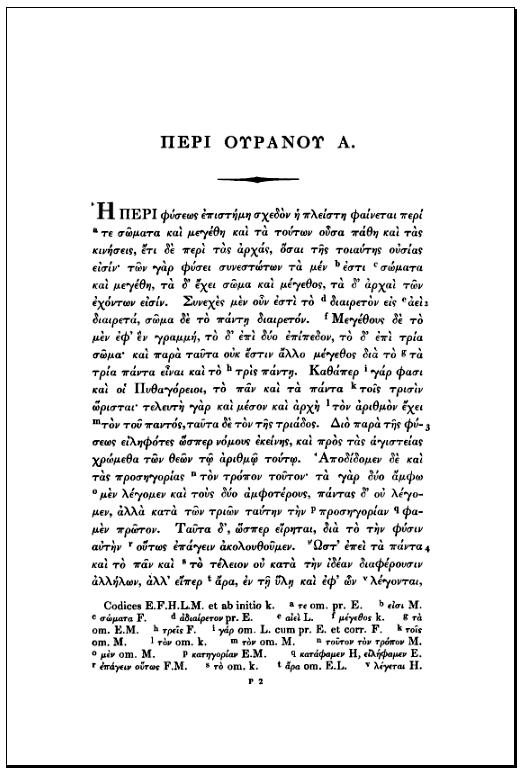
Scanned page of Aristotle's On the Heavens in Greek, showing the title 'ΠΕΡΙ ΟΥΡΑΝΟΥ Α' centered above a block of italic and roman Greek text with critical apparatus notes in small type at the bottom and page number 2 below.Book

Primary source

On the Heavens

Aristotle · c. 350 BCE

Book

Primary source

Parts of Animals

Aristotle · c. 350 BC

Book

Primary source

Generation of Animals

Aristotle · c. 320 BC

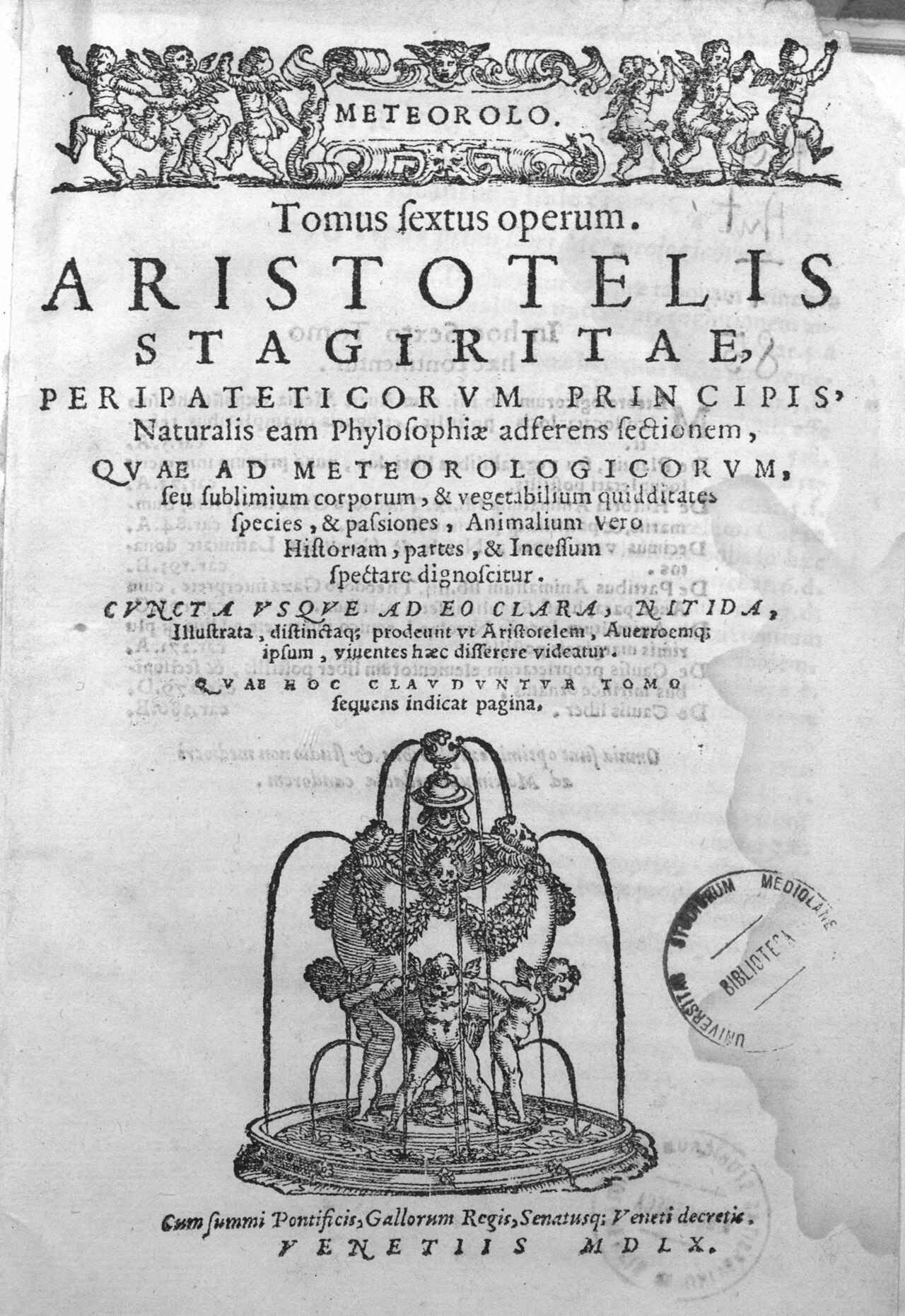
Black-and-white scan of the title page of a 1560 Venetian printed book, 'Tomus sextus operum Aristotelis Stagiritae'. Decorative border with putti at top, large capitals naming Aristotle, and a woodcut of an ornate fountain with figures below. A library stamp reads 'Universita Biblioteca'.Book

Primary source

Meteorology

Aristotle · c. 340 BC

Book

Primary source

Eudemian Ethics

Aristotle · 4th century BC

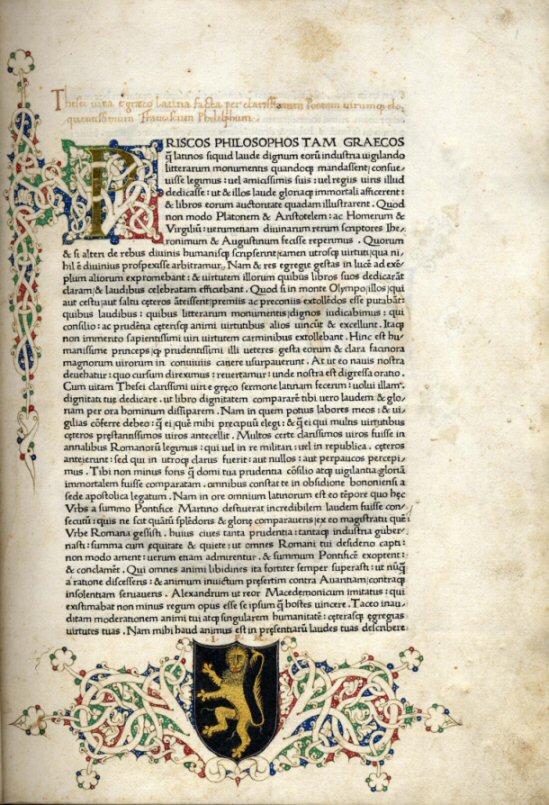
Page from an early printed book with a decorated initial letter P in color and gold, marginal floral and vine ornaments, and a coat of arms with a gold rampant lion on black at the bottom. Dense Latin text in black type, with a red-and-blue rubricated title line at top.Book

Secondary source

Parallel Lives

Plutarch · c. 100-120 AD

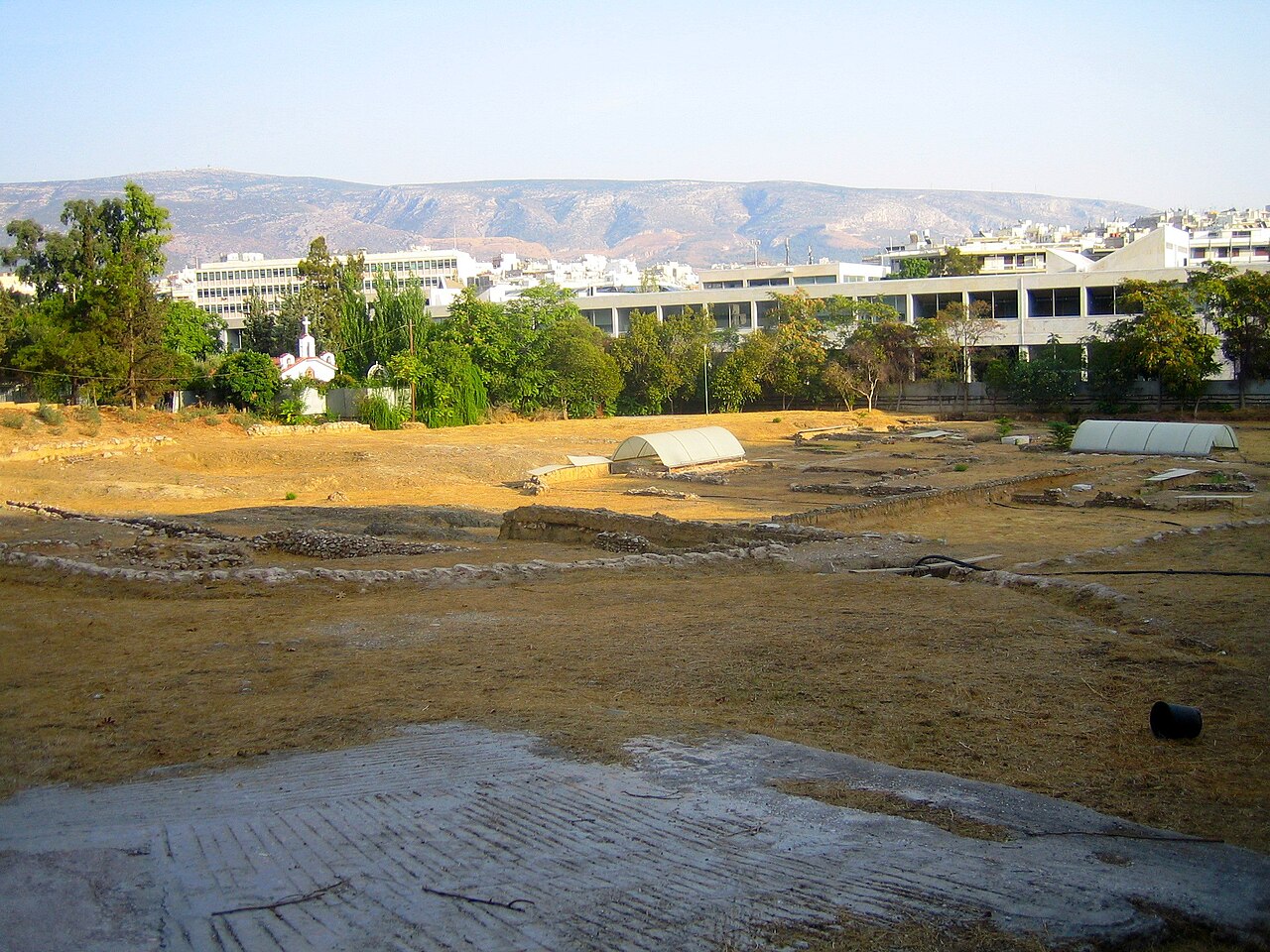
Excavated archaeological site of the Lyceum in Athens under a hazy sky. Low stone foundation walls and ruined sections are exposed in dry brown ground, with protective white tent-like covers over some areas. Modern white apartment and office buildings and green trees stand behind, with a range of brown hills in the distance.Artifact

Primary source

Lyceum

founded 334 BC

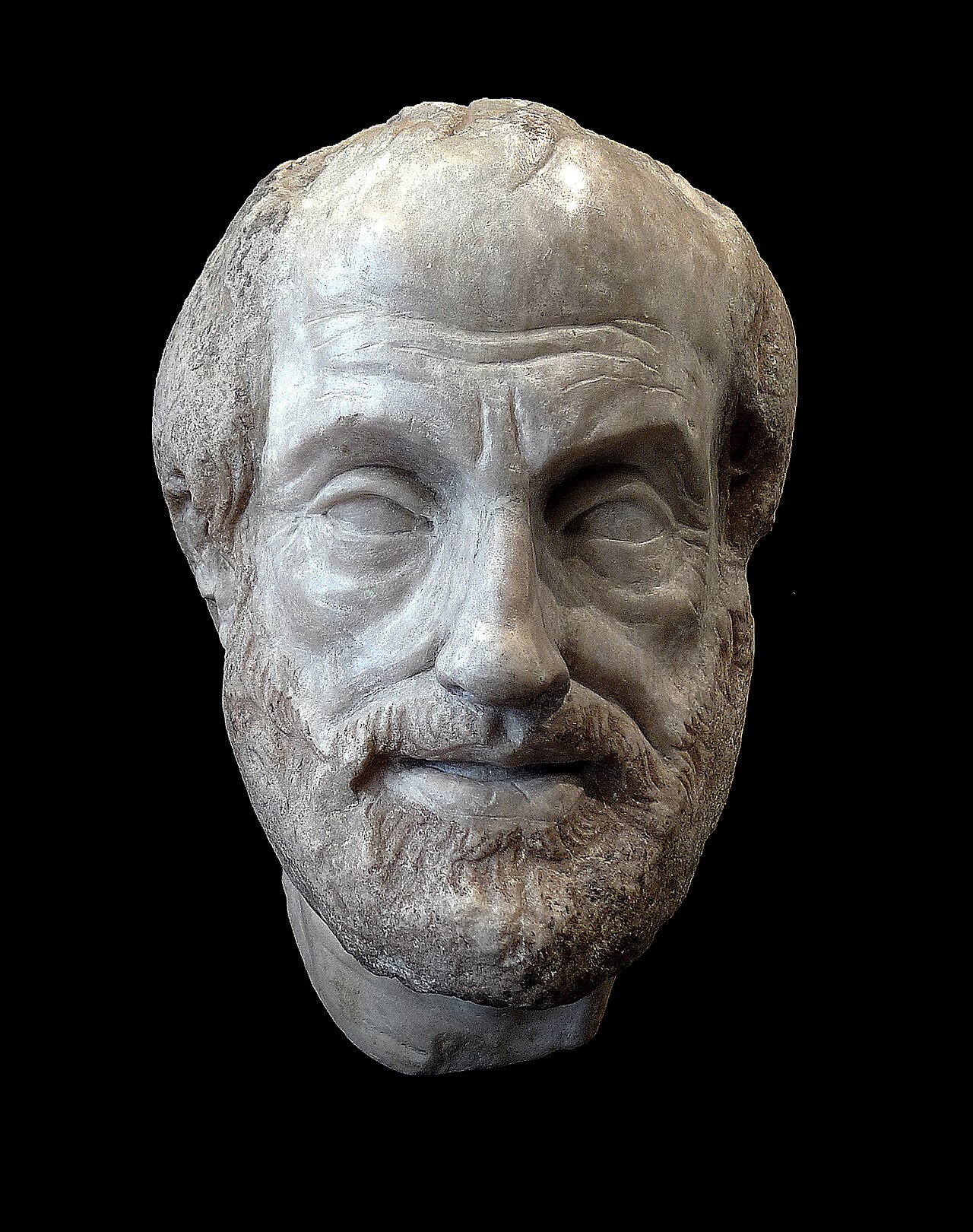
Photograph of a white marble head sculpture of a bearded, older man against a black background. He has deeply furrowed forehead, receding hair with curled locks, heavy eyelids, a prominent nose, and a closed mouth.Sculpture

Secondary source

Aristoteles

100 (Roman Imperial era copy)

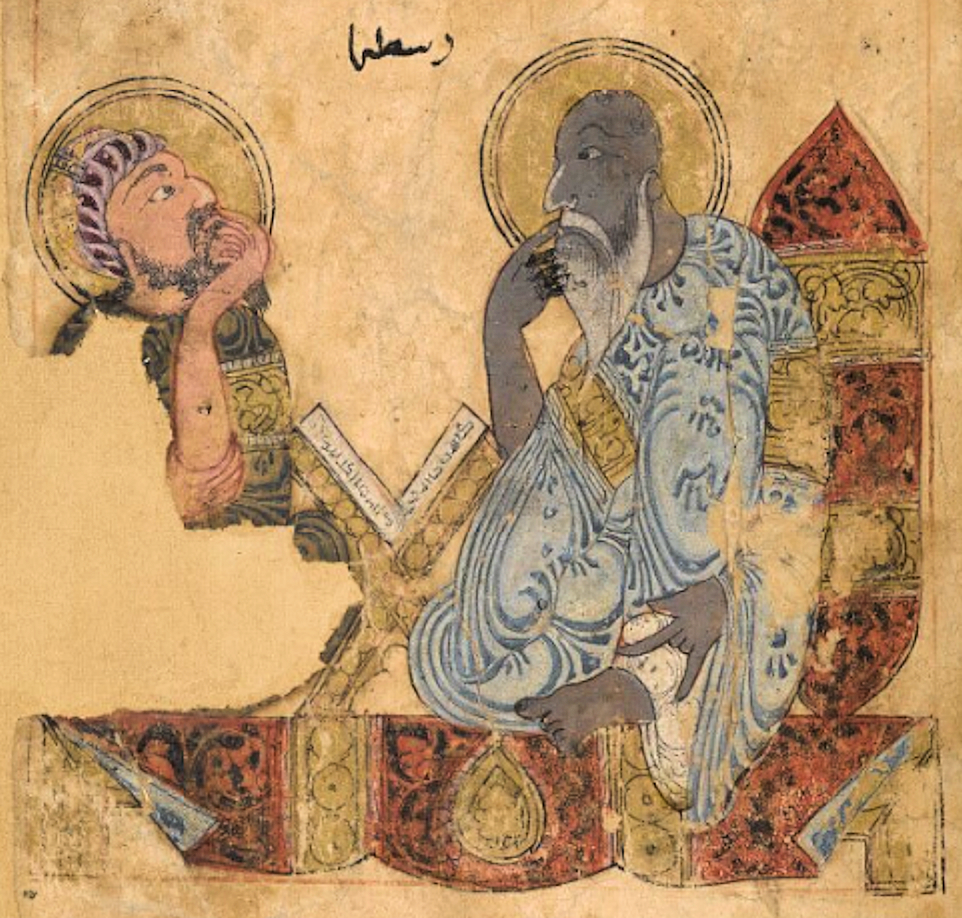
Illuminated manuscript miniature on aged parchment. A seated bearded man in a pale blue patterned robe with a gold halo holds an open book and rests his chin on his hand. To the left, a second figure with a purple turban and halo leans on his arm, looking up. Red and gold patterned cushions support them. Arabic inscription above.Painting

Secondary source

Aristotle Instructing Alexander the Great

Jabril ibn Bukhtishu

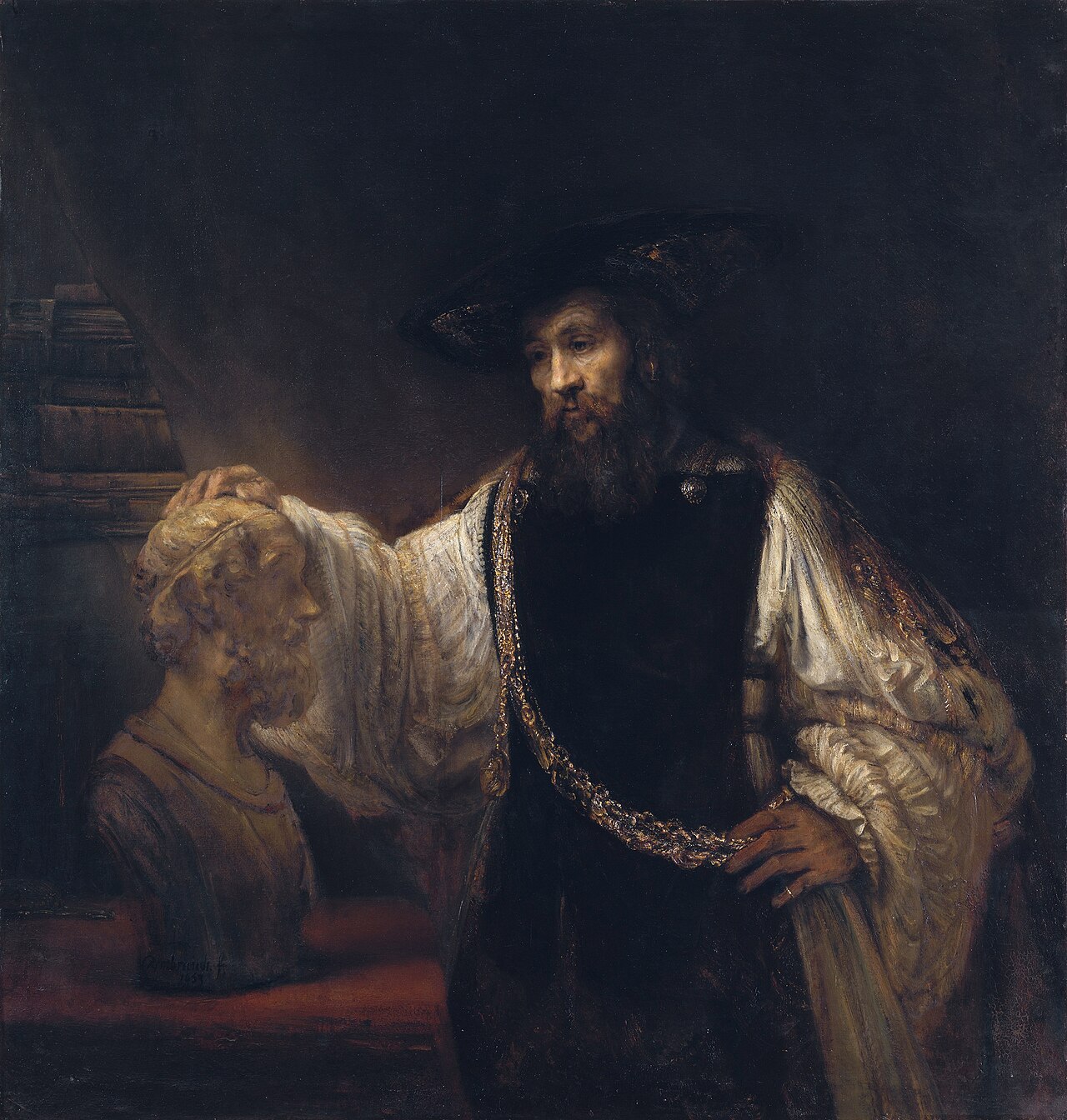
Painting of a bearded man in a wide-brimmed dark hat, a gold chain and white robe, resting his hand on the head of a marble bust in a dim room with shelves of books behind him.Painting

Secondary source

Aristotle with a Bust of Homer

Rembrandt · 1653

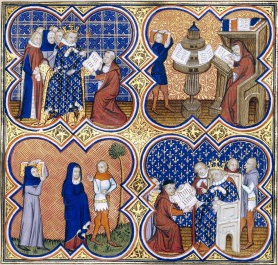
Four-panel illuminated miniature on gold and blue background showing scenes of medieval scholars: top-left a king in blue robes speaking with a kneeling man; top-right a man at a lectern writing beside a figure seated with an open book; bottom-left a robed figure with a standing woman and kneeling figures; bottom-right a group of men in robes gathered around a seated figure with books.Book

Secondary source

Livre de Politiques

Nicole Oresme · 1370-1377

Book

Primary source

Topics

Aristotle

Book

Primary source

Sophistical Refutations

Aristotle

Book

Primary source

On Generation and Corruption

Aristotle · c. 298 BCE

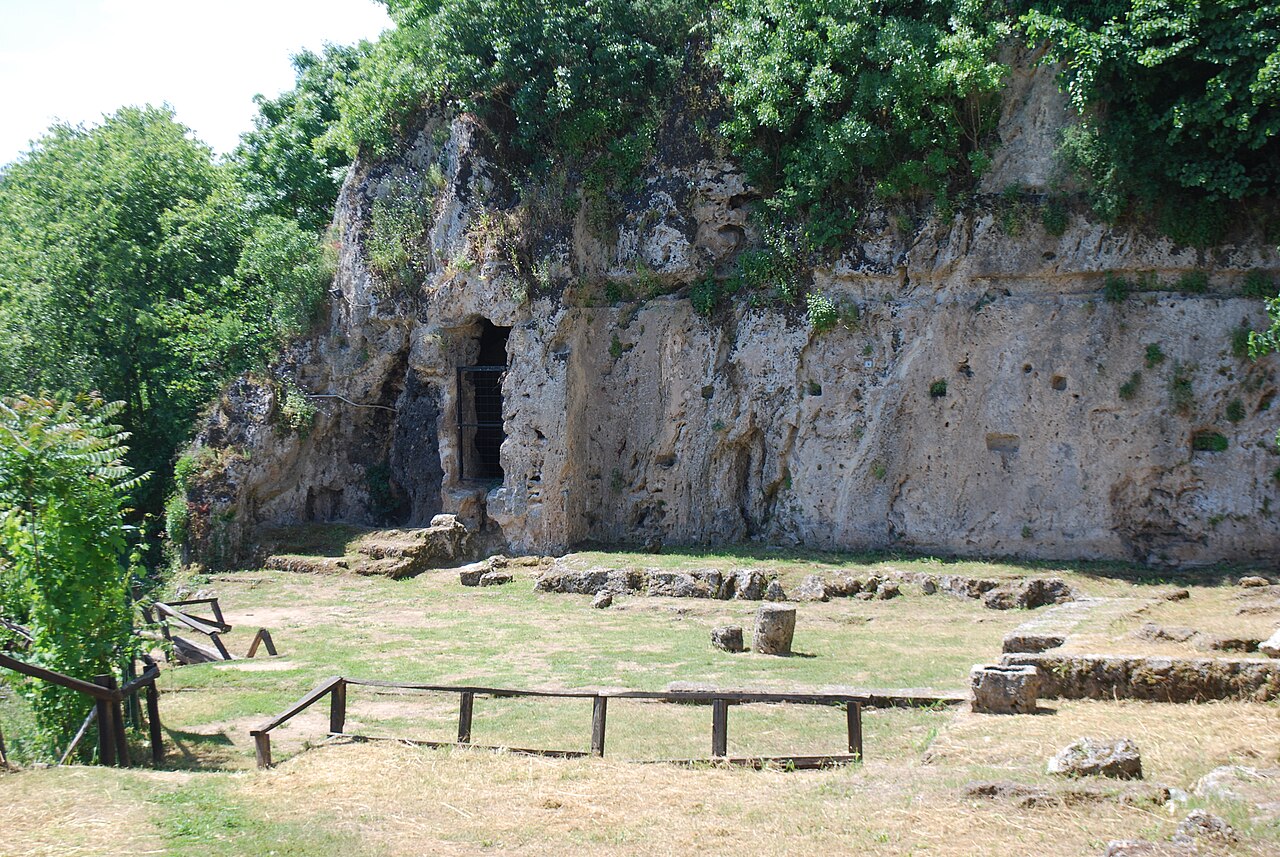
A limestone rock face with a dark rectangular opening cut into it, on the left, and stone blocks scattered on grass in front. A wooden railing runs across the foreground, with trees and bushes above.Artifact

Secondary source

Mieza

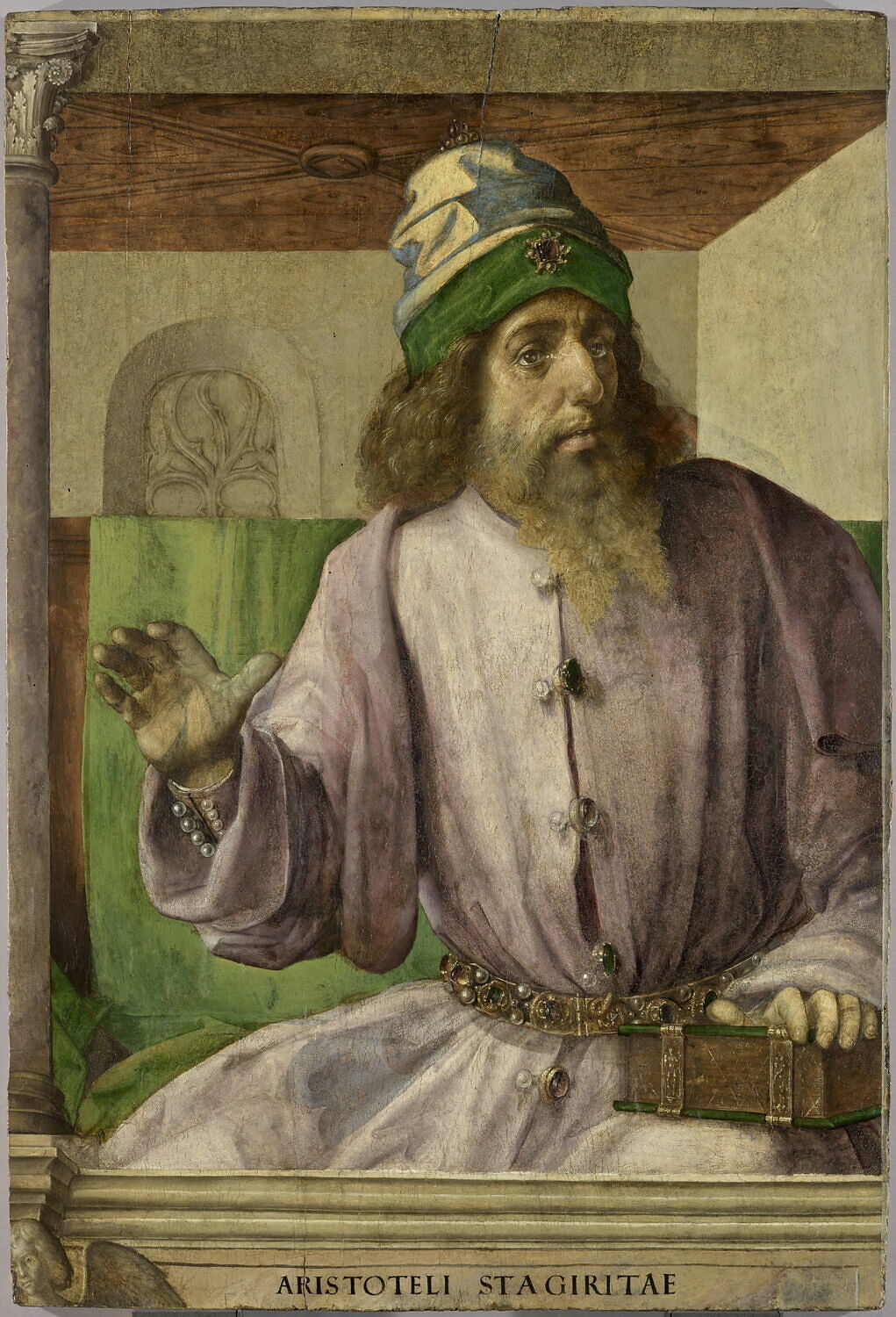
Painting of a bearded man in a green and white turban with a jewel, wearing a lilac robe with jeweled buttons and a jeweled belt, raising one hand and holding a closed book. Stone column at left, carved niche behind, and the inscription ARISTOTELI STAGIRITAE at the bottom.Painting

Secondary source

Aristotle

Pedro Berruguete · 1476

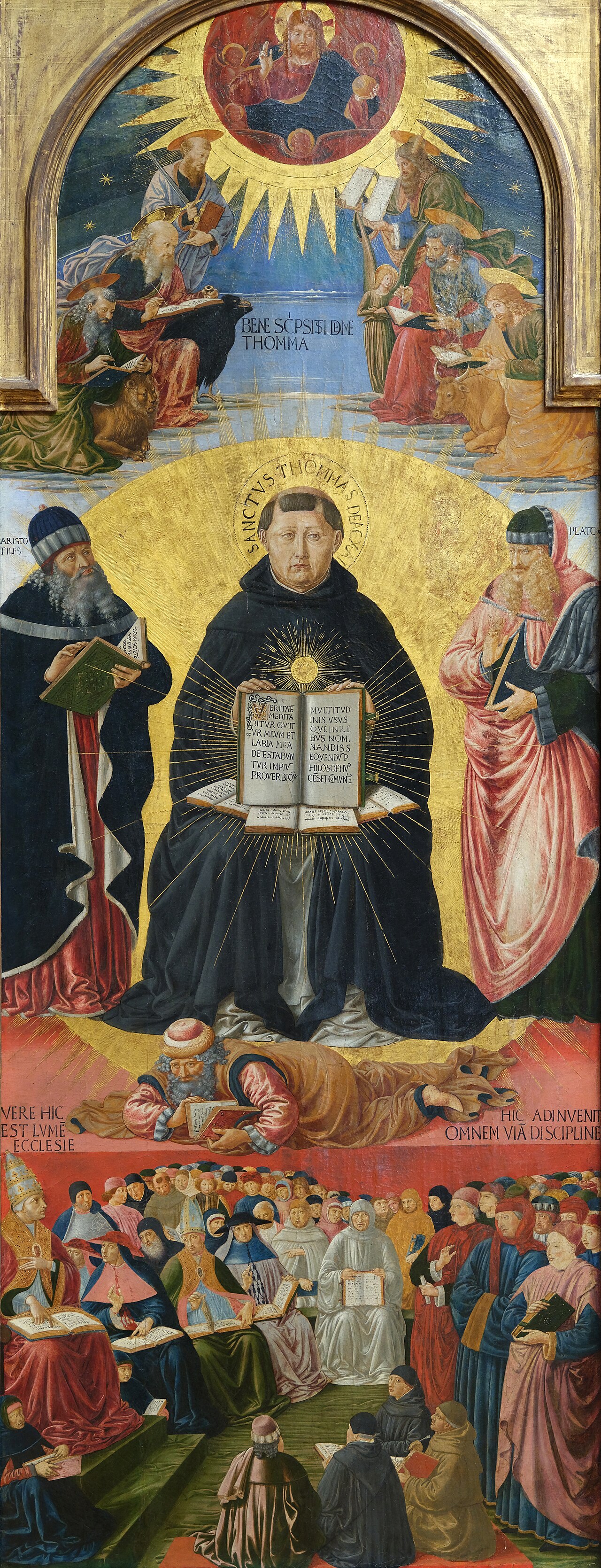
Large altarpiece painting in an arched gold frame. At top, Christ blesses within a red and gold sunburst, surrounded by evangelists and prophets. Center, a black-robed friar holds an open book with gold halo. Philosophers flank him, and kneeling figures fill the lower register.Painting

Secondary source

Triumph of St. Thomas Aquinas

Benozzo Gozzoli · 1472

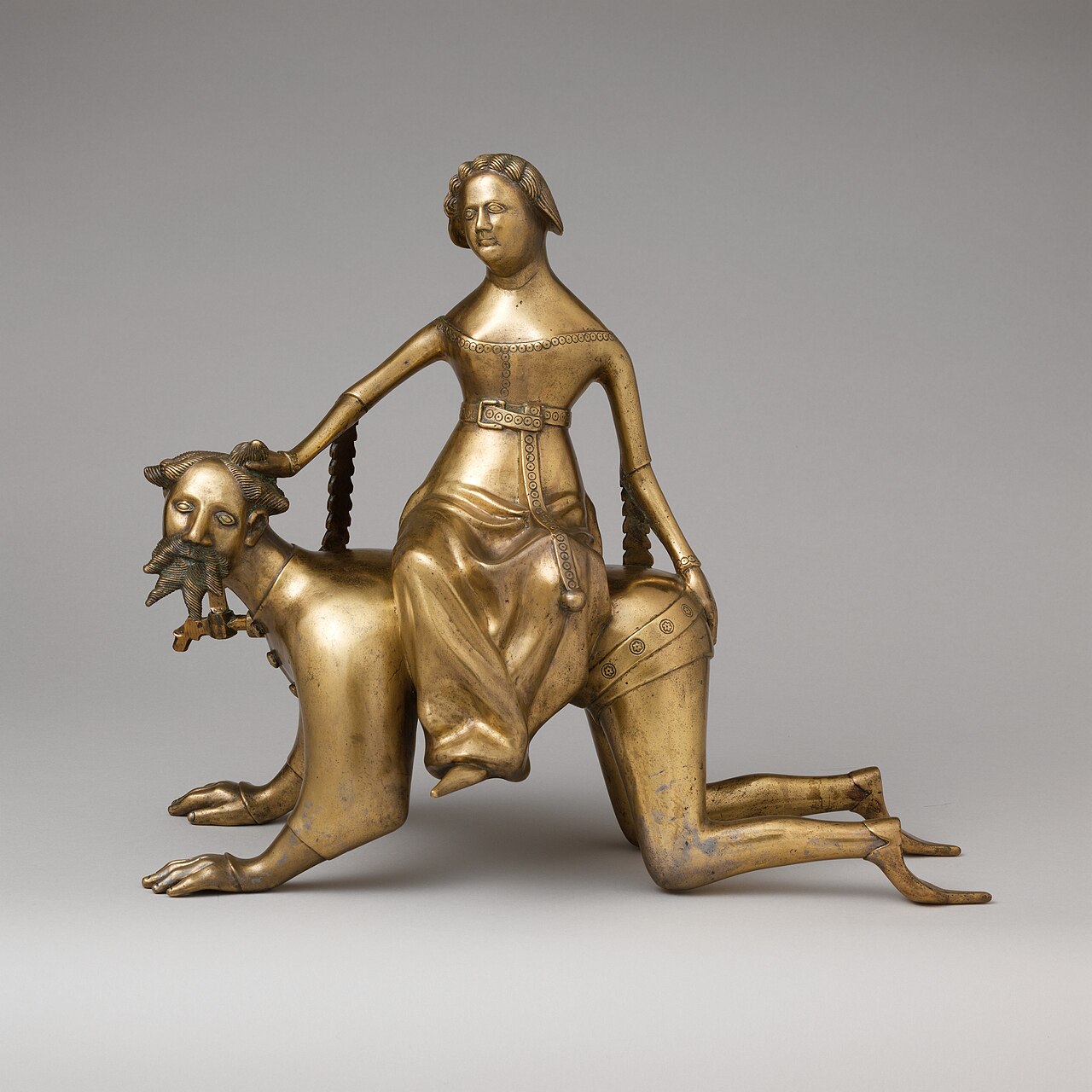
Gilt bronze sculpture on a gray background: a crowned woman in a long gown and belt sits astride a kneeling, bearded man who crawls on hands and feet. She holds a rein-like braid in one hand and his head is turned toward the viewer.Artifact

Secondary source

Aquamanile in the Form of Aristotle and Phyllis

1403

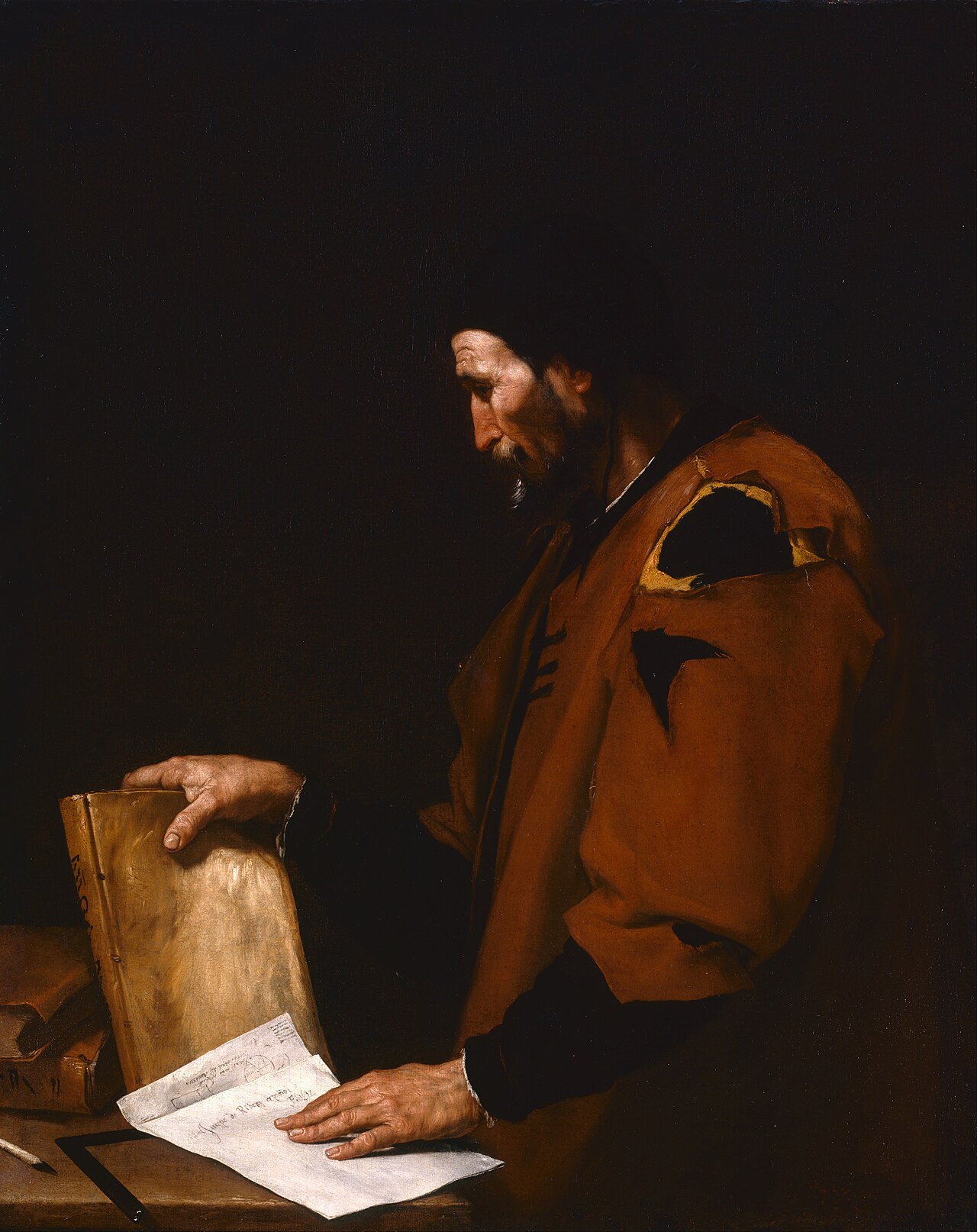
Painting of an elderly bearded man in a torn orange-brown robe, seen in profile, looking down at a sheet of paper on a table. He rests one hand on a large book and has his other hand on the paper. Books and a pen lie nearby against a dark background.Painting

Secondary source

Aristotle

Jusepe de Ribera · 1637

Book

Primary source

Movement of Animals

Aristotle

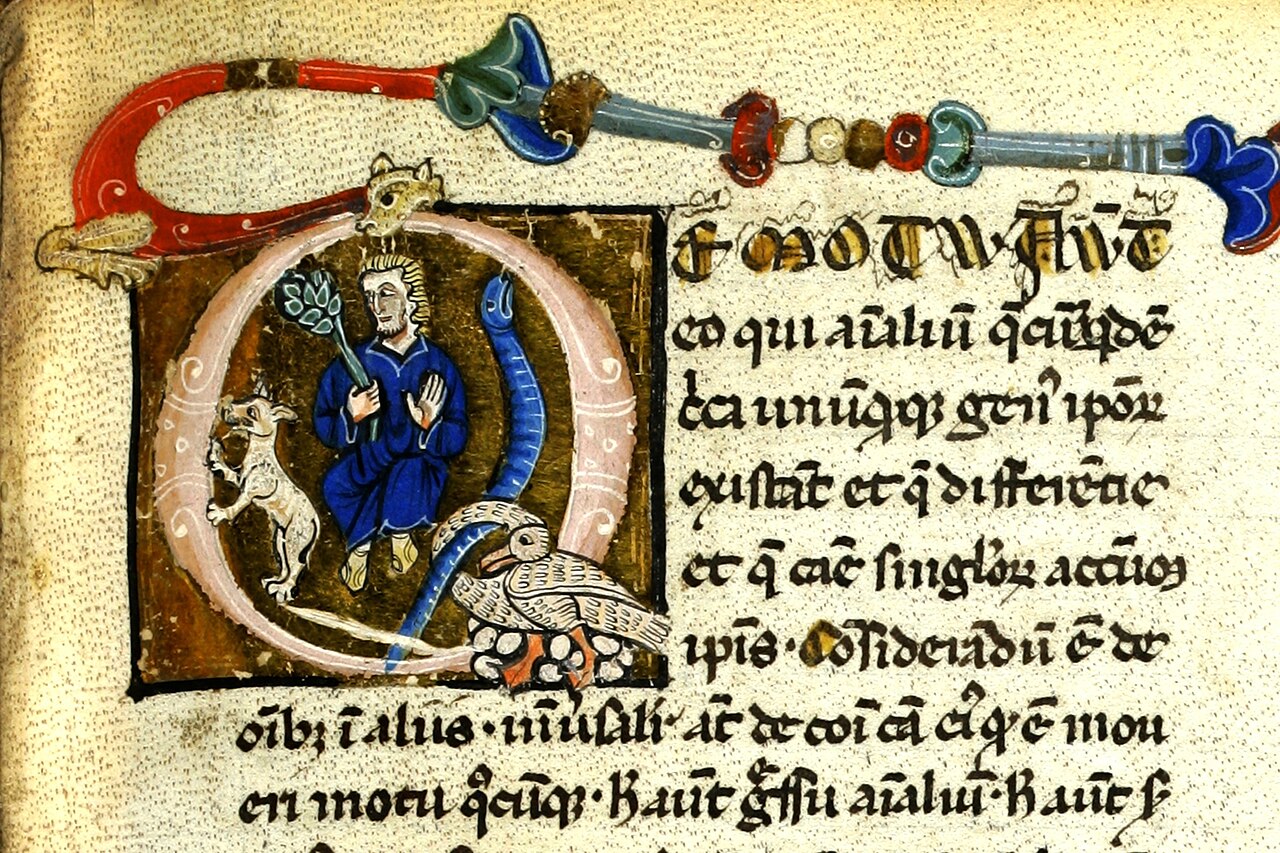
Illuminated initial in a medieval manuscript page: a man in a blue robe holds a leafy branch while a dog leaps at his side, a blue serpent coils behind him, and a bird perches below. Gold-trimmed red and blue decorated penwork runs across the top, beside black Gothic text in columns.Book

Secondary source

Aristoteles-Albertus-Magnus-Handschrift

first half of the 13th century

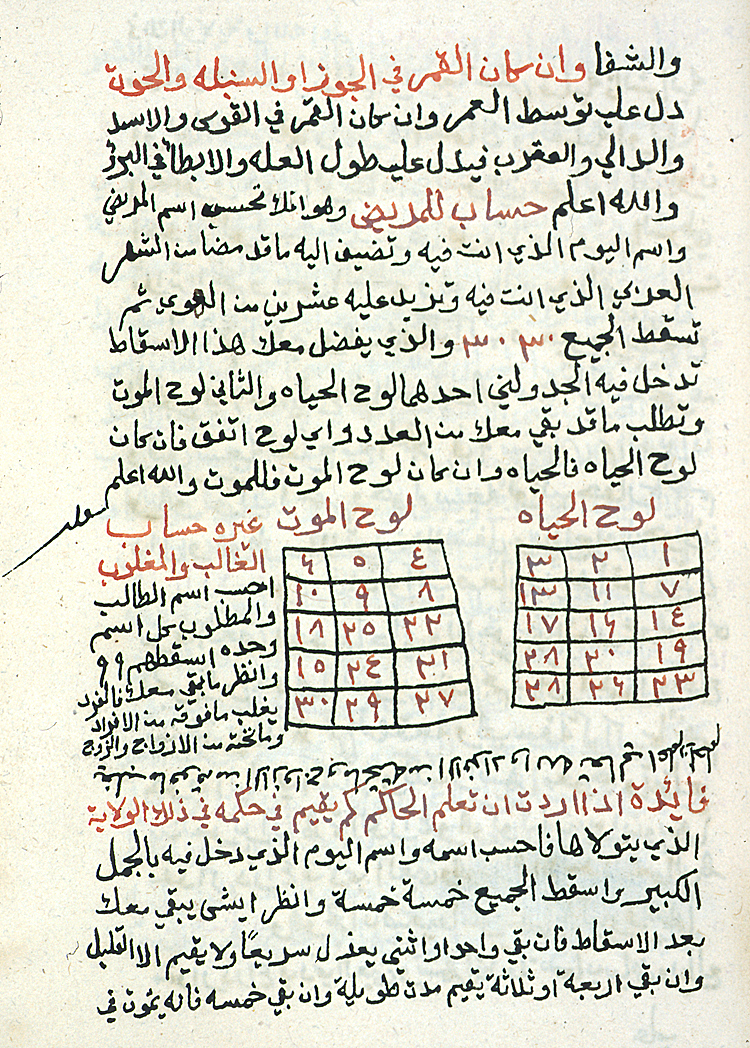
Manuscript page in Arabic script with red and black ink, containing text and two numerical tables labeled 'lawh al-hayat' (table of life) and 'lawh al-mawt' (table of death), used for estimating lifespan by name using the abjad system.Book

Secondary source

Secretum Secretorum

Pseudo-Aristotle · likely 10th century

A long, narrow medieval textile border with a red and blue background, framed by a dark leafy band. Within a row of pointed arched medallions are small figures in period dress, some on horseback and some seated, with heraldic shields and inscriptions in the corners. The fabric is worn and faded.Artifact

Secondary source

Malterer tapestry

c. 1325

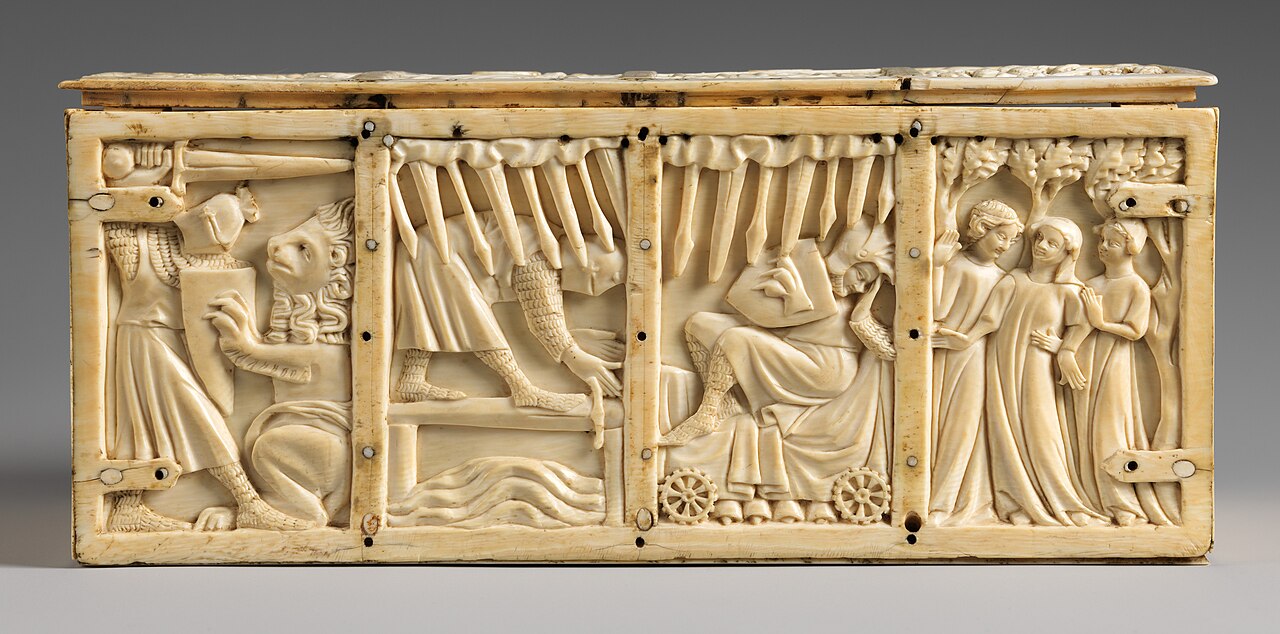
Photograph of an ivory casket with carved panels in relief. Left panel shows a figure with a lion, a seated figure in a scene with a rearing figure. Second panel: a figure with a wooden table and draped fabric. Third: a seated figure in a wheeled cart. Right: standing figures among trees. Metal hinges and fittings visible on the front.Artifact

Secondary source

Casket with Scenes from Romances

c. 1320

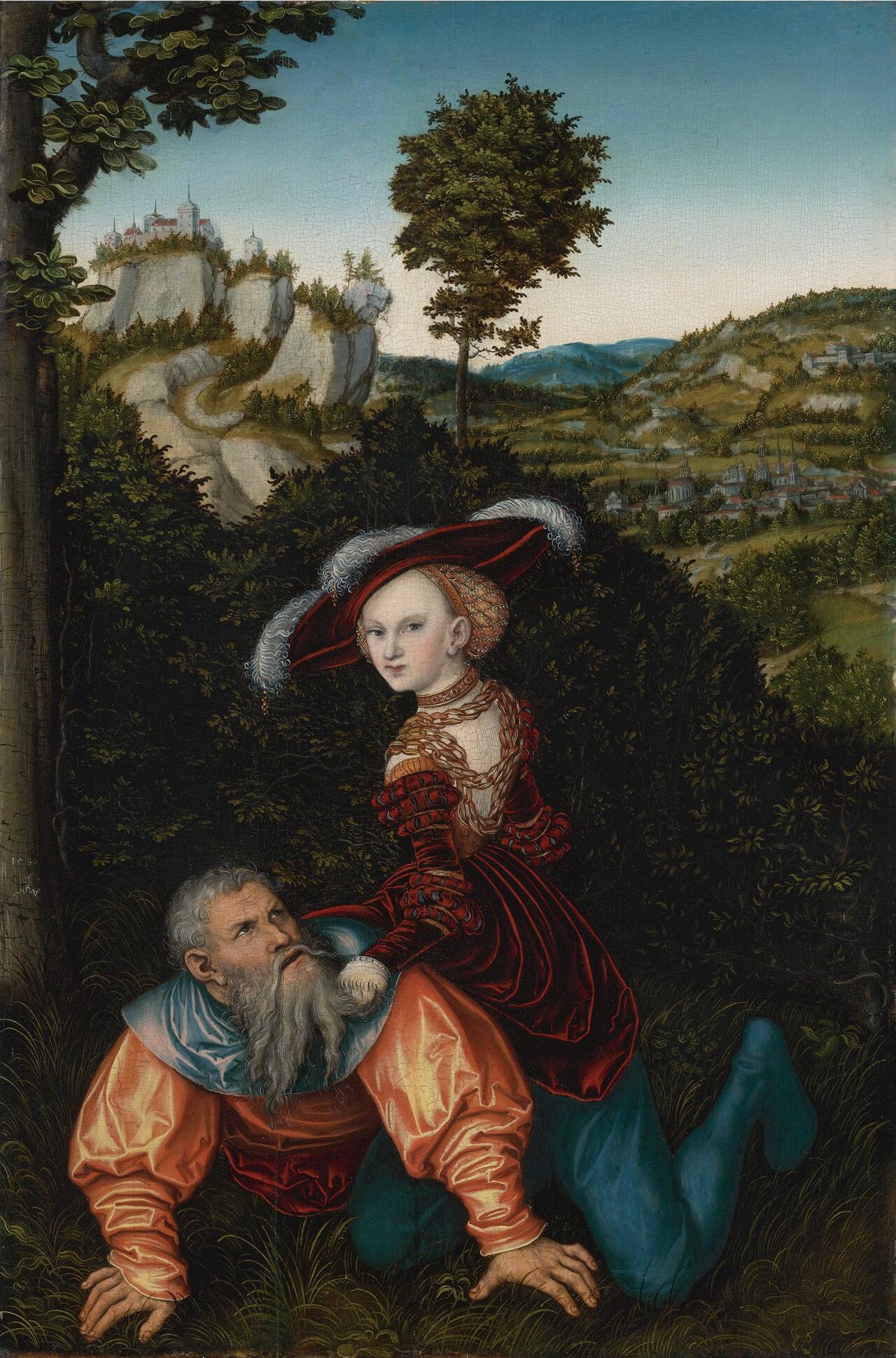
Painting of a young woman in a red dress and feathered red hat riding on the back of an older bearded man who crawls on all fours in grass. He wears an orange garment and blue collar. A tree frames the left, with a castle on a rocky outcrop and a town in a valley behind.Painting

Secondary source

Phyllis and Aristotle

Lucas Cranach the Elder · 1530

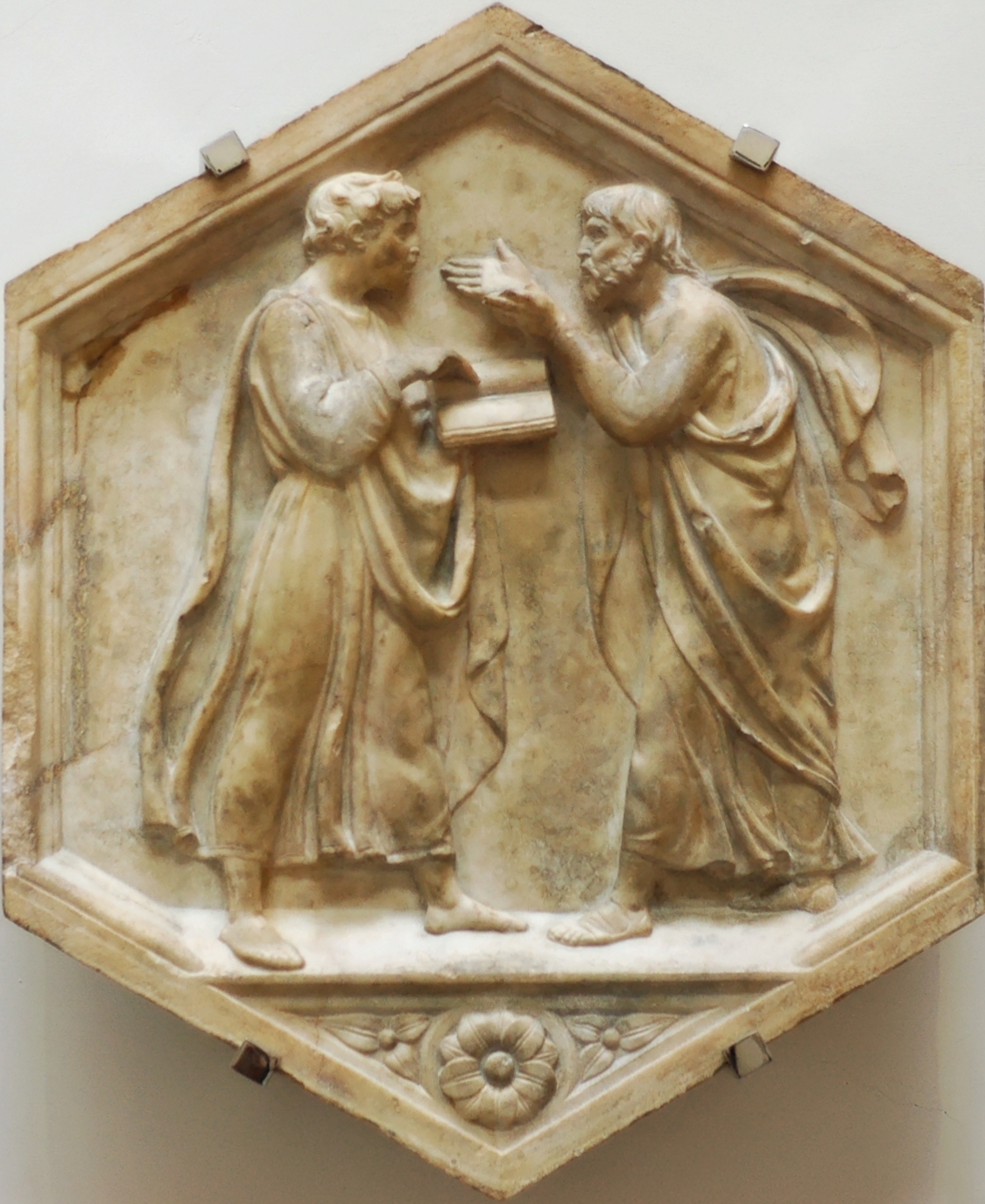
Hexagonal white marble relief panel showing two standing bearded and robed figures facing each other. The figure on the left holds a closed book and gestures toward the figure on the right, who extends an open hand. Flower rosette at the bottom.Sculpture

Secondary source

Plato and Aristotle (Philosophy) relief

Luca della Robbia · 1437–1439

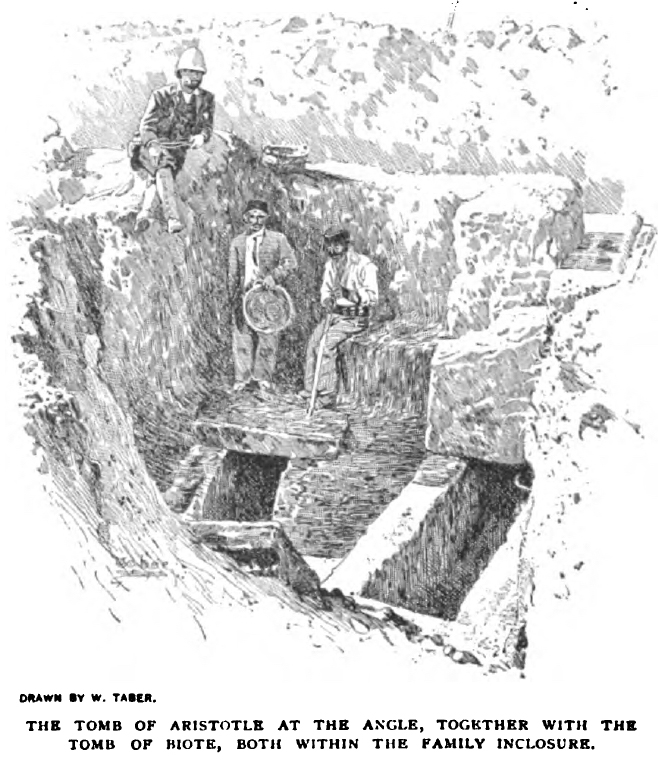
Engraving of an excavation trench with stone blocks and a tomb opening. Three men stand or sit within and beside the trench; one wears a pith helmet and sits on the upper edge, one holds a round hat and stands in the trench, and one sits on a stone block holding a cane. Caption below reads: The Tomb of Aristotle at the Angle, together with the Tomb of Biote, both within the Family Inclosure. Drawn by W. Taber.Artifact

Secondary source

Tomb of Aristotle Excavation Engraving

W. Taber · 1892

The Works of Aristotle, translated under W.D. RossBook

Primary source

The Works of Aristotle, translated under W.D. Ross

Aristotle · 1908

Aristotle's Theory of Poetry and Fine ArtBook

Secondary source

Aristotle's Theory of Poetry and Fine Art

S. H. Butcher · 1920

Book

Primary source

On Colours

Aristotle

Newspaper article

Secondary source

Aristotle as a Zoologist

Frederik Atherton Fernald · April 1885

Book

Secondary source

Aristotle's Rhetoric and Art of Poetry

Alexander Grant · 1898

Book

Secondary source

Aristotle by Alexander Grant, Chapter 2

Alexander Grant · 1898

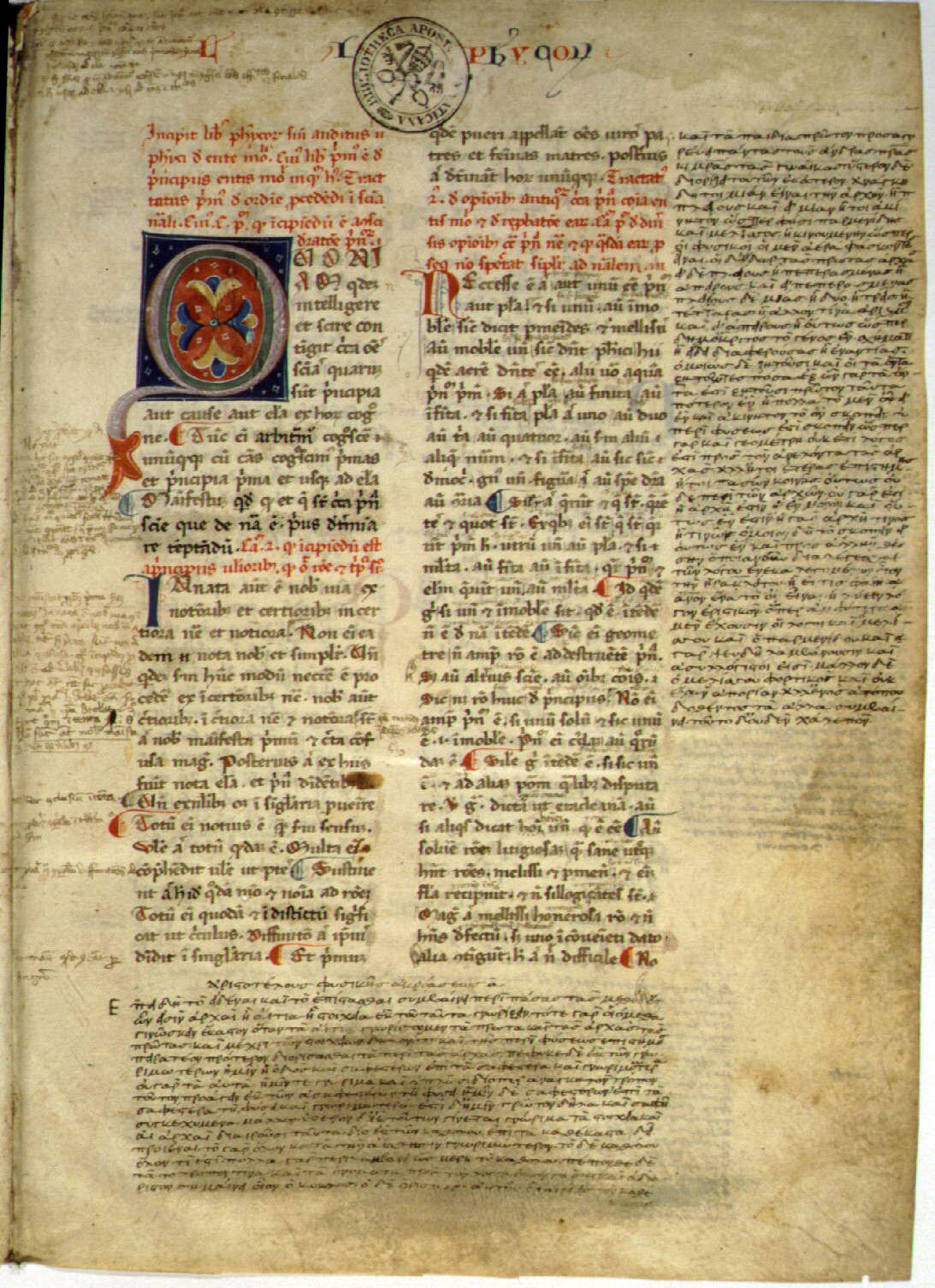
Page of a medieval manuscript with two columns of Latin text in black ink, red initials and rubrics, a decorated historiated initial O with a red and blue floral design, a Vatican Library stamp at top, and Greek text written along the bottom and right margin.Document

Primary source

Medieval Latin Manuscript of Aristotle's Physics

Aristotle

Book

Primary source

Nikomachische Ethik (German translation by Eugen Rolfes)

Aristotle · 1911

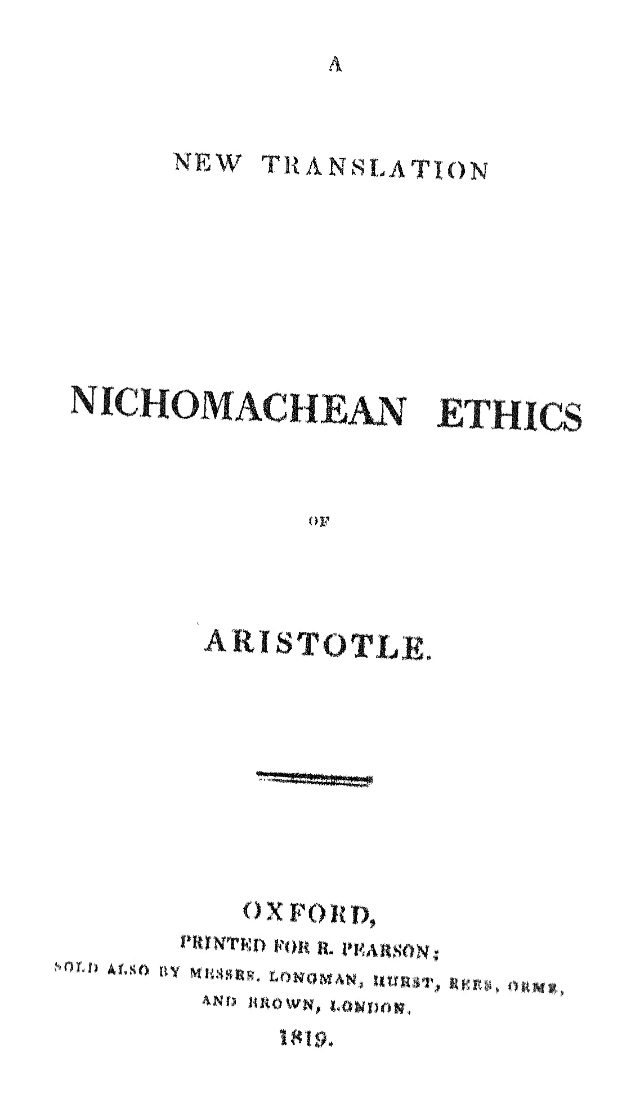
A New Translation of the Nicomachean EthicsBook

Primary source

A New Translation of the Nicomachean Ethics

Aristotle · 1819

Nicomachean Ethics (1910 edition)Book

Primary source

Nicomachean Ethics (1910 edition)

Aristotle · 1910

OeconomicaBook

Secondary source

Oeconomica

Aristotle · 1920

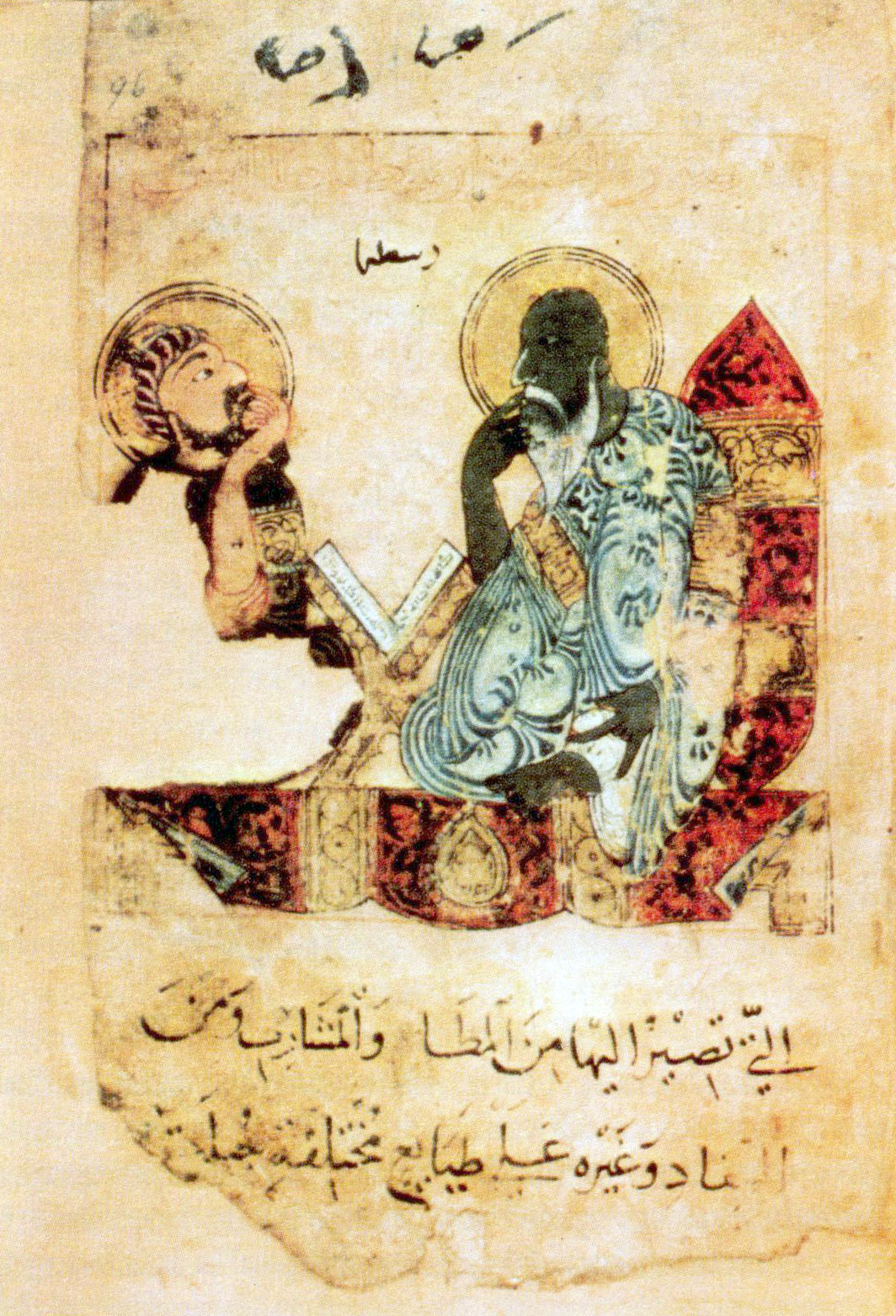
Miniature painting on aged parchment: a seated bearded figure in a blue patterned robe and gold-rimmed halo rests his head on his hand before a lectern with an open book, while a second haloed bearded figure in profile sits at left. Arabic script appears above and below.Painting

Secondary source

Aristotle Teaching, from an Arabic Bestiary

Unknown artist · c. 1220

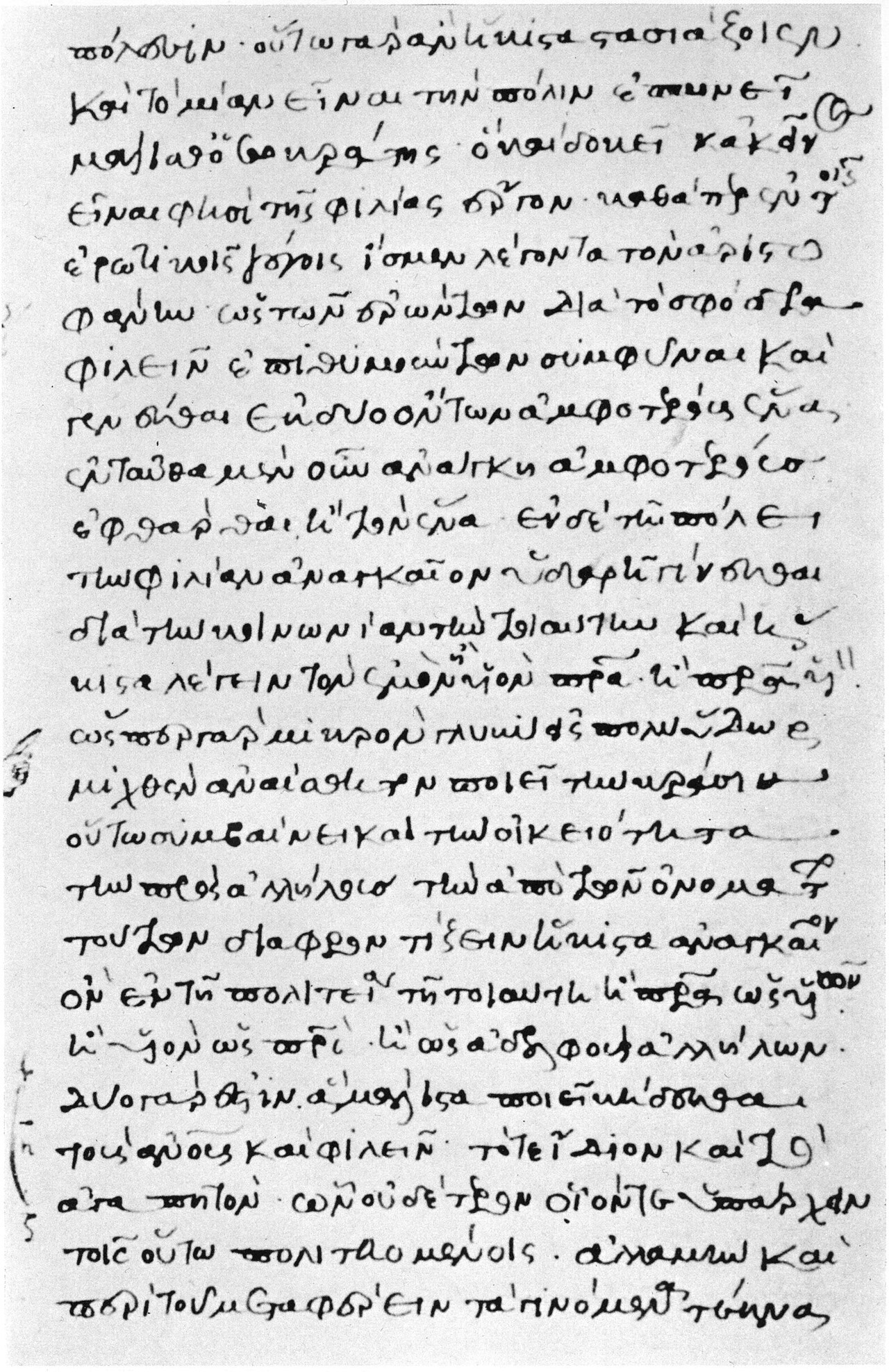
Page of a handwritten Greek manuscript in dark ink on pale paper, written in cursive lines with marginal marks at the left and right edges. The text is Aristotle's Politics, copied by Theodorus Gaza.Book

Primary source

Aristotle's Politics II, Manuscript Copied by Theodorus Gaza

Aristotle · c. 1450

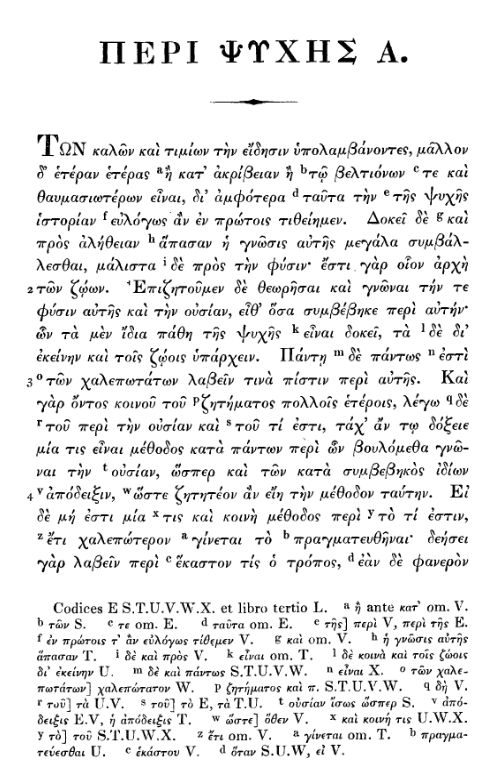
Scanned page of a Greek text titled ΠΕΡΙ ΨΥΧΗΣ Α (Peri Psychēs A), with a short horizontal ornament below the title. Dense Greek body text in italic-style print follows, with superscript letters marking textual variants, and a critical apparatus of smaller type at the bottom listing manuscript readings.Book

Primary source

De Anima, Manuscript Page

Aristotle

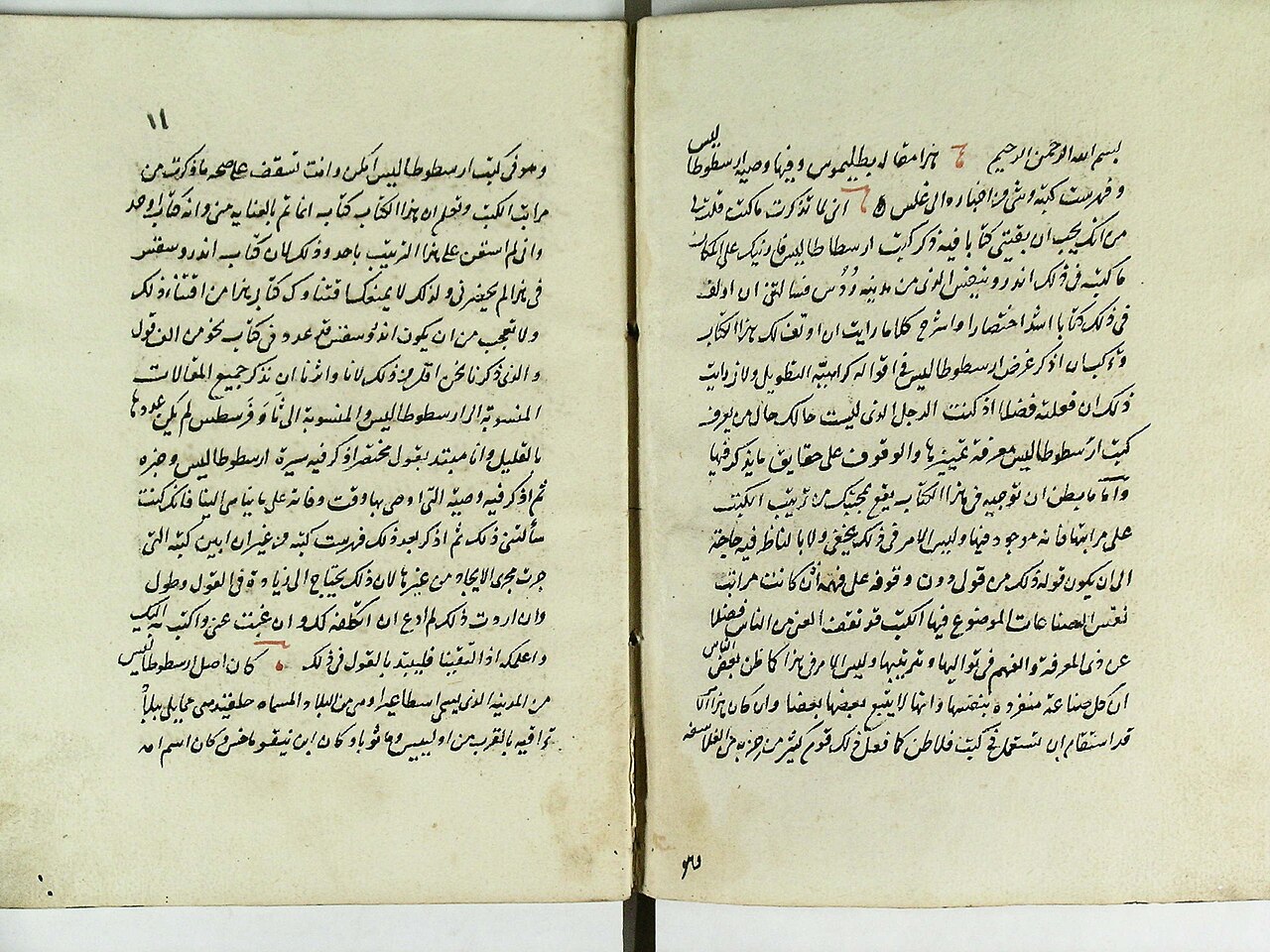
Open two-page spread of a handwritten Arabic manuscript in black ink with red markings and folio number 11 at upper left, showing dense right-to-left script in several lines per page on aged cream paper.Book

Secondary source

Life of Aristotle with List of His Works

Ptolemy-el-Garib · Unknown date

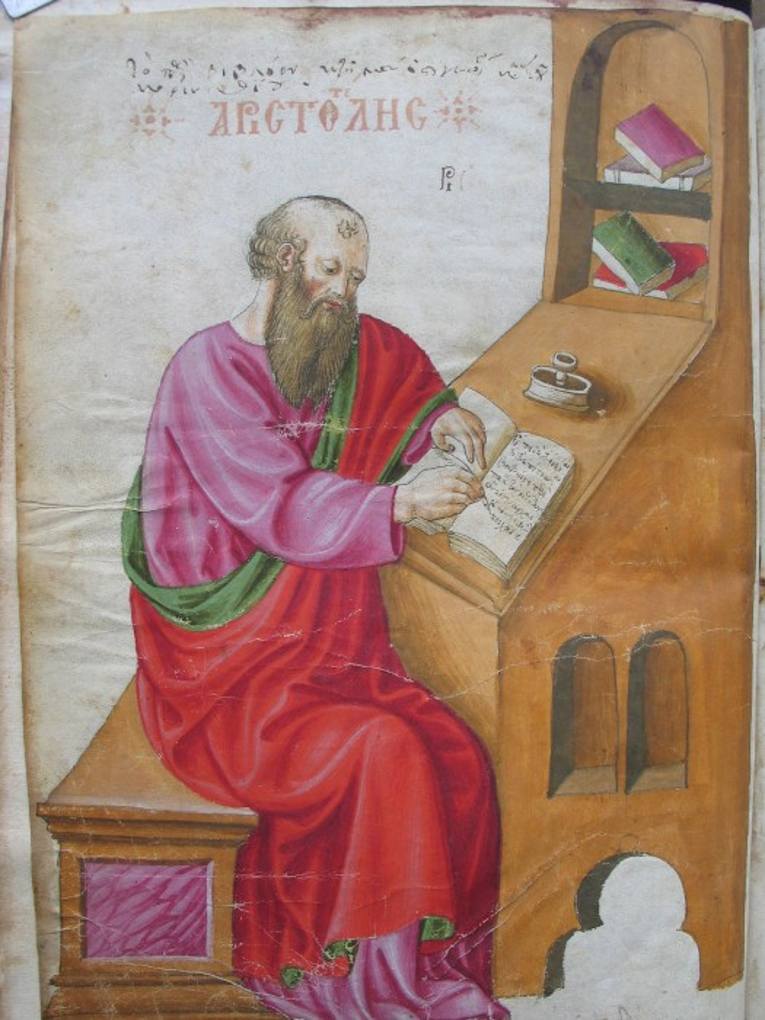
Painted miniature of a bearded man in a red and pink robe with a green sash, seated at a slanted wooden desk writing in an open book. Greek title 'ARISTOTELES' above him, shelves with books behind, an inkwell on the desk.Book

Secondary source

Manuscript Miscellany of Aristotle's Texts

Unknown author · 1457

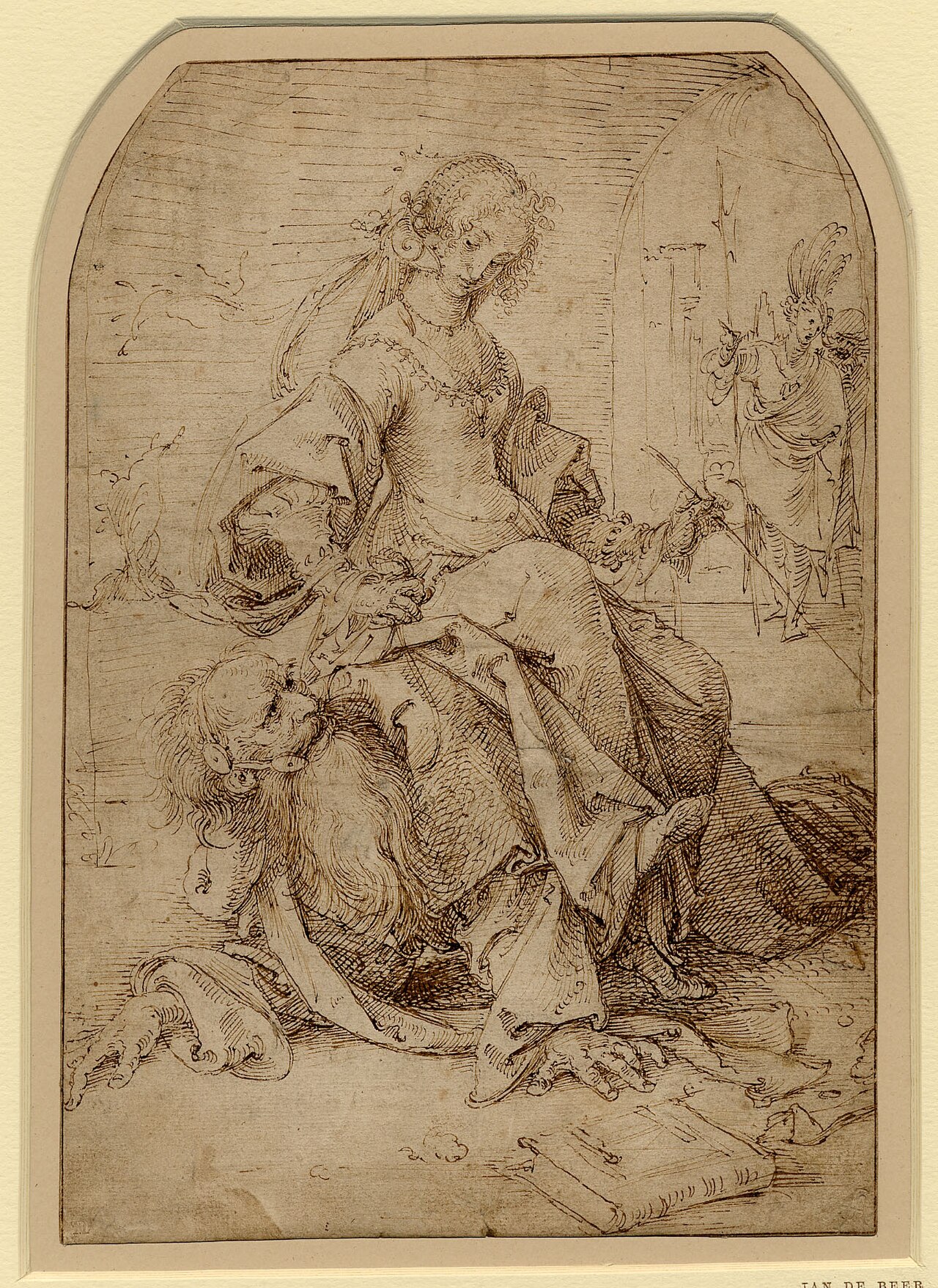
Pen and brown ink drawing on paper within an arched frame, showing a seated woman with curly hair and a flowing gown who looks back toward an older bearded man crawling on hands and knees on the floor below her, with an open book on the ground. On the right, a figure stands with a staff near an archway.Painting

Secondary source

Aristotle and Phyllis

Jan de Beer · c. 1515-1520

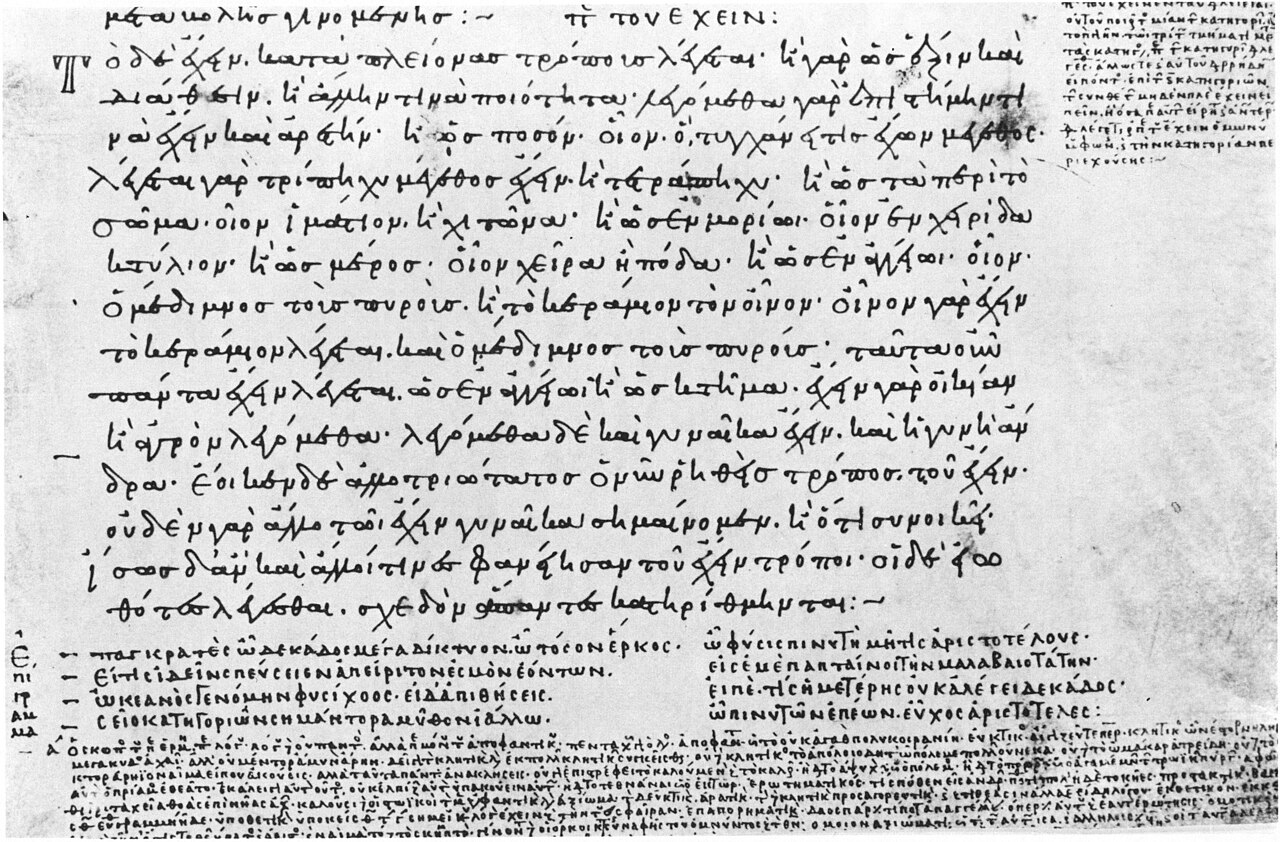
Black-and-white photograph of a manuscript page in Greek uncial-style handwriting, with main text in lines across the center, a marginal column of smaller script at the upper right, and dense scholia in small script along the bottom and left margin.Book

Secondary source

Aristotle's Categories with Scholia

Aristotle · 954

Book

Secondary source

The Sophistical Elenchi

Octavius Freire Owen · 1853

Book

Secondary source

On the Vital Principle

Charles Collier · 1855

Book

Secondary source

Economics (LibriVox audio reading)

Aristotle (attribution disputed) · 1920

Book

Secondary source

Magna Moralia (LibriVox audio reading)

Aristotle (attribution disputed) · 1915

Book

Secondary source

The Story of Aristotle's Philosophy

Will Durant · 1923

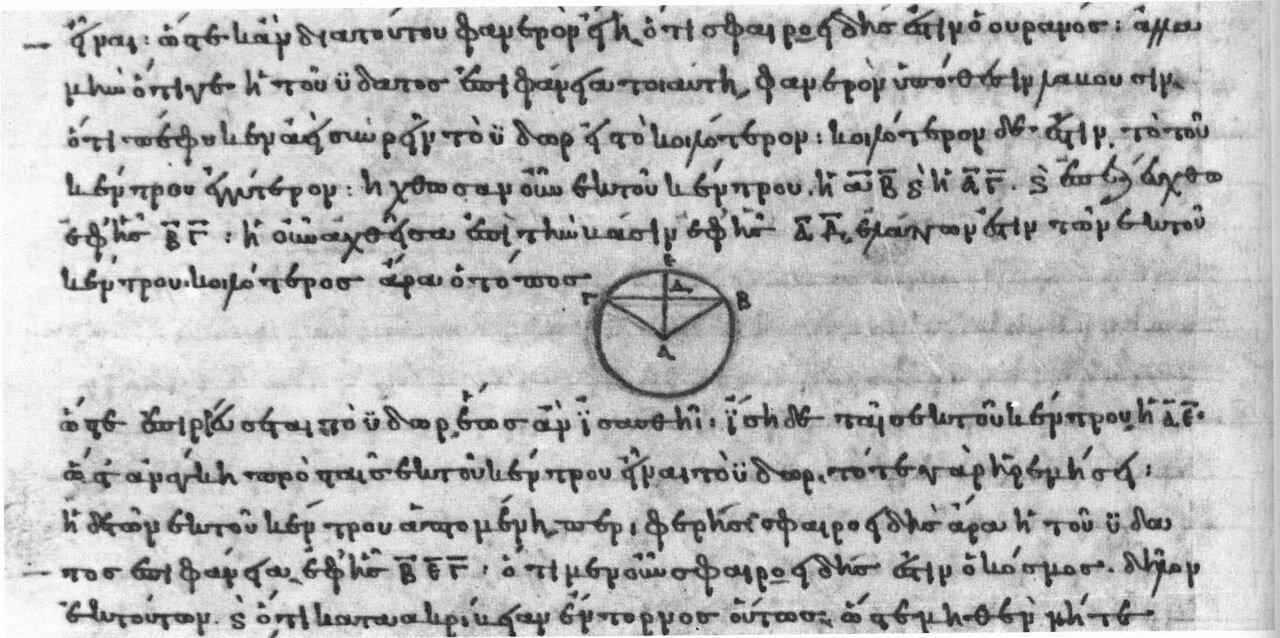
Scanned page of a Greek manuscript with dense handwritten lines of text in ink, and a circular diagram in the middle of the page showing a circle with labeled points Γ, A, B, Δ and straight lines drawn between them, illustrating a geometric proof.Book

Secondary source

Diagram from Aristotle's On the Heavens, Vienna manuscript

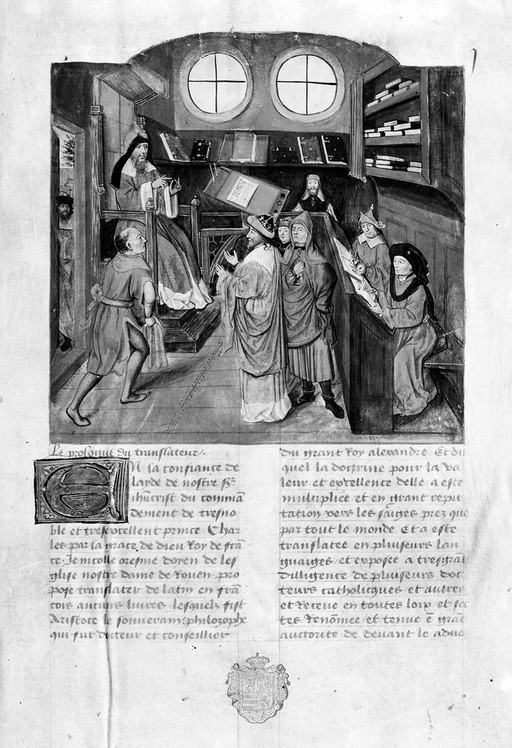
Black-and-white scan of a manuscript page with a miniature painting of a scholarly scene: a bearded man in a tall hat at a desk, robed figures and a standing man gesturing, bookshelves and books in a room with round windows. Below is a decorated initial and columns of French text.Book

Secondary source

Ethicques de Aristote manuscript

14th century

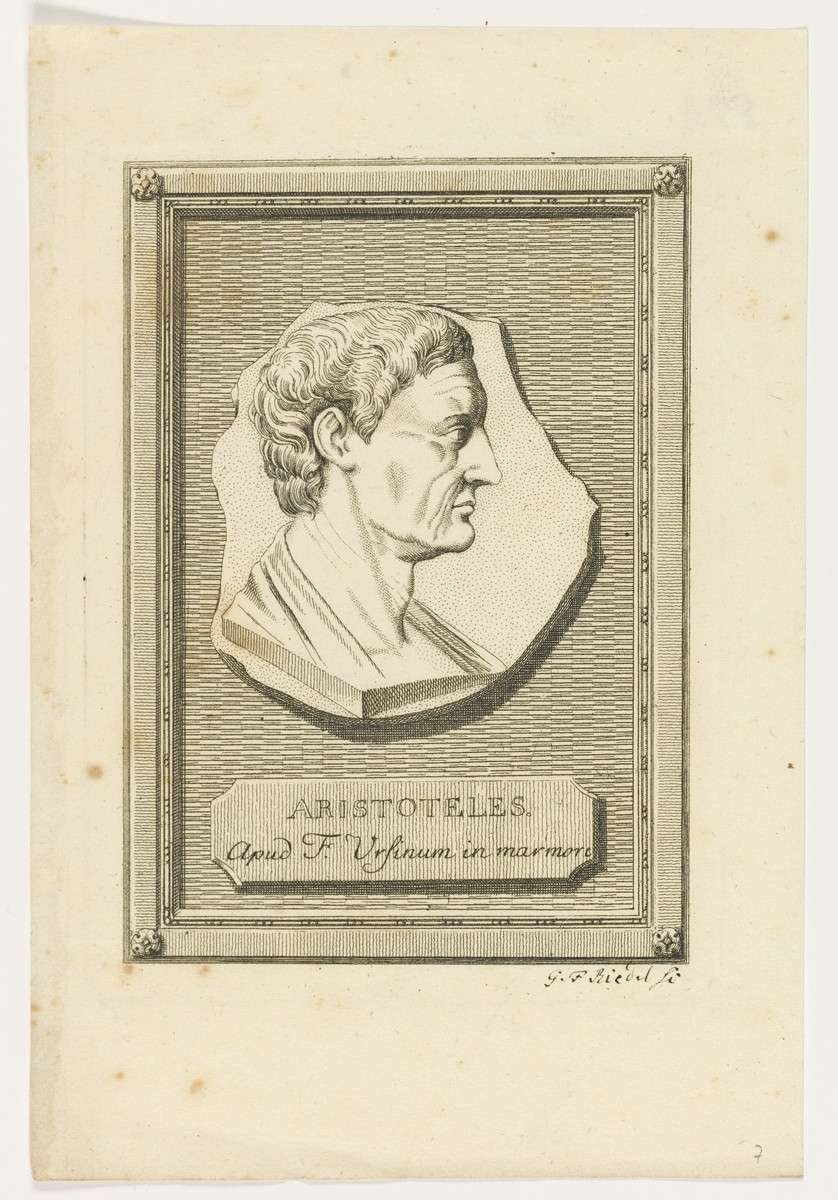
Engraving of a marble bust in profile facing right, showing a man with curly hair, a furrowed brow, and a prominent nose, on a ruled background within a decorative border. Below is a caption reading ARISTOTELES and Apud F. Ursinum in marmore, with the engraver's signature G. F. Riedel sc. in the lower right corner.Painting

Secondary source

Portrait of Aristotle, engraving after a marble bust

G. F. Riedel

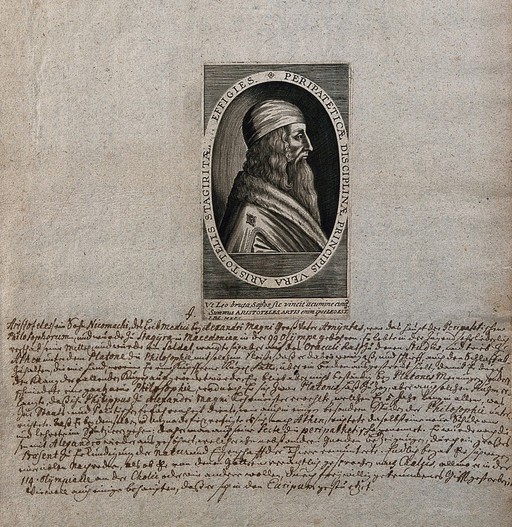
Line engraving of Aristotle in an oval frame with Latin inscriptions, bearded man in a headdress and cloak in profile, with handwritten manuscript notes below on aged paper.Painting

Secondary source

Aristotle, line engraving

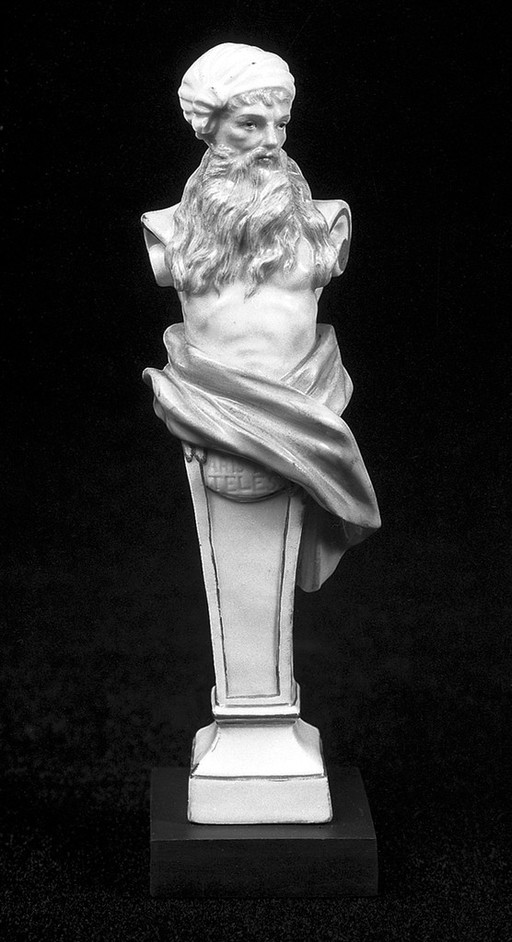
Black-and-white photo of a white statuette of a bearded man wearing a head covering, with a draped cloth over his shoulder, on a tall pedestal inscribed with partly legible lettering, set on a dark square base against a black background.Sculpture

Secondary source

Statuette of Aristotle

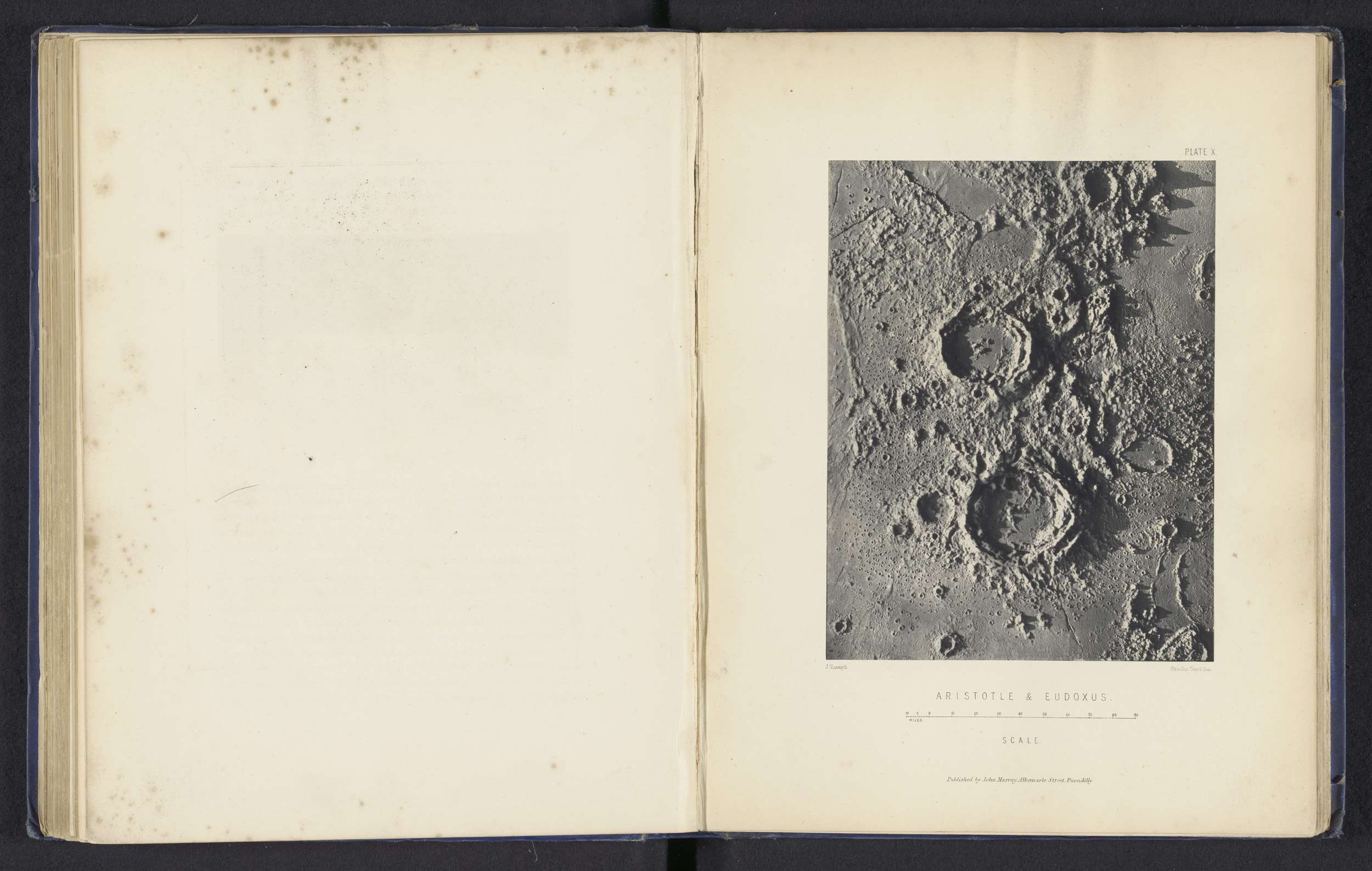
Open book showing, on the right page, a black-and-white photographic plate labeled Plate X of the lunar craters Aristotle and Eudoxus, with a scale bar in miles and the caption 'Aristotle & Eudoxus' beneath. The left page is blank.Painting

Secondary source

Aristotle and Eudoxus

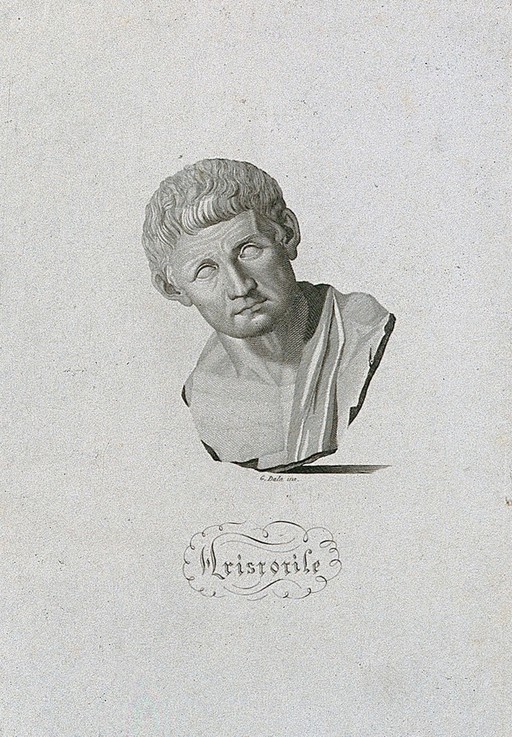
Engraved print of a marble bust of a curly-haired man with a draped shoulder, in profile turned slightly. Below is a decorative cartouche with the inscription 'Aristotile' and a small signature reading 'G. Dala inc.'Painting

Secondary source

Aristotle

G. Dala

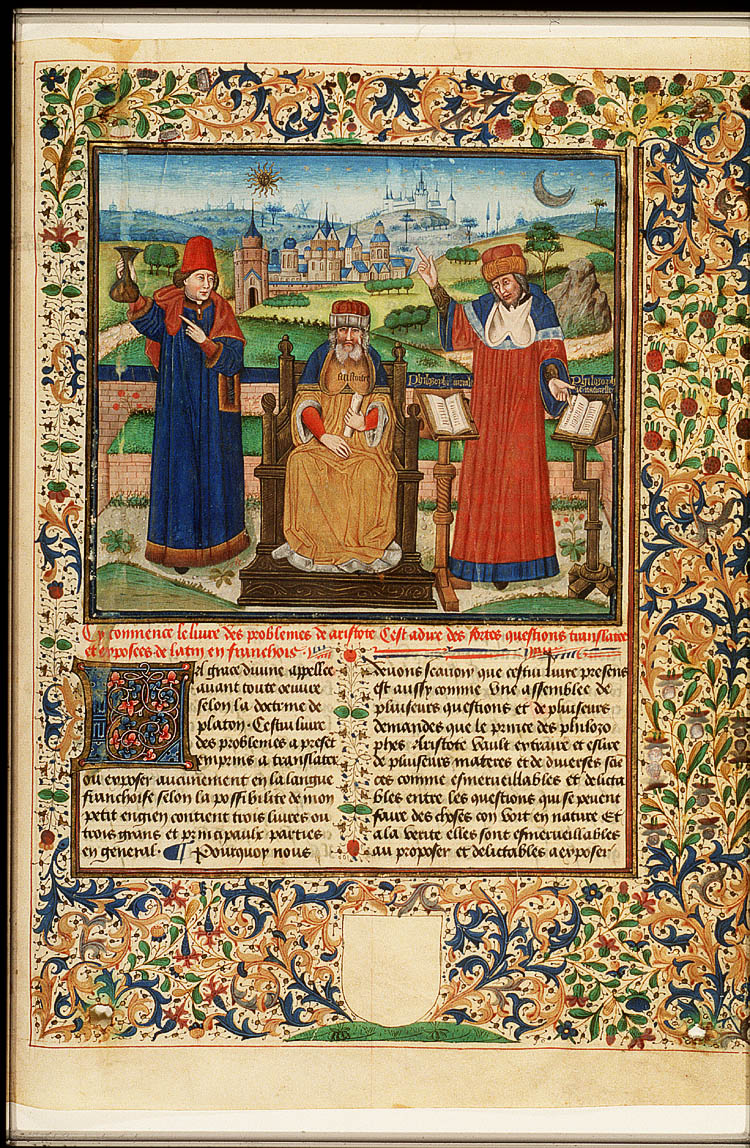
Illuminated manuscript page with a painted miniature showing a seated bearded figure labeled Aristote on a throne, flanked by two standing men in robes, one holding an open book, under a blue sky with a castle-like city. Surrounding decorative floral border and red-and-black French text below.Book

Secondary source

Aristotle discussing medical and philosophical questions

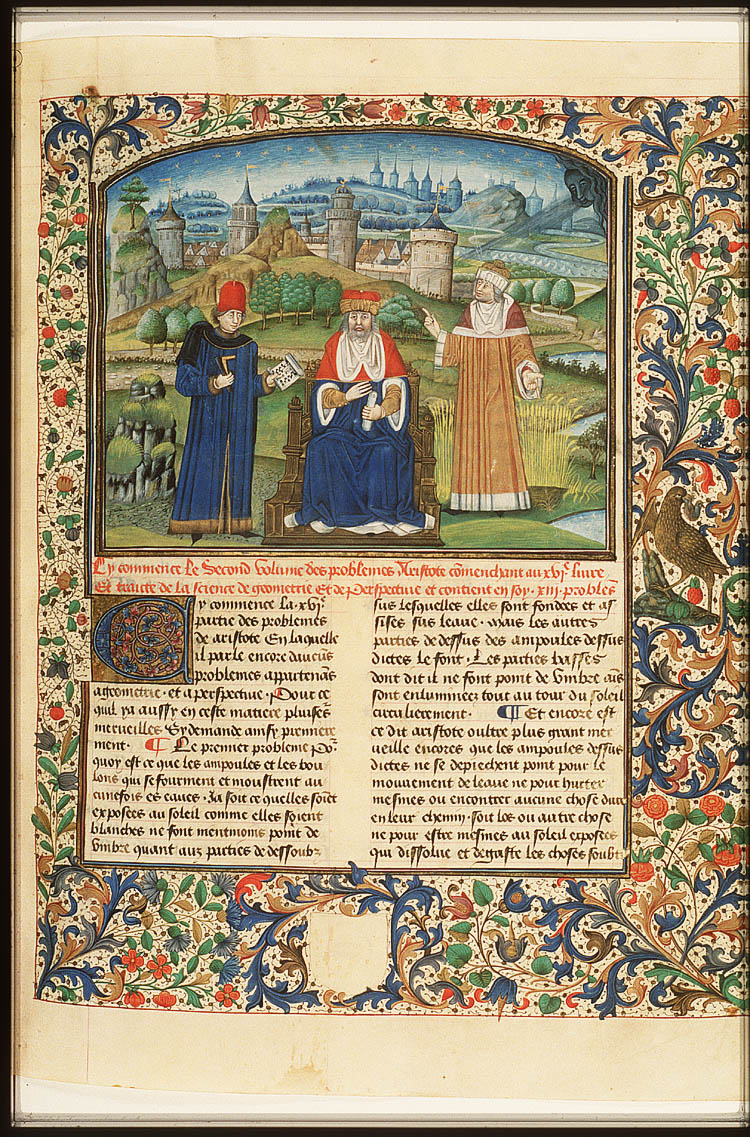
Illuminated manuscript page with a painted miniature showing a seated bearded man in a red hat and white robe on a throne, flanked by a standing figure in blue holding a book and a woman in orange pointing; a medieval town with towers is behind. Text in columns below, with decorative borders and a painted initial.Book

Secondary source

Aristotle discussing geometry and perspective

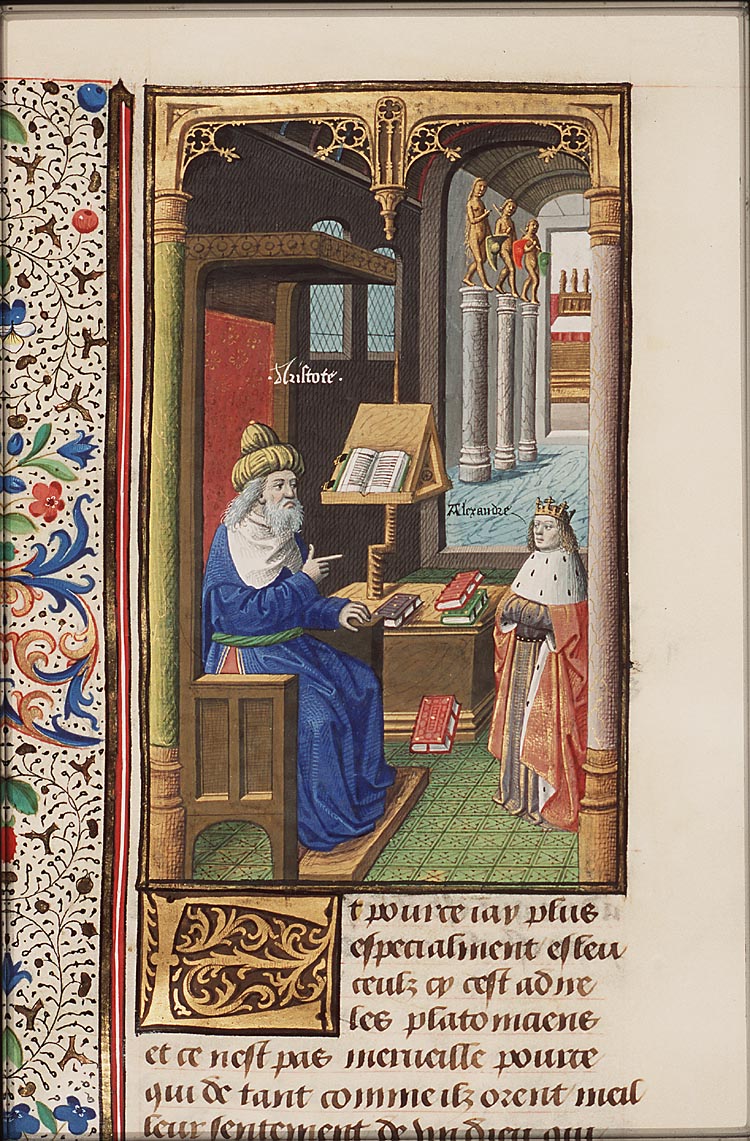
Illuminated manuscript miniature: a bearded man in a blue robe and yellow turban sits at a lectern with an open book, gesturing, labeled Aristotle. Before him a crowned young king in a white ermine-trimmed red robe stands, labeled Alexandre. Gilded columns and a painted interior frame the scene; text in Gothic script runs below.Painting

Secondary source

Alexander the Great Receives Instruction from Aristotle

Maïtre François

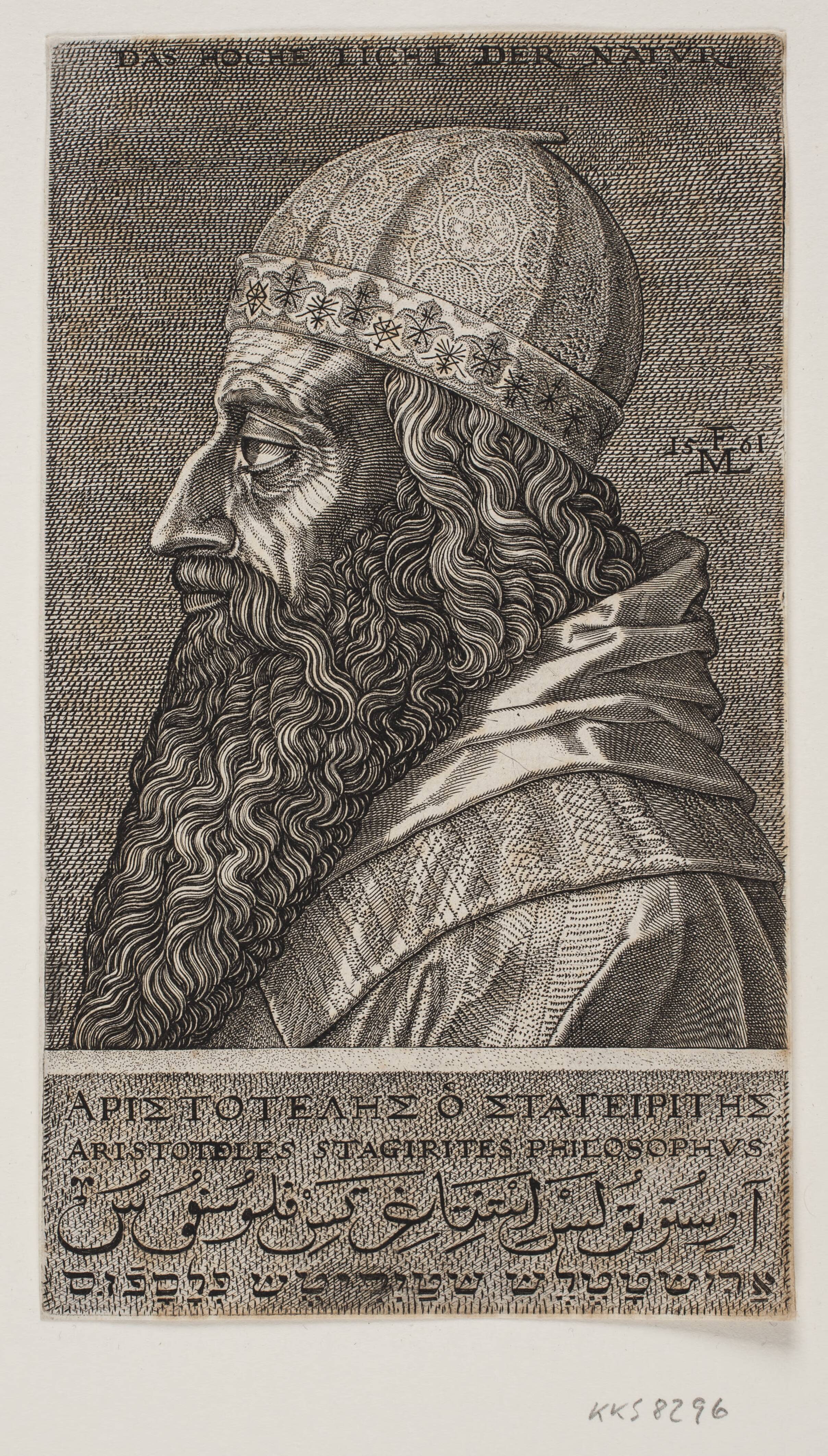
Engraved print of an elderly bearded man in profile facing left, wearing a patterned turban-like cap with star motifs and a draped robe. Above him is German text reading 'Das hoche Licht der Natur'. Below is a caption in Greek, Latin, Arabic, and Hebrew reading Aristoteles Stagirites Philosophus. A date 1561 appears at right.Painting

Secondary source

Aristotle, half-length portrait in profile

1561

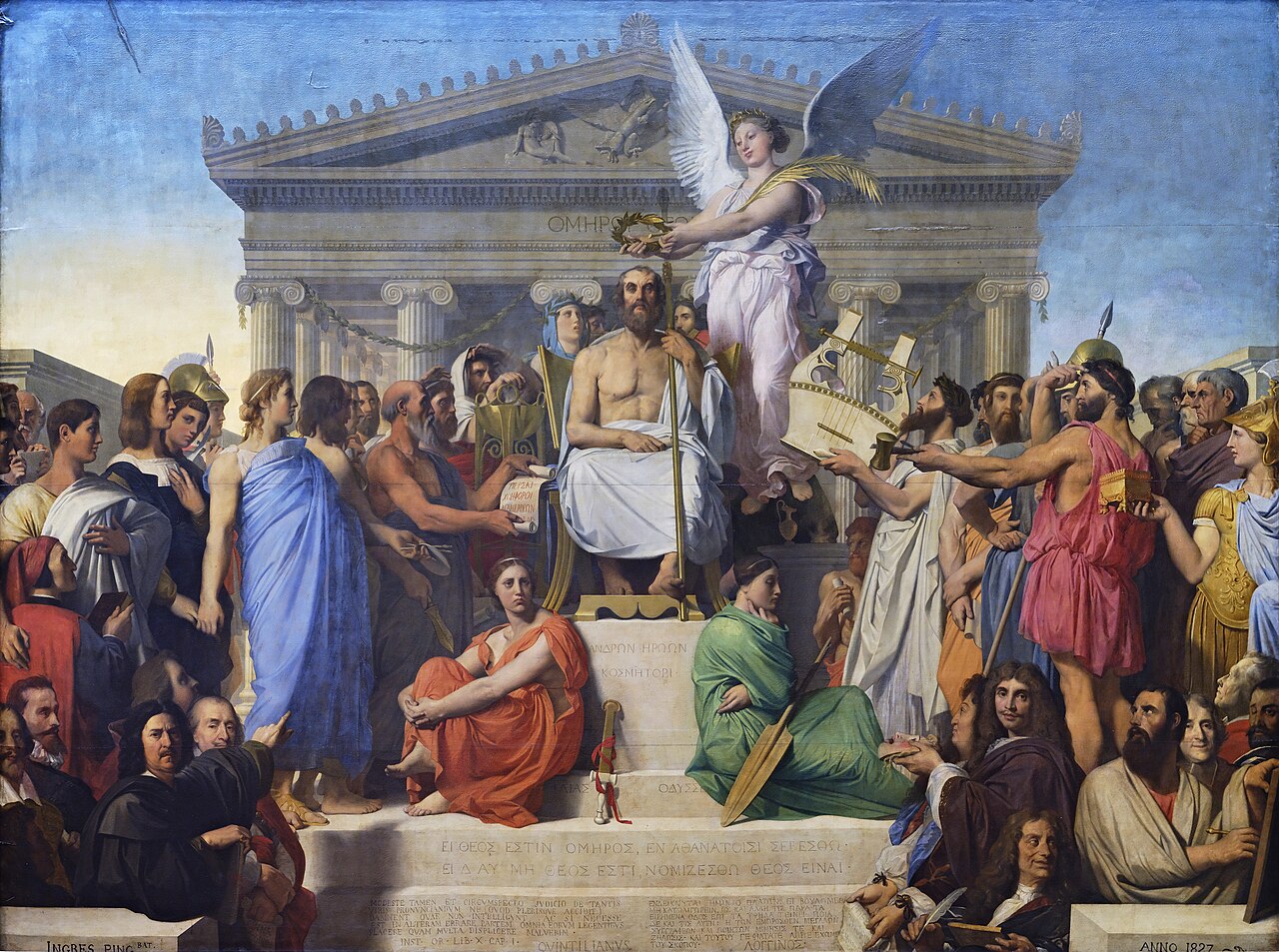
Ingres's painting The Apotheosis of Homer: a seated, bare-chested figure of Homer with a scepter at center, crowned by a winged Victory on a temple facade, surrounded by a crowd of figures from antiquity and later eras, with inscriptions on a stone pedestal below.Painting

Secondary source

The Apotheosis of Homer

Jean-Auguste-Dominique Ingres · 1827

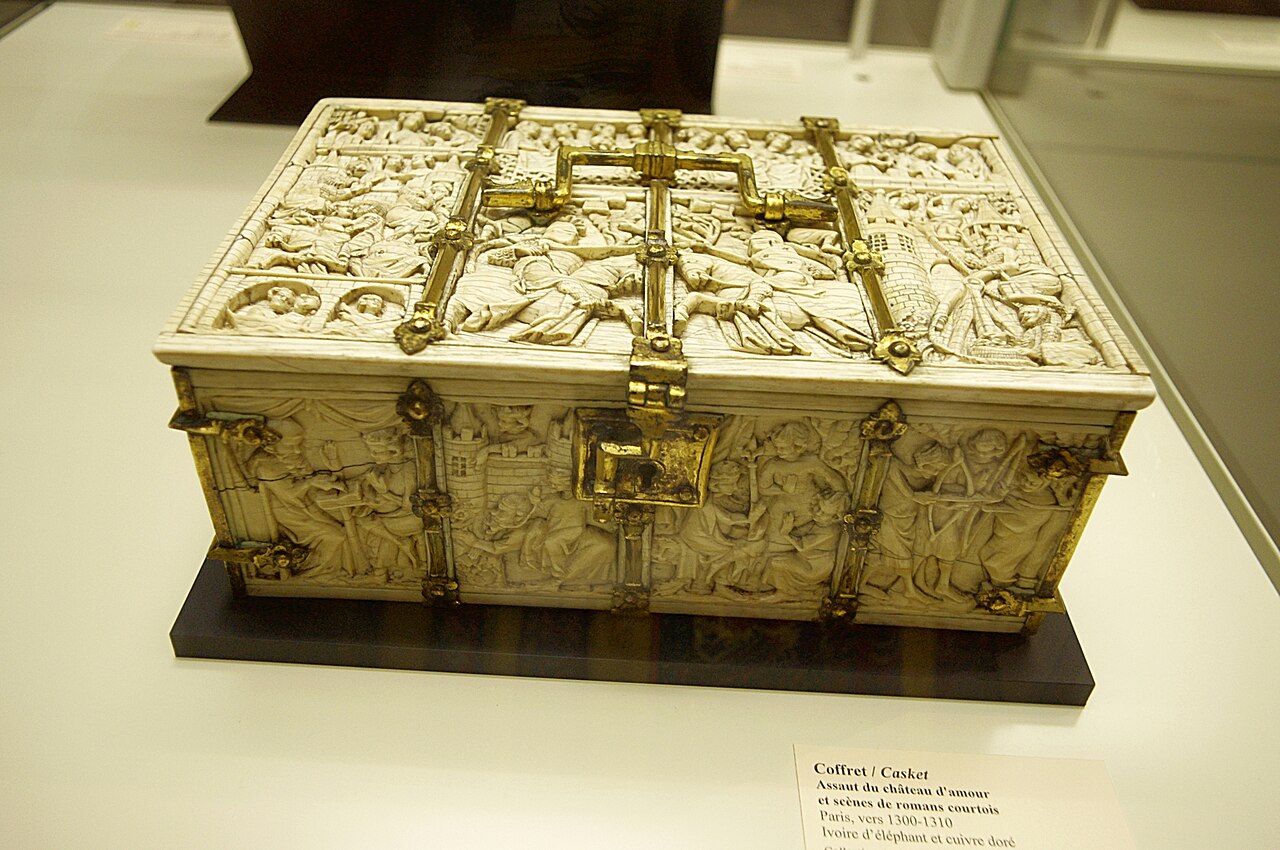
An ivory casket with gilded metal bands and hinges, carved on its lid and front panels with scenes of medieval figures, displayed on a dark base in a museum case. A museum label is visible in the lower right.Artifact

Secondary source

Casket with Scenes of Romances

c. 1300

Want the full shelf? Chat with Aristotle in the app and open the Sources panel — every quote links back to the original.

Use Aristotle in class

1 collection

A ready-made collection from the Humy team that features Aristotle. Preview it, then try it free.

Trusted by educators worldwide

Conversations
375,000+
Real exchanges between students and historical figures
Messages exchanged
4,142,000+
Across every figure, classroom and language
Historical figures
100,000+
Each informed by a curated biography and selected sources
Languages supported
50+
From English and Spanish to Arabic and Korean

Paying customers

Used by 98 schools and universities

Partner school logo
Tecnológico de Monterrey logo
Hyper Island logo
Partner school logo
Chambersburg Area School District logo
Broward County Public Schools logo
Nebo School District logo
National Louis University logo
South Florida PBS logo
Punahou School logo
University of Wisconsin–River Falls logo
Partner school logo
Partner school logo
Archbishop Mitty High School logo
Kingsburg High School logo
Norwalk Public Schools logo
Partner school logo
Connections logo
Partner school logo
Moore Public Schools logo
Partner school logo
Partner school logo
Partner school logo
Partner school logo
Robbinsville Public Schools logo
Partner school logo
Partner school logo
Partner school logo
Tecnológico de Monterrey logo
Hyper Island logo
Partner school logo
Chambersburg Area School District logo
Broward County Public Schools logo
Nebo School District logo
National Louis University logo
South Florida PBS logo
Punahou School logo
University of Wisconsin–River Falls logo
Partner school logo
Partner school logo
Archbishop Mitty High School logo
Kingsburg High School logo
Norwalk Public Schools logo
Partner school logo
Connections logo
Partner school logo
Moore Public Schools logo
Partner school logo
Partner school logo
Partner school logo
Partner school logo
Robbinsville Public Schools logo
Partner school logo
Partner school logo

What educators are saying

“We enjoyed the program last year and used it frequently.”
“My students say it’s a welcome change of pace. I’m not a fan of the “sage on the stage” model, so I try to incorporate research-oriented and self-paced activities. With Humy, students have to take charge of their learning. They’ve become more adept at critical thinking, forming better questions, and improving their reading comprehension. The interview feature has been my go-to tool. I create assignments where students must ask historical figures a set number of questions, then summarize the responses to ensure they’re truly absorbing the material. This approach lets them actively explore the past rather than passively consuming information.”
“Humy has helped me bring historical figures, sometimes long past, to life. When my students interact with these figures in real-time, it eliminates some of the perceived “ancient” characteristics of my curriculum. This has shifted my students’ thinking away from viewing history as abstract or irrelevant. Real-time interactions make historical figures relatable, even allowing students to ask off-topic questions that help put historical lives in a more relevant context for 13-year-olds. The feature I use the most is the interview feature. After teaching a topic, most recently Gandhi and Joan of Arc, I have the students ask pointed, focused questions. We practice good conversation techniques beforehand, teaching them to listen (or read) carefully and formulate thoughtful follow-up questions rather than just interrogating. It helps students practice effective conversation skills.”

FAQ

Frequently asked questions

Who is Aristotle?
Ancient Greek philosopher and polymath. On Humy.ai you can chat with an AI version of Aristotle that draws on a short biography and 80 historical sources during the conversation — by text or voice, in 42 languages.
Is Aristotle AI free?
Aristotle is part of Humy's full library of more than 100,000 figures, which comes with a paid plan. A free account (no credit card) includes 20 messages a month with the free library's figures, so you can try how the conversations work first.
What sources does the Aristotle AI use?
It draws on a short biography and 80 historical sources (books, paintings and artifacts), including “Nicomachean Ethics”, “Politics” and “Poetics”. Each source has its own page on Humy.ai.
How historically accurate is the AI version of Aristotle?
Each figure uses a short biography and a small set of selected historical sources as context (retrieval-augmented generation), so answers stay closer to known material than the model's general knowledge alone. It isn't a citation-grade research tool — like any LLM, the AI can get details wrong or extrapolate. Treat it as a strong starting point for inquiry and cross-reference important claims.
Can I talk to Aristotle by voice?
Yes. In addition to text chat, you can call Aristotle and hear their voice respond in real time — useful for auditory learners, interview practice and Socratic dialogue.
Is Humy.ai safe and compliant for schools?
Yes. Humy.ai is used by more than 100 schools, universities and organisations. The platform is FERPA- and GDPR-aligned, supports SSO, and offers an IT-approval pack tailored for school procurement teams.

Ready when you are

Start chatting with Aristotle now.

20 messages free · No credit card · Available in 50+ languages.