


Secondary sourcePainting1561
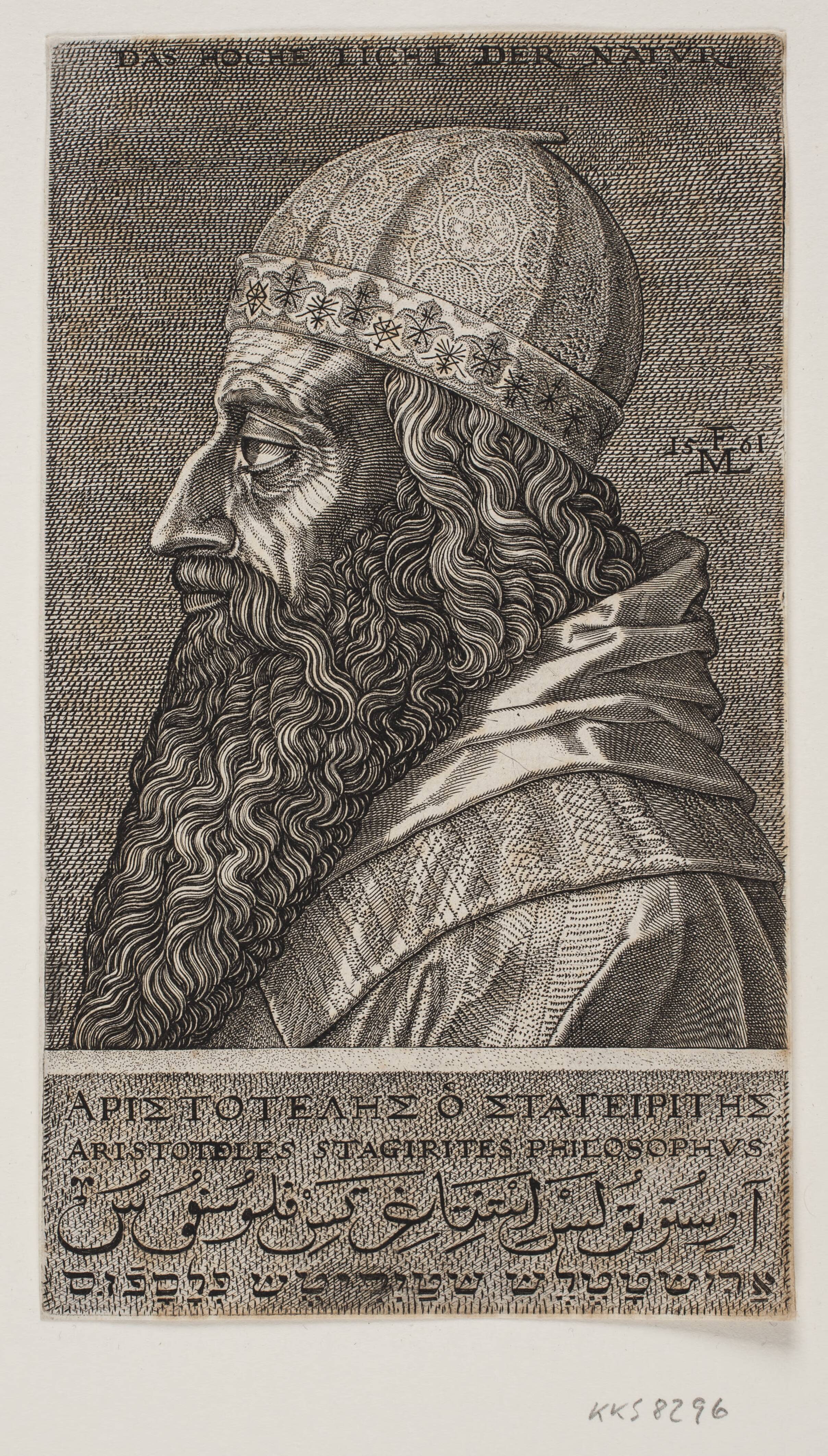
Aristotle, half-length portrait in profile
1561
An engraved print of an elderly bearded man in profile, with text in German and in several languages naming Aristotle. It is dated 1561 and is held by the National Gallery of Denmark.
Shows how Aristotle was imagined and labeled in a sixteenth-century portrait print, long after his death.
About this source
What it is
This is a print held by the National Gallery of Denmark. It shows an elderly bearded man in profile, facing left, wearing a patterned turban-like cap with star motifs and a draped robe. German text above him reads 'Das hoche Licht der Natur'. A caption below is written in Greek, Latin, Arabic and Hebrew and reads Aristoteles Stagirites Philosophus. The date 1561 appears at the right.
The curator describes it as a later painted portrait of Aristotle in profile. The media record describes the image as an engraved print, so the picture is a later image and not a likeness made in his lifetime.
Why it matters
The caption in four languages shows that Aristotle's name and works were known across several scholarly and religious traditions in the sixteenth century. The turban-like cap shows how European artists sometimes dressed the ancient philosopher in eastern costume. The print thus reflects how different cultures read and imagined Aristotle.
Look closer
- Why might the caption use Greek, Latin, Arabic and Hebrew together?
- What does the cap tell you about how the artist imagined Aristotle?
- What might the German phrase above him suggest about the people who bought this print?
This painting is part of the curated material that grounds the AI version of Aristotle on Humy.ai — when students ask about related events, the AI can quote it and cite it.
More Aristotle sources
Meet the AI Aristotle →
Ready when you are
Start chatting with Aristotle now.
20 messages free · No credit card · Available in 50+ languages.