


Secondary sourceArtifact1892
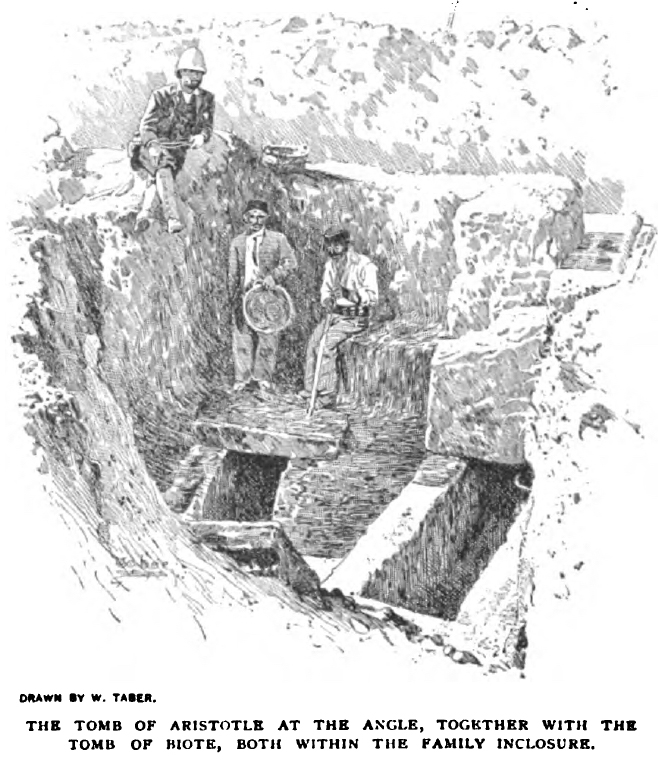
Tomb of Aristotle Excavation Engraving
W. Taber · 1892
An 1892 magazine engraving showing an excavation at Eretria claimed to be the tomb of Aristotle.
Shows the 19th-century search for Aristotle's physical remains, reflecting his enduring fame long after his death.
About this source
What it is
This engraving, drawn by W. Taber, appeared in The Century Illustrated Monthly Magazine in 1892. It shows an excavation trench with stone blocks and a tomb opening, with three men standing or sitting around it, documenting a dig by the American School of Classical Studies in Athens.
Why it matters
The excavation at Eretria was claimed by its 19th-century excavators to have uncovered Aristotle's tomb. The image shows how scholars and archaeologists of that era searched for physical traces of ancient philosophers, reflecting the era's enthusiasm for connecting classical texts to tangible sites.
Look closer
- What clues in the image show this is a scientific excavation rather than casual digging?
- Why might 19th-century Americans have been eager to find Aristotle's tomb?
- What does the caption claim, and how might that claim be questioned today?
This artifact is part of the curated material that grounds the AI version of Aristotle on Humy.ai — when students ask about related events, the AI can quote it and cite it.
More Aristotle sources
Meet the AI Aristotle →

Ready when you are
Start chatting with Aristotle now.
20 messages free · No credit card · Available in 50+ languages.