


Primary sourceArtifact1953
Chandigarh Capitol Complex
Le Corbusier · 1953
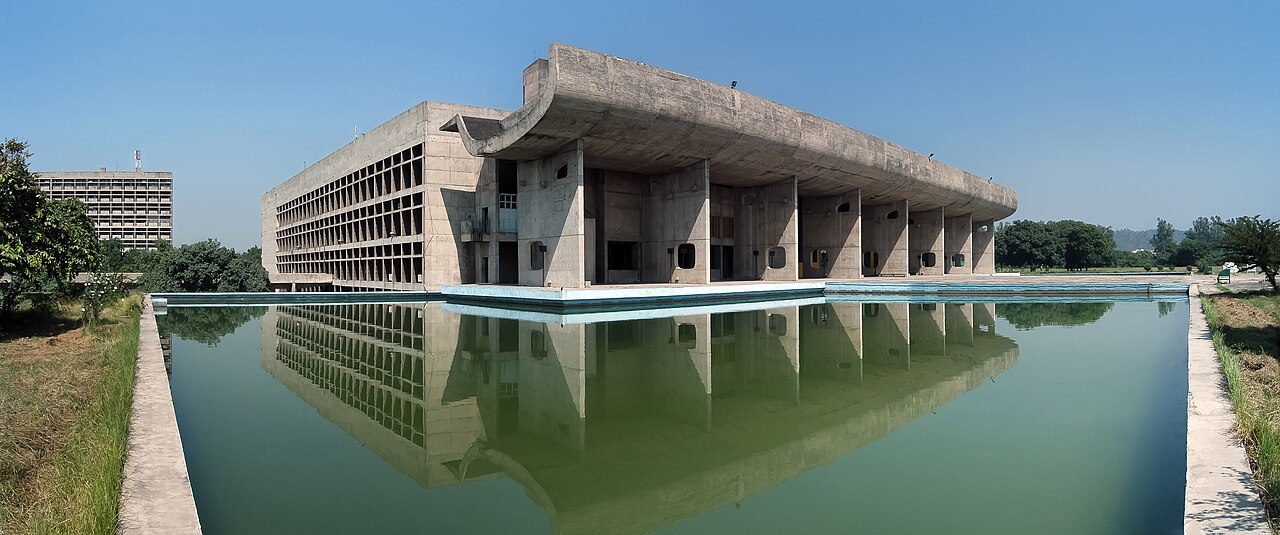
A government compound of three monumental concrete buildings in Chandigarh, India, designed by Le Corbusier and his team.
Le Corbusier designed this complex, the architectural summit of his career, as part of the new Indian city of Chandigarh.
About this source
What it is
The Capitol Complex is a government compound in Chandigarh, India, comprising the Palace of Assembly, Secretariat Building and High Court, plus several monuments, designed by Le Corbusier with collaborators including his cousin Pierre Jeanneret, and British architects Maxwell Fry and Jane Drew. It was built in the 1950s and is a UNESCO World Heritage Site.
Why it matters
Commissioned after India's independence and partition, when Punjab lost its old capital Lahore, the complex was meant to be a symbol of a new, modern India, championed by Prime Minister Jawaharlal Nehru. It shows Le Corbusier applying his ideas of exposed concrete, sun-shading screens, and proportional design on a huge civic scale, becoming the culmination of his career.
Look closer
- Why would a newly independent country want strikingly modern government buildings rather than traditional styles?
- What clues in the photograph show how the architects dealt with heat and sunlight?
- Whose vision does a government building usually express — the architect's, the political leaders', or the people who use it?
This artifact is part of the curated material that grounds the AI version of Le Corbusier on Humy.ai — when students ask about related events, the AI can quote it and cite it.
More Le Corbusier sources
Browse all 88 →
Ready when you are
Start chatting with Le Corbusier now.
20 messages free · No credit card · Available in 50+ languages.