


Secondary sourceArtifact1st quarter 14th century
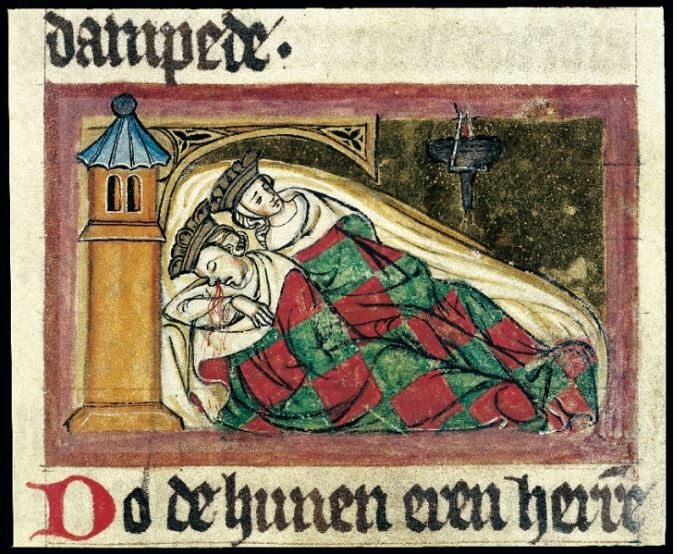
Death of Attila the Hun, Saxon World Chronicle page
Eike von Repgow · 1st quarter 14th century
A manuscript page from the Saxon World Chronicle, a 14th-century German chronicle by Eike von Repgow, showing the death of Attila the Hun. It is a medieval picture of the ruler, made centuries after his death.
Shows how a 14th-century German chronicle pictured Attila's death, a medieval view of the ruler rather than his own record.
About this source
What it is
This is an illuminated manuscript page from the Saxon World Chronicle, a German chronicle associated with Eike von Repgow. It was made in northern Germany in the first quarter of the 14th century and is held by the Staatsbibliothek zu Berlin, Manuscript Division, inventory MS germ. 129f; 53r. The page is captioned as the death of King Attila the Hun. Its picture shows a crowned man lying in bed with blood running from his nose, while another crowned figure lies beside him. Gothic lettering in black ink appears above and below the picture.
Why it matters
Attila died in 453, so this picture was made many centuries after his death. It shows how medieval German writers remembered the Hunnic ruler: not as a figure checked against records, but as a character in a chronicle of the world. The page shows what medieval readers expected from a story about a famous ruler's death, a dramatic and bloody scene.
Look closer
- What details of the bed, the blood and the candle does the artist use to tell the story of the death?
- Why might a 14th-century chronicler want readers to picture Attila this way?
- What does this image leave out about the real events of 453 and about the Huns themselves?
This artifact is part of the curated material that grounds the AI version of Attila the Hun on Humy.ai — when students ask about related events, the AI can quote it and cite it.
More Attila the Hun sources
Meet the AI Attila the Hun →

Ready when you are
Start chatting with Attila the Hun now.
20 messages free · No credit card · Available in 50+ languages.