


Secondary sourceDocument21 September 2006 (upload date)
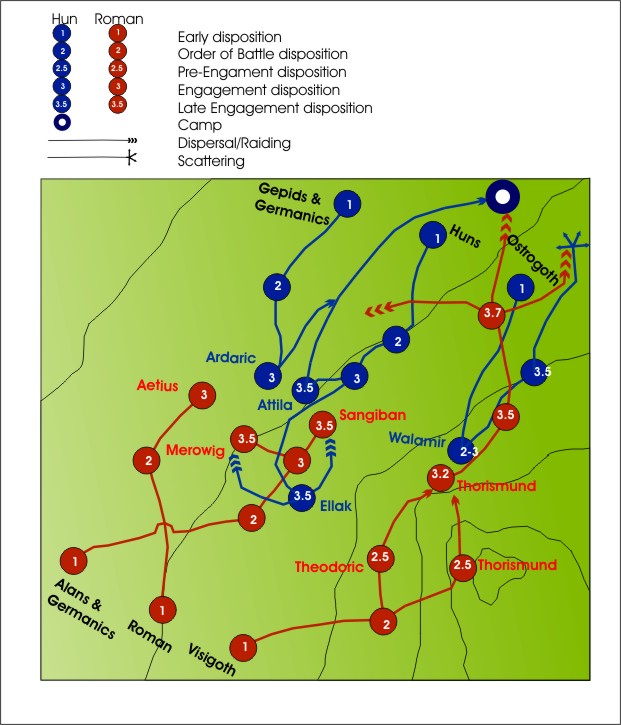
Disposition of Forces at the Battle of Chalons
Dryzen · 21 September 2006 (upload date)
A modern map showing where the Hun and Roman-allied forces stood at the Battle of Chalons, the battle Attila led. It is a reconstruction, not a record made at the time.
Shows the forces Attila commanded at Chalons and how they were arranged against the Roman-allied army.
About this source
What it is
This is a modern map of the disposition of forces at the Battle of Chalons, the battle Attila led. Hun forces are shown in blue and Roman and allied forces in red, across a green terrain. Numbered symbols mark stages of the battle, and commanders such as Attila, Aetius, Theodoric and Thorismund are labeled. The map was drawn in CorelDraw 11 from several sources, including a Military Magazine article from December 2003 and a French web page on the battle. It was uploaded to Wikimedia Commons in 2006.
Why it matters
A map like this does not come from the battle itself. It is a reconstruction based on written accounts, so it shows how historians understand the campaign rather than what anyone saw at the time. Attila appears here as one of several commanders, alongside Aetius, who is also labeled on the map. The groups shown, including Ostrogoths, Gepids and Alans, reveal how many peoples were drawn into the fighting in 451.
Look closer
- Which side is shown in blue and which in red? What might that choice suggest about how the battle is presented?
- Who made this map, and which sources did they rely on most? What might those sources leave out?
- Why might a modern map show the battle as numbered stages instead of as a single moment?
This document is part of the curated material that grounds the AI version of Attila the Hun on Humy.ai — when students ask about related events, the AI can quote it and cite it.
More Attila the Hun sources
Meet the AI Attila the Hun →
Ready when you are
Start chatting with Attila the Hun now.
20 messages free · No credit card · Available in 50+ languages.