


Primary sourcePainting1616
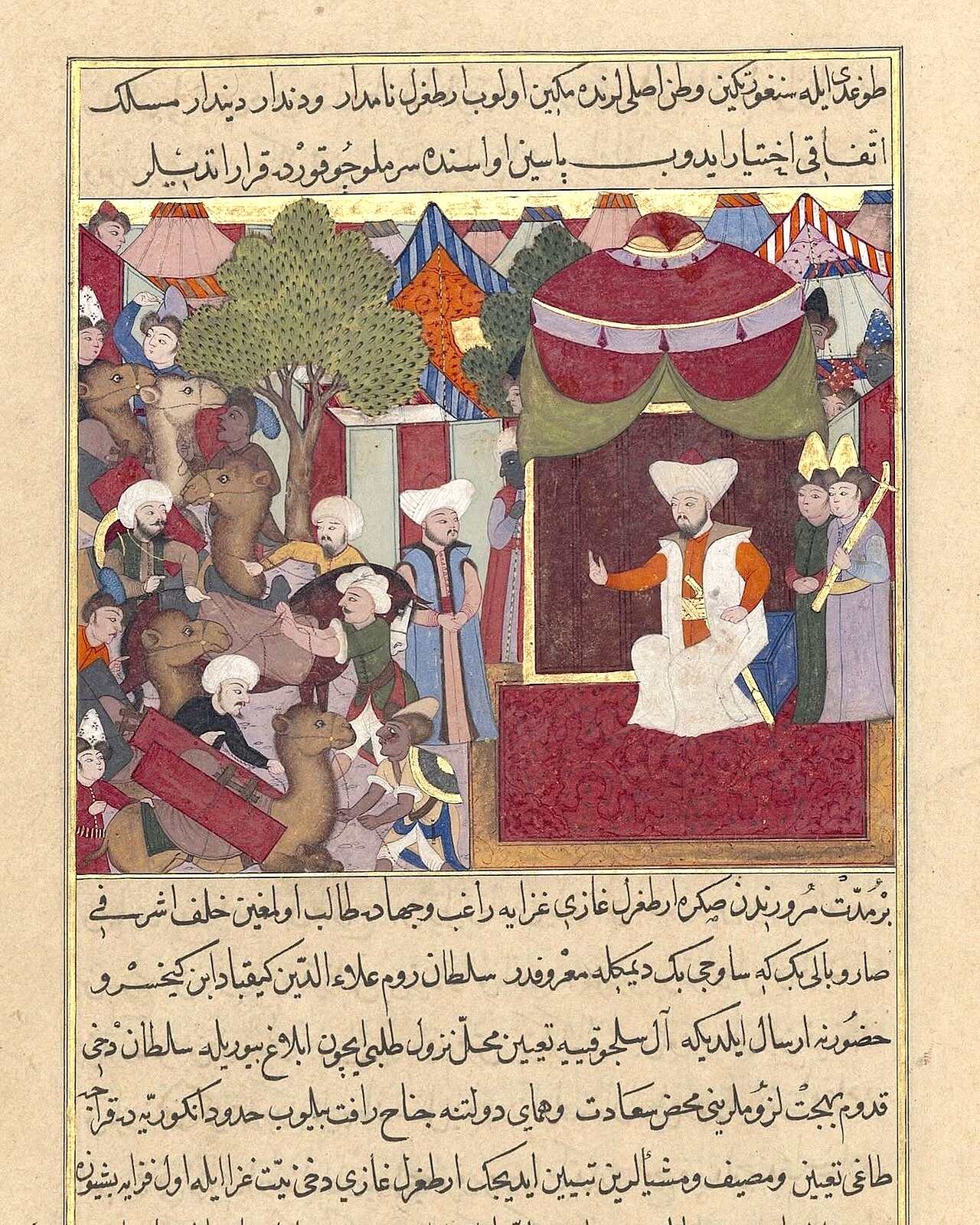
Ertugrul Sends Savci Bey
1616
A 1616 Ottoman court miniature depicting the legendary founder Ertugrul, made during Ahmed I's reign as sultan.
Produced in 1616 during Ahmed I's reign, this miniature shows how his court commissioned histories linking him to the dynasty's legendary founders.
About this source
What it is
This miniature, painted in gouache heightened with gold, comes from the Tadj al-Tawarikh ("Crown of Chronicles"), a history of the Ottoman dynasty. It shows the legendary leader Ertugrul Gazi, father of Osman I, sending his son Savci Bey to a sultan with a request. It was made in Istanbul in 1616 and is now held at the Musée Jacquemart-André in Paris.
Why it matters
Although it depicts events centuries before Ahmed I's time, this manuscript was produced in 1616, during his actual reign, showing that Ottoman rulers continued to commission illustrated histories tracing their dynasty back to its legendary founders. It reveals how Ahmed's court invested in art that linked his rule to a long, honoured lineage.
Look closer
- Why might a sultan's court want to commission art about events from centuries earlier?
- What details in the costumes and setting show this was made for an elite audience?
- What does the choice of subject tell you about how rulers used history to support their authority?
This painting is part of the curated material that grounds the AI version of Ahmed I, Ertuğrul and Osman I on Humy.ai — when students ask about related events, the AI can quote it and cite it.
More Ahmed I sources
Browse all 51 →
Ready when you are
Start chatting with Ahmed I now.
20 messages free · No credit card · Available in 50+ languages.