


Secondary sourcePainting17th century
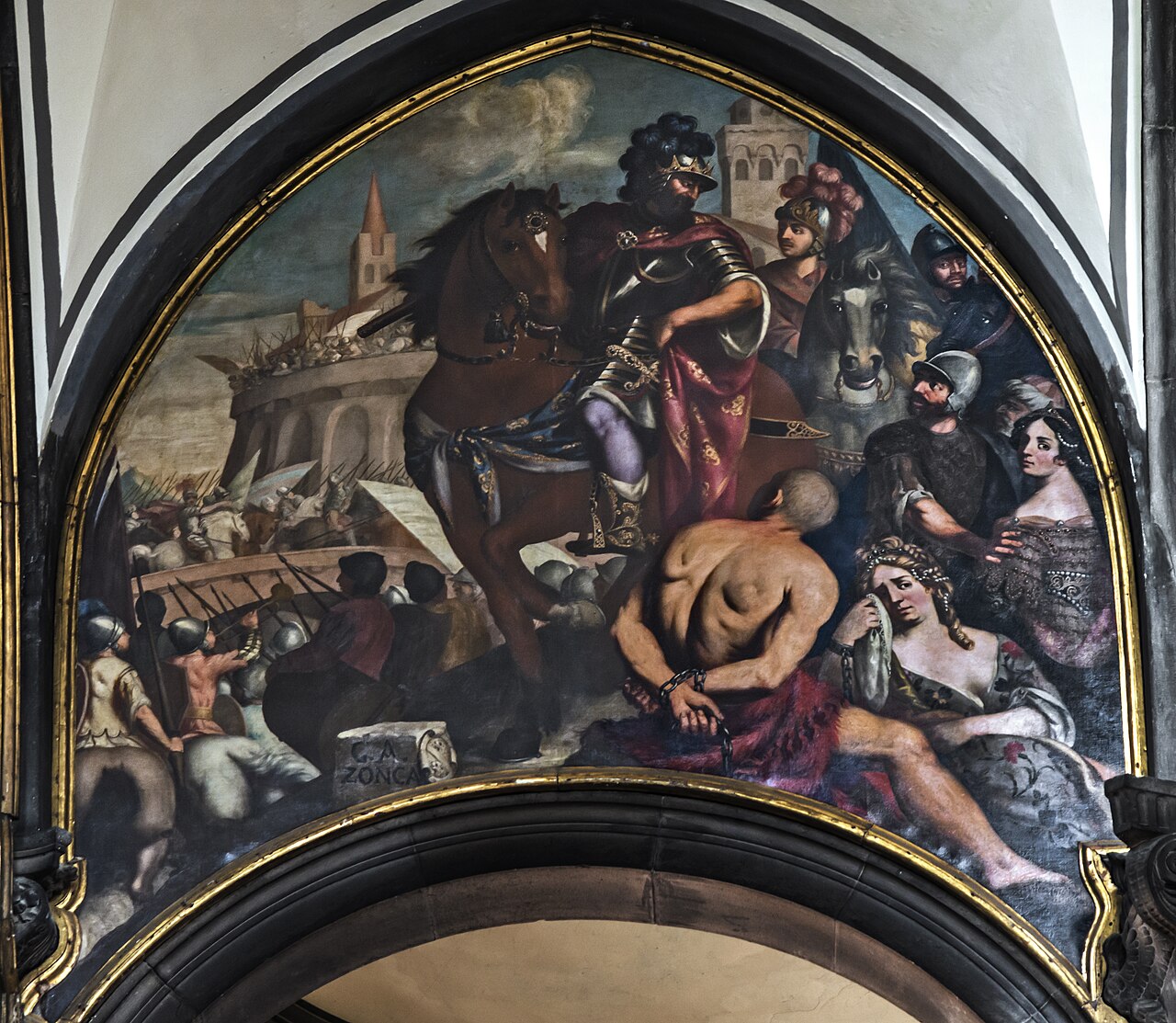
Fresco of Attila conquering Aquileia
Zonca · 17th century
A later 17th-century fresco in the church of San Zaccaria in Venice showing Attila's conquest of Aquileia. It is a secondary depiction made long after the events.
Shows how a later artist pictured Attila's conquest of Aquileia, a scene from his invasions of the Roman world.
About this source
What it is
This is a fresco in a curved lunette above an arch in the church of San Zaccaria in Venice. It shows a mounted warrior with a dark curly beard and a red cloak on a brown horse, armored soldiers, a fleeing crowd, a stone tower, and a bare-backed chained man kneeling before a seated woman. The signature 'Zonca' appears at the bottom. The photograph was taken on 12 May 2015 by Didier Descouens. The fresco is a later 17th-century work, so it reflects the imagination of its own time rather than eyewitness observation.
Why it matters
Attila led Hunnic raids into the Roman Empire in the 5th century, and the conquest of Aquileia became one of the best-known episodes of his campaigns. Artists in later centuries returned to this story to show Attila as a frightening conqueror. The painting therefore tells us as much about how later Venetians remembered the Huns as about the events themselves.
Look closer
- What details make Attila look powerful, and what details make the defeated people look helpless?
- Why might a church in Venice choose to show a scene of conquest from the 5th century?
- What events or people does this painting leave out, such as the Roman side of the story?
This painting is part of the curated material that grounds the AI version of Attila the Hun on Humy.ai — when students ask about related events, the AI can quote it and cite it.
More Attila the Hun sources
Meet the AI Attila the Hun →
Ready when you are
Start chatting with Attila the Hun now.
20 messages free · No credit card · Available in 50+ languages.