


Primary sourceArtifact1416
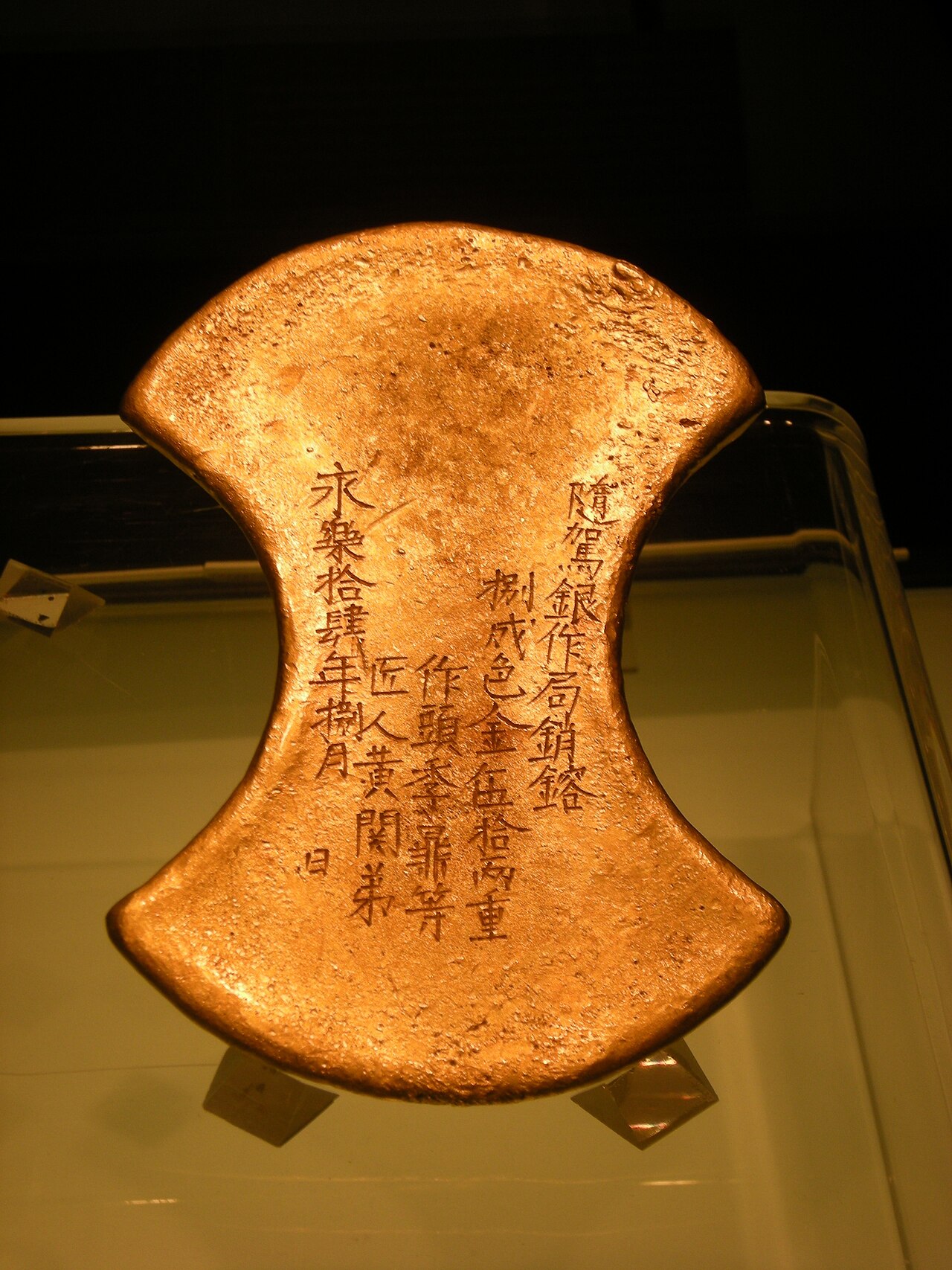
Gold Ingot Inscribed with Yongle 14th Year
1416
A gold ingot excavated from a Ming prince's tomb, inscribed with the 14th year of the Yongle Emperor's reign (1416).
This gold ingot is inscribed with the 14th year of the Yongle Emperor's reign, directly dating it to his rule.
About this source
What it is
This gold ingot is one of two excavated from the tomb of Prince Zhuang of Liang, a member of the Ming dynasty, in Zhongxiang City, Hubei Province. Its inscription shows it was made in the 14th year of the Yongle Emperor's reign, corresponding to 1416.
The ingot has a concave, hourglass-shaped outline with two columns of engraved Chinese characters.
Why it matters
This ingot provides direct evidence of how the Yongle Emperor's reign years were used to date and authenticate currency and goods across the Ming empire. Its discovery in a prince's tomb also shows the wealth held by Ming nobility during his reign.
Look closer
- What does using the emperor's reign year on money tell you about how time was measured in Ming China?
- Why might gold ingots like this be buried with a prince?
- What does this object tell you, and what does it leave unanswered, about the Ming economy?
This artifact is part of the curated material that grounds the AI version of Yongle Emperor on Humy.ai — when students ask about related events, the AI can quote it and cite it.
More Yongle Emperor sources
Meet the AI Yongle Emperor →

Ready when you are
Start chatting with Yongle Emperor now.
20 messages free · No credit card · Available in 50+ languages.