


Secondary sourceSculpture1801
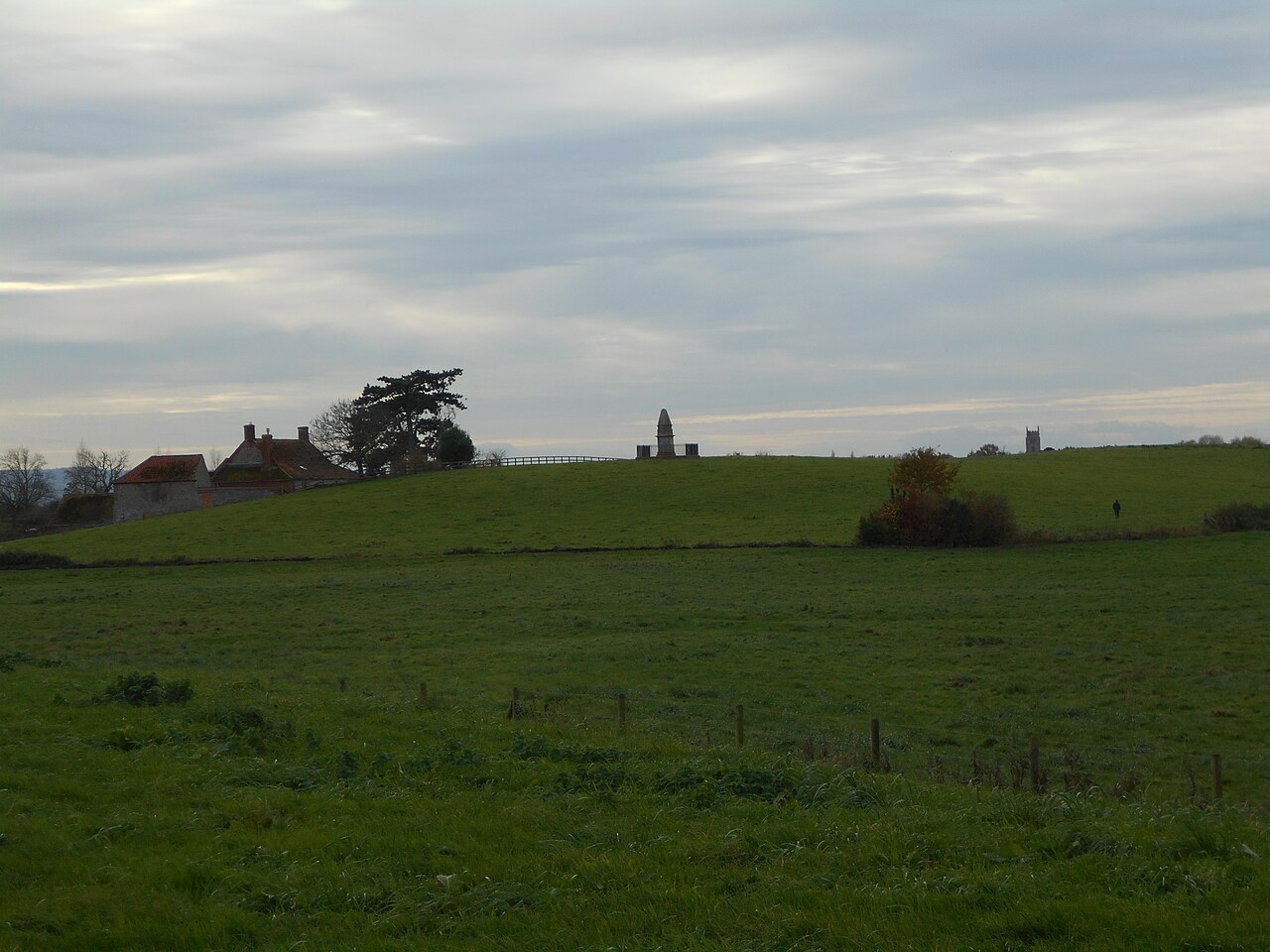
King Alfred's Monument, Athelney
1801
A monument built in 1801 at Athelney, a place where Alfred is said to have hidden. It shows a later commemoration of him.
Shows how Alfred was commemorated in the 1800s at a place linked to his legend of hiding.
About this source
What it is
This photograph, taken in November 2017 by Simon Burchell, shows a stone obelisk on a hilltop in a green, rolling field under a cloudy sky. Low stone plinths stand beside it, and farm buildings with red-tiled roofs and trees are on the left. A small tower is visible on the far right horizon. The monument was built in 1801 for the squire John Slade at Athelney, Somerset.
Why it matters
Alfred the Great (849-899), king of Wessex, is said to have hidden at Athelney, so later people chose this place to mark his story. The monument dates from 1801, long after Alfred's time, so it reveals how a local landowner and his contemporaries wanted to remember the king. It is a secondary record of Alfred's reputation, not a source from his own lifetime. The facts do not describe the monument's design or any inscription.
Look closer
- Why might a landowner in 1801 choose to build a monument to a king from the 800s?
- What does the landscape around the obelisk tell us about how the site is used today?
- What does the photograph leave out, such as any words carved on the monument?
This sculpture is part of the curated material that grounds the AI version of Alfred the Great on Humy.ai — when students ask about related events, the AI can quote it and cite it.
More Alfred the Great sources
Meet the AI Alfred the Great →
Ready when you are
Start chatting with Alfred the Great now.
20 messages free · No credit card · Available in 50+ languages.