


Secondary sourcePainting19th century
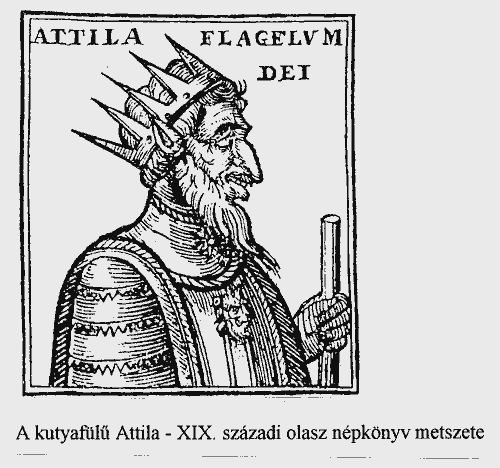
Kutyafülű Attila (Dog-eared Attila)
19th century
A 19th-century Hungarian caricature of Attila as the Scourge of God, shown as a bearded man in a spiked crown holding a staff, reproduced from an Italian chapbook.
Shows how a later medieval label, Scourge of God, was repeated in popular imagery, so it belongs in his archive as a later reputation rather than a likeness.
About this source
What it is
This is a woodcut-style engraving of a bearded man in profile, wearing a spiked crown and a fur-trimmed garment and holding a staff. The text above reads ATTILA and FLAGELVM DEI, meaning the Scourge of God. The Hungarian caption says the image is a nineteenth-century Italian popular-book engraving. It is presented as a caricature of one of the greatest rulers of the first millennium.
Why it matters
In medieval Christian thinking, Attila was seen as the Scourge of God, sent by God to punish a sinful world. This image carries that medieval label into the nineteenth century. It shows how later writers and artists kept Attila's reputation alive long after his death in 453.
Look closer
- What do the words ATTILA and FLAGELVM DEI tell you about how the figure is meant to be understood?
- Why might a popular book in the nineteenth century include an image like this?
- What does the engraving leave out, such as Attila's own words or any record from his lifetime?
This painting is part of the curated material that grounds the AI version of Attila the Hun on Humy.ai — when students ask about related events, the AI can quote it and cite it.
More Attila the Hun sources
Meet the AI Attila the Hun →
Ready when you are
Start chatting with Attila the Hun now.
20 messages free · No credit card · Available in 50+ languages.