


Secondary sourceBook830
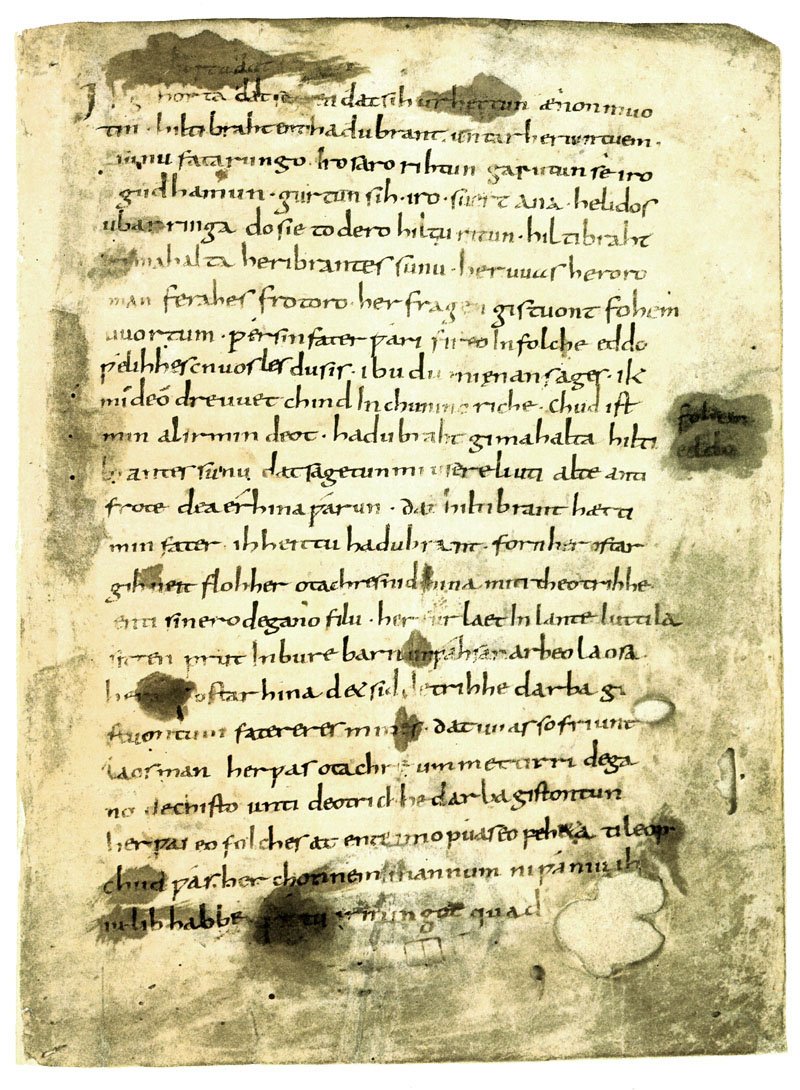
Lay of Hildebrand
830
The oldest Old High German heroic poem, in which a warrior offers gold rings he received from the 'Lord of the Huns', a legendary echo of Attila's court.
The poem's reference to the 'Lord of the Huns' is a legendary echo of Attila surviving in Germanic oral tradition.
About this source
What it is
The Hildebrandslied is a heroic poem in Old High German alliterative verse, written in the 830s by two scribes on spare pages of a religious manuscript at the monastery of Fulda. It is the earliest poetic text in German. It is now held in Kassel University Library.
The poem tells of a father, Hildebrand, and son, Hadubrand, who meet as enemies on a battlefield without recognizing each other.
Why it matters
In the story, Hildebrand mentions gold arm-rings given to him by the 'Lord of the Huns' — a legendary reference that medieval audiences would have linked to Attila. This shows how Attila's name survived for centuries in Germanic oral tradition and poetry, long after his own empire had vanished, becoming a symbol of a powerful, distant overlord.
Look closer
- Why might Germanic storytellers have invoked Attila's name generations after his death?
- What does the unfinished ending tell you about how this poem survived?
- How might oral retelling have changed the story over time?
This book is part of the curated material that grounds the AI version of Attila the Hun on Humy.ai — when students ask about related events, the AI can quote it and cite it.
More Attila the Hun sources
Meet the AI Attila the Hun →

Ready when you are
Start chatting with Attila the Hun now.
20 messages free · No credit card · Available in 50+ languages.