


Secondary sourceArtifact17th century
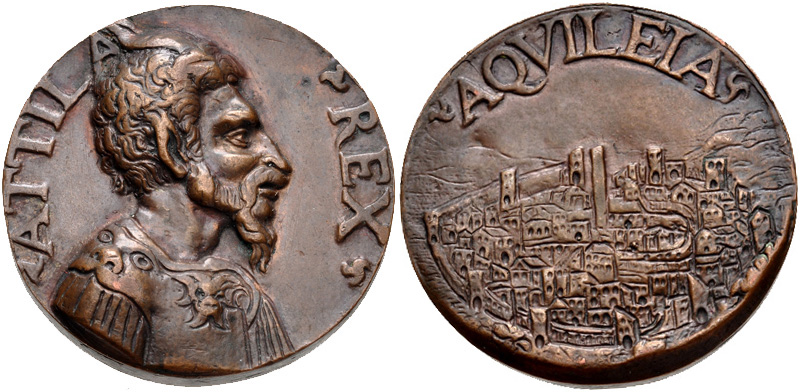
Medal of Attila with Aquileia on the Reverse
17th century
A seventeenth-century bronze medal that shows Attila on one side and the city of Aquileia on the other. It shows how Attila was remembered in later centuries.
Shows how Attila was remembered as a king on a 17th-century medal, long after his death.
About this source
What it is
This is a two-sided bronze medal from the 17th century. The obverse shows a profile bust of a bearded man with curly hair and armor, facing right, with the inscription ATTILA REX. The reverse shows a walled hilltop city with towers and buildings, labeled AQVILEIA, which is the Italian city of Aquileia. The maker of the medal is not known.
Why it matters
The medal was made more than a thousand years after Attila's lifetime, so it shows how later people chose to remember him. Pairing the ruler with Aquileia links him to a city that was attacked in the 5th century. Medals were small objects that carried official or commemorative messages, and this one shows that Attila had become a subject of historical interest in early modern Europe.
Look closer
- What does the inscription ATTILA REX tell you about how the medal's makers wanted him to be seen?
- Why might a city be shown on the reverse of a medal about a ruler?
- What does this small object leave out about the real events at Aquileia?
This artifact is part of the curated material that grounds the AI version of Attila the Hun on Humy.ai — when students ask about related events, the AI can quote it and cite it.
More Attila the Hun sources
Meet the AI Attila the Hun →
Ready when you are
Start chatting with Attila the Hun now.
20 messages free · No credit card · Available in 50+ languages.