


Primary sourceArtifactlate 16th–17th century
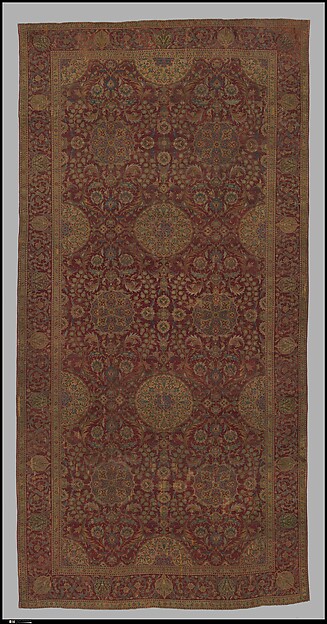
Ottoman Court Carpet
late 16th–17th century
A wool carpet made for the Ottoman court around the time of Ahmed I's reign, showing the luxury textiles used in palace life.
A carpet roughly contemporary with Ahmed I's reign, illustrating the material culture of the Ottoman court he ruled.
About this source
What it is
This is a large wool carpet made with an asymmetrically knotted pile, produced for the Ottoman court in the late 16th to 17th century. It is now held at The Metropolitan Museum of Art, having entered the collection as part of a bequest.
Why it matters
Carpets like this were central to Ottoman court life, decorating palaces and reception rooms. It dates from roughly the same period as the reign of Ahmed I, and helps show the kind of rich material culture that surrounded the sultan and his court, even though it cannot be linked to him personally.
Look closer
- What do the colors and patterns suggest about who used this carpet?
- Why might a carpet survive for centuries while other textiles do not?
- What does an object like this tell us that a written document cannot?
This artifact is part of the curated material that grounds the AI version of Ahmed I on Humy.ai — when students ask about related events, the AI can quote it and cite it.
More Ahmed I sources
Browse all 51 →
Ready when you are
Start chatting with Ahmed I now.
20 messages free · No credit card · Available in 50+ languages.