


Secondary sourcePaintingca. 1587-89
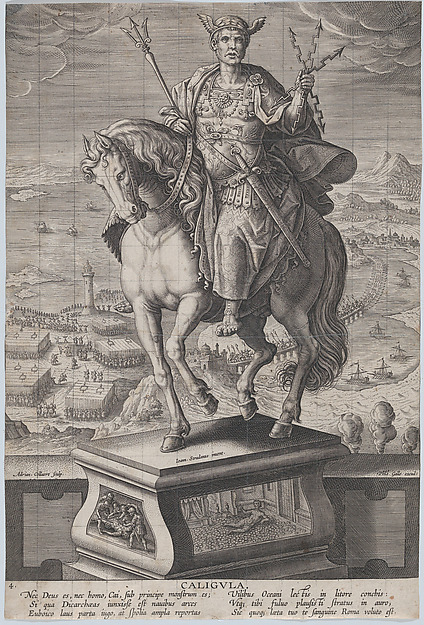
Plate 4: Equestrian Statue of Caligula
Adriaen Collaert · ca. 1587-89
A late sixteenth-century engraving by Adriaen Collaert showing Caligula as an equestrian statue. It is held by the Metropolitan Museum of Art and shows how later artists imagined him.
Shows Caligula as an imagined equestrian statue in a late sixteenth-century series, reflecting how later artists portrayed him.
About this source
What it is
This is a black and white engraving of an equestrian statue of Caligula on a stone pedestal. The rider wears a winged helmet and armour, holds a forked staff in one hand and a bundle of arrows in the other. A harbor town with ships and a distant mountain fill the background, and the inscription CALIGVLA and Latin text lie below. Adriaen Collaert made the print around 1587 to 1589, and it comes from a series called Roman Emperors on Horseback. The Metropolitan Museum of Art holds it, and the museum describes it as a later imagined depiction.
Why it matters
Late sixteenth-century artists often pictured Roman emperors as mounted commanders, which linked ancient power to the rulers of their own time. This plate shows Caligula in that heroic style, although it was made long after his reign. It reveals how the emperor's image was reshaped by artists and their audiences.
Look closer
- What does the statue and military setting suggest the artist wanted viewers to think about the emperor?
- Who was Collaert, and what kind of buyers would have collected a series of emperors on horseback?
- What does the print leave out about the real Caligula, and how could a viewer find out more?
This painting is part of the curated material that grounds the AI version of Caligula on Humy.ai — when students ask about related events, the AI can quote it and cite it.
More Caligula sources
Browse all 88 →
Ready when you are
Start chatting with Caligula now.
20 messages free · No credit card · Available in 50+ languages.