


Secondary sourceDocument
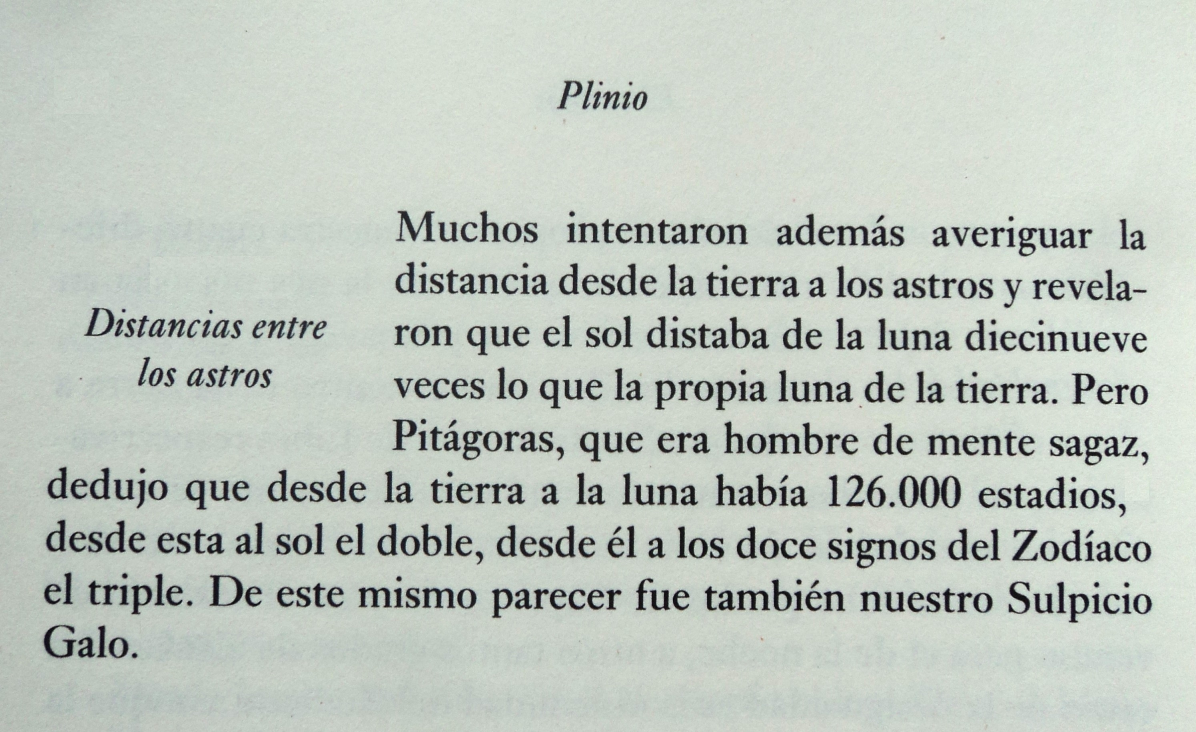
Pliny's Distances to the Heavenly Bodies (Spanish Panel)
A modern Spanish panel summarising Pliny the Elder's account of the distances to the visible heavenly bodies, drawing on Pythagoras and Sulpicius Gallus. It is a later summary, not Pliny's own text.
Summarises Pliny's astronomical distances, showing a later reader's view of his claims about the heavens.
About this source
What it is
This is a modern Spanish panel titled El Universo: Distancias a los astros segun Plinio. It summarises how the Roman writer Pliny the Elder described the distances to the visible heavenly bodies, drawing on his predecessors Pythagoras and Sulpicius Gallus. The panel converts these distances into kilometres, based on an Attic stadium of 184.92 metres. It is a secondary summary, not Pliny's own words.
Why it matters
Pliny's account of the heavens combined figures from earlier thinkers, and this panel shows how those figures were passed on and rewritten for later readers. Its numbers come from ancient estimates, so students can compare them with modern measurements and see how knowledge changed.
Look closer
- Which units does the panel use, and how are they linked to the stadium?
- Why might a modern panel restate a Roman writer's distances in kilometres for today's audience?
- What does the panel leave out about how these distances were originally estimated?
This document is part of the curated material that grounds the AI version of Pliny the Elder on Humy.ai — when students ask about related events, the AI can quote it and cite it.
More Pliny the Elder sources
Browse all 84 → Book
Secondary source
Natural History
Pliny the Elder · 77-79 CE
 Sculpture
Secondary source
Laocoön and His Sons
Athanadoros · uncertain, Hellenistic to early Imperial period
 Book
Primary source
Naturalis historia Illuminated Initial Leaf
Pliny the Elder · c. 1476
 Book
Secondary source
The History of the World, Commonly Called the Naturall Historie of C. Plinius Secundus
Philemon Holland · 1601
Free account
Read every Pliny the Elder source
Sign up free →
Ready when you are
Start chatting with Pliny the Elder now.
20 messages free · No credit card · Available in 50+ languages.