


Secondary sourcePainting1800s
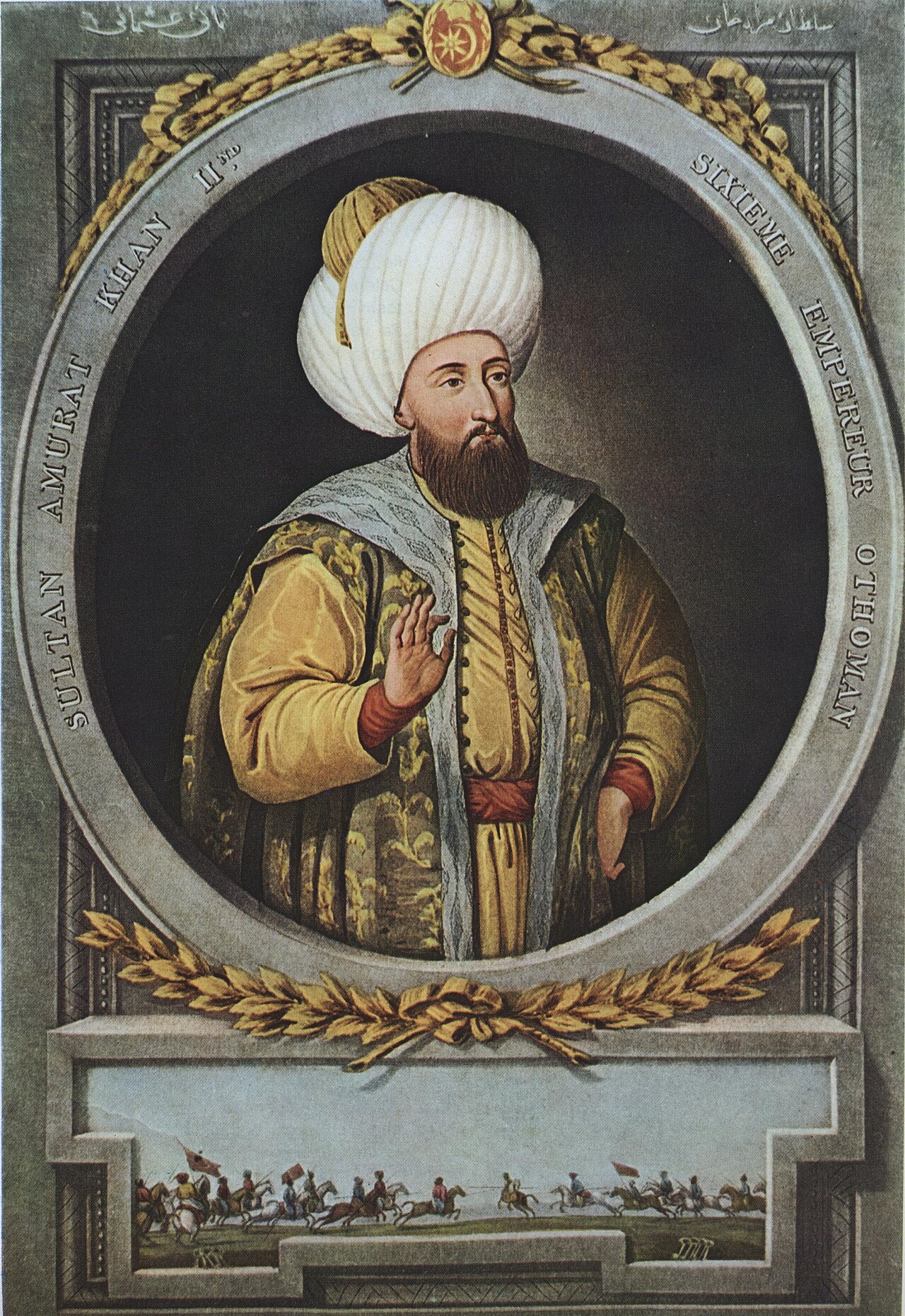
Portrait of Murad II by Konstantin Kapıdağlı
Konstantin Kapıdağlı · 1800s
A later imagined portrait of Sultan Murad II, painted long after his death, showing how he was remembered and pictured by later artists.
This later imagined portrait shows how artists pictured Murad II long after his lifetime, not from direct observation.
About this source
What it is
This oval portrait of Murad II was painted by Konstantin Kapıdağlı in the 1800s, centuries after the sultan's death. It shows a bearded man in a large white turban with a gold top, wearing a patterned robe with a fur-trimmed collar and a red sash, his hand raised. Inscriptions in French and Arabic surround the frame, and a small panel below shows horsemen riding across a plain.
Why it matters
Because this was painted long after Murad II lived, it was not drawn from life. It instead reflects how later generations imagined Ottoman sultans, blending European and Ottoman visual traditions. Images like this tell us more about the artists and audiences who made and viewed them than about Murad II's actual appearance.
Look closer
- What details in the clothing and setting seem designed to look grand or powerful?
- Why are there inscriptions in both French and Arabic?
- What might the horsemen in the small panel below be meant to represent?
This painting is part of the curated material that grounds the AI version of Murad II on Humy.ai — when students ask about related events, the AI can quote it and cite it.
More Murad II sources
Browse all 80 →
Ready when you are
Start chatting with Murad II now.
20 messages free · No credit card · Available in 50+ languages.