


Secondary sourceDocument3 June 1926
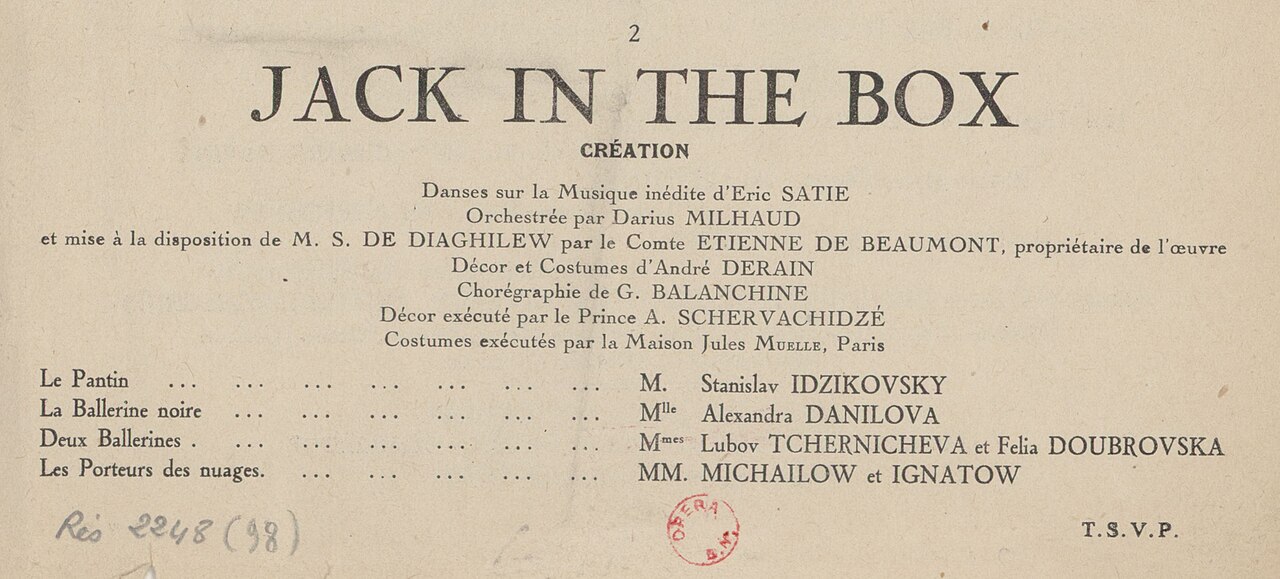
Programme for the 1926 premiere of Satie's Jack in the Box
Théâtre Sarah Bernhardt · 3 June 1926
A printed theatre programme for the 1926 staging of Jack in the Box, a ballet using Satie's unpublished music, the year after he died.
This programme shows Satie's music performed after his death, so it documents his posthumous reputation rather than his own work.
About this source
What it is
This is a scanned printed programme for the ballet Jack in the Box, marked as its creation (CRÉATION). It was issued by the Théâtre Sarah Bernhardt and dated 3 June 1926. The page lists Satie's unpublished music, names Milhaud as the orchestrator, and gives the cast and credits in French. A red library stamp and a handwritten shelf mark appear at the bottom.
Why it matters
Satie died in 1925, so this programme shows how his work was staged after his death. The ballet used music he had not published, and the programme credits Darius Milhaud for the orchestration. Such documents show how theatres, composers and performers worked together in Paris in the 1920s, and how a composer's unpublished material could reach an audience.
Look closer
- Who is named on the programme, and what roles do they seem to have had?
- Why would a theatre print a programme for a new ballet, and who was it written for?
- What does the programme not tell you about how the music sounded on stage?
This document is part of the curated material that grounds the AI version of Erik Satie on Humy.ai — when students ask about related events, the AI can quote it and cite it.
More Erik Satie sources
Browse all 82 →
Ready when you are
Start chatting with Erik Satie now.
20 messages free · No credit card · Available in 50+ languages.